University of Windsor University of Windsor
Scholarship at UWindsor
Scholarship at UWindsor
Electronic Theses and Dissertations Theses, Dissertations, and Major Papers
11-27-2015
Using Heritage in Multi-Population Evolutionary Algorithms
Using Heritage in Multi-Population Evolutionary Algorithms
Andrew William Hlynka
University of Windsor
Follow this and additional works at: https://scholar.uwindsor.ca/etd
Recommended Citation Recommended Citation
Hlynka, Andrew William, "Using Heritage in Multi-Population Evolutionary Algorithms" (2015). Electronic Theses and Dissertations. 5641.
https://scholar.uwindsor.ca/etd/5641
This online database contains the full-text of PhD dissertations and Masters’ theses of University of Windsor students from 1954 forward. These documents are made available for personal study and research purposes only, in accordance with the Canadian Copyright Act and the Creative Commons license—CC BY-NC-ND (Attribution, Non-Commercial, No Derivative Works). Under this license, works must always be attributed to the copyright holder (original author), cannot be used for any commercial purposes, and may not be altered. Any other use would require the permission of the copyright holder. Students may inquire about withdrawing their dissertation and/or thesis from this database. For additional inquiries, please contact the repository administrator via email
Using Heritage in Multi-Population Evolutionary Algorithms
By
Andrew William Hlynka
A Thesis
Submitted to the Faculty of Graduate Studies through the School of Computer Science in Partial Fulfillment of the Requirements for
the Degree of Master of Science at the University of Windsor
Windsor, Ontario, Canada
2015
Using Heritage in Multi-Population Evolutionary Algorithms
by
Andrew William Hlynka
APPROVED BY:
______________________________________________ M. Guarini
Department of Philosophy
______________________________________________ S. Goodwin
School of Computer Science
______________________________________________ Z. Kobti, Advisor
School of Computer Science
iii
DECLARATION OF ORIGINALITY
I hereby certify that I am the sole author of this thesis and that no part of this thesis has been published or submitted for publication.
I certify that, to the best of my knowledge, my thesis does not infringe upon anyone’s copyright nor violate any proprietary rights and that any ideas, techniques, quotations, or any other material from the work of other people included in my thesis, published or otherwise, are fully acknowledged in accordance with the standard referencing practices. Furthermore, to the extent that I have included copyrighted material that surpasses the bounds of fair dealing within the meaning of the Canada Copyright Act, I certify that I have obtained a written permission from the copyright owner(s) to include such material(s) in my thesis and have included copies of such copyright clearances to my appendix.
iv ABSTRACT
v
DEDICATION
vi
ACKNOWLEDGEMENTS
vii
TABLE OF CONTENTS
DECLARATION OF ORIGINALITY ... iii
ABSTRACT ... iv
DEDICATION ...v
ACKNOWLEDGEMENTS ... vi
LIST OF FIGURES ...x
LIST OF APPENDICES ... xi
LIST OF ABBREVIATIONS/SYMBOLS ... xii
CHAPTER 1 Heritage and Evolutionary Algorithms ...1
1.1 Existing Evolutionary Algorithms ... 1
1.2 Limitations of Genetic, Cultural and Multi-Population Algorithms ... 3
1.3 The Introduction of Heritage as a Paradigm ... 6
1.4 Summary of Thesis Contributions ... 9
1.5 The Structure of This Thesis ... 10
CHAPTER 2 A Background Review ...11
2.1 Evolutionary Algorithms ... 11
2.1.1 General Evolutionary Algorithms and Genetic Algorithms ... 11
2.1.2 Cultural Algorithms ... 15
2.1.3 Multi-Population Evolutionary Algorithms ... 19
2.2 Agent-Based Modeling ... 23
2.2.1 General Overview ... 23
2.2.2 Agent-Modeling in Evolutionary Algorithms ... 24
2.3 Weighted-Connections in Computer Algorithms ... 25
CHAPTER 3 Using Heritage with Multi-Population Cultural Algorithm ...27
3.1 What is Heritage? ... 27
viii
3.3 How is Heritage Defined? ... 32
3.3.1 Heritage Representation as a Tree ... 32
3.3.2 Heritage Representation as a Set ... 36
3.3.3 Heritage Functionality at the Action Stage ... 39
3.3.4 Dynamically-Generating Populations ... 41
3.3.5 Full Implementation Example of Heritage-Dynamic Cultural Algorithm ... 41
3.4 Really Need Heritage? ... 42
3.5 An Example Case of Using Heritage ... 43
CHAPTER 4 Heritage with Multi-Population Cultural Algorithm against Optimization Problems ...46
4.1 Introduction ... 46
4.2 Definition of Algorithms ... 48
4.2.1 Heritage-Dynamic Cultural Algorithm ... 48
4.2.2 Heterogeneous Multi-Population Cultural Algorithm ... 50
4.2.3 Cultural Algorithm ... 51
4.2.4 Genetic Algorithm ... 52
4.3 Test Functions and Results ... 53
4.4 Discussion of the Results ... 56
4.4.1 General Performance Conclusions ... 56
4.4.2 Additional Insight and Test Variances with HDCA ... 61
CHAPTER 5 Using Heritage in Simulation with the Peloponnesian War ...65
5.1 Heritage in a Simulation Context ... 65
5.2 The Peloponnesian War ... 66
5.3 Translating the War into a Computer Model ... 70
5.3.1 Background Insight and Preparation ... 70
5.3.2 HDCA Implementation ... 74
5.4 Simulation Results and Discussion ... 76
CHAPTER 6 Conclusions and Retrospective ...81
6.1 Concluding Remarks of Previous Chapters ... 81
6.2 Future Improvements and Directions ... 82
ix
APPENDICES ...89
Appendix A ... 89
Appendix B ... 92
x
LIST OF FIGURES
Figure 1 A Typical GA (Holland 1992) 14
Figure 2 The Original CA (Reynolds 1994) 16
Figure 3 A Visual Example of Heritage (Tree) 35
Figure 4 Pseudo-code for Heritage (Tree) 35
Figure 5 A Visual Example of Heritage (Set) 38
Figure 6 Pseudo-code for Heritage (Set) 38
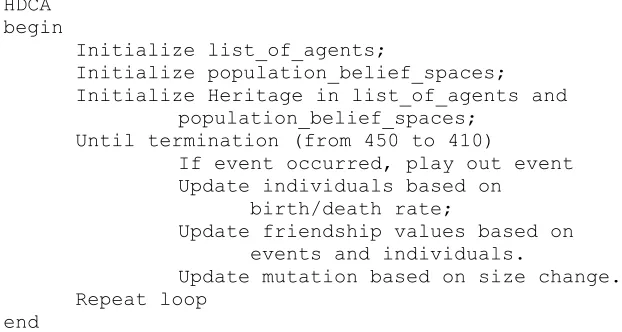
Figure 7 Pseudo-code for HDCA 42
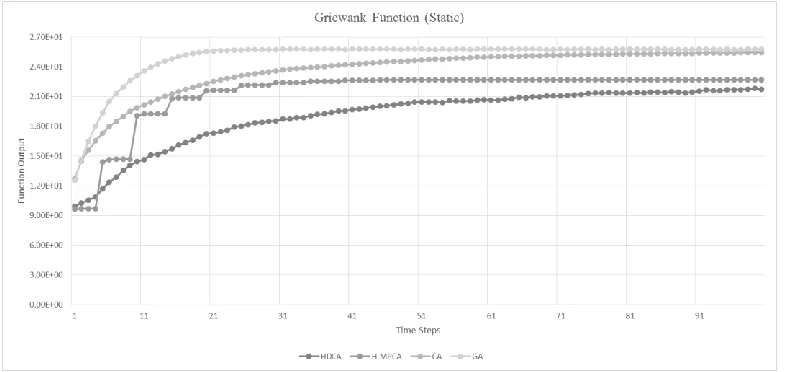
Figure 8 Example results from dynamic function (Griewank) 55 Figure 9 Example results from static function (Griewank) 55
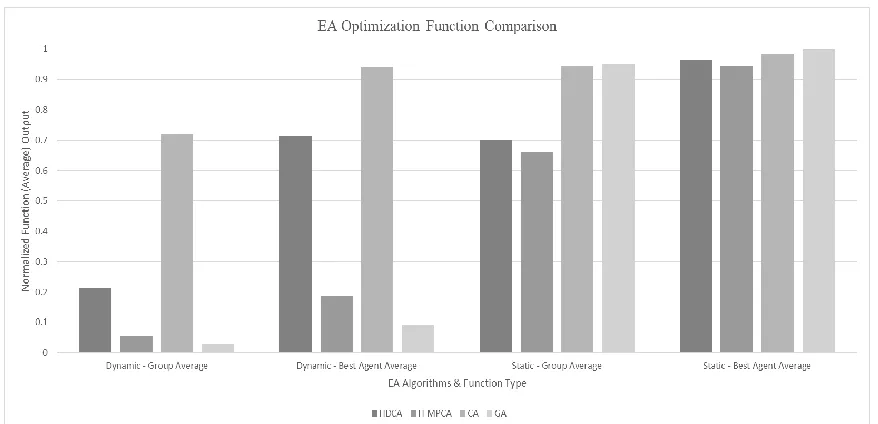
Figure 10 Normalized comparison of EA 56
xi
LIST OF APPENDICES
Appendix A “The following is additional data from the results of experiments performed in Chapter 4.”
89
Appendix B “The following is the program code (Java) of HDCA as used in Chapter 4.”
xii
LIST OF ABBREVIATIONS/SYMBOLS
EA Evolutionary algorithm(s)
GA Genetic algorithm(s) (Holland 1992)
CA Cultural algorithm(s) (Reynolds 1994)
MP Multi-population
MPCA Multi-population cultural algorithm(s)
MP-EA Multi-population evolutionary algorithm(s)
HDCA Heritage-dynamic cultural algorithm(s)
H-MPCA Heterogeneous multi-population cultural algorithm(s) (Raessi and Kobti 2013)
PARCA Parallel co-operating cultural algorithm(s) (Digalakis and Margaritis 2002)
MCGA Multi-population genetic algorithm(s) (Da Silva and De Oliveira 2009)
MCAKM Multi-population cultural algorithm(s) adopting knowledge migration (Guo et al. 2011)
MCPSCA Multi-population cooperative particle swarm cultural algorithm(s) (Guo and Liu 2011)
MCDE Multi-population cultural algorithm(s) with differential evolution (Xu et al. 2012)
1 CHAPTER 1
Heritage and Evolutionary Algorithms
1.1 Existing Evolutionary Algorithms
Evolutionary Algorithms (EA) are a set of algorithms related to evolutionary computation
in the field of artificial intelligence (Back 1996). In their purest form, they represent a
series of solutions which improve over time through evolution. This concept is inspired
by biological evolution where species of living organisms evolve and improve with many
generations. The benefit of utilizing this in computer programming is that computers can
iterate through (simplified) generations of individuals at incredible speed: millions of
years of evolution could be calculated within a day!
Typically, EA can be generalized in pseudo-code as being comprised of three main
functions that help form a new generation of individuals from the previous generation.
These are called selection, reproduction and mutation (Back 1996). Selection and
reproduction select appropriate individuals to generate offspring as a combination of
traits, and mutation allows controlled random variance to help discover elements of new
solutions not represented by the parents. To help select the best performing individuals a
fitness function (typically the problem that is to be solved) is used to rank the individuals
numerically. With this in mind, it makes sense that the majority of research with EA
relates to optimization problems.
There are many types of EA, each inspired by different aspects of nature. Some of these
2
Optimization, and Cultural Algorithms (Back 1996). Of these, Genetic Algorithms (GA)
and Cultural Algorithms (CA) are of the most interest in this study. GA use a basic
structure of selection, reproduction, and mutation, defining individuals as a set of
modulated memes that represent smaller parts of a larger solution (Holland 1992). By
defining individuals in this manner it is easier to combine individuals in the reproduction
stage to generate new individuals. CA are said to be an extension of GA, but utilize
additional logic and knowledge in the individual’s generation. This is accomplished with a “belief-space” that keeps memory of the best found knowledge so far discovered, which
can quickly distribute knowledge without waiting for explicit sharing between individuals
(Reynolds 1994).
The term “individuals” is often used for the solutions represented in each generation. In
agent-based modeling, an agent (or “intelligent agent”) is described as an autonomous
entity which observes its environment and directs its activity to achieve its goals. A
multi-agent system allows communication between agents to achieve such goals (Niazi
and Hussain 2011). This description is not too different from how CA are defined, as
such CA are especially well-suited to agent-based modeling where agents represent the
individuals. Some work in the literature uses EA with agents (Gilbert and Terna 2000,
Kobti et al. 2003).
While CA are generally considered an improvement over GA, they can still be limited in
that the agents are uniform: other than the specific search space they occupy, their
3
problem, Multi-Population EA (MP-EA) have been introduced more recently, including
MPCA (Digalakis and Margaritis 2002). This acts as multiple CA working in parallel,
each as its own population with its own individuals and belief-space. By defining
separate groups the agents can be defined to use separate strategies and knowledge
sources as well as explore different search spaces or optimize different variables. As a
drawback of MPCA being a new concept with less examples of it in existing work, very
few studies currently use MPCA directly for agent-modeling and simulation. This is
unfortunate as the ease of defining different strategies of communication and knowledge
use makes them directly applicable to this type of model.
1.2 Limitations of Genetic, Cultural and Multi-Population Algorithms
The main benefit of GA is their ease of implementation and flexibility. Little to no
explicit knowledge of the problem itself is needed for GA to be programmed: the only
requirement is the format of an appropriate solution to the problem to help define the
format of the individuals. The problem definition is treated as a “blind-box” for the
fitness function to rank the individuals. However, this simplicity can come at the cost of
optimization. While GA may be capable of reaching acceptable solutions with good
speed, bare GA are not intended to always reach the best or most optimal solution.
It appears intuitive that CA would perform better than GA since they are meant to use
explicit knowledge for problem solving. Studies show this to be true, but it leads to a
difficult question of how exactly knowledge should be defined in a computer algorithm.
4
requires much insight from the programmer. Should the problem’s criteria change
slightly, a CA would need to be re-written from scratch, unlike the more flexible GA. The
generalization of CA in the manner of GA to make them more adaptable for various
problems is still under study. Also, as previously stated as the inspiration for MPCA,
standard CA is uniform amongst its individuals for simplicity, which limits how logic can
be defined and utilized.
MPCA are designed to be capable of utilizing multiple strategies and knowledge
resources independently, while allowing separate goals. This can allow competitive,
cooperative, or independent forms of CA to be run in parallel for the same problem
domain while allowing the ability to share knowledge between populations. This can lead
to faster convergence to solutions of optimization problems, to the discovery of better
problems that a standard CA might miss, and is also better suited for complex problems
that include multiple variables or parameters in the solution format. In a way this is a
better representation of the complexity of interaction among evolutionary species as this
was inspired by nature and by problem solving logic. However, one flaw which
contradicts these inspirations is that agents are set to belong to one population at a time.
They may switch between populations at the jurisdiction of the programmer, but to date
no implementation exists that allows an agent to belong to more than one population at a
time. This ensures the agents are still to some extent limited, since each agent mimics the
behavior and logic of their population In reality one would see a much more diverse
5
This observation suggests that MPCA is still too simple, in the same way that CA is a
simplified representation of human problem solving.
Another serious issue in MPCA is the wide potential of inter-population communication
and lack of standardization. MPCA’s strength is that it contains multiple populations
which can share and communicate their discoveries with one another. But how do they
make these exchanges? In existing work that define MPCA, examples have shown
exchange through individual agents communicating with agents from other populations,
like saying hello to a neighbor. Other examples limit agent communication to only other
agents within the same population, similar to having students from the same school talk
to each other, where sharing between populations occurs when an agent migrates from
one population to another (moves to a “new school”). Some uses of MPCA skip agent
communication and focus on inter-belief-space communication, which in theory might
propagate the best discoveries more quickly. Even further, there exist examples where a
single global belief-space is shared amongst all populations and controls how knowledge
is distributed. These all bring up a variety of questions: do agents themselves maintain
individual-belief-spaces or local knowledge in the way their populations do for when
communication occurs? Do optimization the only concern to use MPCA or can it involve
testing other factors of the problem-solving process? To what depth and detail is
knowledge represented in these belief-spaces? If a global shared belief-space is used,
6
MPCA is still a recent EA and the lack of standardization with both CA and MPCA reduce their applicability, where GA’s simplicity makes it much easier to create and
maintain for any problem. To put it simply, GA only requires extensive knowledge of the
solution format, but CA and MPCA requires both extensive knowledge of the solution
and the problem itself, which many researchers struggle with.
1.3 The Introduction of Heritage as a Paradigm
While the exact use and definition of MPCA is debatable, this thesis will attempt to solve
the first problem of MPCA defined in Section 1.2. Currently, an agent in MPCA can only
belong to one population at a time. To allow agents to be defined as belonging to more
than one population at once, and therefore to take advantage of the benefits of these
multiple groups, this text introduces a new heuristic approach called “Heritage.”
The definition of Heritage in the context of this study would be described as a binary tree
comparable to the classical “family tree.” During the reproduction process of MPCA
where the traits of two parent agents are combined into a child agent for the new
generation, a single variable that defines the population that child belongs to would
normally copy that of the parents (or should the parents be mixed, then of the stronger
parent). By using a binary tree that history of populations is not lost, allowing generations
far into the future to have a varied and diverse group of individuals as defined by their
Heritage. Along with setting the population id, a numeric weight value is added to describe the amount of influence that population has on the agent’s Heritage. This would
7
easily merged between populations, a weighted-random selection process can be used to determine an agent’s immediate actions, and 2) the further down the tree a population
resides, or the older the population is in the Heritage, the less effect it should have on the
agent, which can be easily implemented by reducing all current influence values before
extending the tree.
While seemingly creating further complexity to the MPCA model, using Heritage
requires certain assumptions. Heritage must be used in a MP-algorithm, EA with only
one population that is uniform in its agents would have nothing to benefit in seeking
varied behavior in its individuals. Heritage as it is defined here can be used in other
MP-EA, but MPCA is the main focus of this study as it purposely defines the concepts of
knowledge in its structure. This definition of Heritage requires that it must be possible for
new generations to be created through the mating of agents across different populations, otherwise an agent’s Heritage would only have a single population throughout its span. It
also allows the assumption that individual agents themselves do not necessarily maintain
individual knowledge through the generations: by defining an agent with a potentially
unique Heritage, individuality can be seen in the Heritage alone even though the population’s belief-spaces maintain the knowledge being used. In this way the
implementation may be reduced to a higher level that focuses on the populations and their
belief-space definitions, even though the individual agents still do the work to solve the
8
Aside from historic knowledge of whom an agent’s ancestors’ populations were, Heritage
also represents symbolic ties to those older populations. Unlike historic knowledge that
maintains a snapshot of the knowledge itself, Heritage is a dynamic link to populations,
so as the populations change over time, so do the actions the agent carries out when
consulting its Heritage. Heritage is not meant to replace existing concepts of knowledge
in MPCA, but to be used alongside it. Like most EA, Heritage is based on observation of
nature. In the animal kingdom, some species will show signs of devotion and loyalty to
its family or community. In the human race, as people migrate to new homes, the cities
and countries that make up their culture are an important factor in their way of life, even
though their current home might hold the greatest influence. When countries change,
even people with more distant ties to that country are affected. In this way, Heritage is a
better representation of “culture” than that seen in most implementations of cultural
algorithms.
The use of Heritage may still be questioned. While it makes sense through hypothetical
scenarios, it may not necessarily be used effectively in most optimization or search
problems. Our hypothesis is that it will not. The existing design of example MPCA show
that removing traits that inspired the initial design from nature led to better performance.
But in that vein, EA are not necessarily the best choice for optimization problems either.
What is expected is that using Heritage will help maintain a greater diversity and make it
more difficult to lose what might have been important information, which may be
especially appropriate for stability in dynamic problems. More importantly, the use of
9
the interactions and evolution of the individuals, the study of cultural evolution and social
networks. Again, most EA are not the best choice for these types of problems, so why use
them at all? Because they provide reasonable results and are easily understood, allowing
insight into conclusions that might not be possible otherwise.
1.4 Summary of Thesis Contributions
In summary, the contributions of this thesis include:
Enabling individuals in Multi-Population Evolutionary Algorithms to belong to
more than one population at a time, allowing it to combine advantages (and
disadvantages) of multiple groups at once, through a proposed paradigm called “Heritage.”
Defining the operations and rules for Heritage by example in Heritage-Dynamic
Cultural Algorithm, as an example of a more standardized and flexible version of
Multi-Population Cultural Algorithm.
Testing the benefits of Heritage-Dynamic Cultural Algorithm in numerical
optimization functions as a typical benchmark problem, and testing ease of use
and capabilities with a simulation of historical politics.
Showing that Heritage-Dynamic Cultural Algorithm does provide greater
diversity in its population over related algorithms, that it had better learning
properties in dynamic environments over related algorithms, and that the use of
10
1.5 The Structure of This Thesis
The following chapters will continue to explain the inspirations and details of Heritage,
used in what is called a “Heritage-Dynamic Cultural Algorithm” (HDCA). This leaves
out MP because it is assumed that HDCA would require MP. Chapter 2 provides an
in-depth survey of existing work in EA, specifically MPCA, plus the concepts of
weighted-links to populations and the use of EA for agent-based modeling. Chapter 3 explains in
detail the structure and implementation of Heritage and HDCA. Chapter 4 tests HDCA
against related EA algorithms in static and dynamic environments built around
single-goal optimization functions. Chapter 5 provides an in-depth example of HDCA to model
a simulation of the Peloponnesian War of Ancient Greece history. Chapter 6 summarizes
11 CHAPTER 2
A Background Review
This chapter includes an in-depth overview of Evolutionary Algorithms (EA),
specifically Cultural Algorithms (CA), Multi-Population Cultural Algorithms (MPCA)
and their uses with agent-based modeling and simulation. This is included not only for its
relevance and importance to understanding the contributions of this thesis, but also
because there does not yet exist a summary of this nature elsewhere in available
literature.
2.1 Evolutionary Algorithms
2.1.1 General Evolutionary Algorithms and Genetic Algorithms
EAs mimic the basic processes of evolution as understood by modern natural sciences,
where the name originates. There are many common examples of algorithms that can be
categorized as EA, including Genetic Algorithms, Ant-Colony Optimization Algorithms,
Particle-Swarm Optimization and Cultural Algorithms, each of which are also inspired
from different observations of nature (Back 1996). These types of algorithms are often
associated with optimization or search problems, and are designed with both their
inspirations and problem solving goals in mind.
Different types of EA typically share certain features. One is that a population of artificial creatures, referred to as “individuals,” represent the algorithm’s progress towards a
12
individuals usually represent solutions to the problem that algorithm is attempting to
solve, symbolized as fixed length strings (Jones 1998).
In the first generation, the individuals are produced randomly. During each time-step, an
EA evolves the current population into a new generation with three steps: “selection,” “reproduction” and “mutation.” First, the “selection” process occurs where the best-fit
individuals are chosen by testing against the problem (a “fitness function”) and
comparing the numeric results. The “reproduction” process breeds new individuals with
those chosen during the selection process. This is done with crossover operations that
combine the individuals, using individual elements from at least two individuals to create
the new individual. A third process called “mutation” is completed at the same time as
the reproduction process, randomly making slight modifications in the new individual’s
parameters. Mutation is justified by observations of unusual occurrences in natural
evolution. A child is never exactly like its parents: there are always slight differences that
appear for the first time in the child, and sometimes children can have properties that
make them outliers to the rest of their population. This also makes sense for problem
solving – if not for mutation, an EA would converge quickly to a certain solution and
never explore values outside of those randomly generated in the first generation. These
processes of selection, reproduction and mutation occur indefinitely, until a satisfactory
solution is reached or until a time limit has expired. Specific details of these steps, such
as how many individuals to choose during the selection process or how many parents a
new child should have, or exactly how individuals are selected and reproduced, are
13
While the exact solution of the problem may not yet be known, the fitness function must
be capable of returning a value indicating how well the solution has performed so far. A
simple example is a mathematical function F(x,y) with two variables x and y: the
individuals would have two values that represent example values for x and y. The
individuals that return the highest values of F(x,y) are kept for the selection process. The
fitness function is treated as a blind-box component, such that the algorithm’s
programming logic does not know any details about the function when attempting to
solve it.
There are three main implementation branches of EA: Genetic Algorithms, Evolution
Strategies, and Evolutionary Programming (Jones 1998). This thesis focuses on Genetic
Algorithm examples.
Genetic Algorithms (GA) are a popular EA to use, partly because of its simplicity and
partly because of its adaptive nature to many problems. Holland (1992) is credited with
the original design of the GA, the concept of which can be viewed in Figure 1.
Individuals are described as genes with a set of chromosomes, which is where the name
comes from.
As Figure 1 shows, the pseudo-code of GA is not too different from the description of a
typical EA. Instead of simply choosing the top individuals during the selection process,
14
have a chance to be selected, albeit with less probability than more successful individuals
(this also means there is no guarantee that the best performing individuals are used at all). The parents are purposely paired in two’s, so new children would only have two parents
in the reproduction process. Probability values based on their success helps combine the parents’ genes for the creation of the child, with mutation performed afterwards. While
certain details here are more specific than the previous description of EA provided, GA
can still vary in implementation, and so the exact differentiating factors between a basic
EA and GA are not clear, although EA can also classify more complicated algorithms
other than GA.
GENETIC ALGORITHM
1. A population of u random individuals is
initialized.
2. Fitness scores are assigned to each individual.
3. Using roulette wheel parent selection u/2 pairs
of parents are chosen from the current population to form a new population.
4. With probability Pc, children are formed by performing crossover on the u/2 pairs of
parents. The children replace the parents in the new population.
5. With probability Pm, mutation is performed on the new population.
6. The new population becomes the current population.
7. If the termination conditions are satisfied exit, otherwise go to step 3.
Figure 1 A Typical GA (Holland 1992)
The main limit of GA is its easy convergence to local optima of a problem and lack of
problem-specific knowledge to solve the problem. But few researchers ever point out its
benefit, that the lack of problem-specific knowledge makes it easy to apply to many
15
convergence at cost of final solution fitness, and vice-versa. This simplicity can make it
troublesome for researchers to understand how a solution was found, making higher-level
understanding difficult with GA.
It is worth pointing out that the individual’s representation in GA can be as simple as a
string of binary values (Holland 1992), but can be implemented with strings of integer
values or more complicated representations, including matrices (Michalewicz 1992) and
trees (Zhou and Gen 1999, Syarif et al. 2002). While the use of trees as the chromosomes
of an individual is meant for optimizing network trees purely for representing the solution
format, this concept has loose ties to the inspiration behind the proposed contribution of
this thesis in Chapter 3. GA are now a widely known EA, and while many publications
exist with them using various extensions and novel problems, including wind turbine
placement (Grady et al. 2005), vehicle routing (Ombuki et al. 2006) and bankruptcy
prediction (Min et al. 2006), few research projects stand out as being important to the
development of GA in the last ten years.
2.1.2 Cultural Algorithms
Robert G. Reynolds (1994) is credited for proposing the concept of Cultural Algorithms (CA). He describes evolution as a process of “dual inheritance,” occurring both at the
individual level, and being generalized into a group “mappa,” otherwise called a
“belief-space,” which in turn influences evolution in future generations with group knowledge
16
The inspiration of CA is said to come from the concept of cultural evolution. Where some
EA, such as GA, focus on the genetic level for evolution and progress, cultural evolution
suggests that faster adaptation can occur through societies then through standard
biological inheritance (Reynolds 1994). Interestingly, the concept of “cultural evolution”
as a field of study in computer modeling appears to be non-existent at the time of this
writing.
In its simplest form, CA can derive directly from GA, although forms of CA based on
other EA can be produced. The traits saved in the belief-space can vary greatly, but again
the simplest form is to take the best performing values of what the population has done so
far. Pseudo-code for CA (Reynolds 1994) is provided in Figure 2.
CULTURAL ALGORITHM begin
t=0;
Initialize Population POP(0); Initialize Belief Network BLF(0);
Initialize Communication Channel CHL(0); Evaluate (POP(0));
t=1; repeat
Communicate (POP(0), BLF(t)); Adjust (BLF(t));
Communicate (BLF(t), POP(t)); Modulate Fitness (BLF(t), POP(t)); t = t+1;
Select POP(t) from POP(t-1); Evolve (POP(t));
Evaluate (POP(t));
until (termination condition) end
17
Comparing Figure 1 and Figure 2, the main differences in CA is the addition of a
space network and a communication channel between the population and the
space. Here, each time-step has the population’s individuals communicate to the
belief-space, the belief-space adjusting its generalized knowledge, then having the belief-space
communicate back to all of the individuals. After this, the evolution process occurs in the
same fashion as GA.
Five specific knowledge categories have been defined to describe types of knowledge
that can be used (Reynolds and Saleem 2005): Situational knowledge storing
well-performing past individuals for specific environment situations, Domain knowledge able
to use problem-specific intuition to predict environment patterns, Normative knowledge
storing dynamic ranges for finding optimized parameters, Historical knowledge storing
sequences of past environmental changes from a global perspective, and Topographical
knowledge that divides the landscape into sub-maps for sampling to predict unknown
data. While Reynolds and Saleem provide fair contextual examples using a “Cone’s
World” problem (a simple maximization problem where the domain is a set of hills), the
representation and usage of these can vary greatly based on the problem. Exactly which
knowledge should be used at certain periods during the problem solving phase brings
questions.
It intuitively makes sense that CA would lead to faster solutions than GA, since a
belief-space shared with all individuals would help communicate knowledge of other solutions
18
However, GA has no such requirement: GA’s selection process does not state that only
nearby (or else those with similar genetics) individuals can mate with each other. GA
assumes individuals are globally accessible, and while their selection process can vary
from a variety of methods including tournament selection, truncation selection,
roulette-wheel selection and others (Thierens and Goldberg 1994), using positional comparisons
between individuals is not common.
So if the increased speed of best-found solutions is not a benefit of CA over GA, what is
the purpose of CA? CA has a belief-space that can hold knowledge more advanced than
what genomes of individuals in GA can represent, with greater flexibility not limited to
the individual. That CA can technically represent its population using GA, neural
networks, swarm intelligence, or any other number of forms (Reynolds and Saleem 2005)
gives it further flexibility, although this freedom can lead to more confusion during
implementation. Most importantly, it is clear from these sources that the ability to use
location-based information and selective knowledge dispersal allows the study of
knowledge distribution and acceptance in a variety of domains, to be able to determine if
certain knowledge types are more powerful than another or if a certain communication
method is more realistic than another. The use of the belief-space, its main unique factor
over other EA, represents elements of society that may not be fully understood, but is
high-level enough to be implemented for study of other external elements despite not
understanding those finer details. The belief-space itself can provide a generalized
overview of the population as a whole rather than the best-performing individuals for
19
While seemingly of little meaning, these thoughts suggests that CA were not meant
purely for the study of optimization problems, and begin to delve further into qualitative
information for new types of problems, even though using functions that return
comparable fitness values still helps greatly in testing. This mindset is part of the
inspiration behind the developments in Chapter 3. Recent uses of CA focus on the
specific design and uses of social structures and patterns (Ali et al. 2013, Reynolds et al.
2014), but significant developments in CA have slowed down in the past few years.
2.1.3 Multi-Population Evolutionary Algorithms
Multi-Population Cultural Algorithms (MPCA) are a natural extension of CA that are still
relatively new in modern research. The concept is straight-forward: CA are defined as
having a population of individuals with a global belief-space helping guide their
evolution. Instead of a single population with a single belief-space, it could be beneficial
to have more than one, for greater variety and capability of easier representations of
different groups (two heads are better than one!). So MPCA consists of two or more
sub-populations, each with its own individuals and its own belief-space. Note that some may
prefer to describe MPCA as a set of “sub-populations” instead of a set of “populations;” “sub-populations” suggests that they are still part of a larger group or algorithm rather
than being entirely separate, but since many other sources in this field use the same
definition for both terms, they will be used interchangeably in this thesis with the same
20
While MPCA is the main focus of this section, it should be pointed out that the concept
of Multi-Population (MP) has been applied to other EA as early as 1991, including GA
(Cohoon et al. 1991), memetic algorithms (Quintero and Pierre 2003) and swarm
algorithms (Blackwell and Brake 2004). Coincidently, research using MPCA specifically
is fairly recent and sparse as of this writing.
MPCA implementations usually do not require extensive alteration of existing definitions
of CA. The focus of designing a functional MPCA, and the new area of research which
MPCA allows, is how these separate populations interact with each other. Should
populations be completely separate or have a form of shared memory? Should they share
all available information whenever possible, share the best available information, or share
information expected to help respective neighbor populations based on their unique
goals? Should they communicate knowledge between each other or should they migrate
individuals that contain knowledge or behavior traits for the population to recognize over
time? These vary based on what the purpose of the implementation requires, and these
thoughts have led to a variety of different MPCA.
MPCA first appeared in 2002 from Digalakis and Margaritis, although their implementation was called a “parallel-co-operating cultural algorithm” (PARCA). The
concept was still similar to later works that used the MPCA name, and involved using
multiple sub-populations of CA to solve local parts of a scheduling problem. A master
global-knowledge module would keep track of the sub-populations as they each evolved
21
communicate with each other to avoid redundant exploration through the exchange of
their best individuals.
Other uses of MPCA are to specifically find and keep track of more than one solution to a
problem (Alami et al. 2007), to speed up evolution (Guo et al. 2011) and to discover
dominant uses of specific types of knowledge (Hlynka and Kobti 2013). While some
work uses MPCA with a defined finite-set of sub-populations (Digalakis and Margaritis
2002), some use dynamically forming sets of sub-populations such that new populations
can appear (Alami et al. 2007, Xu et al. 2012). Additionally, while some uses of MPCA
share knowledge through the migration of individuals between sub-populations
(Digalakis and Margaritis 2002, Da Silva and De Oliveira 2009, Mokom and Kobti
2014), others share knowledge directly in the sub-belief-spaces (Alami et al. 2007, Guo et
al. 2011, Raeesi and Kobti 2012), and some even simplify MPCA to have a single global
belief-space for all sub-populations (Guo and Liu 2011, Raeesi and Kobti 2013).
It is significant that there does not exist many examples of MPCA designed for traditional
numerical optimization problems (Raessi and Kobti 2013), a common benchmark for
algorithm comparison involving optimizing multiple parameters of a mathematical
function. This may be due to MPCA still being a new concept in algorithmic research, as
standard CA has been used in numerical optimization (Reynolds and Chung 1997, Coello
Coello and Becerra 2004). It is difficult to confirm that having multiple populations can
lead to faster or better solutions, although research with Heterogeneous Multi-Population
22
It is a fair assumption for both MPCA and CA that problem-specific information does not
necessarily improve performance, and that added complexity could hurt performance if
not used correctly.
While things like quicker evolution, multiple solutions, solving multi-goal problems and
maintaining diversity during search were common reasons cited for using MPCA, it is
clear from these varied implementations that MPCA is plagued with lack of
standardization, adding complexity and confusion to similar issues in CA. Many of these cited articles also like to “extend” their version of MPCA as its own algorithm: these
include PARCA (Digalakis and Margaritis 2002), MCGA (Da Silva and De Oliveira
2009), MCAKM (Guo et al. 2011), MCPSCA (Guo and Liu 2011), MCDE (Xu et al.
2012), H-MPCA (Raessi and Kobti 2013) and TAMPCA (Hlynka and Kobti 2013), just
to name a few (these terms can be found on the “Abbreviations” page of this thesis).
One might bring up whether or not the existence of MPCA is really necessary. In theory,
could the functionality of MPCA be made in a single CA? In examples where there is a
single large belief-space shared amongst several sub-populations, yes. It would make
sense to have a numerical ID assigned to each individual to keep track of what population
it belongs to, which would affect communication and goals for the individual, otherwise a
single standard CA will carry out the same general functionality. In the case where there
are multiple belief-spaces, the algorithm requires multiple separate CA. However, from a ‘meta’ point-of-view, a set of populations can be seen as a set of individuals, such that
23
up of a subpopulation of the MPCA). Truly, the main reason to use MPCA is for
organization of complex interactions between individuals that would normally be difficult
to implement with CA or GA alone. Moreover, multiple belief-spaces can be observed
along with the output data for conclusions. Because of the nature of the structure, it is
easier to understand the interactions of these complex individuals using MPCA.
As discussed in Chapter 1, an individual can migrate between populations, but cannot
belong to two or more populations concurrently. This missing element is the basis of the
contributions in Chapter 3.
2.2 Agent-Based Modeling
2.2.1 General Overview
Agent-based modeling is a computational model consisting of multiple autonomous
agents, which themselves are simple individuals able to sense parts of their local
environment or other local agents and act upon their discoveries to achieve goals.
Typically “agent-based modeling” is concerned with the agent framework themselves and
their collective behavior to deduce qualitative understanding, where the term
“multi-agent system” refers to a system with multiple “multi-agents applied to more traditional
problems of practical significance (Niazi and Hussain 2011). The exact definition and use
of agents can vary greatly based on the problem. It is even possible to have an agent
defined as a series of sub-agents that reach the larger agent’s conclusion and action
24
2.2.2 Agent-Modeling in Evolutionary Algorithms
GA, CA, MPCA and other similar EA are often specifically defined as being a set of “individuals,” not “agents.” Many experts in the field will correct someone trying to
define these EA as a set of agents. The term “agent” may be inaccurate for algorithms
such as GA, where the individuals do not necessarily have a local environment or other
individuals to sense to determine actions. GA will constantly use selection, reproduction
and mutation, the only decisions to be made is which individuals to use at each
generation and how to use them, decisions made by the global class and not by the
individuals themselves.
However, the definition of CA in Chapter 2.1.2 suggests that decisions become an
important part of the process. A belief-space is introduced, as well as more complex uses
of knowledge. The purpose to store knowledge is to make some form of decision with it
at various stages. Further, the belief-space is meant to spread knowledge more quickly,
suggesting that local individuals could not simply spread knowledge to the rest of the
algorithm otherwise, and that the concept of “local” individuals is in fact considered.
These ideas lend themselves perfectly to the thoughts of agents and agent-based
modeling. MPCA, meant to encourage diversity and multiple goals, seems even better
suited for the concept of using agents as the individuals. The opposite can also be considered, to use GA, CA or other EA as elements of a single agent’s reasoning process,
25
A brief search revealed the existence of agent-based-models that use GA for the
fundamental learning process of the individual agents (Gilbert and Terna 2000), although
some existing work does refer to GA/MPGA using populations of agents (Chen and Yeh
2001). CA has significantly less results appear in existing literature that relates to agents,
again using CA in the logical process of agent-based-models (Ostrowshi et al. 2002) and
using CA with agents instead of individuals (Kobti et al. 2003, Peng and Reynolds 2004,
Reynolds et al. 2014). Use of MPCA and agents is limited to a handful of articles at the
time of this writing (Hlynka and Kobti 2013, Mokom and Kobti 2014). The reduction in
use of agents as they become more relevant seems only related to the amount of work
available in the EA, with little on MPCA due to it being in its infancy in modern
research.
The purpose of this section is to demonstrate that the words “agents” and “individuals”
being used interchangeably in this thesis is appropriate based on past work and the
problems studied in later chapters.
2.3 Weighted-Connections in Computer Algorithms
An important feature of Chapter 3 will be the concept of using weighted connections in
MPCA, as opposed to a binary variable that only allows an agent to belong to one
population at a time.
Weighted connections exist in a variety of algorithms in computer science. Artificial
26
components that update over time (Russell and Norvig 2010). More specifically in
agent-modeling, Denton Cockburn (2012) proposed a Weight-Allocated Social Pressure System
(WASPS) to improve specialization in an agent framework.
EA concepts have been used to improve neural networks (Yao and Liu 1997, Karaboga et
al. 2007) and similar problems involving the design of networks (Juang 2004). One
example of MPGA with weights given to the populations to determine direction to
explore solutions was found (Chang et al. 2007). However, no examples exist in the
literature to allow individuals in MPGA or MPCA to belong to more than one population
27 CHAPTER 3
Using Heritage with Multi-Population Cultural Algorithm
3.1 What is Heritage?
Heritage is a new proposed heuristic approach to extend Multi-Population
Cultural-Algorithms (MPCA). Similarly, the concept of Heritage as it is defined here can be
applied to other MP algorithms and not strictly to CA.
According to the Merriam-Webster Online English Dictionary, the word “Heritage” can be defined as “something transmitted by or acquired from a predecessor” (Def. 2, July 20,
2015). This definition is not too different from how the concept of “culture” is defined in
CA, as a form of information passed down from generation to generation. However, the term “Heritage” does not just suggest knowledge, but also “tradition,” where knowledge
and behavior might be passed down based on ties to the source. For example, in human
societies, cultural-Heritage refers to countries, clans or groups that the individual’s
ancestors belonged to, and those groups still hold meaning to descendants that were not
directly part of those groups. More importantly, in human-societies Heritage is additive,
growing over time as a combination of ties to many groups, such that many unique
Heritage trees exist among individuals, instead of a tie to a single group.
With this in mind, Heritage as it relates to MPCA is meant to be a method to represent
individuals that belong to multiple populations at the same time. Currently, while
individuals could migrate from one population to another, there exist no examples of
28
Heritage is built by combining the Heritage of two parent agents to become the Heritage
of their child, and after several generations individuals would have diverse cultural
makeups. When agents act based on their Heritage, weight values keep track of which
populations in the Heritage have the most influence in helping determine current
behavior, strategies and goals. Aside from being a more complex yet manageable solution
for agent-based modeling with MPCA, this concept could also take advantage of
combining traits from multiple populations in search decisions for potential improvement
against certain problems.
This concept is used in a new example algorithm called “Heritage-Dynamic Cultural Algorithm” (HDCA). Multi-Population is left out of the name because the existence of
Heritage assumes the existence of multiple populations. Additionally, Heritage assumes
that the definitions of the populations, whether it be through their objectives or methods
to obtain those objectives, are unique from one another. In this way, HDCA is loosely
related to concepts explored in Heterogeneous MPCA (Raessi and Kobti 2013).
3.2 Why Use Heritage?
Current research around MPCA does not allow individuals to belong to more than one
population. This is a flaw that only exists in the concept of MP algorithms, and has no
relevance to traditional single-population CA or GA. Because MPCA are still a recent
concept in algorithmic research, the use of Heritage seems a natural evolution in the early
29
There are a handful of theoretical benefits to using Heritage. One is the representation of
a new property inspired by natural behavior. Evolutionary algorithms are often inspired
by specific traits in nature and perform with reasonable success. This would make them
well-suited as general algorithms for agent-based models the require modeling of natural
properties, but most evolutionary algorithms are left in their most basic forms for
simplicity, leaving a lot of potential details overlooked. Heritage and MPCA do not
satisfy all the potential influences in the world to represent cultures and societies, but as a
generalization can do more than MPCA alone. Further, enough implementation details of
MPCA are left open that they could be added later when an appropriate problem could
make use of them.
A greater benefit of Heritage, and the greatest factor in its inspiration, is the creation of
greater diversity. One of the reasons MPCA is utilized today is that the separate
populations can act differently from each other, using diversity in ways that help keep
track of different solutions or to help find new solutions in different spaces. However,
individuals can only belong to one population at a time, only receiving influence from
one belief-space at a time. The level of diversity is limited by the number of populations
defined. This may have been by design, to help maintain simplicity and allow closer
study of the populations as a whole instead of the individuals. But with Heritage,
individuals would have unique combinations of existing populations to drive their
behavior. This means that opposed to homogeneous individuals forming groups,
individuals are unique from each other and have a more important role: the micro-level of
30
Aside from being diverse, Heritage is something that is always part of the individual,
even if the influence value becomes very small. This way, information (or in this case,
ties to a certain population) is more difficult to lose. Standard CA and MPCA converge
by only using the best individuals in the reproduction of a new generation, but HDCA
uses evolution both to create new generations and to change weight values of Heritage
nodes. This added complexity makes it difficult to suggest that HDCA can lead to better
or faster solutions (storing potentially insignificant information may confuse which
strategy to use), but the greater diversity it does maintain can prove significant. In
dynamic environments where repeated patterns are likely to occur, Heritage’s ability to
retain older combinations in some form might make it more likely to perform favorably.
Another aspect of belonging to multiple populations is the potential for finding
combinations of populations that work well together, as a simplified form of feature
selection for reducing parameters used in an optimization problem. MPCA is well-suited
to representing different objectives amongst different groups or populations. Combining
the goals of these groups in some manner has been studied in Heterogeneous MPCA
(Raeesi et al. 2014), meant to improve performance by testing strategies of dividing
multi-dimension problems into sub-problems per population. By using Heritage,
dimension combinations would be found naturally during the evolution process instead of
during pre-processing, poor-performing combinations would be less likely to affect future
generations while better combinations thrive. Heritage also allows weighted influence
31
This section describes many intuitive reasons to make Heritage a favorable addition to
the library of evolutionary algorithm paradigms, but it also promises a more generalized
method to represent MPCA. Certain assumptions must be made to use Heritage. By
assuming Heritage, agents must be capable of producing offspring together regardless of
their corresponding population. It no longer makes sense to keep populations as separate
physical groups with controlled migration of agents or knowledge between them. The concept of “population” is reduced to the population’s belief-space, as originally intended
in early forms of MPCA and CA, to be a hypothetical example of knowledge distributing
quickly to influence its new generations, and to represent the population as a whole.
Further, the definitions of individuals themselves had always been dependent on the
target problem, posing questions such as whether individuals should have their own logic
and belief-space outside that of the population. Now, Heritage itself would define the individual, with the individual’s goals and past knowledge being stored exclusively in the
population’s belief-spaces, the only local knowledge being the agent’s current state and
surrounding environment. Then the aspects of the populations themselves and how
multiple populations differentiate themselves can be focused on. Not meant to replace
other methods of knowledge representation, Heritage does not interfere with how
populations describe storing and utilizing problem solving components. While the
individual is given greater focus than other forms of MPCA, this description also makes
32
Heritage in MPCA can remove open decisions about how to control communication and
migration between different populations, and how to differentiate individuals from
populations. While not meant to become a standard component of MPCA, the inclusion
of Heritage helps bring a generalization that MPCA and CA have lacked, potentially
being a benefit to programmers looking to implement algorithms in this family.
3.3 How is Heritage Defined?
This section discusses how to implement Heritage in a Heritage-Dynamic Cultural
Algorithm (HDCA).
3.3.1 Heritage Representation as a Tree
The concept of Heritage can be best related to the common idea of a family tree. A
typical family tree can be traced from the child to its parents, from the parents to their
parents, and so on. A family tree can also grow into a complex web when additional
children or siblings not directly related to the original child’s lineage are included. For
the sake of representing Heritage, these additional components are not necessary, so the
tree is simplified to a linear tree.
During the reproduction process of MPCA, traits of two or more parents are combined to
create a new child. With Heritage saved in each individual, it can also be passed down
from the parents to the children. So each individual contains at least two references of a
33
programming. In a simple implementation, the programmer may only need to consider
two parents per child, and therefore only needs two references. But for flexibility, this
can also be expanded to using a linked-list reference, which ultimately acts as a list of
lists.
A node contains two additional variables besides references to other nodes. It also
contains information on the current population with a numeric ID, and a real value that
represents the strength of influence the node would have on children. When initialized, a
agent or node with no existing Heritage still has a current population and influence value
initialized.
Exactly how influence values are defined can be up to the programmer. It may be worth
considering using the performance from the fitness function to help determine this
number. But there is a natural occurrence of Heritage in real life that inspires Heritage as
a paradigm: when a node is farther in the past of the tree, it should automatically have
less influence. So when the influence of a node of the current child is calculated, it should
use the number of branches it took to reach it as a decreasing factor. This can be
calculated in real-time at run-time when a child is accessing its Heritage, but to do so
often can require large computation. It may be worth storing a set to quickly store the
influence values after a single calculation for quick reference (this is explained in further
detail in Chapter 3.3.2). Influence is additive, so if a node with the same population
occurs more than once, all instances add together to give that population a greater
34
should they appear often in the past, instead of assuming the most recent population has
the greatest effect on the individual.
The current population of a node can be determined in different ways. It can be
determined based on past Heritage using the influence values, or it can be randomized.
The act of randomizing the current node of an agent to state population can be seen as
part of the mutation process of EA. If randomized, it better ensures that all populations
can be represented somewhere in the individuals, but if mutation is not used to determine
current population than this would be an appropriate method for modeling opportunities
of population extinction.
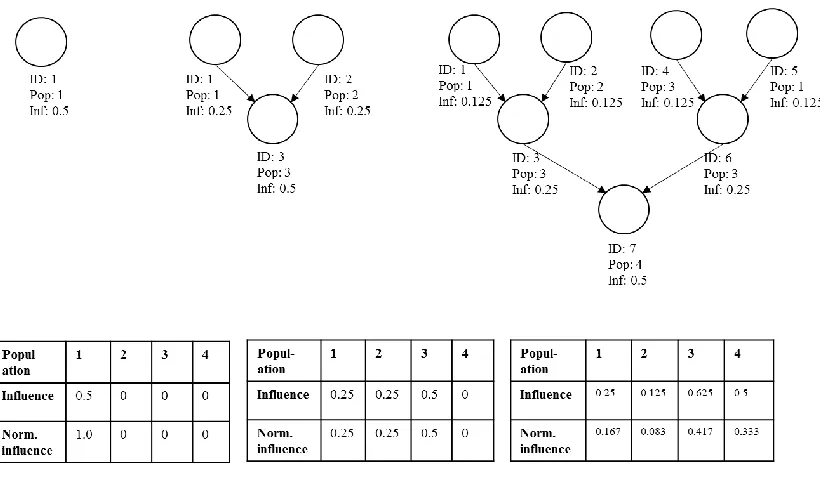
Figure 3 shows a diagram example of a Heritage tree growing, and how the influence
values change accordingly in future generations. Figure 4 provides example pseudo-code
that describes how Heritage can be stored and updated in an example agent.
The use of a list of lists can grow to a limitless size, and can be effected quickly by
hardware limits. If a child is limited to only having two parents, each generation would
have Heritage growing by approximately O(n2) at each time-step, where n is the number
of generations. From the previous description, nodes far in the past would always have a
very low influence on the current generation, so it may be acceptable to check and delete
older nodes that have influence below a certain threshold. This then allows for flexibility
35
Figure 3 A Visual Example of Heritage (Tree)
HERITAGE_TREE begin
Node
List<Node> parents = null;
Int population_id = 1;
Double influence = 1.0;
End Node
Update_Heritage(List<Node> parents)
Node.parents = parents;
End Update_Heritage
Get_Influence(int pop_id, double degree)
Double influence = 0.0f;
If (node.population_id == pop_id)
Influence +=
node.influence * degree;
For each (p in node.parents)
Influence +=
p.Get_Influence(pop_id, degree*0.5);
End loop
Return influence;
End Get_Influence end
36
The purpose of storing Heritage explicitly as a tree is to be able to track the origins of
Heritage. In certain problem environments it is helpful to know this type of information
to recognize patterns from past experiences. Further, the Heritage tree itself could result
in patterns that help guide appropriate Heritage in future generations. It could show
certain combinations of parents / Heritages working well and others not. Heritage is not
meant to replace historic knowledge, but using Heritage in this way could help add to
historic information to make decisions. The exact usage of Heritage is open for many
types of applications. But in cases where this type of historical pattern information is not
of benefit, storing Heritage as a set instead of a tree can save memory and still provide
general information on influence values.
3.3.2 Heritage Representation as a Set
To use Heritage as defined in this thesis with evolutionary algorithms, the major criteria
is to have an influence value corresponding to each existing population. The simplest
form of this is a set or array of real values, normalized between 0.0 and 1.0, such that the
sum of all the values add up to 1.0. Every individual would have their own set indicating
the influence populations have on them.
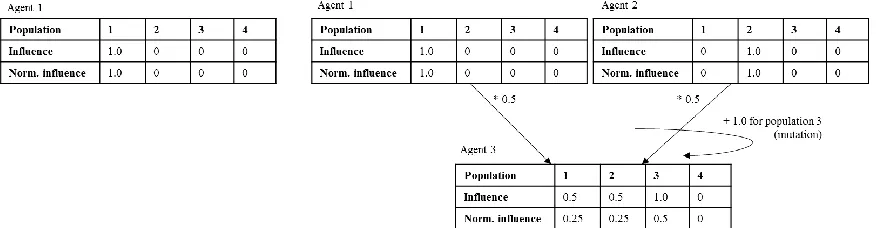
At the beginning of an HDCA, it is assumed the set of individuals will be initialized to
belong to a single population. This means their Heritage set has one value of 1.0 and many 0.0’s. When Heritage is combined at the reproduction stage for a new individual,
the Heritage from the parents are combined and added together. If the Heritage was
37
Heritage should be 2.0. After being added, to represent the decrease in Heritage over
time, the values are decreased by a certain percentage (to match the similar strategy of
Chapter 3.3.1, the valued are decreased by half as an example). Similar to Chapter 3.3.1,
the programmer may or may not choose to use mutation to add value to the influence
from a specific population, or may add value based on the existing influence values in the
Heritage. In this case, the Heritage values would need to be normalized again, such that
all values in the set add up to 1.0. Normalizing the values at the end of the reproduction
stage helps ensure consistency and makes it easier to compare the values for further study
during a simulation.
Figure 5 shows a diagram example of Heritage sets developing over multiple generations,
and Figure 6 shows example pseudo-code to help guide how such a set would be
programmed.
Compared to a tree, storing Heritage as a set can be beneficial for computation. The
memory usage for each individual would be consistent, at O(k), where k is the number of
populations. Accessing the influence values is also more straight forward.
As described in Chapter 3.3.1, the programmer may wish to use both a tree and a set to
represent Heritage: the set could be a place to store the total influence values in the tree,
and the tree would act as a secondary source in instances where the origin of Heritage
points were required. But in some cases the use of this type of historic information may