FIRE PROTECTION SYSTEM
QUAH LEE HUI
A MULTI-CRITERIA GENERIC PROCESS MODEL FOR SELECTING FIRE PROTECTION SYSTEM
QUAH LEE HUI
A thesis submitted in fulfillment of the requirements for the award of the degree of
Master of Science (Quantity Surveying)
Faculty of Built Environment Universiti Teknologi Malaysia
ACKNOWLEDGEMENT
Words cannot express my gratitude towards my supervisor, Associate Professor Dr. Roslan Amiruddin for the patience, humble supervision and advice I received from him in the course of this dissertation.
I am heartily thankful to all fire expert respondents and professional engineers whose encouragement, guidance and support from the initial to the final level which enabled me to develop an outcome of the subject.
Tremendously thankful to Prof. Dr. Ahmad Rosdan Abd Razak, PM Dr. Zainal Abidin Akasah and Dr. Kherun Nita Ali for their advise, comment and recommendation which guide me to the award of Master in Quantity Surveying.
ABSTRAK
ABSTRACT
TABLE OF CONTENTS
CHAPTER TITLE PAGE
DECLARATION ii
DEDICATION iii
ACKNOWLEDGEMENTS iv
ABSTRAK v
ABSTRACT vi
TABLE OF CONTENTS vii
LIST OF TABLES xii
LIST OF FIGURES xiv
LIST OF SYMBOLS xvi
LIST OF APPENDICES xviii
1 INTRODUCTION 1
1.1 Background of Studies 1
1.2 Statement of Problem 5
1.3 Aim and Objectives 9
1.4 Scope of Work 9
1.5 The Importance of Research 10
1.6 Organisation of Research Chapter 10
2 PRESCRIPTIVE FIRE PROTECTION SYSTEM 12 DESIGN
2.1 Introduction 12
2.2 Fire Issues 14
2.3.1 Reasons for Design and Installation of 25 Fire Protection
2.4 Fire Protection and Prevention Code of Practices 27 2.4.1 National Fire Protection Association 41
(NFPA) Regulation Code
2.5 Fire Protection System Assessment Tools and 43 Solution
2.5.1 Fire Risk Evaluation and Cost Assessment 45 Model (FiRECAM™)
2.5.2 Fire Evaluation and Risk Assessment 49 System (FIERA System)
2.6 Active Fire Protection System 50
2.7 The Criteria/Attributes Selection of Fire Protection 53 Systems
2.7.1 Introduction on the Selection of Equipment 53 and Systems
2.7.2 The Human Side of Fire System 55 2.7.3 Fire Protection Authority Code 56
2.7.4 Design Plan and Needs 59
2.7.5 Cost of Budget 60
2.7.6 Life Safety Contribution 61
2.7.7 Ability of the Fire Protection System 62 2.7.8 Fire Protection System to Clearly Notify 63
Occupant
2.7.9 Safe Time for Occupant Evacuation Escape 64 2.7.10 Integration and Adaptability of Fire 64
Protection System
2.7.11 Means of Accessibility Fire Protection 66 System
System
2.7.13 Consumer Friendly Operation of Fire 68 Protection System
2.7.14 Interior Finishes and Spaces 69 2.7.15 Fire Protection System Environment 69
Contribution
2.8 Summary 70
3 RESEARCH METHODOLOGY 71
3.1 Overview of Approach 71
3.2 Data Prerequisite 73
3.3 Data Required to Developed Fire Protection 74 System Selection
3.4 Source of Data 75
3.5 Introduction of Data Collection 76
3.6 Data Collection Technique 78
3.7 Methodology Tools for Fire Protection System 79 Selection
3.7.1 Scenario-Based Goal Decomposition 83 Approach
3.7.2 Dynamic Programming 84
3.7.3 Fuzzy Logic 86
3.7.4 Delphi Method 87
3.7.5 Analytical Hierarchy Process (AHP) 88 3.8 Data Collection Integrated with AHP Rating 89
Technique Analysis
3.9 Data Segregation and Compilation in AHP Rating 90 Technique Analysis
3.10 Generic Process Model Development 90
3.11 Evaluation and Validate Generic Process Model 90
ANALYSIS
4.1 Introduction to Data Analysis 92
4.2 Introduction to Analytical Hierarchy Process 93
4.3 AHP Data Analysis 94
4.4 Assembly of Data before Analytical Hierarchy Process 96 (AHP) Analysis
4.5 Organize Data in Analytical Hierarchy Process (AHP) 98 Analysis
4.6 Interpretation 109
4.7 Summary 109
5 IDEFØ MODEL AND MODELLING TECHNIQUE 110
5.1 Concept Modeling Development 110
5.2 Modelling Development 113
5.3 Layers of Model in Computer Integrated Construction 116 (CIC)
5.3.1 Specific Model 116
5.3.2 Reference Model 116
5.3.3 Conceptual Model 118
5.3.4 Metamodel 118
5.4 IDEFØ Modelling 120
5.5 IDEFØ Concepts 121
5.6 IDEFØ Syntax 122
5.7 IDEFØ Cell Modeling Graphic Representation 123
5.8 Strengths and Weaknesses of IDEF-0 124
5.9 Expected Result 126
6 GENERIC PROCESS MODEL PERFORMANCE 132 VALIDATION
6.1 Introduction 132
6.2 Respondent Validation 132
6.3 Result and Recommendation 134
6.4 Concluding 138
7 CONCLUSION AND RECOMMENDATION 139
7.1 Statement of Conclusion 139
7.2 Future Recommendation 141
REFERENCES 142
APPENDIX - A 164
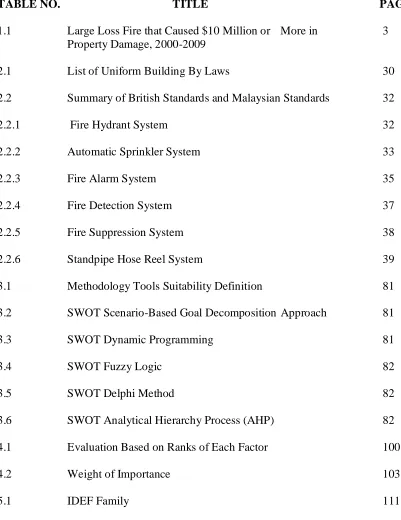
LIST OF TABLES
TABLE NO. TITLE PAGE
1.1 Large Loss Fire that Caused $10 Million or More in 3 Property Damage, 2000-2009
2.1 List of Uniform Building By Laws 30
2.2 Summary of British Standards and Malaysian Standards 32
2.2.1 Fire Hydrant System 32
2.2.2 Automatic Sprinkler System 33
2.2.3 Fire Alarm System 35
2.2.4 Fire Detection System 37
2.2.5 Fire Suppression System 38
2.2.6 Standpipe Hose Reel System 39
3.1 Methodology Tools Suitability Definition 81
3.2 SWOT Scenario-Based Goal Decomposition Approach 81
3.3 SWOT Dynamic Programming 81
3.4 SWOT Fuzzy Logic 82
3.5 SWOT Delphi Method 82
3.6 SWOT Analytical Hierarchy Process (AHP) 82
4.1 Evaluation Based on Ranks of Each Factor 100
4.2 Weight of Importance 103
6.1 Summary of Professional Respondent 128
6.2 Summary of Result and Recommendation from 129
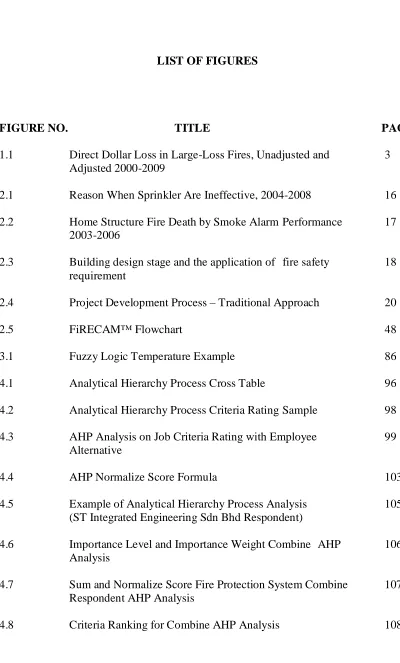
LIST OF FIGURES
FIGURE NO. TITLE PAGE
1.1 Direct Dollar Loss in Large-Loss Fires, Unadjusted and 3 Adjusted 2000-2009
2.1 Reason When Sprinkler Are Ineffective, 2004-2008 16
2.2 Home Structure Fire Death by Smoke Alarm Performance 17 2003-2006
2.3 Building design stage and the application of fire safety 18
requirement
2.4 Project Development Process – Traditional Approach 20
2.5 FiRECAM™ Flowchart 48
3.1 Fuzzy Logic Temperature Example 86
4.1 Analytical Hierarchy Process Cross Table 96
4.2 Analytical Hierarchy Process Criteria Rating Sample 98
4.3 AHP Analysis on Job Criteria Rating with Employee 99 Alternative
4.4 AHP Normalize Score Formula 103
4.5 Example of Analytical Hierarchy Process Analysis 105 (ST Integrated Engineering Sdn Bhd Respondent)
4.6 Importance Level and Importance Weight Combine AHP 106 Analysis
4.7 Sum and Normalize Score Fire Protection System Combine 107 Respondent AHP Analysis
5.1 Abstraction Level for Meta-Model Processes 119
5.2 IDEFØ Box and Arrow Graphics 124
5.3 AHP Criteria Grouping 127
LIST OF SYMBOLS
NFPA – National Fire Protection Association MEP – Mechanical, Electrical and Plumbing AHP – Analytical Hierarchy Process
IBC – International Building Code UBBL – Uniform Building By Law CO2 – Carbon Dioxide
FEO – For Exposition Only FP – Fire Protection
FIDO – Fire Incident Data Organisation
FiRECAM™ – Fire Risk Evaluation and Cost Assessment Model ISO – International Organisation for Standardisation FIERA – Fire Evaluation and Risk Assessment
FPEtools – Fire Protection Engineering Tools HVAC – Heat Ventilation Air Conditioning
CFAST – Fire Growth and Smoke Transport Modeling HAZARD I – Fire Hazard Assessment Method
BS – British Standard
MS – Malaysian Standard
IDEFØ – Integration Definition for Function Modeling CIC – Computer Integrated Construction
SWOT – Strengths, Weakness, Opportunities and Threats MEP – Mechanical, Electrical and Plumbing
SADT – Structured Analysis and Design Technique FCRC – Fire Code Reform Centre
OSTD – Object State Transition Description ICOM – Input, Control, Output and Mechanism IDEF – Integrated Definition
LIST OF APPENDICES
APPENDIX TITLE PAGE
A Developed Generic Process Model 164
CHAPTER 1
INTRODUCTION
1.1 Background of Studies
Research development and legislation on problems of fire and buildings have three main aims (Eric, 1972). First is to reduce or ideally to eliminate the risk of personal injury or death due to fire. The second aim is to reduce the total loss of buildings, plant and goods. The third aim is to protect the public at large, e.g. the community by ensuring that fire in a building is confined to that building, where possible. Understanding of these three main aims, the nature scope of fire loss problem is necessary to provide basis for reducing losses. Losses offer valuable lessons because they provide information that are needed to prevent or reduce the impact of similar losses in future (Schroll, 2002). Lessons learned from losses incurred in fire and prevent it in the first place before the fire break out and take away all of our valuables. With the three guidelines stated previously fire prevention should be initiated to serve the massive building and human with the right protection.
interruption to a major financial loss. Owning a building, lease a workspace or work at home, insurance protect all business’ physical assets either the interior as well as the whole entire physical of building. Unfortunately, buildings face their own enemy which is fire that cause damage or even destroy the entire of it. Results, fire protection system are the engineering method used by commercial property insurance companies which turn on for superior coverage and to serve and maintain building from fire strike disaster (Morgan, 2009).
Installation of fire protection is an important part of modern architecture to ensure that protection to the building and the occupants inside the building. Fire systems are effective in detecting, containing, and controlling as well as including extinguishing fire in early stage. Therefore, some little investment must be allocated in insurance to protect it against fire disaster where utilisation of fire protection system for a building will be the insurance to save lives, saving property and preserving business continuity.
Table 1.1 illustrates the small share of fires that account for major losses. Trend of the table shows ten years case where there is major fire loses three to fours years in sequence. Fire protection principles reflected in National Fire Protection Association’s codes and standards are essential if we are to reduce the occurrence of large-loss fires and explosions in the United States. Proper guideline design with early maintenance factor consideration and method operation of fire protection systems including features can reduce the fire losses damage due to fire disaster.
Source: NFPA’s Fire Incident Data Organisation (FIDO, 2010)
Deborah (2010) professional engineer from Society of Fire Protection Engineers insist that “Fire protection engineers must be involved in all aspects of the fire design in order to ensure a reasonable degree of protection of human life from fire and the
products combustion as well as to reduce the potential loss from fire i.e., real and
personal property, information, organisational operations”. Fire protection must be
integrated into the preliminary conceptual design process and coordinated throughout construction period. Sometimes the fire protection design approach is different for new construction than for existing buildings, but the underlying design principles are the same.
enables the designer to analyse all of the building components as a total building fire safety system package. Jane (2003) also explained that design analysis not only concentrate on code compliance or meeting the minimum legal responsibilities for protecting a building; but on the same time building and fire systems are intended to protect against loss of life and limit fire impact on the community and necessarily protect the mission or assets, or solve problems brought upon by new projects with unique circumstances. Therefore, it is necessary to creatively and efficiently integrate code requirements with other fire safety measures as well as other design strategies to achieve a balanced design that will provide the desired levels of safety.
Fire protection systems may not be installed in all kind of buildings, but they stand ready to raise the alert, control, extinguish a fire in terms of protection to occupants and building.“Fire protection systems are complicated and sophisticated and are different for just about every building. You need to look beyond a systems standpoint
and examine as a whole, how all the components work together.” noted by Jeffrey
(2008) from an organisation of fire protection and security consultants based in Chicago.
in its early stages and to make survival for occupant during the fire. To achieve the beneficial symbiosis between these components, it’s best to involve an experienced system designer, such as a fire protection engineer in the early planning and design stage (Lau, 1996).
Fire protection system cannot be taken for granted, so selection of fire protection system is not a one day task which can complete with simple step, but it consists of code references, experience of the system functional, criteria’s require which need to be considered during the design stage. Complexity of selecting a suitable fire protection system which incorporating the consideration of design factors that are available, reliable and contributing in eliminating fire risk is important. However, fire engineers need a tool to consider and measure all criteria before deciding the best fire system for a building. Therefore there is a need of guideline tools which can work into the symbiosis of fire protection system which serves the best result for building and occupants itself.
1.2 Statement of problem
select the best fire protection system for a building itself.
We interpret few news from the News Strait Time on 25 July 1998 reported that an estimate of 200 staffs were seeking for help at the roof top of Menara Lion, Jalan Ampang during fire break in the middle floor of the building when the fire protection system was unable to function to extinguish the fire. Unfortunately, the fire spread and took over the lives and properties. Another case happened in John Sevier Retirement Center, Johnson City, Tenn was an eleven storey building caught in fire at the first floor causing 16 deaths due to the bad fire safety system design (Joseph, 1992). Therefore, we know that fire is a threat and enemy to a building which lead to installation of fire protection system to protect them against destroy and damage. Thus, it is important to choose a fire protection system that is incorporating the functionality of the system for a building.
The answer is still remaining in doubt when designing a fire protection system for building because there are myriads of alternative systems, factors, technology improvement and conflicting regulations. All these considerations must be taken into account not only comply to the building authority fire regulation and code but also to enhance the design needs, cost, life safety, hazardous area, aesthetic view, environment pollution and the most important is the fire protection system ability to extinguish fire in a safe duration of time (Jane, 2003). Although the entire factors are listed out, architects and engineers may not consider all the factors during designing a fire protection system.
required coordination integration into the design process throughout the construction process. This is because at anytime, any other discipline changes a design, the fire protection has to be checked. Design process starts from the conceptual design going up to preliminary design, detail design and construction stage includes handing over with inspection. On top of design team view, fire protection system must be effectively integrated within the early design stage, construction stage, layout, and occupancy of the building and knowing the functions that the fire protection systems are expected to serve by eliminating the hazards. Chapter-2 will discuss in more detailed on the building design process with illustration incorporating with fire safety requirement throughout the whole construction.
In market, there are too many active fire protection systems such as fire alarms, automatic sprinklers, gas suppression systems, fire extinguishers, hose reels and hydrant to be chosen by the designers, contractors and engineers. Selection on the effectiveness and efficiency of fire protection systems based on specific requirements is not an easy task. With updated technologies, fire protection evolving into a more advance system which gives extra protection and extinguishment towards fire. This makes selecting the best fire system with consideration of surrounding factors a little complicated and guidelines needed. Architects, engineers and contractors who lack of proper guidelines and knowledge are trying to select a fire protection system relying on their past experience on past projects and code practice references (Deborah, 2010). Hence, there are many disadvantages when designers are more heavily relied on experience from previous work and rules of thumbs. As such, by developing a detail guideline it will helps to generate more information for future references.
consist of fire protection system concept model development with compilation of all criteria variables and factor circumstances which faced by the industry nowadays can be overcome. Knowledge and experience by fire expert alone are not enough to design a fire protection system (Andrew, 2003). Tools are vital to fire expert designers where enable them to investigate many alternative and scenario which will ultimately yield an optimum selection fire protection system. Therefore, we need a model to determine the type of fire protection system that is needed in a building by considering all criteria involved. Towards selection of fire protection system in commercial building this generic process model will show in flow diagram all the criteria needed for selection of fire protection system.
1.3 Aim and Objectives
The aim of this research is to develop a generic process model to select fire protection systems for commercial buildings. The model takes into account of standard criteria that influences the implementation of a fire protection system in a building. This will be achieved through interrelated general objectives which are:
1) To identify the interrelationship factors that influences the designer in selection of active fire protection system.
2) To develop a generic process framework to design and evaluate active fire protection system.
3) To evaluate and validate the proposed generic process framework.
1.4 Scope of work
Importance of this research is an improvement development of a generic process model to select and install a comprehensive fire protection system in every building so that the cost of loss and damage due to fire can be kept to a minimum. Commercial buildings are often accommodated by a vast number of occupants with many sophisticated technologies automation, aesthetic interior and fit-outs. There is a significant need to adopt a suitable, reliable and effective fire protection system which helps in saving lives and properties damage. Hence, this research is to develop a generic process model level that can be used for evaluating and selecting an efficient and effective fire protection system for a commercial building.
1.6 Organisation of Research Chapter
This section briefly state about the organisation of the whole research dissertation and the content of each chapter that can be divided into seven (7) chapters as follows:
Chapter 2: Prescriptive of Fire Protection System Design
Chapter 3: Research Methodology
This chapter discuss about the research methodology overview approach, listed out data required for the research, source of data for this dissertation, methodology tools for fire protection system selection, data collection integrated with analytical hierarchy process rating technique, data segregation and compilation inside AHP, developing a generic process model and evaluation and validation of the model.
Chapter 4: Analytical Hierarchy Process (AHP) Data Analysis
This chapter starts from introduction of analytical hierarchy process, assembly of data before AHP analysis, organizing and analysis data using AHP rating score and the rating score will be converted into development of a generic process model using IDEFØ. Idea of concept modeling development stated briefly.
Chapter 5: IDEFØ Model and Modeling Technique
This chapter looks into the modeling concept development, modeling development and modeling layer in Computer Integrated Construction (CIC). IDEFØ funtion model which consist of IDEFØ Modelling, IDEFØ Concepts, IDEFØ Syntax and Cell Modeling Graphic Representation will be used to develop this dissertation generic process model. Strengths and weaknesses of IDEFØ discussed in this chapter.
Chapter 6: Generic Process Model Performance Validation
This chapter discusses about the developed generic process model validated by the professional engineers in consultancy firm including recommendation given.
Chapter 7: Conclusion and Recommendation
REFERENCES
Abdalla H.S, Edalew K.O and Nash R.J (2000). A Computer-Based Intelligent System for Automatic Tool Selection. Department of Design Management and
Communication, De Montfort University, The Gateway, Leicester LE1 9BH, UK
Adler, M., Ziglio. E. (1996). Gazing into the oracle: The Delphi Method and its application to social policy and public health. London: Jessica Kingsley
Publishers.
Ahmed Sherif Megri (2009). Integration of Different Fire Protection/Life Safety Elements into the Building Design Process. Technical Paper: Practice Periodical on
Structural Destruction and Construction Volume 14, Issue 4, pp.181-189.
Andrew Bowman, P.E (2003). Making an Impact: Fire Protection Engineers and the Design Process. Fire Protection Engineering, 1, 12-22.
ARGOS (2002). Theory Manual. Denmark: Danish Institute of Fire Technology, Danish Fire Protection Associtation, Birkeroed.
Aznan Adnan (2010). Statistic of Fire and Rescue Department Analysis. Article Jabatan Bomba dan Penyelamat Malaysia (JBPM), Malaysia.
Bare, William K. (1978). Introduction to Fire Science and Fire Protection. New York : Wiley.
Barnett, Cliff Council on Tall Buildings and Urban Habitat (1992). Fire Safety In Tall Buildings/ Council On Tall Buildings and Urban Habitat. New York :
McGraw-Hill.
Barnfield, J, et al, (1993). Draft British Standard Code of Practice for the Application of Fire Safety Engineering Principles to Fire Safety in Buildings. London: British
Standards Institute.
Bénichou, N.; Kashef, A.; Torvi, D.; Hadjisophocleous, G.; Reid, I, (2002). FIERAsystem: A Fire Risk Assessment Model for Light Industrial Building Fire Safety
Evaluation. Canada: National Research Council Canada.
Analytical Hierarchy Process. London: Springer-Verlag.
Bjork, B-C (1992). A Unified Approach for Modeling Construction Information, Building and Environment. 27(2):173-194.
Bjork, B-C (1999). Information Technology in Construction: Domain Definition and Research Issues. International Journal of Computer Integrated Design and
Construction. 1(1):3-16.
British Standard (1972). Classification of fires. BS4547:1972, EN2:1972.
British Standard (2004). Fire detection and fire alarm systems for buildings. Code of practice for the design, installation and maintenance of fire detection and fire
alarm systems in dwellings. BS 5839-6:2004
British Standard (2005). Underground fire hydrants. BS EN 14339:2005.
British Standard (2005). Sprinkler systems for residential and domestic occupancies. Code of practice. BS 9251:2005.
British Standard (2006). Fire detection and fire alarm systems. Aspirating smoke detectors. BS EN 54-20:2006.
British Standard (2006). Fire detection and fire alarm systems. Aspirating smoke detectors. BS EN 54-20:2006.
British Standard (2006). Code of practice for fire extinguishing installations and equipment on premises. Hose reels and foam inlets. BS 5306-1:2006
British Standard (2008). Code of practice for the operation of fire protection measures. Electrical actuation of pre-action watermist and sprinkler systems. BS
7273-3:2008.
British Standard (2008). Fire detection and fire alarm systems for buildings. Code of practice for system design, installation, commissioning and maintenance.
BS 5839-1:2002+A2:2008.
British Standard (2008). Fire detection and fire alarm systems for buildings. Code of practice for the design, installation, commissioning and maintenance of voice
alarm systems. BS 5839-8:2008.
Butcher, E.G, Parnell, A.C (1983). Designing for Fire Safety. Chichester : John Wiley
Bukowski, R.W., Peacock, R.D., Jones, W.W., and Forney, C.L. (1989). HAZARD I -Fire Hazard Assessment Method, NIST Handbook 146 (three vols.). Gaithersburg, MD
20899: National Institute Standard Technology.
Bukowski, R.W. (1 993). Balanced Design Concepts Workshop. Gaithersburg, MD: NISTIR 5264, National Institute of Standards and Technology,
Burke, Robert (2008). Fire Protection : Systems and Response. Boca Raton, FL : CRC
Chen, P.P., Thalheim, B. and Wong, L.Y. (1999). Future Directions of Conceptual Modeling. Lecture Notes in Computer Science 1565. P.P. Chen, J. Akoka, H.
Kangassalo and B. Thalheim, Eds. Berlin, Germany: Springer.
Churchman, C. West (1960). Management Sciences, Models and Techniques. Institute of Management Sciences, Pergamon Press. United State: New York.
Colburn, Robert E. (1975). Fire Protection & Suppression. New York : McGraw-Hill
Craighead, Geoff (1995). High-Rise Security and Fire Life Safety. Boston: Butterworth Heinemann.
Dato’ Hamzah Abu Bakar (2006). Guide to Fire Protection in Malaysia. Kuala Lumpur: The Institution of Fire Engineers (UK) Malaysia Branch (IFEM).
Deborah F. Boice, P.E. (2010). Whole Building Design Guide. United States: Society of Fire Protection Engineers.
Deal, S. (1995). Technical Reference Guide for FPEtool Version 3.2, NISTIR 5486. Gaithersburg, MD 20899: National Institute Standard Technology.
Department of Agriculture Fire Service, US (2007). Specification for Water Enhancer (Gels) for Wildland FireFighting, Specification 5100-306a. United State:
Department of Agriculture Fire Service.
Diamantes David (2006). Fire Prevention: Inspection and Code Enforcement, 3rd Edition. United States of America: Thomson Delmar Learning.
Drysdale, J.W. (1965). Fire Protection in Buildings-Tall buildings Fires and Fire Prevention. Sydney: Department of Works Commonwealth Experimental
Eric W. Marchant (1972). A Complete Guide to Fire and Buildings. University of Edinburgh: Medical and Technical Publishing Co Ltd.
Feldman, C.G. (1998). The Practical Guide to Business Process Engineering Using IDEF0. New York: Dorset House Publishing.
Fire Incident Data Organisation, FIDO (2010). Fire Losses Property Damage in United States. National Fire Protection Association (NFPA) Statistics.
Fire Code Reform Centre - FCRC (1996), Fire Engineering Guidelines, first edition. Australia, Sydney: Fire Code Reform Centre.
Finucane, M, and Pickney, D. (1987). “Reliability of Fire Protection and Detection Systems” United Kingdom Atomic Energy Authority. Scotland: University of
Edinburgh.
Fisher, Colin (2004). Researching and Writing A Dissertation for Business Student. England : Pearson Education Ltd.
Forman, E. (1980). Decision By Objectives. George Washington University: Expert Choice Inc.
Forman, Ernest H.; Saul I. Gass (2001). The Analytical Hierarchy Process – An Exposition. Operation Research 49 (4): 469-487.
Fraser-Mitchell, J.N. (1994). An Object Oriented Simulation (CRISP2) for Fire Risk Assessment. IAFSS: Proc of the Fourth International Symp, p793-804.
Forrest, J. C. M (1972). The Design of Industrial Buildings for National Fire Protection the Role of the Structural Engineer. Evening Meeting, Centrel Hall, Westminster,
20 April, London: Concrete Society, 1-12
Grogan, Edward (1972). The design of industrial buildings for rational fire protection - the role of the architect. London : Concrete Society.
Groner, N.E., Williamson, R.B. (1998). Scenario-based Goal Decomposition: A Method for Implementing Performance-Based Fire Safety Analysis. In: Proceedings of the
Second International Conference on Fire Research and Engineering. pp. 200–211.
Tools. CIB Procedings 180, W78 Workshop on Modeling Buildings Through
Their Lifecycle. Stanford, CA, August 21-23. 163-171.
Hasofer A. M., Beck V. R., Bennetts I. D., (2007). Risk Analysis in Building Fire Safety Engineering. Oxford, United Kingdom: Butterworth-Heinemann.
Howard W. Emmons (1965). Fire Development Theory – An Overview. Professor of Mechanical Engineering, Havard University.
IBC. (2006). International Building Code. United States: International Building Code.
IEEE Computer Board (1998). IEEE Standard for Functional Modeling Language-Syntax Semantics for IDEF0. Software Engineering Standards Committee of the IEEE
Computer Society: IEEE-SA Standards Board.
International Organisation for Standardisation (1982). Concept and Terminology for the Conceptual Schema and the Information Base. Griethuysen, J.J. (ed). ISO
TC97/SC5/N695. New York: American National Standard Institute.
International Organisation for Standardisation (2006). Fire protection - Automatic sprinkler systems Part 5: Requirements and test methods for deluge valves.
International Organisation for Standardisation (2006). Fire protection - Automatic sprinkler systems Part 6: Requirements and test methods for check valves.
ISO 6182-6:2006
Jane I.Lataille, P.E. (2003). Fire Protection Engineering in Building Design. United States: Butterworth Heinemann.
Jelani Abdullah (2001). Fire In Tall Buildings- Occupants’ Safety and Owners’ Liability. Kuala Lumpur: International Law Book Services.
Jeffrey E. Harper, P.E. (2008). Fire Protection Engineering. United State: Society of Fire Protection Engineers.
Jarrett, D.N. (2005). Cockpit Engineering. Aldershot, Hampshire: Ashgate Publishing.
John R. Grandzol (1989). Improving the Faculty Selection Process in Higher Education: A Case for AHP or Analytical Hierarchy Process. Pennsylvania: Bloomsburg.
of intelligent building systems. Hong Kong: Department of Building and Real
Estate, The Hong Kong Polytechnic University.
Jones A.Maurice (2009). Fire Protection System. United States: Delmar, Cengage Learning.
Joseph Zicherman (1992). Council on Tall building and Urban Habitat Committee 8A. Fire Safety In Tall Building. McGraw-Hill, Inc.
Kawalek, P. and Kueng, P. (1997). The Usefulness of Process Models: A Lifecycle Description of How Process Models Are Used in Modern Organisation.
Proceeding of The Second Caise/IFIP8.1, International Workshop on Evaluation of Modelling Methods in System Analysis and Design. Barcelona, 16-17 June 1997.
Klinoff. Robert.W (2003). Introduction to Fire Protection, 2nd Edition. New York: Thompson Delmar Learning.
Klote, John H. (2002). Design of Smoke Control System for Buildings. Washington: US Veterans Administration.
Ladwig, T. (1991). Industrial Fire Prevention and Protection. London: VNR.
Lau, Lay Cher (1996). Fire Fighting System Design. Skudai : Universiti Teknologi Malaysia.
Lee, Y.T. (1999). An Overview of Information Modelling for Manufacturing Systems Integration. U.S.A: Manufacturing Engineering Division, NIST. NISTIR 6382.
Logendran Subramaniam (2006). Fire Safety In High Rise Buildings. Skudai : Universiti Teknologi Malaysia.
Lotfi Zadeh (2004). Fuzzy Logic System: Origin, Concepts and Trends. UC Berkeley: Computer Science Division Department of EECS.
Malaysian Standard (1977). Code of practice for hydrant systems. MS 484 : 1977
Malaysian Standard (1990). Fire extinguishing media : Part 3 : Specification for powder. MS 1180 : Part 3 : 1990.
Specification for control and indicating equipment. MS 1404 : Part 4 : 1996
Malaysian Standard (1999). Specification for semi-rigid reel hose for first aid fixed installations. MS 1488 : 1999.
Malaysian Standard (1999). Specification for fixed fire fighting systems - Hose reels with semi-rigid hose. MS 1447 : 1999.
Malaysian Standard (1999). Fire extinguishing installations and equipment : Part 1 : Hydrant systems, hose reels and foam inlets. MS 1489 : Part 1 : 1999.
Malaysian Standard (1999). Fire protection Fire extinguishing media Carbon dioxide. MS ISO 5923 : 2003.
Malaysian Standard (1999). Vocabulary on fire protection : Part 3 : Fire detection and alarm. MS 1471 : Part 3 : 1999.
Malaysian Standard (1999). Specification for fire hydrant systems equipment. MS 1210 : Part 1,2,3,4,5 : 1991 (1999)
Malaysian Standard (2000). Fire protection - Automatic sprinkler systems - Part 2: Requirements and test methods for wet alarm valves, retard chambers and water
motor alarms. MS ISO 6182-2 : 2000.
Malaysian Standard (2000). Fire protection - Automatic sprinkler systems - Part 3: Requirements and test methods for dry pipe valves. MS ISO 6182-3 : 2000
Malaysian Standard (2000). Fire protection - Automatic sprinkler systems - Part 4: Requirements and test methods for quick-opening devices. MS ISO 6182-4 : 2000.
Malaysian Standard (2000). Fire protection - Automatic sprinkler systems - Part 5: Requirements and test methods for deluge valves. MS ISO 6182-5 : 2000.
Malaysian Standard (2004). Fire detection and alarm systems: Part 1: Introduction. MS 1745 : Part 1 : 2004 .
Marty Ahrens (2009). Smoke Alarms in U.S. Home Fires. Quincy, MA: National Fire Protection Association.
Mayer, Richard J., et al (1992). IDEF Family of Methods for Concurrent Engineering and Business Re-engineering Applications. Texas: Knowledge-Based Systems,
Practical Period Structural Design Construction. 13(2), 54-62.
Mihram, G. Arthur (1972). Simulation: Statistical Foundations and Methodology. . United State: New York, Academic Press.
Ministry of Construction (1988). Comprehensive Fireproof Building Design Methods. Four Volumes (in Japanese). Japan: Tokyo.
Mohamed Rashid Embi (1997). An intelligent assistant for designing to fire regulations in Malaysia. United Kingdom : University of Sheffield.
Morgan Hurley, P.E (2009). Fire Protection Engineering. United States: Society of Fire Protection Engineers.
Mustafa Yurdakul (2003). AHP as a strategic decision-making tool to justify machine tool selection. Ankara, Turkey: Department of Mechanical Engineering, Faculty
of Engineering and Architecture, Gazi University.
National Fire Protection Association (2002). Fire Protection Handbook. Quincy, MA: NFPA
National Fire Protection Association Code (2002). National Fire Code. Quincy, Mass: NFPA
National Fire Protection Association-11 (2005). National Fire Code, Quincy, Mass: NFPA
National Fire Protection Association (2006). Journal NFPA Volume104 Number1~10. Mass: NFPA
National Fire Protection Association (2009). Journal NFPA Volume104 Number1~10. Mass: NFPA
National Fire Protection Association (2010). Fire Protection Handbook. Quincy, MA: NFPA
National Fire Protection Association (2010). Journal NFPA Volume104 Number1~10. Mass: NFPA
Quincy, Mass: NFPA.
O’leary, Zina (2004). The Essential Guide to Doing Research. London: SAGE Publication Ltd.
Osullivan, D. (1991). Project Management in Manufacturing Using IDEF0. International Journal of Project Management. pp;162-168.
Oxford (1999). The concise Oxford dictionary / edited by Judy Pearsall. Oxford : Oxford University Press.
P. DiNenno (1995). SFPE Handbook of Fire Protection Engineering, Second Edition. Boston: Society of Fire Protection Engineer.
Pandya, K.V. (1995). Review of Modelling Technique and Tools for Decision Making in Manufacturing Management. In IEEE Proceedings on Science, Measurement and
Technology. 142(5): 371-377.
Peacock, R.D., Forney, G.P., Reneke, P., Portier, R., and Jones, W.W. (1993). CFAST, the Consolidated Model of Fire Growth and Smoke Transport, NIST Technical
Perry Pat (2003). Fire Safety Question and Answers: A Practical Approach. London: Thomas Telford Books.
Portier, R.W., Peacock, R.D., and Reneke, P.A. (1996). FASTLite: Engineering Tools for Estimating Fire Growth and Smoke Transport, NIST SP899. Gaithersburg, MD
20899: National Institute Standard Technology.
Rasbash D. (2004). Evaluation of Fire Safety. Chichester. West Sussex: John Wiley Sons Ltd.
Raymond M. Hill (2007). Fire Technology, Part III An Approach to Fire Protection Code. Springer Netherlands: Springerlink.
Richard Fellows & Anita Liu (2003). Research Methods For Construction, Second Edition. Great Britain: Blackwell Publishing.
Richard J. Mayer (1992). A Reconstruction of the Original Air Force Wright Aeronautical Laboratory Technical Report AFWAL-TR-81-4023. University
Drive East, Texas: Knowledge Based Systems, Inc.
Richard W. Bukowski, P.E. (1996). Fire Risk or Fire Hazard as the Basis for Building Fire Safety Performance Evaluation. Gaithersburg: NIST Building and Fire
Protection Systems. Gaithersburg: MST Building and Fire Research Laboratory
Robert P. Hanrahan (1995). The IDEF Process Modeling Methodology. Software Technology Support Centre.
Ryde N. (1991). FIRECALC Computer Software for the Engineering Professional Version 2.2. Australia: CSIRO Division of Building, Construction, and
Engineering.
S. Dasgupta, C.H. Papadimitriou, and U.V. Vazirani (1998). Dynamic Programming Algorithm. Chapter-6 Dynamic Programming.
Saaty, Thomas L. (1980). The Analytic Hierarchy Process. New York: McGraw Hill.
Saaty, Thomas L. (1982). Decision Making for Leaders : The Analytical Hierarchy Process World. Belmont, Calif. : Lifetime Learning Pub.
Saaty, T.L. and Vargas, L.G. (2000) Models, Methods, Concepts and Applications of the Analytic Hierarchy Process, Boston: Kluwer Academic Publishers.
Saaty, Thomas L.; Paniwati. Kirti (2008). Group Decision Making: Drawing Out and Reconciling Differences. Pittsburgh, Pennsylvania: RWS Publications.
Sayre, Kenneth M. ; Crosson, Frederick J. (1963).The Modeling of Mind; Computer and Intelligence. University of Notre Dame Press: Notre Dame Industries.
Schroll, R.Craig (2002). Industrial Fire Protection Handbook. Boca Raton, Florida: CRC Press LLC.
Scott, Dornan. (2008). Industrial Fire Brigade: Principles and Practice / International Association of Fire Chiefs, National Fire Protection Association. Sudbury, Mass:
Jones and Bartlett
Shields, T J, Silcock, G W and Donegan, H A (1990). Towards the development of a fire safety systems evaluation for public assembly buildings. Construction
Management and Economics, 8(2), 147-58.
Stephen G.Badger (2010). Large-Loss Fires In The United States-2009. Batterymarch Park, Quincy: Fire Analysis and Research Division National Fire Protection Association
Steiguer, J.E.; Jennifer Deberstein, Vicente Lopes (2003). The Analytic Hierarchy Process as a Means for Integrated Watershed Management. In Renard, Kenneth
Stollard, Paul., Abrahamas, John. (1999). Fire from First Principle: A Design Guide to Building Fire Safety. London: E & FN Spon.
Strathfield (1996). Fire Engineering Guidelines, First Edition. NSW: Standards Australia.
Tanaka, T., Nakamura, K. and Shimizu, K.(1987). Refinement of a Multiroom Fire Spread Model, Thermal Engineering, Vol. 1. Japan: ASME.
Teh, Poh Seng (1996). Research on the Sultanah Zanariah Library fire fighting system. Skudai : Universiti Teknologi Malaysia.
Uniform Building By Law, UBBL (2005). ACT133. Kuala Lumpur: MDC Publisher Sdn Bhd
Warrington Fire Research (1996). Probablistic Risk Assessment Data - Delphi Exercise. Warrington, United Kingdom: Warrington Fire Research.
William Butler Yeats (1921). Introduction to Fire in California-Sample Chapter. California: UC Press Education Books.
Wisnosky, Dennis E., Allen W. Batteau (1990). IDEF in Principle and Practice. GATEWAY, pp. 8-11.
Yahya Mohamad Yatim (1993). A critical review of the techniques and procedures for fire detections and fighting provision for the high rise buildings. Edinburgh :
Heriot-Watt University.
Ying-Shen Juang (2006). Design and implementation of a fuzzy inference system for supporting customer requirements. Taiwan: Elsevier Ltd
Yung, D.; Bénichou, N. (2000). Consideration of Reliability and Performance of Fire Protection Systems in FiRECAM™∗. InFIRE Conference 2000, 9-12 May. Ottawa, Canada: InFIRE, 1-11.
Yung, D.; Hadjisophocleous, G.V.; Yager, B (1998). Case study: the use of
FiRECAM<TM> to identify cost-effective fire safety design options for a large 40-storey office building. Pacific Rim Conference and 2
nd
International
Conference On Performance-Based Codes & Fire Safety Design Methods 1998,