Corporate Skills Estimation Model (COSEM)
for Software Project Management
Bh.V. Rama Krishna 1, Tennati Uma SaiLakshmi 2, Maddipati Yamini3
Associate Professor, Department of CSE, ISTS Women’s Engineering College, Rajanagaram, A.P, India1
Student, Department of CSE, ISTS Women’s Engineering College, Rajanagaram, A.P, India2
Student, Department of CSE, ISTS Women’s Engineering College, Rajanagaram, A.P, India3
ABSTRACT: In software corporate sectors project management staff with good skill set is in demand. Traditional approaches need more effort from company authorities in conducting surveys manually, also identification of skill enhancement required zones is a tedious job. In this proposed model (COSEM) a phased iterative approach developed to estimate the project personal skills. The model also supported with proposed framework to learning and improving the employ skills working in software MNCs. This paper attempts to provide a skill set estimation and development process considering various functional and non-functional requirements for Project-Management in companies. The proposed model improves the software quality factors as well as software project staff abilities to handle projects efficiently with high success rates.
KEYWORDS: Software Project Management; Skills; Companies; Soft Skills; Estimation; factors
I. INTRODUCTION
The Software Project Management is an integral discipline of Software Engineering having broad scope of research. Multi National companies currently under need for skilled personals. The project management is influenced by Software Development Life Cycle models [1]. Wide range of models available to satisfy different project environments, hybrid models are also used to handle today’s modern projects. The major factors that affect project management are Functional requirements and Non-functional requirements in an organization [3]. Estimation techniques and models are vital for measurement and analysis of various functional points of project. The cost estimation models identified a relation among skill factors in staff and their effort. Skill factors influences various efforts in a project [2]. The skill set transferability method computes the occupational skills transferability among project staff in a hierarchy [4]. The team based project include wide variety of skilled staff which demands more effort to identify skill set rate for a single employ among team[4][5]. Software Project management needs soft skill enriched staff to enhance the quality in software development as well as services [7].
Corporate sectors are hunting for skilled person in projects scheduling. The estimation of skill set among employee placing a great effort on companies. Using of traditional approaches gives limited scope in judging the skill factors in software personnel. In this paper Section 2 elaborates about ‘Life Cycle Models’ and their evolution. Section 3 describes the proposed model COSEM and its underlying framework. Section 4 depicts a comparison over traditional estimation techniques in contrast to COSEM followed by conclusion and future work.
II. LIFE CYCLE MODELS
risk analysis from core to periphery. In 1960 C. Larman developed Iterative model in which for each iteration of life cycle phases new functional capabilities are added to system. The iteration is a combination of Design, Method and Build modeling. The Evolutionary prototyping model coined in 1975 consists four phase’s requirement identification, Initial prototyping, Reviewing and Revising and Enhancement. Some other models like Agile and V-model are also developed with some unique approaches to manage the software project processes.
III. CORPORATE SKILL ESTIMATION MODEL(COSEM)
A. Underlying Frameworks:
Figure1. Underlying Framework for COSEM
The underlying framework for COSEM as shown in figure 1 represents a layered architecture organizing the skill sets of a company into hierarchies. Each level supports measuring tools or methods for extracting the skill rate of employee in an organization. For each level Resource estimation, Effort estimation, Skill estimation and Skill improvement processes incorporated. The level-wise organization of process domains are as follows.
LEVEL 1:
The corporate professional or project staff must have some abilities to work in environments where a high collaboration is needed between multi nation companies. Communication skills are the primitive requirement to project personal to interact between various dimensional workgroups. In this level staff abilities in speaking fluent English, Mental ability, general knowledge and professional attitudes are treated as skill set required to reach next layer.
LEVEL 2:
A crucial level in skill set estimation process which tracks the corporate staff working skills. In this layer project personal skill set regarding the following skills are estimated
Domain Knowledge
Knowledge Learning
The ability to improve the knowledge by using various learning skills are identified and estimated in this layer. This functional requirement influences the domain knowledge of project staff in corporations.
Problem Solving
The ability and skills to understand the scope of the project and identifying the challenges in various working environments related to project. This skill improves the analysis of critical zones in project management like Risk Analysis and Management area. Problem Solving skill improvement techniques are estimated among staff.
Adaptability
In corporate environments heterogeneous projects are organized in collaboration with multi dimensional teams. The adaptability to specific environment is a required skill to project staff. The ability of adoptability to heterogeneous environments depends on staff intra-domain knowledge based skills which are estimated and identified here.
Teamwork
Working with teams in corporate sectors needs logical, Initiative, creative, organization, constructive and supportive skills. Communication with other teams is also essential skill for collaborative working environments in software companies.
LEVEL 3:
The next higher phase concentrating on assessment and improving of employ skill abilities to higher levels. This phase not only makes software project personnel expertise in their relative domains, but also makes them research oriented to explore new origins of domain specific solutions.
Domain Expertise
Project staff must be stronger in their specific domain based knowledge. This impacts the quality of project processes and quality of product. Companies choose various techniques to make their staff as domain expertise. In this level of framework estimation of domain knowledge rate among employee as well as identifying training requirements done.
Research Skills
The abilities of software professionals innovative thinking to resolve a problem in point of effort and cost reduction estimated. The staffs with researching abilities are more efficient as they not only build systems efficiently but also generate more sophisticated model systems from existing systems.
Trend Analysis
The skill set required for observation of current trends in market and change their work style to meet market needs are estimated as well as improved here.
Auditing Skills
Auditing and Accounting capabilities are essential functional requirements for any organization. The estimation of efficiency in auditing among employee and training to improve these qualities concerned here majorly.
Planning Skills
Project Planning is the key stage in software engineering. In corporate companies to deal with any project staff must need a perfect planning. Here the skill sets required for efficient planning and monitoring modules are estimated and necessary improvement training approaches are identified.
LEVEL 4:
The highest level in framework brings up guidance, direction and managing qualities among corporate staff. Complete leadership qualities based skill set enhancement focused here.
Emotional Intelligence
Ethics Management
Knowing the project staff awareness on Business ethics, managerial ethics and moral values at working environments are estimated to identify training requirements to improve these qualities in staff.
Leadership Qualities
The qualities like Inspiration, confidence, communication, Decision making, Accountability, Empowerment, Empathy, Creativity and innovative thinking are the skill set requirements needed for leaders in corporate sectors. These skills are estimated and identified training requirements.
Mentoring Qualities
Human relation maintenance, skill sharing, knowledge distribution, positive attitude, demonstrating efficiency, guidance and constructive feedback maintenance are the skill set required for mentoring. Employee are estimated on these skill set based on rating required training assets are estimated.
Business Strategies
Here the project staff skill set regarding business strategy, work plan scheduling, vision, objective prioritization, optimized financial planning, managing stakeholders and strategic building are estimated and required training resources are estimated.
B
B.. COCOSSEEM(M(CCOOrrppoorraattee SSkkiillll EEssttiimmaattiioonn MMooddeell)) ::
An Iterative model based approach proposed by authors shown in figure 2. The model was a level wise enhancement framework to increase the skill set efficiency in corporate professionals. The four phases of the model iteratively performed until the skill standards are optimized in employee of software projects.
LEVEL 1:
Identification of tools, computer based trainings (CBTs), seminars, presentations, equipment for training skills are analyzed
LEVEL 2:
Software staff skill estimation tools, methods are applied to identify the factors of various skills among employee. LEVEL 3:
Conducting meetings, group discussions, individual presentations, written tests, online tests and skill level tests to derive statistical measuring of skill rate among employs.
LEVEL 4:
Provides training on various skills such as communication, management, planning, mentoring, leadership, personality development and business strategies. This level increases the maturity level of staff to peaks to hand over any challenges during project management as well controlling vital activities in companies.
IV.TRADITIONAL VS. COSEM
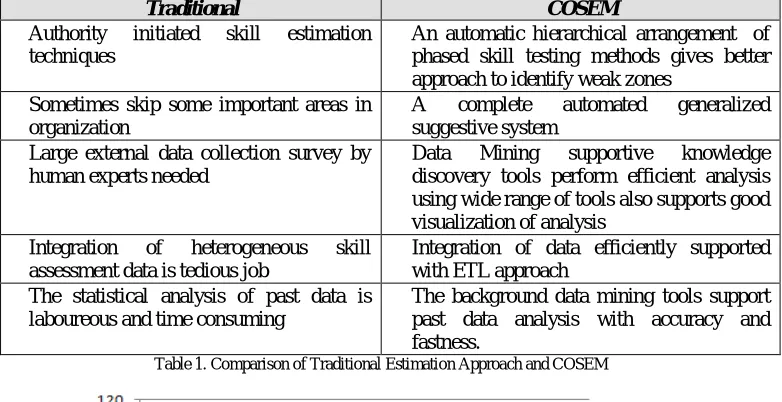
The following Table 1 shows the comparative study over traditional skill assessment techniques to proposed COSEM estimation model. The juxtapose characteristics are based on factors like Time, Cost, Resources and Effort for estimating skill set efficiency among project personnel.
Traditional COSEM
Authority initiated skill estimation techniques
An automatic hierarchical arrangement of phased skill testing methods gives better approach to identify weak zones
Sometimes skip some important areas in organization
A complete automated generalized suggestive system
Large external data collection survey by human experts needed
Data Mining supportive knowledge discovery tools perform efficient analysis using wide range of tools also supports good visualization of analysis
Integration of heterogeneous skill assessment data is tedious job
Integration of data efficiently supported with ETL approach
The statistical analysis of past data is laboureous and time consuming
The background data mining tools support past data analysis with accuracy and fastness.
Table 1. Comparison of Traditional Estimation Approach and COSEM
From above figure there is a significant improvement over traditional skill estimation approach is noticed in proposed COSEM. In order to support this analysis a real-time project environment survey to be performed in future work of us.
V. CONCLUSION AND FUTURE WORK
The proposed model COSEM can be adaptive to any corporate business environment to improve the skills in Corporate personnel. The framework developed in a hierarchical phased structure provides better understanding of staff maturity at each stage. Majority skill sets are covered by this model to perform complete skill estimation. The model based on iterative process model hence for each iteration we can track effort estimation variations as well as employ skill set improvement rate. In future work a survey based analysis conducted over traditional skill assessment process and COSEM skill assessment process in a real time organization environment with statistical analysis methods.
REFERENCES
1. S. Grimstad and M.Jorgensen,’A framework for the analysis of software cost estimation accuracy’, ISESE-Conference’06, ACM Library, 1-59593-218-6/06/0009, 2006.
2. P. Patrgnani and G. Conlon,’Estimating Impact of Training on Productivity using Firm Level Data’, Department of Business, Research Paper-72, London, May-2012.
3. C.Belzil, J. Hanson and Xing Liu ,’ Estimation of a Life-Cycle Skill Accumulation Model with Comparative Advantages and its Economic Implications’, Concordia-University Press, 2014.
4. Habibur Rahmanz, Saravanan Thirumuruganathanz and Senjuti Basu Royy ,’Worker Skill Estimation in Team Based Tasks’, Proceedings of the VLDB Endowment, Vol. 8, No. 11, 2007.
5. M.Jorgenson ,’ A review of studies on expert estimation of software development effort’, The Journal of Systems and Software 70 (2004) 37– 60,ELSEVIER,2002.
6. K. Nawakitphaitoon and Russell Ormiston, 'The estimation methods of occupational skills transferability', Springer Link, DOI 10.1007/s12651-016-0216-y, 2016.
7. https://www.thesoftskillscompany.com/.
8. https://www.investopedia.com/terms/s/soft-skills.asp. 9. https://en.wikipedia.org/wiki/SoftwareEngineering Models
AUTHORS
B
B..VV..RRaammaaKKrriisshhnnaa
Author currently working as Associate Professor in ISTS-Women’s Engineering College, He Completed his M.Tech (CSE) and M.Tech (IT) and doing his Ph.D. (CSE) from Acharya Nagarjuna University. His areas of interest are Data Mining, Cloud Computing, Software Engineering and Computer Networks. He also contributed many technical papers in journals. He is a Lifetime member of CSI.
T
T..UUmmaaSSaaiiLLaakksshhmmii
Currently Studying final year B.Tech.(CSE) in ISTS-Women’s Engineering College. Her areas of interest are Software Engineering, Mobile Computing.
M M..YYaammiinnii