ISSN(Online): 2320-9801
ISSN (Print): 2320-9798
I
nternational
J
ournal of
I
nnovative
R
esearch in
C
omputer
and
C
ommunication
E
ngineering
(An ISO 3297: 2007 Certified Organization)
Vol. 4, Issue 3, March 2016
Effective Key Management Technique in
Dynamic Wireless Sensor Network
Akshay Shrikhande1, Dr. R. S Kawitkar2
PG Student, Department of ETC, Sinhagad College of Engineering, Vadgaon (BK), Pune, Savitribai Phule Pune
University, Pune India.
Professor, Department of ETC, Sinhagad College of Engineering, Vadgaon (BK), Pune, Savitribai Phule Pune
University, Pune India.
ABSTRACT: Key organization has remained a troublesome issue in remote device frameworks (WSNs) as a delayed consequence of the prerequisites of contraption center point resources. Distinctive key organization plots that trade off security and operational necessities are proposed recently. Remote device Networks (WSNs) incorporates minor sensor center points with strained essentialness, memory and estimation limits. They're usually passed on within the unattended and disagreeable environment. So device center points locale unit powerless against ambushes, for instance, center catch and intrigue attack by unfavorable ascent. This paper proposes a key scattering subject, in perspective of Exclusion-based structures (EBSs) and t-degree sum. Its accomplice degree imperativeness profitable component key organization plot that performs constrained rekeying to diminish overhead. In this paper, we tend to propose a verification less-convincing key organization (CL-EKM) tradition for secure correspondence in component WSNs depicted by center point adaptability. The CL-EKM reinforces commonsense key updates once a center point leaves or joins a group and ensures forward and in opposite key puzzle. The tradition moreover supports reasonable key revocation for exchanged off centers and minimizes the impact of a center deal on the affirmation of alternative correspondence joins. A security examination of our theme shows that our tradition is effective in prepared for moved strikes. We have a tendency to execute CL-EKM in Conic OS and reproduce it misuse Coola machine to assess now is the ideal time, essentialness, correspondence, and memory execution.
KEYWORDS: Certificate less public key cryptography,clustering, key management, security and confidentiality,wireless sensor networks.
I. INTRODUCTION
ISSN(Online): 2320-9801
ISSN (Print): 2320-9798
I
nternational
J
ournal of
I
nnovative
R
esearch in
C
omputer
and
C
ommunication
E
ngineering
(An ISO 3297: 2007 Certified Organization)
Vol. 4, Issue 3, March 2016
to encounter the computation and correspondence overhead of CL EKM. Also we tend to add to a machine to encounter the essentialness use of CL-EKM. By then, we have a tendency to coordinate the proliferation of center point advancement by accepting the stochastic system quality Model and the Manhattan quality Model among the structure.
II. RELATED WORK
ISSN(Online): 2320-9801
ISSN (Print): 2320-9798
I
nternational
J
ournal of
I
nnovative
R
esearch in
C
omputer
and
C
ommunication
E
ngineering
(An ISO 3297: 2007 Certified Organization)
Vol. 4, Issue 3, March 2016
flexibility to hub bargains. Likewise, since such topic utilizes a clear ECC-based DH key understanding by exploitation each hub's semipermant open key and individual key, the mutual pair savvy mystery is static and therefore, is not secure against known-key assaults and can't give re-key operation utilize an ECDSA subject to check the personality of a group head and a static EC-DiffieHellman key assention topic to share the pair shrewd key between the bunch heads. In this way, the topic by Duet al. isn't secure against known-key assaults, as an aftereffect of the pair savvy key between the bunch heads is static. On the inverse hand, Du et al. utilize a standard math based isosceles key way to deal with offer the pair shrewd key between a locator hub and a group head. In this manner, an identifier hub can't straightforwardly build up a couple insightful key with various locator hubs and, rather, it needs the backing of the bunch head. In their subject, so as to discover a couple insightful key between two hubs inside of the same group, the bunch head self-assertively produces a couple astute key and scrambles it exploitation the common keys with these two hubs. At that point the group head transmits the encoded pairwise key to each hub. Hence, if the bunch head is traded off, the pair shrewd keys between non-bargained identifier hubs in the same group will be traded off.
III. SYSTEM MODEL& ANALYSIS METRICS
A. SYSTEM MODEL
The basic system model of this paper is pictured in Figure.1.It consists of 1 BS and lots of uniform sensing element nodes with distinctive ID. It uses cluster and two-layer design for scalability. Every cluster has some key generation nodes (KGNs) that distribute point keys among that cluster. These KGNs is also the final sensingelement nodes elect by cluster heads (CHs).We assume that the fundamental system model is deployed for the purpose of watching the hostile atmosphere. End-to-end node communication is unusual as a result of sensing element nodes in each cluster monitor the finite space. For the info aggregation, there square measure several communications between the nodes among the same cluster. Thus, the most task of this model could be a information transfer from sensing element nodes to BS and an information aggregation in every cluster
B. ANALYSIS METRICS
WSNs have some criteria that represent fascinating characteristics in key management scheme. To boot, energy consumption is that the most vital criterion thanks to the power constraint of detector nodes. Energy consumption might affect primarily the network lifespan. The key criteria square measure shown below.
• Resilience against node capture • Revocation • Scale • Energy consumption
IV. PROPOSED SCHEME
ISSN(Online): 2320-9801
ISSN (Print): 2320-9798
I
nternational
J
ournal of
I
nnovative
R
esearch in
C
omputer
and
C
ommunication
E
ngineering
(An ISO 3297: 2007 Certified Organization)
Vol. 4, Issue 3, March 2016
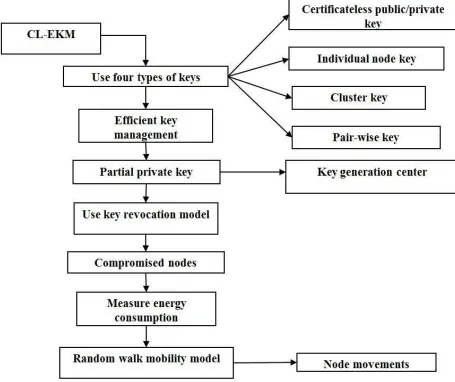
V. OVERVIEW OF THE CERTIFICATELESS EFFECTIVE KEY MANAGEMENTAND SECURITY MODEL SCHEME
FIG NO 1. CERTIFICATELESS EFFECTIVE KEY MANAGEMENTAND SECURITY MODEL SCHEME
Explanation-
ISSN(Online): 2320-9801
ISSN (Print): 2320-9798
I
nternational
J
ournal of
I
nnovative
R
esearch in
C
omputer
and
C
ommunication
E
ngineering
(An ISO 3297: 2007 Certified Organization)
Vol. 4, Issue 3, March 2016
A. Network Model
We contemplate a heterogeneous dynamic wireless device network (See Fig. 1). The network consists of variety of stationary or mobile device nodes and a bachelor's degree that manages the network and collects knowledge from the sensors. Device nodes will be of 2 types: (i) nodes with high process capabilities, referred to as H-sensors, and (ii) nodes with low process capabilities, said as L-sensors. We have a tendency to assume to own N nodes within the network with variety N1 of H-sensors and variety N2 of L-sensors, wherever N = N1 + N2, and N1 N2. Nodes could be part of and leave the network, and thus the network size could dynamically amendment. The H-sensors act as cluster heads whereas L-sensors act as cluster members. They are connected to the bachelor's degree directly or by a multi-hop path through other H-sensors. H-sensors and L-sensors will be stationary or mobile. Once the network preparation, every H-sensor forms a cluster by discovering the neighboring sensors through beacon message exchanges. The L-sensors will be part of a cluster, move to different clusters and conjointly re-join the previous clusters. To maintain the updated list of neighbors and property, the nodes in anexceedingly cluster sporadically exchange very light-weight beacon messages. The H-sensors report any changes in their clusters to the bachelor's degree, as an example, once an L-sensor leaves or joins the cluster. The bachelor's degree creates a listing of legitimate nodes; Associate in Nursing updates the standing of the nodes once an anomaly node or node failure is detected. The bachelor’s degree assigns every node a unique symbol. A L-sensor nil is unambiguously known by node ID Li whereas a H-sensor nHj is assigned a node ID Hj . A Key Generation Center (KGC), hosted at the bachelor's degree, generates public system parameters used for key management by the BS and problems certificate less public/private key pairs for every node within the network. In our key management system, a unique individual key, shared solely between the node and also the bachelor's degree is assigned to every node. The certificate less public/private key of a node is employed to ascertain pair wise keys between any 2 nodes. A cluster secret's shared among the nodes in a very cluster.
B. Adversary Model and Security Requirements
We assume that someone will mount a physical attack on a device node once the node is deployed and retrieve secret information and knowledge keep within the node.The someone also can populate the network with the clones of the captured node. Even while not capturing a node, Associate in nursing someone will conduct Associate in nursing impersonation attack by injecting Associate in nursing illegitimate node, which attempts to impersonate a legitimate node. Adversaries will conduct passive attacks, such as, eavesdropping, replay attack, etc to compromise knowledge confidentiality and integrity. Specific to our planned key management theme, if someone perform a known-key attack to be told pair wise master keys if it somehow learns the short keys, e.g., pair wise secret writing keys.
VI. CL-EKM MECHANISM
The CL-EKM is comprised of 7 phases: system setup, pair wise key generation, cluster formation, key update, node movement, key revocation, and addition of a new node Secure key management theme for WSNs supporting mobile nodes, the following security properties are critical:
I. Compromise-Resilience: A compromised node should not affect the protection of the keys of different legitimate nodes. In different words, the compromised node should not be in a position to reveal pair wise keys of non-compromised nodes. The compromise-resilience definition doesn't mean that a node is resilient against capture attacks or that a captured node is prevented from causing false knowledge to different nodes, BS, or cluster heads.
II. Resistance Against biological research and Impersonation: The scheme should support node authentication to safeguard against node replication and impersonation attacks.
ISSN(Online): 2320-9801
ISSN (Print): 2320-9798
I
nternational
J
ournal of
I
nnovative
R
esearch in
C
omputer
and
C
ommunication
E
ngineering
(An ISO 3297: 2007 Certified Organization)
Vol. 4, Issue 3, March 2016
antecedently exchanged messages encrypted with previous keys. Forward and backward secrecy are accustomed defend against node capture attacks.
IV. Resilience against Known-Key Attack: The theme should be secure against the known-key attack.
A. Types of Keys
a. Certificate less Public/Private Key: Before a node is deployed, the KGC at the BS generates a singular certificate less private/public key combine and installs the keys in the node. This key combine is employed to get a reciprocally authenticated pair wise key.
b. Individual Node Key: every node shares a singular individual key with BS. As an example, an L-sensor will use the individual key to write Associate in Nursing alert message sent to the BS, or if it fails to speak with the H-sensor. An H-sensor will use its individual key to write the message akin to changes within the cluster. The BS also can use this key to write any sensitive information, such as compromised node info or commands. Before a node is deployed, the BS assigns the node the individual key.
c. Pair wise Key: every node shares a unique pair wise key with every of its neighboring nodes for secure communications and of those nodes. As an example, in order to hitch a cluster, a L-sensor ought to share a pair wise key with the H-sensor. Then, the H-sensor will firmly encrypt and distribute its cluster key to the L-sensor by victimization the pair wise key. In Associate in Nursing aggregation supportive WSN, the L-sensor will use its pair wise key to firmly transmit the detected information to the H-sensor. Each node can dynamically establish the pair wise key between itself and another node victimization their various certificate less public/private key pairs.
d. Cluster Key: All nodes in an exceedingly cluster share a key, named as cluster key. The cluster key's chiefly used for securing broadcast messages in an exceedingly cluster, e.g., sensitive commands or the amendment of member standing in an exceedingly cluster. Only the cluster head will update the cluster key once a L-sensor leaves or joins the cluster.
VII. EXPERIMENTAL SET UP
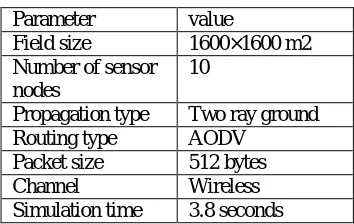
We use Network simulator IN java to show the performance of our proposed scheme. A WSN consists of 10 sensor nodes are randomly deployed over a square region of 1600 ×1600 m2 used in this simulation. The size of the data packet is 512 bytes. Adhoc on Demand Routing (AODV) protocol is used. We have 2 cluster groups. As compared to existing scheme, our proposed scheme has better performance in terms of energy consumption, delay, and throughput. The following section shows the simulation parameters, results and comparison performance of the proposed system. Table 1 shows the simulation parameters for the proposed key management method.
Simulation Parameters
Parameter value
Field size 1600×1600 m2
Number of sensor nodes
10
Propagation type Two ray ground
Routing type AODV
Packet size 512 bytes
Channel Wireless
Simulation time 3.8 seconds
ISSN(Online): 2320-9801
ISSN (Print): 2320-9798
I
nternational
J
ournal of
I
nnovative
R
esearch in
C
omputer
and
C
ommunication
E
ngineering
(An ISO 3297: 2007 Certified Organization)
Vol. 4, Issue 3, March 2016
DELAY GRAPH FOR VEHICULAR NODE
ISSN(Online): 2320-9801
ISSN (Print): 2320-9798
I
nternational
J
ournal of
I
nnovative
R
esearch in
C
omputer
and
C
ommunication
E
ngineering
(An ISO 3297: 2007 Certified Organization)
Vol. 4, Issue 3, March 2016
OVERHEAD COST (TIME) FOR REACHING WARNING SIGNAL.
VIII. CONCLUSION AND FUTURE WORK
This Project proposed to the crucial confirmation less convincing key organization tradition (CL-EKM) for secure correspondence in component WSNs. CL-EKM support saving correspondence for key updates and organization once a center point leaves or joins a bundle and immediately ensures forward and in opposite key riddle. Our subject is flexible against center exchange off, cloning and impersonates ambushes and secures the data protection and uprightness. This endeavor tend to exhibit a substitution subject which will be used for development varied keys (pair sagacious keys, way keys and cluster keys) for remote device frameworks. It can do lively credibility while not propel counts and correspondences. The examination result shows the execution of TKLU is new. Accomplice in nursing essentialness capable component key organization point abuse the EBSs, polynomials and riddle symmetry keys. EEDKM gives restricted rekeying which is reasonably performed not puncturing the converse segments of WSN. Since EEDKM uses separately symmetric key between the four year affirmation and sensor center point, it will guarantee the center point and performs rekeying more essentialness rapidly than LOCK within the higher layer. EEDKM is additional flexible than general key organization arrangement supported the EBSs and polynomial keys. Thusly rekeying is performed less of times. These numerical models are utilized to gage the right worth for the Told and Takeoff for parameters maintained the pace besides the needed exchange between the imperativeness usage moreover the security level.
REFERENCES
[1] H. Chan, A. Perrig, and D. Song, “Random key predistribution schemes for sensor networks,” in Proc. IEEE Sump. SP, May 2003, pp. 197–213. [2] W. Du, J. Deng, Y. S. Han, and P. K. Varshney, “A key redistribution scheme for sensor networks using deployment knowledge,” IEEE Trans. Dependable Secure Compute., vol. 3, no. 1, pp. 62–77, Jan./Mar. 2006.
[3] W. Du, J. Deng, Y. S. Han, P. Varshney, J. Katz, and A. Kaila, “A pair wise key redistribution scheme for wireless sensor networks,” ACM Trans. Inf. Syst. Secur., vol. 8, no. 2, pp. 228–258, 2005.
ISSN(Online): 2320-9801
ISSN (Print): 2320-9798
I
nternational
J
ournal of
I
nnovative
R
esearch in
C
omputer
and
C
ommunication
E
ngineering
(An ISO 3297: 2007 Certified Organization)
Vol. 4, Issue 3, March 2016
[5] M. R. Alagheband and M. R. Aref, “Dynamic and secure key management model for hierarchical heterogeneous sensor networks,” IET Inf. Secure., vol. 6, no. 4, pp. 271–280, Dec. 2012
[6] Arvinderpal S. Wander, Nils Gura, Hans Eberle, Vipul Gupta, and Sheueling Chang Shantz.(2005) Energy Analysis of Public Key Cryptography for Wireless Sensor Networks. In Proceedings of the Third IEEE International Conference on Pervasive Computing and Communications, pages 324– 328.
[7] M. Eltoweissy, M. Moharrum and R. Mukkamala, “Dynamic Key Management in Sensor Networks,” Communications Magazine, IEEE, vol 44, pp 122-130, April 2006.
[8] Liu, D. and Ning P. 2003. Establishing pairwise keys in distributed sensor networks. In CCS '03: Proceedings of the 10th ACM conference on Computer and communications security. ACM, New York, NY, USA, 52−61.
[9] Liu D., and Ning P., “Efficient distribution of key chain commitments for broadcast authentication in distributed sensor networks”. In Proceedings of the 10th Annual Network and Distributed System Security Symposium, pages 263–276, 2004.
[10] ParadisL.and Han Q., “A survey of fault management in wireless sensor networks,” J. Netw. Syst. Manage., vol. 15, no. 2, pp. 171–190, 2007. [11] Perrig A., Szewczyk R., Tygar J. D., Wen V., and Culler D. E. “Spins: security protocols for sensor networks”. Wireless Networking, 8(5):521– 534, 2002.
[12] Perrig A., Stankovic J., and Wagner D., ―Security in Wireless Sensor Networks,ǁCommun. ACM, vol. 47, no. 6, June 2004, pp. 53–57. [13] Rassam M. A., Maarof M. A., and Zainal A., “A survey of intrusion detection schemes in wireless sensor networks,” Amer. J. Appl. Sci., vol. 9, no. 10, pp. 1636–1652, 2012.
[14] Sattam S. Al-Riyami and Kenneth G. Paterson., Information Security Group,” Certificateless Public Key Cryptography”, Royal Holloway, University of London, Egham, Surrey, TW20 0EX.
[15] Seung-Hyun Seo., IEEE Transactions On Information Forensics And Security, Vol. 10, No. 2, February 2015.
[16] Wen Tao Zhu, Jianying Zhou, Robert H. Deng and FengBao., “A Detecting node replication attacks in mobile sensor networks.” Vol:5, issue:5, pages 496-507, May-2012.