Clinical Document Architecture for
Exchange EHR between Different Hospitals
with Cloud Computing
1
P. Shainaz Sulthana Begum , 2K.G.S. Venkatesan , 3K. Tejaswini, 4K. Kavya
5
K. Vishnu Priya, 6K. Vedavyas
1,3,4,5,6
Dept. of C.S.E., GATES Institute of Technology, ( Affiliated to JNTUA ), GOOTY, A.P, India.
2
Professor, Dept. of C.S.E, GATES Institute of Technology,(Affiliated to JNTUA), GOOTY, A.P, India
ABSTRACT : In Electronic Health Record helps improve patient safety and quality of care, but it has the prerequisite of interoperability between Health Information Exchange at different hospitals. The Clinical Document Architecture (CDA) developed by Health Level Eight could be a core document normal to make sure such ability, and propagation of this document format is important for ability. In hospitals are reluctant to adopt practical HIS as a result of its preparation price apart from different countries. A drag arises even once a lot of hospitals begin victimisation the CDA document format as a result of the information scattered in numerous documents aronerous to manage. In this paper, we have a tendency to describe our CDA document generation and integration Open API service supported cloud computing, through that hospitals are enabled to handily generate CDA documents while not having to buy proprietary software system. Our CDA document integration system integrates multiple CDA
documents per patient into one CDA document and physicians and patients will browse the
clinical knowledge in written record order. Our system of CDA document generation and integration is predicated on
cloud computing and also the service is obtainable in Open API. Developers victimisation completely
different platforms so will use our system to boost ability.
KEYWORDS : Cloud Computing, Infrastructure as a Service, Health Information Exchange.
I.
I
NTRODUCTION
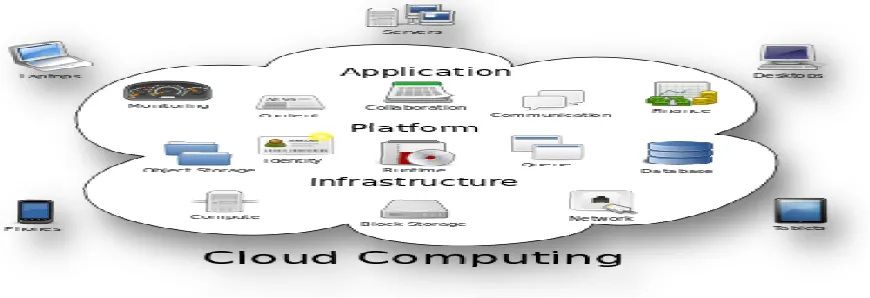
Figure 1 : Structure of cloud computing
The cloud computing uses networks of large groups of servers typically running low-cost consumer PC technology with specialized connections to spread data-processing chores across them. This shared IT infrastructure contains large pools of systems that are linked together. Often, virtualization techniques are used to maximize the power of cloud computing [7].
Electronic Health Record (EHR) is longitudinal collection of electronic health information for and about
persons, where health information is defined as information pertaining to the health of an individual or health care provided to an individual and it can support of efficient processes for health care delivery [27] .
CDA is a document markup standard that specifies the structure and semantics of ‘clinical documents’ for the
purpose exchange. The first version of CDA was developed in 2001 and Release to came out in 2005. Many projects adopting CDA have been successfully completed in many countries .
when all of the CDA documents are integrated into a single document, the medical personal is empowered to
review the patient's clinical history conveniently in chronological order per clinical section and the follow-up care service can be delivered more effectively [3].
Characteristics and Services Models :
The salient characteristics of cloud computing based on the definitions provided by the National Institute of Standards and Terminology (NIST) are outlined below:
On-demand self-service: A consumer can unilaterally provision computing capabilities, such as server time and network storage, as needed automatically without requiring human interaction with each service’s provider.
Broad network access: Capabilities are available over the network and accessed through standard mechanisms that promote use by heterogeneous thin or thick client platforms (e.g., mobile phones, laptops, and PDAs).
Rapid elasticity: Capabilities can be rapidly and elastically provisioned, in some cases automatically, to quickly scale out and rapidly released to quickly scale in. To the consumer, the capabilities available for provisioning often appear to be unlimited and can be purchased in any quantity at any time.
Measured service: Cloud systems automatically control and optimize resource use by leveraging a metering capability at some level of abstraction appropriate to the type of service (e.g., storage, processing, bandwidth, and active user accounts). Resource usage can be managed, controlled, and reported providing transparency for both the provider and consumer of the utilized service [34].
Figure 2 : Characteristics of cloud computing
Services Models :
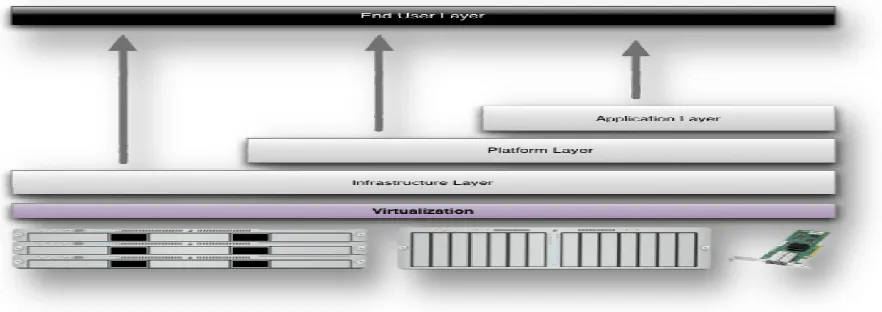
Cloud Computing comprises three different service models, namely Infrastructure-as-a-Service (IaaS), Platform-as-a-Service (PaaS), and Software-as-a-Service (SaaS). The three service models or layer are completed by an end user layer that encapsulates the end user perspective on cloud services [54]. The model is shown in figure below. If a cloud user accesses services on the infrastructure layer, for instance, she can run her own applications on the resources of a cloud infrastructure and remain responsible for the support, maintenance, and security of these applications herself. If she accesses a service on the application layer, these tasks are normally taken care of by the cloud service provider.
Benefits of cloud computing :
1. Achieve economies of scale – increase volume output or productivity with fewer people. Your cost per unit, project or product plummets.
2. Reduce spending on technology infrastructure. Maintain easy access to your information with minimal upfront spending. Pay as you go (weekly, quarterly or yearly), based on demand.
3. Globalize your workforce on the cheap. People worldwide can access the cloud, provided they have an Internet connection.
4. Streamline processes. Get more work done in less time with less people.
5. Reduce capital costs. There’s no need to spend big money on hardware, software or licensing fees. 6. Improve accessibility. You have access anytime, anywhere, making your life so much easier! 7. Monitor projects more effectively. Stay within budget and ahead of completion cycle times.
8. Less personnel training is needed. It takes fewer people to do more work on a cloud, with a minimal learning curve on hardware and software issues.
Advantages:
1. Price: Pay for only the resources used.
2. Security: Cloud instances are isolated in the network from other instances for improved security.
3. Performance: Instances can be added instantly for improved performance. Clients have access to the total resources of the Cloud’s core hardware.
4. Scalability: Auto-deploy cloud instances when needed.
5. Uptime: Uses multiple servers for maximum redundancies. In case of server failure, instances can be automatically created on another server.
6. Control: Able to login from any location. Server snapshot and a software library lets you deploy custom instances.
7. Traffic: Deals with spike in traffic with quick deployment of additional instances to handle the load.
Figure 3 : Structure of service models
II. LITERATURE SURVEY
J. L ahteenmaki, J. Lepp anen, and H. Kaijanranta, “ Interoperability of personal health records”. The establishment
of the Meaningful Use criteria has created a critical need for robust interoperability of health records. A universal definition of a Personal Health Record (PHR) has not been agreed upon. Standardized code sets have been built for specific entities, but integration between them has not been supported. The purpose of this research study was to explore the hindrance and promotion of interoperability standards in relationship to PHRs to describe interoperability progress in this area. The study was conducted following the basic principles of a systematic review, with 61 articles used in the study. Lagging interoperability has stemmed from slow adoption by patients, creation of disparate systems due to rapid development to meet requirements for the Meaningful Use stages, and rapid early development of PHRs prior to the mandate for integration among multiple systems. Findings of this study suggest that deadlines for implementation to capture Meaningful Use incentive payments are supporting the creation of PHR data silos, thereby hindering the goal of high-level interoperability.
S. Kikuchi, S. Sachdeva, and S. Bhalla, “Applying cloud computing model in PHR architecture”. In recent years,
regards to applying Cloud architecture in the PHR explicitly despite generating volume data. In this paper, we review our trial on the general architecture design by applying the Cloud components for supporting healthcare record areas and clarify the required conditions to realize it.
M. Bellare, “Health Information Privacy, Security, and Your EHR”. If your patients lack trust in Electronic
Health Records (EHRs) and Health Information Exchanges (HIEs), feeling that the confidentiality and accuracy of their electronic health information is at risk, they may not want to disclose health information to you. Withholding their health information could have life-threatening consequences. To reap the promise of digital health information to achieve better health outcomes, smarter spending, and healthier people, providers and individuals alike must trust that an individual’s health information is private and secure. EHR developer, is responsible for taking the steps needed to protect the confidentiality, integrity, and availability of health information in your EHR system.
C. Ng and P. Lee. Revdedup, “A Secure Anti-Collusion Data Sharing Scheme for Dynamic Groups in the Cloud”.
Benefited from cloud computing, users can achieve an effective and economical approach for data sharing among group members in the cloud with the characters of low maintenance and little management cost. Meanwhile, we must provide security guarantees for the sharing data files since they are outsourced. Unfortunately, because of the frequent change of the membership, sharing data while providing privacy-preserving is still a challenging issue, especially for an untrusted cloud due to the collusion attack. Moreover, for existing schemes, the security of key distribution is based on the secure communication channel, however, to have such channel is a strong assumption and is difficult for practice. In this paper, we propose a secure data sharing scheme for dynamic members. Firstly, we propose a secure way for key distribution without any secure communication channels, and the users can securely obtain their private keys from group manager. Secondly, our scheme can achieve fine-grained access control, any user in the group can use the source in the cloud and revoked users cannot access the cloud again after they are revoked. Thirdly, we can protect the scheme from collusion attack, which means that revoked users cannot get the original data file even if they conspire with the untrusted cloud. In our approach, by leveraging polynomial function, we can achieve a secure user revocation scheme. Finally, our scheme can achieve fine efficiency, which means previous users need not to update their private keys for the situation either a new user joins in the group or a user is revoked from the group
III. EXISTING SYSTEM
Existing Framework proposes an Effective health information exchange needs to be standardized for interoperable
health information exchange between hospitals. Especially, clinical document standardization lies at the core of guaranteeing interoperability.
It takes increasing amount of time for the medical personnel as the amount of exchanged CDA document increases
because more documents means that data are distributed in different documents. This significantly delays the medical personnel in making decisions. Hence, when all of the CDA documents are integrated into a single document, the medical personnel is empowered to review the patient’s clinical history conveniently in chronological order per clinical section and the follow-up care service can be delivered more effectively. Unfortunately for now, a solution that integrates multiple CDA documents into one does not exist yet to the best of our knowledge and there is a practical limitation for individual hospitals to develop and implement a CDA document integration technology [10].
DISADVANTAGES OF EXISTING SYSTEM :
The HIS development platforms for hospitals vary so greatly that generation of CDA documents in each hospital
invariably requires a separate CDA generation system. Also, hospitals are very reluctant to adopt a new system unless it is absolutely necessary for provision of care. As a result, the adoption rate of EHR is very low except for in a few handful countries.
Unfortunately for now, a solution that integrates multiple CDA documents into one does not exist yet to the best of
To establish confidence in HIE interoperability, more HIS’s need to support CDA. However, the structure of CDA
is very complex and the production of correct CDA document is hard to achieve without deep understanding of the CDA standard and sufficient experience with it [32].
IV. PROPOSED SYSTEM
In this paper we present (1) a CDA document generation system that generates CDA documents on different
developing platforms and (2) a CDA document integration system that integrates multiple CDA documents scattered in different hospitals for each patient.
CDA Generation API generates CDA documents on cloud.
CDA Generation Interface uses the API provided by the cloud and relays the input data and receives
CDA documents generated in the cloud.
Template Manager is responsible for managing the CDA documents generated in the cloud server. Our system
uses CCD document templates [20].
CDA Generator collects patient data from hospitals and generates CDA documents in the template formats as
suggested by the Template Manager.
CDA Validator inspects whether the generated CDA document complies with the CDA schema standard.
ADVANTAGES OF PROPOSED SYSTEM :
Hospital systems can simply extend their existing system rather than completely replacing it with a new
system. Second, it becomes unnecessary for hospitals to train their personnel to generate, integrate, and view standard-compliant CDA documents.
The cloud CDA generation service produces documents in the CDA format approved by the National Institute
of Standards and Technology (NIST).
If this service is provided for free at low price to hospitals, existing EHR are more likely to consider adoption
of CDA in their practices.
Interoperability between hospitals not only helps improve patient safety and quality of care but also reduce
time and resources spent on data format conversion.
V. ARCHITECTURAL DESIGN
1. The DFD is also called as bubble chart. It is a simple graphical formalism that can be used to represent a
system in terms of input data to the system, various processing carried out on this data, and the output data is generated by this system.
2. The data flow diagram (DFD) is one of the most important modeling tools. It is used to model the system
components. These components are the system process, the data used by the process, an external entity that interacts with the system and the information flows in the system.
3. DFD shows how the information moves through the system and how it is modified by a series of
transformations. It is a graphical technique that depicts information flow and the transformations that are applied as data moves from input to output.
4. DFD is also known as bubble chart. A DFD may be used to represent a system at any level of abstraction.
DFD may be partitioned into levels that represent increasing information flow and functional detail.
UML stands for Unified Modeling Language. UML is a standardized general-purpose modeling language in the field of object-oriented software engineering. The standard is managed, and was created by, the Object Management Group.
The Unified Modeling Language is a standard language for specifying, Visualization, Constructing and documenting the artifacts of software system, as well as for business modeling and other non-software systems.
The UML represents a collection of best engineering practices that have proven successful in the modeling of large and complex systems.
The UML is a very important part of developing objects oriented software and the software development process. The UML uses mostly graphical notations to express the design of software projects.
GOALS:
The Primary goals in the design of the UML are as follows:
1. Provide users a ready-to-use, expressive visual modeling Language so that they can develop and exchange
meaningful models.
2. Provide extendibility and specialization mechanisms to extend the core concepts.
3. Be independent of particular programming languages and development process.
4. Provide a formal basis for understanding the modeling language.
5. Encourage the growth of OO tools market.
6. Support higher level development concepts such as collaborations, frameworks, patterns and components.
7. Integrate best practices.
VI. IMPLEMENTATION
MODULES:
Construction of System Environment
The CDA Document
Construction of a Cloud Computing Environment
Integration of CDA Documents via Our Cloud Server
6.1 Construction of System Environment
In the first module we develop the Construction of the System Environment to prove our proposed system
model. In this module we develop Hospital A, Hospital B, Doctor, Patient/User, Admin and Cloud Modules.
In Hospital A, we create the User Authorization with Login Credentials. This module provides the option of
Upload the Patient details as XML File in the Cloud with Encrypted and also provides the option to check the status of the uploaded file with the XML Format. The same is followed in the Hospital B too.
In the Admin part, we provide the Admin Authorization with login Credentials and view pending request of
users and doctors. The admin only give Approval to the request by sending secret key to user/doctor to access the file [47].
In cloud Login, view the patient details in the XML format which is acquired from CDA.
6.2 The CDA Document :
In this module we develop the CDA document. The HL7 Clinical Document Architecture Release 2 (CDA R2)
was approved by American Nation Standards Institute. It is an XML-based document markup standard that specifies the structure and semantics of clinical documents, and its primary purpose is facilitating clinical document exchanges between heterogeneous software systems.
A CDA document is divided into its header and body. The header has a clearly defined structure and it
includes information about the patient, hospital, physician, etc. The body is more flexible than the header and contains various clinical data.
Each piece of clinical data is allocated a section and given a code as defined in the Logical Observation
the purpose of the document, and we chose the Continuity of Care Document (CCD) because it contains the health summary data for the patient and it is also widely used for interoperability [51].
6.3 Construction of a Cloud Computing Environment :
In this module we develop the Cloud computing environment. We use DriveHQ Cloud Service provider to
upload our files in the Cloud.
In this module, we develop the construction of a Cloud Computing Environment and how multiple CDA
documents are integrated into one in our CDA Document Integration System. The standard for this is Korean Standard for CDA Referral and Reply Letters (Preliminary Version). Templates which generate a CDA use CCD part of Consolidated CDA which is released by ONC and made by HL7. However, an actually generated CDA has a form of CDA Referral and Reply Letters.
The rationale for CDA document integration is as followed. When CDA-based HIE (Health Information
Exchange) is actively used among hospitals, the number of CDA documents pertaining to each patient increases in time. Physicians need to spend a significant portion of their time on reading these documents for making clinical decisions [50].
At a hospital, the CDA documents to be integrated are processed through our CDA Integration API. The CDA
Integration Interface relays each CDA document sent to the cloud to the CDA Parser, which converts each input CDA document to an XML object and analyzes the CDA header and groups them by each patient ID. The CDA Document Integrator integrates the provided multiple CDA documents into a single CDA document. In this process, the data in the same section in the document body are merged [43].
6.4 Integration of CDA Documents via Our Cloud Server :
We integrated multiple CDA documents of patient referrals and replies by using the API at our server. The use
case scenario and patient data used for integration are shown in this module.
We adopted sample patient data provided by the US EHR Certification Program, Meaningful Use. The data
does not pertain to an actual person. It is fictional, and available for public access. This module is to show how a client integrating multiple CDA documents by using our API. The sample many clinical documents are shown to be successfully integrated [52].
VII. CONCLUSION
As the number of HIE based on CDA documents increases, interoperability is achieved, but it also brings a problem where managing various CDA documents per patient becomes inconvenient as the clinical information for each patient is scattered in different documents. The CDA document integration service from our cloud server adequately addresses this issue by integrating multiple CDA documents that have been generated for individual patients. The clinical data for the patient in question is provided to his/her doctor in chronological order per section so that it helps physicians to practice evidence-based medicine. In the field of document-based health information exchange, the IHE XDS profile is predominant and our cloud computing system can be readily linked with the IHE XDS profile.
The approach employed in this paper is applicable in adopting other standards, too, such as the EHR Extract based on openEHR. If a hospital sends the content archetype, admin archetype, and demographic archetype to the cloud server, then the server extracts necessary information from each archetype. Next, it generates an Extract containment structure that fits with a designated template and returns the structure to the requested hospital.
REFERENCES
1. Y. Kwak, “International standards for building Electronic Health Record (EHR),” in Proc. Enterprise Netw. Comput. Health care Ind., pp. 18– 23, Jun. 2005.
3. T. Benson, Principles of Health Interoperability HL7 and SNOMED. New York, NY, USA: Spinger, 2009.
4. K Xiaoyong Li, Huadong Ma, Feng Zhou and Xiaolin Gui, “Service Operator-aware Trust Scheme for Resource Matchmaking across Multiple”, IEEE Transactions on Parallel and Distributed Systems Volume: 26 Year: 2015, pp.14-24
5. H. Yong, G. Jinqiu, and Y. Ohta, “A prototype model using Clinical Document Architecture (CDA) with a japanese local standard: designing and implementing a referral letter system,” Acta Med Okayama, vol. 62, pp. 15–20, 2008.
6. K. Huang, S. Hsieh, Y. Chang, F. Lai, S. Hsieh, and H. Lee, “Application of portable CDA for secure clinical-document exchange,” J. Med. Syst., vol. 34, no. 4, pp. 531–539, 2010.
7. C. Mart ınez-Costa, M. Men arguez-Tortosa, and J. Tom as Fern andez-Breis, “An approach for the semantic interoperability of ISO EN 13606 and OpenEHR archetypes,” J. Biomed. Inform., vol. 43, no. 5, pp. 736–746, Oct. 2010.
8. K.G.S. Venkatesan. Dr. V. Khanna, S.B. Amarnath Reddy, “Providing Security for social Networks from Inference Attack”, International Journal of Computer Science Engineering & Scientific Technology, March – 2015.
9. A.R. Arunachalam, K.G.S. Venkatesan, Abdul Basith.K.V., M. Sriram, “Traffic Identification Method Engine : An open platform for Traffic classification “,”, International Journal of Innovative Research in computer & communication Engineering, V o l . 3 , I s s u e 3 , P P . 2 4 7 5 – 2 4 8 1 , M a r c h - 2015.
10. S. Ha, I. Rhee, and L. Xu. CUBIC: a New TCP-friendly High- Speed TCP Variant. ACM SIGOPS Operating System Review, 2008.
11. K. Tan, J. Song, Q. Zhang, and M. Sridharan. A Compound TCP Approach for High-Speed and Long Distance Networks. In Proc. IEEE INFOCOM, 2006.
12. L. Xu, K. Harfoush, and I. Rhee. Binary Increase Congestion Control (BIC) for Fast Long-Distance Networks. In INFOCOM 2004.
13. V. N. Padmanabhan and R. H. Katz. TCP Fast Start: A Technique for Speeding Up Web Transfers. In Proc. IEEE Global Internet Conference (GLOBECOM), 1998.
14. K. Winstein and H. Balakrishnan. TCP Ex Machina: Computer generated Congestion Control. In Proc. ACM SIGCOMM, 2013.
15. K.G.S. Venkatesan and M. Elamurugaselvam, “Design based object oriented Metrics to measure coupling & cohesion”, International journal of Advanced & Innovative Research, Vol. 2, Issue 5, PP. 778 – 785, 2013.
16. S. Sathish Raja and K.G.S. Venkatesan, “Email spam zombies scrutinizer in email sending network Infrastructures”, International journal of Scientific & Engineering Research, Vol. 4, Issue 4, PP. 366 – 373, April - 2013.
17. K.G.S. Venkatesan, “Comparison of CDMA & GSM Mobile Technology”, Middle-East Journal of Scientific Research, 13 (12), PP. 1590 – 1594, 2013.
18. P. Indira Priya, K.G.S.Venkatesan, “Finding the K-Edge connectivity in MANET using DLTRT, International Journal of Applied Engineering Research, Vol. 9, Issue 22, PP. 5898 – 5904, 2014.
19. Ms. J.Praveena, K.G.S. Venkatesan, “Advanced Auto Adaptive edge-detection algorithm for flame monitoring & fire image processing”, International Journal of Applied Engineering Research, Vol. 9, Issue 22, PP. 5797 – 5802, 2014.
20. K.G.S. Venkatesan. Dr. V. Khanna, “Inclusion of flow management for Automatic & dynamic route discovery system by ARS”, International Journal of Advanced Research in computer science & software Engg., Vol.2, Issue 12, PP. 1 – 9, December – 2012.
21. K.G.S. Venkatesan, R. Resmi, R. Remya, “Anonymizimg Geographic routing for preserving location privacy using unlinkability and unobservability”, International Journal of Advanced Research in computer science & software Engg., Vol. 4, Issue 3, PP. 523 – 528, March – 2014.
22. K.G.S. Venkatesan, G. Julin Leeya, G. Dayalin Leena, “Efficient colour image watermarking using factor Entrenching method”, International Journal of Advanced Research in computer science & software Engg., Vol. 4, Issue 3, PP. 529 – 538, March – 2014.
23. K.G.S. Venkatesan. Kausik Mondal, Abhishek Kumar, “Enhancement of social network security by Third party application”, International Journal of Advanced Research in computer science & software Engg., Vol. 3, Issue 3, PP. 230 – 237, March – 2013.
24. K.G.S. Venkatesan, “Planning in FARS by dynamic multipath reconfiguration system failure recovery in wireless mesh network”, International Journal of Innovative Research in computer & comm. Engineering, V o l . 2 , I s s u e 8 , A u g u s t - 2014.
25. K.G.S. Venkatesan and M. Elamurugaselvam, “Using the conceptual cohesion of classes for fault prediction in object-oriented system”, International journal of Advanced & Innovative Research, Vol. 2, Issue 4, PP. 75 – 80, April 2013.
26. K.G.S. Venkatesan, “Automatic Detection and control of Malware spread in decentralized peer to peer network”, International Journal of Innovative Research in computer & comm. Engineering, V o l . 1 , I s s u e 7 , P P . 1 5 1 5 7 – 1 5 1 5 9 , S e p t e m b e r - 2013.
27. Satthish Raja, S K.G.S. Venkatesan, “Electronic Mail spam zombies purify in email connection”, International Journal of Advanced Research in Computer Science Engineering & Information Technology, Vol. 1, Issue 1, PP. 26 – 36, June – 2013.
28. K.G.S. Venkatesan. Dr. V. Khanna, S.B. Amarnath Reddy, “Providing Security for social Networks from Inference Attack”, International Journal of Computer Science Engineering & Scientific Technology, March – 2015.
29. K.G.S. Venkatesan, Dr. Kathir. Viswalingam, N.G. Vijitha, “ Associate Adaptable Transactions Information store in the cloud using Distributed storage and meta data manager”, International Journal of Innovative Research in computer & communication Engineering, V o l . 3 , I s s u e 3 , P P . 1 5 4 8 – 1 5 5 5 , M a r c h - 2015.
30. K.G.S. Venkatesan, Dr. V. Khanna, Jay Prakash Thakur, Banbari Kumar, “Mining User profile Exploitation cluster from computer program Logs”, International Journal of Innovative Research in computer & communication Engineering, V o l . 3 , I s s u e 3 , P P . 1 5 5 7 – 1 5 6 1 , M a r c h - 2015.
31. K.G.S.Venkatesan, “Planning in FARS by dynamic multipath reconfiguration system failure recovery in wireless mesh network”, International Journal of Innovative Research in computer & comm. Engineering, V o l . 2 , I s s u e 8 , A u g u s t -2014.
32. J. Bethencourt, A. Sahai, and B. Waters. “Cipher text-Policy Attribute-Based Encryption”. In Proc. of IEEE Symp. on Security and Privacy, May 2006.
33. Yang Tang, Patrick P. C. Lee, John C. S. Lui, Radia Perlman “Transactions And Dependable And Secure Computing” IEEE , VOL.9 NO.6, 2012
March – 2015.
36. F. Ye, S. Roy, and H. Wang, “Efficient Data Dissemination in Vehicular Ad Hoc Networks, ” in IEEE J. on Sel. Areas in Comm., vol.30, no.4, pp.769-779, May 2012.
37. K.G.S. Venkatesan, Dr. V. Khanna, Dr. A. Chandrasekar, “Reduced path, Sink failures in Autonomous Network Reconfiguration System ( ANRS ) Techniques”, International Journal of Innovative Research in computer & communication Engineering, V o l . 3 , I s s u e 3 , P P . 2 5 6 6 – 2 5 7 1 , M a r c h - 2015.
38. L. Ghaderi, D. Towsley, and J. Kurose, “Reliability Gain of Network Coding in Lossy Wireless Networks, ” in Proc. IEEE INFOCOM, Phoenix, AZ, Apr. 2008.
39. K.G.S. Venkatesan. Dr. V. Khanaa, K.P. Kaliyamurthie , Multi-Layer Integrational of cluster computing, JIRAS, A Unit of UIIRS, PRINT ISSN : 2320 1932, ONLINE ISSN – 2348 3636, Vol. 2, Issue 1, PP. 188 – 196, January-June 2016.
40. K.G.S. Venkatesan. Dr. V. Khanaa , Construction of Economical coloured Trees for node failures, JIRAS, A Unit of UIIRS, PRINT ISSN : 2320 1932, ONLINE ISSN – 2348 3636, Vol. 2, Issue 2, PP. 152 – 160, JUL-DEC 2016.
41. K.G.S. Venkatesan, Satyavijay Kumar, Rohit Kumar, Energy-Minimum Data gathering operations based on dynamic programming using wireless sensor Network, JIRAS, A Unit of UIIRS, PRINT ISSN : 2320 1932, ONLINE ISSN – 2348 3636, Vol. 2, Issue 2, PP. 169 – 179, JUL-DEC 2016.
42. K.G.S. Venkatesan. Dr. V. Khanaa, Dr. A. Chandrasekar, “Autonomous System ( AS ) for mesh network by using packet transmission & failure detection”, Inter. Journal of Innovative Research in computer & comm. Engineering, V o l . 2 , I s s u e 1 2 , P P . 7 2 8 9 – 7 2 9 6 , D e c e m b e r - 2014.
43. K.G.S. Venkatesan. Dr. V. Khanna, S.B. Amarnath Reddy, “Network Monitoring using Test Packet Generation”, IJSCONLINE, PP. 1-12, March – 2015.
44. C. Fragouli, J. Widmer, and J. Le Boudec, “Efficient Broadcasting Using Network Coding, ” in IEEE/ACM Trans. on Netw., vol.16, no.2, pp.450-463, Apr. 2008.
45. Sathish Raja, K.G.S. Venkatesan, “Electronic Mail spam zombies purify in E-mail connection”, International Journal of Advanced Research in computer science Engineering & Information Technology, Vol. 1, Issue 3, pp. 28 - 36, June – 2013.
46. K.G.S. Venkatesan. Dr. V. Khanaa, “Implementation of GOLEM based mostly Mobile Learning Application as a versatile Learning Media”, International Journal of Pharmacy & Technology, ISSN : 0975 – 766X, Vol. 8, Issue No. 3, pp. 17280 - 17288, Sep-2016.
47. K.G.S. Venkatesan. Dr. V. Khanaa, “On the Construction of SMPS”, International Journal of Pharmacy & Technology, ISSN : 0975 – 766X, Vol. 8, Issue No. 3, pp. 17397 -17403, Sep-2016.
48. K.G.S. Venkatesan. Dr. V. Khanaa, “Contrasting Flip-Flop Gates & Agents”, International Journal of Pharmacy & Technology, ISSN : 0975 – 766X, Vol. 8, Issue No. 3, pp. 17410 -17414, Sep-2016.
49. K.G.S. Venkatesan. Dr. V. Khanaa, “Decoupling the Location-Identity split from active Networks in the Turning Machine”, International Journal of Pharmacy & Technology, ISSN : 0975 – 766X, Vol. 8, Issue No. 3, pp. 17415 -17419, Sep-2016.
50. K.G.S. Venkatesan. Dr. V. Khanaa, “Partitional Agglomeration calculations attempts & Territorially enhance an exact Foundation”, International Journal of Pharmacy & Technology, ISSN : 0975 – 766X, Vol. 8, Issue No. 3, pp. 18514 -18520, Sep-2016.
51. K.G.S. Venkatesan. Dr. V. Khanaa, “Reliable communication in MANET to communicate in Ad-hoc Network”, International Journal of Pharmacy & Technology, ISSN : 0975 – 766X, Vol. 8, Issue No. 3, pp. 17770 -17775, Sep-2016.