A Survey on a New Scheduling Algorithm for
Real-Time Communication in LTE Networks
Rohit Gore, Mininath Mahanavar, Akshay Khutale, Bhalchandra Mane, Prof. Priyadarshini Patil
Student, Department of Computer Engineering, D Y Patil College of Engineering, Ambi Talegaon Dabhade,
University- Savitribai Phule Pune University, Pune, India
Prof, Department of Computer Engineering, D Y Patil College of Engineering, Ambi Talegaon Dabhade, University-
Savitribai Phule Pune University, Pune, India
ABSTRACT: A principle component in the LTE activity handling is the bundle scheduler which is responsible for allotting radio assets to User Equipment (UE) base on planning plans required in the LTE base station. The fundamental part of this work is to offer another booking calculation for Long Term Evolution (LTE) framework. The arranged scheduler fulfills the nature of administration (QoS) prerequisites of the continuous activity. Recreation comes about demonstrates that the proposed scheduler can modernize the execution on the utilized measurements among administrations. The execution assessment is looked at regarding responsible for allotting radio assets to User Equipment (UE) base (PLR), basic throughput and cell spectral proficiency.
KEYWORDS: LTE; QoS; scheduling algorithms; Allocation radio resources; Real-time traffic.
I. INTRODUCTION
In recent years, there has been an increasing demand for multimedia services over the mobile devices. To address this, the wireless telecommunication industry defined a new air interface for mobile communication that offers a framework for high mobility broadband services and enhances in the overall system capacity. LTE system exposes a very stimulating multiuser communication problem: Many User Equipments (UEs) in the same cell require high on-demand data rates in a limited bandwidth with low latency. Multiple access techniques permit UEs to allocate the available bandwidth by the assignment of each UE some fraction of the limited radio resources. One of these multiple access techniques is Orthogonal Frequency Division Multiple Access (OFDMA) which is adopted by 3GPP release 8 thanks to its suppleness for accommodating many UEs with broadly varying applications data rates and QoS exigency. Although the LTE specs represent both Frequency Division Duplexing (FDD) and Time Division Duplexing (TDD) to separate uplink and downlink transmission,market preferences impose that several deployed systems will be FDD.
Motivation
1. There is a major motivation beyond the scheduling and resource allocation of limited resources to improve system performance by enhancing the spectral efficiency of the wireless interface and improving the system capacity.
2. To demonstrate the requirement for algorithms of scheduling and radio resource allocation in LTE Networks.
3. Scheduling is a key Radio Resource Management (RRM) mechanism for achieving QoS requirements and
enhancing system performance of LTE networks
4. In order to be able to meet the QoS demands for real time communication various packet scheduling algorithms have been used to allocate limited frequency and time sources for all data transfer devices
Objective and goal
1. Goal- Increase throughput and reduce PLR(Packet Loss Ratio)
2. Objectives - Implement the effective Scheduling Algorithm For LTE Network.
3. In recent times, the demand for high data rates is ever increasing in any wireless network environment. Long
Term Evolution-Advanced (LTE-A) is the latest 4G technology which is developed based on 3GPP specifications. Our main objective in this proposed research wok is to analyze the various packet scheduling algorithms for downlink real time data and present their scheduling metrics.
II. LITERATURE SURVEY
1. COMPARATIVE ANALYSIS OF DOWNLINK PACKET SCHEDULING ALGORITHMS IN 3GPP LTE NETWORKS, Farhana Afroz1, RoshanakHeidery, MarufShehab, KumbesanSandrasegaranand Sharmin Sultana Shompa
Long Term Evolution (LTE) mobile network aim to bolster fast system benefits even in highmobility situations. To accomplish this objective, LTE receives some propelled highlights in Radio Resource Management (RRM) techniques. Among them, LTE parcel booking assumes a principal part in expanding framework execution. In this paper, a similar examination on the exhibitions of Proportional Fair (PF), Exponential/Proportional Fair (EXP/PF), Exponential (EXP) Rule, Maximum-Largest Weighted Delay First (M-LWDF), Logarithmic (LOG) Rule and Frame Level Scheduler (FLS) LTE downlink parcel planning calculations is accounted for. Execution is assessed in single cell with obstruction condition while expanding client number and client speed.
2. Bandwidth Allocation Scheduling Algorithms for IEEE 802.16 WiMax Protocol to Improve QoS: A Survey, Avinash Kaur
In recent times, wireless network is widely got to innovation to associate remote client terminal with its essential system. QoS is the indispensable parameter that can be dealt with admirably when information is exchanged between terminal clients and system heads. In WiMax, QoS is resolved precisely at MAC layer however data transfer capacity portion booking calculation which characterizes QoS is not unmistakably characterized in IEEE 802.16 system design. This paper assesses and think about different existing calculations and illuminate distinctive issues in outlining of these calculations, besides another data transfer capacity distribution planning calculation is proposed for IEEE 802.16 WiMax convention keeping in mind the end goal to enhance Quality of Service (QoS).
3. A Survey on Analysis and Design of Scheduling Algorithm for LTE-Advanced Heterogeneous Networks, Ammar Hafeez, Mohammad MasoomZafar, Sir Ahmad Mudassir
Long Term Evolution Advanced (LTE-Advanced) is the one of the fastest growing technologies. As it is new formof Long Term Evolution (LTE) networks. It gives its endorsers enhanced administration abilities and enhanced system execution and this is helped through the savvy sending of new methods and advancements. In 3G LTE the transmission of information is conveyed as parcels and through the savvy choice of the clients. Long haul Evolution (LTE) bolster traffics like video conferencing, voice over IP (VoIP), video gushing, document exchange and furthermore the web perusing. Shrewd parcel planning calculations are in charge of picking fine time and recurrence determination and they assume the principle part in LTE systems. Some essentially known components of LTE-Advanced are upgrade in heterogeneous systems, transporter accumulation, multipoint transmission and gathering, utilization of transfer hubs in the remote system and propelled various data sources and different yield use. LTE-Advanced is for improvement of the radio get to some portion of cell systems. In this paper, we think about some bundle planning calculations for LTE downlink instrument.
4. Radio Resource Scheduling in 3GPP LTE: A Review, Davinder Singh, Preeti Singh
Long Term Evolution (LTE),proposed by 3rdGeneration Partnership Project (3GPP) as a 3.9G technology,speaks to an
bolster immeasurable scope of sight and sound and web administrations at high information rates that too with expanded ghostly productivity; LTE fuses different Radio Resource Management (RRM) systems. The way to accomplish ideal execution of base station is progressively planning constrained assets like power and data transmission to offer the best administration for terminals with the most minimal cost.
In this specific situation, radio Resource designation systems assume a key part in disseminating radio assets among various stations by thinking about the channel conditions and QoS necessities. The present paper gives audit of radio asset designation methodologies show in the writing.
5. WE-MQS: A new LTE Downlink Scheduling Scheme for Voice Services based on User Perception, Hang Nguyen
The Long Term Evolution (LTE) is a high data rates and fully All-IP network. Scheduling and resource allocation are very important tasks in LTE network. So that, the improvement of the constant administrations transmission is exceptionally basic. Be that as it may, there are many difficulties while conveying the live sight and sound administrations, for example, VoIP, Video, and so on. This paper proposes another booking plan which in view of the Wideband (WB) E-model, Channel-and QoS-Aware (known as WE-MQS scheduler) for voice movement in LTE downlink bearing. The voice movement stream is exceptionally touchy to network weaknesses, for example, delay, bundle misfortune, jitter, and so forth. The proposed planning plan depends on the expansion of the WB E-show and the thought of Maximum Queue Size (MQS) as an element for the metric. Since this planning plan considers Mean Opinion Score (MOS) values, consequently, it gets higher client recognition.
6. A Review of Downlink Packet Scheduling Algorithms for Real Time Traffic in LTE-Advanced Networks,S. Radhakrishnan1, S. Neduncheliyan and K. K. Thyagharajan
The requirements for 4G systems as specified by 3rd Generation Partnership Project (3GPP), a part of International Mobile Telecommunications-Advanced (IMT-A), is 1 Gbps downlink peak data rate and 500 Mbps uplink peak data rate1. Orthogonal Frequency Division Multiple Access (OFDMA), Carrier Aggregation (CA), Multi Input and Multi Output (MIMO), Coordinated Multi-Point transmission (CoMP) techniques, Relaying and Heterogeneous Networks (HetNets) deployments are some of the key technologies standardized for fulfilling IMT-A targets
III. EXISTING SYSTEM APPROACH
A frame is 10 ms in length and each frame, in time domain, is divided into 10 subframes. Theduration of a subframe is 1 ms in length and each subframe is also divided into 2 slots where each slot is 0.5 ms in length. In frequency domain, each slot is divided into a number of resource blocks. Each slot contains 6 or 7 OFDM symbols in normal cyclic prefixes and extended cyclic prefixes, respectively. The frequency domain structure of a time slot is divided into bandes of 180 kHz that contain 12 consecutive subcarriers.
Fig. 1: LTE frame structure.
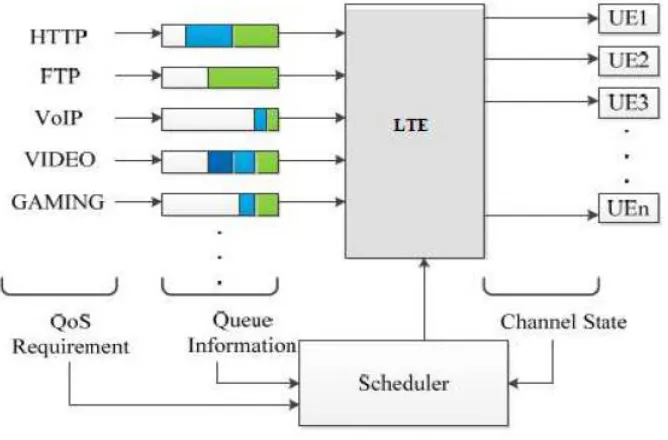
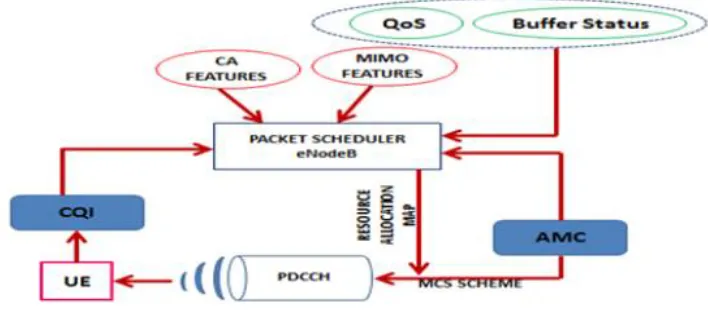
The architecture of a downlink data scheduler with multiple shared channels for multiple UEs is shown in Fig. 2. An eNodeB serves M UEs in a cell at a given time. Every TTI, the UE computes the Channel Quality Indicator (CQI) in compliance with the SINR and enquire the eNodeB of the state channel.
Fig. 2: Packet Scheduling Model.
Scheduling algorithm. In order to get a suitable scheduling algorithm, we have to weigh and balance channel state, QoS requirement, and queue status. The users are prioritized by packet scheduler on the basis of a scheduling algorithm being used. These algorithms while
making scheduling decisions, take into account the instantaneous or average channel conditions, Head of Line (HOL) packet delays, status of receiving buffer or type of service
being used.
IV. PROPOSED SYSTEM APPROACH
This paper gives a new scheduling algorithm for downlink direction in LTE system. The simulation results were implemented using the open source LTE system simulator called long term evolution-SIM (LTE-SIM). The whole process can be divided into a sequence of the scheduler which calculates a metric for each stream that can be allocated. We assume that the metric attributed to stream i on j-th sub-channel is noted by wi,j. In particular, at each TTI, the estimate Riis given by:
Where ri(k) is the rate allocated to i-th flow during the k-th TTI and Ri(k − 1) is the average transmission data rate estimating at the (k-1)-th TTI.
A. Proportional Fair (PF) Scheduler
The PF scheduling algorithm provides a good trade off between system throughput and fairness by selecting the user. PF is a very suitable scheduling option for non-real time traffic.
B. Modified Largest Weighted Delay First (M-LWDF) Scheduler
M-LWDF is an algorithm selected to support mixed real time data users in CDMA-HDR systems
C. VT-M-LWDF Scheduler
The main goal of the virtual token scheme (VT-M-LWDF) given in is to ameliorate the QoS performance metrics for real time communication, like video and VoIP, and to conserve minimum throughput for non real times communication. Then, we use the M-LWDF scheduler with DHOL,ibeing changed by Qi. The following equation give the metric used to represent the VT-M-LWDF scheduler:
D. Queue-HOL-MLWDF Scheduler
E. Proposed Scheduler
Figure 3.Basic model of a packet scheduler3.
Considering the characteristics of real-time traffic, especially in regard to the delay requirements, a scheduling process should consider various factors. First, we must assure that packets are received within a time limit, preventing them from being discarded by the expiration of this deadline. Thus, the scheduler assigns a deadline for each ow that has a packet queued at the eNodeB. The deadlines are computed taking into account the following parameters: the maximum delay for the class of ow τi, the waiting time of the ow in the queue DHOL,i and the queue size Qi. The proposed scheduler adopts the consideration of theirparameters in order to evaluate the performance of the proposed scheduler when serving RT traffic compared to the others schedulers.
Proposed System Advantages
1. The presented review will help the researchers and academicians to develop more efficient scheduling schemes for real time applications for smart phone users with better quality of experience and efficient radio resource management.
V. CONCLUSION
In this paper a new scheduling algorithm has been implemented along with some well-known algorithms to evaluate the performance of multimedia services. We defined two performance metrics such as throughput and PLR. Moreover, the proposed scheduler aimed, in particular, at improving the performance metrics for video services and maintaining, in general, a satisfactory level of the performance metrics for the other services in the network simultaneously.
REFERENCES
1. FarhanaAfroz, RoshanakHeidery, Maruf Shehab, Kumbesan Sandrasegaran4 and Sharmin Sultana Shompa, COMPARATIVE ANALYSIS OF DOWNLINK PACKET SCHEDULING ALGORITHMS IN 3GPP LTE NETWORKS, International Journal of Wireless & Mobile Networks (IJWMN) Vol. 7, No. 5, October 2015
2. AvinashKaur, Bandwidth Allocation Scheduling Algorithms for IEEE 802.16 WiMax Protocol to Improve QoS: A Survey, International Journal of Computer Applications (0975 – 8887) Volume 98– No.11, July 2014
3. AmmarHafeez, Mohammad MasoomZafar, Sir Ahmad Mudassir, A Survey on Analysis and Design of Scheduling Algorithm for LTE-Advanced Heterogeneous Networks, COMSATS Institute of Information Technology, LHR Pakistan.
4. Davinder Singh, Preeti Singh, Radio Resource Scheduling in 3GPP LTE: A Review, International Journal of Engineering Trends and Technology (IJETT) – Volume 4 Issue 6- June 2013
5. Hang Nguyen, WE-MQS: A new LTE Downlink Scheduling Scheme for Voice Services based on User Perception, International Journal of Computer Applications (0975 – 8887) Volume 142 – No.10, May 2016