DEVELOPMENT OF METHODS TO REDUCE COSTS FOR MAJOR
CONTAINMENT STRUCTURES IN FUTURE NUCLEAR PLANTS
\
J. Michael O'Connell, l) Dr. Martin Fischer, 2) Dr. Abhinav Gupta 3)
1) Duke Engineering and Services, Marlborough, MA
2) Stanford University Department of Civil and Environmental Engineering, Palo Alto, CA 3) North Carolina State University Department of Civil Engineering, Raleigh, NC
ABSTRACT
This paper will describe some goals and challenges for reducing the cost of the next generation of nuclear power plants, designated as Generation IV by the US Department of Energy (DOE) from a Civil Engineering and constructability perspective. There have been a number of developments in advancing light water reactor technology in terms of improved safety and licensability. However, there remains the goal of achieving a reliable construction time such that the overnight capital cost for a power plant is less than $1,000 per kW and an assurance that the risk premium associated with making the capital investment is significantly reduced from today's perceptions.
As technology allows even greater simplification of electro/mechanical systems and components, the burden will be more than ever on the civil engineering perspective in generating new techniques for erection and installation of bulk materials. Our preliminary studies have indicated that overall project cost and schedule are very sensitive to civil engineering issues, and this influence will increase further as active components are replaced by a combination of passive systems and civil design features. This paper will outline some avenues of research to address meeting the cost targets and to solicit the Civil Engineering community's response to the challenges.
I N T R O D U C T I O N
"The morphology of a structure is intimately linked to both the material and the construction method, and the design cannot be separated from them. Joint consideration of all these factors at the very beginning of the project, and during development of the preliminary sketches, will determine the success of the structure, justify its design and even the designer. For, ingenuity in solving all problems encountered has been, and will always be, the essential quality of the true engineer." (Toroja Miret, 1958). The statement remains as a truism of our design endeavors. We cannot isolate a single structure and propose changes without a full consideration of its constitutive elements and the process that created it. During the course of one of the NERI projects authorized in 1999, Development of Advanced Technologies to Reduce Design, Fabrication and Construction for Future Nuclear Power Plants (DPCIT), (O'Connell et al. 1998), members of that project team noted that a key contribution to the capital cost of a nuclear plant comes from the material, labor, and construction time associated with large concrete internal structures as well as the containment.
GOALS AND C H A L L E N G E S F O R G E N E R A T I O N IV R E A C T O R C O N S T R U C T I O N
The Generation IV requirements emerging from US and International efforts to define the next generation of reactor technology performance requirements has illustrated a set of requirements. Generation IV reactor technology will reflect the experiences from operational, risk, and financial perspectives. Several statements of performance requirements relevant to the civil engineering domain are:
Generation IV nuclear energy systems will have a clear life cycle cost advantage over other energy systems. Generation IV nuclear energy systems will have a level of financial risk comparable to other energy projects (US DOE, 2001).
: i
SMiRT 16, Washington DC, August 2001 Paper # 1507
Effectively, these requirements translate into the following goals:
• Total capital cost less than $1000 US per kilowatt installed
• Time to build less than 36 months from first concrete to new fuel load
Additionally, findings from the ongoing NERI DPCIT research project illuminate the following challenges"
• In hole construction time is a significant critical path issue • Confidence in meeting planned schedule is vital
• Avoiding congestion effects of too many people and too much materiel is essential for productive use of resources • Elimination of excess margin is desirable from cost/schedule perspective
Life-cycle costs are heavily influenced by the costs of construction while assessments of financial risk reflect the confidence in building new plants within promised time frames and budgets. Each of these items reflects a new demand upon the civil engineering discipline to produce techniques capable of building complex facilities with greater confidence. In summary, there are a number of elements vital to the construction of new nuclear power plants that are embedded in the structures that comprise nuclear power facilities. Thus, changes to the design, construction, and management methods will be crucial to inventing new mechanisms to meet the goals and master the challenges mentioned above.
P R O V O K I N G NEW T H I N K I N G
While the NERI DPCIT project team has been engaged in examining methods to reduce capital costs and shorten construction times, it became apparent that, without a detailed reconsideration of the entire design, substantive changes in schedule and cost reduction could not be achieved. We also noted a number of improvement strategies being applied in analogous industries such as aerospace and assembly plants. Thus, we were encouraged that significant change within the nuclear power industry to achieve productivity changes matching the manufacturing industry could be possible. However, simply observing that improvements are possible is insufficient to provoke actual change.
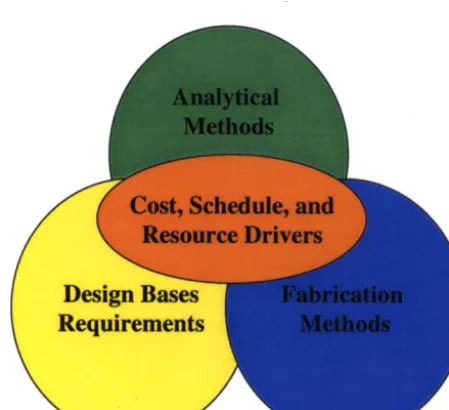
Figure 1 illustrates our argument that the intersection of analytical methods, design bases requirements, and fabrication methods all interrelate to the issue of total cost, construction schedule and we believe to be equal in significance, the rate at which resources are utilized such as manpower, raw materials and semi-finished materials. Our claim is that resolving or simplifying a single domain will not have a significant impact on cost, schedule and resource utilization. Our prior work on the reduction of cost and schedule mentioned above has illustrated the limitations in attempting to take advantage of potential safety system reductions due to the expected impact of risk informed regulations. We observed that when bound with an already designed facility and its interrelated design bases and fabrication methodologies, the ability to shrink cost and schedule was very limited.
Design Bases
Requirements
Therefore our exercise to invent new practices and to suggest the invention of new practices will be based on a combination of elements:
• Identifying Sources of Change
• Reevaluating Existing Design Practices • Capturing Construction Process Knowledge
• Examining Construction and Visualization Research
The sYnthesis of these elements will produce a set of goals for research aimed at reducing cost and complexity of Generation IV reactor plant structures. From this set of goals we will suggest some research initiatives for consideration.
I D E N T I F Y I N G SOURCES OF C H A N G E
Some of the primary reasons for the high costs are (1) excessive conservatism in the estimation of design loads, and (2) excessive conservatism in the deterministic design methods which are based on postulated failure modes and not on performance-based (Risk-Informed) failure modes. The impact of this conservatism and reliance upon older analysis models precludes the use of innovative techniques for plant construction, thus further escalating the costs for nuclear plants.
As an example, NUREG/CR 6661 provides benchmark problems and recommends the use of coupled building- piping system analysis. It is now widely accepted that a coupled analysis gives seismic responses for equipment and piping that are not only more rational but can also be an order of magnitude less than those evaluated from the conventional uncoupled analysis. Reduction in seismic loads transferred from the main steam nozzle and the steam generator snubbers together with the reduction in pressure requirements as shown by the Risk-Informed work can be used to address the first of the two items mentioned above. Reduced loads will lead to not only a reduction in the quantity of reinforcement but may also help in using alternative structural systems such as composites or even steel structures.
Similarly, significant advancements have taken place in both the concrete and the steel design codes. Unlike the current design standards for these structures in the nuclear industry, the ACI and AISC codes are now based on limit state design principles to incorporate the concepts of performance-based design and risk-informed evaluation. The new structural systems for the internals have the potential to introduce off-site construction and fabrication leading to a significant reduction in construction time as well as to significantly reduce the material and labor costs. For containment, reduction in the quantity of reinforcement will significantly improve constructability and reduce construction time. Additionally, Stanford University's Center for Integrated Facilities Engineering has pioneered multiple stakeholder resolution of complex design decisions using engineering analysis complemented with information technology. The impact of information technology has not only sped up tedious calculations, but more importantly, introduced new collaborative methods that can support design optimization.
R E E V A L U T A T I N G E X I S T I N G DESIGN P R A C T I C E S
Large-scale structural systems in nuclear power plants consist of heterogeneous subsystems such as buildings, equipment, and piping that differ significantly in their physical, inertial, and material characteristics. As the complexity increases, a creative designer needs to supplement intuition with computational tools and experimental data in order to verify the validity of new concepts and to generate alternatives that are good and yet different. Historically, availability of limited computational resources affected the evolution of existing design and qualification practice wherein the subsystem interactions such as those between the soil, building, equipment, and piping are ignored. Instead, conservative assumptions are made with intent to ensure safety, with consequences that include the inability to predict failures as well as high life-cycle costs. For example, the earthquake behavior of the building, equipment, and piping is greatly influenced by the interaction among them. An individual subsystem model (the current practice) gives stresses and support loads that are not,, only arbitrary but also several orders of magnitude higher than the true values (Gupta and Gupta, 1994, 1995a, 1995b). Experience data supports this observation and shows that a majority of structural failures, in spite of excessive conservatism in the design, can be attributed to the inability of individual subsystem models in predicting multiple failure mechanisms. Recently, the US Nuclear Regulatory Commission reviewed the methods to perform such coupled building-equipment-piping system analysis and developed benchmark problems for their verification and validation (USNRC, 2000).
conservative estimates for the main steam nozzle loads on the steam generators as well as the loads on steam generator snubbers during seismic motion. These large loads then result in excessive design moments for the internal concrete structures supporting the steam generators. A coupled building-equipment-piping system analysis can be used to evaluate realistic design loads for these structural systems. Similarly, risk-informed assessment and regulation may be used to explore the effect of reduction in internal design pressure requirements due to the impact of risk informed technologies upon design basis events.
Reduction of loads can be used to not only improve the constructability of existing internal structure designs but also to explore alternative designs such as composites or steel structures. The internal concrete structures in the AP600 plant are designed as steel-concrete composites in which steel plates are used as the skin and the concrete is filled in between them. Such a steel-concrete composite structure improves constructability but its design in the AP600 plant is based on the existing methods of evaluating excessively conservative loads. Consequently, the benefits of using composites in the design of internal structures are not fully exploited because its in-situ construction cannot yet be avoided thereby resulting in significantly large construction time. It is anticipated that reduced design loads will further simplify the construction of these composite structures as well as reduce construction time. It may also be possible to explore the benefits of constructing pre- fabricated units and transporting them to the construction situ for in-situ assembly. For structural systems that do not serve as gamma ray shields, it may even be possible to use pre-fabricated steel structures.
Prior work has been based on the assumption that during pressure tests on the containment, orthogonal cracks are introduced. The concern that these cracks may not be able to transmit sufficient horizontal shear has resulted in an amplification factor of 1.5 and a low limit of the allowable shear stress. It is now known, based on the available test data that structures with orthogonal cracks are able to transmit sufficient shear to initiate inclined cracks. For 5000 psi concrete, the ACI Building Code gives an allowable shear stress of 1000 psi, which is much greater than the ACI-ASME (1977) value of 160 psi or the USNRC allowable value of 60 psi. If a higher allowable shear stress value were adopted, the need for diagonal reinforcement would be eliminated in almost all containment designs. This would lead to a significant reduction in not only the material and labor costs but also the construction time.
ASCE (1999) emphasizes accurate modeling of the shear wall structures including the shear-lag effect (Gupta, 1983). The ASCE working group recommended that the shear wall stiffness calculated using ACI 318 (1983) modulus be modified by +/- 25% to account for the variability. A unified approach for predicting the inelastic behavior of shear walls leading to failure was developed by Gupta and Maestrini (1989). Akbar and Gupta (1986) modeled the inelastic behavior in reinforced concrete containment and showed that with only orthogonal (and without the diagonal) bars it can withstand loads higher than those corresponding to design earthquake and internal pressure. Klamerous et al. (1996) gave similar conclusion for both steel and concrete containment. Tests on a 1/10 model of prestressed concrete and on a 1/8 model of reinforced concrete containment (Sasaki et al. 1998) and their computer simulations (James et al. 1998) have shown that the models withstood earthquake loads higher than the design levels by factors of 2.5 and greater.
For internal concrete structures, the use of composite construction with steel skin plates has been explored in the recent past for reducing the construction time. Some laboratory prototypes have also been built and tested for CANDU reactors (Abdelrahman and Rizkalla 1996). However, a significant benefit could not be achieved due to excessively large design loads resulting from the current practice of seismic analysis. Presently used methods analyze the buildings, piping and equipment separately and ignore the interaction between them. Consequently, they give excessively conservative responses (Stevenson et al. 1994, USNRC 1984). In addition, they cannot account for nonclassical damping effect that can be significant. New methods have been developed for coupled systems with nonclassical damping (Gupta 1992; Gupta and Gupta 1995a). These methods give more accurate and significantly lower responses (Gupta and Gupta 1995b). Recently, Brookhaven National Laboratory under contract to US Nuclear Regulatory Commission reviewed these new methods for the seismic analysis of building-equipment-piping systems and developed benchmark problems for their verification and validation (Xu, 2000).
C A P T U R I N G C O N S T R U C T I O N P R O C E S S K N O W L E D G E
The Construction Industry Institute defines constructability as "the optimum use of construction knowledge and experience in planning, design, procurement, and field operations to achieve overall project objectives" (CII 1986). Improving the constructability of a project is widely seen as a key approach to reduce the duration and cost of construction. Several authors provide general concepts and guidelines to improve constructability (e.g., Tatum et al, 1985 and 1986; O'Connor 1987). Furthermore, many firms have lessons learned files that often contain constructability knowledge from projects. However, few specific engineering guidelines and methods exist that formalize design and construction knowledge in a way that makes it immediately useful for engineers when they design a structure and the corresponding construction process.
Studies attempting to provide such engineering guidelines have focused on formwork for reinforced concrete structures (Hanna and Sanvido 1990; Fischer and Tatum 1997; Hanna 1998) and on mechanical, electrical and piping systems
for buildings (Korman and Tatum, 1999). All these studies relate design features (e.g., reinforcement content, sizes of structural components) to constructability issues related with particular construction methods. Hence, they provide construction knowledge that is useful for designers when they lay out and dimension a structure. However, they do not provide knowledge and methods to consider cost, schedule, and resource (or production) considerations explicitly.
To consider production goals more explicitely during the design of a structure the constructability analysis needs to be based on a richer model than a feature-based 3D model. A 4D model that combines the three spatial dimensions with the temporal project dimension is a promising starting point for a constructability analysis that considers production considerations explicitly because it models the time dimension, which is an essential dimension of production, explicitly. Aalami et al (1998) formalize the knowledge required to generate 4D production models. Akinci and Fischer (2000) show how such a 4D production model supports the computer-based analysis of a design and corresponding schedule.
EXAMINING CONSTRUCTION AND VISUALIZATION R E S E A R C H
On many construction projects, progress and efficiency are hampered by poor communication of discipline-specific models. For example, designers use 2D or 3D CAD models and constructors use CPM diagrams, Gantt charts, and spreadsheets to show their view of the project. Advanced computer visualization (EPRI 2000 and Liston et al. 2000) can be used to integrate, relate, or overlay these disparate models to understand cross-disciplinary impacts of design, construction, and facility management decisions. Today, project teams must rely solely on the project participants' ability to interpret these rather abstract, discipline-specific models to form a mental picture of a proposed design and its corresponding construction approach. Even good designs and construction plans often get misinterpreted by some of the participants, which can lead to inefficient processes accomplishing the wrong thing. CIFE researchers have extended 4D CAD (3D plus time) technology that allows designers and builders to represent their view of the project in one common and sharable model. 4D CAD communicates the design and construction process visually, making the communication of design and construction decisions more comprehensive and faster. Ongoing work to improve the creation, manipulation, and use of 4D models includes research on user interfaces (Schwegler et al, 2000), development of models to support computer-based generation and analyses of 4D models (Fischer and Aalami 1996, Akinci and Fischer, 2000) and visual explanations of a proposed design and construction schedule (Liston et al, 1998, Liston et al, 2000). Schwegler et al (2001) report that 4D models could have saved at least 40% of unplanned change orders on large capital facility projects. Hence, 4D models have the potential to reduce the scope, cost, and schedule risks quite dramatically.
Where formal analysis and optimization methods fail, visualization of a project design and schedule as 3D and 4D models on the desktop and in CAVEs (Computer-Assisted Virtual Environment) and other advanced visualization environments can be an effective way to improve the design, cost and schedule of a proposed structure. For example, Walt Disney Imagineering successfully incorporated the input of 400 project stakeholders from very diverse disciplines (architects; structural, mechanical, electrical engineers; landscape and show designers; business developers; construction managers; corporate managers; etc.) into the design of the Paradise Pier portion of Disney's California Adventure theme park in Anaheim, CA, over a two month period (Schwegler et al, 2000). All stakeholders provided this input on the basis of graphic or visual 3D and 4D models they reviewed in small groups in a CAVE.
GOALS F O R G E N E R A T I O N IV R E A C T O R PLANTS
The overall goal for new research will be to either simplify the existing designs or develop alternative designs for the internal concrete structures and the concrete containment with emphasis on reducing the capital cost by lowering the costs associated with material, labor, and construction time. Future research efforts should be based on six major concepts.
• First, recent developments in the simulation and analysis methods should be used for evaluating realistic design loads, which are also significantly lower than those used in the past. Methods such as coupled b~ilding-piping system analysis will be employed for evaluating the seismic requirements, which can otherwise be excessively conservative. The impact of risk-informed assessment and regulation on the design basis events should be used to explore the benefits of reduction in the internal pressure requirements.
• Second, extensive studies conducted over the past decade or so on the performance of concrete and steel structures should be used to update the existing design criteria and to develop performance-based design criteria leading to simple structural systems that are suitable for efficient and economical construction.
• Third, simulation based formal decision making tools should be used to simplify the existing designs as well as develop new designs that employ composite steel-concrete construction or even steel frames.
• Fourth, the application of Risk-Informed technologies has the prospect to substantially reduce the energy inputs into containment and sub-compartment design. Therefore, the feasibility of new designs should be evaluated based on a suite of evaluation criteria that include constructability, cost, schedule, regulatory constraints, risk, etc.
Fifth, bring the analytical environment closer to the 3D design environment and the construction environment by implementing "design to analysis" principles.
Finally, use information technology in a broad fashion to not only automate and speed analysis tasks, but most importantly to create simulation models and environments that support integrated design reviews with designers, constructors and analysts.
PROPOSED RESEARCH INITIATIVES
Fundamental to the existing design is a background of engineering analysis based upon codes, standards, and methods that while valid today, have significant consequences to advanced nuclear plants because of excessive conservatism as well the lack of updates to reflect advances in the state of the art for non-nuclear construction. Therefore, we suggest pursuing an evaluation of the containment and containment internal structures for an advanced containment design with the intention to produce new and more effective techniques for building these structures that meet our concerns for cost, constructability, resource loading, pre-fabrication usage, safety and risk. Specific research objectives could be focused on the following:
Reduce excess conservative effects on capital cost of the containment structure and its internal support structures for major components.
II. Decrease loads through updates to the state of the art for concrete/steel structures.
Ill. Analyze and evaluate new construction methods made possible by consideration of objectives I and II.
IV. Evaluate potential benefits to costs and construction methods from impact of Risk- Informed technologies upon design basis events.
V. Develop prototype designs that incorporate concepts and insights generated through completion of objectives I through V for testing in a follow on research program.
Supporting these research initiatives would be complementary research in "design to analysis" principles, and development of methods to hand data cleanly from a design program to analytical programs and thence to the constructor. An information technology environment model would also support development of new practices to utilize the power of collaborative engineering tools.
REFERENCES
Abdelrahman, A., and Rizkalla, S., (1996), "Composite structures for CANDU reactors, experimental program and test results," Technical Report, Civil and Geological Engineering Department, University of Manitoba, Winnipeg, Manitoba, Canada, July, 1996.
ACI (1983), "Building code requirements for reinforced concrete," AC1318-83, American Concrete Institute, 1983.
ACI-ASME (1977), "Code for concrete reactor vessels and containment," A CI-ASME Committee 359, ASME Boiler and Pressure Vessel Code, Section III, Division 2, ASCE, New York, NY/American Concrete Institute, Detroit, MI, July, 1977.
Akbar, H. and Gupta, A. K., (1986), "Ultimate Behavior of an R.C. Nuclear Containment Subjected to Internal pressure and Earthquake," Journal of Structural Engineering, ASCE, Vol. 8, No. 6, pp. 1280-1295.
Akinci, Burcu; and Fischer, Martin (2000). "4D WorkPlanner - A prototype system for automated generation of construction spaces and analysis of time-space conflicts." Eighth International Conference on Computing in Civil and Building
Engineering (ICCCBE-VIII), Renate Fruchter, Feniosky, Pena-Mora and W.M. Kim Roddis (Eds.), ASCE, Rest, n, VA, pp. 740-747.
Construction Industry Institute (CII) 1986. "Constructibility: A Primer." Publication 3-1. Construction Industry Institute, Bureau of Engineering Research, The University of Texas at Austin.
EPRI, Virtual Reality Construction: 4D Visualization, EPRI, Palo Alto, CA, and Westinghouse Electric Company, Nuclear Systems, Windsor, CT, 2000
Fischer, Martin A., and Aalami, Florian (1996). "Scheduling with Computer-Interpretable Construction Method Models." Journal of Construction Engineering and Management, ASCE, 122(4), 337-347.
Fischer, Martin A. (1993). "Automating Constructibility Reasoning with a Geometrical and Topological Project Model." Computing Systems in Engineering, 4(2-3), 179-192.
Fischer, Martin and Tatum, C.B. (1997). "Characteristics of Design-Relevant
Constructability Knowledge." Journal of Construction Engineering and Management, ASCE, 123(3), 253-260.
Fischer, Martin (2000). "Benefits of 4D Models for Facility Owners and AEC Service Providers." 6th Construction
Congress, ASCE, Kenneth D. Walsh (Ed.), Orlando, FL, Feb. 20-22, 2000, 990-995.
Fischer, Martin; Liston, Kathleen; and Schwegler, Benedict R. (2001). "Interactive 4D Project Management System."
Proceedings of The 2nd Civil Engineering Conference in the Asian Region, Tokyo, April 16-18, 2001.
Gupta, A. K., (1983), "Seismic Modeling of Nuclear Power Plant Buildings and Shear Lag Problems," Proceedings, Seventh
International Conference on Structural Mechanics in Reactor Technology, Paper K2/5, Chicago, IL.
Gupta, A. K., 1992, "Response Spectrum Method in Seismic Analysis and Design of Structures," CRC Press, Inc.
Gupta, A. K., and Maestrini, S. R., (1989), "Unified Approach to Modeling Post-Cracking Membrane Behavior of Reinforced
Concrete," Journal of Structural Engineering, ASCE, Vol. 115, No. 4, pp. 977-993.
Gupta, A., and Gupta, A.K., (1994), "Reduction in seismic response of piping systems due to coupling," Proceedings of5th
Symposium on Current Issues Related to Nuclear Power Plant Structures, Equipment and Piping, Lake Buena Vista, Florida, December 14-16, 1994.
Gupta, A., and Gupta, A.K., (1995a), "New developments in coupled seismic analysis of equipment and piping," Proceedings
of 13th International Conference on Structural Mechanics in Reactor Technology, Vol. III, Porto Alegre, Brazil, August 13- 18, 1995.
Gupta, A., and Gupta, A.K., (1995b), "Application of new developments in coupled seismic analysis of piping systems,"
Proceedings of 13th International Conference on Structural Mechanics in Reactor Technology, Vol. III, Porto Alegre, Brazil, August 13-18, 1995.
Hanna, Awad S. and Sanvido, Victor E. (1990). "Interactive Vertical Formwork Selection System." Concrete International, 12(4), pp. 26-32.
Hanna, Awad S. (1998). Concrete Formwork Systems. Marcel Dekker, Inc.
James, R. J., Zhang, L., Rashid, Y. R., Cherry, J., Chokshi, N., and Tsurumaki, S., (1998), "Post Test Analysis of a PCCV
Model Dynamically Tested Under Simulated Design-Basis Earthquakes," Proceedings of the 7 th International Symposium on
Current Issues Related to Nuclear Power Plant Structures, Equipment and Piping, Raleigh, NC.
Korman, Thomas and Tatum, Bob C. (1999). "MEP Coordination in Building and
Industrial Projects." Working Paper Nr. 54, Center for Integrated Facility Engineering, Department of Civil and Environmental Engineering, Stanford University, Stanford, CA.
Liston, Kathleen; Fischer, Martin; and Kunz, John (2000). "Designing and evaluating visualization techniques for
Liston, Kathleen McKinney; Fischer, Martin; and Kunz, John (1998). 4D Annotator: A Visual Decision Support Tool for Construction Planners." Computing in Civil Engineering, Proceedings of International Computing Congress, Boston, October
18-21, Kelvin C.P. Wang (Ed.), ASCE, 330-341.
O'Connell, J. Michael; Turk, Richard; and Matteson, Donn (2000), "Report on NERI Research Project to Reduce Capital Costs and Plant Construction Time for Future Nuclear Power Plants.", 8 th International Conference on Nuclear Engineering, Baltimore, April 2-6, ASME 8273
O'Connor, James T., Rusch, Stephen E., and Schulz, Martin J. (1987). "Constructibility Concepts for Engineering and Procurement." ASCE Journal of Construction Engineering and Management, 113(2), pp. 235-248.
Sasaki, S., Tsurumaki, S., Hattori, K., Akiyama, H., Takiguchi, K., Satoh, K., Eto, H., Goto, M., and Kobayashi, T., (1998), "Seismic Proving Test of Concrete Containment Vessels," Proceedings of the 7th International Symposium on Current Issues Related to Nuclear Power Plant Structures, Equipment and Piping, Raleigh, NC.
Schwegler, Ben; Fischer, Martin; and Liston Kathleen. (2000). "New Information Technology Tools Enable Productivity Improvements." North American Steel Construction Conference, AISC, Las Vegas, Feb. 23-26, pp. 11-1 to 11-20.
Schwegler, Benedict R.; Fischer, Martin A.; O'Connell, Michael J.; H~inninen, Reijo, and Laitinen, Jarmo (2001). Near- Medium- and Long Term Benefits of Information Technology in Construction. International Construction Conference, Hong Kong, June 20-21.
Stevenson, J. D., Adam, T. M. and Zhao, Y., (1994), "Rigid Versus Flexible Support Design: The Hidden Cost of Dynamic Response Spectrum Piping Analysis," Proceedings of the Pressure Vessels and Piping Conference, ASME-PVP,
Minneapolis, MN.
Tatum, C.B., Vanegas, J.A., and Williams, J.M. (1985). "Constructibility Improvement During Conceptual Planning." Technical Report Nr. 290, Construction Institute, Department of Civil Engineering, Stanford University.
Tatum, C.B., Vanegas, J.A., and Williams, J.M. (1986). "Constructibility Improvement Using Prefabrication, Preassembly, and Modularization." Technical Report Nr. 297, Construction Institute, Department of Civil Engineering, Stanford University.
Toroja Miret, Eduardo (1958). Philosophy of Structures.
USDOE (2001). Technology Goals for Generation IV Future Nuclear Energy Systems, February 13,2001 Draft
USNRC (2000), "Benchmark program for the evaluation of methods to analyze nonclassically damped coupled systems," NUREG report - NUREG/ CR-6661, US Nuclear Regulatory Commission.