Design and Implementation of Congestion
Aware Software Defined Networks with
Security Considerations
C.Sushma, K.Venkatesh
P.G. Student, Dept. of Computer Engineering, SRM University, Kattankulatur, Chennai, Tamilnadu, India
Assistant Professor (Sr. G), Dept. of Computer Engineering, SRM University, Kattankulatur, Chennai, Tamilnadu, India
ABSTRACT: Now-a-days a huge increase of mobile traffic needs and increasing cloud data centers demands, the network managers requires some new approaches to handle the situations. The Software Defined Networks (SDN) has raised as a promising solution providing more effective, programmable and granular configurations in order to isolate all the dynamic traffic requirements and spiky changes in the physical topological status of the networks from the network management. In this paper, we propose a novel SDN Controller which classifies the network traffic types according to the heterogeneous Quality of Service requirements that the network data is separated into the Constant Bit Rate (CBR) based real-time traffic and File Transfer Protocol (FTP) based non-real time traffic. Some pivotal activity stream parameters, for example, parcel conveyance proportion; steering overhead and postponement are additionally considered in this characterization. A novel convention header is additionally created by the proposed SDN controller keeping in mind the end goal to spread the fundamental data through the L2/L3 switches in the Data Plane. This header is made out of the Parameter, Rule, Controller Action subfields. The proposed SDN controller chooses the best system organization technique, i.e. turning into an impromptu or being concentrated, utilizing the activity sorts, system parameters furthermore, the header data. An itemized execution assessment is given which shows the effectiveness of the proposed SDN controller while choosing important arrangement considering the heterogeneous movement sorts and in addition the expanded number of clients in the topology. Apart from the present system, we additionally include the security enhancements by means of crypto methodologies such as RSA and SHA, with this we can achieve high security and data rates without any attack possibilities over Software Defined Network.
KEYWORDS: SDN, Congestion Aware Routing, Malicious Node, Crypto System.
I. INTRODUCTION
With the expanded information activity requests, the proficient and reasonable administration of the present system designs has turned into a period devouring and costly test. Particularly, the dynamic changes in the portable activity thickness and in addition the eccentric developments of the end-clients make the physical topology administration and the possible upkeep of current systems a more mind boggling and troublesome assignment to handle with asset serious endeavors. Next to the dynamic movement prerequisites and high portability, the developing requests of vast scale server farms which are bound to the prominent Cloud-based applications have lead the system overseers to look for new system administration approaches.
To this end, the Software Defined Networks [SDN] has raised as an answer giving more viable and granular setups keeping in mind the end goal to disengage all the dynamic movement necessities and spiky changes in the physical topological status of the systems from the activity control and system administration. SDN has risen as a promising structural answer for handle the asset administration and support challenges in future system arrangements. SDN decouples the Data Plane which comprises of L2/L3 sending gadgets (switches, switches) physically conveying all
information bundles, from the Control Plane which are fundamentally the sending and directing data for all the streams. Utilizing SDN, the dynamic movement requests can be controlled in a unified and programming based way. The SDN-mindful L2/L3 sending gadgets in the Data Plane and User-Defined programmable Controller in the Control Plane convey through the OpenFlow convention to effortlessly work and oversee, and to be better ready to react to the changing requests of uses to the system conditions.
II. CONTRIBUTIONS
Considering these motivations, in this paper we propose the following contributions:
• The SDN Controller is proposed which classifies the network traffic types according to the Quality of Service requirements that the network data is separated into the Constant Bit Rate (CBR) based traffic with realtime traffic and File Transfer Protocol (FTP) based nonreal time traffic. Some crucial traffic parameters such as packet drop rate, routing overhead, delay and packet delivery ratio are also considered in this classification.
• The proposed SDN Controller disseminates the necessary information to the L2/L3 switches in the Data Plane using a novel SDN header format. This header is composed of the Parameter, Rule, Controller Action subfields.
• The proposed SDN controller decides the most effective network deployment strategy, i.e. becoming an adhoc or being centralized, using the traffic types, network performance parameters and the header information.
Network Architecture:
In order to do a performance evaluation in different scale SDN-based topologies, we constructed a model of mobile devices which are communicating each other with homogenous and heterogeneous traffic flows in a certain area.
One SDN-controlled topology is structured with wireless mobile devices communicating with each other without any constituted network infrastructure i.e. without a Base Station. On the contrary, in the other considered topology, wireless mobile devices are communicating each other through a base station. In both topology types we consider, i.e centralized and adhoc, the roaming of devices are disabled and the positions are kept static to obtain statistical data with utmost accuracy. Both the ad-hoc and centralized topology performance evaluation results give us a reference point about how to control the flow of data throughout a network that have different node densities and different background traffic. Our network model is also based on an increasing density of mobile devices with different traffic types. Here, we examined the SDN deployment for 4, 8 and 16 mobile devices which are representing low, medium and high density deployments of devices.
The communication between wireless devices are established as pairs and the performance evaluation parameters are calculated for different traffic types such as homogenous CBR (Constant Bit Rate) over UDP (User Datagram Protocol) traffic stream, homogenous FTP (File Transfer Protocol) over TCP (Transmission Control Protocol) traffic stream, and heterogeneous traffic flow including both CBR over UDP and FTP over TCP with different percentages of mixing. The communicating pairs kept as same for each of the cases, thus the positions and the distances cannot affect the results; only the density and the background traffic flows affect the results. Both in heterogeneous and homogenous simulations, the SDN controlled traffic flow is sustained from the beginning to the end of the simulation without ceasing any traffic type flow, so that any other traffic type has no priority over another in a certain amount of time. As routing protocol, DSDV (Destination- Sequenced Distance Vector) is used in both centralized and adhoc simulations, since DSDV performs sufficiently well with both infrastructure mode and ad-hoc mode.
Proposed Framework:
behavior information before the pairs directly communicate.
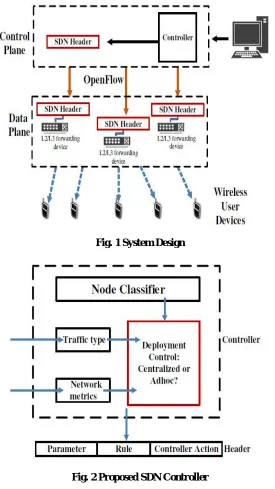
As seen in Fig. 1, the proposed SDN framework is composed of two different planes. The Control Plane has a Controller in which we decide appropriate deployment strategies according to the heterogeneous traffic and QoS network criteria. The Controller disseminates the decisions using a special header as seen in Fig. 1.
Fig. 1 System Design
Fig. 2 Proposed SDN Controller
III. TOPOLOGICAL SCENARIO
bundle size is 1000 bytes, however while discharging the parcel from its sender, the reproduction puts extra 40 bytes into the parcel header, so the last size of one FTP bundle is 1040 bytes. In every reproduction, we needed to keep the extent of all information parcels comparative for a reasonable examination; consequently we characterized the span of the CBR bundles as 1000 bytes. Information send interims are additionally kept with their default values.
The bundle send interims are not changed on the grounds that CBR parcels can arrive their destinations in a brief span if no crash or circle happens, while FTP bundles possess their source and destination hubs with extra affirmation parcels because of the handshaking instrument of TCP; so the normal lifetime of FTP parcels are longer than CBR bundles.
When the traffic flow is homogenous, performance of ad-hoc deployments on average delay is not good as it is for centralized topologies but the difference on average delay performance gets larger on heterogeneous traffic streams and the ad-hoc topologies fall behind the centralized topologies in this respect. Routing overload is another performance criterion which is analyzed for the topology decision of the control plane of our proposed model. Graphics which are showing the routing overload results, routing load of centralized topologies are higher than the adhoc topologies since the packets of authentication, association and scanning processes in centralized structures occupying the whole simulation for a significant amount of time. When we consider the general characteristics of the graphics about average delay and routing overhead, centralized SDN structures have higher performance on the average delay parameter; and ad-hoc SDN structures have higher performance on routing load. At this point, our controller will consider the performance evaluation metrics and their priorities; it will evaluate the inputs and at the end, it will choose the most appropriate structure for communication.
Pseudo Code: Distance Estimation:
global c n bnd src dst j0 j1 set nbr [open FSRNeighbor.out a] set x1 [expr int([$n1 set X_])] set y1 [expr int([$n1 set Y_])] set x2 [expr int([$n2 set X_])] set y2 [expr int([$n2 set Y_])] set d
[expr int(sqrt(pow(($x2-$x1),2)+pow(($y2-$y1),2)))] if {$d<300} {
if {$nd2!=$nd1} {
puts $nbr "$nd1\t\t$nd2\t$x1\t\t$y1\t\t$x2\t$y2\t\t$d" }
}
close $nbr }
for {set i 0} {$i <$val(nn)} {incr i} { for {set j 0} {$j <$val(nn)} {incr j} {
IV. EXPERIMENTAL RESULTS
Fig.3. Parameter Specification
Fig.5. Region/Cluster Establishment
Fig.6.Localization
Fig.8. Bandwidth Usage
Fig.10. Network Energy Assessment
V. CONCLUSION
In this framework, a control and choose system is proposed to get the most extreme execution by assessing the QoS parameters. This is acknowledged by a Software Defined Network approach with a controller structure. The considered system movement is isolated into the Constant Bit Rate [CBR] based activity with continuous activity and File Transfer Protocol [FTP] based non-ongoing activity. Some significant system execution criteria, for example, bundle drop rate, steering overhead, normal postponement and parcel conveyance proportion are likewise considered in this arrangement. A novel convention header is additionally produced by the proposed SDN controller keeping in mind the end goal to scatter the important data to the L2/L3 switches in the Data Plane. The assessments demonstrate that the execution of a SDN construct framework depends with respect to QoS parameters, for example, delay, directing burden and jitter on the scope region which can change after some time and influence the reasonability of the system.
REFERENCES
[1] Open Networking Foundation, “Software-defined networking: The new norm for networks,” White Paper, 2012.
[2] N. M. et al, “Openflow: Enabling innovation in campus networks,” ACM SIGCOMM Computer Communication Review, vol. 38, no. 2, pp. 69–74, 2008.
[3] C. Sher Decusatis, A. Carranza, and C. DeCusatis, “Communication within clouds: open standards and proprietary protocols for data center networking,” IEEE Communications Magazine, vol. 50, no. 9, pp. 26–33, 2012.
[4] D. Staessens, S. Sharma, D. Colle, M. Pickavet, and P. Demeester, “Software defined networking: Meeting carrier grade requirements,” in 18th IEEE Workshop on Local Metropolitan Area Networks (LANMAN), 2011, pp. 1–6.
[5] S. Vaughan-Nichols, “Openflow: The next generation of the network?” Computer, vol. 44, no. 8, pp. 13–15, 2011.
[6] F. de Oliveira Silva, J. de Souza Pereira, P. Rosa, and S. Kofuji, “Enabling future internet architecture research and experimentation by using software defined networking,” in European Workshop on Software Defined Networking (EWSDN), 2012, pp. 73–78.
[7] D. Levin, A. Wundsam, B. Heller, N. Handigol, and A. Feldmann, “Logically centralized state distribution trade-offs in software defined networks,” in SIGCOMM, HotSDN, 2012.
[8] D. Mcdysan, “Software defined networking opportunities for transport,” IEEE Communications Magazine, vol. 51, no. 3, pp. 28–31, 2013. [9] R. Bennesby, P. Fonseca, E. Mota, and A. Passito, “An inter-as routing component for software-defined networks,” in IEEE Network Operations
and Management Symposium (NOMS), 2012, pp. 138–145.
[10] T. Luo, H.-P. Tan, and T. Quek, “Sensor openflow: Enabling softwaredefined wireless sensor networks,” IEEE Communications Letters, vol. 16, no. 11, pp. 1896–1899, 2012.
[11] Nokia-Siemens Networks, “Liquid net: Core network virtualization a proof-of-concept,” White Paper, 2012.
[12] D. Drutskoy, E. Keller, and J. Rexford, “Scalable network virtualization in software-defined networks,” IEEE Internet Computing, vol. 17, no. 2, pp. 20–27, 2013.
[13] M. C. et.al, “Network functions virtualization,” in the SDN and Open-Flow World Congress, 2012.
BIOGRAPHY
C. Sushma, Studying M.Tech., in Cloud Computing Domain. She is studying in SRM University, Kattankulatur, Chennai, Tamilnadu, India. Her areas of interests are Cloud computing, mobile cloud, cloudsim, networking, wireless communications.