ISSN(Online): 2320-9801
ISSN (Print) : 2320-9798
International Journal of Innovative Research in Computer
and Communication Engineering
(An ISO 3297: 2007 Certified Organization)
Vol. 4, Issue 4, April 2016
Twitter Trending Topic Summarization Using
Speech Act
Nilambari Maruti Dhanve
M.E Student, Dept. of CSE, Shri Vithal Education & Research Institute, Pandharpur, Solapur University,
Maharashtra, India
ABSTRACT: In the world of social media such as facebook, whatsup,skype, viber, twitter, linked in,twitter is most common and widely used social media.We have seen in previous papers that there are lot of methods which are useful for summerizing the data,but it may it may be subject to some error.So to remove that drawbacks I have described Classification ,Preprocessing, Summarization methods .We have described phrase reinforcement and ranking algorithms that generates summary templet of different tweets. People tweets millions of time onces in day .This is like an multi document type ,in which it was very difficult to know ,the what people intent to be.So I have remove this drawback,I used different algorithms,symbol based and word based featurs to generate summary of particular topic.
KEYWORDS: Twits,speech act, summarization, word extraction, ranking, processing, templet.
I. INTRODUCTION
Twitter is an online social networking service that enables users to send and read short 140-character messages called "tweets". Registered users can read and post tweets, but those who are unregistered can only read them. Users access Twitter through the website interface, SMS or mobile device application which is development in San Francisco. Twitter offer large volumesof real-time data. The quality of messages can vary accordingly,such as high quality text to meaningless strings., Ad hoc abbreviations, phonetic substitutions, Typos, ungrammatical structures and emoticonsetc.
Nowadays, microblogging streams are useful to detect and track political events [1], media events[2] , and other real world events[3]. In fact, given a specific topic on Twitter a huge amount of relevant tweets that are redundant or not relevant due to the ambiguity and noise of the social media exists Nevertheless, it is really difficult to understand the main aspects of the news or events and efficient as it convert the original content of images to incompressible contents.
By constructing trust management scheme [6], Hwang et al. showed the practical with the watermarked software and data coloring, which provides the ability by data encryption and data coloring that the guarantees of content’s owners privacy and integrity.
II.RELATED WORK
In previous papers develop an algorithm to compress twitter message in small tweets ,in high quality. There summary allows one to issue queries to retrieve messages over arbitrary time intervals. The original messages can be approximately reconstructed to support topic modeling algorithm.
First twitter is created in real time with 140 character limit and popularity of tweeter in mobile application user can tweet ,retweet and like instantly. For example Every user can report news that is happening around him or her. Thus, tweets cover nearly every aspect of daily life. With these features, Twitter is, in nature, a good resource for detecting and analyzing events, which are the main concepts which in this paper we will demonstrate.
III.PROPOSEDMETHOD A. Scheme for Assembling Tweets
ISSN(Online): 2320-9801
ISSN (Print) : 2320-9798
International Journal of Innovative Research in Computer
and Communication Engineering
(An ISO 3297: 2007 Certified Organization)
Vol. 4, Issue 4, April 2016
numerous, short, and jumbled nature of tweets. Most existent twitter summarization methods are extractive. Finally its interesting findings about noise in Twitter text. For our task at the least, intensive and expensive text de-noising or normalization can be avoided.
Fig.1 System architecture
a] Speech Act in Twitter
In this section we have described the our work on speech act for twitter text,Type of acts are distinguished by of attitude expressed.As below ,There are all sorts of things we can do with words. We can make statements, requests, ask questions, give orders, make promises, give thanks, offer apologies, and so on.
Type Example
Statement “A Tringle has three sides “
Question “Can you play chess?”
Suggestion “We should leave now”
Comment “Is enjoying this rain”
b] Featuers set in twiter
Word Based:
Tweets can of word based or symbol based.We have two major types of 535 words based featurs, Some speech acts are typically signaled by some cue words or phrases, such as whether for “question” and could you please for “suggetion” known as cue words.Some special words, though not intuitively cuing speech acts, may indirectly signal speech acts.
Symbol based:
ISSN(Online): 2320-9801
ISSN (Print) : 2320-9798
International Journal of Innovative Research in Computer
and Communication Engineering
(An ISO 3297: 2007 Certified Organization)
Vol. 4, Issue 4, April 2016
After the tweets are classifified, next evaluation is done on the collected tweets with the help of of data preprocessing ,that means transforming raw data into an understandable format. Data goes throught as serious of steps; such as Data Cleaning: Data is cleansed through processes such as filling in missing values, smoothing the noisy data, or resolving the inconsistencies in the data.
c] Organization of tweets
Data Integration: Data with different representations are put together and conflicts within the data are resolved.Data Transformation: Data is normalized, aggregated andgeneralized. Data Reduction: This step aims to present a reduced representation of the data in a data warehouse. Data Discretization: Involves the reduction of a number of values of a continuous attribute by dividing the range of attribute intervals. And finally result is generated.
B.Word/phrase Extraction
The purpose of extraction is to generate the summary information among all the tweets described in types of speech act as statement ,question and so on.
a] Noise Based Word/Phrase Extraction
We first Extract the tweets and then compile it to filter to less informative words. Then we extract key words as frequent nonstop words. Extracting the key phrases is as finding frequent ngram collocations. Many approaches to collocation finding are based on statistical tests, such as t-test and chi-square test. We use likelihood ratio, a statistical test that gives the ratio of a non-collocation (word independence) likelihood to a collocation (word dependence).
b].POS-Based Phrase/Word Patterns
The process of assigning one of the part of speech to the given word is called part of speech(POS). POS Includes nouns, verbs, pronouns, adverb, adjective, conjunction and their sub categories. POS based extraction is easy to implement and difficult in case of noisy tweets. Representative POS-based regular expression patterns are listed in the following, along with illustrative examples.
The statement-relevant word is a noun, or ‘/N/’ (e.g., college), phrase is a noun phrase, such as ‘/Adj/ /N/’ (e.g., high quality) and ‘/Adj/ /N/ /N/’ (e.g., harashment abuse charges).
The comment-relevant POS patterns are like the statement relevant ones. But comment phrases must have at least one opinion word (e.g., good thing) judged from SentiWordNet[34] and the Wilson Lexicon [35].
The suggestion-relevant word is a verb, or ‘/V/’ (e.g., hate), phrase is verb-centered10, such as ‘/Adv/ /V/’ (e.g., truly wish) and ‘/V/ /N/ /N/’ (e.g., sell health drugs).
The question-relevant word is either a verb or a noun, or (/‘N’/ /‘V’/) (e.g., reason), phrase is either a noun phrase or a verb-centered phrase, such as ‘/Adj/ /N/ /N/’ (e.g., dirty ass mirror).
c] .Word/phrase ranking
A ranking is a relationship between a set of items such that, for any two items, the first is either 'ranked higher than', 'ranked lower than' or 'ranked equal to'.It is not necessarily a total order of objects because two different objects can have the same ranking. The rankings themselves are totally ordered.Among the speech act-relevant words and phrases (ngrams).
ISSN(Online): 2320-9801
ISSN (Print) : 2320-9798
International Journal of Innovative Research in Computer
and Communication Engineering
(An ISO 3297: 2007 Certified Organization)
Vol. 4, Issue 4, April 2016
IV. EXPERIMENTAL RESULT
A.TWITTER TOPIC SKETCH
For twitter topic,the words/phrase are extracted for its major speech act.The ranked words are filled in slots of a template specially designed to accommodate (English) speech acts. Then we provide details of template design and propose.Twitter topic preprossing. Frequently the texts we have are not those we want to analyze. We may have an single file containing the collected works of an author although we are only interested in a single work, where the division into volumes is not important to us.For the design of templet we can generate an abstractive summary by inserting them into proper slots of speech act-guided templates. In the current work, we aim at short (tweet-long) summaries,which can be conveniently expressed as sentences.
For the design of templet :
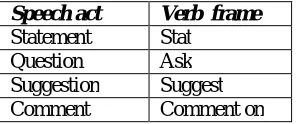
for”<topic word>”,people<verb frame>”ngrame”{,(and)<verb frame>”<ngrams>”}*
Fig 2.verb frame for speech act
Speech act Verb frame
Statement Stat
Question Ask
Suggestion Suggest
Comment Comment on
Fig 3.verb frame for speech act
The “ngrams” are the salient words/phrases extracted for the major speech act types. A “verb frame” is a verb or verb phrase specific to a particular speech act type.The algorithm favors longer ngrams so that the generated summary contains informative and less ambiguous phrases. As in multi-document summarization in general, information redundancy should be avoided. A Twitter topic is itself important information that should be included in the summary because it represents the common ground—sometimes the only common ground—shared by all its tweets. Each <verb frame >“ <ngrams> ” clause in the template represents the salient information about one speech act. We first decide the specific verb frames according to all the major speech act types and order them in the template according to the number of tweets with the speech acts. For example, if a topic has only two major speech act types: “statement” and “comment” with 2000 and 2500 tweets respectively, the template is “For people comment on and state”.
The statistics show that the summaries generated with our method are comparable to human writings in terms of explanatoriness and informativeness. On these criteria our method significantly out performs SumBasic and Hybrid TF-IDF with a large margin. The same is also true for readability, showing the superiority of abstractive summarization.
B.SUMMARIZATION OF EVALUTION
In this section we have described to generate abstract summary with the help of automatic and manual evaluation,sothat result will generate.For this summary collect the above data and apply data preprocessing on this data .Data Preparation is the process of collecting, cleaning, and consolidating data into one file or data table for use in analysis. For comparison, we generate peer summaries of two kinds. The first is by SumBasic, a simple but very robust extractive summarizer for generic documents [4]. The second is by “Hybrid TF-IDF” [5] that ranks tweet sentences by the normalized TF-IDF of their words, a simple system that reportedly defeats.
ISSN(Online): 2320-9801
ISSN (Print) : 2320-9798
International Journal of Innovative Research in Computer
and Communication Engineering
(An ISO 3297: 2007 Certified Organization)
Vol. 4, Issue 4, April 2016
V. CONCLUSION
Thus we have described in this paper, summarization of twitter trending topic ,which helps us to conclude the decision regarding any topic. This is an most important in case of social networking, for measuring the major twits in single or multipal database. Exisiting system was unable to do this, so this paper will achieve twitter object of generating abstract summary among large twits.
REFERENCES
1.N.A. Diakopoulos, D.A. Shamma, Characterizing debate performance via aggregated twitter sentiment, in: Proceedings of the SIGCHI Conferenc onHuman Factors in Computing Systems, CHI ’10, ACM, New York, NY, USA, 2010, pp. 1195–1198
2.D. Shamma, L. Kennedy, E. Churchill, Tweetgeist: can the twitter timeline reveal the structure of broadcast events?, Horizon, in: CSCW 2010.
3.K. Watanabe, M. Ochi, M. Okabe, R. Onai, Jasmine: a real-time local-event detection systembased on geolocation information
propagated to microblogs,in: Proceedings of the 20th ACM International Conference on Information and Knowledge Management,
CIKM ’11, ACM, New York, NY, USA, 2011.
4. A. Nenkova and L. Vanderwende, “The impact of frequency on summarization,” Microsoft Research, Redmond, WA, Tech. Rep.
MSR-TR- 2005-101, 2005.
5.B sharifi M-A. Hutton and J.kalita.”Experiment in microblogsummarization”inProc. IEEE 2nd Int. Conf.Social Comput., 2010.
6. D. Inouye, Multiple post microblog summarization REU Research Final Rep., 2010.
7.C.-Y. Lin, “ROUGE: A package for automatic evaluation of summaries,” in Proc. ACL Workshop Text Summarizat. Branches, 2004,pp.
74-81
8.M. Kumar, D. Das, S. Agarwal, and A. Rudnicky, Non-textual event summarization by applying machine learning to template-based language
generation,” in Proc. Workshop Lang. Generat. Summarisat.(UCNLG Sum 2009), 2009, pp. 67–71.
9.A. Wierzbicka, English Speech Act Verbs: A Semantic Dictionary. Orlando, FL: Academic, 1987.
10. S. Baccianella, A. Esuli, and F. Sebastiani, “SentiWordNet 3.0: An enhanced lexical resource for sentiment analysis and opinion
mining,” in Proc. 7th Conf. Int. Lang. Resources Eval., 2010.
BIOGRAPHY