Optimizing Content Based Image Retrieval of
Kannada Document Using Harmony Search
Nithya E1, Harshitha K2
Associate Professor, Dept. of CSE, Dr.Ambedkar Institute of Technology, Bangalore, India1
4th sem, M.Tech, Dept. of CSE, Dr.Ambedkar Institute of Technology, Bangalore, India2
ABSTRACT: This work presents a novel approach for content based Kannada Document image Retrieval from the collection of scanned copy of Kannada documents. This is done by using the Harmony Search as the optimization technique. This work represents the advanced version of Content based Kannada document retrieval in terms of robustness and Flexibility. The overview serves as emphasizing the ways required for the growing needs in newly emerging areas, reminiscent of progress of electronic libraries, multimedia databases and methods which require handwriting information entry. The proposed system consists of pre-processing, morphological based operations, Feature extraction using shape and Gabor features and finally we retrieve the documents using Harmony Search (HS).
KEYWORDS: Content Based Image Retrieval [CBIR]; Gabor Features; Harmony Search [HS]; Morphological-based Segmentation; Adaptive Histogram Equalization [AHE]; Support Vector Machine[SVM].
I. INTRODUCTION
The main areas of interest in the content recognition field are the text type, hand-written and machine-printedcharacter recognition systems. Machine-printed document comprises the materials such as textbooks, journals, magazines, documents and various writing entities in image. Due to the advent in recent technologies, we are now able to process, store, and transmit documents efficiently. With an aim to proceed in the direction of the paperless office, large quantities of documents are scanned, computerized and stored as images in databases.
There has been a lot of research going on in the field of document image retrieval. The pilling up of multimedia data has necessitated the need to find the new technologies to retrieve the information one is looking for. Content based image Retrieval (CBIR) uses the contents of the image mainly, the similarity in the features of images such as color, structure, texture and size of the image, and other relevant features of image for retrieval. In order to retrieve the documents it is important to identify the words in the documents. Optical character recognition systems are available for printed Greek, eastern, French, German, English and other oriental languages with excellent performances. However, the performance of OCR systems is low for Indian scripts. The proposed system addresses the complications involved in designing a font and dimension independent image retrieval system for printed Kannada documents. Kannada is one of main language among the Indian languages. Retrieval of Kannada documents is more difficult when compared to other Indian languages since it consists of large number of vowels, consonants, conjuncts, complex character grapheme and large variations among fonts within the characters belonging to the same class. The recent progress in technology has enabled us to digitize the physical written information by using huge data storage systems. Still, a large number of people would need to interact intermittently with computer systems.
ISSN(Online): 2320-9801 ISSN (Print): 2320-9798
I
nternational
J
ournal of
I
nnovative
R
esearch in
C
omputer
and
C
ommunication
E
ngineering
(An ISO 3297: 2007 Certified Organization)
Vol. 4, Issue 4, April 2016
access wherever essential. All these methods come under the title of file image retrieval, which has acquired importance as a major research area in the recent days.
II. RELATED WORK
We have studied many earlier works done in this area by various researchers. There are different approaches that were followed by various researchers such as font and size based, binarization based and segmentation based,Characterization of the Image, Correlation based and entropy based algorithms. Some of the previous works are given below:
RitendraDatta,Jia Li and James Z. Wanghave proposed the recent trends and approaches for content based image retrieval [1].They have mentioned about the key contributions made in the recent decade in the field of Content based image retrieval. About 120 references are made in this paper. They have mentioned about the new technologies and growing interest in image retrieval related fields. Key challenges involved in adaptation from the existing system to more useful system have been mentioned. In this paper [2] MangijaoSingh,K and. Hemachandran have together proposed the content based image retrieval using the Gabor feature and color moments. Here the minimal amount of spatial information is encoded in the color index. Image is divided horizontally into three equal non-overlapping regions.The three moments of the color distribution are extracted from each region of the image and stored them in the index.27 floating point numbers are stored for each image.In this paper [3] Chandrakala H T has proposed the content based Image retrieval of Kannada documents using the correlation method. Recognition free approach is followed .First the image is pre-processed segmented, then the correlation based method is applied to search for images in large scale database.In [4] G.TSrinivasan, and Dr.C.Chandrashekar have together compared the various edge detection techniques used in image processing. The software is implemented using MATLAB. The Gradient and Laplacian operators are used here.The case study deals with observation of Shark Fish Classification through Image Processing using the various filters which are mainly gradient based Roberts, Sobel and Prewitt edge detection operators, Laplacian based edge detector and Canny edge detector.In this paper [5] Thanuja C and Shreedevi G R proposed Content Based Image Retrieval System for Kannada Query Image from Multilingual Document Image Collection; here they presented visual clues based approach to identify the Kannada text in other languages such as Hindi, English and Malayalam documents. M.C. Padma and P.A.Vijaya extracted Texture based features for automatic script identification [6]. In [7] authors have proposed the efficient algorithms to segment the hand-written text lines. Text line algorithm is used which uses the morphological operators to extract features from images. The experimental results using the IAM-database have showed that this approach is robust and fast
.
In [8] authors have discussed the effects of histogram Equalization and contrast limited adaptive histogram Equalization. Here contrast limited adaptive histogram Equalization are applied for qualitative enhancement of myocardial perfusion Images.III.PROPOSED SYSTEM
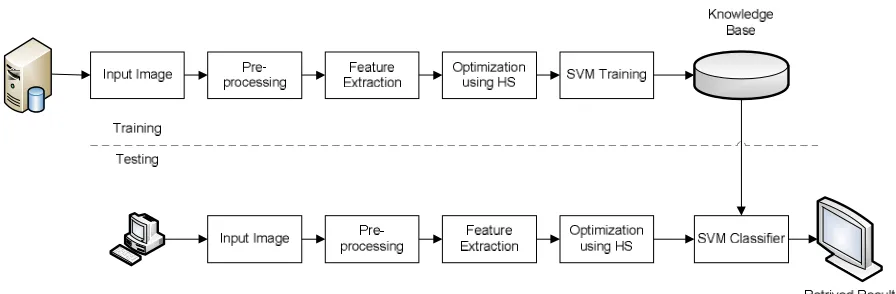
The content-based image retrieval approach retrieves the stored Kannada Document image from the database by using the features of the query image against the images in the collection. The system first extracts and stores the features of the query image then it go through all images in the database and extract the features of each and every image. Then the Harmony search is applied to classify the images. SVM Classifiers are used to increase the accuracy of prediction. The results are the Kannada document images that match with the query image.
Figure 1: Proposed System
A. Pre-processing:
Pre-processing is a technique of enhancing the raw images by suppressing the unwanted distortions. During the pre-processing stage, we have converted the input image into gray scale image. A gray scale image carries only intensity information. The gray values range between 0-255. Adaptive Histogram Equalization is used to improve the contrast in images. Wiener Filter is used to remove noise in the images
.
Adaptive Histogram Equalization(AHE): AHE is the image pre-processing technique used for improving the contrast in
images [11].AHE method first computes several histograms, where each histogram corresponds to a distinct region of the image. These histograms are used to redistribute the lightness values in images. Therefore, it is suitable to improve the local contrast and enhance the definition of the edges in each section of an image.
Wiener Filter: Wiener filter is the de-blurring technique used to remove the noise from the image. It uses the statistical
approach. Wiener filter is different from the Natural filters. In Wiener filter we should have the knowledge regarding the spectral properties of the noise and common signal. Wiener filter finds its application in noise reduction, signal detection, deconvolution and system identification. Characteristics of the Wiener filter are:
Assumption: signal and (additive) noise are stationary linear random processes with known spectral characteristics.
Requirement: the filter must be physically realizable, i.e. causal (this requirement can be dropped, resulting in a non-causal solution).
Performance criteria: minimum mean-square error.
B. Segmentation:
Segmentation is defines as a process that seeks to partitions an image which a sequence of characters into multiple parts. Basically it is used to find the objects and boundaries in an image. Initially we convert the image to binary. In a binary image, each pixel takes only two possible values. This is followed by dilation, area, height, width based morphological operations are applied. Dilation is one of the basic operators in the field of mathematical morphology. It is commonly used on binary images. The main function of the operator on the image is to gradually widen the boundaries of regions of foreground pixels (i.e. White pixels, generally). Hence, areas of foreground pixels enlarge in dimension, at the same time the holes inside these regions becomes smaller. Dilation facilitates objects to enlarge, thus potentially filling in small holes and joining disjoint objects.
C. Feature Extraction:
In our proposed system we have extracted Gabor features and shape based features.
Gabor Features: Gabor filter is a linear filter which finds its application in edge detection. A 2D Gabor filter is a band-passspatial filter with selectivity to both orientation and spatial frequency. It can be expressed as follows:
( , , ) = ( , ) cos( )−exp −
2 + ( , )∗sin( ) eq. (1)
ISSN(Online): 2320-9801 ISSN (Print): 2320-9798
I
nternational
J
ournal of
I
nnovative
R
esearch in
C
omputer
and
C
ommunication
E
ngineering
(An ISO 3297: 2007 Certified Organization)
Vol. 4, Issue 4, April 2016
= 2 [ ( ) + ( )], =2 eq. (3)
= , = 0,1,2, … … . , −1 eq. (4)
Where is the wave length, is the oscillation direction, and is the number of directions.
Gabor features are extracted by constructing the elastic meshes on the character image and by taking the centre of each mesh to be the sampling point. Then the Gabor feature at the sampling point ( , ) is extracted as,
( , ) = ( , ) ( − , − ; , )eq. (5)
Where , , is the size of filter image, ( , ) is the pixel value on each point ( , ). in practice amplitude of
( , ) is usually used as a feature.
D. Optimization: Harmony Search
The usage of harmony memory is important, as it is similar to choice of best-fit individuals in genetic algorithms (GA). This will ensure that the best harmonies will be carried over to the New Harmony memory. In order to use this memory more effectively, it is typically assigned as a parameter ∈[0,1], called harmony memory accepting or considering rate. If this rate is too low, only few best harmonies are selected and it may converge too slowly. If this rate is extremely high (near 1), almost all the harmonies are used in the harmony memory, then other harmonies are not explored well, leading to potentially wrong solutions.
E. Classification: SVM
Support vector machines (SVMs) are a set of related supervised learning methods used for classification and regression. They belong to a family of generalized linear classifiers. In another terms, Support Vector Machine (SVM) is a classification and regression prediction tool that uses machine learning theory to maximize predictive accuracy while automatically avoiding over-fit to the data. Support Vector machines can be defined as systems which use hypothesis space of a linear functions in a high dimensional feature space, trained with a learning algorithm from optimization theory that implements a learning bias derived from statistical learning theory
IV.SIMULATION &RESULTS
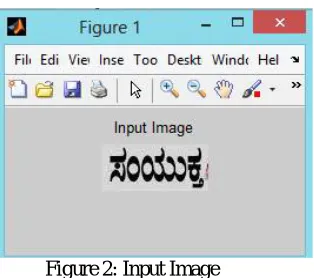
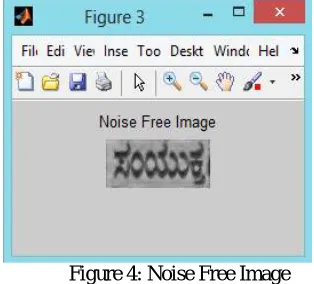
Thebelow figures show the results of our proposed work. Figure 2 represents the query input image selected by the user. Now this input image will be pre-processed by applying Adaptive Histogram Equalization. Figure 3 represents the Histogram Equalized image. This is followed by noise removal using wiener filter. Figure 4 represents the Noise free image. The harmony search algorithm is applied to retrieve the Kannada documents matching the query image. Figure 5 represents the retrieved Kannada document Images.
Figure 2: Input Image
Figure 3: Histogram Equalized Image
Figure 3 represents the Histogram equalized image.Adaptive histogram equalization is a pre-processing technique applied to improve the contrast in images.
Figure 4: Noise Free Image
Figure 4 represents the noise free image.Noise in the image is removed using wiener filter.
ISSN(Online): 2320-9801 ISSN (Print): 2320-9798
I
nternational
J
ournal of
I
nnovative
R
esearch in
C
omputer
and
C
ommunication
E
ngineering
(An ISO 3297: 2007 Certified Organization)
Vol. 4, Issue 4, April 2016
Figure 5 represents the results of the searching process which retrieves the Kannada document images in which the user specified query image is present.
V. CONCLUSION AND FUTURE WORK
In this paper we have proposed a new methodology to retrieve the Kannada document images. Harmony Search is the algorithm which we adapted in our work. This approach matches the query input image with stored documents and the matching documents will be retrieved. Harmony search contributes to the robustness of the system. We intend to explore the higher level strategies for better search efficiency in quality in future
REFERENCES
1.RitendraDatta,Jia Li and James Z. Wang ,’Content-Based Image Retrieval - Approaches and Trends of the New Age’, International Journal of Computer Applications , 2005.
2.S. Mangijao Singh , K. Hemachandran,’ Content-Based Image Retrieval using Color Moment and Gabor Based Image Retrieval using Color Moment and Gabor Texture Feature’, International Journal of Computer Science Issues, Vol. 9, Issue 5, No 1, September 2012 ISSN (Online): 1694-0814
3.Chandrakala H T,’ A Kannada Document Image Retrieval System based on Correlation Method’, International Journal of Computer Applications (0975 – 8887) Volume 77– No.3, September 2013
4.G.T Srinivasan,Dr.C.Chandrashekar ,’ A comparison of various Edge detection Techniques used in Image processing ‘International Journal of Computer Science Issues, Vol. 9, Issue 5, No 1, September 2012
5.Thanuja C and Shreedevi G R, ’Content Based Image Retrieval System for Kannada Query Image from Multilingual Document Image Collection’, Volume 3, Issue 4, pp 1329-1335, Jul-Aug 2013.
6.M.C. Padma and P.A.Vijaya, ’Entropy Based Texture Features Useful for Automatic Script Identification’, Volume 2, Issue 2, pp 115-120, 2010. 7.Rodolfo P. dos Santos, Gabriela S. Clemente, Tsang IngRen and George D.C. Calvalcanti, ’Text Line Segmentation Based on Morphology and
Histogram Projection’, 2009.
8.NeethuM.Sasi, V.K.Jayasree, ’Contrast Limited Adaptive Histogram Equalization for Qualitative Enhancement of Myocardial Perfusion Images’, pp 326-331, 2013.
BIOGRAPHY
Prof. Nithya E,working as Associate Professor in the Department of CSE, Dr. Ambedkar Institute of Technology, Bangalore, India.