Customer Reviews and Analysis using
Opinion Mining Adaptive Algorithm
Palla Pavankumar1, Tippani Gayathri2 , Kathi Venkataramana3
Assistant Professor, Dept. of Computer Engineering, Keshav Memorial Institute of Technology, Narayanaguda,
Hyderabad, India1
Assistant Professor, Dept. of Computer Engineering, Keshav Memorial Institute of Technology, Narayanaguda,
Hyderabad, India2
Assistant Professor, Dept. of Computer Science & Engineering, Geethanjali Institute of Science & Technology,
Nellore, India3
ABSTRACT: The important part to gather the information is always seems as what the people think. The growing availability of opinion rich resources like online review sites and blogs arises as people can easily seek out and understand the opinions of others. Users express their views and opinions regarding products and services. These opinions are subjective information which represents user’s sentiments, feelings or appraisal related to the same. The concept of opinion is very broad. In this paper we propose an opinion mining adaptive algorithm (OMAA) focuses on the Classification reviews on customer reviews that conveys user’s opinion i.e. positive or negative at various levels. The OMAA is to predicting opinions enable us, to extract the sentiments from the web for online customer’s preferences, which could prove valuable for marketing research. Much of the research work had been done on the processing of opinions or sentiments recently because opinions are so important that whenever we need to make a decision we want to know others’ opinions. This opinion is not only important for a user but is also useful for predicting the online marketing purchases and improving impacts on products and sales.
KEYWORDS: Opinion Mining, Sentiment Analysis, Mining Classifications, Web Mining
I. INTRODUCTION
We Opinion mining is a type of natural language processing for tracking the attitudes, feelings or appraisal of the public about particular topic, product or services. Textual information in the entire world is of two types: facts and opinions. The facts are the objective expressions which describe the entities, events and properties whereas the opinion is the subjective expression which describes people's opinions, emotions and sentiments towards entities and their properties. The current search engine searches for facts because they assume the facts are true and can be expressed with keywords. But these search engines do not find the opinions because opinions or sentiments are very difficult to express by keywords and that is why there ranking strategy are not appropriate for opinion retrieval. Now, the web has significantly changed its way that people comments their views and opinion on any product and services. User can post their comments on any internet forums, review sites, blogs and discussion group which are commonly known as user generated content which contains the important information. This online word- of- mouth behaviour represents new and considerable sources of information and their applications. These online comments are not limited to our friend circle but it is also expanded on a global or web scale. Today, if the user wants the views on a particular product he/she has no longer limited to ask their friends because they got the opinion for that product on the internet through various reviews or comments. In the same if the organization wants the opinion of their products and services they use these user generated contents from the web for the review or comments of their products and services.
who write the text. It used Natural Language Processing and Machine Learning ethics to determine opinion in the text. The evaluation of opinion can be done in two ways:
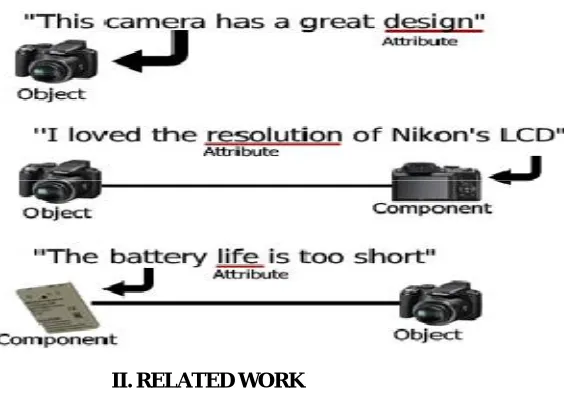
Direct opinion, gives positive or negative opinion about the object directly. For example, “The picture quality
of this camera is poor” expresses a direct opinion.
Comparison means to compare the object with some other similar objects. For example, “The picture quality
of camera-y is better than that of Camera-x.” expresses a comparison.
1.1 Defining Opinion Components in a Opinion Mining Context
The definitions used in this section were proposed in [9], and they summarize important elements that compose an opinion. Some of these definitions are just a naturalobservation of elements present in opinions, while others refer to definition of problemsaddressed in [9]. For this reason some of these definitions may not apply to otherworks as they can differ a lot from their goals as well as from the strategies they employ toachieve them.
1.1 Defining Opinion Components in a Opinion Mining Context
II.RELATED WORK
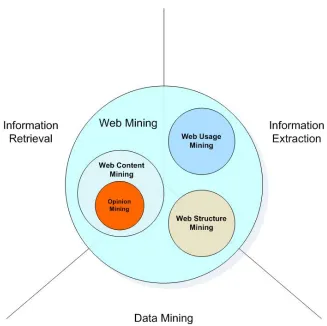
2.1 Web Content Mining
Web content mining is very important as it deals directly with information. The goal isto mine content from web documents in order to build knowledge from it. This knowledge can be either hidden or somehow simply difficult to be analyzed in a straightforward way. Next subsection will introduce an important field of Web Content Miningcalled Opinion Mining.
Fig 2.1: Information retrieval systems.
2.3 Opinion Mining
Opinion Mining is a field of Web Content Mining that aims to find valuableinformationout of users opinions. Mining opinions on the web is a fairly new subject, and its importance has grown significantly mainly due to the fast growth of e-commerce, blogsand forums. With the high profits of e-commerce increasing year after year many people had
opinionsabout a given product, the web site could place ads from an alternative product froma competitor. Also, manufacturers can get the feedback of their products to improvetheir products or services.
III. SYSTEM ARCHITECTURE
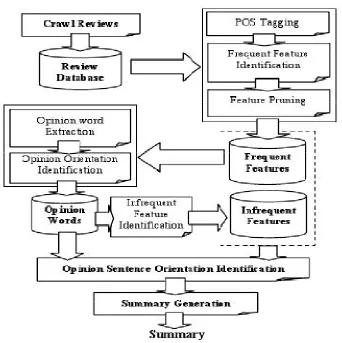
Figure 3: Architecture of an opinion mining system
The system counts with a crawling module, which first downloads all the reviews
and stores them in the database. After that a POS tagger tags all the reviews whichwill work as hooks for the mining part responsible for finding frequent features. Thisstep is skipped by some systems which employs manual feature annotation as in [21],where ontologies were used to annotate movies features manually. Next, with thetagged sentences and features identified, opinion words are extracted and their semantic orientation is identified with the help of WordNet. Now with opinion words identifiedand extracted, the system identifies infrequent features.
IV. ANALYSIS 4.1 Feature Identification
Feature identification is the process used to deduce possible product features out of
Mining for Movie Reviews", an ontology basedapproach was used to extract features from opinions. In they work, they experimentedit with movies reviews, where they identified sentences containing the ontology terminologies.
Here it is important to differentiate between the two approaches with their prosand cons. In [15] and [9], feature identification is performed automatically. The greatadvantage of this method is to perform the whole process automatically, with minimalhuman intervention. The biggest downside however is that the output (the frequent features) depends a lot on the number of opinions being analyzed. Also, there is noguarantee that a frequent feature found by the system is actually a real feature. In [21]and other works where features were manually annotated, the advantage is that thesystem will always identify real features, being frequent or not. This will only dependon the correctness of the previously made annotation. The great downside however, isthat a great number of annotations have to be made. They may not be only specificto categories (such as digital cameras, video games, cellular phones), but they could be even more specific such as models of a specific brand (Nikon P90, Nikon D5000,etc). That would make the annotation of features a very hard work. Also, people maycomment on the lack of features of a given product, or they may use different words torefer to the same feature which a system with manual annotated features will fail torecognize.Given the short comparison between the different approaches above, the methodexplored in [15] and [9] will be further discussed, as it needs a minimal human intervention to perform its task reasonably well which could be later improved by othermethods.
4.2 Frequent Features Identification
In, [15] and [9] the proposed system extract only nouns or noun phrases (explicit possiblefeatures) from the text. In this step, the extracted nouns are called candidate features.
Then an association mining algorithm finds all the frequent itemsets, which are theset of frequent features (those ones that many users write about). The idea behindthis technique is that features that appear on many opinions have more chance to berelevant, and therefore, more likely to be actually a real product feature. The Apriorialgorithm [2] was used to generate the set of frequent itemsets. However, for this task there was no need of finding association rules among items, therefore only the part ofthe algorithm that finds frequent itemsets wasinteresting for these works. In [9] and[15], a minimum support of 1% was used.
4.2.1 Infrequent Features Identification
A very simple heuristic was used in [15] to discover possible infrequent features (the ones referenced by a small number of people), as the association mining is unable toidentify them.
Example:
I. "The pictures are absolutely amazing." II. "The software that comes with it is amazing."
In the above example, the two sentences have one opinion word in common: amazing. Because an opinion word could be used to describe more than one object, theseopinion words are used to look for features which couldn't be found in the step describedon
.
Figure 4.2.1: Infrequent feature extraction
4.3 Opinion Sentiment Analysis
Sentiment classification or sentiment analysis is an area of study that aims to classify the sentiment encoded by texts as shown in the following example:
Example:
II. The sun is absolutely beautiful today positive
The word sentiment is a synonym for polarity and both are widely used to describethe orientation of texts, sentences and words as in example 4. This work will deal with sentiment classification of texts represented by users opinions, therefore the nameopinion sentiment.The analysis of sentiment can be performed on several levels of granularity (words,sentences, texts and documents). For many applications, classifying the sentimentof documents as a whole is sufficient, for others a finer level of granularity might benecessary.The work done by [18] and [22] classifies each user opinion as a whole. In [15] and [3] sentiment classification is done at the sentence level. In [9], each feature within aopinion has a sentiment associated. The reason why this last approach is preferablethan the others, is easy to realize through a simple observation. To illustrate it, thinkabout a specialized web site for cameras, where customers can write their opinions abouta certain product, as illustrated in figure 3.4. For example
the sentence: "I like my camera and the 24x zoom, but i think the battery life is tooshort". Here it is easy to realize that the sentence is "more positive than negative",however that would still hide one negative aspect of the camera under discussion. Thismay represent a very important piece of information, which can be obfuscated byclassifying the whole sentence as positive. For this reason the method explored by [9]achieves an optimal granularity level as it treats each attribute of an OuD with thenecessary details.
4.3.1 Determining Sentiment of Opinions at the Sentence Level
An opinion can be analyzed at different levels of granularity. In this work, the approaches used to analyze the opinion as a whole are going to be discarded as in
[18] and [22].Therefore, thetwo remaining approaches with respect to their granularity, are going to be exposed with more details. Figure 4.2.1 shows a pseucocode which aims to find the sentimentof opinions at the sentence level. The next section, will analyze the sentiment of anopinion at the feature level, as proposed by [9], which is of greater importance for thiswork.
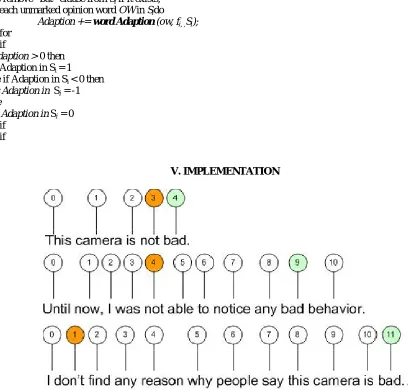
4.3.2 Negation Rules
A negation word such as no, not and never and also some words that follow patternssuch as “stop" + “vb-ing", “quit" + “vb-ing" and “cease" + “vb-ing" change theorientation of opinion words in the following way:
I. Negation Negative Positive II. Negation Positive Negative III. Negation Neutral Negative
Some examples for each negation rule defined above: I. “no problem"
II. “not good" III. “does not work"
4.3.4 Determining Opinion Sentiment at the Feature Level
In [9], after identifying all the opinion words for a given feature, the system calculates the opinion orientation for each feature using the following equation:
Score( ) = . ( , )
: ∈ ^ ∈
S is a sentence with a set of features
wi is an opinion word
V is the set of all opinion words(including idioms)
wi.SO is the semantic orientation of opinion word wi
dis(wi, f) is the distance between feature f and opinion word wi in the sentence S
word, V is the setof all opinion words (including idioms) and s is the sentence that contains the feature f,dis(wi; f) is the distance between feature f and opinion word wi in the sentence s. Thereason for the multiplicative inverse in the formula is to give low weights to opinionwords that are far away from the feature f. The pseudo code of figure 3 was used to find the opinion orientation at the feature level.
OPINION MINING ADAPTIVE ALGORITHM (OMAA)
for each sentence Si that contains a set of features do features = features contained in Si
for each feature fi in features do
Adaption = 0;
if feature fi is in the “but” clause then
Adaption = apply the“but” clause rule else remove “but” clause from Si if it exists; for each unmarked opinion word OW in Sido
Adaption += word Adaption (ow, fi, ,Si); endfor
endif
ifAdaption > 0 then
fi‘s Adaption in Si = 1 else if Adaption in Si < 0 then
fi ‘s Adaption in Si = -1
else
fi ‘s Adaption in Si = 0 endif
endif
V. IMPLEMENTATION
Figure 5.1: Sentences with negation words
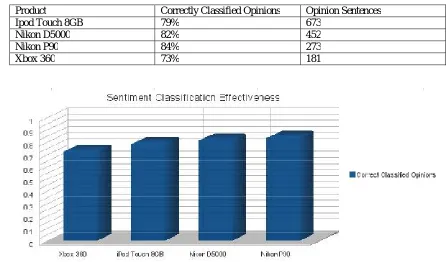
To evaluate the effectiveness of the sentiment classification algorithm, the orientation
negative or positive opinionfor a given feature, which was correctly identified by the system. All the features were identified automatically, and only the sentences with real features (frequent features)were analyzed. Sentences with candidate features were discarded. The effectiveness of the automatic feature identification algorithm will be discussed later on section 7.3.It is important to consider the complexity of judging (even for a human) whetheran opinion is positive or negative. There are many cases where this analyzes is pretty1ObjectSpace is a Ruby module used for memory management, which is disabled by default inJRuby. One of POECS libraries use this feature which can be enabled by passing the parameters-X+O. It has been reported by the JRuby developing team that ObjectSpace can create a substantial overhead and thus affecting the performance of the system.
Table 5.1: Effectiveness of sentiment classification
Product Correctly Classified Opinions Opinion Sentences
Ipod Touch 8GB 79% 673
Nikon D5000 82% 452
Nikon P90 84% 273
Xbox 360 73% 181
Figure 5.1: Effectiveness of opinion sentiment classification
IV. EVALUATION
Straightforward, especially when explicit opinion words are used. However, in somecases, in order to understand whether an opinion is negative or positive, a domain specific knowledge is needed. Example 1 illustrates some of these cases:
Example 1:
I. "The iPod battery lasts for 5 hours with music and Wi-Fi turned on." II. "The device heats very fast."
In sentence I, it is difficult to know whether a battery lasting for 5 hours underthe described conditions is positive or negative. In sentence II, heating fast depends alot of which device is being analyzed. For instance getting hot fast could represent anegative behaviour of an electronic device such as video games or notebooks. However,if the OuD is a portable heater or an electric oven, heating fast should be a positive behaviour.
Example 2:
I. "This battery is really GOOD."
II. "[. . . ] hard drive of 120 GB which comes with the device."
In sentence I, the word GOOD is written in upcase, a common practice among internet users, which aims to emphasize sentiments. The POS tagger however interprets this word as belonging to the group of proper nouns. Therefore, the mining algorithmwill fail to recognize it as an opinion word. In this work, such cases were not coveredsince they are not common and hence addressing them would produce a great delay forthe mining tasks.A snippet of a customer opinion for Xbox 360 is shown in sentence II. It wasdetected that the POS tagger would fail to recognize hard drive as a noun group(feature). Unlike, the POS tagger interprets the word as follows: hard adjective anddrivenoun. Thus, hard was taken by the mining algorithm as an opinion word.
VI. CONCLUSION& FUTURE WORK
Opinions are a unique type of information which are different from facts. The methods for content classification based on ranking (like those used by search engines) are not effective or simply do not accurately depict reality, as one opinion is different frommultiple opinions.
During the evaluation of POECS it was possible to see that it is feasible and re liable to build system capable of classifying and organizing opinions through the so called feature based summary, which resumes themost relevant information for users. However, it is undeniable that a great number of opinions are difficult to classify dueto the complexity of the human language.Evaluation also showed that the system can be more effective when domain specific,using the help of manual annotations to treat common exceptions. A system cantherefore combine multiple approaches with the intelligence of automatic algorithmsand manual annotations in order to provide a high degree of accuracy.
Many studies including this one is striving to discover patterns of use of language that can be reused, widespread and processed by computers. While many annotations are still required, they do not offer the necessary exibility and often turn out to be very specific domain. There are complex cases as the one presented during evaluation (which the system fails to correctly classify) which remains as challenges for new algorithms which are capable of solving disambiguation problems.
As discussed, when one is commenting about a product, a word can have different meanings or can refer to different objects. Solving this problem is a good challenge for new algorithms in Opinion Mining. Also, understanding the semantics of text in a more intelligent way is necessary. A good direction would be methods which have global knowledge of opinions dependent on complex contexts, which can use this information later to help solving context problems in any local analysis (at the sentence or word level).
REFERENCES
[1] NidhiMishra C.K.Jha, PhD Classification of Opinion Mining Techniques International Journal of Computer Applications (0975 – 8887) 2012 [2] J. Handl, J. Knowles and M. Dorigo Ant-based clustering: a comparative study of its relative performance with respect to k -means, average link and 1d-som 2016
[3] HoracioSaggionKalinaBontcheva Christian LeiboldAdam Funk, Yaoyong Li. Opinion analysis for businessintelligence applications. OBI'08, 2009.
[4] Rakesh Agrawal and Ramakrishnan Srikant. Fast algo rithms for mining association rules. 1994.
[5] Oren Etzioni Ana-Maria Popescu. Extracting productfeatures and opinions from reviews. EMNLP-05, 2005.34
[6] Vadim Tkachenko Jeremy Zawodny D. Arjen LentzDerek J. Balling Baron Schwartz, Peter Zaitsev. HighPerformance MySQL: Optimization, Backups, Replication, and More. O'Reilly Media, 2008.
[7] Liu Bing. Web Data Mining.Springer, 2007.
[8] Max Bramer. Principels of Data Mining. Springer, 2007.21
[9] Brian Clifton. Advanced Web Metrics with Google Analytics. Sybex, 2 edition, 2010. [10] Yukihiro Matsumoto David Flanagan. The Ruby Programming Language.O'Reilly, 2008.
[11] Philip S. Yu Ding Xiaowen, Liu Bing. A holistic lexicon based approach to opinion mining. WSDM'08, 2008.vii,27, 28, 30, 31, 32, 33, 34, 35, 36, 37, 39, 58, 59, 87
[12] Brad Ediger. Advanced Rails. O G Popa, 2008.
[13] David A. Freedman. Statistical Models: Theory and Practice. Cambridge University Press, 2 edition, 2009.
[16] Lynne Schrum Gwen Solomon. Web 2.0: New Tools, NewSchools. International Society for Technology in Education; First Edition edition, 2007.
[17] Liu Bing Hu Minqing. Mining and summarizing customer reviews. KDD'04, 2004.vii, 27, 30, 31, 32, 33, 34,35, 38, 59. [18] Eibe Frank Ian H. Witten. Data Mining: Practical Machine Learning Tools and Techniques. Morgan Kaufmann;2 edition, 2005.
[19] Paul Kimmel. UML Demystified. McGraw-Hill OsborneMedia; 1 edition, 2005. [20] David M. Pennock Kushal Dave, Steve Lawrence.Mining the peanut gallery: Opinion extraction and semantic classification of product reviews.WWW'03, 2003. 34, 36
[21] Arthur M. Langer. Analysis and Design of InformationSystems.Springer; 3rd edition, 2007.
[22] David Heinemeier Hansson Leonard Richardson,Sam Ruby. Restful Web Services. O'Reilly Media; edition, 2007. [23] Chunping Li Lili Zhao. Ontology based opinion miningfor movie reviews. KSEM 2009, 2009.
[24] Simon Corston-Oliver Eric Ringger Michael Gamon, Anthony Aue. Pulse: Mining customer opinions from freetext. IDA, 2005.34, 36.
BIOGRAPHY
PallaPavankumaris anAssistant professor in the Computer Science and Engineering Department,Keshav Memorial Institute of Technology, Narayanaguda, Hyderabad. He received Master of Technology (M.Tech) degree in 2012 from SKD college, Gooty, Ananatapur, India. His research interests are Data Mining, Computer Networks (wireless Networks), Image Processing, Algorithms etc.
TippaniGayathriis an Assistant professor in the Computer Science and Engineering Department,Keshav Memorial Institute of Technology, Narayanaguda, Hyderabad. She received Master of Technology (M.Tech) degree in 2014 from JNTU, Hyderabad India. Her research interests are Image Processing, Data Mining, Computer Networks (wireless Networks) etc.
TippaniGayathriis an Assistant professor in the Computer Science and Engineering Department,GeethanjaliInstitute of Science & Technology, Nellore. He received Master of Technology (M.Tech) degree in 2013 from JNTU,