University of Windsor
University of Windsor
Scholarship at UWindsor
Scholarship at UWindsor
Electronic Theses and Dissertations
Theses, Dissertations, and Major Papers
6-1-1970
Study of field structure inside a rectangular waveguide corner.
Study of field structure inside a rectangular waveguide corner.
S. P. Mathur
University of Windsor
Follow this and additional works at: https://scholar.uwindsor.ca/etd
Recommended Citation
Recommended Citation
Mathur, S. P., "Study of field structure inside a rectangular waveguide corner." (1970). Electronic Theses and Dissertations. 6863.
https://scholar.uwindsor.ca/etd/6863
by
S. P. Mathur
A THESIS
SUBMITTED TO THE FACULTY OF GRADUATE STUDIES
THROUGH THE DEPARTMENT OF ELECTRICAL ENGINEERING
IN PARTIAL FULFILLMENT OF THE
REQUIREMENTS FOR THE DEGREE OF
MASTER OF APPLIED SCIENCE
University of Windsor
UMI Number: EC52814
INFORMATION TO USERS
The quality of this reproduction is dependent upon the quality of the copy
submitted. Broken or indistinct print, colored or poor quality illustrations and
photographs, print bleed-through, substandard margins, and improper
alignment can adversely affect reproduction.
In the unlikely event that the author did not send a complete manuscript
and there are missing pages, these will be noted. Also, if unauthorized
copyright material had to be removed, a note will indicate the deletion.
®
UMI
UMI Microform EC52814
Copyright 2008 by ProQuest LLC.
All rights reserved. This microform edition is protected against
unauthorized copying under Title 17, United States Code.
ProQuest LLC 789 E. Eisenhower Parkway
ABSTRACT
Field structure inside a rectangular waveguide corner is
studied. An attempt to calculate the electric and magnetic fields
inside the waveguide in the neighbourhood of the discontinuity region
is presented.
An experimental strategy that is based upon the analogous
behaviour of the acoustic pressure and axial magnetic field is presented.
The technique utilizes holographic interferrometery. Results of some
The author wishes to express sincere thanks to Mr. Philip
Alexander for his guidance and moral support throughout the course of
this work. I would also like to acknowledge the financial help given
TABLE OF CONTENTS
ABSTRACT (ii)
AC KNOWLEDGE EE NTS (ii i )
TABLE OF CONTENTS (iv)
LIST OF TABLES (v)
LIST OF FIGURES (vi)
GLOSSARY OF SYMBOLS (vii)
CHAPTER I INTRODUCTION 1
CHAPTER II THEORETICAL ANALYSIS 5
CHAPTER III THEORY OF THE EXPERIMENT 18
CHAPTER IV EXPERIMENTAL SETUP 36
CHAPTER V RESULTS AN) DISCUSSION 42
CHAPTER VI CONCLUSIONS 45
BIBLIOGRAPHY 46
APPENDIX I 48
TABLE 4. 1 PROPERTIES OF HOLOGRAPHIC PLATES
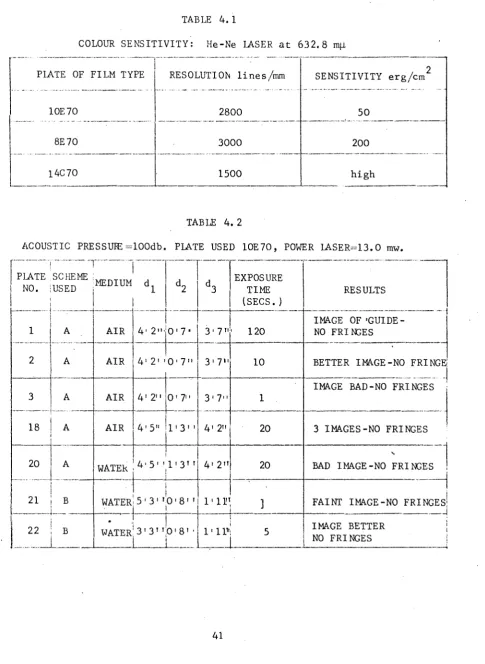
TABLE 4. 2 DESCRIPTION OF HOLOGRAMS
TABLE 5.1 FIELD COEFFICIENTS
LIST OF FIGURES
FIG. 1 GEOMETRY OF THE RIGHT ANGLE CORNER 8
FIG. 2 PRIMED COORDINATE SYSTEM 14
FIG. 3 RELATION BETWEEN ACOUSTIC AND ELECTROMAGNETIC BOUNDARY 20
CONDITIONS
FIG. 4 GEOMETRY FOR GENERAL DESCRIPTION OF THE HOLOGRAPHIC PROCESS 23
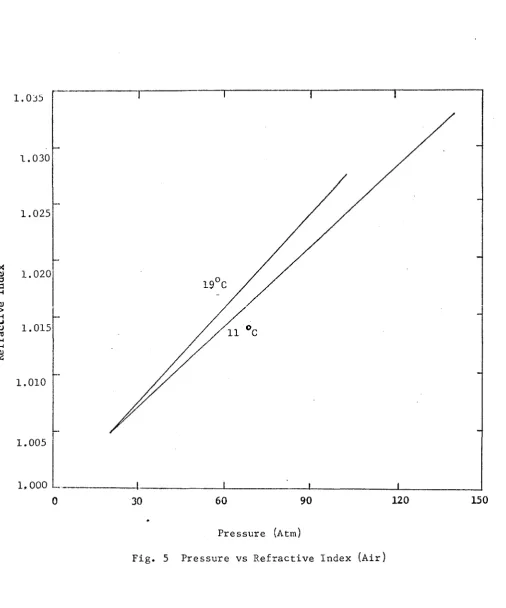
FIG. 5 PRESSURE vs REFRACTIVE INDEX (AIR) 31
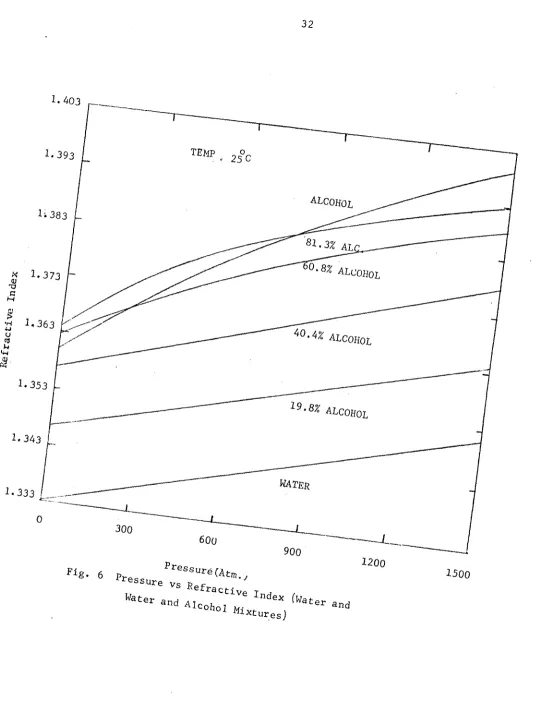
FIG. 6 PRESSURE vs REFRACTIVE INDEX (WATER AND WATER AND ALCOHOL 32 MIXTURE)
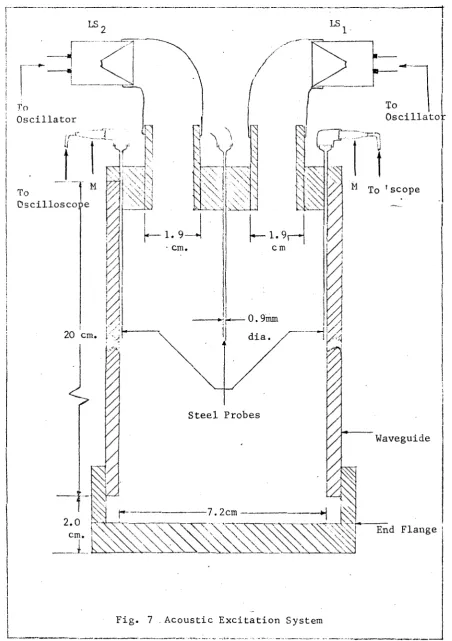
FIG. 7 ACOUSTIC EXCITATION SYSTEM 38
FIG. 8 SETUP FOR HOLOGRAPHIC INTERFERROMETRY (SCHEME l) 40
a larger dimension of the waveguide
amplitude of the incident wave
A field coefficients
n
b smaller dimension of the waveguide
B field coefficients,
m
c velocity of light in medium of refractive index r|
c velocity of light in air
c velocity of sound
s J
d distance between truncating plane and opposite corner of the waveguide
d distance between opposite corner and intersection of extended waveguide
Ey y-component of the electric field
f frequency of light wave
f acoustic frequency
x-component of magnetic field
z-component of magnetic field
I intensity of stationary image
J zeroeth order Bessel function
o
k propagation constant for light waves
1 length of path of light through the acoustic waveguide
L change in the optical path length
p excess pressure in the waveguide
propagation constant of (1,0) acoustic mode
T transmittance of holographic plate
u particle velocity
U amplitude of acoustic source
v velocity potential
Vq field strength of object beam at recording plate
amplitude of object beam at recording plate
V2 field strength of reference beam at recording plat e
amplitude of reference beam at recording plate
x, y, z cartesian coordinate system
GREEK
|3 propagation constant for (n,0) acoustic mode
1 -9
Cq permittivity of medium, x 10 f/m
p. permeability of medium, 4rr x 10^ h/m
o
X^ light wavelength, 6328 A
A. waveguide wavelength
§
co angular velocity in radians
p density of medium
1-1 GENERAL
The determination of Electromagnetic field configuration in any
region is a solution of Maxwell's equations, formulated either in terms
of a differential equation with appropriate boundary conditions or as an
integral equation which incorporates boundary conditions. The choice
between either method depends on the specific problem.
In the case of waveguide discontinuity problems, an exact solu
tion by the above methods is very difficult, if not impossible, to obtain.
However, a nearly exact solution can be obtained in most cases by taking
a large number of terms of the series used to express the result.
In the present work, a symmetrically truncated rectangular
waveguide corner is the object of study. The problem is reduced to
2-dimensions by symmetry considerations.
An algorithm for numerical calculation of the field configura
tion is developed and the computer results are tabulated.
A n experimental strategy to obtain the field structure for
the waveguide is suggested.
1-2 LITERATURE SURVEY
The problem of waveguide discontinuities due to rectangular
corners has been tackled by many workers. M i l e s ^ ^ derived the equiv
alent circuit of a simple rectangular waveguide corner without
2
used a conformal transformation which carries a bent waveguide into a
straight waveguide filled with non-uniform media. The problem is then
formulated as an integral equation containing a Green's function for
the region. The integrations involved in Rices' work are very difficult
to evaluate and he has not gone beyond the second iteration even for
small angles. Rice obtained approximate formulae for reflection and
transmission coefficients in sharp corners. He did not obtain the field
structure.
(3)
Kao used quasi-optical theory to solve for EM fields in
an overmoded H-plane truncated corner excited by TE^q mode. The diff
raction effects were, however, neglected in his theory, so that the
comparison of experimental and theoretical results show only fair
agreement.
(4)
Hamid has tried to give the solution to the truncated
waveguide corner problem using Ray theory. However, it must be remem
bered that Ray methods yield only the first term in the asymptotic
expansion of the modal solution of the total field present in the region
concerned. Even so, the Ray solutions can be changed to mode solutions
by the use of the Poisson sum formula . However, the agreement is only
asymptotic. The method is so complicated that it has only been tried
for parallel-plate waveguide corners.
G o y a l ^ has used the same alternating procedure as adopted
(
6
)by Poritsky and Blewett . He assumes appropriate auxiliary fields
for different subregions satisfying the appropriate boundary conditions.
in different subregions. The equations are solved by assuming infinite
series representations for the unknown field components. The results
calculated in terms of the y-parameters of the equivalent network show
good agreement with published data.
Recently, C a m p b e l l ^ ’ has treated the problem of symm
etrically truncated right-angled corners in the parallel-plate w a v e
guide case. The results are also applicable to the rectangular wa v e
guide in the TE^q mode of propagation. In these papers he has solved
the general boundary valie problem of a truncated corner. The results
are expressed in terms of y-parameters of the equivalent network for
different d/do values. Standing Wave Ratio (SWR) v s d/do is also plotted.
1-3 PROBLEM FORMULATION
From the literature survey, it can be concluded that although
many workers have tried to solve the problem of waveguide corners, their
main efforts have been in the direction of finding out a suitable equiv
alent network representation for the specific problem concerned. The
problem taken up in this thesis is that of getting a graphical represen
tation of total fields inside the symmetrically truncated right angle
waveguide corner. It is believed that this point of view will help in
understanding the behaviour of the 1'corners" in a more complete
fashion. An understanding of this nature could lead to the design of
low SWR (and therefore, low loss) waveguide corners.
In the first part of this thesis (ChapterII), the numerical
algorithm is presented and the results are tabulated. In later sections
4
strategy for obtaining the field structure in the rectangular waveguide.
An indirect technique that makes use of holographic interferrometry
II-l Introduction
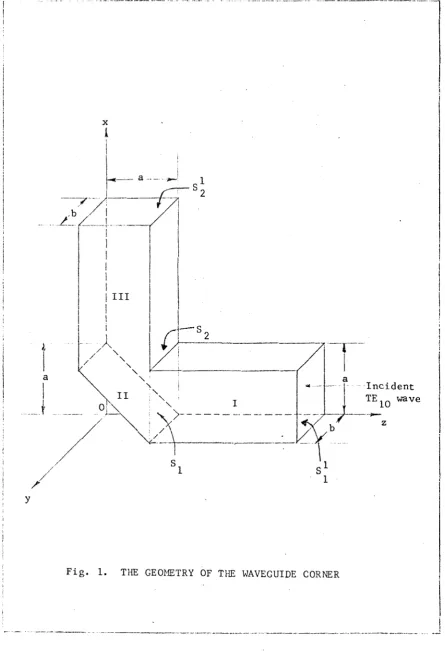
Figure 1 shows the geometry of the right angle symmetrically
truncated waveguide corner. As pointed out in sefction (1.2), so far
researchers have been concerned with establishing equivalent network
of the discontinuities from solution of the wave equation with appro
priate boundary conditions.
The present work deviates from this approach in that the
primary objective here is to obtain the plot of the fields involved.
The system equations are solved to obtain axial magnetic field in the
neighbourhood of, and including the discontinuous region. The total
region is broken up into three sub-regions as shown in fig. 1. The
three sub-regions in this case are not all simple regions in that the
field solution to sub-region II is not available. A numerical algor
ithm is developed for this sub-region in Section I I -2.
In view of the above discussion it is reasonable to assume
that the field in region II is the vector sum of the fields in sub-
regions I and III if the expressions for fields in region I and III
take into account the effect of the truncating plane i.e. they include
an infinite no. of higher order modes.
II-2 Discontinuity Field Analysis
In this section, solution is obtained for sub-regions I, II
6
i
III
Incident TE^q wave II
>
-y
(9 )
standard and are briefly stated. The numerical a l g o r i t h m for
sub-region II is discussed in some detail.
Since there is no discontinuity in the y-direction, the
electric and magnetic fields will be uniform in the y-direction
i.e. independent of variation in the y-direction.
Furthermore, the waveguide is so designed that only TE^q
mode can propagate in the waveguide so the appearance of higher order
modes will be mainly c o n f i n e d to the discontinuity region. Again,
due to symmetry in the y-directions, it will be assumed that all the
higher order modes will also be TE type.
Therefore, for Region I, near S^;
A Sin (— ) exp (r,z) + A R Sin(— ) exp(-r,z)
1 3 1 . 1 1 3 . 1
+ E~An S i n ( ^ ^ ) exp(F z) (2.1)
n = 2 a n
where
_ r i nrr \ 2 2 - i
r
=
[ T
- u jx e ]
t n L a ’ o o
2 n 2 1 ‘
P. = jfco p e -(-) ] 1 . J o o a J
Other field components are calculated using the following equations
derived from M axwell’s curl equations:
1/2
y n — 2, 3 j • • •
2
(
2.
2)
Where the superscripts refer to the sub-regions.
In sub-region III, it is assumed that the termination is
matched to the waveguide so that there are no reflections appearing at
i
S 0. T h u s :
= E B Sin (mrT'Z ) exp (-F x) (2.4)
y m=l m a r m
Where
rm = " “ V o 3 1/2 ’ m = I* 2 ’ 3 (2*5)
and the other field components are computed using the following
equations:
r^111 h i i i = _ i _ y
X
, * m
H = - -r2— (2.6)
z jcop. §Z
o
For sub-region II, it is assumed that the fields are vector
coefficients and are calculated by applying the boundary condition
on Ey in sub-region II.
Accordingly, the electric field in sub-region II is given
by:
E11 = E1 + E111 = [A1 Sin (— )(exp(r.z) + R,exp(-F,z))
y y y 1 a 1 1 1
+ E 0 A Sin(^-^)exp(-F z) + S B Sin(— )exp(-f x) 3 (2.7)
n=2 n a n m=l in a m
Equation (2.7) will automatically satisfy the boundary
conditions at and S2 (see fig. l) since the field in sub-region II
is the vector sum of the fields in sub-regions I and III. For instance,
at the contribution of fields in sub-region II due to those of sub-
region I is zero, satisfying the boundary condition at S
At the truncation plane, the boundary condition is:
E11 | , = 0 (2.8)
y 1x+z=a
For simplicity, let the incident TE^q m °de be of unit ampli
tude, i.e. A^ = 1.; then equation (2.8) becomes:
K1Sin(T )exp(-rli5) + n| 2 An Sin (SES) e x p l - r ^ l + j ^ s l n l ^ l e x p l - r * )
10
Truncating the infinite series in eq. (2.9a) to N terras each;
the number of unknowns in this equation is 2N. Therefore, by applying
eq. (2.9a) to 2N different points on the plane x+z = a; 2N equations
in 2N unknowns are obtained. P and P are calculated using equations
n m
( 2. 2) and ( 2. 5) respectively.
Equation (2.9a) can be written 2N times as:
rrx N N mrrz.
R,Sin( ) exp ( -P z.)+ E „ A Sin (-^^i) exp ( -ri z )+ E.B Sin( ~) exp( -P x )
J. a 1 1 n=2 n a 1 1 m=l m a m l
trx^
-sin( ) exp(riz 1)
a 1 1
rrx„ N Ttrrx N mrrz„
R-sin( )exp(-P z 0)+P A Sin( )exp( -p, z„)+P1B Sin( )exp(-p x„)
J. a 1 1 2 n=2 n a * 1 2 m=l m a r m 2
ttx2
■sin(--- ) exp(riz„)
a 1 2
trx^j N nnx_ N
R sin(— — )exp(-P z )+ EJ1 Sin( )exp(-P z )+ E.B
1 a 1 2N n = Z n a 1 2N m=l :
mrrz „ n x
Sin( )exp(-p x„ )= -Sin( )exp(P1z ) (2.9b)
a r m 2 N a 1 2 N
where x ^ + z ^ = a ; f = 1, 2, 3, ... 2N.
rcl k ] [ ^ ] = -rD i l ] (2.1 0 )
where fC., 1 is a 2N x 2N matrix whose element values are given by: lk
krrx.
C.. = Sin (--- -) exp (-r,Z.)
lk a k i
for i = 1, .... , 2N
k = 1 , a . . . 9 N
and
and
knZ.
C., = Sin(----— ) exp(-r,x.)
lk a k l
(2.1 1)
Pk+N “ r k for k ~ 1 ... N
[x. 1 is a 2N x 1 column vector of unknown field coefficients. Its l
elements are related in equation (2.9) by the following relation:
x i = R i
and [D ] is a 2N x 1 column vector whose entries are given by:
TTX.
D. = Sin(— ~)exp (F,z.)
i a l l
(2.13) f or i = 1, . . . 2N
The solution to equation (2.10) is,formally:
[x] = -[C]-1 [D] (2.14)
Solution for equation (2.14) involves matrix inversion of a complex
2N x 2N matrix, which can be accomplished on a digital computer.
„I ,,111 , _II
T h e n , the e x p r e s s i o n s for E , E a n d E are:
y
y
y
E* = Sin(— ) '*'Z + a 1 sin(— )exp(-F, z) + E ? a sin ( ^ p ) exp(-F z)
v a e 1 a 1 n= 2 n a n
(2.15)
E = E a s m ( )exp(-F x) (2.16)
v •> m a m
ro^l
N
E^1 = [{sin(^) (exp(r^z)+a^exp( -F^z)) an sin^^aT^exp( -I^z) } +
N
{ E , a Sin(^~!exp( -F x)]] ( 2. 17)
1 m a m J
The axial magnetic fields in regions I, III and II are given
as (by use of eqs. (2.2) and (2.5)):
HI = HI = . - i _ i
axial z ^
H1 = - ~~~~ [(-)cos(^) (exp(r..z)+a exp(-F.z) + 2- (^p)
z jcopt u a a 1 1 1 n=Z a
a cost )exp(-F z) ] (2.18)
. n a n
BE111 HIII = Hm = _ J _ y.
axial x
N
IIX 1 t-» /mcrr\ ** /mrrz \ / \ t * r%\
H = --- E (— Jam cos ( )exp(-F x) (2.19)
14
II II
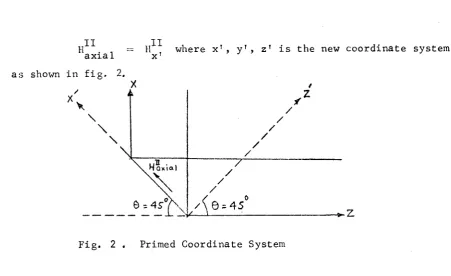
H . , = H , where x 1 , y ' , z' is the new coordinate system
axial x'
is shown in fig. 2.
X
A 0-45
Fig. 2 . Primed Coordinate System
Making the coordinate transformation from unprimed system
to primed system with equations of transformation given by eqs. (2.20);
E'^ is given by (2.21).
x = x 1 cos# + zjsin#
z = z 1 cos# - x Tsin# 4- a (2. 20)
I f # = 45 then
= (x1 + z 1)
/ 2
z = (zT - X 1) -pi + a
and
.N
{ E
m=i m
si n(mrr(:
a / 2
-X1 ) , / (xT+ Z T ) \
+ a) )} (2. 21a)
where
F = + a ) + a 1exp(-ri ^Z^ i; V a) (2.21b)
H"^ can be obtained by applying X
H1^ = T T " 5V (2.22)
X1 JW|J,
o Sz
Therefore with (2.21a) and (2.22), is obtained and then x'
transforming back to the unprimed system of coordinates . in terms 3 XI3 x
of x, y, and z is obtained (given by eq. (2.23))’
H1 1 . . = H11 + j H11 (2. 23)
axial are aim
where
n*1 = rot in [(sin(j3.z) (l-a ) + a cos(j3,z))
(r,
sin(^) + (j) cos ( ^ ) )are /2toji u K1 Ire lim ^ 1 a a a
+ E_ exp(-F z)a . (— )cos(— ) - sin(^-^) F ) + F exp(-r x)a .
n=2 n m m a a a n m=l r m mim
/ T T H T / I U l T Z \ ^ ^ . / U U T Z \ i t * \
(— cos ( ) -
r
S m ( ) J ( 2. 24)16
and
r
H^1 = - /k~ r(cos( P z) (l + a . ) + sin(p z) a . (t^- sin(r^) + (rr)
aim J 2wlx - 1 Jre P1 lim 2 a —
o a
cost— )) + exp(-r z)a . (— cost2 3 ) - T S i n ( ^ ) ) +
a n=2 n nre a a n a
E e x p ( - r x ) a (— cos t^3 ^) -r Sint2 2 3 ))] (2.25)
tt=1 m mre a a m a
where second subscripts re and im mean real and imaginary parts respectively
In arriving at equations (2.24) and (2.25) the following relations were
used.
2 TT 2 L/2
r i = % where h = ^ " y ^
" I ^ “ n — 1, ... N a = a +Ja„.
n nre nim
a =? a +ja . ; m = N + l , . . . 2N (2.26)
m mre mim
Equations (2.15) through (2.19) and ( 2.24), ( 2. 25) give
complete field solutions to the problem.
Using the solution method outlined above one can obtain the
field coefficients. The field coefficients values are substituted
in equations (2.18), (2.19) and (2.23) to obtain the axial magnetic
fields near discontinuity, the z-dimension in the input guide can be
taken as 5\g and the x-dimension in the output guide can be taken as
CHAPTER III
THEORY OF THE EXPERIMENT
III-l General
The most commonly used experimental techniques to plot the
electromagnetic fields inside a waveguide consist of small electric
or magnetic probes inserted through slots in the waveguide walls.
These methods are fine except that the probes can appreciably disturb
the fields to be plotted.
suggested here. Before going into the detailed theory of the method
it is relevant to point out the analogue that is suggested as a means
of achieving the desired result. An examination of the wave equation
and its solution in acoustics for pressure variation reveals that there
exists a resemblence between acoustic pressure variation in an acoustic
waveguide and axial magnetic field variation in an electromagnetic
waveguide.
The acoustic wave equation in terms of excess pressure, p,
in three dimensions is given by:
A non-disturbing technique to obtain the field plots is
(3,1) c
for time harmonic fields with boundary conditions
Equation (3.1) applies to a straight waveguide with z axis as
the axis of propagation and rigid walls (normal particle velocity being
zero at perfectly rigid walls.)
Solving equations (3.1) and (3.2) for p gives:
pi v (x, y, z) — P / x cos cos p p exp(-Pz) (3.3)
y ‘vm,n) J o (m,n) a b
rCJ2 . 2-i 1/2 P = propagation constant = + K J
c
For the (l,0) mode the expression becomes:
p (l j0)(x, y, z) - po (ij0) cos (? } exp(_Pl0 z) {3‘4)
where P^^ is the propagation constant for the (l,0) mode. The expression
(3.4) resembles the expression for in the TE-^q mode for the correspond
ing electromagnetic waveguide:
u „ rTTx'\ -rio z joJt (3.5)
H = H._ cos(— )e 10 e
z 10 a
where the propagation constant for the TE^q wave.
The analogue between pressure field in an acoustic waveguide
and corresponding electromagnetic waveguide will not be complete without
cin investigation of boundary conditions in the two cases. Since a
waveguide termination is used in most practical applications, the follow
ing discussion on boundary conditions assumes a waveguide with rigid
20
At a perfectly rigid plane wall, the normal component of
particle velocity must be zero and since:
3u _ 1 Bp
Bt £ Bn = 0
we have = 0
Bn
which implies that Bp. 3x
x=0 ,a
Be By
Be
3z = 0 (3.6)
z=0 ,d y=0 ,b
In the electromagnetic guide, the boundary conditions on
H a r e : z BH ___2 Bx x=0 ,a BH ___ 2 By
= o (3.7)
y=0,b z=0 ,d
is not complete since is normal to the wall at z
A comparison of equations (3.6) and (3.7) reveals ttet theanalcgje
0,d. Therefore,
to establish a complete analogue, one has to look at the pressure dis
tribution at a boundary away from the rigid wall.
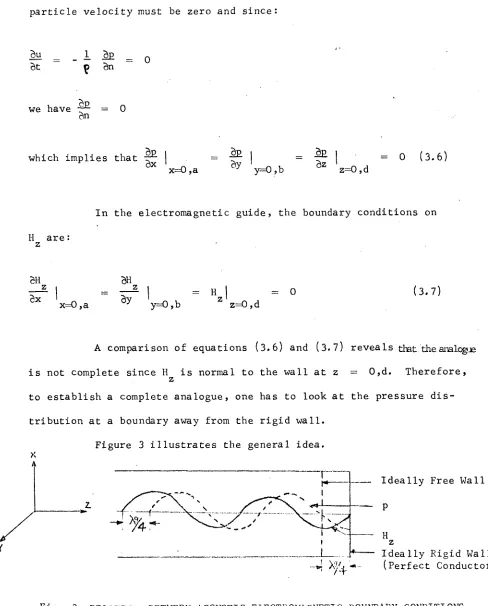
Figure 3 illustrates the general idea.
Ideally Free Wall
Z
Y
Therefore, the axial H-field normal boundary condition is
analogues to the acoustic pressure condition occuring a quarter wav e
length away from the rigid wall.
Equations (3.4) and (3.5) along with similar boundary condi
tions on p and clearly demonstrate the analogous behaviour of acoustic
pressure and axial magnetic fields in waveguides. This suggests that
a longitudinal discontinuity in an electromagnetic waveguide can be
studied (in terms of the spatial field distribution) by simply studying
the pressure variations in the acoustic waveguide.
Holographic technique can be advantageously employed for a
study of the analogous acoustic waveguide referred to above. In the
following section, the basic principles of holography are explained.
I l l -2 HOLOGRAPHY
Holography,also referred to as lensless photography, is
essentially a two step imaging process. The first step consists of
recording the interferrogram between a reference and an object beam
(light beam scattered, diffracted or transmitted by the object). After
developing, the interferrogram is placed in the same position as before
and a reference beam is used to view the ''reconstructed'' object. The
object is reproduced by virtue of the reconstruction of the object
beam that has complete information (amplitude and phase) about the
light coming from the object. In the 11 recording'' process, if the
distance traversed by the reference beam and the object beam to the plate
22
phase variations introduced in the object beam by the light coming from
different points on the object itself. In other words, the path
difference introduced between the object and the reference beams (due
to object) is responsible for intensity (amplitude) and phase variations
on the object beam. Next, we consider how such a hologram can be made.
Light waves that are scattered, diffracted or transmitted
by the object impinge on the photographic plate. This light wave
is completely described by its amplitude and phase as functions of
position. The photographic plate will only record the amplitude. To
preserve the phase information, a reference beam, derived from the
same coherent light source, is impinged on the plate. The plate records
the interference pattern between object and reference beams. The inter
ference will be constructive or destructive according to the relative
phase difference between the object and the reference beams at the
plate thus producing a fringe pattern on the plate. In general, one
can look upon the fringe pattern as a spatial modulation process, in
which the reference beam incident at the photographic plate has
superimposed on it the information that was carried by the object beam.
I l l -3 ANALYTICAL DESCRIPTION OF HOLOGRAPHY^10^
Let £he field strength of object beam at the plate be given
(in complex exponential form) by: (Fig. 4)
Fig. 4
24
where
f'c = ^ is the frequency of the lightwave and and § describe the
amplitude and phase of the light at each position (x, y, z) of the recording
plane. Let the reference beam be:
V 2 = V y, z) exp [j(kx + u>t)3 (3.9)
where k represents the propagation constant in z-direction and is given
2rrcpsft
by . . > 6 is the angle at which the reference beam is incident on the Ac
plate (the angle between the direction of propagation and the normal to
the plate).
The total field at the hologram plane P^ is:
V = Vq+ = [V^ + exp(jkx-j$) 3 exp(j§+jwt)
and the i n t e n s i t y of the recorded field is:
t 2 2
I = J V. V ^ d t ^ V ^ + V ^ + V jV^exp( jkx-j $)+V^V^exp( - jkx+j $) 3
i.e. I = + 2V^V^cos (kx-§)
In the above expression the cosine term indicates that the
spatial amplitude modulation and phase modulation §, are preserved
regard the holographic plate as a (i) detector or mixer to produce a
spatial waveform from a temporal one and (ii) a storage device preserving
the spatial distribution thus produced.
In the reconstruction process, let the reference beam be
incident on the plate. The amplitude transmission through the plate
which is coherently illuminated by V d e p e n d s on the '1 transmittance
cf the plate1T, T. Under normal conditions of photographic processing
T is approximately proportional to the intensity of the exposing radia
tion i.e.,
T cc I = + ^ ^ 2 cos [kx-§(x, y> z) }
Since the transmitted wave amplitude is given as the product
of the incident wave amplitude and the transmittance, the wave emanating
from the plate illuminated by a replica of the reference beam \ ? 2 i-s:
V. = rv? + V Q2 + 2V V cos(kx-$)}.V0
4 1 3 1 3 2
that is
2 V 1 I
= V^^V-^expJ j<|>)+(V3+— )exp( jlcx)+V1exp(2jkx-j<fi)Jexp( jwt)J (3.10)
Thus, the light emerging from the plate consists of three
te r m s :
26
and thus when sensed by the observer, appears to be coming from the object
(even though the object has been removed). It produces a virtual
image behind the plate.
(ii) The second term is merely the reference beam and can be reduced
by making large as compared to (typically 10 times as large).
(iii) the third term represents the presence of the original wave
with a negative phase term. This implies that, when sensed by an
observer there seems to be a wave propagating ,Ttoward,T a version of
the object. This is the real image of the object,• formed in front of
the plate and it can be viewed or projected on a screen without the
use of additional optics.
The exp(jkx) term merely suggests that the wave leaves the
plate obliquely and thus images will be formed off-axis.
In the above analysis light is described as a cosi nusoidal
waveform implying thereby that it is highly monochromatic and is derived
from a single point radiator i.e., the light has both temporal and
spatial coherence. The light produced by a correctly adjusted laser
is highly monochromatic and spatially coherent. These features make the
laser an automatic choice for the light source in this application.
Next, since the holographic process is essentially an interferrometric
method, components (mirrors etc . ) should be stable. For this reason
all the components have heavy bases and the whole setup is on a stable,
vibration free, flat stone table. This stability requirement on the
III.4 VIBRATION ANALYSIS
The adherence to requirements of stability imposed on compon
ents and the object itself during the exposure time is vital to obtain
a hologram of the stationary object. A vibrating object can be considered
stationary if the exposure time is much less than the period of vibration
of the object (’’pulse .holography’’). ’’Pulse’’ holography gives infor
mation regarding the amplitude of vibration at various points of the
object at one particular instant of time.
An extension of the above idea is double-exposure pulse-
holography. Here, two ’’pulse1' holograms are recorded on the same
holographic plate — one with the object in the stationary state, the
other with the object at its peak amplitude of vibration. This type of
hologram can yield information regarding deformation of the surface
of the object due to its motion. The optical path difference between
the two object beams introduced by the motion of the object gives a
fringe pattern in the reconstructed image.
One of the difficulties in ’’pulse holography’’ is that of
synchronization of the laser pulse with the maximum amplitude of vibra
tion of the object,that is, one must know precisely when to activate
the pulsed laser so as to avoid recording the object going through a
null position. This is difficult to decide in most cases and particularly
so in the case of standing wave in a ’guide.
A further extension of the idea of double exposure pulse
holography is time-average holography. This can be thought of as the
28
or scattering) surfaces distributed along the positions that the actual
vibrating object will occupy during the exposure time. In this type of
holography the exposure time is several cycles of the frequency of
vibration of the object and a continuous wave laser such as a He-Ne
laser is used.
Powell and S t e t s o n ^ ^ described a method for recording
various modes of vibrating objects using time-average holography.
It was shown that each part of the reconstructed image will be degraded
in accordance with the amplitude of vibration of that part of the object.
The intensity of reconstruction and the amplitude of vibration of the
object are related by the zero order Bessel function :
I = J [r“ L 3 x I (3.11)
o St
c
where L is the maximum optical path length change and I is intensity
of the image of the stationary object.
The reconstructed image thus has dark and light fringes
corresponding to the zero and extrema of Jq respectively. These lines
represent the contours of constant amp of vibration.
In order to view the hologram reconstruction (and any of the
interference effects that may occur due to motion of the object during
the recording interval), one must image the wavefronts diffracted by the
hologram when it is illuminated by a suitable replica of the reference
field. One method consists of illuminating the hologram by a wave
time average holography is the amplitude of vibration of the object.
As indicated by equation (3.10) the intensity of the reconstructed
image depends on V which in turn depends on the amplitude of vibration
of the object. A very low amplitude will mean a low phase shift (angular
path difference) between reference and object beams thereby giving a
2rrL
small number of fringes (or no fringes at all if is less than the c
first zero of dQ )* On the other hand, too large ananplitude will
mean a large number of fringes and the extrema will be small in amplitude,
resulting in poor fringe contrast in the reconstructed image.
I l l -5 APPLICATION OF VIBRATION ANALYSIS
The technique of time average holography can be applied to
obtain the fringe pattern in the reconstructed image that corresponds
to the excess pressure field variations that are present in an acoustic
waveguide. The passage of a pressure wave causes the refractive index
of a material to change. This creates an optical path length change
between the two parts of the object beam (one passing through the region
of maximum refractive index change and the other passing through the
region of minimum refractive index change) and a fringe pattern is thus
obtained in the reconstructed image.
Equation (3.1l) shows that the brightness of the reconstructed
image is proportional to the magnitude of the zero order Bessel functions
2ftL
of argument . Since the first zero of J occurs at approximately c
2.40 radians; the minimum phase change, , between two object beams must
correxpond to this value. In order to obtain five to six dark and light
30
One way to obtain the phase shift, §, is to change the optical path
length for the object beam. A change in optical path length can be
affected by changing the optical refractive index of the medium through
1 *
which the beam is passing, since c = — c . As the pressure wave n
travels through the acoustic waveguide the refractive index of the medium
is changed according to the pressure variations in the compressions and
rarefactions of the wave. Actual data shows that the relation between
refractive index and pressure is linear for most cases (fig. 5, 6). Thus,
the peak to peak pressure variation in the acoustic waveguide introduces
a change in optical path length of the object beam as it passes through
the waveguide, and hence effects the phase shift, §.
From equation (3.11) we have,
I = J U ) I
o st
2ttL ' _ , or ^ — r $
c
or 2rr (Maximum change in optical path length due to pressure variation) = §
(3. 12a)
Therefore, knowing S, by considerations of fringe number
desired, a maximum change in optical path length can be calculated from
equation (3.12a). The corresponding necessary change in refractive index
R
e
f
r
a
c
t
i
v
e
I
n
d
e
x
1.030
1.025
1.020
19 C
1.015
1.010
1.005
1,000
120
15060 90
0 30
Pressure (Atm)
32
1. 4 03
TEMP
M
40 • « a l c o h o l
1 9 -sz ALCOHOL
300
900
Pressure(Atm.;
Fig. 6 Pressure vs Refractive Index (Water and
Water and Alcohol Mixtures)
1200
( 1 2 )
III.6 EXCITATION OF ACOUSTIC GUIDE '
When the acoustic frequency is sufficiently highso that more
than one mode can be propagated in the guide, it becomes necessary to
design a source which will excite only the desired mode. As in the
electromagnetic case, one can design mode filters to allow only one
mode to propagate without special design of the source but as it turns
out, the design of the source is much more convenient to control in
the acoustic case. For this, it is important to realize the conditions
necessary for the exclusion of unwanted modes.
The velocity potential v i-n a lossless semi-infinite rectangu
lar acoustic guide defined by the planes at y = + a and z = + b
- (12)
and source located at x = 0 is given by
v = v Sin( ^ ^ ) e x p j(wt-p x) (3.13)
n=0 n cos 2a pn
except in the vicinity of the source. Since the source is u = U(y)
exp(jwt), the x dependance can be neglected if frequency f does not
Q g / \
exceed the cut off frequency — of the (0, 1) mode. Also,
"W 2 9 1/2
^n = £(^ ) ” ^^b^ ^ ^or ^n ’ ^ m°de ' (3.14)
V " = t ^ t3.»)
34
(3.15) is zero for any value of n, (i.e. a particular mode), the source
will not excite that mode.
In particular a symmetrical source [u(y) = u ( - y ) 3 w i l l
not excite odd order modes while an an tisymmetrical source will only
excite odd modes.
If the frequency of operation is so adjusted that only (0,0)
and (l,0) modes propagate (i.e. — < f g < ^ ) , then these modes can be
selectively excited by two piston sources operating with equal amplitudes
in phase or out of phase giving conditions of symmetrical and anti-
symmetrical sources described above. Equation (3.15) gives the conditions
for elimination of (0,0) and (1,0) modes as:
+b
J U(y) dy = 0 (3.16a)
-b
and
+b
j
U(y) sin (^■)dy = 0 (3.16b)-b
Equation (3.16a) means that the mean strength of the source
should be zero and (3.16b) implies that the source be symmetrical
and have zero strength at the origin.
To excite mode (2,0) free of (0,0) and (l,0) modes, one must
satisfy equations (3.16a) and (3.16b) simultaneously. This can be done
if we have three piston sources; a pair of equal amplitudes and same
phase located at + yQ (where Y0 < b ) and a third at y = 0 in a n t i
+b
U(y} CO S (“t") = 0 (3.16c)
-b b
Condition (3.16c) can be achieved by reversing the phase
of the centre source ( ^ p i s t o n ' 1) fchA (l,0) modeiwill still be excluded
since the source remains symmetric.
III.6 EXCLUSIVE EXCITATION OF P MODE 1°
For this mode the sourceatx=0 must be anti symmetrical so
that all the even modes will not be excited by virtue of equations (3.16).
The exclusion of higher (odd) order modes is affected by proper choice
of the frequency f of the transducer (acoustic source). If f is chosen
s s
so that “ < f < then modes (3,0). (5,0) etc. will all be cut off.
6a s ' 4a
Therefore, if two transducers at + yQ (y < b) operating with
equal amplitude but opp. phase are used, the only mode excited will be
(l,0). Small probes may be placed at +b and at origin to monitor the
proper amplitude and phase relationship of the sources. Ideally, the
CHAPTER IV
EXPERIMENTAL SETUP
IV. 1 GENERAL
For mechanical convenience the waveguide dimensions were
chosen to be 7.185 x 3.36 cm.I. D> This corresponds to a cutoff
frequency of 2. 376 kHz for the (ip) mode in air at 18°C and a cutoff wave
length of 14.37 cm. The cutoff frequency for the (0,l) mode is about
5.080 kHz. The mediatised have the property of being colorless and not
reacting with plexiglass, which is the material for the wavegiide. The
length of waveguide was kept at 20 cm. for the straight guide while for
the truncated corner one of the arms, was 20 cm. long. The reason for
this is because of the pressure probes that extend up to app 6 cm, of
the length of the 'guide! Thus the region under observation is relatively
free from distortion introduced by the presence of the probes. The
frequency used was 6.0 kHz.
The vibrations in the walls of the waveguide are kept at a
minimum by making them 1.0 cms. thick (see Appendix I).
I V . 2 ACOUSTIC DESIGN
Based upon equations (3.12a) and (3.12b), the maximum change
required in refractive index, to obtain the phase shift, §, of 13.0 to
14.0 radians in the light beam, is from 13.09936 x 10 ^ to 14.1070 x 10 ^
per cm. of path of light in acoustic waveguide. Expected number of fringes
is about five (corresponding to the number of extremas for Jq in 13.0
The maximum pressure change required to achieve this change
in refractive index (see Fig. 5) for air would be 0.000325 p. bars.
This corresponds to a sound pressure level (SPL) of 140 db. In terms
4
of acoustic power this SPL is approximately equal to 10 watts. Such
high power requirements, if the above computations are to be considered
reliable (an earlier estimate had yielded a lower value), would be
difficult to meet through normal amplification systems. In any event,
attempts have to be directed towards utilizing high power transducers
along with high pressure microphones to generate or monitor the pressure
inside the waveguide.
Figure 7 gives the details of the excitation system. This
(
12)
is based upon a similar arrangement used by Shaw in an experiment
to determine absorption coefficient of different acoustic materials.
The unsymmetrica1 excitation is achieved by operating two loud speakers
in phase opposition. The excitation for both LS^ and LS^ is derived
from the same source; Oscillator (200 CD HP) which is fed to a stereo
amplifier (80 watt stereo). The phase reverse control on the stereo
amplifier is used to obtain phase opposition between LS^ and L S^
The amplitude controls on chi and ch2 of the amplifier are so adjusted
as to give the same amplification to both channels.
The amplitude and phase of the pressure is monitored by
using two identical B and K microphones (type 4136). The connection
to the respective probes is made by a small flexible rubber tubing. The
length of the two rubber tubes is kept the same and small to have the
38
LS. LS.
! To
Oscillator
To
Oscilloscope
0. 9 mm
20 cm. i dia.
Steel Probes
7. 2cm
To
Oscillatot
To 'scope
Waveguide
End Flange
The output of the microphones is monitored on a dual beam oscilloscope
for ready comparison.
IV.3 LIGHT SOURCE AND HOLOGRAPHIC PLATES
Since time average holography was to be tried the source of
o
light is a JODON He-Ne laser with A of 6328 A and max power output of
15 mw. A spatial filter is used to ''clean11 the beam and then a beam
splitter (mostly 25 mm. cube type) is used. Wheneverthe mirror type beam
splitter is used, it is placed in front of the spatial filter as shown
in fig. 8.
Holographic plates used were SCIENTIA 10E70 and 8E70 plates.
The data on these plates appear in Table (4.1). The 10E70 plates are
high resolution, average sensitivity plates while 8E70 are high resolu
tion, low sensitivity plates. Film 14C70 is extremely low resolution
and highly sensitive. The 10E70 plates were chosen in view of the max;
power available from laser.
All the optical components used were highly stable and the
experiment was carried out on a stable vibration free, flat surface.
IV.4 EXPERIMENTAL DETAILS
The max. pressure created inside the acoustic guide was 100 db
(for air and water). Figures 8 and 9 represent the general scheme used
for obtaining the hologram. Table 4.2 lists the critical distances
involved, exposure times and remarks on the result of the hologram.
The light beam was incident normally on the waveguide (object) and the
40
OBJECT
SPATIAL FILTER
Ml
EXPERIMENTAL SETUP (SCHEME A) Fi
BEAM SPLITTER
]LASER
OBJECT
SPATIAL \ FILTER
/Ml
Fig. 9. EXPERIMENTAL SETUP (SCHEME B)
PLATE OF FILM TYPE RESOLUTION lines/mm SENSITIVITY erg/cm2
10E70 2800 50
8E70 3000 200
14C70 1500 high
TABLE 4. 2
ACOUSTIC PRESSUIE =100db. PLATE USED 10E70, POWER LASER=13.0 raw.
PLATE NO.
1
SCHEME
USED MEDIUM d i
4' 2"' j ~ J ! d3 EXPOSURE TIME (SECS. ) RESULTS
A AIR 0 1 7" 3' 7" ' 120
IMAGE OF 'GUIDE - NO FRIN3ES
2 A AIR 4' 2' 'O' 7" 3' 7" 10 BETTER IMAGE-NO FRINGE
3
18
A AIR 4' 2" 0' 7" 3' 7" 1
IMAGE BAD-NO FRINGES
A AIR 4'5" 1 • 3 * ' 4' 2" 20 3 IMAGES-NO FRINGES
20 A
WATEk 4 1 5' '1 1 3 ’ ' 4' 2" 20
\
BAD IMAGE-NO FRINGES
21 | B WATER
*
i
i 5 ' 3 "0 ' 8 "
' .
1' 11" ] FAINT IMAGE-NO FRINGES
22 B
' i |
WATER1 3' 3 ’ '.O' 8' '
_______ ]______ L _
I'll1'! 5
1. ... . ... .
CHAPTER V
RESULTS AND DISCUSSIONS
V.l COMPUTATIONAL RESULTS
The algorithm outlined in Chapter II was used to obtain
numerical results on an IBM 360/50 computer. For the calculation of
elements of matrices C and D a FORTRAN IV programme is used. For inver
sion of complex matrix C and evaluation of complex field coefficients
(vector x) MATLAN is used.
The results are presented in Table 5-1. (Appendix I I ). The
reflection coefficient for some of the runs are higher than one which
-9
is physically inconsistent. On setting the error criterion at 10 , some
of the results improved, although the difference from the previous results
was only at the sixth decimal place. Setting the error criterion even
-5 "3
higher, at 10 and 10 , the coefficient values changed significantly
but some of the reflection coefficients were still' higher than one. No
trend in the values of coefficients with error settings could be observed.
The reason for inconsistent reflection coefficients is not
immediately obvious. It is possible that the initial assumption made
in developing the algorithum, namely that the field in the subregion II is
vet£or sum of fields in subregions I and III, is responsible for this behaviour.
V . 2 EXPERIMENTAL RESULTS
As indicated in Chapter IV, Table 4.2, the hologram studies
were conducted varying different parameters such as distances involved
and medium in the acoustic waveguide. Although the holograms of stationary
varia-tion in an acoustic waveguide could not be obtained in these runs.
In what follows, some possible reasons for this are briefly
enumerated and discussed:
(i) Acoustic power considerations. It is possible that
acoustic power level may have been too low to create any appreciable
difference in optical path length between two object beams. But on the
otherhand, power levels of the magnitude predicted by theory (section IV-3)
are impractical.
(ii) Acoustic frequency considerations. The choice of acoustic
frequency depends on the following considerations:
(a) A n incorrect choice of frequency might lead to the fringes
in the hologram being washed out. The criterian here is that if the
exposure time is greater than the time required to obtain an optical
phase shift of ninety degrees, between object and reference beams, then
the fringes will be washed out.
A simple calculation shows that for the present choice of acoustic
frequency (6.0 KH Z ) , the exposure time is much less than the time required
to obtain phase shift of ninety degrees between object and reference
beams. In fact high acoustic frequency in the range of several megahertz
is low enough to ensure that the criterian for obtaining the fringes is
not violated.
(b) A low acoustic frequency has the disadvantage that a
corresponding high acoustic power is required to effect the necessary
(optical) refractive index change in the waveguide (as indicated in
require-44
ments to a reasonable level (14).
The problem associated with the use of high frequencies are
two fold - first, the existance of (propagating) higher order modes in
the waveguide and second, the phenomenon of Bragg reflection. Both the
these effects are undesirable since they interfere with the objective
of this experimert;
The frequency used in this set up is a bit low so that high
acoustic powers must be generated. A proper choice of acoustic frequency
seems to be 1.0 M H Z , which gives the advantages associated with high
frequencies while avoiding the disadvantages that might ensue if the
The problem of obtaining electrical and magnetic field structures
inside a rectangular waveguide corner has been investigated from both
theoretical and experimental aspects.
A theoretical analysis of the problem is carried out and field
coefficients have been calculated. Some, of the results display a reflec
tion coefficient higher than unity. It can be concluded that the approx
imation used to calculate the field structure is not completely satisfactory.
The reason for this may lie in the assumption that field in discontinuous
sub-region is the vector sum of the fields in the continuous sub-regions.
An experimental method for indirectly obtaining the field structure
is developed based on the analogy between the axial magnetic field in an
electromagnetic waveguide and excess pressure variations in a corresponding
acoustic waveguide. The experimental strategy is charted out. A no n
disturbing method (holographic interferrometry) of obtaining excess pressure
variations in the acoustic waveguide is described. Exploratory runs were
made during this investigation in an effort to obtain hologram^of^ above
mentioned pressure fluctuations. Although the results obtained with the
existing equipment fail to display the fringe pattern for an acoustic
waveguide, it is believed that further investigations can overcome the
associated experimental difficulties (as discussed in section V . 2, Chapter V)
and that the strategy presented in this thesisis a workable one.
BIBLIOGRAPHY
1. Miles, J . W . , 1'The Equivalent Circuit of a Corner Bend in a Rectang ular Wavegui.de'1 , Proc. I.R.E., Vol. 35, Pp. 1313 - 17, Nov. 1947.
2. Rice, S.O., ''Reflection from Corners in Rectangular Waveguides --Conformal Transformation1', Bell System Technical Journal, Vol. 28,
Pp. 104 - 135, 1949.
3. Kao, K.C., ''Approximate Solution of the 11-Plane Right-Angled
Corner in Overmoded Rectangular Waveguide, Operating in H Mode'', Proc. I E E , Vol. Ill, No. 4, pp. 624 - 628, April 1964.
4. Hamid, M.A.K. , ''An Investigation of Sharp Discontinuities in Rectangular Waveguides by Ray Theory'', International Microwave Symposium, Proceedings, Detroit, Michigan, pp. 39, IEEE cat. no. 68, C38, 1968.
5. Goyal, K . G . , ''Field Structures in Waveguide Corrars'', M.Sc. Thesis, University of Toronto, 1969.
6. Poritsky, H . , and Blewett, M . R . , ''A Method of Solution of Field Problems by means of Overlapping Regions,'' Quarterly of Appl. Math., Vol. Ill, No. 4, Jan. 1946.
7. Campbell, J . J . , ''Applications of the Solutions of Certain Boundary Value Problems to the Symmetrical Form-Post Junction and Specially Truncated Bends in Parallel-Plane Waveguides and Balanced Strip Transmission Lines1', IEEE Trans. M T T , Vol. MTT-16, pp. 165 - 176, March 1968.
8. Campbell J.J. and Jones W . R . ,''Symmetrically Truncated Right-Angle Corners in Parallel-Plate and Rectangular Waveguides'', IEEE Trans. MTT, Vol. MTT - 16, pp. 517 - 529, Aug. 1968.
9. Collin, R.E. , ''Field Theory of Guided Waves'', McGraw - Hill Book Co 1960.
10. Reynolds, G . , and DeValise, ''Theory and Applications of Holography'' Addision - Wesley.
11. Powell, R . L . , and Stetson, K . A . , ''Interferrmetric Vibration
Analysis by Wavefront Reconstruction1', J. of Optical Soc. of Amer. Vol. 55, No. 12, pp. 1593 - 1598, Dec. 1965.
13. 1'Handbook of Engineering Fundamentals'', Eschbach, W . , e d . , 2nd ed. John Wiley, 1966.
APPENDIX I
CALCULATION OF MAXIMUM VIBRATION OF WAVEGUIDE WALLS
The problem of vibration of waveguide walls can be considered
as equivalent to that of bending a plate of dimensions a x b, fixed
(rigi dly) on all sides as shown, in Figure A-I below. It is possible
\ \ \ \ \ \
(o, O)
a
_ Y . . .
i ---.)
to do so since the waveguide walls were formed by gluing together
four Plexiglass plates each one centimeter thick. It is assumed that the
glue is perfectly applied.
To calculate maximum deflection at (0,0), co , due to a maximum max
constant pressure of q p.s.i., the following formulae are used (13).
CO
max 0.00230 qa /D (A.l)
for b/a ^ 1.7, and
(0
max 0.00260 qa4/D (A. 2)
Eh
2n r 11-5 )
where h = thickness of plate
E = Youngs’ modulus
A = Poisson ratio (0. 3 + 5$)
The pressure in the waveguide is acoustic pressure and it is
not concentrated at any one point, but varies sinusoidally. However, if
we take it to be constant and equal to p and calculate OJ due to p =q,
o max o 7
the resulting waveguide wall design will be conservative since pressure
will never be greater than p^. A maximum variation of k/100 may be
considered as limiting w & max
In Table A.l, the pressure values corresponding to two to max
values are indicated. Equation A . 2 is used since b/a = 2.1.
TABLE A.l
to max
\ / 1 0 0
V i o
0.3
0.3
q , p.s. i.
6.936
69.36
q, pbars
0. 47
4.70
As can be seen from the above table, a pressure of 0.47 pbars
would be needed to move the waveguide walls by A./100. But from the
50
0.0035 pbars. Therefore 1 cm. thick plates are adequate for our pur
Table 5.1
COMPLEX FIELD COEFFICIENTS AND THEIR MAGNITUDE
FIELD FREQUENCY^4.32 GH
COEFFICIENTS Real Imaginary Absolute Va li
R 1 -4.578 x 10 -1.025 1.1.23
A 2 ! 2.552 -4.278 x 101 2.590
A 3 -2.796 5.976 6.598
A 4 5.594 x 10 -2.421 x 10 6.096 X 10
A 5 -1.767 x 10² 7. 753 x 10 1.930 X
io 2
A 6 -4.621 x 10² 1.983 x 10² 5.028 X
io 2
A 7 4.186 x 10 -1.179 x 10 4.349 X 10
A 8 2. 785 x 103 -1. 296 x 103 3.072 X
io3
: A 9
3
-2. 206 x 10 -8.177 x 102 2.352 X
io3
l
i
; A 10 -1.479 x 10³ 5.193 x 10² 1.568 Xio3
I
B 1 -8.851 x 10 2 -3.304 x 101 3.420 X
io"1
B 2 -1.936 2.999 3.570
B 3 -1.533 -5.576 5.783
B 4 8. 205 2.685 x 10 2.807 X 10
1 B 5 2.150 x 10 -6.877 2. 257 X 10
| B 6 1.027 x 10 -4.022 x 10 4.151 X 10
i B 7 4.757 x 10² -1.317 x 10³ 1. 400 X
io3
B 8 4.813 x 10² -4.964 x 10^ 6.914 X 10 2
B 9 -1.605 x 10²
2
8.673 x 10 8.821 X
io 2
:..—
b i o
... ... ...
FIELD
COEFFICIENTS Real
FREQUENCY = 4. ' I...
; Imaginary
40 GHZ
Absolute Value
R 1 1.175 x 10_1 : -8341 x IO"1 8.423 X
io -1
A 2 -7.833 ii 6.447 1.014 X 10
A 3 -2.408 K 10 ; 2.045 x 10 3.160 X 10
A 4 3. 743 x 10 j 2.817 x 10 4.685 X 10
A 5 5.161 x
io2
\ -4.100 x IO2 6.592 Xio2
A 6 1.196 x
io3
1j -9.646 x IO2 1.536 Xio3
A 7 -5.106 x 10
{
I 7.511 x 10 9.081 X 10
A 8
3
-3.451 x 10 2.701 x IO3 4.383 X
io3
A9
8. 8 45 xio3
| -7327 x IO3 1. 148 Xio4
a io 6.033 x
io3
-4.978 x IO3 7.823 Xio3
B 1 3.284 x
io"1
; 1.025
xio"1
3.440 Xio"1'
B 2 1.967 ;1.380 1.826
B 3 1.409 x 10 j 4.990 1.495 X 10
B 4 1.666 x 10 ■ 2. 798 x 10 3.256 X 10
B 5 7.975 x 10 : 2.961 x 10 8.507 X 10
B 6 3.807 x 10 ;-9.117
■
3.914 X 10
B7
7.210 xio 2
’■-4.552 x IO2 8.07 x IO2B 8 9.640 x
io 2
1.417 x IO2 9.743 Xio 2
B9
-2.057 xio 2
’4. 974 x IO2 5,383 Xio 2
Table 5.1 (contd.)
FIELD
COEFFICIENTS
FREQUENCY = 4.90 G H ;
Real | Imaginary | Absolute Valu
.
i
R1
-1.095 S -1.215 x 10 j|
1.101A 2 -1.438 | -6.211 6.376
A 3 -1.099
!
• 3.403 x 10I
3.405 X10
A 4 -1.618 x 10 -1.293 x 102 1.303
2 io 2
A 5 1. 254
j
-2. 303 x 102j
2. 303 Xio2
A 6 -1.787 x 10
!
-8.457 x 10² 8.459 Xio2
A7
8.698 x 10 i 1.092 x 10³ 1.096 Xio3
>
00
3.270 x 10² ; 5.207 x 10³ 5. 218 Xio 2
A 9 -1.884 x 10
j
-4.862 x IO3 4.863 Xio 2
a io -3.488 x 10² : -6.360 x IO3 6.370 X
io 2
B 1 3.056 x IO-1 1 -3.387 x 10_1 4.562 X
io"
B 2 -3.722 x IO- 1 ; 3.238 3. 259
B 3 -2. 396 5.943 6.407
B 4 -1.204 x 10
7.566 x 10 7.660 X 10
B5 -1. 210 x 10 1.382 x 10 1.837 X
10
B 6 -3.348 x 10 6.743 x 10 7.529 X 10
B 7 1.560 x 10 -1.686 x IO2 1.694 X
io 2
B 8 8.029 x 10 -4.885 x IO2 4.950 X io2
B 9 -3.107 x 10² 8.054 x IO2 t
8.633 X io2
.
FIELD COEFFICIENTS R A, A , A f A ( A. / A £ A„ 1 10 5 56 Real
I 1.395
! 6.523
j
5.289 x 10; -4.232 x 10
[ -5.383 x 10'
]
! -9.959 x 10'
8.172 x 10
5.935 x IO2
-1.022 x 10Z
,2
-1
10
1.494 x 10
1.818 x 10
-4.489
1.579 x 10
7.356 x 10
1.292 x IO2
j -1.119 x 10' {
| -1.302 x 10"
1 3.450 x IO3
3.204 x IO3
5.420 x IO3
FREQUENCY = 4.53
Imaginary
1.77
1.694
1.644 x 10
-2.505 x 10
-2.812 x IO2
-5.423 x IO2
3.526 x IO2
8.674 x IO2
-4.909 x IO3
-4.321 x IO2
-1
GH,
-1 5.460 x 10
-2. 715
3.129 x 10
3.888 x 10
1.212 x IO2
-3.204 x 10
-7.570 x 10'
1.766 x IO3
1.725 x IO3
3.820 x IO3
Absolute Value
2. 255
6.740
5.539 x 10
4.918 x 10
6.073 x IO2
1.134 x IO3
8.900 x IO2
1.051 x IO3
1.134 x IO4
4.457 x IO2
| 9.536 x 10 \
| 5. 246 i
; 1.580 X 10
I
j 8.320 X 10 t
; 1.771 x 10'
| 1.644 x 10' >
\
j 1.506 x 10" j
I 3.876 x 10" j
! 3.639 X 10j
|
-5I 6.631 x 1 0 ”