One of the most interesting and rich fields of recent artificial intelligence (AI) research has come from examining embodied agents, the creation of which, poses interesting challenges and opportunities. Many traditional AI approaches which have previously proven successful quickly fail in the face of the unique challenges facing embodied agents. There is extensive multidisciplinary research into solving these problems, employing ideas and theory from not just computer science, but cognitive science, psychology, philosophy, neuroscience, as well as a range of other fields. Although the nature of embodied intelligence has risen to prominence in AI research relatively recently, animal behaviorists have been examining it for decades. One of the most explored areas of research into the nature of natural embodied intelligent agents (animals) involves their use of tools. We believe that the creation of artificial tool using behaviors yields insights into the nature of intelligence.
The proposed research will survey animal tool using behaviors and argue that some form of imitation may serve as an integral part of most animal tool using behavior. This claim, for the significance of imitation in tool use, will be supported with results from ethology, psychology and neuroscience. We will present a system based on
multidisciplinary research that employs action ontologies to enable robotic imitation. We will demonstrate with this research that if mechanisms for imitative behaviors are
Dynamic Ontology Driven Control and Learning of Robotic Tool Using Behavior
by
Lloyd C. Williams
A dissertation to be submitted to the Graduate Faculty of North Carolina State University
in partial fulfillment of the requirements for the Degree of
Doctor of Philosophy
Computer Science Raleigh, North Carolina
2009
APPROVED BY:
___________________________________________ ___________________________________________ Dr. Ronald Endicott Dr. Thomas Honeycutt
___________________________________________ ___________________________________________ Dr. Robert St. Amant Dr. R. Michael Young
DEDICATION
BIOGRAPHY
ACKNOWLEDGEMENTS
I would like to thank my wife Laura, who helped me in innumerable ways in the completion of this thesis.
Also a great deal of thanks is due to the support to fellow members of the
Knowledge Discovery Lab (KDL). Thomas Horton deserves special recognition for tireless proofreading, and support. Also, Brent Dennis, Sarat Kocherlakota, Amit Sawant, and Laura Tateosian helped and made the journey far more fun than it would have been without them. There are many other members of the KDL to whom I will always be grateful for friendship and support. It is impossible to think of KDL without mentioning Dr. Christopher Healey. Dr Healey could always be counted on as a friend, a mentor, and to provide a laugh when my frustration got the better of me.
TABLE OF CONTENTS
LIST OF FIGURES . . . . . . . . . . . . . . . . . vii
1 Introduction . . . . . . . . . . . . . . . . . . . . . . . . . . . . . . . . 1
2 Tool use as a Task Domain . . . . . . . . . . . . . . . . . . . . . . . . . . 8
2.1 Definition of Tool Use . . . 8
2.2 Survey of Tool Use in Nature . . . 9
2.2.1 Invertebrates . . . 9
2.2.2 Fish . . . 10
2.2.3 Birds. . . 11
2.2.4 Nonprimate Mammals . . . 12
2.2.2 Primates . . . 13
2.3 Analysis of Animal Tool Use . . . 14
3 An Ontological Basis for Action . . . 20
3.1 The Role of Ontology . . . 20
3.2 Evidence for Ontology in Neuroscience . . . 24
3.3 Ontology in Computer Science . . . 27
3.4 Ontology in Robotics . . . 29
3.5 Grounding an Ontology . . . 30
4 Human and Robot Imitation . . . 40
4.1 Imitation . . . 40
5 Achieving Tool Using Behaviors through Action Ontology Based Imitation . . . 45
5.1 Simulation Environment . . . 46
5.2 Semantically Grounding the Core Ontology in the Simulation Environment through Babbling . . . 50
5.3 Learning Actions on Objects . . . 63
5.4 Imitating Actions on Objects. . . 75
5.5 Learning a Body Schema . . . 81
5.6 Demonstrating Tool Use . . . 87
6 Discussion and Conclusions . . . 94
LIST OF FIGURES
Figure 2.1 Tool using behavior observed clustering in populations . . . 17
Figure 3.1 Examples of grasp task and F5 neuron firings in monkeys . . . 25
Figure 3.2 Explanation for getting a drink . . . 31
Figure 3.3 Explanation for power alarm . . . 31
Figure 3.4 The Triangle of Meaning and Semiotic Triangle . . . 33
Figure 3.5 Outline of a Mug From Different Angles . . . 34
Figure 4.1 Meltzoff’s video captures of newborn imitation . . . 41
Figure 5.1 Basic simulation with robotic hand . . . 47
Figure 5.2 The hand . . . 47
Figure 5.3 The basic simulation with the directions labeled . . . 49
Figure 5.4 This figure shows a cube that extends above the floor and roughly shows the limits of the hands motion . . . 54
Figure 5.5 A simple ROC Curve representing learning a model for simple linear motion . . . 56
Figure 5.6 Software model of hand . . . 57
Figure 5.7 The two wheeled vehicle . . . 60
Figure 5.8 The hand in simulation now accompanied by a cube . . . .63
Figure 5.9 The position of the cube over time along the north/south east/west . . . 66
Figure 5.10 The data has now been divided into six clusters identified by color . . . .69
Figure 5.12 The vehicle presented with the same simple problem . . . 76
Figure 5.13 The hand holding a poke tool . . . .78
Figure 5.14 A model of the tools motion . . . 79
Figure 5.15 The hand holding the tool is presented the same problem . . . 80
Figure 5.16 A ledge added to the cube on goal plate ask . . . 82
Figure 5.17 The goal plate problem with three differently sized corridors . . . 83
Figure 5.18 A corridor that is barely too small for the open hand to fit . . . 84
Figure 5.19 An expanded model . . . 85
Figure 5.20 Two convex hulls . . . 86
Figure 5.21 The cube is under a ledge . . . 88
Figure 5.22 The cube in a narrow corridor . . . 89
Figure 5.23 A simple box . . . 90
Figure 5.24 The box after opening with the tool . . . 91
Chapter 1
1.1 Introduction
also psychology (Greeno 1994, Young, McNeese 1995), neuroscience (Clancey 1993), cognitive science (Kirsh 1995), ethology (Povinelli 2000) and philosophy (Clark 1998).
Embodiment is a somewhat fluid concept. Essentially the idea is that embodied agents are intelligent agents that interact with an environment through some body. Research on embodiment typically places a higher value on active perception (Ballard et al. 1995), being able to handle dynamic change in the environment (Brooks 1991), and biologically-inspired designs (Arkin 1998), especially in robotics; a lesser value is placed on artificial task environments, abstract problem representations, and arbitrarily long computations.
and representation from several fields to provide support for specific claims about how intelligent tool-using abilities can plausibly arise.
The main claim, in simple form, is the following:
Imitative mechanisms give rise to tool-using capabilities.
That is, if an agent is built with mechanisms that give it imitative capabilities, the agent also becomes capable of carrying out tool-using behaviors based on those same mechanisms. The bulk of this dissertation is devoted to collecting and producing evidence for this claim.
Evaluation of embodied cognitive systems, especially robotic systems (Brooks 1991) but also simulated physical systems, is notoriously difficult. That is, while it is straightforward to design experiments to test whether a system meets some specific performance criteria, it is much more difficult to evaluate the proposition that a given architecture or set of algorithms represents an appropriate model for some category of real-world activities. It will thus be worth explaining the research agenda of this project at the outset.
at which it is appropriate to represent behavior, the structure of such representations, and the content of the representations. We will see that despite a startling number of exemplars of animal tool use, not many are behaviors we would describe as intelligent. The “intelligent” behaviors of some insects and some other tool users quickly break down if the tool-using task is slightly altered. It will become clear that different perspectives on tool use are appropriate, from the view that tool use can arise from blind adherence to a genetically hard-coded set of instructions, or from learning and reasoning. This recognition, that successful tool users need have little or no understanding of their own tool using behaviors, leads us to recognize that simply successfully using tools cannot be a litmus test for an intelligent agent. Although a technical challenge, hard-coding a robotic agent to use tools could be done and the agent could succeed in the task without any understanding or intelligence concerning its own behavior.
One reason this hypothesis is interesting is that imitation is one of the primary methods by which young human children learn. Human imitation has been extensively studied, as reflected in a large body of research in developmental psychology. This has sparked some interest among robotics researchers as well; we find a wide range of projects in which robots and other computational systems are designed with imitative capabilities in mind. Imitation in general has received considerable attention as a possible mechanism for robots to acquire new behaviors, as an alternative to programming or to other forms of machine learning (Schaal 1999).
The research described in this dissertation pulls together these two areas, imitation (in humans and in robots) and tool use (in animals and in robots), in an argument that they can be viewed as being essentially related. The empirical aspects of the argument are reflected in a simulation of two different agents, one representing a four-fingered robot hand, the other a wheeled robot vehicle. (Relying on a simulation rather than a physical robot limits the generalizations possible from this research, but we believe that the results are nevertheless compelling.) We use the environment and its agents to demonstrate the following:
• Given a minimal spatial ontology (largely agent-centered but in a global Cartesian
• If the ontologies of the two agents are aligned (i.e., the north of one agent is tied
to the north of the other, and all other mappings are similarly supplied) then each agent becomes capable of a simple form of imitation, even though the relationships to motor effects differ between the agents because of their different embodiments.
• One agent can imitate another to achieve goals it has not experienced itself. It is
possible for one agent to apply a problem solving strategy that was learned by another agent. The critical capability here is that a predictive model is imposed on a situation that is not identical to that in which it was originally learned. By representing a solution in a shared ontology it may be possible to use the strategy in other contexts or with different agents.
• Following the same process, the hand agent can predict the effects of its use of a
tool, using its ontology as a bridge. Some of the same strategies that the hand has learned to manipulate objects, may be applied to a tool held in the hand, if the tools motion has been properly grounded within the ontology.
Chapter 2
Tool Use as a Task Domain
2.1 Definition of Tool Use
The most widely accepted definition of tool use comes from Beck (Beck 1980):
Thus tool use is the external employment of an unattached environmental object to alter more efficiently the form, position or condition of another object, another organism, or the user itself when the user holds or carries the tool during or just prior to use and is responsible for the proper and effective orientation of the tool.
and to create a foundation for considering the intelligence inherent in instances of tool use, a survey of tool use throughout the natural world will be helpful.
2.2 Survey of Tool Use in Nature
Review of literature has shown that tool use is widespread within the animal kingdom. Perhaps the best know example is Jane Goodall's famous work with chimpanzees’ use of reeds to remove termites (Goodall 1963), yet far from the only example of tool use, this is one of dozens. Beck (Beck 1980) in his book Animal Tool Behavior, along with his definition of tool use, provided a survey of animal tool use which is summarized and extended here.
2.2.1 Invertebrates
Ant Lion: Neuropteran flies undergo a larval stage that may last for as long as two years. During this larval stage, they are known as ant lions. The ant lion has been observed constructing a funnel shaped depression in sand. The ant lion then waits in the bottom of the depression to catch and consume prey that fall in. The ant lion has also been observed to throw sand at prey which escapes its initial grasp. It is believed this serves the purpose of causing the escaping prey to fall back into the depression.
colony. The use of this type of tool allows the ants to carry ten times the amount of food they could carry in their crop alone.
Sphecine Wasp: Two Species of wasp, Ammophila urnaria and Ammophila aberti, have been observed using a small pebble as a tool (Brockmann 1985). A female wasp will lay her eggs within a hole. The top of this hole is then covered with small pebbles to help protect it. The pebbles are then pounded down to make the hole less conspicuous. The wasps have been observed to hold pebbles within their mandibles and then to use the pebble as a tool to hammer down dirt and other pebbles.
Marine Crab Melia Tessellata: This crab has been observed to remove small anemones from the substrate and then brandish them one in each cheliped (Duerden 1905). The stinging properties of the anemones allows them to be used as both weapons and tools for the collection of food.
2.2.2 Fish
2.2.3 Birds
Bower bird: In Australia and New Guinea, the males of this species will collect all manner of flotsam and assorted colorful debris to decorate their elaborate nests, called bowers. One remarkable instance of this elaborate decoration is some birds which have been observed to use a piece of bark as a paintbrush in nest decoration. They will wet the “brush” with saliva and charcoal and proceed to use it to paint the nest.
American Robin: This bird has been observed using a twig to rummage through leaf litter looking for ants (Potter 1970).
Black-breasted Buzzard: Circumstantial evidence has been provided that these birds will use stones to break open emu eggs for consumption.
Egyptian Vulture: Demonstrate similar use of rocks to break open ostrich eggs. Interestingly only certain populations of the vultures demonstrate this behavior. It was observed that in the same environment there would be groups of vultures where many demonstrated the behavior, at the same time other populations were observed where no members demonstrated the behavior (van Lawick-Goodall 1970).
approaching their nest. One scientist reported being targeted by eight golf ball sized rocks in one encounter.
Crow: New Caledonian crows have been observed in the wild creating two different types of hooked tools which aid them in capturing prey. This tool manufacture by birds has been observed by Hunt to have a high degree of standardization, distinctly discrete tool types with a deliberate and distinct imposition of form, and the use of hooks (Hunt 1996).
Geospizine Finche: These finches from the Galapagos Islands have been observed using a small twig to aid in the collection of insect prey(Gifford 1919). The finches will obtain a small and narrow tool such as a twig or cactus spine. They then take this tool in their beaks and use it to probe for insects in narrow crevices. They have also been observed to use the tool to impale and remove insects from deep holes.
2.2.4 Nonprimate Mammals
California Ground squirrel: Will throw sand into the face of predators such as gopher snakes and rattlesnakes. The throwing is accomplished by a shoving motion of the forearms.
California Sea Otter: These otters have been seen in the wild breaking shells with rocks (Riedman et al. 1989). It is interesting to not that although Alaskan sea otters are genetically identical to California Sea Otters, they do not demonstrate this behavior.
Elephant: Elephants are known for their intelligence and have been observed using a variety of tools. Elephants have been observed using a stick to scratch themselves (Douglas-Hamilton, Douglas-Hamilton 1975). They have also been observed constructing a tool from leafy branches to shoo flies (Hart, Hart 2001).
Dolphin: Dolphins have been observed in the wild breaking sea sponges off the ocean floor and then using then to forage for food (Krutzen et al. 2005). This is not believed to instinctual behavior but behavior which is taught from mother to offspring as evidenced by mitochondrial DNA analyses.
2.2.5 Primates
(Chevalier-Skolnikoff 1990), using environmental objects to open oysters (Fernandes 1991), and using a club to attack a snake (Boinski 1988).
Gibbon: Gibbons have been observed dropping sticks on intruders (Tomasello 1997).
Chimpanzee: In many ways the chimp is the holy grail of animal tool use. It was Jane Goodall’s observation of chimps using narrow stalks to extract termites that exploded the myth that only humans use tools (Goodall 1963). This is surprising because as early as the 1600s there are written accounts by Portuguese explorers of chimps using stones to crack open nuts(Inoue-Nakamura 1997). Regardless of when knowledge of chimpanzee tool use became mainstream, it is not surprising that they come the closest to human-level tool use. Studies have shown chimpanzee and human DNA are 95-98% the same (Britten 2002). The chimpanzee is capable of remarkable feats of tool use. In captivity chimps have been taught to use tools ranging from hammers to complicated machinery (Hayes, Hayes 1951, Savage-Rumbaugh, S McDonald, K Sevcik, R A Hopkins, W D Rubert,E. 1986). Chimpanzees have even been taught in captivity to manufacture stone tools by knapping (Toth 1993).
2.3 Analysis of Animal Tool Use
In many of the examples, if the task is altered or an action executes improperly (an unfortunately common occurrence in robots) the solution breaks down quickly. These types of failures are often seen in some insect tool using behaviors such as the wasp. It uses a stone to tamp its burrow. It uses its vision and antennae to direct the application of the pebble onto the burrow, but it is following an instinctual sequence of instructions. The wasp lacks the comprehension that it using the tool towards the goal of protecting it’s young. Insect behavior often appears intelligent while not bearing out that appearance on further examination. The lack of comprehension of a task being performed by insects is often demonstrated by the way the their ability to perform a task breaks down with slight intervention; they will demonstrate strange behaviors such as continuing to “mime” the tool using task even if the tool is removed. This “apparent stupidity” of insects (Lubbock 1889) results from following a rule set in the absence of higher level comprehension.
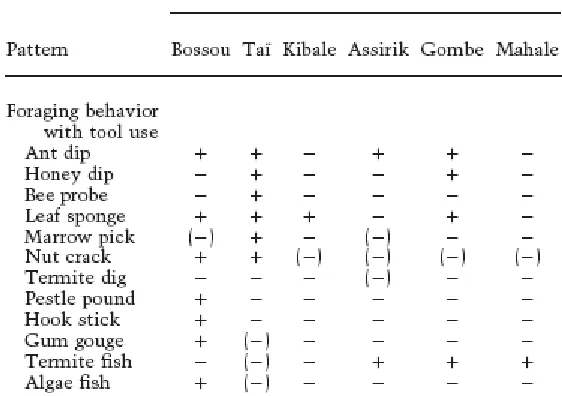
There do appear to be some differences in populations of tool users that social learning must explain. Only certain populations of the Egyptian vultures use stone to open eggs. Genetically similar vulture populations in the same environment do not demonstrate the egg opening behavior. Some populations of sea otters use stones to open shells while others do not. It is the chimpanzee where these discrepancies are most surprising. In the same forest there will be groups of chimps that all demonstrate a particular tool using behavior occupying the same niche groups where not a single individual demonstrates the behavior.
Boesch and Tomasello (1998) posited that there must be some primary social learning occurring if:
(1) Two groups of the same species differ in a behavior (with a countable number in each group conforming).
(2) There are no obvious differences in the environments of the two groups, making an explanation in terms of individual learning (environmental shaping) unlikely. (3) There are no genetic differences between individuals that acquire the behavior
Figure 2.1 Tool using behavior observed clustering in populations (from (Boesch, Tomasello 1998))
As the figure above shows, there are in fact strong differences in tool using behaviors seen in populations of chimpanzees that meet all of Boesch and Tomasello’s criteria. It seems as though there must be some learning mechanism to account for these stark divisions between genetically similar chimps in similar environments. While the exact mechanism of the learning remains controversial, many have proposed that imitation is a likely candidate to explain how genetically similar populations in similar environments would exhibit different tool using behaviors (Whiten 2000).
Most acts of tool use have a link to imitation. The imitation may be hard coded and passed though evolution. While not imitation in a traditional sense of the word, it is not too far a stretch to recognize the methods by which evolution repeats successful strategies as a form of imitation. In other contexts, this imitative nature is far more obvious; we will designate two forms of imitation, internal and external. In external imitation, an agent may observe another agent successfully employing a tool and imitate the behavior.
Internal imitation may be as simple as self imitation. An agent may discover a successful tool using strategy and attempt to imitate it by repeating the successful behavior. An agent may try to improve performance of a task with a tool by imitating a task it normally performs unaided but adding a tool to the act. Although it is an acknowledged stretch, it could even be said that some novel tool using behaviors involve imitating a potential solution that has been generated internally through reason. Even if a solution is discovered through trial and error, if the agent lacks an ability to self imitate, the solution must be rediscovered again and again.
Chapter 3
An Ontological Basis for Action
3.1 The Role of Ontology
This concept of carving life at the joints seems intuitively correct, and anyone who has carved a chicken can understand the metaphor. If one takes a cleaver and haphazardly divides a chicken there will be a disorderly pile of meat and bone fragments. If however, a knife is applied to the joints there will be a far more orderly pile with legs and thighs easily identifiable. While this metaphor is straightforward when thinking of the legs and thighs of a chicken, it is problematic when other parts are considered. The back and neck are often left whole in carving but they are filled with joints, and even though cutting the leg and thigh at their actual joints has an appeal, it would also be natural to take the legs and thighs and divide them into piles of meat, skin, fat, and bone.
The endeavor of dividing the chicken is one of categorization, classifying the substances that form the chicken and identifying natural and functional sets. Even in this straightforward example, the results are not straightforward; different divisions will more naturally fit reasoning for different tasks involving the chicken. This problem and others like it have come to be known as lying within the discipline of Knowledge Representation. Skin, fat, bone, thigh, leg etc. are all words that represent certain aspects of a chicken.
Shrobe & Szolovits 1993). First, and most fundamentally, a knowledge representation is a surrogate for the thing itself. Once we have representations of reality, we can use them to determine consequences in the world through thought rather than action. Second, a knowledge representation is a commitment to how we will define and reason about reality. One of the most important aspects of this work will be understanding the ways in which how an agent represents reality influences its thinking regarding it. Third, a knowledge representation is a fragmentary theory of intelligent reasoning because it chooses how and when to draw inferences from partial data and to what extent those inferences are included in the knowledge set. Fourth, a knowledge representation is a medium for pragmatically efficient computation. By discretizing data and recommending some inferences as more important than others, it is possible to make many problems far more tractable. Fifth, a knowledge representation is a medium for expression. Representations of things allow reasoning, but they may also allow the sharing of that reasoning.
about reality biases the perception of it. It is not ultimate reality that is experienced, rather it is a view of reality through the lens of one particular knowledge representation. As Davis et al. describe it:
If, as we argue, all representations are imperfect approximations to reality, each approximation attending to some things and ignoring others, then in selecting any representation, we are in the very same act unavoidably making a set of decisions about how and what to see in the world. That is, selecting a representation means making a set of ontological commitments. The commitments are, in effect, a strong pair of glasses that determine what we can see, bringing some part of the world into sharp focus at the expense of blurring other parts. These commitments and their focusing-blurring effect are not an incidental side effect of a representation choice; they are the essence (Davis, Shrobe & Szolovits 1993).
robotics, but first we will look at evidence from neuroscience that seems to indicate that there are mechanisms for making these kinds of abstractions inherent in the brain.
3.2 Evidence for Ontology in Neuroscience
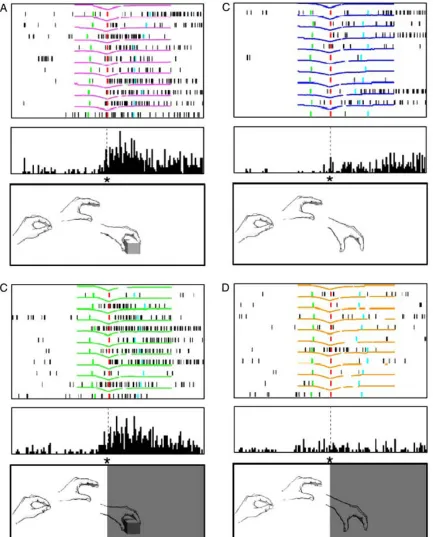
In the figure above from Metzinger, it is possible to see the neuronal firings in a monkey observing situation A where the hand is observed grasping the block. When the hand is observed performing an identical action in B, but there is no block present, there is no firing. It is interesting to note that this relation holds, even if the view of the block is occluded. If the monkey is shown the presence or absence of the block and then a screen is placed in form of the block (represented in the image by the grey area). The same difference in neuron firing is still observed (see C&D above). It is interesting to note that these two scenarios appear identical to the monkey, but the neuron firing is different based on its knowledge of whether or not the block is present.
Further examination indicated that it was the goal of grasping being represented and not just hand movements when it was seen that different acts of grasping would excite this area regardless of the effecter employed. It was demonstrated that grasping done by not just the hand but even the mouth would excite the area (Rizzolatti 1988, Rizzolatti, Fogassi & Gallese 2000). Not just the act of grasping will excite this area, the presence of graspable objects will also do so (Jeannerod 1995, Murata 1997, Rizzolatti 1988, 2000)
would occur. It was the goals of the activities that showed high and consistent correlations with neuron firings. The same neurons would associate with goals of an activity regardless of whether the hand or mouth was used to accomplish the activity. It has even been shown that the same goal neurons will fire when a tool, in the form of a stick, is used to achieve the same goal (Ferrari 2005). There appears to exist not simply neuronal control of hand movement but direct evidence for a neuronal basis for a type of goal-directed behavior model (Gallese 2003). There appears to be an innate ability for abstraction in the brain that is similar to the abstraction inherent in placing any kind of knowledge in a particular framework.
3.3 Ontology in Computer Science
Although the study of ontologies has hundreds of years of history in Philosophy, some of the most interesting work in applied ontology has come from within the field of Computer Science quite recently. Although the term ontology as it is used in Computer Science has its roots deeply in the Philosophical background, the term has evolved to take on its own separate meaning that relates to the traditional concept while being its own new and independent entity.
be employed rather than pursued as vehicles for insights into the underlying nature of being. The first example of this was in 1980 by John McCarthy in his work on Non-Monotonic Reasoning (McCarthy 1980). McCarthy described an ontology as a list of “the things that exist”, this was not a complete departure from this philosophical background, but it was a shift in focus. The goal of the list of things that exist was not meant to be a description of the fundamental nature of being, but rather it was a medium, upon which logic could occur. Hayes, in 1985 wrote a book chapter entitled Naïve Physics I: Ontology for Liquids, where ontology was again used slightly differently than had previously been seen. In this context, ontology was again a formalism to be employed. Its members served as a representation for various states and aspects of water. These representations were then utilized to perform calculations in Predicate Calculus. John Sowa also used ontology differently in the mid 80’s. Ontologies were again formalisms of underlying reality, which Sowa could use in the creation of conceptual graphs, a derivation of semantic networks (Sowa 1984).
Ontologies have emerged as ways of formalizing a particular view of some domain. The most referenced was of stating this comes from Gruber:
An ontology is an explicit specification of a conceptualization. (Gruber 1993).
Ontologies serve as the foundation upon which common understandings of domains can be achieved. An ontology is an common vocabulary which is specifically designed to describe a certain domain.(Cardoso 2007, Guizzardi 2005, Sharman, Kishore & Ramesh 2007) Ontologies can provide models for the semantics that are inherent in underlying reality. They can also serve as the basis for storing informational descriptions of spacio-temporal reality (Havas, Larue & Camus 2008).
3.4 Ontology in Robotics
Bateman has described previous use of formal ontology in Cognitive Robotics as limited, but argues that a closer interaction is appropriate (Bateman, Farrar 2005). He describes three roles ontology has to play in cognitive robotics.
1) Ontology can enhance the design of robot knowledge representations by clarifying the relations among various representational levels and providing a semantically coherent account of entities used in symbolic reasoning.
3) Ontologies can provide a framework to help deal with incomplete sensor information.
Research has used ontologies as the foundation for modeling capacities, objects, verbs, colors, state, people, and space.(Havas, Larue & Camus 2008) There has been much work of modeling spatial relations with Kuipers Spatial Semantic Hierarchy (SSH) (Kuipers 2000). Ontologies have been used to create an “agent belief store” with ontology axioms acting as schema for dynamic beliefs (Clark 2007). Ontologies have served as the foundation to guide coalition formation and cooperation (Fanelli et al. 2006). Ontologies have been proposed as an appropriate foundation for guiding image recognition and object categorization (Eric Maillot, Thonnat 2008).
3.5 Grounding an Ontology
In some domains, agents can be pre-programmed with an ontology that reflects all the relevant information in their environment. For our purposes, as will become clear, it is advantageous for an agent to be able to “ground” its representation in its environment.
was thirsty." Dretske diagrams this relationship in the following manner:
Figure 3.2 Explanation for getting a drink
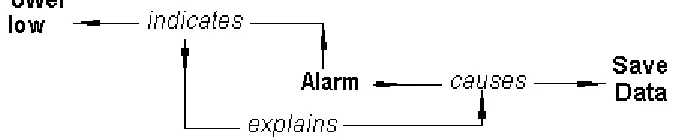
I am thirsty. This indicates that I need a drink and causes me to go and get a beer. The fact that thirst indicates a need for a drink explains why it causes me to go and get a beer. This diagram clearly shows an example of a belief with semantic meaning. “Being thirsty”, has the meaning behind it of needing a drink. For contrast, consider a robot that runs on a battery. This battery eventually runs out of power. If the robot does not save his data before his battery runs out he will lose all of it. Imagine that the robot has a low battery alarm, and let us again construct a diagram of the same form as Figure 3.2:
Figure 3.3 Explanation for power alarm
semantic grounding in the fact that it represents the charge status of the battery. Some people might say that this alarm is just too simple a mechanism for us to describe this robot as thinking. It would be like saying that a thermostat thinks and this is certainly a valid criticism.
Learning to recognize a linkage between a idea such as “I’m almost out of power” and a sensor value such as low voltage in a battery is a problem that has received a great deal of attention from many disciplines of computer science. While it is possible to engineer such connections into a robot, making them meaningful is challenging. This problem has come to be known as the symbol grounding problem (Harnad 1990). How is it possible for an agent (artificial or otherwise) to link a symbol such as a word to an underlying meaning?
Vogt has proposed a method he calls “anchoring semiotic symbols” as a way to get around the symbol grounding problem (Vogt 2003). This method is based on a model called the “Triangle of Reference” first proposed by Ogden in The Meaning of Meaning
Figure 3.4 The Triangle of Meaning and Semiotic Triangle, taken from Ogden and Vogt respectively
Vogt refers to the image above as the Semiotic Triangle. The terms he uses are adopted from Pierce’s definition of semiotic symbols (Peirce 1931):
Form. A form (or word) is the shape of the sign, which is not necessarily material. Meaning. The meaning is the sense that is made of the sign.
Referent. A referent is the object that stands for the sign, which may include abstractions, actions or other signs.
Figure 3.5 Outline of a Mug From Different Angles
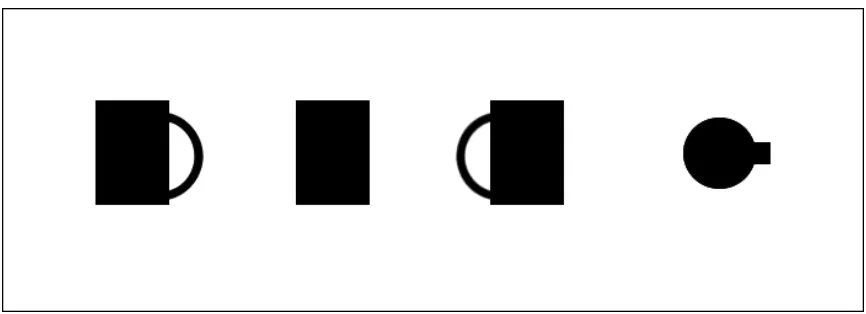
Vogt’s semiotic anchoring attempts to move beyond all these problems. Vogt proposes that the problems arise because the focus is on the wrong part of the problem. It is inappropriate to classify the problem of recognizing a cup as creating algorithms where every conceivable projection of a cup can be properly classified. What needs to occur is the focus needs to shift. The observer needs to recognize the objective reality that there is an actual cup sitting there and use the real object as the anchor for the concept.
to the problem. What the example demonstrates is that this type of approach is doomed to fail for certain tasks. If creating a lookup table for something as simple as a coffee cup fails as the size of the table grows out of control, it is clear that we will need an alternative approach.
The approach that has often been proposed involves the use of concepts. Concepts represent the semantics of a situation. A concept is a mental category that may be employed to classify objects, events, or ideas. It is very important to note that a commitment to a particular set of concepts to represent a domain is precisely what is meant by commitment to a particular ontology as was discussed in a previous section. An ontology is, among other things, an agreement to employ a certain set of concepts when representing a particular domain.
The learning of concepts involves linking low-level perceptual information to higher level representations. Cognitive psychologist Jerome Bruner is credited with first defining the problem of concept attainment and defines it as "the search for and listing of attributes that can be used to distinguish exemplars from non exemplars of various categories."(Bruner 1956)
In a more recent paper, Lawrence Barsalou noted that agreeing on a shared definition of exactly what a concept is remains contentious, but said:
knowledge about birds represents the bodies, behaviors and origins of the respective entities. Knowledge plays a central role throughout the spectrum of cognitive activities. In on-line processing of the environment, knowledge guides perception, categorization and inference. In off-line processing of non-present situations, knowledge reconstructs memories, underlies the meanings of linguistic expressions, and provides the representations manipulated in thought (Barsalou et al. 2003).
For our particular application, the problem of concept learning is fortunately quite constrained by our ontology. Initially, we will only be concerned with the foundational concepts contained without our object ontology and spatial relations ontology. Once we have learned these concepts, they will serve as a basis for the creation and extension of an action ontology as is discussed in the following section.
3.6 Ontology of a Robotic Tool User
The first ontology is straightforward; an ontology of objects is an ontology of the objects which make up the world. This is a very simple ontology that will just be a set of object types that can exist within our robot environment. The ontology of objects would include items such as basic shapes and types of objects. This enables basic identification of items in the environment.
Once objects have been recognized it will be necessary to represent how they relate to each other. This is done with an ontology of spatial relations. Previous work has demonstrated that spatial relations can be recognized with neural networks or other machine learning (Schwering 2007, Regier 1996). In his book Human Semantic Perception, Regier identified seven important spatial terms that he was able to learn to recognize with a back propagating neural network. They were above, below, to the left of, to the right of, inside, outside, on, and off.
With a directional and spatial ontology to provide descriptions of our environment, it is possible to learn how an agent may manipulate that environment. This involves learning initial environment description / agent action pairs that consistently lead to certain resulting environment descriptions. Recent work by Modayil and Kuipers (Modayil, Kuipers 2007) has suggested a formalization for representing actions:
α
is an action α∈ActH C D, , =
α
Where D is the change in an object property resulting from an action and C is the context where the action occurred and H is the control signalGiven that actions are occurring in a closed world, it is possible to safely assume that any change is the result of an agent acting. The goal with this type of approach is to identify contexts and control signals that consistently result in certain resulting states. The resulting tuples will be the basis of an action ontology that will inform an agent how it may manipulate its world.
to comprehend in the abstract. In chapter 5 they will be presented again in much greater detail in the context of the environments they are being used to represent.
Chapter 4
Human and Robot Imitation
With the goal of this research being insight into tool use, the motivation for our approach lies as much in understanding human and animal cognition as it does computer science. This type of approach not only allows us to base our work on the best examples of tool users available; it will provide a path to insight and deeper understanding regarding tool using behaviors.
4.1 Imitation
examination of previous work that had been done regarding human imitation. In the late 1970’s a revolutionary Science paper by Meltzoff and Moore found that newborn infants as young as two to three weeks could imitate facial gestures (Meltzoff, Moore 1977). Previously it had been thought that this capability was a landmark development and did not emerge until far later, at 8 to 12 months of age (Piaget 1962).
In subsequent years, Meltzoff continued to refine his theories of imitation, eventually settling on a four stage progression of imitative abilities (Meltzoff 1997, Meltzoff, Prinz 2002):
1) Body Babbling. This is the stage where an organism will learn how various motor signals influence various elementary body configurations. In this stage, random trial and error learning will link motor signals to resultant end states. This stage has been suggested by Calderon as where the construction of a body schema occurs (Acosta-Calderon, Hu 2005)and Stoytchev has used babbling behaviors to actually learn an extensible body schema for a robotic arm (Stoytchev 2005, Stoytchev 2003).
representational structure that allows infants to defer imitation and to correct their responses without any feedback from the experimenter.”
Two experiments particularly supported some intermediary representation. First was the presence of delayed imitation. If a pacifier was used to restrict mouth movement, imitation would still occur after a 2.5 minute delay if the infant viewed a passive expression on the face that had made an expression before the delay (Meltzoff, Moore 1977). This delay was successfully extended to as long as 24 hours in 6-week-old infants (Meltzoff, Moore 2002) .
In other experiments agents were also found to correct imitative responses over time and converge on more accurate matches of behavior without any feedback from the experimenter (Meltzoff 1997, Meltzoff, Moore 2002).
The presence of an apparent mediating structure in human imitation strongly influenced the direction of the research into robot imitation described later in this dissertation. Recognizing the apparent presence of a mediating structure in human imitation was instrumental in the later decision to base attempts to model imitation in robots within the mediating structure of an ontology.
objects, they are able to imitate that interaction. It is this form of imitation that allows the transfer of knowledge such as tool use from one individual to another.
4) Imitation Based on Inferring Intentions of Actions. This is the most sophisticated form of imitative learning. At this stage it is not the action itself being imitated but the inferred goal of the observed action. Meltzoff has also explored this type of imitation experimentally. Eighteen month old toddlers have demonstrated an ability to infer goals. After observing several unsuccessful attempts at an action the toddlers would recognize and imitate the apparent goal, not the failed attempt (Meltzoff 1995).
Chapter 5
Achieving Tool Using Behaviors through
Action Ontology Based Imitation
In chapter two, imitation was identified as an interesting component of higher level tool using behaviors. In chapter three ontology was identified as a medium for knowledge representation and transfer. Human imitation was explored in chapter four with four individual stages identified. These disparate yet connected themes lead to both a fundamental question and a path to answering that question.
conclusively answer this question, but it will offer significant insight into the discussion by demonstrating that in artificial agents, with a self learned imitative mechanism, it is possible for tool using behaviors to arise.
5.1 Simulation Environment
Due to the much lower overhead and ability to rapidly change parameters, this research was conducted in a simulation environment. The breve simulation environment was used to create simulations which would allow the exploration of basic robotic tool using behaviors. The breve environment is a small world simulation that realistically models physics with the Open Dynamics Engine (ODE). ODE models rigid body dynamics and collisions and is freely available under both the Berkeley Software Distribution (BSD) and GNU Lesser General Public License (LGPL). In addition to the physics modeling, there is an OpenGL display engine that creates a fully interactive view of all activity occurring within the simulation.
Figure 5.1 Basic simulation with robotic hand
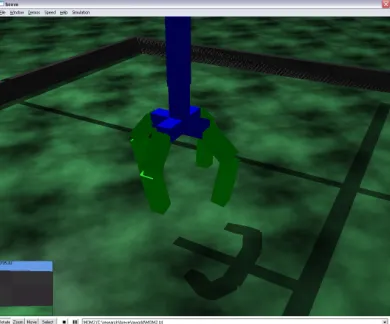
The first agent explored was a robotic hand, which was completely created within the breve simulation environment. The hand was coded within the environment using only simple rigid bodies and simple actuators with motion in two opposing directions. In the
environment, the hand is hung from two rails which act as linear actuators with one rail enabling forward and backward motion, while the other provides side to side motion. The hand itself is placed on a third linear actuator which allows it to be raised and lowered. The up and down arm actuator is connected to the palm via a wrist joint. Each of the four fingers is connected to the palm with a rotational joint which allows for each finger to rotate inwards towards the center of the hand, closing the hand in a grasp, or outwards to a limit, opening the hand. It is possible for all of these motor signals to be performed independently or simultaneously in any combination.
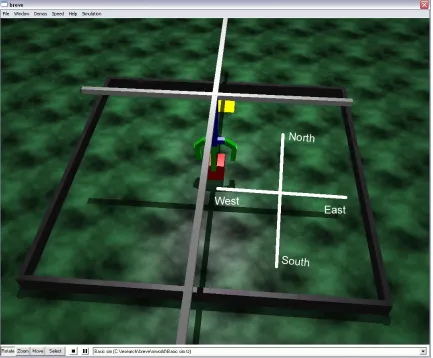
Figure 5.3 The basic simulation with the directions labeled.
very difficult to describe what was occurring within the environment at any given time. The core ontology provides an objective vocabulary to describe what is occurring within the simulation.
5.2 Semantically Grounding the Core Ontology in the Simulation
Environment thorough Babbling
Using these stages of human development as the basis for robotic development has precedent. Meltzoff himself later co-authored a paper suggesting that the stages could serve as a pathway for teaching robotic imitation (Rao, Shon & Meltzoff 2004), and others have successfully executed limited imitative acts with robot based which learned to imitate based on the four stages (Acosta-Calderon, Hu 2005).
In achieving ontology mediated imitation, the first task is to provide a linkage between the actions of the hand agent and the core ontology. The ontology and the agent are separate entities and if there is to be linkage between them, it must be either hard coded or learned. This is sometimes referred to as semantically grounding the ontology. The problem is that although there is a hand agent and it is only capable of performing a limited set of motor signals there is no preexisting knowledge of how motor signals and the ontology will align. This connection must be learned or hard coded, there is a very strong emphasis in this research on trying to have the agent learn all the components of the actions itself. The point is not to demonstrate that a robot agent could be programmed to perform an action, but rather to demonstrate that the agent could learn to perform that action itself. The foundation of this learning involved babbling behaviors, similar to those seen in the first stage of human imitation.
described as babbling because random signals are sent and the resulting changes are observed. If there are motor signals that consistently result in certain changes then it is possible to begin to strengthen the connection between a certain signal and a certain change.
In humans, this type of babbling and learning behavior is innate. To accomplish it within simulation requires a great deal of infrastructure capable of accomplishing several tasks, first to create large amounts of data, second to analyze this data, thirdly to recognize patterns within the data, then to test these pattern, and if they test successfully, to record them as behaviors.
Within the simulation it was possible to collect huge amounts of data. This was accomplished by collecting data from a range of sources every 200 milliseconds. The data which was collected fell into several categories. For the initial babbling there were two types of data considered, motor signal and position. For the motor signals attribute, all motor signals passed to the hand were recorded. For the position attribute, virtual sensors which tracked position were placed on the hand and their position recorded. Position data was recorded for the center of the hand on the palm as well as all four of the fingertips.
various motor signals while recording data. With large enough amounts of data recorded, it gradually becomes possible to see certain consistent patterns within the data. With repeated firings of all motor signals it emerges in the data that there is a fixed range of motion to all of the actuators.
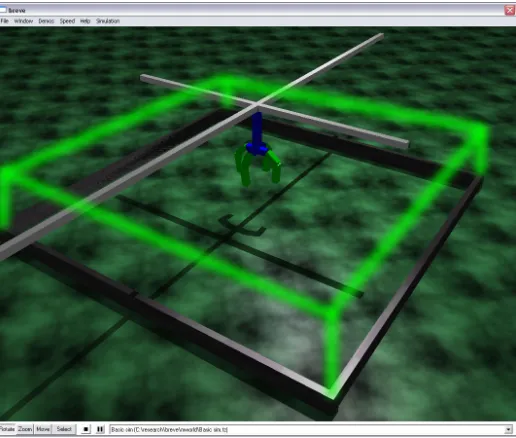
With each of the actuators it was possible to learn a series of values that bound their motion. Once these limits are reached the actuators no longer respond to signals directing further motion. It is important to account for these limits so that failure to respond to a motor signal at the limit of motion can be taken into account. The north south actuator was found to never move the hand farther north than 24 units and to never move it farther south than 24 units. Similarly the east west rail was found to extend the hand 20 units to the east and 20 units to west, but never any further. The up down actuator was found to go as high as 10 unit above the floor and only go as low as 1 unit above the floor.
Figure 5.4 A cube, outlined in green, that extends above the floor and roughly shows the limits of the hands motion.
While exploring and learning the limits of motion is important, it is also important to learn correspondence between specific motor signals and specific motions. It was possible to see that finger signals only move the finger that is sent the signal a short distance to the finger’s limit, while the rails will move the hand and all fingers a much greater distance before their much larger limit is reached. With each motor signal it was possible to create a model of motion in each direction for all position sensors. In addition to direction, these models also represent the rate of motion for each motor signal. The motion of the actuators was simple linear motion, so it was possible to represent it mathematically with equations.
aaaa
1111xxxx
1111+a
+a
+a
+a
2222xxxx
2222+…+a
+…+a
+…+a
+…+a
nnnnxxxx
nnnn=b
=b
=b
=b
Each motor signal was sent to the hand and the effect of the signal on each of the hands position sensors was recorded. It was found that if the hand was not at the limit of its motion it was possible to model the motion completely using a simpler form of the equation, the general form of the linear equation for only two variables:
A
A
A
Ax+
x+
x+
x+By
By
By
By+
+
+
+C
C
C=
C
=
=0000
=
The hand was sent a single signal and this signal lead to motion in one of the axes. It was possible to collect this positional data and time data and use the data points to solve the linear equation. Once the equation had been solved it could be used to predict the position of a particular sensor, in the presence of a given signal, at a certain time.
Examination of the data demonstrated that each sensors motion could be accurately modeled with a linear model which was quickly learned. In practice, accurate models could be made from very few data points and performance improved only marginally if the data set was enlarged.
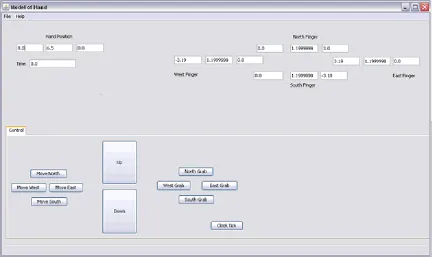
Figure 5.6 Software model of hand.
In the figure above we can see all of the position data represented by the text fields in the upper regions above as well as all of the possible motor signals represented by buttons in the lower region. This software implementation combined all the linear models to accurately predict hand behavior over time in the presence of various motor signals.
At any time motor signals could be changed or removed. In practice, it was found that the model provided accurate predictions of hand motion.
The ability of the model to accurately predict the hands movements is interesting from a technical standpoint, but it also has significance from a more semantic standpoint. Initially an instruction such as move hand north would have been meaningless to the hand agent. By exploring all the hands motor signals and their subsequent effect on position it was possible to learn from experience that to move the hand north the best method was to send the north south rail a signal to move forward. By examining the effects of motor signals on position, it was possible to learn how motor signals related to our core ontology.
behavior had firmly grounded them semantically for the hand. These motions were now behaviors that were directly linked to particular motor signals.
Figure 5.7 The two wheeled vehicle
possibility involves a multiple number of rotations which end in a rotation pointing in the correct direction and then the vehicle moving forward.
It was possible to examine repeated random sequences of motor signals to the vehicle and to identify sequences that moved the vehicle directly in a particular direction. If this was solely done until three candidates where found it was fairly quick, but often several of the learned behaviors would involve spinning a few times before moving i.e. they belonged in the third category of solutions described above. If a utility function was added to that favored quicker solutions with less steps, it was found that it was possible to gradually learn strategies for moving in all directions that did not involve unnecessary turns if the data set was large enough. By increasing the size of the data set it became more likely that the random sequences of motions would contain the quickest solution for each direction.
Though the use of this process it was possible for the vehicle to learn a sequence of motor signals that would allow it to move directly in each of the four directions of our core ontology. This allowed the vehicle to be given a series of behaviors in the same manner that the hand had been. The hand was able to learn to carry out the following behaviors:
ontology. Even though the motor signals involved where quite different, both agents were able to learn sets of motor signals that allowed themselves to move in each of the four directions of our core ontology. For example, both agents were able to learn a Move North behavior that moved them northward, the motor signals each learn for the similar act varied widely. The hand learned to activate one of its rail actuators, while the vehicle learned to turn in place and then move forward. Even though their approaches to movement were quite different, both agents were able to semantically ground there own locomotion within the ontology. It is important to note that there will only be a correlation in possible behaviors between different agents in so far as their inherent abilities correlate. For example the hand has behaviors for Move Up and Move Down, while there are no corresponding movements for the vehicle since it lacks any ability to move up and down.
It is interesting to note that these behaviors enable some very basic imitation between the agents where they overlap. If one of the agents moves north, it can describe its action as
5.3 Learning Actions on Objects
Once the two agents had learned basic motions the next step involve exploration of basic actions upon objects. This type of activity could be described as similar to Meltzoff’s stage of “imitation of actions on objects”. To explore actions upon objects, the same simulation environment was used with a cube placed within the environment along with the hand.
Initially the hand will have no knowledge regarding how it might interact with the cube. In fact from the majority of positions it was seen that most of the hands motor signals have no effect on the cube. In was possible to identify locations where the hand was able to move the cube in any way through the flowing algorithm:
function actionExploration ( )returns a set of interesting actions
α
inputs:static: possibleActions, The set of possible actions including combinations of actions maxPosition, end of range of motion
initialObjectPosition starting position of object
interestingActions a set of interesting actions, initially empty
while notDone
moveAgent(randomPosition)
for agentPosition ←0 to maxPosition
while possibleActionStack notEmpty then do
currentAction ←pop possibleActionStack
Execute(currentAction)
if currentObjectPosition notEqualTo initialObjectPosition
logData(agentPosition, possibleActions, initialObjectPosition)
interestingActions ←{agentPosition, currentAction,
currentObjectPosition, initialObjectPosition}
possibleActionStack ← possibleActions
return interestingActions
The same data from the initial babbling was recorded, the position of the hand and each fingertip, and the motor signal that was sent. Additional information was recorded as well. The position of the cube was recorded as well as the position of each sensor relative to the cube. This relative position was recorded in terms of the core ontology. For example, along the east west axis, there were five possibilities for how a sensor could be positioned relative to the cube. The possibilities were: west of the cube, on the west edge of the cube, centered east/west with the cube, on the east edge of the cube, and finally, east of the cube. This relative positioning to the cube was also recorded for the north/south and up/down axes as well.
With all of theses data objects being recorded, the hand would interact with the cube, moving to random positions and recording data when it was able to move the cube in any way. This process was carried out over hundreds of trials and gradually a data set was recorded that was representative of the ways in which the hand could move the cube if it was placed in the center of the playpen. Once the data set was sufficiently large so as to be representative, it was possible to learn from it.
thought of as a birds eye view of the cubes position on the floor. Any data point not in the center at 0,0 represents a situation were the cube has been moved by the hand.
Figure 5.9 The position of the cube over time along the north/south east/west
to look at individual data points, but it is better to examine sets of data to see if they share characteristics.
To break the created data sets up into smaller subsets various clustering algorithms were employed. The first we employed was k-means. K-means automatically clusters a dataset into a number of clusters. The number of clusters must be specified beforehand. The algorithm operates by assuming that object attributes form a vector space and then tries to minimize intra-cluster variance calculated by the squared error function:
Where there are k clusters Si, i=1,2,…,k and µi is the centroid of all the pints xj∈Si. The
iterative refinement heuristic known as Lloyd’s algorithm may be applied until points no longer switch clusters.
k-means but does not need to be given a number of clusters. The algorithm will return a configuration and number of clusters that will optimize the Bayesian Information Criterion (BIC).
Pelleg (2000) (Pelleg, Moore 2000)presents the following method and equations to
calculate the BIC for a set of data and a family of alternative models which
correspond to different values of K. The models are scored by their posterior
probabilities
Pr[
| ].
To approximate the posteriors, up to normalization, Pelleg employs the following equation from Kass and Wasserman (Kass, Wasserman 1995) also know as the Swarz criterion.Where is the log-likelihood of the data according to the j-th model (taken at the maximum likelihood point) and pj is the number of parameters in . The Maximum
likelihood estimate (MLE) may then be calculated as:
The log-likelihood of the data is
Pelleg’s approach will return a number and configuration of clusters that will maximize BIC and therefore represent a good choice for clustering a given data set. When a x-means clustering algorithm is applied to the data set in the previous graph the following six clusters were identified:
Figure 5.10 The data has now been divided into six clusters identified by color.
=== Run information ===
Scheme: weka.clusterers.XMeans -I 2 -M 1000 -J 1000 -L 2 -H 7 -B 1.0 -C 0.5 -D "weka.core.EuclideanDistance -R first-last" -S 10
Relation: Simple NSEW-weka.filters.unsupervised.attribute.Remove-R1-4,6,8-39 Instances: 41152
CanisPos_x CanisPos_z
Test mode: evaluate on training data
=== Model and evaluation on training set ===
XMeans ======
Requested iterations : 2 Iterations performed : 2 Splits prepared : 6 Splits performed : 4 Cutoff factor : 0.5 Percentage of splits accepted
by cutoff factor : 0 % ---
Cutoff factor : 0.5 ---
Cluster centers : 6 centers
Cluster 0 -0.002904847043701792 -14.723117435732595 Cluster 1 -13.468230047988675 -0.01093418489767108 Cluster 2 14.173503561844885 0.007007901467505207 Cluster 3 -0.006276841483979775 14.702864377740333 Cluster 4 0.026043435030095267 0.07067545202494767 Cluster 5 -3.0869459451659345 -1.5080033968253888 Distortion: 749.042159 BIC-Value : 133946.27671 Clustered Instances
0 757 ( 2%) 1 1249 ( 3%) 2 904 ( 2%) 3 723 ( 2%) 4 36637 ( 89%) 5 882 ( 2%)
points where the hand has somehow moved that cube from the center to northern portion of the enclosure. It is possible to examine this cluster of data to gain insight into how the cube may be moved by the hand.
When the light blue cluster is examined in detail it is seen that for every data point that is present in the cluster there are certain common features. Of course there is a common position of the cube on the northern area of the floor, this is obvious given that the data was all classified based on position. What is more interesting is that there are other features that are common for the entire data set. It is interesting to note that in each instance where the hand has managed to move the cube to the north of the enclosure, there are the same spatial relations of where the hand is relative to the cube, there are some exceptions with friction or the cube flipping over creating noise in the data, but there are clear patterns. In the vast majority of cases the hand is centered up down with the cube. In almost all the data the hand is centered west east with the cube. In nearly every case the hand is to the south of the cube. In every single data point we found that the hand was sending a motor signal to the north/south rail to move forward. These features were common to nearly every instance where the cube was moved northward.