O R I G I N A L R E S E A R C H
Analysis of the circular RNA transcriptome in the
grade 3 endometrial cancer
This article was published in the following Dove Press journal: Cancer Management and Research
Fei Ye1,*
Qiong Lan Tang2,* Fang Ma1,*
Lei Cai1 Ming Chen1 Xiao Xia Ran1 Xiao Yu Wang1 Xue Feng Jiang1
1Department of Obstetrics and
Gynecology, The First Affiliated Hospital, Jinan University, Guangzhou 510630, People’s Republic of China;2Department
of Pathology, Sun Yat-sen Memorial Hospital, Sun Yat-sen University, Guangzhou 510120, People’s Republic of China
*These authors contributed equally to this work
Background/aims: Circular RNAs (circRNAs), a class of newly discovered endogenous
non-coding RNAs, have shown large capabilities in gene regulation. Patients with the grade 3 endometrial cancer (EC) have a generally poor prognosis, and the specific role of circRNAs in the grade 3 EC remains unclear. This study aims to investigate the roles of circRNAs in the grade 3 EC.
Methods:In the current study, we screened the expression profiles of circRNAs taken from
two women with the grade 3 EC and adjacent non-cancerous endometrial tissue using circRNAs sequencing. Bioinformatic analyses were applied to study these differentially expressed circRNAs. Quantitative reverse transcription polymerase chain reaction (qRT-PCR) of six dysregulated circRNAs was performed to validate the sequencing results. Bioinformatic analyses, including the negative correlation network analyses of circRNAs– microRNAs (miRNAs)–messenger RNAs (mRNAs) and the Cytoscape, were used to deline-ate the interaction of circRNAs/miRNAs of the entire network.
Results: Data of circRNA sequencing showed a significant change in 75,928 unique
circRNAs (P<0.05). The upregulated hsa_circ_0039569 and hsa_circ_0001610 and down-regulated hsa_circ_0000437, hsa_circ_0001776, and hsa_circ_0009043 were validated by qRT-PCR analysis. Using bioinformatical methods, we found that hsa_circ_0039569 has the MRE of hsa-miR-542-3p and hsa-let-7c-5p. Hsa-miR-542-3p and hsa-let-7c-5p were down-regulated in the grade 3 EC validated by qRT-PCR analysis. In the clinicopathological parameters, the expression level of hsa_circ_0039569 was significantly correlated with tumor differentiation (P=0.001).
Conclusion:This is thefirst study demonstrated that there were a lot of differences between the
tissue of the grade 3 EC and adjacent non-cancerous endometrial in circRNA expression and may offer novel molecular candidates for diagnosis and clinical treatment of the grade 3 EC.
Keywords:grade 3 endometrial cancer, circRNAs, transcriptome, RNA-Seq
Introduction
Endometrial cancer (EC) is the most common gynecological malignancy of the
female reproductive system. Traditionally, EC was divided into type 1 and type 2,1
grades 1 and 2 are considered “type 1”EC, while grade 3 is considered“type 2”.
Type 1 may arise from atypical hyperplasia and is associated with excess proges-terone and estrogen receptor. In addition, the prognosis is relatively good. Type 2 may arise from atrophic endometrium and is associated with a lack of estrogen and progesterone receptor.However, it shows the worse prognosis than type 1 because of the aggressive cancerous tissue.
Non-coding RNAs (ncRNAs) play an important role in epigenetics increasingly. NcRNAs can be divided into circular non-coding RNAs (circRNAs) and linear
Correspondence: Xue Feng Jiang; Xiao Yu Wang
Department of Obstetrics and
Gynecology, The First Affiliated Hospital, Jinan University, Guangzhou 510630, People’s Republic of China Tel 0086-15917362956; 0086-13556136326
Email [email protected]; [email protected]
Cancer Management and Research
Dove
press
open access to scientific and medical research
Open Access Full Text Article
Cancer Management and Research downloaded from https://www.dovepress.com/ by 118.70.13.36 on 20-Aug-2020
ncRNAs. However, in recent years, we have observed the explosive growth of published research on various aspects of circRNA biology. It indicates that this molecular plays an important role in normal cellular differentiation, tissue homeostasis as well as in the development of the disease. As it is known that circRNAs arise from precursor
mRNAs, their biogenesis remains unspecific. circRNAs
differ from other RNAs in their extraordinary continuous
closed loop structure, which is covalently linked by free 3′
and 5′ends.2It is also called a“back-splicing”structure,3
and is generated from the joining of an upstream 3′splice
site to a downstream 5′ splice site, which prevents them
from degradation by RNA exonucleases.4There are many
biological functions of circRNA, and the most important function is to regulate gene expression. An increasing number of studies have found that many circRNAs as miRNA sponges or competitive endogenous RNAs (ceRNAs) can regulate the expression of miRNA targets, hsa_circ_0072309 inhibits proliferation and invasion of
breast cancer cells via sponging miR-492,5
hsa_circZNF609 promotes breast cancer cell growth,
migration, and invasion via sponging miR-145-5p.6 In
addition to acting as miRNA sponges, circRNAs can also regulate the transcription and alternative splicing. The experiment of co-localization indicated that circRNAs could interact with RBPs. It has been reported the
interac-tion among circ-Foxo3 with E2F1, ID-1, HIFα, and FAKs
played a part in anti-aging and anti-stress.7 Besides the
non-coding function of circRNAs, scientists have also
studied the capacity of translation of circRNAs.8 Based
upon the functions of circRNAs, researchers have studied the role of circRNAs in pathology and physiology. The evidence show that circRNAs exert a regulatory function in different diseases via different mechanisms. Moreover, circRNAs have the potential to serve as clinical diagnosis
markers and therapeutic targets.9
To date, only one study has shown that circRNAs may play
roles in EC, with grade (1–2) type I EC.10However, it was
known little about the underlying regulatory mechanisms of circRNAs with the grade 3 EC. To our knowledge, this was the
first study of circRNAs transcriptome analysis of the grade 3
EC in the worldwide. We made a description about the factor of circRNAs transcriptome analysis of the grade 3 EC, detected the differentially expressed circRNAs, and made a further analysis of the related microRNAs of the differen-tially expressed circRNAs. In short, the differendifferen-tially expressed circRNAs might become the diagnosis, treatment, and the potential biomarker of the prognosis of the grade 3 EC.
Materials and methods
Ethics statement
The project was approved and supervised by the Ethics
Committee of the First Affiliated Hospital of Jinan
University, Guangzhou, People's Republic of China. All samples were collected from the patient who had
under-gone surgery in the First Affiliated Hospital of Jinan
University. All the enrolled patients have signed the informed consent. This study was conducted in accordance with the Declaration of Helsinki.
EC and normal tissue samples
Tissues were collected from the patients with EC under-gone surgery at the Department of Surgery at the First
Affiliated Hospital of Jinan University, and the
nontumor-ous tissue was collected at the site 10 mm away from the affected region at the same time. The tumor specimen was
staged and classified by pathological result. Two pairs of
snap-frozen endometrial tissue with the grade 3 EC and adjacent non-cancerous endometrial tissue were collected
for circRNA sequencing analysis (Tables 1 and 2) and
another 60 samples (15 pairs of the grade 3 EC and adjacent non-cancerous endometrial tissue, 15 pairs of
the grade 1–2 EC and adjacent non-cancerous endometrial
tissue) were collected for qRT-PCR validation.
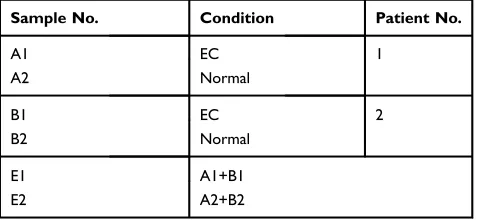
Table 1Patient and tissue sample chart
Sample No. Condition Patient No.
A1 EC 1
A2 Normal
B1 EC 2
B2 Normal
E1 A1+B1
E2 A2+B2
Table 2 Detailed clinical pathological parameters of patients
being sequenced
Clinicopathological parameters Patient 1 Patient 2
Age (years old) 72 67
Histopathologic grades G3 G3
FIGO stage Ia Ia
Myometrial invasion <1/2 <1/2
Lymph node metastasi Negetive Negetive
BMI 24.56 25.67
Diabetes No No
Hypertension No No
Cancer Management and Research downloaded from https://www.dovepress.com/ by 118.70.13.36 on 20-Aug-2020
RNA isolation
We used TRIzol (Invitrogen, Carlsbad, CA, USA) to extract total RNA from each frozen specimen and treating them with DNase (Takara, Dalian, People's Republic of China) according
to the manufacturer’s instructions. The RNA integrity was
assessed using an Agilent Bioanalyzer2100 (Agilent
Technologies, Santa Clara, CA, USA). The quantity (ng/mL) and purity (260/280 and 260/230 ratios) of total RNAs were assessed using NanoDrop 2,000 spectrophotometer (Thermo, Waltham, MA, USA) and denaturing agarose gel electrophor-esis. Each RNA sample had an A260:A280 ratio above 1.9 and an A260:A230 ratio above 1.8. The values of RIN of A1, A2, B1, and B2 were 8.8, 8.7, 8.9, and 8.6.
Circrnas sequencing analysis
RNA library preparation and circRNA sequencing were performed by the Beijing Genomics Institute (Shengzheng, People's Republic of China). The sample preparation and microarray hybridization were performed according to the
Arraystar’s standard instructions. In short, total RNA
sam-ples were digested with RNase R (Epicenter Inc, San Francisco, CA, USA) to remove linear RNAs and enrich circRNAs. The rRNA-depleted RNA was used to build up the RNA libraries with TruSeq Stranded Total RNA Library Prep Kit (Illumina, San Diego, CA, USA). Quality of libraries were checked with BioAnalyzer 2100 system (Agilent Technologies, Richardson, TX, USA). The RNA libraries were denatured as single-stranded DNA molecules. The cDNAs were captured on Illumina
Flow Cells (Illumina, San Diego, CA, USA) amplified
in situ as clusters andfinally sequenced with 150-bp paired
reads on HiSeq 4000 sequencing system (Illumina, San Diego, CA, USA).
We used Cluster and Tree View software to perform hierarchical clustering analysis, in order to analyze the differentially expressed circRNAs between the grade 3 EC and adjacent non-cancerous endometrial tissue. The
predicted functions of the differentially expressed
circRNAs between the grade 3 EC and adjacent non-cancerous endometrial tissue were obtained by GO (http:\ \www.geneontology.org\) and KEGG pathway analysis (http:\\www.genome.jp\kegg\).
Delineation of circrna/mirna interactions
The circRNA/microRNA interaction was predicted using
Arraystar’s home-made miRNA target prediction software
based on TargetScan and miRanda.11,12We searched MREs
on circRNAs using the software and then selected the miRNAs according to seed-matching sequence to establish circRNA-miRNA network. Then, we used Cytoscape (ver-sion 3.6.0, USA) to draw the graph of the circRNA/miRNA network.
Quantitative real-time polymerase chain
reaction (qRT-PCR) validation
MLV reverse transcriptase (Invitrogen, Carlsbad, CA, USA) was used for synthesizing cDNA according to
manufac-turer’s instructions after RNA extraction. The expression
level of the circRNAs was evaluated by SYBR Green
qPCR. Specific divergent primers were designed to amplify
the circular transcripts, only primers achieving a single peak in the melting curve were considered proper for qRT-PCR
validation. PCR was performed in 10μL reaction volume,
including 2μL of cDNA, 5μL 2×Master Mix, 0.5 μL of
Forward Primer (10 μM), 0.5 μL of Reverse Primer (10
μM), and 2 μL of double-distilled water. The reaction was
set at 95°C for 10 mins for pre-denaturation, then at 95°C for 10 s and at 60°C for 60 s repeating 40 cycles. Housekeeping gene U6 was used as an internal control.
Both target and reference were amplified in triplicate
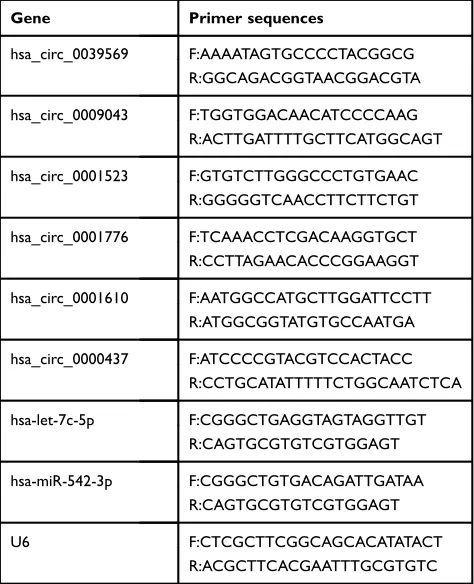
Table 3Primers allowed for amplification of genes in this work
Gene Primer sequences
hsa_circ_0039569 F:AAAATAGTGCCCCTACGGCG R:GGCAGACGGTAACGGACGTA
hsa_circ_0009043 F:TGGTGGACAACATCCCCAAG R:ACTTGATTTTGCTTCATGGCAGT
hsa_circ_0001523 F:GTGTCTTGGGCCCTGTGAAC R:GGGGGTCAACCTTCTTCTGT
hsa_circ_0001776 F:TCAAACCTCGACAAGGTGCT R:CCTTAGAACACCCGGAAGGT
hsa_circ_0001610 F:AATGGCCATGCTTGGATTCCTT R:ATGGCGGTATGTGCCAATGA
hsa_circ_0000437 F:ATCCCCGTACGTCCACTACC R:CCTGCATATTTTTCTGGCAATCTCA
hsa-let-7c-5p F:CGGGCTGAGGTAGTAGGTTGT R:CAGTGCGTGTCGTGGAGT
hsa-miR-542-3p F:CGGGCTGTGACAGATTGATAA R:CAGTGCGTGTCGTGGAGT
U6 F:CTCGCTTCGGCAGCACATATACT
R:ACGCTTCACGAATTTGCGTGTC
Abbreviations:F, forward primer; R, reverse primer.
Cancer Management and Research downloaded from https://www.dovepress.com/ by 118.70.13.36 on 20-Aug-2020
wells. The relative expression of candidate circRNAs was
normalized to U6 and then calculated using the 2−ΔΔCt
method.Primers are designed using PRIMER5 software (Table 3).
Statistical analysis
All statistical analyses in this study were accomplished by the GraphPad Prism 7.0 (GraphPad Software, La Jolla, CA, USA) and the SPSS 23.0 software package (IBM,
Chicago, IL, USA). Paired t test, independent t test, and
chi-square test were used in this study accurately.P-value
of 0.05 or less was considered statistically significant.
Results
Identi
fi
cation of differentially expressed
circrna pro
fi
les
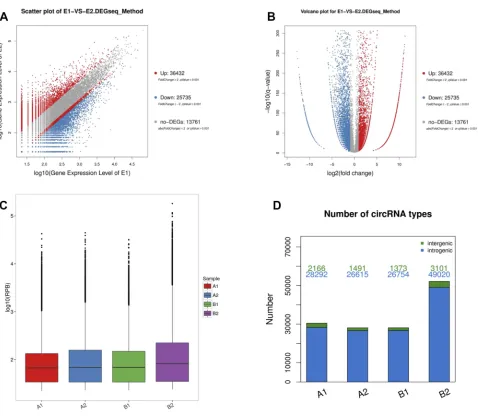
High throughput sequencing analysis facilitated our research on circRNA expression signatures in the grade 3 EC. A total of 75,928 circRNA targets were detected by microarray probes in two pairs of samples. In the initial stage of experiments,
circRNA expression profile of two pairs of the grade 3 EC
and adjacent non-cancerous tissues were performed. We
con-firmed the differentially expressed circRNA with statistical
significance between the two groups by using Scatter plot
filtering and Volcano Plot filtering (Figure 1A andB). Box
Figure 1Bioinformatics analysis of differentially expressed circRNAs in patients with the grade 3 EC and adjacent non-cancerous endometrial tissue.
Notes:(A) Scatter plot shows the variation of circRNA between the adjacent non-cancerous endometrial (Y-axis) versus the grade 3 EC tissue (X-axis). The upper red squares to the left indicate 2.0 fold changes of circRNA, while the bottom blue squares indicate negative fold changes of 2.0. (B) Volcano plot shows the differential circRNA expression in the grade 3 EC and adjacent non-cancerous endometrial tissue. (C) Box plot shows the distributions of circRNAs in more direct way. (D) The bar diagram shows the circRNA category. Most of them are transcribed from the introgenic, some are from intergenic.
Cancer Management and Research downloaded from https://www.dovepress.com/ by 118.70.13.36 on 20-Aug-2020
Figure 2The distribution of differentially expressed circRNAs in human chromosomes (A1, A2, B1, and B2).
A
B
Group
Up_Down E1 4
2
0
–2
–4
A2
A1 B1
B2
E2
Up Down Pheatmap for E1&E2
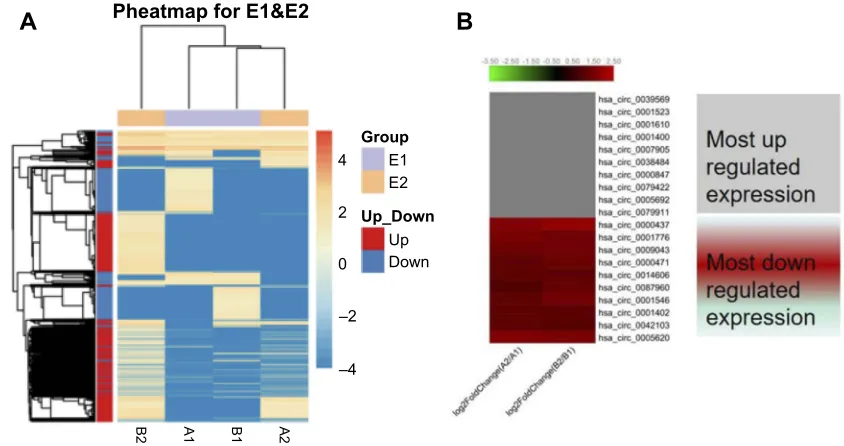
Figure 3Heat map and hierarchical clustering showing the expression values of all target circRNAs and the most up and downregulated circRNAs. Each column represents a sample and each row represents a circRNA.
Notes:(A) Hierarchical cluster analysis of all target circRNAs. (B) Hierarchical cluster analysis of the most 10 up and downregulated circRNAs. A2/A1 means A2 divided A1. B2/B1 means B2 divided B1.
Cancer Management and Research downloaded from https://www.dovepress.com/ by 118.70.13.36 on 20-Aug-2020
plots show the normalized intensities from the two groups (Figure 1C). What is more, we analyzed the category of differentially expressed circRNAs. Most of them are
tran-scribed from the introgenic, some are from intergenic (Figure
1D). Furthermore, we analyzed the distribution of the
differ-ential expression of circRNAs on all the human chromosomes (Figure 2).
Identi
fi
cation of differentially expressed
circRNAs in patients with the grade 3 EC
and adjacent non-cancerous endometrial
tissue
Hierarchical cluster was performed to analyze all
the circRNAs and shown the top 10 up and downregulated circRNAs between the grade 3 EC and adjacent
non-cancerous endometrial tissues (Figure 3Aand B). The data
suggested that the expression of circRNAs in the grade 3 EC tissues was different from the matched non-tumor tissue.
A total of 62,167 unique circRNAs were significantly altered
in women with the grade 3 EC and adjacent non-cancerous
endometrial tissue (P<0.05). Among them, 25,735 were
sig-nificantly upregulated and 36,432 were down-regulated. The
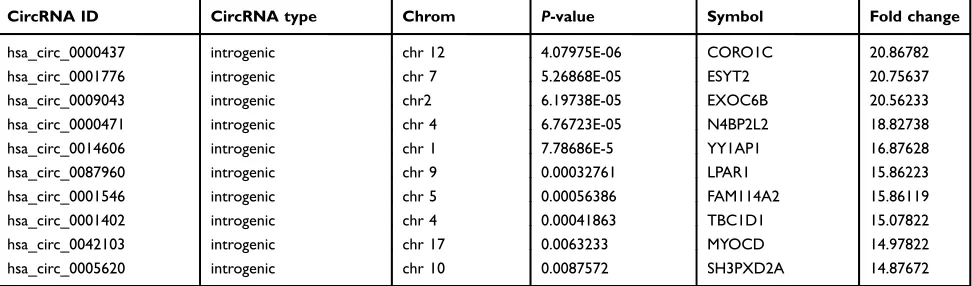
top 10 up and downregulated circRNAs between the two
groups are listed in Tables 4 and 5, respectively. Among
these, the expression levels of hsa_circ_0039569, hsa_-circ_0001523, hsa_circ_0001610, hsa_circ_0001400, and hsa_circ_0007905 were up-regulated, and hsa_circ_0000437,
hsa_circ_0001776, hsa_circ_0009043, hsa_circ_0000471,
and hsa_circ_0014606 were downregulated as top 5, respectively.
Construction of the circRNA/miRNA
interaction network and prediction of
circRNA-miRNA associations
Considered that the circRNA had the potential to serve as miRNA sponges to regulate gene expression, so we made a further exploration about the function of ceRNA of circRNA. We used TargetScan and miRanda database software to predict the target miRNAs of circRNAs based on the base pairing rule in Arraystar. All the differentially expressed
Table 4Comparison of the grade 3 EC with the adjacent non-cancerous endometrial tissue for the top 10 upregulated circRNAs (fold
change>2 andP<0.05) ranked by fold changes in microarray date
CircRNA ID CircRNA type Chrom P-value Symbol Fold change
hsa_circ_0039569 introgenic chr 16 4.07867E-06 CCL22 21.76285
hsa_circ_0001523 introgenic chr 5 5.86834E-05 ZNF608 20.98622
hsa_circ_0001610 introgenic chr 6 0.00065652 TNFRSF21 18.81641
hsa_circ_0001400 introgenic chr 4 0.00014689 RELL1 16.98614
hsa_circ_0007905 introgenic chr 1 6.78686E-5 STX6 16.86283
hsa_circ_0038484 introgenic chr 16 0.00057861 VWA3A 15.28875
hsa_circ_0000847 introgenic chr 18 0.00576386 SMAD2 14.28628
hsa_circ_0079422 introgenic chr 7 0.00581689 ICA1 13.32534
hsa_circ_0005692 introgenic chr 16 0.0063233 GLIS2 14.97822
hsa_circ_0079911 introgenic chr 7 0.0034546 POU6F2 12.27567
Table 5Comparison of the grade 3 EC versus the adjacent non-cancerous endometrial tissue for the top 10 downregulated circRNAs
(fold change>2 andP<0.05) ranked by fold changes in microarray data
CircRNA ID CircRNA type Chrom P-value Symbol Fold change
hsa_circ_0000437 introgenic chr 12 4.07975E-06 CORO1C 20.86782
hsa_circ_0001776 introgenic chr 7 5.26868E-05 ESYT2 20.75637
hsa_circ_0009043 introgenic chr2 6.19738E-05 EXOC6B 20.56233
hsa_circ_0000471 introgenic chr 4 6.76723E-05 N4BP2L2 18.82738
hsa_circ_0014606 introgenic chr 1 7.78686E-5 YY1AP1 16.87628
hsa_circ_0087960 introgenic chr 9 0.00032761 LPAR1 15.86223
hsa_circ_0001546 introgenic chr 5 0.00056386 FAM114A2 15.86119
hsa_circ_0001402 introgenic chr 4 0.00041863 TBC1D1 15.07822
hsa_circ_0042103 introgenic chr 17 0.0063233 MYOCD 14.97822
hsa_circ_0005620 introgenic chr 10 0.0087572 SH3PXD2A 14.87672
Cancer Management and Research downloaded from https://www.dovepress.com/ by 118.70.13.36 on 20-Aug-2020
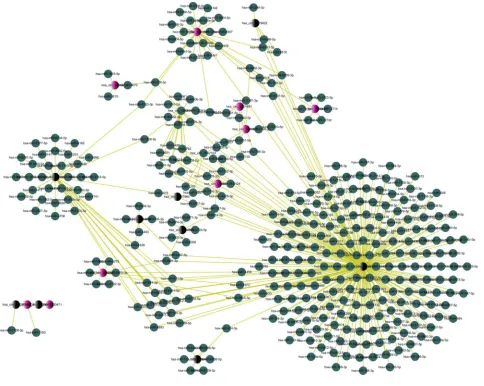
circRNAs were predicted according to the complementary miRNA matching sequence. There were a total of 451 miRNAs, the top 10 upregulated and downregulated circRNAs, could be combined with circRNAs. Then, used Cytoscape delineated an entire network of circRNA/miRNA interaction (Figure 4).
Validation for the differential expression
level of circRNAs
To confirm the data analysis expression of circRNA
micro-array, six circRNAs (hsa_circ_0039569, hsa_circ_0001523,
hsa_circ_0001610, hsa_circ_0000437, hsa_circ_0001776,
and hsa_circ_0009043) were validated out using qRT-PCR in 30 pairs of samples including 15 pairs of the grade 3 EC and adjacent non-cancerous endometrial tissue, 15 pairs of
the grade 1–2 EC and adjacent non-cancerous endometrial
tissue. The results showed that circRNAs were significantly
differentially expressed between the grade 3 EC and the
grade 1–2 EC.
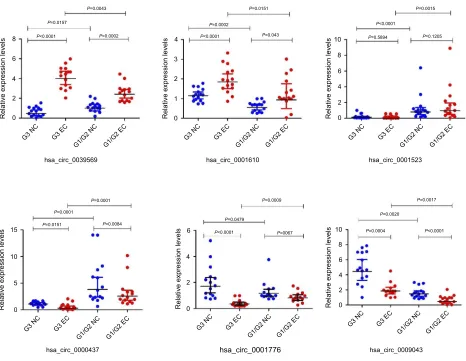
The qRT-PCR results are presented in Figure 5. It
showed that the expression of the circRNAs hsa_-circ_0039569 and hsa_circ_0001610 were upregulated at
the grade 3 EC and the grade 1–2 EC tissue versus the
adjacent non-cancerous endometrial tissue, compared with
the grade 1–2 EC tissue, hsa_circ_0039569 and
hsa_-circ_0001610 have a higher level of expression in the grade 3 EC. The hsa_circ_0001523 qPCR results were inconsistent with the microarray analysis. The hsa_-circ_0009043, hsa_circ_0000437, and hsa_circ_0001776
were significantly downregulated at the grade 3 EC and
the grade 1–2 EC tissue versus the adjacent non-cancerous
endometrial tissue. And the hsa_circ_0009043 and hsa_-circ_0001776 had a higher level of expression in the
Figure 4circRNAs-miRNAs network diagram.
Notes:The red and black nodes represent circRNA, while the blue nodes represent target miRNAs. Red and black nodes represent upregulation and downregulation, respectively.
Cancer Management and Research downloaded from https://www.dovepress.com/ by 118.70.13.36 on 20-Aug-2020
grade 3 non-cancerous endometrial tissue versus the grade
1–2 non-cancerous endometrial tissue, whereas
hsa_-circ_0000437 had a lower level of expression.
The relationship between the expression of
hsa_circ_0039569 and clinicopathological
parameters of the 30 patients
The qPCR results showed that hsa_circ_0039569 was higher expression of the grade 3 EC versus the grade
1–2 EC. To analyze the relationship between the
expres-sion of hsa_circ_0039569 and clinicopathological para-meters of the 30 patients, the patients were divided into low expression group (n=15) and high expression group (n=15) with the hsa_circ_0039569 relative expression
level 2−ΔΔCт, median is 2.985. The correlation between
the hsa_circ_0039569 and clinicopathological data was analyzed. The results showed that the expression level of hsa_circ_0039569 was not correlated with age, lymph
node metastasis, tumor size, FIGO stage, and myometrial
invasion (P>0.05), and was significantly correlated with
tumor differentiation (P=0.001). The difference was
statis-tically significant (Table 6).
Prediction of circRNA-miRNA
associations
In order to explore the mechanism of circRNAs, the circRNA-miRNA axis in cancer-related pathways was predicted. DIANA-miRPath determined all the candidate miRNAs that
were involved in possible pathways byp-value cutoff at 0.05.
The data showed that hsa_circ_0039569 was associated with cancer-related pathways for the grade 3 EC with the greatest potential. Base on TargetScan and miRanda, the hsa_-circ_0039569/microRNAs interaction was predicted using
Arraystar’s home-made miRNA target prediction software.
KEGG analysis of all microRNAs showed that miR-542-3p and -let-7c-5 was associated with cancer-related pathways for
8 P<0.0001 P<0.0001
P=0.0157 P=0.0043 P=0.0002 P=0.0151 P=0.0015 P<0.0001 P=0.5894 P=0.1205 P=0.0017 P=0.0009 P=0.0001 P=0.0084 P=0.0001 P=0.0151 P=0.0479 P<0.0001 P=0067 P=0.0020 P=0.0004 P<0.0001 P=0.043 P=0.0002 6 0 2 4 4 10 8 4 2 0 6 3 2 1 0
hsa_circ_0039569 hsa_circ_0001610 hsa_circ_0001523
Relative expression levels Relative expression levels Relative expression levels
10 8 4 2 0 6
Relative expression levels
6
2
0 4
Relative expression levels
15
5
0 10
Relative expression levels
G3 NC G3 EC
G1/G2 NC G1/G2 EC G3 NC G3 EC G1/G2 NC G1/G2 EC G3 NC G3 EC G1/G2 NC G1/G2 EC
hsa_circ_0009043 G3 NC G3 EC
G1/G2 NC G1/G2 EC
hsa_circ_0001776 G3 NC G3 EC
G1/G2 NC G1/G2 EC hsa_circ_0000437
G3 NC G3 EC
G1/G2 NC G1/G2 EC
Figure 5Quantitative real-time PCR validation for the expression of six circRNAs.
Notes:The expression levels of six circRNAs were validated by qPCR in 30 patients. G3 NC, grade 3 non-cancerous endometrial tissue. G1/G2 NC, grades 1–2 non-cancerous endometrial tissue. G3 EC, grade 3 EC. G1/2 EC, grades 1–2 EC.
Cancer Management and Research downloaded from https://www.dovepress.com/ by 118.70.13.36 on 20-Aug-2020
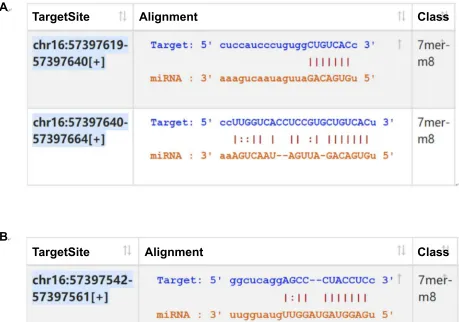
the grade 3 EC with the greatest potential. Firstly, we further analyzed the binding sequence between hsa_circ_0039569
and hsa-miR-542-3p or hsa-let-7c-5p interaction by
TargetScan and miRanda analysis. We found circ_0039569 had a perfect match sequence (7-mer-m8 seed type) to bind
miR-542-3p (Figure 6A) or let-7c-5p (Figure 6B). To made
a confirmation of the relationship between circRNA between
hsa_circ_0039569 and miR-542-3p or let-7c-5p, hsa-miR-542-3p and hsa-let-7c-5p were validated by using qRT-PCR in 30 pairs of samples.
The qRT-PCR results are presented in Figure 7. It
showed that the expression of the microRNAs hsa-miR -542-3p and hsa-let-7c-5p was upregulated at the grade
3 non-cancerous endometrial tissue and the grade 1–2
non-cancerous endometrial tissue versus the the
grade1-3 EC tissue, compared with the grade 1–2
non-cancerous endometrial tissue, miR-542-3p, and hsa-let-7c-5p have a higher level of expression in the
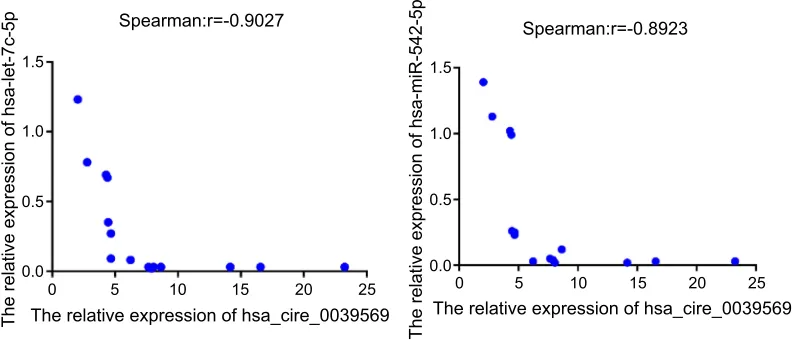
non-cancerous endometrial tissue. So, the hsa_circ_0039569-hsa-miR-542-3p/hsa-let-7c-5p axis was predicted as one of the circRNA-miRNA axis. Spearman correlation test was used to analyze the correlation between hsa_-circ_003956 and hsa-miR-542-3p and hsa-let-7c-5p in
the grade 3 EC. The correlation coefficient R results
are -8923 and -0.9027 (Figure 8). So, hsa_circ_003956
has a negative correlation with miR-542-3p and hsa-let-7c-5p.
Discussion
Presently, the mechanism and role of circRNAs in cancer
progression haven’t been well identified.13 Emerging
evi-dence have found that circRNAs played an important part role in multiple pathological and physiological functions. The available evidence showed that circRNAs are
asso-ciated with proliferation,14 cell cycle,15 aoptosis,16 and
autophagy,17 involving nervous system disease,
cardio-vascular system disease, and series of tumors.18,19
Especially, more and more studies have found that circu-lar RNA plays an increasingly important role in malig-nant tumors which were related to sex hormones. Accumulating evidence indicates that hsa_circ_006054, hsa_circ_100219 hsa_circ_0006528, and circ-ABCD10
might also play roles in breast cancer.20–22 Furthermore,
hsa_circ_0001982 promotes breast cancer cell
carcino-genesis by targeting miR-143.23Additionally, the
expres-sion of circ-Foxo3 was downregulated in mouse breast tumor tissues compared with normal breast, lipid tissues, and skin, and as an inhibitor of breast cancer tumor cells
inhibits tumor cell proliferation and survival.24 It has
been proved that circ-SMARCA5 acts as an oncogene in prostate cancer by promoting the cell cycle and
inhi-biting apoptosis.25
In the field of EC, up to the present time, just one
study has shown that circRNAs may play roles in EC,
with grade (1–2) type I EC, it reported the circular
transcriptome specific for EC as determined by RNA
sequencing and found that the abundance of circRNAs
was lower in the grade 1–2 EC than in adjacent
non-cancerous endometrial tissue. What is more, they found
that numerous “hotspot” genes from which circRNAs
were transferred that may account for alterations in circRNA expression between the non-cancerous
endo-metrial tissue and the grade 1–2 EC. Most importantly,
they have also identified circRNAs which were
differ-entially expressed between the grade 1–2 EC and
nor-mal endometrial tissue. More and more researchers
Table 6 The relationship between the expression of
hsa_-circ_0039569 and clinicopathological parameters of the thirty patients
Clinicopathological Number of cases
Parameters (30) Hsa_circ_0039569 expression P-value Low (%) High (%)
Age distribution (years old)
<45 4 1 (25.00%) 3 (75.00%) 0.427
≥45 26 12 (46.15%) 14 (53.85%)
Tumor size (cm)
<4 25 16 (36.00%) 9 (64.00%) 0.317
≥4 5 2 (40.00%) 3 (60%)
Histopathologic grades
G1 and G2 15 12 (80.00%) 3 (20.00%) 0.001
G3 15 3 (20.00%) 12 (80.00%)
FIGO stage
Ia 24 15 (62.50%) 9 (37.5%) 0.368
Ib 4 1 (25.00%) 3 (75.00%)
II-IIIa 2 1 (50.00%) 1 (50.00%)
Myometrial invasion
<1/2 24 14 (58.33) 10 (41.67%) 0.272
≥1/2 6 2 (33.33%) 4 (66.67%)
Lymph node metastasis
Positve 2 1 (50.00%) 1 (50.00%) 1.000
Negetive 28 14 (50.00%) 14 (50.00%)
Cancer Management and Research downloaded from https://www.dovepress.com/ by 118.70.13.36 on 20-Aug-2020
A
TargetSite
Alignment
Class
TargetSite
Alignment
Class
B
Figure 6The interaction between hsa_circ_0039569 and hsa-miR-542-3p or hsa-let-7c-5p was predicted by TargetScan and miRanda. Notes:(A) The interaction between hsa_circ_0039569 and hsa-miR-542-3p. (B) The interaction between hsa_circ_0039569 and hsa-let-7c-5p.
6
4
3
2
1
0 P=0.0004
P=0.0287
P=0.0381
P=0.0184 P=0.1070
P=0.0041
P=0.0067
P=0.0009
4
2
Relative expression levels 0 Relative expression levels
hsa-let-7c-5p
G3 NC G3 EC
G1/G2 NC G1/G2 EC
hsa-miR-542-3p
G3 NC G3 EC
G1/G2 NC G1/G2 EC
Figure 7Quantitative real-time PCR validation for the expression of two miRNAs.
Notes:The expression levels of two miRNAs were validated by qPCR in 30 patients. G3 NC, grade 3 non-cancerous endometrial tissue. G1/G2 NC, grades 1–2 non-cancerous endometrial tissue. G3 EC, grade 3 EC. G1/2 EC, grades 1–2 EC.
Cancer Management and Research downloaded from https://www.dovepress.com/ by 118.70.13.36 on 20-Aug-2020
acknowledge that the patients with the grade 3 EC have
a generally poor prognosis,26 and the specific role of
circRNAs in the grade 3 EC remains unclear.
In this study, the differentially expressed profiles of
circRNAs in the grade 3 EC tissue and adjacent non-cancerous endometrial tissue were analyzed and validated.
Up to now, this is thefirst study to evaluate the differential
expression of circRNAs in the grade 3 EC patients. It indi-cated that the grade 3 EC-associated circRNAs could be exploited as new candidates for diagnosis and treatment of the grade 3 EC.
Base on the above study, there were 25,735 circRNAs
significantly upregulated and 36,432 circRNAs significantly
downregulated in the grade 3 EC tissue compared with adjacent non-cancerous endometrial tissue. Among these,
the expression levels of hsa_circ_0039569,
hsa_-circ_0001523, hsa_circ_0001610, hsa_circ_0001400, and
hsa_circ_0007905 were upregulated, and
circ_0000437, hsa_circ_0001776, hsa_circ_0009043, hsa_-circ_0000471, and hsa_circ_0014606 were downregulated as top 5, respectively. The upregulated hsa_circ_0039569
and hsa_circ_0001610 and downregulated
hsa_-circ_0000437, hsa_circ_0001776, and hsa_circ_0009043 were validated by qRT-PCR analysis. Hsa_circ_0039569 were selected for further analysis, in the clinicopathological parameters of the 30 patients, the expression level of
hsa_-circ_0039569 was significantly correlated with tumor
dif-ferentiation (P=0.001), and was not correlated with age,
lymph node metastasis, tumor size, FIGO stage and
myo-metrial invasion (P>0.05). Furthermore, using Cytoscape to
delineate an entire network of circRNAs/miRNAs
interac-tion. This was the first time of our study which predicted
hundreds of circRNAs/miRNAs interaction. An interaction network of circRNAs/miRNAs was constructed, which pro-vided valuable information for ceRNA research of circRNAs in the grade 3 EC. In addition, the results showed that the hsa_circ_0039569 was highly expressed in the grade 3 EC compared to control. With bioinformatical methods, we found that hsa_circ_0039569 had MREs of hsa-miR-542-3p and hsa-let-7c-5p. Hsa-miR-542-3p and hsa-let-7c-5p were downregulated at the grade 3 EC were validated by qRT-PCR analysis. Predicting that hsa_-circ_0039569-hsa-miR-542-3p/hsa-let-7c-5p was one of the circRNA-miRNA axis. Our results indicated that it was worthwhile to investigate these novel dysregulated circRNAs as miRNA sponges and their potential biological functions in the grade 3 EC.
All in all, for the first time, our study revealed the
circRNA expression signatures of the grade 3 EC. Furthermore, the regulation of hsa_circ_0039569-hsa-miR -542-3p/hsa-let-7c-5p axis was initially predicted in the grade 3 EC. Next, our laboratory is doing further research on the mechanism of hsa_circ_0039569. The result of our study emphasized that hsa_circ_0039569 could be an impor-tant prediction of the grade 3 EC. This study has laid the foundation for the functional studies, further diagnosis, treat-ment of circRNAs of the grade 3 EC.
Conclusion
This study demonstrated that lots of differentially expressed cricRNAs in endometrial tissue of the grade 3 EC patients compared with adjacent non-cancerous endometrial tissue. Therefore, it may offer novel molecular candidates for diag-nosis and clinical treatment of the grade 3 EC.
1.5
Spearman:r=-0.9027 Spearman:r=-0.8923
1.0
0.5
The relative expression of hsa-let-7c-5p The relative expression of hsa_cire_0039569 The relative expression of hsa-miR-542-5p The relative expression of hsa_cire_0039569 0.0
1.5
1.0
0.5
0.0
0 5 10 15 20 25 0 5 10 15 20 25
Figure 8The result of spearman correlation test between hsa_circ_003956 and hsa-miR-542-3p/hsa-let-7c-5p in the grade 3 EC.
Cancer Management and Research downloaded from https://www.dovepress.com/ by 118.70.13.36 on 20-Aug-2020
Acknowledgments
We thank all the donors who participated in the work. This study was supported by the Natural Science Foundation of Guangdong Province (No: 2016A030313115).
Author contributions
Fei Ye, Xiao Yu Wang, and Xue Feng Jiang conceived and designed the experiments. Fang Ma and Qiong Lan Tang performed the experiments. Lei Cai, Ming Chen, and Xiao
Xia Ran analyzed the data. Fei Ye prepared the figures and
wrote the manuscript. All authors contributed to data analysis,
drafting or revising the article, gave final approval of the
version to be published, and agree to be accountable for all aspects of the work.
Disclosure
The authors report no conflicts of interest in this work.
References
1. Bokhman JV. Two pathogenetic types of endometrial carcinoma.
Gynecol Oncol.1983;15(1):10–17.
2. Granados-Riveron JT, Aquino-Jarquin G. The complexity of the translation ability of circRNAs.Biochim Biophys Acta Gene Regul Mech.2016;1859(10):1245–1251. doi:10.1016/j.bbagrm.2016.07.009 3. Barrett SP, Salzman J. Circular RNAs:analysis, expression and potential functions. Development. 2016;143(11):1838–1847. doi:10.1242/ dev.128074
4. Qu S, Yang X, Li X, et al. Circular RNA:A new star of noncoding RNAs.
Cancer Lett.2015;365(2):141–148. doi:10.1016/j.canlet.2015.06.003 5. Yan L, Zheng M, Wang H. Circular RNA hsa_circ_0072309 inhibits
proliferation and invasion of breast cancer cells via targeting miR-492.
Cancer Manag Res.2019;11:1033–1041. doi:10.2147/CMAR.S186857 6. Wang S, Xue X, Wang R, et al. CircZNF609 promotes breast cancer
cell growth, migration, and invasion by elevating p70S6K1 via sponging miR-145-5p. Cancer Manag Res. 2018;10:3881–3890. doi:10.2147/CMAR.S174778
7. Du WW, Yang W, Chen Y, et al. Foxo3 circular RNA promotes cardiac senescence by modulating multiple factors associated with stress and senescence responses.Eur Heart J.2017;38:402–1412. 8. Legnini I, Di Timoteo G, Rossi F, et al. Circ-ZNF609 is a circular
RNA that can be translated and functions in myogenesis.Mol Cell. 2017;66(1):22–37. doi:10.1016/j.molcel.2017.02.017
9. Han B, Chao J, Yao H. Circular RNA and its mechanisms in disease: from the bench to the clinic.Pharmacology&Therapeutics.2018;187:31–44. 10. Chen BJ, Frances L, Byrne F, et al. Analysis of the circular RNA
transcriptome in endometrial cancer.Oncotarget.2018;9(5):5786–5796.
11. Pasquinelli A. MicroRNAs and their targets: recognition,regulation and an emerging reciprocal relationship. Nat Rev Genet. 2012;13 (4):271–282. doi:10.1038/nrg3162
12. Enright AJ, John B, Gaul U, Tuschl, T., Sander, C., Marks, D S. MicroRNA targets in drosophila. Genome Biol. 2003;5:R1. doi:10.1186/gb-2003-5-1-r1
13. Ebbesen KK, Hansen TB, Kjems J. Insights into circular RNA biology. RNA Biol. 2017;14(8):1035–1045. doi: 10.1080/1547 6286
14. Bachmayr-Heyda A, Reiner AT, Auer K, et al. PilsCorrelation of circular RNA abundance with proliferation—exemplified with color-ectal and ovarian cancer, idiopathic lungfibrosis, and normal human tissues.Sci Rep.2015;5(1):8057. doi:10.1038/srep08057
15. Du WW, Yang W, Liu E, Yang, Z., Dhaliwal, P., Yang, B B. Foxo3 circular RNA retards cell cycle progression via forming ternary complexes with p21 and CDK2. Nucleic Acids Res. 2016;44:2846–2858. doi:10.1093/nar/gkw027
16. Du WW, Fang L, Yang W, Wu, N., Awan, F M., Yang, Z., Yang, B B. Induction of tumor apoptosis through a circular RNA enhancing Foxo3 activity. Cell Death Differ. 2017;24:357–370. doi:10.1038/ cdd.2016.133
17. Huang R, Zhang Y, Han B, et al Circular RNA HIPK2 regulates astrocyte activation via cooperation of autophagy and ER stress by targeting MIR124-2HG. Autophagy. 2017;13(10):1722–1741. doi:10.1080/15548627.2017.1356975
18. Greene J, Baird AM, Brady L, et al. Circular RNAs: biogenesis, function and role in human diseases.Front Mol Biosci.2017;4:38. doi:10.3389/fmolb.2017.00038
19. Li P, Chen H, Chen S, et al. Circular RNA 0000096 affects cell growth and migration in gastric cancer. Br J Cancer. 2017;116:626–633. doi:10.1038/bjc.2016.451
20. Gao D, Zhang X, Liu B, et al. Screening circular RNA related to chemotherapeutic resistance in breast cancer. Epigenomics. 2017;9:1175–1188. doi:10.2217/epi-2017-0055
21. Liang HF, Zhang XZ, Liu BG, Jia, G-T., Li, W-L. Circular RNA circ-ABCB10 promotes breast cancer proliferation and progres-sion through sponging miR-1271. Am J Cancer Res. 2017;7:1566–1576.
22. Lu L, Sun J, Shi P, Kong W, et al. Identification of circular RNAs as a promising new class of diagnostic biomarkers for human breast cancer. Oncotarget. 2017;8:44096–44107. doi:10.18632/ oncotarget.17307
23. Tang YY, Zhao P, Zou TN, et al. Circular RNA hsa_circ_0001982 promotes breast cancer cell carcinogenesis through decreasing miR-143.
DNA Cell Biol.2017;36:901–908. doi:10.1089/dna.2017.3862 24. Yang E, Du WW, Li X, Yee, A J., Yang, B B. Foxo3 activity
promoted by non-coding effects of circular RNA and Foxo3 pseudo-gene in the inhibition of tumor growth and angiopseudo-genesis.Oncogene. 2016;35:3919–3931. doi:10.1038/onc.2015.460
25. Kong Z, Wan X, Zhang Y, et al Androgen-responsive circular RNA circSMARCA5 is up-regulated and promotes cell proliferation in prostate cancer. Biochem Biophys Res Commun. 2017;493:1217–1223. doi:10.1016/j.bbrc.2017.07.162
26. Amant F, Mirza MR, Koskas M, Creutzberg, C L. Cancer of the corpus uteri. Int J Gynaecol Obstet. 2018;143 Suppl 2:37–50. doi:10.1002/ijgo.12612
Cancer Management and Research downloaded from https://www.dovepress.com/ by 118.70.13.36 on 20-Aug-2020
Cancer Management and Research
Dove
press
Publish your work in this journal
Cancer Management and Research is an international, peer-reviewed open access journal focusing on cancer research and the optimal use of preventative and integrated treatment interventions to achieve improved outcomes, enhanced survival and quality of life for the cancer patient.
The manuscript management system is completely online and includes a very quick and fair peer-review system, which is all easy to use. Visit http://www.dovepress.com/testimonials.php to read real quotes from published authors.
Submit your manuscript here:https://www.dovepress.com/cancer-management-and-research-journal
Cancer Management and Research downloaded from https://www.dovepress.com/ by 118.70.13.36 on 20-Aug-2020