A Meet-in-the-Middle Attack on Round-Reduced mCrypton
Using the Differential Enumeration Technique
Yonglin Hao1?, Dongxia Bai1, Leibo Li2
1
Department of Computer Science and Technology, Tsinghua Universtiy, Beijing 100084, China [email protected], [email protected]
2 Key Laboratory of Cryptologic Technology and Information Security, Ministry of Education,
School of Mathematics, Shandong University, Jinan, 250100, China [email protected]
Abstract. This paper describes a meet-in-the-middle (MITM) attack against the round reduced ver-sions of the block cipher mCrypton-64/96/128. We construct a 4-round distinguisher and lower the memory requirement from 2100 to 244 using the differential enumeration technique. Based on the dis-tinguisher, we launch a MITM attack on 7-round mCrypton-64/96/128 with complexities of 24464-bit blocks and 257encryptions. Then we extend the basic attack to 8 rounds for mCrypton-128 by adding
some key-bridging techniques. The 8-round attack on mCrypton-128 requires a time complexity 2100
and a memory complexity 244. Furthermore, we construct a 5-round distinguisher and propose a MITM
attack on 9-round mCrypton-128 with a time complexity of 2115encryptions and a memory complexity
of 2113 64-bit blocks.
1
Introduction
mCrypton is a 64-bit block cipher introduced in 2006 by Lim and Korkishko [1]. It is a reduced version of Crypton [2]. It is specifically designed for resource-constrained devices like RFID tags and sensors in wireless sensor networks. According to key length, mCrypton has three versions namely mCrypton-64/96/128.
Quite a few methods of cryptanalysis were applied to attack mCrypton. Under the related-key model, there are two main results. Park [3] launched a related-key rectangle attack on 8-round mCrypton-128 in the year 2009. Then, in 2012, Mala, Dakhilalian and Shakiba [4] gave a related-key impossible differential cryptanalysis on 9-round mCrypton-96/128. These related-key attacks are important basis in estimating the security of a block cipher, but they are not regarded as a real threat to the application of the cipher in practice since they require a powerful assumption that the adversary can ask to modify the unknown key used in the encryption.
For the attacks under the single-key model, there are only two biclique results on mCrypton: [5] managed to attack mCrypton-96/128 and [6] further adapted the methods to all three versions. Like the biclique result on AES [7], the two attacks mount to the full mCrypton but only with a marginal complexity over exhaustive search. In this paper, we try to attack mCrypton under the single-key model using the meet-in-the-middle method.
The meet-in-the-middle (MITM) attack was first introduced by Diffie and Hellman in 1977 [8]. In the past decade, the MITM scenario has become one of the most fruitful cryptanalysis method. It has been used to analyze block ciphers such as DES [9], KASUMI [10], IDEA [11],XTEA [12], KTANTAN [13] and Camellia [14,15]. It also shows good efficiency in the cryptanalysis of hash functions [16,17,18] and is adapted to attack against public key cryptosystem NTRU [19].
Among all the results of MITM attack, the most impressive ones come from the cryptanalysis on AES block cipher in single-key setting [20,21,22,23,24].
Demirci and Sel¸cuk launched the first MITM attack on AES at FSE 2008 [20]. They constructed a 5-round distinguisher and managed to analyze 7-5-round AES-192 and 8-5-round AES-256 using data/time/memory tradeoff. Their attack needs a small data complexity of 232. But its memory complexity reaches 2200since it requires to store a precomputation determined by 25 intermediated variable bytes. The number of parameters
?
can be reduced to 24 by storing the differentials instead of values in the precomputation table. Although modifications was made in [21] and [22], the crisis of memory requirement remained severe.
At ASIACRYPT 2010, Dunkelman, Keller and Shamir [23] introduced the differential enumeration and multiset ideas to MITM attacks and reduced the high memory complexity in the precomputation phase. They proved that if a pair conforms a truncated differential characteristic, the number of desired 24 intermediate variable bytes will descend to 16. Furthermore, at EUROCRYPT 2013, Derbez, Fouque and Jean [24] modified Dunkelman et al.’s attack with the rebound-like idea. They proved that many values in the precomputation talbe are not reached under the constraint of the truncated differential. They further lower the number of desired intermediate variable bytes to 10 and diminish the size of precomputation table by a large scale. Based on the 4-round distinguisher, they gave the most efficient attacks on 7-round AES-128 and 8-round AES-192/256. They also introduced a 5-round distinguisher to analyze 9-round AES-256. In this paper, we apply [24]’s method to mCrypton.
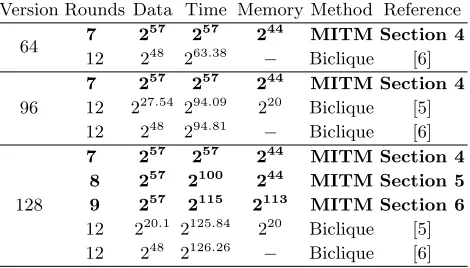
Table 1.Summary of the Attacks on mCrypton-64/96/128 under the Single-Key Model. Version Rounds Data Time Memory Method Reference
64 7 2
57
257 244 MITM Section 4
12 248 263.38 − Biclique [6]
96
7 257 257 244 MITM Section 4
12 227.54 294.09 220 Biclique [5] 12 248 294.81 − Biclique [6]
128
7 257 257 244 MITM Section 4
8 257 2100 244 MITM Section 5
9 257 2115 2113 MITM Section 6
12 220.1 2125.84 220 Biclique [5] 12 248 2126.26 − Biclique [6]
Our contribution. We construct a 4-round distinguisher of mCrypton and, using the differential enumer-ation technique, we prove that such a distinguisher can be determined by 11 intermediate variable nibbles. Based on these ideas, we launch a MITM attack on 7 rounds for all three versions of mCrypton, which recovers 36 subkey bits with a low memory complexity of 244 64-bit blocks. Then, we find some properties of key schedule and extend the basic attack to 8 rounds for mCrypton-128. The 8-round attack recovers 100 subkey bits. Furthermore, we construct a 5-round distinguisher and mount to 9 rounds for mCrypton-128.. This 9-round attack can recover 116 subkey bits with a time complexity of 2115 and a memory complexity 2113. Table 1 summarizes our results along with the other previous results of mCrypton-64/96/128 under the single-key model.
Organization of the Paper. Section 2 provides the description of the block cipher mCrypton and some related works. Section 3 describes the 4-round distinguisher of our basic attack and the way in which the differential enumeration method lower the memory complexity. Section 4 describes our basic MITM attack on 7-round mCrypton-64/96/128. In Section 5, we extend the basic attack to 8-round mCrypton-128 using some key bridging techniques. Then, in Section 6 we present a 5-round distinguisher and attack 9-round mCrypton-128. Finally, we summarize our paper in Section 7.
2
Preliminary
2.1 Description of mCrypton
mCrypton is a 64-bit lightweight block cipher based on SPN design. It consists of 16 4-bit nibbles which are represented by a 4×4 matrix as follows:
A=
a0 a1 a2 a3 a4 a5 a6 a7 a8 a9 a10a11 a12a13a14a15
(1)
It has three versions, categorized by key length, namely mCrypton-64/96/128. All the three versions have 12 rounds and each round consists of 4 transformations as follows.
Nonlinear Substitution γ. This transformation consists of nibble-wise substitutions using four 4-bit S-boxesSi(0≤i≤3). The four S-boxes has relationship:
S0=S2−1, S1=S3−1.
According to our experiments, the S-boxes of mCrypton have the same property with the S-box of AES (Property 1).
Property 1. Given∆i and∆o two non-zero differences in IF16, the equation
St(x)⊕St(x⊕∆i) =∆o, ∀t∈[0,3] has one solution on average.
Bit Permutation π. The bit permutation transformationπ has the same function with the MixColumns transformation of AES. It mixes each column of the 4×4 matrix A. For column i(0 ≤i ≤3), it uses the corresponding column permutationsπi. Suppose
A= (A0, A1, A2, A3) where Ais the 4×4 matrix andAiis itsi-th column. Then, we have
π(A) = (π0(A0), π1(A1), π2(A2), π3(A3)).
According to [1], eachπi is defined for nibble columnsa= (a0, a1, a2, a3)tandb= (b0, b1, b2, b3)t by
b=πi(a)⇔bj = 3
M
k=0
(m(i+j+k)mod4•ak).
The symbol• means bit-wise AND and the masking nibblesmi are given by
m0= 0xe= 11102, m1= 0xd= 11012, m2= 0xb= 10112, m2= 0x7 = 01112. πtransformation is an involution, which means π=π−1. It has a differential brunch number of 4.
Column-To-Row Transposition τ. This is simply the ordinary matrix transposition. It moves the nibble from the position (i, j) to position (j, i).
Key Additionσ.It is a simple bit-wise XOR operation and resembles the AddRoundKey operation of AES. Ther-th round (1≤r≤12) of mCrypton applied to a 64-bit statexcan be denoted by
ρkr(x) =σkr◦τ◦π◦γ(x).
Like AES, mCrypton also performs an initial key addition transformation (σk0) before round 1. In addition,
mCrypton adds a linear operationφ=τ◦π◦τ after round 12. So, the whole process of mCrypton encryption is
Since we use some key bridging skills to analyze mCrypton-128, we briefly introduce the key schedule of mCrypton-128:
Key Schedule of mCrypton-128.The 128-bit internal register U = (U0, U1, U2, U3, U4, U5, U6, U7)
is first initialized with the 128-bit user key. EachUi(0≤i≤7) is a 16-bit (4-nibble) word, occupying a row of the 4×4 matrix. Round keyskr(0≤r≤12) are computed consecutively as follows:
T ←S(U0)⊕Cr, Ti ←T•Mi
kr= (U1⊕T0, U2⊕T1, U3⊕T2, U4⊕T3) U ←(U5, U6, U7, U0<<3, U1, U2, U3, U4<<8).
S is the nibble-wise S-box operation using S-box S0. Cr is the round constant word for round r. Masking wordsMi is to take thei-th nibble of a word:
M0= 0xf000, M1= 0x0f00, M2= 0x00f0, M3= 0x000f. The symbolX<<n means left rotation of a 16-bit wordX bynbits.
2.2 Notations and Units
Here, we summarize the notations that we use through this paper.
State xi
r: The 64-bit mCrypton state is represented by different small letters. Plaintexts and ciphertexts
are represented bypandc. In the r-th round, we denote the internal state after σkr transformation by xr, after γ by yr, after π by zr and after τ by wr. kr represents the round key while ur is calculated linearly fromkrwithur=π◦τ(kr). The difference of statexis denoted by∆x. Besides, the superscript represents the position that the state lies in a sequence (or set).
Nibble x[i]: We refer to thei-th nibble of a statexbyx[i], and usex[i,· · ·, j] for nibbles at positions from itoj. The nibbles of the state is numbered as the matrix in equation (1).
Bit x[i]|k: Each nibble has 4 bits numbered 4,3,2,1 from left to right. If we refer to bitkof nibblex[i], we
denote it byx[i]|k.
Bit-wise operators:
k concatenate two strings of bits.
⊕ bit-wise XOR.
• bit-wise AND.
In this paper, memory complexities of our attacks are measured by the number of 64-bit mCrypton blocks and time complexities by mCrypton encryptions (decryptions).
2.3 The Related Works
From the generic view of meet-in-the-middle attack, the cipher EK is treated as the combination of three partsEK =EK2
2◦E
m◦E1
K1. TheE
mpart in the middle has some particular property (such as a differential characteristic), according to which we can identify the correct key by finding the appearance of the property under each guess of subkey (K1, K2). The following definition will be used in this part.
We denote theσ-set by (x0,· · ·, x255). After we encrypt theσ-set by an encryption functionEK, thei-th byte of the output values will form a 2048-bit ordered sequence (EK(x0)[i],· · ·, EK(x255)[i]). The sequences with particular properties will be stored in a precompted lookup table for distinguishing the correct key guess during the attack.
In the first MITM attack on AES, Demirci et al. [20] build a distinguisher inEmassociated with σ-set. When aσ-set is encrypted, a certain byte of the 256 output values will form an ordered sequence. Demirci et al. found that such an ordered sequence can be expressed as a function of 25 (or 24 if they only store the differences rather than the values) intermediate byte parameters of Em. In precomputation phase of their attack, the adversary precomputes the 28×25 ordered sequences and stores them in a table. In the online phase, the adversary mounts an attack by guessing the value ofK1, choosing suitable plaintexts to construct a σ-set of Em, then partially decrypting the ciphertexts by guessingK2 to get the corresponding ordered sequence, and checking whether the value lies in the precomputed table. If the value is found in the table, the key guess (K1, K2) will be kept, otherwise discarded.
We also consider applying the differential enumeration technique proposed by Dunkelman et al. [23] to reduce the memory requirement of the attack. This technique based on the observation that if a message of the σ-set belongs to a pair conforming a spacial truncated differential characteristic, the possible values of the ordered sequence will be restricted to a small subset of the value space. The essence of this technique is fixing some values of intermediate parameters utilizing the truncated differential so that the size of the precomputed table can be diminished by a large scale. On the other hand, additional steps has to be taken in the online phase in order to find a pair satisfying the truncated differential characteristic because theσ-set is constructed only for this kind of pairs. Apparently, the differential enumeration technique reduce the memory requirement but also increase the data and time complexity. It is noticeable that Derbez et al. [24] improved this technique at EUROCRYPT 2013. They further reduced the possible values in the precomputed table by introducing some rebound-like ideas.
3
The 4-Round Distinguisher and The Differential Enumeration Tehcnique
The meet-in-the-middle strategy combined with the differential enumeration technique is the basis of our attack. Imitating those of AES, we define theσ-set of the mCrypton as Definition 2.
Definition 2. (σ-set of mCrypton).A σ-set is a set of 16 64-bit mCrypton-states that are all different in one nibble (the active nibble) and all equal in the other state nibbles (the inactive nibbles).
In our basic MITM attack, the middle partEm starts fromx1 and ends atx5. So, in the following parts of this paper, we denote theσ-set with an active nibble at positionj(0≤j≤15) by
Aj= (x01, ..., x151 ), (2) and the corresponding ordered sequence constituted by the l-th nibble (l∈[0,15]) ofx5 is denoted by
Bjl = (∆1x5[l],· · ·, ∆15x5[l]), (3) where ∆ixr=xi
r⊕x0r(1≤i≤15,0≤r≤12).
Proposition 1 shows that 25 intermediate variable nibbles are required to deduceBjl fromAj. However, if the x0
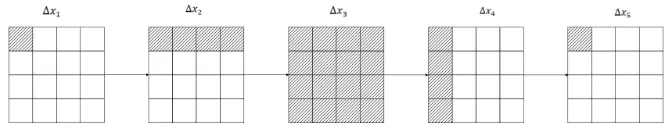
1 of σ-set A0 belongs to a pair conforming the truncated differential characteristic in Figure 1, we can prove that the corresponding sequenceB0
0 can only have 244 values determined by 11 nibble parameters (Proposition 2). This is the differential enumeration method used in [23] and [24] to lower the memory complexities of their attacks on AES.
Proposition 1. ∀j ∈[0,15]and∀l∈[0,15]. Let the σ-set be
Aj= (x01, ..., x151 )
Then, the corresponding sequence
Bjl = (∆1x5[l],· · ·, ∆15x5[l])
– 1 nibble ofx01.
– The full 16-nibble statex03;
– 4 nibbles ofx0
2.
– 4 nibbles ofx0
4.
Proof. We just letj= 0 andl= 0. Then, the 25 nibbles required are:
x01[0], x 0
2[0,1,2,3], x 0
3[0,· · ·,15], x 0
4[0,4,8,12].
For the t-th element of B00 (t ∈ [1,15]), the difference ∆tx5[0] can be deduced from x04[0,4,8,12] and ∆tx
4[0,4,8,12]. ∆tx
4[0,4,8,12] requires the knowledge ofx03[0,· · ·,15] and∆tx3[0,· · · ,15]. ∆tx
3[0, ...,15] is generated linearly from ∆ty2[0,· · ·,3], which can be deduced from x02[0,1,2,3] and ∆tx2[0,1,2,3].
∆tx2[0,1,2,3] is generated linearly from ∆ty1[0], which requires the knowledge of x0
1[0] and ∆tx1[0]. ∆tx1[0] can be deduced directly fromA0. Hence, all the nibble parameters required are: x01[0],x02[0,1,2,3], x0
3[0,· · ·,15],x04[0,4,8,12]. ut
Figure 1.The 4-round truncated differential characteristic. Dashed nibbles are active.
Proposition 2. If thex01 of a σ-set A0 belongs to a pair satisfying the differential characteristic in Figure
1, the corresponding sequence B0
0 can only take 244 values.
Proof. According to Proposition 1,B0
0 is determined by 25 nibbles namely: x01[0], x02[0,1,2,3], x30[0,· · ·,15], x40[0,4,8,12].
But if x0 of A0 belongs to one of the pairs conforming the truncated differential characteristic in Figure 1, the corresponding sequenceB0
0 can only take 244values determined by 11 nibbles namely x01[0], ∆x1[0], x02[0,1,2,3], x04[0,4,8,12], ∆z4[0],
where ∆refers to the difference of the pair conforming the differential characteristic. The knowledge of x0
1[0] and ∆x1[0] is sufficient to deduce ∆x2[0,1,2,3]. Combining x02[0,1,2,3] and ∆x2[0,1,2,3], we get the 16-nibble difference ∆x3.
Similarly, we can deduce∆y4[0,4,8,12] from∆z4[0]. Adding the knowledge ofx04[0,4,8,12], the 16-nibble differential∆y3 is determined.
Sincey3=γ(x3), according to the property of mCrypton S-boxes (Property 1), we can only get one value on average for each of the 16-nibble statex3using super-box matches technique [26].
This is the way we deduce the sequenceB0
0 from theσ-set A0. ut
4
The Basic Attack on 7-Round mCrypton-64/96/128
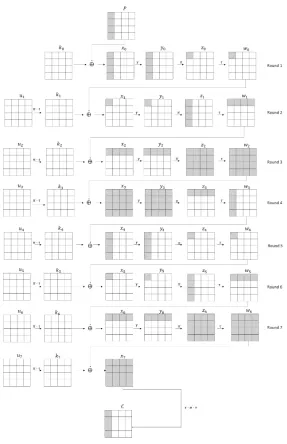
In this part, we describe our basic attack on 7-round mCrypton-64/96/128. This attack can recovery 36 subkey bits. The complete differential path used in this attack can be seen in Figure 4 in Appendix A. This attack is composed of two phases: the precomputation phase and the online phase.
Precomputation Phase:In the precomputation phase, we set up a lookup table containing 244 ordered sequences described as Proposition 2. The procedure is similar to the proof of Proposition 1 and Proposition 2, and is described as follows.
1. For each 44-bit stringx0
1[0]k∆x1[0]kx02[0,· · ·,3]kx04[0,4,8,12]k∆z4[0], we compute the possible value of the 25 nibbles, namelyx01[0], x02[0,· · · ,3], x03, x04[0,4,8,12], only with which can we determine the ordered sequenceB0
0. The procedure is as follows:
(a) Compute∆x2[0,· · ·,3] with the knowledge ofx01[0] and∆x1[0]; (b) Compute∆x3 with the knowledge ofx0
2[0,· · ·,3] and∆x2[0,· · ·,3]; (c) Compute∆y4[0,4,8,12] with the knowledge of∆z4[0];
(d) Compute∆y3with the knowledge of∆y4[0,4,8,12] andx4[0,4,8,12];
(e) With the knowledge of∆y3and∆x3and using the super-box matches, we can determine the possible values ofx0
3satisfyingγ(x03)⊕γ(x03⊕∆x3) =∆y3. According to Property 1,x03has only one possible value on average.
2. Now that we have obtained the value of the 25 nibbles namelyx01[0], x02[0,· · ·,3], x03, x04[0,4,8,12]. For all the 15 possible values of∆tx0
1[0], t∈[1,15], we can compute thet-th element ofB00,∆tx5[0], by executing the following substeps:
(a) Compute∆tx2[0,· · · ,3] with the knowledge of∆tx0[0] andx0 1[0]; (b) Compute∆tx3 with the knowledge of∆tx2[0,· · ·,3] andx0
2[0,· · · ,3]; (c) Compute∆tx4[0,4,8,12] with the knowledge of∆tx3andx03;
(d) Compute ∆tx
5[0] with the knowledge of ∆tx4[0,4,8,12] and x40[0,4,8,12]. And ∆tx5 is the t-th element ofB0
0 3. Store all the 244B0
0s in a hash tableTs.
Online Phase: In the online phase of this attack, we first find the right pairs satisfying the truncated differential characteristic. Then, for each member of the pairs, we construct its σ-set A0 and deduce the corresponding ordered sequenceB0
0 through partial encryptions&decryptions. Finally, we check whether the obtained B0
0 exist in the precomputed lookup tableTs. The detailed procedure is as follows.
1. Encrypt 241 structures of 216 plaintexts such that p[0,4,8,12] takes all values and other nibbles are constants. There are about 231 pairs (p, p0) in each structure, so there are 272 pairs in total.
2. Within each structure, select the pairs whose∆c only have difference at positions 0,4,8,12. Since this is a 48-bit filter, approximately 224 of the 272 message pairs will remain after this step.
3. For each remaining pair, assuming that it satisfies the differential path in Figure 4, we do the following substeps.
(a) Guess the difference value∆x1[0] and linearly deduce ∆y0[0,4,8,12].
(b) For each guess, deduce the possible subkey nibblesk0[0,4,8,12] with the knowledge of∆y0[0,4,8,12] and∆x0[0,4,8,12] =∆p[0,4,8,12]. According to Property 1, onek0[0,4,8,12] value can be acquired on average.
(c) Guess the difference value ∆y5[0] and deduce∆x6[0,· · ·,3].
(d) For each guess, deduce the possibleu7[0,· · · ,3] with the knowledge of∆x6[0,· · ·,3] and∆y6[0,4,8,12] (∆y6=∆τ(c)). According to Property 1, oneu7[0,· · ·,3] can be acquired on average.
4. For each deduced subkeyk0[0,4,8,12]ku7[0,· · ·,3], we obtain at least one ordered sequenceB00with the following substeps.
(a) Select one message of the right pair, denoted byp0, and deduce itsx0
1[0] through partial encryption. (b) Then, letttraverse through [1,15] so that we can compute∆tx1[0] =x0
(c) Query the ciphertexts of (p0,· · ·, p15) and deduce the sequence
(x06[0,· · ·,3],· · · , x156 [0,· · ·,3]) (4) through partial decryption with the knowledge ofu7[0,· · ·,3].
(d) Guess subkeyu6[0] and deduce the ordered sequenceB0
0= (∆1x5[0],· · ·, ∆15x5[0]) from (4) through partial decryption.
5. Identify the right subkeysk0[0,4,8,12]ku6[0]ku7[0,· · · ,3] by verifying whether the sequenceB00exists in the precomputed lookup tableTs. IfB00∈Ts, the key guesses are correct with high probability. The error rate is 244−60= 2−16to be precise.
Complexity analysis. In the pre-computation phase,Tscontains 244sequences and each sequence occupies 60 bits of space. So the memory complexity of this attack is dominated byTs’ 244 64-bit blocks. Since each sequence has 15 nibbles, it requires 244×15 ≈ 248 encryptions to construct the lookup table. The time complexity of the online phase is dominated by step 1 which involves encrypting 241×216= 257 plaintexts. So the time and data complexity of our attack are both 257.
5
Extend the Basic Attack to 8 Rounds for mCrypton-128
Using the key bridging technique, we can further attack 8-round mCrypton-128. According to the key schedule of mCrypton-128, the knowledge ofk8 can deduce some bits ink0 (Proposition 3) with which we can lower the time complexity of the online phase.
Proposition 3. By the key schedule of mCrypton-128, knowledge of the entire 16-nibble k8 allows deduce
k0[6], 3 bits ofk0[2] and 1 bit ofk0[14].
Proof. According to the key schedule of mCrypton-128, the relationship of the 8 bits are:
k0[2]|4,3,2=k8[3]|3,2,1 (5)
k0[6]|4,3,2=k8[7]|3,2,1 (6)
k0[6]|1=k8[4]|4 (7)
k0[14]|1=k8[12]|4 (8)
The readers may refer to [1] for the detailed key schedule of mCrypton-128. ut
In order to make full use of Proposition 3, we deliberately change the form of the truncated differential characteristic of this attack to the one in Figure 2. Theσ-set of this attack has an active nibble at position 8 and is denoted by A8. The corresponding ordered sequence is composed of nibble 0 ofx5 and is denoted byB0
8. The complete differential characteristic of this attack can be seen in Figure 5 in Appendix A.
Figure 2.The differential characteristic for 8-round mCrypton-128.
The precomputation phase of this 8-round attack is identical to that of the basic attack. In this phase, we construct a lookup table Ts containing 244 possible values ofB08 determined by 11 intermediate variable nibbles namely
x01[8], ∆x1[12], x02[0,1,2,3], x04[0,4,8,12], ∆z4[0].
1. Encrypt 241 structures of 216 plaintexts with active nibbles at positions 2,6,10,14. There are about 231 pairs (p, p0) in each structure, so there are 272 pairs in total.
2. For each pair, do the following substeps.
(a) Guess the difference∆y6[0,· · · ,3] and compute the subkey k8 using the super-box matches. Since there are 216 possible values of ∆y6[0,· · ·,3] and each can deduce onek8 one average (Proposition 1), 216 k8 values are obtained in this step.
(b) Deducek0[6] fromk8 using Proposition 3 and obtain∆y0[6] through partial encryption. Discard the keys if∆y0[6]|46= 0 because
∆y0[6] =m3•∆z0[2], m3= 01112. (9)
This is a one-bit filter so there are 215 subkey guesses left.
(c) Now that we have acquired z0[2]|3,2,1 from (9), we guess z0[2]|4 and compute ∆y0[2,6,10,14] with which we can deducek0[2,6,10,14]. Discard the guesses violating equations (6) and (8) of Proposition 3. This step involves a 1-bit guess and a 4-bit filter, so there are about 215+1−4= 212 subkey guesses remain.
(d) Guess∆y5[0] and deduce the 24 possible values ofu7[0,· · ·,3]. At this point, we have acquired 216 key guesses ofk0[2,6,10,14]ku7[0,· · · ,3]kk8.
3. For each subkey, select a member of the right pair, guessu6[0] and construct the sequenceB80 through partial encryptions & decryptions.
4. Identify the right guess by checking whetherB80exist inTs.
Complexity analysis.Similar to the basic attack, the data complexity of this attack is 257and the memory complexity is still dominated by the pre-computed lookup table, which is 24464-bit blocks to be precise. The time complexity of this attack is dominated by the 3rd step of the online phase which involves a 4-bit guess and 16 encryptions/decryptions to constructB0
8. Since this step has to be executed on each of the 220subkey guesses within each of the 272 pairs, the time complexity of this attack is 272×220×24×16 = 2100. The 8-round attack recovers 100 subkey bits namely k0[2,6,10,14]ku6[0]ku7[0,· · ·,3]kk8.
6
9-Round Attack on mCrypton-128
The 15-nibble sequences used in the previous attacks can not provide enough information to identify the correct subkey guesses in the 9-round attack on mCrypton-128. In the 9-round attack, we consider the σ -set with 2 active nibbles containing 256 64-bit blocks and its corresponding ordered sequence consists of 255 nibbles occupying 1020 bits of space. The key bridging technique used in this attack is interpreted as Proposition 4.
Proposition 4. By the key schedule of mCrypton-128, the knowledge of the entire 16-nibble k9 allows to
deduce k0[0,3]
Proof. According to the key schedule, we have
k0[3]|4,3,2=k9[12]|3,2,1 k0[3]|1=k9[13]|4
k0[0] =S0((k9[8]|2,1kk9[9]|4,3))⊕(k9[13]|3,2,1kk9[14]|4)⊕1
These relationships can be deduced easily from the key schedule. ut
To fully utilize the key bridging technique, we select the σ-set with active nibbles at positions 0 and 12, denoted by
A0,12={x01, x11, ..., x2551 }.
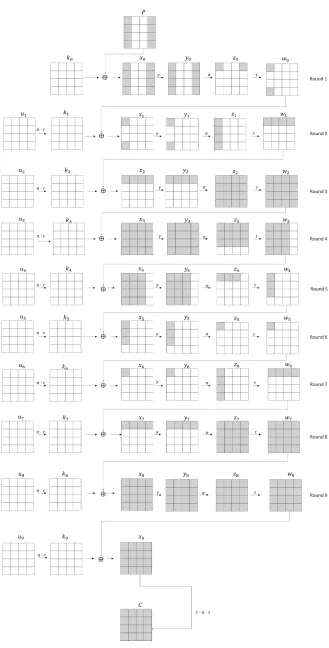
Figure 3.The 5-round differential characteristic for attacking 9-round mCrypton-128.
shown in Figure 3. The ordered sequence corresponding to A0,12 consists of ∆tx6[0](1 ≤ t ≤ 255) and is denoted by
B0,120 = (∆1x6[0],· · · , ∆255x6[0]). Similar to Proposition 1 and 2, the sequenceB0
0,12 is determined by 42 intermediate variable nibbles namely: x01[0,12], x02[0,· · · ,3], x03, x04, x05[0,4,8,12]
and the number of desired nibbles can be lowered to 29 with the help of the truncated differential characteristic in Figure 3 by using the differential enumeration method. The 29 decisive nibbles forB0
0,12 are namely x01[0,12], ∆x1[0,12], x02[0,1,2,3], x03, x05[0,4,8,12], ∆z5[0]. (10) However, the differential character can only be satisfied when ∆z5[0] = 0x8 = 10002, which means ∆z5[0] can only take 1 rather than 24values. Since∆z5[0] can only take 1 value,∆x5[0,4,8] can only take 23×3= 29 values, which is also true forx05[0,4,8] according to Property 1. So the total number of the targeted ordered sequence is 24×25+9 = 2109. This 9-round attack is in high accordance with the 8-round one introduced in Section 5, so we only briefly summarize the whole procedure as follow.
Precompuation phase. Construct the lookup tableTs containing 2109 values of B0,120 determined by 29 nibble parameters listed in (10).
Online phase.
1. Encrypt 225structures of 232plaintexts such thatp[λ], where λ= (0,3,4,7,8,11,12,15),
takes all values and other nibbles are constants. There are 288 pairs in total. 2. For each pair, do the following steps.
(a) Guess∆y7[0,· · ·,3] and deducek9 using super-box matches. Since there are 216 possible values of∆y7[0,· · ·,3] and each can deduce averaging onek9(Proposition 1), 216k9values are obtained in this step.
(b) Deducek0[0,3] with the knowledge ofk9using Proposition 4. Then, compute∆y0[0,3] and deduce ∆y0[λ] with the relation between∆y0 and ∆z0. With the knowledge of ∆y0[λ], we can further retrievek0[λ].
(c) Guess∆y6[0] and deduce 23 possible values ofu8[0,· · · ,3]ku7[0], whereu7[0] is deduced from the knowledge of∆x6[0] = 10002.
3. For each subkey, select a member of the right pair and deduce itsB0
0,12 through partial decryptions. 4. Refer to theTsand identify the right guess.
7
Conclusion
In this paper, we analyze the lightweight SPN block cipher mCrypton using the meet-in-the-middle (MITM) attack under the single-key model. We use the differential enumeration technique to lower the memory com-plexity, which used to be the bottleneck of the MITM method. We set up a 4-round distinguisher and manage to launch a basic MITM attack on 7-round mCrypton-64/96/128. Adding some key bridging techniques, we extend the basic attack to 8 rounds for mCrypton-128. We construct a 5-round distinguisher and further mount to 9 rounds for mCrypton-128. The 9-round attack retrieves 116 subkey bits with memory complexity 2113and time complexity 2115.
Acknowledgement. This work has been supported by the National Natural Science Foundation of China (Grant No. 61133013) and by 973 Program (Grant No. 2013CB834205).
References
1. Lim, C.H., Korkishko, T.: mcrypton–a lightweight block cipher for security of low-cost rfid tags and sensors. In: Information Security Applications. Springer (2006) 243–258
2. Lim, C.H.: Crypton: A new 128-bit block cipher. NIsT AEs Proposal (1998)
3. Park, J.H.: Security analysis of mcrypton proper to low-cost ubiquitous computing devices and applications. International Journal of Communication Systems22(8) (2009) 959–969
4. Mala, H., Dakhilalian, M., Shakiba, M.: Cryptanalysis of mcryptona lightweight block cipher for security of rfid tags and sensors. International Journal of Communication Systems25(4) (2012) 415–426
5. Shakiba, M., Dakhilalian, M., Mala, H.: Non-isomorphic biclique cryptanalysis and its application to full-round mcrypton. IACR Cryptology ePrint Archive2013(2013) 141
6. Jeong, K., Kang, H., Lee, C., Sung, J., Hong, S., Lim, J.I.: Weakness of lightweight block ciphers mcrypton and led against biclique cryptanalysis. Peer-to-Peer Networking and Applications (2013) 1–17
7. Bogdanov, A., Khovratovich, D., Rechberger, C.: Biclique cryptanalysis of the full aes. In: Advances in Cryptology–ASIACRYPT 2011. Springer (2011) 344–371
8. Diffie, W.: Exhaustive crypianalysis of the nbs daia encrypiion siandard. (1977)
9. Dunkelman, O., Sekar, G., Preneel, B.: Improved meet-in-the-middle attacks on reduced-round des. In: Progress in Cryptology–INDOCRYPT 2007. Springer (2007) 86–100
10. Jia, K., Yu, H., Wang, X.: A meet-in-the-middle attack on the full kasumi. IACR Cryptology ePrint Archive
2011(2011) 466
11. Demirci, H., Sel¸cuk, A.A., T¨ure, E.: A new meet-in-the-middle attack on the idea block cipher. In: Selected Areas in Cryptography, Springer (2004) 117–129
12. Sekar, G., Mouha, N., Velichkov, V., Preneel, B.: Meet-in-the-middle attacks on reduced-round xtea. In: Topics in Cryptology–CT-RSA 2011. Springer (2011) 250–267
13. Bogdanov, A., Rechberger, C.: A 3-subset meet-in-the-middle attack: cryptanalysis of the lightweight block cipher ktantan. In: Selected Areas in Cryptography, Springer (2011) 229–240
14. Lu, J., Wei, Y., Pasalic, E., Fouque, P.A.: Meet-in-the-middle attack on reduced versions of the camellia block cipher. In: Advances in Information and Computer Security. Springer (2012) 197–215
15. Chen, J., Li, L.: Low data complexity attack on reduced camellia-256. In: Information Security and Privacy, Springer (2012) 101–114
16. Aoki, K., Sasaki, Y.: Meet-in-the-middle preimage attacks against reduced sha-0 and sha-1. In: Advances in Cryptology-CRYPTO 2009. Springer (2009) 70–89
17. Sasaki, Y.: Meet-in-the-middle preimage attacks on aes hashing modes and an application to whirlpool. In: Fast Software Encryption, Springer (2011) 378–396
18. Sasaki, Y., Aoki, K.: Meet-in-the-middle preimage attacks on double-branch hash functions: Application to ripemd and others. In: Information Security and Privacy, Springer (2009) 214–231
19. Howgrave-Graham, N.: A hybrid lattice-reduction and meet-in-the-middle attack against ntru. In: Advances in Cryptology-CRYPTO 2007. Springer (2007) 150–169
20. Demirci, H., Sel¸cuk, A.A.: A meet-in-the-middle attack on 8-round aes. In: Fast Software Encryption, Springer (2008) 116–126
22. Wei, Y., Lu, J., Hu, Y.: Meet-in-the-middle attack on 8 rounds of the aes block cipher under 192 key bits. In: Information Security Practice and Experience. Springer (2011) 222–232
23. Dunkelman, O., Keller, N., Shamir, A.: Improved single-key attacks on 8-round aes-192 and aes-256. In: Advances in Cryptology-ASIACRYPT 2010. Springer (2010) 158–176
24. Derbez, P., Fouque, P.A., Jean, J.: Improved key recovery attacks on reduced-round aes in the single-key setting. In: Advances in Cryptology–EUROCRYPT 2013. Springer (2013) 371–387
25. Daemen, J., Rijmen, V.: Aes proposal: Rijndael. (1999)
26. Gilbert, H., Peyrin, T.: Super-sbox cryptanalysis: improved attacks for aes-like permutations. In: Fast Software Encryption, Springer (2010) 365–383