Broadcast Amplification
Martin Hirt, Ueli Maurer, Pavel Raykov {hirt,maurer,raykovp}@inf.ethz.ch
ETH Zurich, Switzerland
Abstract. A d-broadcast primitive is a communication primitive that allows a sender to send a value from a domain of sizedto a set of par-ties. A broadcast protocol emulates thed-broadcast primitive using only point-to-point channels, even if some of the parties cheat, in the sense that all correct recipients agree on the same valuev(consistency), and if the sender is correct, thenvis the value sent by the sender (validity). A celebrated result by Pease, Shostak and Lamport states that such a broadcast protocol exists if and only ift < n/3, where n denotes the total number of parties andt denotes the upper bound on the number of cheaters.
This paper is concerned with broadcast protocols for any number of cheaters (t < n), which can be possible only if, in addition to point-to-point channels, another primitive is available. Broadcast amplification is the problem of achievingd-broadcast whend0-broadcast can be used once, ford0< d. Letφn(d) denote the minimal suchd0for domain sized.
We show that forn= 3 parties, broadcast for any domain size is possible if only a single 3-broadcast is available, and broadcast of a single bit (d0 = 2) is not sufficient, i.e.,φ3(d) = 3 for any d≥3. In contrast, for n >3 no broadcast amplification is possible, i.e.,φn(d) =dfor anyd.
However, if other parties than the sender can also broadcast some short messages, then broadcast amplification is possible forany n. Letφ∗n(d)
denote the minimal d0 such thatd-broadcast can be constructed from primitivesd01-broadcast,. . . ,d0k-broadcast, whered
0
=Q
id 0
i(i.e., logd0=
P
ilogd 0
i). Note thatφ ∗
n(d)≤φn(d). We show that broadcasting 8nlogn
bits in total suffices, independently ofd, and that at leastn−2 parties, in-cluding the sender, must broadcast at least one bit. Hence min(logd, n− 2)≤logφ∗n(d)≤8nlogn.
1
Introduction
1.1 Byzantine Broadcast
We consider a set P = {P1, . . . , Pn} of n parties connected by authenticated
synchronous point-to-point channels.1 The broadcast problem (also known as
1
the Byzantine generals problem) is defined as follows [PSL80]: A specific party, the sender, wants to distribute a message to the other parties in such a way that all correct parties obtain the same message, even if up tot of the parties cheat (also called Byzantine) and deviate arbitrarily from the prescribed protocol. We assume thatP1is the sender andR=P \ {P1}is the set of recipients. Formally:
Definition 1. A protocol for the setP ={P1, . . . , Pn}of parties, where P1 has
an input value v ∈ D and each party in R outputs a value in D, is called a broadcast protocol for domainDif the following conditions are satisfied:2 Consistency: All correct partiesPi∈ Routput the same valuev∈ D. Validity: If the senderP1 is correct, thenv is the input value ofP1.
Termination: Every correct party in P terminates.
A broadcast protocol can be understood as emulating a so-called broadcast primitive (or channel), i.e., an ideal communication primitive where P1 inputs
a value which is output to all other parties. Broadcast is one of the most fun-damental primitives in distributed computing. It is used as building block in various protocols like voting, bidding, collective contract signing, secure multi-party computation, etc.
A celebrated result by Pease, Shostak and Lamport states that for any non-trivial D (i.e., |D| ≥ 2), a broadcast protocol exists if and only if the upper boundt on the number of cheaters satisfiest < n/3 [PSL80,BGP92,CW92].
1.2 Broadcast Amplification
This paper is concerned with broadcast protocols for any number of cheaters (t < n), which can be possible only if, in addition to point-to-point channels, another primitive is available.3 We consider perfect security, which means that the cheating probability is zero.
The perhaps most natural choice of such an additional primitive is the avail-ability of some broadcast primitives for smaller domain sizes. Let d-broadcast be a broadcast primitive (or broadcast channel) for message domain sizedfor a specific sender.
We assume that in addition to point-to-point channels, the parties have access to a system calledBBB which provides a broadcast primitive as a black-box. If invoked for senderPiand domainD0,BBBtakes inputv∈ D0fromPiand outputs v to all parties inP (exceptPi).
In this setting, the first and most natural question that arises is: Can a sender broadcast a message with domain sizedby using point-to-point communication and broadcasting only a singlemessage with domain sized0< d?
2 The domain can without essential loss of generality be assumed to beD= [d], where
here and below we define [k] ={1, . . . , k}.
3 One type of primitive considered previously is a so-called trusted
Definition 2. Let φn(d) denote the minimal d0 such that d-broadcast can be
constructed from d0-broadcast.
Trivially, φn(d) ≤ d, as d-broadcast can be constructed directly from d
-broadcast.
The most natural generalization of the above question is the following:4 If
any party can broadcast short messages, what is the minimal total number of bits that need to be broadcast to construct an `-bit broadcast? More precisely, since we consider arbitrary alphabet sizes (not just powers of 2), the question is to determine the quantityφ∗n(d) defined below.
Definition 3. Let φ∗n(d) denote the minimal d0 such that d-broadcast can be constructed from the k primitives d01-broadcast, . . . , d0k-broadcast, where d0 =
Q id
0
i.
Note that logd0 =P ilogd
0
iis the total number of bits of information5
broad-cast using BBB. It is therefore often natural to state results for the quantity logφ∗n(d). It is obvious thatφn∗(d)≤φn(d).
A protocol that amplifies the domain of a broadcast, in the sense of the above two definitions, is called abroadcast-amplification protocol. A broadcast amplifi-cation protocol for domain sizedcan be used to replace a call to ad-broadcast primitive within another protocol. Hence broadcast amplification protocols can be constructed recursively.
One can callφn(d) and φ∗n(d) the intrinsic broadcast complexity of domain
sized, in the single-sender and in the general multi-sender model, respectively.6 The goals of this paper are twofold. First, we study feasibility results, i.e., what is possible in principle. Therefore while studying the quantitiesφn(d) and φ∗n(d) we do not make any restriction on the use of point-to-point channels (In fact, our protocols which are optimized for the BBB usage communicate expo-nential number of messages over point-to-point channels and are built for suc-cinctness of the proof, not for communication complexity.) Second, based on the obtained bounds for φn(d) and φ∗n(d) we search for protocols which are both efficient in terms of theBBBand point-to-point channels usage.
1.3 Contributions of this Paper
This paper introduces the concept of broadcast amplification and proves a num-ber of results, both feasibility results in terms of protocols as well as infeasibility results in terms of impossibility proofs.
We first study the first question mentioned above, namely the setting where the sender uses a single broadcast primitive of smaller domain. For the case of
4
More refined versions of this question exist but will not be considered. 5 Not necessarily exactly the number of actual bits.
6
three parties (n= 3), the smallest non-trivial case, we show the quite surprising result that broadcast for any domain sizedis possible if only a single 3-broadcast (d0= 3) is available. Moreover broadcast of a single bit (d0 = 2) is not sufficient. In other words,φ3(d) = 3 for anyd≥3.
In contrast, forn >3 no broadcast amplification is possible, i.e.,φn(d) =d
for anyd.
If not only the sender, but also other parties can broadcast some short mes-sages, then (strong) broadcast amplification is possible forany n. We show that broadcasting 8nlognbits of information in total suffices, independently ofd, i.e., logφ∗n(d)≤8nlogn. On the negative side, we show that at least n−2 parties must broadcast at least one bit, i.e., min(logd, n−2)≤logφ∗n(d).
The protocol that uses 8nlognbits to broadcast a value of domain sized com-municates exponentially many messages over point-to-point channels. We give an optimized version of this protocol which communicates a polynomial number of messages over point-to-point channels but needs to broadcastO(n2log logd) bits withBBB.
1.4 Related Work
All known protocols for efficient multi-valued broadcast [TC84,FH06,LV11,Pat11] can be interpreted as broadcast-amplification protocols, as they actually employ an underlying broadcast scheme for short messages (besides the point-to-point channels). These protocols tolerate only t < n/3 or t < n/2, where the under-lying broadcast itself is realizable with a normal broadcast protocol (hence the given broadcast channels are not needed at all).
Another approach for broadcast amplification can be derived from existing signature-based broadcast protocols [DS83,PW96]. One can use the available black-box broadcast to generate an appropriate setup (e.g., a PKI) and then use the corresponding protocol over point-to-point channels to broadcast the ` bit message. Thus we obtain broadcast-amplification protocols fort < nwith crypto-graphic and statistical security that require all parties to broadcast Poly(n) log`
bits in total for the construction of an`-bit broadcast.
Fitzi and Maurer considered amplification of the broadcast recipient set [FM00]. That is, they showed that with the access to local broadcast among everyk par-ties one can construct broadcast amongnparties ifft < kk−+11n[FM00,CFF+05].
Another related line of research is the amplification of other primitives, like OT extension [Bea96,IKNP03] or coin-toss extension [HMQU06].
In [HR13] the authors give a protocol for 3 players allowing to broadcast message of any length by broadcasting 10 bits only is given. In our notation this shows that logφ3(d)≤10 for alld.
2
Broadcast-Amplification Model
A broadcast-amplification protocol consists of the programsπ1, . . . , πn that the
playersP1, . . . , Pnuse. Each programπiis a randomized algorithm (which takes
an input from domain D in case of the sender’s program π1) and produces
an output. The program πi has n−1 interfaces to point-to-point channels to communicate with the other programs and additional interfaces to accessBBB.
We now describe how the programs interact withBBB. First, we extend the notion ofd-broadcast given in Section 1.2. Let (r, Pi, d)-broadcast be a broadcast channel available in roundrwhich allowsPi to broadcast one single value from a domain of size damong the parties. We assume that each programπj has an interface to each (r, Pi, d)-broadcast channel. Whenever we say that the parties broadcast withBBB, we mean that they actually access the corresponding broad-cast channel by explicitly giving input/asking for an output on that channel’s interface.
The protocol must ensure that the correct parties agree on which (r, Pi, d )-broadcast channels to invoke, that is, on r, Pi and d.7 We say that a (r, Pi, d )-broadcast channel is used if the correct parties access it, i.e., in roundrcorrect parties expect an output provided byPi of a domain of the size d(in case of a correctPi, he provides the corresponding input). Note that which channels are
used by the protocol may not be necessarily fixed a priori and may depend on the execution. We say that a broadcast-amplification protocol has a static BBB usage pattern if the broadcast channels used are fixed beforehand. As opposed to the static case, protocols with a dynamicBBBusage pattern allow to broadcast withBBBadaptively to the execution, where of course still agreement on which broadcast channels to use is required among the correct parties.
Depending on which channels are used we distinguish the following models.
Definition 4. Thesingle-sendermodel allows for protocols where only(r, P1, d
)-broadcast channels are used, i.e., onlyP1 broadcasts withBBB(If only one
chan-nel is used then such a single-sender model is called single-shot; otherwise, it is called multi-shot.) Themulti-sender model does not put any limitations on the broadcast channels used.
The costsd0 of BBBusage of a broadcast-amplification protocol with a static
BBBpattern is defined to beQ
idi, wheredi’s are the domain sizes of the
broad-cast channels used. The protocols with a dynamicBBBusage pattern have costs
d0 to be computed as the maximum ofQ
idi among all possible executions.
We say that a broadcast-amplification protocol isnon-trivialif its costsd0 is strictly smaller than the size of the broadcast value domaind=|D|, i.e.,d0< d.
7
3
Single-Sender Model
In this section we consider a single-sender model, that is, only the sender is allowed to use the BBBoracle. First, we completely investigate the situation for
n= 3, that is, we show that 3-broadcast is enough to simulate any d-broadcast while 2-broadcast is not. On the negative side, we prove that for any n > 3 perfectly secure broadcast amplification is not possible, showing thatn= 3 is a peculiar case in the context of broadcast-amplification protocols.
3.1 Broadcast Amplification for 3 Parties
We construct a broadcast-amplification protocol for three parties that allows the sender to broadcast a valuevfrom domainDof sized, where the sender usesBBB to broadcast one value from a domainD0of sized0= 3. For ease of presentation,
we assume thatD= [d] andD0= [3].
The protocol works recursively. Ford = 3, v is broadcast directly via BBB. For d ≥ 4, the sender transmits v to both recipients, who then exchange the received values and forward the exchanged values back to the sender. Finally, the sender broadcasts a hinthfrom domain [d−1], which allows each recipient to decide which of the values he holds is the right one. Broadcasting the hint is realized via recursion.8
The crucial trick in this protocol is the computation of the hinth. Very gener-ically, this computation is expressed as a special function which takes as input three values (the original value v and the two values sent back to the sender) and outputsh. Given the hinth, the recipients decide on the value received from the sender if it is consistent withh. Otherwise, if the other recipient’s value (as received in the exchange phase) is consistent with h, then that value is taken. Otherwise, some default value (say⊥) is taken.
More formally, denote the value of the sender by v; the values received by the recipients P2 andP3 by v2 and v3, respectively; the values received by the
recipients in the exchange phase byv32andv23, respectively; and the values sent
back to the sender by v321 and v231, respectively. The function producing the
hint is denoted with gd and maps triples of values from [d]×[d]×[d] into the hint domain [d−1]. Then the sender computes the hinth=gd(v, v321, v231) and
broadcasts it. RecipientP2outputsv2ifh=gd(v2, v32,vg231) for somevg231∈[d].
Otherwise,P2 outputsv32ifh=gd(v32,vg321, v2) for somevg321∈[d]. Otherwise, P2outputs⊥.P3decides analogously. Clearly, this protocol guarantees validity.
Consistency is achieved as long as
∀v2, v3,vg231,vg321∈[d] : v26=v3 ⇒ gd(v2, v3,vg231)6=gd(v3,vg321, v2). (1)
Ford≥4, the functiongd(x, y, z) can be constructed as follows: Forx≤d−1,
letgd(x, y, z) =x(for anyy, z). Forx=d, letgd(x, y, z) = min([d−1]\ {y, z}).
One can easily verify thatgd satisfies (1).
8 As we see later, the recursion can be made much more efficient with the help of
ProtocolAmplifyBC3(d, v)
1. Ifd= 3 then broadcastv using theBBB. 2. Otherwise:
2.1 P1 sends v to P2 and P3. Denote the values received withv2 and v3,
respectively.
2.2 P2 sends v2 to P3 and P3 sends v3 to P2. Denote the values received
byP2 andP3withv32andv23, respectively.
2.3 P2sendsv32 toP1and P3 sendsv23 toP1. Denote the values received
byv321 andv231, respectively.
2.4 P1computesh=gd(v, v321, v231). Parties invokeAmplifyBC3(d−1, h).
2.5 P2: If there exists vg231 such that h = gd(v2, v32,vg231) decide on v2.
Else if there exists vg321 such that h= gd(v32,vg321, v2) decide on v32.
Otherwise decide on⊥.
2.6 P3: If there exists vg321 such that h = gd(v3,vg321, v23) decide on v3.
Else if there exists vg231 such that h= gd(v23, v3,vg231) decide on v23.
Otherwise decide on⊥.
Lemma 1. The protocolAmplifyBC3 achieves broadcast. The senderP1
broad-casts one value from domain[3]via BBB.
Proof. We prove by induction that the broadcast properties are satisfied. For
d= 3, broadcast is achieved by assumption of BBB. Now consider d≥4: Validity: If the sender is correct, then P2 and P3 receive h=gd(v, v321, v231)
as output from the recursive call toAmplifyBC3. Ash=gd(v2, v32,vg231) for
g
v231=v231, a correctP2decides onv2=v. Analogously,h=gd(v3,vg321, v23)
forvg321=v321, a correctP3 decides onv3=v.
Consistency: This property is non-trivial only if bothP2 andP3 are correct,
hencev23=v2andv32=v3. Due to the Consistency property of the recursive
call toAmplifyBC3both P2 andP3 receive the same hinth. Ifv2=v3, then
by inspection of the protocol both parties decide on the same value (namely onv2 ifh∈ {gd(v2, v2,·), gd(v2,·, v2)} and on⊥otherwise). Ifv26=v3, then
(1) implies that ifP2 decides onv2 (i.e., h=gd(v2, v32,vg231)), thenP3 does
not decide on v3 (i.e., h 6=gd(v3,vg321, v23)), but decides on v23 = v2 (i.e., h=gd(v23, v3,vg231)). Analogously, ifP3decides onv3, thenP2 decides onv3
as well.
Termination: Follows by inspection.
u t
3.2 Generic Structure of Impossibility Proofs
π1 i
v 1 2
i
−
1
i +
1 n
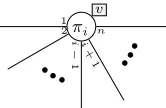
Fig. 1.Drawing of a programπi. It hasn−1 interfaces to bilateral channels with other
playersP \ {Pi}labeled accordingly. The programπiis givenvas input.
contradictory behavior. The configuration consists of multiple copies of πi con-nected with bilateral channels and given admissible inputs. A pictorial drawing of a program in such a configuration is shown in Figure 1. When describing a configuration we will often use such a drawing accompanied with a textual de-scription. If in the drawing an interface to a bilateral channel is not depicted then it is connected to a “null” device which simulates the program sending no messages. The interfaces toBBBare never drawn. Once the configuration is built, one simultaneously starts all the programs in the configuration and analyzes the outputs produced by the programs locally. By arguing that the view of some programs πi and πj in the configuration is indistinguishable from their view
when run by the corresponding playersPi andPj (while the adversary corrupts
the remaining players inP \ {Pi, Pj}) one deduces consistency conditions on the
outputs byπi andπj that lead to a contradiction.
The main novelty of the proofs presented in this paper is that we consider an extended communication model where in addition to bilateral channels players are given access toBBB. While following the path described above, one needs to additionally define theBBBbehavior in the configuration.
In the following impossibility proofs we assume that theBBBusage pattern is static. (In the full version of the paper we show how to adapt the impossibility proofs given to include protocols with a dynamic BBBusage pattern.) Further-more, the lower bounds are given only for perfectly-secure protocols, i.e., those that fail with probability 0.
3.3 Lower Bounds in the Single-Sender Model
Lemma 2. There is no perfectly-secure protocol among 3 parties achieving broad-cast amplification for domainDwith|D| ≥3by broadcasting only 1 bit viaBBB. Proof. Assume towards a contradiction that there is such a protocol (π1, π2, π3).
Without loss of generality, assume that D= [d] for some d≥3.
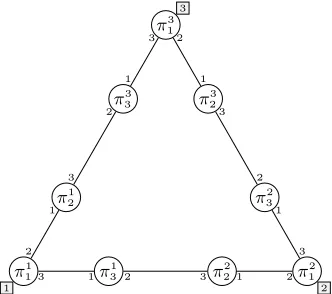
We consider the following configuration: Fori= 1,2,3 andj = 1,2,3 let πij
be an instance of πi. For j = 1,2,3 let π j
1 be given input j. We construct the
configuration by connecting programsπij as shown in Figure 2. Now we execute the programs. Whenever any program πj1 broadcasts a bit withBBB it is given to programsπj2and π3j.
Since there are 3 programsπ1
1, π12, π31 broadcasting 1 bit only, there exist two
of themπi
1andπ
j
π1 1 π 2 1 π3 1 π1 3 π 2 2 π3 3 π1 2 π 2 3 π3 2 2 1 3 2 1 3 1 2 2 3 3 1
3 1 2 3 1 2
1 2
3
Fig. 2.The configuration forn= 3 to show the impossibility of broadcast amplification with broadcasting 1 bit only viaBBB.
π1 1 π 2 2 π 3 3 π 4 4 π 5 2 π 6 3 π 7
4 . . . π 1 z
q+2 V
2 1 3 2 4 3 2 4 3 2 4 3 2
Fig. 3.The configuration forn= 4 to show the impossibility of non-trivial broadcast amplification with only the sender broadcasting.
thatπ1
1 andπ21 broadcast the same bit. The configuration can be interpreted in
three different ways, which lead to contradicting requirements on the outputs of the programs. (i) P1 holds input 1 and executesπ11,P3 executes π31, and P2 is
corrupted and executes the remaining programs in the configuration. Due to the validity property, π1
3 must output 1. (ii)P1 holds input 2 and executes π12, P2
executes π2
2, and P3 is corrupted and executes the remaining programs in the
configuration. Due to the validity property,π2
2 must output 2. (iii) P3 executes
π1
3,P2executesπ22, andP1 is corrupted and executes the remaining programs in
the configuration. Due to the consistency property,π13 and π22 must output the same value. These three requirements cannot be satisfied simultaneously, hence whatever output the programs make, the protocol (π1, π2, π3) is not a
perfectly-secure broadcast-amplification protocol. ut
Lemma 3. There is no perfectly-secure protocol amongn≥4 parties achieving non-trivial broadcast amplification in the single-sender multi-shot model.
Proof. We first prove the lemma for n = 4, then reduce the case of arbitrary
n >4 ton= 4.
(Case n=4) Assume towards a contradiction that there exists a perfectly-secure protocol (π1, π2, π3, π4) achieving non-trivial broadcast-amplification in
information flow argument to prove that there is a program in the configuration that does not have enough information to output v with probability 1 (this argument is inspired by [Lam83]).
(i) We consider the following configuration: Let πij denote an instance of the program πi. Consider a chain ofq+ 2 programs π1
1, π22, π33, π44, π25, π63, . . . , πqz+2
connected as shown in Figure 3. The chain is built starting with a programπ1 1
and then by repeatedly alternating copies of the programs π2, π3 and π4 until
the chain has q+ 2 programs. To simplify the notation we will sometimes refer to the programs in the chain without the subscript, i.e., as to π1, π2, . . . , πq+2. Letπ11 be given as input a uniform random variable V chosen from domain D. Now we execute the programs. Whenever π11usesBBBto broadcast somex, the
valuexis given to all programs in the configuration.
(ii) First, we prove that any pair of connected recipients’ programs (πia, πja+1) (a≥2) in the chain output the same value. One can view the configuration as the playerPi running the programπia andPj runningπja+1 while the adversary
corrupting{P1, P2, P3, P4}\{Pi, Pj}is simulating the programsπ1, . . . , πa−1and πa+2, . . . , πq+2. Due to the consistency property,πa
i andπ
a+1
j must output the
same value. Since every connected pair of the recipients’ programs in the chain outputs the same value, then the programsπ2, . . . , πa+1in the configuration
out-put the same value. Moreover, the configuration can be viewed as P1 executing
π1
1,P2executingπ22while the adversary who corrupts{P3, P4}is simulating the
remaining chain. Due to the validity property, π2
2 must outputV. Finally, each
recipient’s programπ2, . . . , πq+2 in the chain outputsV.
(iii) Let Sir be a random variable denoting the state of the program πi in the chain afterrrounds of the protocol execution. By state we understand the input that the program has, the set of all messages that the program received up to the rth round over point-to-point channels and on the
BBB’s interface together with the random coins it has used. Let Br be a random variable denoting the
list of the values that have been broadcast withBBBup to therth round. Afterrrounds only programsπ1, π2, . . . , πr+1can receive full information about
V. The remaining programs in the chain πr+2, πr+3, . . . , πq+2 can receive only
the information that was distributed with BBB, i.e., the information contained in Br. That is, one can verify by induction that for anyr and for alli≥r+ 2
holds I(V;Sr
i|Br) = 0. Hence, for the last program in the chain πq+2 after q
rounds of computation it holds thatI(V;Sqq+2|Bq) = 0 and henceI(V;Sq q+2)≤
H(Bq). Because we assumed that the protocol achieves non-trivial
broadcast-amplification we have thatH(Bq)< H(V). Combining these facts we get that I(V;Sqq+2)< H(V). Hence, the last programπq+2 cannot outputV with prob-ability one, a contradiction.
(Case n>4) Assume towards a contradiction that there is a protocol (π1, π2,
π3, . . . , πn) allowing to do broadcast amplification in the single-sender model.
One particular strategy of the adversary is to corrupt parties P5, . . . , Pn and
make them not execute their corresponding programs π5, . . . , πn. Still, the
re-maining protocol (π1, π2, π3, π4) must achieve broadcast, which contradicts the
3.4 Summary
Theorem 1. If n = 3 then ∀d ≥ 3 φ3(d) = 3; otherwise, if n > 3 then
∀d φn(d) =d.
The first statement follows from combining Lemma 1 and Lemma 2. The second statement follows from Lemma 3.
4
Multi-Sender Model
As we have seen in the previous section in the single-sender model no broadcast-amplification is achievable forn≥4. In this section we consider a generalization of this model by allowing recipients to broadcast with BBB as well. In such a model we show that broadcast-amplification is achievable for anyn. Moreover, we prove that in order to achieve a non-trivial broadcast-amplification for arbitrary
nessentially all recipients must broadcast withBBB.
4.1 Broadcast Amplification for n Parties
In this section we present a broadcast-amplification protocol fornparties, where the parties broadcast withBBBat most 8nlognbits in total. We first introduce the notion of identifying predicates and give an efficient construction of them. Then we present a protocol for graded broadcast, which achieves only a relaxed variant of broadcast, but only requires the sender to use BBB. Finally, we give the main broadcast-amplification protocol, which uses graded broadcast andBBB (by each party) to achieve broadcast.
While the presented protocol is very efficient in terms of theBBBusage (it broadcasts viaBBBonly 8nlognbits to achieve broadcast of any`bits), it com-municates exponentially many messages over authenticated channels. We then show how to optimize this protocol such that it communicates only a polynomial (inn) number of messages at the expense of a higher BBBusage.
Identifying Predicates. An identifying predicate allows to identify a specific elementvfrom some small subsetS ⊆ D, whereDis a potentially large domain. To our knowledge, this concept has been firstly introduced in [HR13].
Definition 5. A c-identifying predicatefor domain D is a family of functions
Qk∈K :D → {0,1} such that for any S ⊆ D with |S| ≤c and any value v ∈S
there exists a key k∈ KwithQk(v) = 1andQk(v0) = 0for allv0 ∈S\ {v}. We
say that suchv is uniquely identified byQk inS.
Note that any identifying predicatesQk achieve monotonicity in the following sense:
Lemma 4. If v is uniquely identified byQk in S, thenv in uniquely identified in anyS0⊆S withv∈S0.
Polynomial-based identifying predicate construction. Let`= log|D|. Forκ∈N, let any value v ∈ D be interpreted as a polynomial fv over GF(2κ) of degree
at mostb`/κc. We find a pointx∈GF(2κ) such thatf
v(x) is different from all
other valuesfv0(x) forv0∈S\ {v}. For such a pointxto always exist we need
that the total number of points in the field is larger than the number of points in which fv may coincide with other polynomials fv0, i.e., 2κ > (c−1)b`/κc.
To satisfy this condition, it is enough to choose κ := dlog(c`)e. The key for the identifying predicate is defined as k = (x, fv(x)), which is encoded using 2dlog(c`)ebits.9The predicate is defined as follows:
Q(x,y)(v) = (
1, iffv(x) =y;
0, otherwise.
Lemma 5. The polynomial-based construction gives ac-identifying predicateQ
with domainDand key space KD
c ={0,1}2dlog(clog|D|)e.
Graded Broadcast. Graded broadcast (a.k.a. gradecast) was introduced by Feldman and Micali [FM88]. It allows to broadcast a value among the set of recipients but with weaker consistency guarantees. In addition to the value vi
each recipientPialso outputs a gradegidescribing the level of agreement reached by the players. In this paper we extend the original gradecast definition [FM88] with a more flexible grading system:
Definition 6. A protocol achieves graded broadcast if it allows the senderP1to
distribute a value v among parties R with every party Pi outputting a value vi
with a grade gi∈[n]such that:
Validity: If the senderP1is correct, then every correctPi∈ Routputs(vi, gi) =
(v,1).
Graded Consistency: If a correct Pi ∈ R outputs (vi, gi) with gi < n, then every correctPj∈ Routputs (vj, gj)with vj =vi andgj ≤gi+ 1.
Termination: Every correct party in P terminates.
Intuitively, the grade can be understood as the consistency level achieved. The “strongest” grade gi = 1 means that from the point of view of Pi, the sender “looks correct”. Grade gi = 2 means that Pi actually knows that the
sender is incorrect; however, there might be an honestPj for whom the sender
looks correct. Grade gi = 3 means that Pi knows that the sender is incorrect
and every honestPj knows so, too; however, there might be an honest Pk who
does not know that every honest Pj knows that the sender is incorrect. And so
on till the “weakest” gradegi=n.
The protocol proceeds as follows: The sender sends the value v he wants to broadcast to all parties, who then exchange the received value(s) during 2n
9 Such a point xcan be efficiently found by random sampling elements in GF(2κ).
rounds. That is, in every round each party sends the set of values received so far to every other party. In this way each recipientPi forms a growing sequence
of sets M1
i ⊆Mi2 ⊆ · · · ⊆Mi2n (the set Mir represents the set of all messages
received byPiup to the roundr). Finally, the sender distributes a hint consisting of the key k for an identifying predicateQk that should identify v among the values that the recipients hold. Then each recipient Pi computes his grade gi
to be the smallest number in [n] such that both Migi and Mi2n−gi contain a uniquely identified message. There could be only one valueviuniquely identified in both sets sinceMigi ⊆Mi2n−gi. ThenPioutputsviwith the gradegi. Clearly, if the sender is correct, then each correct recipient outputs gi = 1. Otherwise, since for every pair Pi, Pj of correct recipients it holds that Migi ⊆Mjgi+1 and
M2n−(gi+1)
j ⊆M
2n−gi
i we havegj ≤gi+ 1.
Let us detail the step when sender distributes his hintk. While it can be done directly with the help of BBB(which would lead to a less efficient construction), we let the parties to invoke gradecast recursively for the distribution ofk. Once each playerPi outputs a key ki with a gradegi0 he uses ki as a hint. Then the final grade is computed byPias the maximum of two gradesgi andg0i, i.e., it is computed as the “weakest” grade among the two.
ProtocolGradedBC(P1,D, v)
1. If|D| ≤ |KDn2n|thenP1broadcastsv usingBBB, and everyPi∈ Routputs
(v,1). 2. Otherwise:
2.1 SenderP1: SetM10:={v}.∀Pi∈ R: SetMi0:=∅.
2.2 For r= 0, . . . ,2n−1: ∀Pi ∈ P: Send Mr
i (of size at mostnr) to allPj ∈ P,Pj denotes
the union of the received sets withMjr+1, i.e.,Mjr+1=S iM
r i.
2.3 Sender P1: Choose a key k for the n2n-identifying predicate Q with
domainD, the set of valuesM12n and the valuev.
2.4 PlayersP invokeGradedBC(P1,KDn2n, k) recursively. Let (ki, gi0) denote
the output ofPi∈ R.
2.5 ∀Pi ∈ R: Let g be the smallest number in [n] such that there exists
u which is uniquely identified by Qki in M g
i and in M
2n−g
i . Output
(vi, gi) = (u,max(g, gi0)). If such g does not exist output (vi, gi) =
(⊥, n);
Lemma 6. The protocol GradedBC achieves graded broadcast while requiring only the sender to useBBBto broadcast one value of at mostd7nlognebits. Proof. We prove by induction that graded broadcast is achieved. For |D| ≤ |KDn2n|, graded broadcast is achieved by assumption of BBB. For|D|>|KDn2n|:
Validity: If the sender is correct then he selects a keykfor then2n-identifying predicateQksuch that only his valuevis identified byQkinM2n
1 . All correct
Pi it holds that Mi1 ⊆ M
2n−1
i ⊆ M
2n
1 and v ∈ Mi1 this implies that v is
uniquely identified in M1
i and in M
2n−1
i . Hence Pi computes vi = v and gi= 1.
Graded Consistency: LetPidenote a correct recipient outputting the small-est gradegi. Ifgi=nthen Graded Consistency holds trivially. Now assume thatgi< n, and hencegi0< n. Consider any other correct recipientPj. Due to the Graded Consistency property of the recursiveGradedBC, the fact that
g0i< nimplies thatPiandPj have the same keyski andkj which we denote withk. Observe that Migi ⊆Mjgi+1 ⊆M2n−(gi+1)
j ⊆M
2n−gi
i . The value vi
is uniquely identified by Qk in both Mgi
i and M
2n−gi
i , hence vi is uniquely
identified in bothMjgi+1 andM2n−(gi+1)
j . Hence the gradegj∈ {gi, gi+ 1}.
Ifgj =gi+ 1 then vj = vi. If gj = gi then, since M gi
j ⊆M
gi+1
j and vi is
uniquely identified inMgi+1
j , the only value that can be uniquely identified
byQk in Mjgi isvi. This implies thatvj =vi.
Termination: Follows by inspection.
It remains to prove the stated usage complexity of BBB. Note that BBBis only used at the deepest recursion level. We denote the logarithm of broadcast domain size at the rth recursive level to be `
r. We have that `0 = log|D| and `i+1 is
defined recursively to be 2dlog(n2n`
i)e. It can be verified that `i+1< `i for any `i >7nlogn. Hence, the senderP1 broadcasts withBBBat mostd7nlognebits.
u t
Main Protocol. The broadcast-amplification protocol first invokes graded broad-cast. Then, each party broadcasts his grade (using BBB), and decides depending on the grades broadcast whether to use the output of graded broadcast or to use some default value (say⊥) as output.
The core idea of the protocol lies in the analysis of the grades broadcast. Denote the set of all grades by G={gi}i. As|R|=n−1, there exists a grade g ∈ [n] with g /∈ G. Consider the smallest grade gi of an honest party Pi. If
gi> g, then clearly the gradegjof each honest partyPjisgj > g. On the other hand, if gi < g, then by the definition of graded broadcast, the grade gj of any honest partyPj isgj ≤gi+ 1, hencegj < g. In other words, either the grades of all honest parties are belowg, or the grades of all honest parties are aboveg. In the former case, every honest partyPi hasgi< nand hence all valuesvi are equal (and are a valid output of broadcast). In the latter case, no honest party
Pi has gradegi= 1, hence the recipients can output some default value ⊥.
ProtocolAmplifyBCn(P1,D, v)
1. PlayersP invoke GradedBC(P1,D, v), let (gi, vi) denote the output ofPi.
2. ∀Pi∈ R: Broadcast gi usingBBB. LetGdenote the set of all gibroadcast. 3. ∀Pi ∈ R: Let g = min([n]\G). If gi < g, then decide on vi, otherwise
Lemma 7. The protocolAmplifyBCnachieves broadcast and requires the sender to broadcast withBBBone value of at mostd7nlognebits and each of the recip-ients to broadcast one value from domain [n]. In total at most8nlognbits need to be broadcast via BBB.
Proof. We show that each of the broadcast properties are satisfied:
Validity: If the sender is correct then all correct parties get (v,1) as an output fromGradedBCand decide onv.
Consistency: Letg= min([n]\G), and letPi denote a correct recipient
out-putting the smallest gradegi. Ifgi < g, then clearlygi < n, and all honest
partiesPj hold the same value vj =vi and gradegj ≤gi+ 1. Asgj 6=g, it
followsgj < g. Hence, every honest party Pj outputsvj =vi. On the other
hand, ifgi> g, then every honest partyPj holdsgj> gand outputs⊥.
Termination: Follows by inspection.
It remains to prove the stated usage complexity ofBBB. The protocolAmplifyBCn requires the sender to broadcast one value of at most d7nlognebits during the GradedBCinvocation (cf. Lemma 6). Furthermore, each recipient broadcasts the grade (of domain [n]) usingBBB. This sums up to 8nlognbits overall. ut
Efficient Protocol. The main disadvantage of the protocol AmplifyBCn is
that the underlying gradecast protocol GradedBCrequires exponential message communication. Here we briefly sketch how one can achieve polynomial commu-nication complexity inGradedBCat the cost of higherBBBusage. The main idea of the optimized protocolGradedBC+is to allow recipients to use BBBsuch that they can filter out messages from the sets Mr
i. Roughly speaking, if a recipient
holds a set of messagesMr
i then he broadcasts a “challenge” forcing the sender
in his response to invalidate at least all but one values inMr
i. After each of the
recipients has his setMirfiltered, recipients continue exchanging sets consisting of at most one element. The detailed description of this protocol and its analysis is given in Appendix A.
Lemma 8. The protocol AmplifyBCn with the underlying gradecast
implemen-tation by GradedBC+ allows to broadcast an `-bit message while broadcasting O(n2log`) bits with BBB and communicating O(n3`) bits over point-to-point
channels.
4.2 Lower Bounds in the Multi-Sender Model
πu
1 π
v
1
π2
2 π
2 3
u v
2 1 3 2 1 3
Fig. 4.The configuration forn= 3 to show that the sender must useBBBto broadcast at least one bit.
Lemma 9. Every perfectly-secure broadcast-amplification protocol for domain Drequires the sender P1 to broadcast at least 1 bit via BBB.
Proof. We first prove the theorem for n= 3, then reduce the case of arbitrary
n >3 ton= 3.
(Case n=3) Assume towards a contradiction that there is a protocol (π1,
π2, π3) allowing the parties P1, P2, P3 to do broadcast amplification, where the
sender does not broadcast with BBB. We consider the following configuration: Letπ1u andπ1v denote two instances of the programπ1, whereπu1 is given input
u and πv1 is given input v for u, v ∈ D and u 6= v. We connect programs π1u,
π2,π3andπ1v with bilateral channels as shown in Figure 4. Now we execute the
programs. Wheneverπ2 orπ3 useBBBto broadcast somex, the valuexis given
to all programs.
The configuration can be interpreted in three different ways, which lead to con-tradicting requirements on the outputs of the programs. (i)P1holds inputuand
executes πu
1,P2 executes π2, andP3 is corrupted and executesπ3 and π1v. Due
to the validity property, π2 must output u. (ii) P1 holds input v and executes
πv
1, P3 executes π3, andP2 is corrupted and executes π2 and πu1. Due to the
validity property,π3 must outputv. (iii)P2executesπ2,P3executesπ3, andP1
is corrupted and executesπu
1 andπ1v. Due to the consistency property,π2andπ3
must output the same value. These three requirements cannot be satisfied simul-taneously, hence whatever output the programs make, the protocol (π1, π2, π3)
is not a perfectly-secure broadcast-amplification protocol.
(Case n>3) Assume towards a contradiction that there is a protocol (π1, π2,
π3, . . . , πn) allowing to do broadcast amplification where the sender does not
broadcast withBBB. One particular strategy of the adversary is to corrupt parties
P4, . . . , Pn and make them not execute their corresponding programsπ4, . . . , πn.
Still, the remaining protocol (π1, π2, π3) must achieve broadcast, which
contra-dicts the first case. ut
Lemma 10. Every perfectly-secure non-trivial broadcast-amplification protocol requires that at least all but2 of the recipients broadcast at least 1 bit withBBB.
Proof. Assume towards a contradiction that there is a protocol (π1, π2, π3, . . . , πn)
allowing to do non-trivial broadcast amplification with three recipients’ programs not broadcasting with BBB. Without loss of generality, assume that these pro-grams are π2, π3, π4.10 One particular strategy of the adversary is to corrupt
10
parties P5, . . . , Pn and make them not execute their corresponding programs π5, . . . , πn. The programsπ1, π2, π3, π4of the remaining honest players can then
put the values sent and broadcast by the corrupted parties to some default value (say ⊥). The remaining protocol (π1, π2, π3, π4) achieves non-trivial broadcast
amplification, which contradicts Lemma 3. ut
4.3 Summary
The following theorem summarizes results obtained in this section (The proof of this theorem follows from Lemmas 7, 9 and 10.)
Theorem 2. For alln, d we have 8nlogn≥logφ∗n(d)≥min(logd, n−2).11
Additionally, we give an efficient protocol that allows to broadcast an`-bit value while broadcasting O(n2log`) bits with
BBBand communicating O(n3`)
bits over point-to-point channels.
5
Conclusions
Broadcast amplification is the task of achievingd-broadcast given point-to-point channels and access to ad0-broadcast primitive, ford0 < d. The existence of such a broadcast-amplification protocol means in a certain sense that d-broadcast and d0-broadcast are equivalent (respectively thatd0-broadcast is “as good as”
d-broadcast).
It is well known that perfectly-secure broadcast cannot be constructed from point-to-point channels when the number of cheaters is not limited. In this paper, we have shown that:
– For three parties, 3-broadcast andd-broadcast are equivalent for any d≥3. However, 2-broadcast and 3-broadcast are not equivalent.
– For an arbitrary number of parties, (8nlogn)-bit broadcast and`-bit broad-cast are equivalent for any`≥8nlogn. However, forn≥4 parties, (n−3)-bit broadcast and`-bit broadcast are not equivalent for large enough`.
In summary, for three parties, we have given a complete picture of equivalence of broadcast primitives for different domains, under the assumption that point-to-point channels are freely available. Forn≥4 parties, we have proved a lower bound and an upper bound on the broadcast primitive necessary for broadcasting arbitrary messages, namelyΩ(n) andO(nlogn) bits, respectively.
11The last inequality combines the facts that any non-trivial broadcast amplification
References
[Bea96] D. Beaver. Correlated pseudorandomness and the complexity of private computations. InProceedings of the twenty-eighth annual ACM symposium on Theory of computing (STOC ’96), pages 479–488. ACM, 1996. [BGP92] P. Berman, J. A. Garay, and K. J. Perry. Bit optimal distributed
con-sensus. InComputer Science Research, pages 313–322. Plenum Publishing Corporation, New York, NY, USA, 1992.
[CFF+05] J. Considine, M. Fitzi, M. Franklin, L. A. Levin, U. Maurer, and D. Met-calf. Byzantine agreement given partial broadcast. Journal of Cryptology, 18(3):191–217, July 2005.
[CW92] B. A. Coan and J. L. Welch. Modular construction of a byzantine agreement protocol with optimal message bit complexity. Information and Computa-tion, 97:61–85, March 1992.
[DS83] D. Dolev and H. R. Strong. Authenticated algorithms for Byzantine agree-ment. SIAM Journal on Computing, 12(4):656–666, 1983.
[FH06] M. Fitzi and M. Hirt. Optimally efficient multi-valued Byzantine agree-ment. In Proceedings of the 26th annual ACM symposium on Principles of distributed computing, PODC ’06, pages 163–168, New York, NY, USA, 2006. ACM.
[FM88] P. Feldman and S. Micali. Optimal algorithms for byzantine agreement. In Proceedings of the twentieth annual ACM symposium on Theory of comput-ing, STOC ’88, pages 148–161, New York, NY, USA, 1988. ACM.
[FM00] M. Fitzi and U. Maurer. From partial consistency to global broadcast. In F. Yao, editor, Proc. 32nd ACM Symposium on Theory of Computing — STOC 2000, pages 494–503. ACM, May 2000.
[HMQU06] D. Hofheinz, J. M¨uller-Quade, and D. Unruh. On the (Im-)Possibility of extending coin toss. InAdvances in Cryptology - EUROCRYPT 2006, vol-ume 4004 ofLecture Notes in Computer Science, pages 504–521. Springer, 2006.
[HR13] M. Hirt and P. Raykov. On the complexity of broadcast setup. In F. V. Fomin, R. Freivalds, M. Z. Kwiatkowska, and D. Peleg, editors, ICALP (1), volume 7965 of Lecture Notes in Computer Science, pages 552–563. Springer, 2013.
[IKNP03] Y. Ishai, J. Kilian, K. Nissim, and E. Petrank. Extending oblivious transfers efficiently. In D. Boneh, editor,CRYPTO, volume 2729 ofLecture Notes in Computer Science, pages 145–161. Springer, 2003.
[Lam83] L. Lamport. The weak byzantine generals problem.J. ACM, 30(3):668–676, 1983.
[LV11] G. Liang and N. Vaidya. Error-free multi-valued consensus with Byzantine failures. InProceedings of the 30th annual ACM symposium on Principles of distributed computing, PODC ’11, pages 11–20, New York, NY, USA, 2011. ACM.
[Mau04] U. M. Maurer. Towards a theory of consistency primitives. In R. Guerraoui, editor, DISC, volume 3274 of Lecture Notes in Computer Science, pages 379–389. Springer, 2004.
[PSL80] M. C. Pease, R. E. Shostak, and L. Lamport. Reaching agreement in the presence of faults. Journal of the ACM, 27(2):228–234, 1980.
[PW96] B. Pfitzmann and M. Waidner. Information-theoretic pseudosignatures and Byzantine agreement fort≥n/3. Technical report, IBM Research, 1996. [TC84] R. Turpin and B. A. Coan. Extending binary Byzantine agreement to
mul-tivalued Byzantine agreement.Information Processing Letters, 18(2):73–76, 1984.
A
A Broadcast-Amplification Protocol with Polynomial
Number of Messages
In this section we present an optimized implementationGradedBC+of the graded broadcast protocol GradedBC. We first introduce the notion of resolution func-tions (which is closely related to identifying predicates) and give an efficient construction of them. Then we describe the optimized protocolGradedBC+that communicates polynomially many messages over point-to-point channels. Af-ter substitutingGradedBC withGradedBC+ in AmplifyBCn we get a broadcast-amplification protocol with the following properties.
Lemma 8. The protocol AmplifyBCn with the underlying gradecast implemen-tation by GradedBC+ allows to broadcast an `-bit message while broadcasting O(n2log`) bits with BBB and communicating O(n3`) bits over point-to-point channels.
A.1 Resolution Functions
An identifying predicate allows to identify a specific element v from some set
S of potentially a large domainD. Resolution functions extend this notion by providing a collision-free way of choosing one of the values inS while explicitly not choosing the others.
Definition 7. Ac-resolution functionfor domainDand rangeY is a family of functions Fk∈K : D → Y such that for any S ⊆ D with |S| ≤ c there exists a
key k∈ K with Fk(v)6=Fk(v0) for anyv 6=v0 fromS. Such a key k is said to resolve the setS.
We say thatv isidentified by a pair (k, y) inS ifFk(v) =y (trivially, only
one value can be identified ifkresolves the setS). The goal of constructing such a functionF is to have|K|and|Y|as small as possible givencand|D|. We give a construction of ac-resolution function with domainDbelow.
Polynomial-based resolution function construction. This construction is very similar to the polynomial-based construction for identifying predicates presented before. Let ` = log|D|. Consider any set S ⊆ D with |S| ≤ c. For κ∈ N, let any value v ∈ D be interpreted as a polynomial fv over GF(2κ) of degree at
v 6=v0 ∈ S. For such a pointx to always exist we need that the total number of points in the field is larger than the number of points in which anyfv may
coincide with other polynomialsfv0, i.e., 2κ > c(c−1)
2 b`/κc. To satisfy this
con-dition, it is enough to chooseκ:=dlog(c2`)e. The resolution function is defined asFx(v) =fv(x) with the key space and range space being GF(2κ). So, the key and the value of the resolution function can be encoded usingdlog(c2`)ebits.
Lemma 11. The polynomial-based construction gives ac-resolution functionF
for domainD with key and range spacesKD
c =YcD ={0,1}dlog(c
2log|D|)e
.
A.2 The Optimized Graded Broadcast Protocol
The protocol proceeds as follows: The sender sends the valuevhe wants to broad-cast among all recipientsR, who then exchange the received value(s) duringn−1 rounds. In each roundreach partyPisends the value it currently holds (denoted
with vr
i) to every other party and forms the set of at most n received values.
Then each party broadcasts a keykifor ann-resolution function which resolves
the set of the values received. In the end of the round the sender broadcasts the valuesy1, . . . , yn of the resolution function for the keys k1, . . . , kn so that each
of the recipients keeps at most one value identified by all (ki, yi). Finally, each recipientPi decides on the gradegi to be the first “stable” round starting from which the value he holds remain unchanged, i.e.,vigi =vigi+1=· · ·=vn
i.
ProtocolGradedBC+(P1,D, v):
1. SenderP1: Sendvto everyPi∈ R.
∀Pi∈ R: Denote the message received from the sender by v1
i. r. In each stepr= 2, . . . , n, execute the following sub-steps:
r.1 ∀Pi∈ R: Send the value vir−1 to allPj ∈ R,Pj denotes the set of the received values withMr
j.
r.2 ∀Pi∈ R: Choose a keykri for ann-resolution functionF with domain D, that resolves the set of valuesSir. Broadcast the key kir using the BBB.
r.3 Sender P1: Broadcast a list of values (Fkr
2(v), . . . , Fkrn(v)) using the
BBB. Denote the list broadcast with (yr
2, . . . , yrn).
r.4 ∀Pi ∈ R: Select vir to be some u ∈ Mri such that u is identified by
(kr
j, yrj) for allj; set virto⊥if no suchuexists. n+1.∀Pi∈ R: Computegito be the smallest steprsuch thatvr
i =v r+1
i =· · ·= vn
i. Output (vni, gi).
Lemma 12. The protocolGradedBC+ achieves graded broadcast while requiring O(n2log`) bits to be broadcast with BBB and communicating O(n3`) bits over
point-to-point channels.
Validity: If the sender is correct then for any key khe broadcasts y =Fk(v)
such that only his valuev is chosen by correct recipients at every iteration. Hence each correctPi computesvi=vand gi= 1.
Graded Consistency: LetPidenote a correct recipient outputting the small-est grade gi. If gi = n then Graded Consistency holds trivially. Now as-sume that gi < n. Consider any other correct recipient Pj. Observe that vgi
i ∈M
gi+1
j . SincePi kept the value v gi
i till the roundn it implies thatv gi i
is identified in Sr
i by all pairs (kra, yar) for all a and r ≥ gi. Hence, v gi i is
identified inSjgi+1, Sjgi+2, . . . , Sn
j by all pairs (kra, yra) for allaandr≥gi+ 1.
Moreover, sincePj chose the keyskr
j for a resolution function faithfully, only
a unique value can be identified inSgi+1
j , S
gi+2
j , . . . , Sjn. Since only a unique
value can be identified thenPj outputsvj =vgi
i with the gradegj≤gi+ 1.
Termination: Follows by inspection.
It remains to prove the stated usage complexity of BBB. At each step r = 2, . . . , n of the protocolGradedBC+, every recipient Pi broadcasts a key kr
i for
a family of n-resolution functions and the sender broadcasts a list of n values of the function. If the polynomial-based construction of the resolution function is used then each key and a value of function consists of dlog(n2`)ebits. Since in total the protocol works in n−1 rounds we broadcast 2(n−1)2dlog(n2`)e bits withBBB. This expression can be rewritten asO(n2(logn+ log`)). We can assume that ` > n, since for `≤n it is easier to run the trivial algorithm that broadcasts a message bit by bit. Summing up the analysis above, we have that the total number of theBBBinvocations during the protocol run is O(n2log`).
The communication costs ofGradedBC+over authenticated channels consist of distributingn−1`-bit messages during Step 1 and exchanging of (n−1)2(n−1)
`-bit messages during Steps 2, . . . , n. Hence, the total number of bits that need