_____________________________________________________________________________________________________
*Corresponding author: E-mail: [email protected];
www.sciencedomain.org
Panax ginseng and Ergogenic Profile: Randomized,
Placebo Controlled Study
Hayder M. Al-Kuraishy
1*and Taissir Lateef Ali
21
Department of Pharmacology, Toxicology and Medicine College of Medicine, Almustansiriya University, P.O.Box 14132, Baghdad, Iraq. 2
Department of Pharmacology, College of Pharmacy, Almustansiriya University, P.O.Box 14132, Baghdad, Iraq.
Authors’ contributions
This work was carried out in collaboration between both authors. Author HMAK designed the study, wrote the protocol and wrote the first draft of the manuscript. Authors HMAK and TLA managed the literature searches, analyses of the study performed the spectroscopy analysis. Both authors read and approved the final manuscript.
Article Information
DOI: 10.9734/BJMMR/2016/28168 Editor(s): (1) Chan-Min Liu, School of Life Science, Xuzhou Normal University, Xuzhou City, China. Reviewers: (1) P. K. Hota, NTR University of Health Sciences, India. (2)Yu Koyama, Niigata University Graduate School of Health Sciences, Japan. (3)Wagih Mommtaz Ghannam, Mansoura university, Egypt. Complete Peer review History:http://www.sciencedomain.org/review-history/15818
Received 5th July 2016 Accepted 28th July 2016
Published 17th August 2016
ABSTRACT
Introduction: Ginseng is a herbal plant that is known for its therapeutic medical importance for
many diseases; it acts as a tonic and provides energy with significant reduction in mental and physical fatigue.
Objectives: The aim of the present study was evaluating the ergogenic effect of Panax ginseng on
normal healthy volunteers.
Subjects and Methods: Randomized selection of 35 healthy volunteers with age ranged 20-30
years, they are randomly divided into two groups for assessment of the ergogenic effects of
Ginseng compared with a placebo effect. Tunturi bicycle Ergometer (for assessment of exercise
tolerance) was used for evaluating the ergogenic effects before and after two weeks of treatment with Ginseng or placebo. Group A: include 10 healthy volunteers regarded as a control group that treated with 500 mg/day of starch capsule as a single dose. Group B: include 25 healthy volunteers
that received Ginseng capsule 500 mg /day.
Results: Placebo produces insignificant effects following two consecutive weeks of treatment p>0.05. Ginseng showed more significant effects on the most of ergogenic parameters including
pulse, time, distance and calorie consumption p <0.05, but Ginseng therapy showed insignificant effects on speed and maximal oxygen consumption (Vo2max) variables (p>0.05).
Conclusion: Ginseng leads to significant ergogenic effects on normal healthy volunteers
compared to placebo.
Keywords: Ginseng; ergogenic effect; placebo.
1. INTRODUCTION
Ginseng is an herbal plant that is known for its
therapeutic medical importance for a long time in the regions of eastern Asia and North America that used for different purposes in medical fields, it is effective against many diseases, act as a tonic and provide energy with significant reduction in mental and physical fatigue [1].
There are several studies carried out by the researcher that dealing with the pharmacological action of Ginseng extract that improve the body performance, treat and prevent many diseases like cancer, diabetes and inflammation since;
Ginseng contains ginsenoside, acid
polysaccharide, polyacetylene, antioxidative aromatic in its composition, it was found that
Panax ginseng contains approximately 38 types
of the ginsenoid, which are responsible for the most of the Ginseng pharmacological effects [2].
Naturally, different herbs and medicine have been used for their own benefits since; many herbs improve physical performance and speed endurance as well as augmenting body fitness during intense period of acute exercise, moreover, there is a broad array of nutrients and pharmacological agents that afford physical stimulation and/or rapid recovery from intense exercise [3]. The most popular herbs that are used to boost sport performance and exercise endurance are ephedrine, Panax ginseng, caffeine and Eurycoma longifolia [4]. Most of ergogenic agents are illicit and have psychotropic effects like amphetamine [5].
Various forms of Panax ginseng are available such as a tincture, powder and whole root that have a potential role in improving physical health and performance through different mechanisms like anabolic action and stimulation of cortisol hormone secretion during acute exercise [6]. Additionally, Panax ginseng inhibits lipid peroxidation during stress induced by physical performances via free radical scavenges activity
[7]. Furthermore, Panax ginseng has central stimulant effects that augment and improve alertness and reduction of fatigue, which per se enhances the body performance [8]. Many studies have revealed that Panax ginseng effects is duration and dose dependent since; chronic administrations of Panax ginseng leads to significant reduction in blood lactate levels with significant improvement in the cardio-respiratory function, this is mainly seen in individual with poor physical activity [9].
Different studies have been found that therapy with Panax ginseng amplifies and increases the exercise duration during acute exercising testing due to stress adaptation and stress attenuating effects induced by active constituents of Panax
ginseng that stimulates stress hormone
secretions during physical exercise [10]. So; chronic consumption of Panax ginseng lower maximal oxygen consumption during physical performances due to advancement of exercise endurance time [11].
Therefore, the aim of the present study was evaluating the ergogenic effect of Panax ginseng on normal healthy volunteers.
2. SUBJECTS AND METHODS
The study was conducted in Department of Clinical Pharmacology, College of Medicine, Al-Mustansiriya University. This study was approved by the specific Scientific Jury and Ethical Committee by the medical board, college of medicine, Al-Mustansiriya, all of enrolled participants gave an informed verbal consent for their participations in this study. Randomized selection of 35 healthy volunteers with age ranged between 20-30 years have been done, the volunteers have no history of any acute or chronic somatic or psychological diseases.
Ginseng compared with a placebo effect. Tunturi
bicycle Ergometer (for assessment of exercise tolerance) at morning was used for evaluating the ergogenic effects before and after two weeks of treatment with Ginseng or placebo.
Group A: include 10 subjects (9 Males and 1
Female) healthy volunteers that regarded as a control group that treated with 500 mg/day with starch capsule as a single dose.
Group B: include 25 subjects (20 Males and
5 Females) healthy volunteers that were received Ginseng capsule 500 mg /day.
All participants are followed for two consecutive weeks from starting of treatments.
2.1 Inclusion Criteria
The participants that were included in this study should be fit and younger.
2.2 Exclusion Criteria
Older persons, children, smoker, alcoholics, pregnancy, lactation, hypersensitivity to Ginseng, chronic diseases such as diabetes mellitus, hypertension, ischemic heart diseases, renal or hepatic insufficiency, drug abuser and bleeding tendency.
2.3 Ergometer Measurement
All healthy participants in each groups evaluate their fitness by Ergometer measurement via Tunturi bicycle to record heart rate, distance, calorie consumption, speed and time before and after receiving placebo or Ginseng for two consecutive weeks for evaluation the ergogenic effects of Ginseng.
In this research, the exercise program involved cycling on a special bicycle Ergometer (TUNTURI 5835011 OY, LTD, Germany, class A, EN-9591+5), this device allow the researcher to measure and estimate exercise parameters such as energy expenditure, speed, distance…….. etc, heart rate was measured by the ear pulse sensor. Each volunteer do this exercise course till the time of exhaustion and before stopping this cycling exercise all data are recorded from well-ordered digital screen [12].
The volume of oxygen consumption (Vo2max) measured indirectly via special formula that depends on resting heart rate, body weight and age of participant [13].
Vo2max =3.542+ (-0.014× Age) + (0.015× Body mass [Kg]) + (-0.011× Resting Heart Rate)
It measures the maximum capacity for physical fitness, Vo2max considered as the maximum amount of oxygen consumption during the exercise intensity. A mean value of VO2 max for male athletes is 3.5L/minute and 2.7 L/minute for female athletes.
2.4 Statistical Analysis
Data are presented as mean±SD, paired student
t test was used to identify the significance of the
differences before and after drug intake in each treated group, while the ANOVA test was used for detection the inter-groups differences regarding p value less than 0.05 as the significance.
3. RESULTS
Regarding the placebo effects as evaluated by the bicycle Ergometer, the ergogenic effects of placebo effects were insignificant following two consecutive weeks of treatment p>0.05 [1].
While, Ginseng showed more significant effects on the most of ergogenic parameters including pulse, time and distance, Ginseng therapy leads to increase of the pulse from (83.73±13.97) beats/min to (91.46±7.37) beat/min significantly
p=0.0182, time increased from (4.52±2.50) min
to (6.72±3.31) min significantly p=0.0323 and the distance was increased from (1.45±.027) meter to (1.68±0.32) meter significantly p=0.0112. While Ginseng has a more significant effect on calorie consumption, it increased the calorie consumption from 30.26±10.98 Kcal to 48.00±15.22 Kcal p < 0.0001, but Ginseng showed insignificant effects on speed of exercise and maximal oxygen consumption (Vo2max) variables (p>0.05) Table 2.
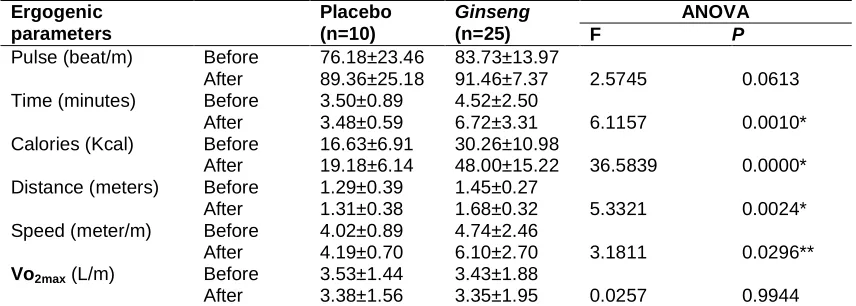
Concerning, the inter-group differences in the ergogenic effects between placebo and Ginseng on all of the ergogenic variables at pre and post treatment period. At the pre - treatment period the Ergometer measures involving time, speed, calorie and distance were significantly differ among the groups p<0.05 except for a pulse and Vo2max that were insignificantly affected p>0.05, Table 3.
4. DISCUSSION
including distance, speed, heart rate, calories consumption and maximal oxygen
consumption after receiving placebo for two
weeks on healthy volunteer. These results are in agreement with several studies that
deal with the expected ergogenic effect of salbutamol that received by
non-asthmatic athletes that found an insignificant effect on ergogenic parameters compared to the
placebo for three weeks duration of therapy [14]. Al-kuraishy et al. [15,16] studies
showed an insignificant effect of placebo compared to the ergogenic effect of carvedilol and yohimbine.
Recently, Ali et al. [17] the study illustrated insignificant effect of placebo
on cyclist performance compared to
glucose rinsing during cycling Ergometer performance.
On the other hand, Tallis et al. [18] single-blind experimental trial reported a positive effect of placebo that depending on the subject expectancy; ergogenic performances were low in subjects preoccupied that caffeine has a higher effect on ergogenic performance even when treated with caffeine, also significant effects were produced in subjects preoccupied that caffeine has higher effects on ergogenic performance even when treated by placebo [18]. The possible explanation of placebo effect may due to modulation of dopamine and noradrenalin neurotransmitters at mesocortical tract that improve alertness during physical performance [19].
Table 1. Ergogenic effects of placebo on normal healthy volunteers
Variables Before(n=10) After(n=10) t 95% CI P
Pulse (beat/m) Time (minutes) Calories (Kcal) Distance (meters) Speed (meter/m) Vo2max (L/m) 76.18±23.46 3.50±0.89 16.63±6.91 1.29±0.39 4.02±0.89 3.53±1.44 89.36±25.18 3.48±0.59 19.18±6.14 1.31±0.38 4.19±0.70 3.38±1.56 1.211 -0.059 0.872 0.116 0.475 0.223 --9.6844-36.0444 -0.7294-0.6894 -3.5913-8.6913 -0.3418 to 0.3818 -0.5823-0.9223 1.2605 to 1.5605 -0.2415 0.9534 0.3945 0.9088 0.6407 0.8257
Results are expressed as mean± SD; p>0.05 Vo2max: maximal oxygen consumption
Table 2. Ergogenic effects of ginseng on normal healthy volunteers
Variables Before(n=25) After(n=25) t 95% CI P
Pulse (beat/m) Time (minutes) Calories (Kcal) Distance(meters) Speed (meter/m) Vo2max (L/m) 83.73±13.97 4.52±2.50 30.26±10.98 1.45±0.27 4.74±2.46 3.43±1.88 91.46±7.37 6.72±3.31 48.00±15.22 1.68±0.32 6.10±2.70 3.35±1.95 2.446 2.204 4.726 2.639 1.851 -0.148 1.3755-14.0860 0.1928-4.2018 10.1932-25.2868 0.0538 to 0.3985 -0.1172-2.8287 -1.1692-1.0092 0.0182** 0.0323** < 0.0001* 0.0112** 0.0704 0.8832
Results are expressed as mean± SD; **p<0.05,*p<0.01 Vo2max: maximal oxygen consumption
Table 3. Variations in ergogenic profile at pre versus post-treatment period
Ergogenic parameters Placebo (n=10) Ginseng (n=25) ANOVA
F P
Pulse (beat/m) Before 76.18±23.46 83.73±13.97
2.5745 0.0613 After 89.36±25.18 91.46±7.37
Time (minutes) Before 3.50±0.89 4.52±2.50
6.1157 0.0010* After 3.48±0.59 6.72±3.31
Calories (Kcal) Before 16.63±6.91 30.26±10.98
36.5839 0.0000* After 19.18±6.14 48.00±15.22
Distance (meters) Before 1.29±0.39 1.45±0.27
5.3321 0.0024* After 1.31±0.38 1.68±0.32
Speed (meter/m) Before 4.02±0.89 4.74±2.46
3.1811 0.0296** After 4.19±0.70 6.10±2.70
Vo2max (L/m) Before 3.53±1.44 3.43±1.88
0.0257 0.9944 After 3.38±1.56 3.35±1.95
Therefore, most of the studies are corresponding with our findings that were insignificant effect of placebo on all ergogenic variables which reflect the ergogenic outcomes of placebo administration.
On the other hand, the present study showed
Ginseng acts as an ergogenic agent and has
beneficial effects in the amelioration of physical performance through enhancing the ergogenic parameters noticeably. The result showed significant changes on the most of ergogenic parameters including pulse, time and distance, as well as a highly significant effect on calorie consumption, but maximal oxygen consumption (Vo2max) and speed were not affected by Ginseng therapy which may be due to small sample size, low dose of Ginseng or poor volunteer complains, these finding are in agreement with previous clinical trial studies that showed an improvement in the physical activity of the younger athletes and healthy elderly persons after treatment with Ginseng due to anti-stress properties with highly safety effect of Ginseng which may due to improvement of post-exercise skeletal muscle glycogen storage and citrate synthase activity as well as reduction of inflammatory markers such as tumor necrosis factor (TNF) and interleukin 10(IL-10), also Vo2max was not augmented thus; Ginseng therapy improves physical performance with significant attenuation of exercise-induced inflammatory changes [20].
Recently, Lee et al. [21] animal model study demonstrated that gintonin which is an active ingredient of Ginseng has powerful ergogenic effect through activation of lysophosphotic acid receptors causing dose dependent effect increasing in the blood glucose after thirty minute of Ginseng administration, also gintonin enhance adrenaline and noradrenalin serum levels in addition to the stimulation of β-adrenergic receptors, these leading to sympathetic activation and preservation of skeletal muscle glucose uptake. This study is certainly corresponded with our ergogenic results of
Ginseng but we have not measured the
catecholamine serum levels during cycling Ergometer.
On the other hand, Biondo et al. [22] showed insignificant effects of Ginseng therapy on cortisol, lactate, insulin and growth hormone serum levels as well as exercise induced immune response following five weeks duration of therapy [22].
Moreover, Panax ginseng produced different pharmacological actions, on the reduction of stress capacity via ginsenosides active constituent that potentiates the ergogenic effect
of Ginseng through its effect on the
hypothalamus-pituitary-adrenal cortex axis that affecting metabolic and cardiovascular functions as well ameliorate and boost the energy expenditure through stimulation of sympathetic nervous system [23]. Therefore, most of these studies supporting our findings regarding the positive ergogenic effects of Ginseng regardless of Vo2max.
The possible explanation and elucidation of ergogenic effect of Ginseng was reported by Hwang et al. [24] research on mice treated with
Ginseng for two weeks, founded that Ginseng led
to significant promotion in fat oxidation and glucose homeostasis that delay the peripheral fatigue during acute exercise performance since; peripheral exhaustion and fatigue are chiefly caused by diminution of body stored energy thus; in order to improve the body efficiency it is essential to increase muscle glycogen, encourage oxidation and advance muscle circulation which done by Ginseng that modulates peroxisome proliferator-activated receptor α (PPAR-α) function that play an essential role in lipid metabolism causing lowering in plasma free fatty acids and elevating blood glucose as well as hepatic glycogen store due to augmentation of insulin signaling pathway mediated by up-regulation of skeletal muscle glucose transporter (GLUT4). In addition, ginsenosides and saponins are able to modulating glucagon-like peptide (GLP-1) that induced 3 mRNA expression leading to significant attenuation in insulin resistance with promotion of glucose uptake during physical performance which per se explains the anti-fatigue effect of Ginseng [25].
Therefore, Ginseng leads to significant ergogenic effects on normal healthy volunteers compared to placebo.
5. CONCLUSIONS
Ginseng leads to significant ergogenic effect on
normal healthy volunteers compared to placebo.
ETHICAL APPROVAL
COMPETING INTERESTS
Authors have declared that no competing interests exist.
REFERENCES
1. Pace R, Martinelli EM, Sardone N, D E Combarieu E. Metabolomic evaluation of ginsenosides distribution in Panax genus (Panax ginseng and Panax quinquefolius) using multivariate statistical analysis. Fitoterapia. 2015;101:80-91.
2. Ru W, Wang D, Xu Y, He X, Sun YE, Qian L, et al. Chemical constituents and bioactivities of Panax ginseng (C. A. Mey.). Drug Discov Ther. 2015;9(1):23-32. 3. Bandyopadhyay A, Ping FW, Keong CC.
Effects of acute supplementation of caffeine and Panax ginseng on endurance running performance in a hot and humid environment. J Hum Ergol (Tokyo). 2011; 40(1-2):63-72.
4. Mora-Rodriguez R, Pallarés JG. Performance outcomes and unwanted side effects associated with energy drinks. Nutr Rev. 2014;72(Suppl 1):108-20.
5. Glennon RA. Bath salts, mephedrone, and methylenedioxypyrovalerone as emerging illicit drugs that will need targeted therapeutic intervention. Adv Pharmacol. 2014;69:581-620.
6. Wang J, Sun C, Zheng Y, Pan H, Zhou Y, Fan Y. The effective mechanism of the polysaccharides from Panax ginseng on chronic fatigue syndrome. Arch Pharm Res. 2014;37(4):530-8.
7. Kumar M, Sharma MK, Saxena PS, Kumar A. Radioprotective effect of Panax ginseng on the phosphatases and lipid peroxidation level in testes of Swiss albino mice. Biol Pharm Bull. 2003;26(3):308-12.
8. Neale C, Camfield D, Reay J, Stough C, Scholey A. Cognitive effects of two nutraceuticals Ginseng and Bacopa benchmarked against modafinil: A review and comparison of effect sizes. Br J Clin Pharmacol. 2013;75(3):728-37.
9. Bai CX, Takahashi K, Masumiya H, Sawanobori T, Furukawa T. Nitric oxide-dependent modulation of the delayed rectifier K+ current and the L-type Ca2+ current by ginsenoside Re, an ingredient of
Panax ginseng, in guinea-pig
cardiomyocytes. Br J Pharmacol. 2004; 142(3):567-75.
10. Liang MT, Podolka TD, Chuang WJ. Panax
ginseng supplementation enhances
physical performance. J Strength Cond Res. 2005;19(1):108-14.
11. Bucci LR. Selected herbals and human exercise performance. Am J Clin Nutr. 2000;72(2 Suppl):624S-36S.
12. Tompuri TT, Lintu N, Soininen S, Laitinen T, Lakka TA. Comparison between parameters from maximal cycle ergometer test first without respiratory gas analysis and thereafter with respiratory gas analysis among healthy prepubertal children. Appl Physiol Nutr Metab. 2016;41(6):624-30. 13. Rexhepi M, Brestovci B. Prediction of
VO2max based on age, body mass, and resting heart rate. Human Movement. 2014;15 (1):56-9.
14. Van Baak MA, de Hon OM, Hartgens F, Kuipers H. Inhaled salbutamol and endurance cycling performance in non-asthmatic athletes. Int J Sports Med. 2004; 25(7):533-8.
15. Al-Kurashiy HM, Iman N. Abdalwahab, Ali IA. Algareeb, Salahaldun B. Alwindy. Effects of carvedilol on the exercise parameters. Journal of Al-Nahrain University. 2011;14(4):121-5.
16. Al-Kuraishy HM, Haidar AN. Abood, Ali Ismail A. Al-Gareeb. Ergogenic effects of yohimbine: Standardized cycling clinical study. Karbala J. Med. 2014;7(2):1850-5. 17. Ali A, Yoo MJ, Moss C, Breier BH.
Carbohydrate mouth rinsing has no effect on power output during cycling in a glycogen-reduced state. J Int Soc Sports Nutr. 2016;13:19.
18. Tallis J, Muhammad B, Islam M, Duncan MJ. Placebo effects of caffeine on maximal voluntary concentric force of the knee flexors & extensors. Muscle Nerve. 2016; 28. [Epub ahead of print].
19. De la Fuente-Fernández R. The placebo-reward hypothesis: Dopamine and the placebo effect. Parkinsonism Relat Disord. 2009;15(Suppl 3):S72-4.
20. Hou CW, Lee SD, Kao CL, Cheng IS, Lin YN, Chuang SJ, et al. Improved inflammatory balance of human skeletal muscle during exercise after supplementations of the Ginseng-based steroid Rg1. PLoS One. 2015; 10(1):e0116387.
Involvement of lysophosphatidic acid receptors and catecholamine release. Neurosci Lett. 2016;612:256-60.
22. Biondo PD, Robbins SJ, Walsh JD, McCargar LJ, Harber VJ, Field CJ. A randomized controlled crossover trial of the effect of Ginseng consumption on the immune response to moderate exercise in healthy sedentary men. Appl Physiol Nutr Metab. 2008;33(5):966-75.
23. Li H, Liu SY, Wang B. Progress of the regulation effect of ginsenosides on HPA
axis. Yao Xue Xue Bao. 2014;49(5):569-75.
24. Hwang H, Kim J, Park J, Yun H, Cheon WK, Kim B, et al. Red Ginseng treatment for two weeks promotes fat metabolism during exercise in mice. Nutrients. 2014; 6(5):1874-85.
25. Liu C, Hu MY, Zhang M, Li F, Li J, Zhang J, et al. Association of GLP-1 secretion with anti-hyperlipidemic effect of ginsenosides in high-fat diet fed rats. Metabolism. 2014;63(10):1342-51.
_________________________________________________________________________________ © 2016 Al-Kuraishy and Ali; This is an Open Access article distributed under the terms of the Creative Commons Attribution License (http://creativecommons.org/licenses/by/4.0), which permits unrestricted use, distribution, and reproduction in any medium, provided the original work is properly cited.
Peer-review history: