The Scikit-HEP Project
EduardoRodrigues1,∗ 1University of Cincinnati
Abstract. The Scikit-HEP project is a driven and community-oriented effort with the aim of providing Particle Physics at large with a Python scientific toolset containing core and common tools. The project builds on five pillars that embrace the major topics involved in a physicist’s analysis work: datasets, data aggregations, modelling, simulation and visualisation. The vision is to build a user and developer community engaging collaboration across ex-periments, to emulate scikit-learn’s unified interface with Astropy’s embrace of third-party packages, and to improve discoverability of relevant tools.
1 Introduction
It is acknowledged that Python is an extremely popular programming language across a broad range of communities. Outside High Energy Physics (HEP), the Python scientific ecosys-tem is built atop the "building blocks" of the SciPy ecosysecosys-tem of open-source software for mathematics, science, and engineering [1]. A self-explanatory visualisation of the ecosystem is given in figure 1. The ecosystem grows to incorporate data manipulation and visualisa-tion tools, packages for statistics and machine learning, etc. At the top of the "pyramid" lie domain-specific projects – for example, astropy [2] – which build on and exploit the building blocks.
Figure 1.Schematic view of the Python scientific software ecosystem. Figure taken from Jake Vander-Plas’s presentation at the PyCon 2017 conference [3].
Traditionally, HEP has been evolving in a rather disjoint ecosystem based on the C++ ROOT data analysis framework [4]. Same as for the Python scientific ecosystem, it provides tools for data manipulation and modeling, for fitting, for statistics and machine learning ap-plications. But it is atoolkitrather than atoolset, with bindings to Python.
Various initiatives exist or have existed, which try and link both HEP and non-HEP worlds. But they mainly tackle(d) specific topics. We believe there is need for a more gener-alised effort, domain-specific oriented.
2 Scikit-HEP project overview
The Scikit-HEP project [5] is a community-driven and community-oriented effort with the aim of providing Particle Physics at large with a Python scientifictoolsetcontaining core and common tools. The project builds on five pillars that embrace the major topics involved in a physicist’s analysis work: datasets, data aggregations, modelling, simulation and visualisa-tion.
The project should neither be seen as a replacement for ROOT nor a replacement for the Python ecosystem based on the SciPy suite. It is rather the following:
• An initiative to improve the interoperability between HEP tools and the Python ecosystem, expanding the typical set of tools for HEP physicists with common APIs and definitions to ease “cross-talk".
• An initiative to build a community of developers and users.
• An effort to improve discoverability of relevant tools.
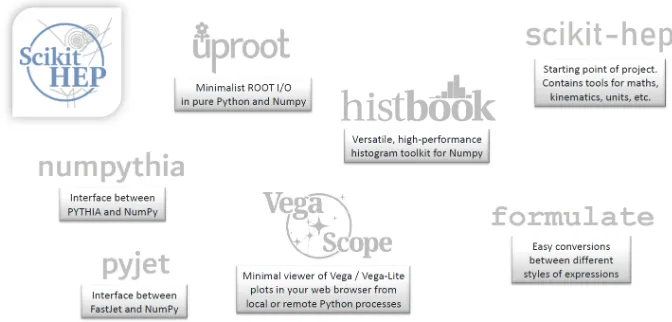
The Scikit-HEP toolset is depicted in figure 2. For completeness, it should be mentioned that the well-known packagesroot_numpy[6] androot_pandas[7], pre-dating the project, are not described in this report. They are nevertheless part of the project, but somewhat deprecated by the new and more versatile packageuproot[8], see below.
The remainder of this report briefly presents each package with simple examples of main functionality.
Traditionally, HEP has been evolving in a rather disjoint ecosystem based on the C++ ROOT data analysis framework [4]. Same as for the Python scientific ecosystem, it provides tools for data manipulation and modeling, for fitting, for statistics and machine learning ap-plications. But it is atoolkitrather than atoolset, with bindings to Python.
Various initiatives exist or have existed, which try and link both HEP and non-HEP worlds. But they mainly tackle(d) specific topics. We believe there is need for a more gener-alised effort, domain-specific oriented.
2 Scikit-HEP project overview
The Scikit-HEP project [5] is a community-driven and community-oriented effort with the aim of providing Particle Physics at large with a Python scientifictoolsetcontaining core and common tools. The project builds on five pillars that embrace the major topics involved in a physicist’s analysis work: datasets, data aggregations, modelling, simulation and visualisa-tion.
The project should neither be seen as a replacement for ROOT nor a replacement for the Python ecosystem based on the SciPy suite. It is rather the following:
• An initiative to improve the interoperability between HEP tools and the Python ecosystem, expanding the typical set of tools for HEP physicists with common APIs and definitions to ease “cross-talk".
• An initiative to build a community of developers and users.
• An effort to improve discoverability of relevant tools.
The Scikit-HEP toolset is depicted in figure 2. For completeness, it should be mentioned that the well-known packagesroot_numpy[6] androot_pandas[7], pre-dating the project, are not described in this report. They are nevertheless part of the project, but somewhat deprecated by the new and more versatile packageuproot[8], see below.
The remainder of this report briefly presents each package with simple examples of main functionality.
Figure 2. Overview of the packages making the Scikit-HEP toolset. All GitHub repositories can be found at the location https://github.com/scikit-hep.
3 Scikit-HEP packages walk
A ROOT file can natively and trivially be read with the pure I/Ouprootpackage [8]. The package strength lies in the fact that it doesnotdepend on ROOT, making it installable on virtually any computer via apip install uprootcommand. It bridges the ROOT and the NumPy-powered worlds. A ROOTTTreeobject is read as a dictionary of arrays as follows:
>>> import uproot
>>> rootfile = "Zmumu.root"
>>> zmumu = uproot .open( rootfile )[" events "] >>> zmumu. arrays (["px1","px2","py1","py2","M"])
{b’px1 ’: array([-41.19528764 , 35.11804977 , 35.11804977 , ..., 32.37749196 , 32.37749196 , 32. 48539387]),
b’px2 ’: array([ 34.14443725 , -41.19528764 , -40.88332344 , ..., -68.04191497 , -68.79413604 , -68. 79413604]),
b’py1 ’: array([ 17. 4332439 , -16.57036233 , -16.57036233 , ..., 1.19940578 , 1.19940578 , 1. 2013503 ]),
b’py2 ’: array([-16.11952457 , 17. 4332439 , 17.29929704 , ..., -26.10584737 , -26.39840043 , -26. 39840043]),
b’M’: array([82.46269156 , 83.62620401 , 83.30846467 , ..., 95.96547966 , 96.49594381 , 96. 65672765])}
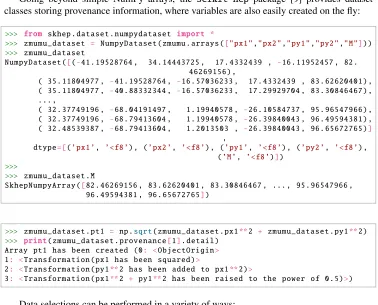
Going beyond simple NumPy arrays, the scikit-hep package [9] provides dataset classes storing provenance information, where variables are also easily created on the fly:
>>> from skhep. dataset . numpydataset import *
>>> zmumu_dataset = NumpyDataset (zmumu. arrays (["px1","px2","py1","py2","M"])) >>> zmumu_dataset
NumpyDataset ([(-41.19528764 , 34.14443725 , 17. 4332439 , -16.11952457 , 82. 46269156 ),
( 35.11804977 , -41.19528764 , -16.57036233 , 17. 4332439 , 83. 62620401 ), ( 35.11804977 , -40.88332344 , -16.57036233 , 17.29929704 , 83. 30846467 ), ...,
( 32.37749196 , -68.04191497 , 1.19940578 , -26.10584737 , 95. 96547966 ), ( 32.37749196 , -68.79413604 , 1.19940578 , -26.39840043 , 96. 49594381 ), ( 32.48539387 , -68.79413604 , 1. 2013503 , -26.39840043 , 96. 65672765 )]
,
dtype=[(’px1 ’, ’<f8’), (’px2 ’, ’<f8’), (’py1 ’, ’<f8’), (’py2 ’, ’<f8’), (’M’, ’<f8’)])
>>>
>>> zmumu_dataset .M
SkhepNumpyArray ([82.46269156 , 83.62620401 , 83.30846467 , ..., 95.96547966 , 96.49594381 , 96. 65672765])
>>> zmumu_dataset .pt1 = np.sqrt( zmumu_dataset .px1**2 + zmumu_dataset .py1**2) >>> print( zmumu_dataset . provenance[1]. detail )
Array pt1 has been created (0: <ObjectOrigin> 1: <Transformation (px1 has been squared )>
2: <Transformation (py1**2 has been added to px1**2)>
3: <Transformation (px1**2 + py1**2 has been raised to the power of 0.5)>)
Data selections can be performed in a variety of ways:
>>> zmumu_dataset .pt2 = np.sqrt( zmumu_dataset .px2**2 + zmumu_dataset .py2**2) >>> zmumu_dataset1 = zmumu_dataset[( zmumu_dataset .pt1 > 20) & ( zmumu_dataset .
>>> zmumu_dataset2 = zmumu_dataset . select ("pt1 > 20 & pt2 > 20") >>> zmumu_dataset1 . nentries
2008
>>> zmumu_dataset2 . nentries 2008
Theformulate[10] package eases the conversions between different styles of (selection) expressions:
>>> import formulate
>>> # write the selection as a formula
>>> pt1 = formulate . from_root (’TMath :: Sqrt(px1 **2 + py1 **2)’) >>> pt2 = formulate . from_root (’TMath :: Sqrt(px2 **2 + py2 **2)’) >>> cut = (pt1 > 20) & (pt2 > 20)
>>> cut. to_numexpr ()
’(sqrt ((( px1 ** 2) + (py1 ** 2))) > 20) & (sqrt ((( px2 ** 2) + (py2 ** 2))) > 20)’
>>> zmumu_dataset3 = zmumu_dataset . select (cut. to_numexpr ()) >>> zmumu_dataset3 . nentries
2008
>>> zmumu_dataset3 . provenance 0: <ObjectOrigin>
1: <Transformation (Array pt1 has been created )> 2: <Transformation (Array pt2 has been created )>
3: <Transformation (Selection , (sqrt((( px1 ** 2) + (py1 ** 2))) > 20) & (sqrt
((( px2 ** 2) + (py2 ** 2))) > 20), applied )>
The manipulation and analysis of datasets typically involves data aggregations and vi-sualisation. The packagehistbook[11] provides a versatile, high-performance histogram toolkit for NumPy. The histograms, often created from ntuples, can be of arbitrary number of dimensions. The package provides methods for selecting, rebinning, and projecting into lower-dimensional space. The created histograms are subsequently exportable to a variety of formats, such as ROOT, Pandas, etc. They can be plotted with Vega-Lite [12], a high-level grammar of interactive graphics built on top of Vega [13], a declarative language for creating, saving, and sharing interactive visualisation designs:
>>> from histbook import *
>>> from vega import VegaLite as canvas
>>> histogram = Hist(bin("Z_M", 50 , 0, 125)) >>> M = zmumu_dataset .M.view(np. ndarray ) >>> histogram .fill(Z_M = M)
>>>
>>> histogram .step("Z_M").to( canvas ) >>>
>>> histogram .root () Welcome to JupyROOT 6.14/00
<ROOT.TH1D object at 0x7f8a305449a0> >>>
>>> histogram . pandas ()
VegaScope[14] is a minimal viewer of Vega and Vega-Lite graphics from Python. It provides visualisation in the web browser from local or remote Python processes.
>>> zmumu_dataset2 = zmumu_dataset . select ("pt1 > 20 & pt2 > 20") >>> zmumu_dataset1 . nentries
2008
>>> zmumu_dataset2 . nentries 2008
Theformulate[10] package eases the conversions between different styles of (selection) expressions:
>>> import formulate
>>> # write the selection as a formula
>>> pt1 = formulate . from_root (’TMath :: Sqrt(px1 **2 + py1 **2)’) >>> pt2 = formulate . from_root (’TMath :: Sqrt(px2 **2 + py2 **2)’) >>> cut = (pt1 > 20) & (pt2 > 20)
>>> cut. to_numexpr ()
’(sqrt ((( px1 ** 2) + (py1 ** 2))) > 20) & (sqrt ((( px2 ** 2) + (py2 ** 2))) > 20)’
>>> zmumu_dataset3 = zmumu_dataset . select (cut. to_numexpr ()) >>> zmumu_dataset3 . nentries
2008
>>> zmumu_dataset3 . provenance 0: <ObjectOrigin>
1: <Transformation (Array pt1 has been created )> 2: <Transformation (Array pt2 has been created )>
3: <Transformation (Selection , (sqrt((( px1 ** 2) + (py1 ** 2))) > 20) & (sqrt
((( px2 ** 2) + (py2 ** 2))) > 20), applied )>
The manipulation and analysis of datasets typically involves data aggregations and vi-sualisation. The packagehistbook[11] provides a versatile, high-performance histogram toolkit for NumPy. The histograms, often created from ntuples, can be of arbitrary number of dimensions. The package provides methods for selecting, rebinning, and projecting into lower-dimensional space. The created histograms are subsequently exportable to a variety of formats, such as ROOT, Pandas, etc. They can be plotted with Vega-Lite [12], a high-level grammar of interactive graphics built on top of Vega [13], a declarative language for creating, saving, and sharing interactive visualisation designs:
>>> from histbook import *
>>> from vega import VegaLite as canvas
>>> histogram = Hist(bin("Z_M", 50 , 0, 125)) >>> M = zmumu_dataset .M.view(np. ndarray ) >>> histogram .fill(Z_M = M)
>>>
>>> histogram .step("Z_M").to( canvas ) >>>
>>> histogram .root () Welcome to JupyROOT 6.14/00
<ROOT.TH1D object at 0x7f8a305449a0> >>>
>>> histogram . pandas ()
VegaScope[14] is a minimal viewer of Vega and Vega-Lite graphics from Python. It provides visualisation in the web browser from local or remote Python processes.
Thenumpythia[15] andpyjet[16] packages provide interfaces between NumPy and the Pythia [17] event generator and the FastJet [18] jet finding algorithm, respectively. The collision events generated with Pythia are piped into NumPy arrays:
>>> from numpythia import Pythia , hepmc_write , hepmc_read
>>> from numpythia import STATUS , HAS_END_VERTEX , ABS_PDG_ID
>>>
>>> params = {"Beams:eCM": 13000 , " WeakSingleBoson : ffbar2gmZ ": "on", "23: onMode ": "off" ,"23: onIfAny ": "13", " WeakZ0 : gmZmode ": 2}
>>>
>>> pythia = Pythia ( params=params )
>>> selection = (( STATUS == 1) & ~ HAS_END_VERTEX ) >>>
>>> for event in pythia ( events=100): ... array = event.all( selection )
... muplus = array[array["pdgid "] == 13] # select muons
Thepyjet package can trivially receive the inputs from the above and feed the generated events into FastJet:
>>> from pyjet import cluster
>>> from pyjet. testdata import get_event >>>
>>> vectors = get_event ()
>>> sequence = cluster (vectors , R=0.1, p=-1)
>>> jets = sequence . inclusive_jets () # list of PseudoJets
4 Outlook
The Scikit-HEP project is gaining interest and momentum as a Python library for HEP anal-ysis. Some of the packages are in fact being used by other communities, in particular the astroparticle physics community.
Much can already be done with the packages described here. The various packages pre-sented are being further developed and improved as users get to strain test them, and provide feedback. It is foreseen that other packages join the project in order to complement the offered toolset.
Anyone is welcome to get in touch as user or developer via the public scikit-hep-forum mailing list. All project administrators and package maintainers can be reached with the scikit-hep-admins mailing list.
References
[1] Eric Jones, Travis Oliphant, Pearu Petersonet al.,SciPy: open source scientific tools for Python, http://www.scipy.org/
[2] The Astropy Collaboration, Thomas P Robitailleet al., Astropy: a community Python package for astronomy, Astronomy & AstrophysicsA 33(2013) 558,
http://doi.org/10.1051/0004-6361/201322068
[3] Jake VanderPlas,The Unexpected Effectiveness of Python in Science,
https://speakerdeck.com/jakevdp/the-unexpected-effectiveness-of-python-in-science, PyCon 2017
[4] The ROOT data analysis framework, https://root.cern.ch/ [5] The Scikit-HEP Project, http://scikit-hep.org/
[7] Chris Burr, Igor Babuschkinet al., “scikit-hep/root_pandas” [software], Zenodo, http://doi.org/10.5281/zenodo.593933
[8] Jim Pivarskiet al., “scikit-hep/uproot” [software], Zenodo, http://doi.org/10.5281/zenodo.1173083
[9] Eduardo Rodrigueset al., “scikit-hep/scikit-hep” [software], Zenodo, http://doi.org/10.5281/zenodo.1043949
[10] Chris Burr, “scikit-hep/formulate” [software] [11] Jim Pivarskiet al., “scikit-hep/histbook” [software],
Zenodo, http://doi.org/10.5281/zenodo.1284426
[12] Vega-Lite – a grammar of interactive graphics, https://vega.github.io/vega-lite/ [13] Vega – a visualization grammar, https://vega.github.io/vega/
[14] Jim Pivarskiet al., “scikit-hep/vegascope” [software]
[15] Noel Dawe, Eduardo Rodrigues, Henry Schreiner, “scikit-hep/numpythia” [software], Zenodo, http://doi.org/10.5281/zenodo.1471492
[16] Noel Dawe, Eduardo Rodrigues, Marcel R., “scikit-hep/pyjet” [software], Zenodo, http://doi.org/10.5281/zenodo.1197493
[17] Pythia, home.thep.lu.se/Pythia/
![Figure 1. Schematic view of the Python scientific software ecosystem. Figure taken from Jake Vander-Plas’s presentation at the PyCon 2017 conference [3].](https://thumb-us.123doks.com/thumbv2/123dok_us/8000296.1328828/1.482.158.327.461.591/figure-schematic-python-scientic-software-ecosystem-presentation-conference.webp)