Clinical, Cosmetic and Investigational Dermatology
Dove
press
O r I g I n a l r e s e a r C h
open access to scientific and medical research
Open Access Full Text Article
regularities of free radical processes and
involutional changes of face and neck skin in
different age groups
eV silina1
Va stupin2,3
sB Bolevich1
ne Manturova2,4
1Department of human Pathology, I.M. sechenov First Moscow state Medical University (sechenov University), Moscow, russia; 2Institute of Plastic surgery and Cosmetology, Moscow, russia; 3Department of hospital surgery №1, Pirogov russian national research Medical University (rnrMU), Moscow, russia; 4Department of Plastic and reconstructive surgery, Cosmetology and Cell Technologies, Pirogov russian national research Medical University (rnrMU), Moscow, russia
Aim: The purpose of this study was to examine the role of free radical oxygen and peroxide– lipid processes along with conducting the study of blood flow level and oxygen saturation of facial tissues in patients of different ages with varying degrees of involutional changes in the skin of the face and neck.
Materials and methods: One hundred and fifty-three people (84.3% women and 15.7% men)
aged from 26 to 78 years with varying degrees of involutional changes in facial skin were exam-ined. The clinical and laboratory evaluation was carried out dynamically and included various indicators of free radical processes, objective and subjective clinical visualization, and laser Doppler flowmetry (LDF) of the facial skin and transcutaneous oximetry (TcpO2) performed at 10 points on the face. To assess the state of free radical processes, the authors investigated the basal indicator of chemiluminescence intensity (ICb), the intensity of chemiluminescence stimulated (ICs) by zymosan, the activity coefficient (AC) of chemiluminescence, antiperoxide activity of plasma, and malondialdehyde (MDA).
Results: With aging, the imbalance of the oxygen constituents of free radical processes grows
with the increase in ROS. Proportional to age, the ICs increased 2.1 times on average in people older than 55 years compared to that in people younger than 30 years and ICb decreased by 1.8 times. As a result, the AC increased by 5.6 times. This correlates with involuntary skin changes and with regression of microcirculation and TcpO2. According to LDF, it was established that average total blood flow in people younger than 30 years and people older than 55 years was 8.1 and 6.4 mL/min, respectively The difference between the indicators of TcpO2 in people younger than 30 years and people older than 55 years was 1.6 times (average 56 vs 35 mm Hg). The stability of the indicators of the peroxide–lipid link of oxidative stress in different age groups demonstrated that the activation of ROS formation in mitochondria is not a cause but a conse-quence of microcirculation and metabolic processes in the face and neck and aging in general.
Conclusion: The tissue metabolism and microcirculation parameters naturally regress with
aging, which is associated with the increase of ROS. The excess of species leads to the intensi-fication of peroxide processes. This, in turn, is reflected in the aesthetic appearance manifested by aging.
Keywords: free radical processes, ROS aging, skin, involution processes, microcirculation
Introduction
Global aging of the world’s population is not only a widely discussed political, social, and medical problem.1 The increase in life expectancy is a consequence of improvement
in the quality of life. By virtue of the successes of the medical and social services, older people of tomorrow, unlike the current ones, will live longer2,3 and have better
Correspondence: eV silina
Department of human Pathology, I.M. sechenov First Moscow state Medical University (sechenov University), Moscow, russia
email [email protected]
Journal name: Clinical, Cosmetic and Investigational Dermatology Article Designation: Original Research
Year: 2018 Volume: 11
Running head verso: Silina et al
Running head recto: Free radical processes and involutional changes of face and neck skin DOI: http://dx.doi.org/10.2147/CCID.S181093
Clinical, Cosmetic and Investigational Dermatology downloaded from https://www.dovepress.com/ by 118.70.13.36 on 21-Aug-2020
For personal use only.
Dovepress silina et al
cognitive processes.4 However, the increase in life expectancy
is accompanied by the growth in the incidence of various socially significant pathologies, a decrease in the level of population’s health. Therefore, the study of the aging process is of utmost importance, and it will help senior citizens to have a long active life.
Aging is a complex biological process that affects biological systems at all levels of the organization. Aging is characterized by metabolic, structural, and functional changes in cells and tissues that are formed in connection with the depletion of biological resources of the body. The earliest visible signs of aging are observed in the face skin, so they are widely studied for medical and cosmetic purposes. However, among a number of antiaging interventions, only a few have demonstrated efficacy. Other techniques are of questionable efficacy, often of a low level of safety, and there-fore, their practical use is limited.5 In this regard, the study of
the physiology and pathophysiology of aging is the basis for effective methods of combating involutional manifestations.
Currently, the free radical theory of aging is generally recognized.
Mitochondria generate ROS in the form of superoxides and other forms as by-products of the ineffective electron transportation in the electron transport chain.6 Superoxide
radicals can additionally be reactive with the formation of other ROS, such as hydrogen peroxides and hydroxyl radicals. These superoxides and other ROS can damage the mitochondria and further reduce the efficiency of the mito-chondrial transport network, which leads to positive feedback and increased mitochondrial oxidative damage.7 However,
although numerous studies have shown the deleterious role of ROS and oxidative stress on the mechanisms of aging of different cells,8–11 another study also suggested that ROS
generation does not always cause cell aging.12
The purpose of this study is to examine the role of free radical oxygen and peroxide–lipid processes along with conducting the study of the blood flow level and oxygen saturation of facial tissues in patients of different ages with varying degrees of involutional changes in the skin of the face and neck.
Materials and methods
The study protocol was approved by the ethics committee of the I.M. Sechenov First Moscow State Medical University. Written informed consent was obtained from each participant of this study.
A prospective study included 153 patients (129 women [84.3%] and 24 men [15.7%]) aged 26–78 years with varying
degrees of involutional changes in the skin of face and neck (mean age, 47.1±16.3 years; median age, 44 years). Patients were divided into four groups according to age: 26–30 years (n=35; 22.9%), 31–40 years (n=32, 20.9%), 41–55 years (n=33; 21.6%), and older than 55 years (n=53; 34.6%). The main criterion for inclusion in the study was the absence of acute diseases, as well as chronic pathological conditions in subcompensation and decompensation stages.
The severity of involutional skin changes ranged from 0 to III degree (0 degree, absence of wrinkles or singular super-ficial wrinkles within the epidermis, corresponding to mimic folds and elastic lines, manifested only during mimic tension; face oval is not changed; sagging of soft tissues beyond the lower edge of the jaw is not present. I degree, visualized superficial wrinkles within the epidermis, facial wrinkles that partially disappear in the absence of facial expressions; a slight change in the face oval; sagging of soft tissues below the edges of the lower jaw up to 0.5 cm. II degree, singular or multiple group wrinkles with skin folds, covering the epidermis and dermis; facial wrinkles are not smoothed out during calm expression, the presence of vertical skin folds in the parotid region, overhanging of the skin of the upper and lower eyelids; moderate deformation of the face oval; sagging of the soft tissues below the edge of the lower jaw up to 0.5–1.5 cm. III degree, deep singular or multiple wrinkles extending to the entire skin in the form of chaotically located deep furrows, constantly present; the presence of vertical folds in the chin area, neck, twinning skinfold lower eyelids; pronounced deformation of the face oval; sagging of soft tissue below the lower edge of the mandible up to more than 1.5 cm). At the study entry, 0 degree of involutional changes in the facial and neck skin was recorded in 20.9%, I degree in 24.2%, II degree in 17.6%, and III degree in 37.3% of the subjects. Naturally, the manifestation of the involuntary changes increased with age.
To evaluate the state of free radical processes in the blood plasma, the indices of ROS generation by leukocytes were studied – the basal indicator of chemiluminescence intensity (ICb) and the intensity of chemiluminescence stimulated (ICs) by Zymosan, and the activity coefficient (AC) of the FRP oxygen phase was calculated according to the follow-ing formula: AC=ICs/ICb. Peroxide–lipid markers were also studied based on two parameters: 1) the antiperoxide activity of secondary plasma (APA), which is the ratio of hydrogen peroxide induced and the spontaneous chemiluminescence secondary plasma and 2) the indicator of malondialdehyde (MDA) – secondary product of lipid peroxidation – which reacts with thiobarbituric acid.
Clinical, Cosmetic and Investigational Dermatology downloaded from https://www.dovepress.com/ by 118.70.13.36 on 21-Aug-2020
Dovepress Free radical processes and involutional changes of face and neck skin
To modernize the assessment of these skin condition parameters of face and neck, modern instrumental methods of investigation were applied. To assess the microcirculation of the skin, laser doppler flowmetry (LDF) of the facial skin was used (flow meter BLF-21; Transonic System Inc., Ithaca, NY, USA). To assess the state of skin metabolic processes, a study on the tissue (intracutaneous) oxygen tension con-dition by a noninvasive method of transcutaneous oximetry (TcpO2) using a TCM 400 Radiometer device (Denmark) was conducted. These studies were conducted at 10 points on the face (cheekbones, orbital regions, mandibular areas, and frontal and chin areas).
The data were statistically analyzed with SPSS 17.0 software using parametric and nonparametric criteria for esti-mating the statistical significance of differences. P<0.05 was considered to be statistically significant. Qualitative param-eters are presented as frequencies (abs, %) and quantitative parameters as median, lower (25%) and upper (75%) quartile, and 5%–95% percentile in cases when the parameter had a function far from normal distribution. To compare the two independent nonparametric samples, the Mann–Whitney test was used, for a multiple comparison, the Kruskal–Wallis test. Qualitative variables were compared using the chi-squared test (Pearson XY-square, conjugacy table analysis). Correla-tions were calculated by Pearson’s method.
Results
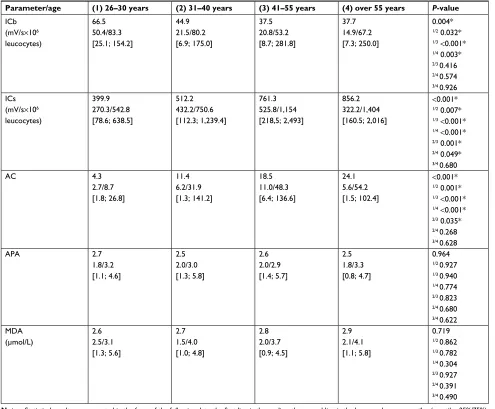
In the course of the study, the role of the SRP in the develop-ment of age-related changes was identified and objectified. That particularly concerned the indicators demonstrating the activity of the oxygen stage of oxidative stress. Proportional to age, the ICs increased (on average from 399.9 mV/s×106
leukocytes in young people up to 30 years of age to 856.2 mV/s×106 leukocytes in people older than 55 years, with the
difference of 2.14 times, P<0.05) and ICb decreased (on aver-age from 66.5 mV/s×106 leukocytes in young people up to 30
years to 37.7 mV/s×106 leukocytes in the people older than 55
years, with the difference of 1.76 times, P<0, 05). As a result of such changes, as the aging progresses, the AC increased (on average from 4.3 in people younger than 30 to 24.1 in people older than 55 years, the difference was 5.60 times, P<0.05).
Consequently, the AC index, demonstrating the presence of active forms of oxygen, is a reflection of the involutionary processes of the body, coupled with aging. It is important to note that there was no difference in SRP between groups of patients aged 41–55 years and older than 55 years (P>0.05). At the same time, the greatest differences were revealed when the youngest group was compared with all other groups. This
indicates fundamental physiological differences, expressed in minimum quantities, and the level of AFC intensification in the first maturity period (in people younger than 30 years) when the energy metabolism is at a high level. Thus, in young patients aged 26–30 years, ICb was 1.48 times greater than in patients aged 31–40 years (P<0.05) and 1.77 and 1.76 times greater than in patients aged 41–55 years and older than 55 years, respectively (P<0.05). Compared with the youngest group, the ICs was 1.28 times greater (P<0.05) in the 31–40 years age group, 1.90 times greater (P<0.05) in the 41–55 years age group, and more than 2.14 times greater (P<0.05) in the older than 55 years age group. AC in people aged 31–40 years, 41–55 years, and older than 55 years was 2.65 times, 4.30 times and 5.60 times, respectively, more than in individuals aged 26–30 years (P<0.05). The indices of MDA and APA in somatically healthy people of different ages remained on the statistically indistinguishable stable level, and there was a distinct tendency of increase in the lipid peroxidation products with aging, which was reflected in the systematic increase in MDA of 2.6 μmol/L in women younger than 30 years to 2.9 μmol/L in people older than 55 years (Table 1).
Thus, the most significant differences were recorded between groups of people younger than 30 years and older than 55 years. At the same time, there were no significant dif-ferences in the SPR indices in the age groups 41–55 years and older than 55 years. These changes can be easily explained by the presence of compensatory tissue hypoxia and a decrease in tissue blood flow in the older age group, which was also shown with instrumental methods of assessing their condi-tions. This was expressed in the relatively early formation of disturbances of interstitial metabolic processes due to a change in the structure of the microcapillary blood channel.
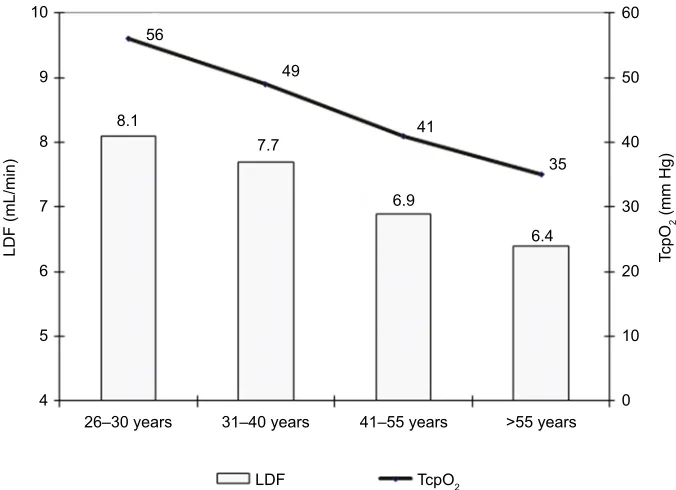
According to LDF, it was established that the parameters of the facial skin microcirculation decreased significantly with age. Thus, the average total LDF (including the total quantitative representation of blood flow at all measured points) in people younger than 30 years was 8.1 mL/min (IQR, 6.3–9.5 mL/min) and people older than 55 years was 6.4 mL/min (IQR, 5.2–7.7 mL/min), and the difference is significant (P<0.05). However, when comparing border groups, the reliability was not obtained, ie, the blood flow of the microcirculatory bed in people aged 41–55 years and people older than 55 years was comparable, and LDF indi-cators in people aged 31–40 and 41–55 years were also not distinguishable. A significant difference of 1.2 times in the average total LDF between the age groups of 31–40 years and older than 55 years was established (P<0.05).
Clinical, Cosmetic and Investigational Dermatology downloaded from https://www.dovepress.com/ by 118.70.13.36 on 21-Aug-2020
Dovepress silina et al
Thus, the results of LDF characterize the decrease of microcirculation parameters with age. These results are consistent with the outcome of the study of microcirculation parameters for TcpO2, characterizing the age-induced invo-lution of tissue oxygenation. The difference between TcpO2 in people younger than 30 years (median, 56 mm Hg; IQR, 49–62 mm Hg) and people older than 55 years (median, 35 mm Hg; IQR, 30–39 mm Hg) was an average of 1.6 times (P<0.05; Figure 1).
A direct correlation between age and levels of tissue (intracutaneous) microcirculation of the facial tissues was
Table 1 Parameters of free radical processes in healthy people of different ages
Parameter/age (1) 26–30 years (2) 31–40 years (3) 41–55 years (4) over 55 years P-value
ICb (mV/s×106 leucocytes)
66.5 50.4/83.3 [25.1; 154.2]
44.9 21.5/80.2 [6.9; 175.0]
37.5 20.8/53.2 [8.7; 281.8]
37.7 14.9/67.2 [7.3; 250.0]
0.004* 1/2 0.032* 1/3<0.001* 1/4 0.003* 2/3 0.416 2/4 0.574 3/4 0.926 ICs
(mV/s×106 leucocytes)
399.9 270.3/542.8 [78.6; 638.5]
512.2 432.2/750.6 [112.3; 1,239.4]
761.3 525.8/1,154 [218,5; 2,493]
856.2 322.2/1,404 [160.5; 2,016]
<0.001* 1/2 0.007* 1/3<0.001* 1/4<0.001* 2/3 0.001* 2/4 0.049* 3/4 0.680
aC 4.3
2.7/8.7 [1.8; 26.8]
11.4 6.2/31.9 [1.3; 141.2]
18.5 11.0/48.3 [6.4; 136.6]
24.1 5.6/54.2 [1.5; 102.4]
<0.001* 1/2 0.001* 1/3<0.001* 1/4<0.001* 2/3 0.035* 2/4 0.268 3/4 0.628
aPa 2.7
1.8/3.2 [1.1; 4.6]
2.5 2.0/3.0 [1.3; 5.8]
2.6 2.0/2.9 [1.4; 5.7]
2.5 1.8/3.3 [0.8; 4.7]
0.964 1/2 0.927 1/3 0.940 1/4 0.774 2/3 0.823 2/4 0.680 3/4 0.622 MDa
(μmol/l)
2.6 2.5/3.1 [1.3; 5.6]
2.7 1.5/4.0 [1.0; 4.8]
2.8 2.0/3.7 [0.9; 4.5]
2.9 2.1/4.1 [1.1; 5.8]
0.719 1/2 0.862 1/3 0.782 1/4 0.304 2/3 0.927 2/4 0.391 3/4 0.490
Notes: Statistical results are presented in the form of the following data: the first line is the median, the second line is the lower and upper quartiles (quartiles 25%/75%),
the third line is [5%; 95% percentile]. *P<0.05 – significant intergroup difference. Comparison of three independent groups according to the Kruskal–Wallis test; comparison of two groups according to the Mann–Whitney test (1/2≤30 and 31–40 years, 1/3≤30 and 41–55 years, 1/4≤30 and >55 years, 2/331–40 and 41–55 years, 2/431–40 and >55 years,
and 3/441–55 and >55 years).
Abbreviations: AC, activity coefficient; APA, antiperoxide activity of secondary plasma; ICs, intensity of chemiluminescence stimulated; ICb, basal indicator of
chemiluminescence intensity; MDa, malondialdehyde.
established (r=0.381, P<0.05). In addition, an inverse cor-relation was established between LDF and such indices of oxidative stress as AC (r=–0.419; P<0.05) and ICs (r=–0.390; P<0.05); and a direct correlation with ICb (r=0.324, P<0.05).
Therefore, the tissue metabolism and microcircula-tion parameters naturally regress with aging, which are associated with the increase in ROS. The excess of species leads to the intensification of peroxide processes. This, in turn, is reflected in the esthetic appearance, manifested with aging.
Clinical, Cosmetic and Investigational Dermatology downloaded from https://www.dovepress.com/ by 118.70.13.36 on 21-Aug-2020
Dovepress Free radical processes and involutional changes of face and neck skin
Discussion
Currently, there is a unified view that SRPs are general biological processes that operate at the level of life support of each cell in the body, regardless of what tissue or organ the cell represents. This can be confirmed by the data from population studies on the increase in the incidence rate of car-diovascular diseases caused by tissue metabolism disorders in older age groups. The obtained results indicate a correla-tion between the level of SRP and the level of involucorrela-tional changes in the state of the skin system. The obtained data revealed the features of the flow of free radical mechanisms underlying the aging processes, including the skin system, and the involutional intradermal disorders, correlated with the severity.
The results revealed in the course of the study confirm the hypothesis that the microcirculatory bed (blood flow level and oxygen level) has a predominant effect on the metabolic processes in the skin, which correlates with the SRP indices. Therefore, the improvement of metabolic processes in cells should be an integral component in the pathophysiologically directed treatment of involutional changes. Due to the fact that any tissue ischemia and hypoxemia, including the ones happening with the involu-tional changes in the skin system, as it was revealed in the authors’ studies, lead to an intensification of SRP and to the triggering of aging mechanisms.
The results of the study of LDF, TcpO2, SRP can serve as early prognostic markers and underlie the development of objective markers for predicting the effectiveness of surgical intervention performed to correct involutional changes in the skin system. In addition, they can serve as the basis for pharmacological correction of free radical and metabolic processes in order to improve the effectiveness of the results of plastic surgery and cosmetology procedures in correction of involutional skin changes.
Conclusion
Thus, based on the data presented, the following conclusion can be drawn. With age, the imbalance of predominantly oxygen constituents of free radical processes increases, which correlates with involutional skin changes and regression of microcirculation and tissue oximetry. Stability of the indica-tors of the peroxidation link of oxidative stress in different age groups demonstrates that the activation of the free oxygen forms formation in the mitochondria is not the cause, but the consequence of microcirculation and metabolic processes in the face and neck skin, and aging in general.
In this regard, it can be concluded that the correction of oxidative stress together with the improvement of the state of metabolic processes in cells in complex therapy for combat-ing the manifestations of agcombat-ing should positively affect the involutional changes in the skin, including the face and neck
Figure 1 Indicators of tissue oximetry and microcirculation of the face skin in patients of different ages (median variables are indicated).
Abbreviations: LDF, laser doppler flowmetry; TcpO2, transcutaneous oximetry.
10
56
49
41
35
6.4 6.9
7.7 8.1
9
8
7
6
5
4
60
50
40
30
Tc
pO
2
(mm Hg)
LDF (mL/min)
20
10
0
26–30 years 31–40 years
LDF TcpO2
41–55 years >55 years
Clinical, Cosmetic and Investigational Dermatology downloaded from https://www.dovepress.com/ by 118.70.13.36 on 21-Aug-2020
Dovepress
Clinical, Cosmetic and Investigational Dermatology
Publish your work in this journal
Submit your manuscript here: https://www.dovepress.com/clinical-cosmetic-and-investigational-dermatology-journal
Clinical, Cosmetic and Investigational Dermatology is an interna-tional, peer-reviewed, open access, online journal that focuses on the latest clinical and experimental research in all aspects of skin disease and cosmetic interventions. This journal is included on PubMed. The manuscript management system is completely online
and includes a very quick and fair peer-review system, which is all easy to use. Visit http://www.dovepress.com/testimonials.php to read real quotes from published authors
Dove
press
silina et al
skin. Isolated correction of SRP cannot significantly affect the aging process. Consequently, complex therapy focused on stabilizing the processes of intradermal metabolism in the cosmetic manipulations in esthetic medicine can actu-ally improve the results of plastic surgery and cosmetology.
Disclosure
The authors report no conflicts of interest in this work.
References
1. He W, Goodkind D, Kowal P. United States Census Bureau. An Aging World: 2015. Washington, DC: U.S. Government Publishing Office; 2016. Available from: http://cdn.cnsnews.com/attachments/census_ bureau-an_aging_world-2015.pdf.
2. Christensen K, Doblhammer G, Rau R, Vaupel JW. Ageing populations: the challenges ahead. Lancet. 2009;374(9696):1196–1208.
3. Vaupel JW. Biodemography of human ageing. Nature. 2010;464(7288): 536–542.
4. Bordone V, Scherbov S, Steiber N. Smarter every day: The deceleration of population ageing in terms of cognition. Intelligence. 2015;52:90–96.
5. Moskalev A, Chernyagina E, de Magalhães JP, et al. Geroprotectors.org: a new, structured and curated database of current therapeutic interven-tions in aging and age-related disease. Aging. 2015;7(9):616–728. 6. Quinlan CL, Perevoshchikova IV, Hey-Mogensen M, Orr AL, Brand MD.
Sites of reactive oxygen species generation by mitochondria oxidizing different substrates. Redox Biol. 2013;1:304–312.
7. Halliwell B, Gutteridge JMC. Free Radicals in Biology and Medicine. 4th ed. Oxford: Oxford University Press; 2007.
8. Florida-James GD, Simpson R, Davison G, Close G. Exercise, free radical metabolism, and aging: cellular and molecular processes. Oxid Med Cell Longev. 2016;2016:3813680.
9. Luo Y, Zou P, Zou J, Wang J, Zhou D, Liu L. Autophagy regulates ROS-induced cellular senescence via p21 in a p38 MAPKα dependent manner. Exp Gerontol. 2011;46(11):860–867.
10. Lawless C, Jurk D, Gillespie CS, et al. A stochastic step model of replicative senescence explains ROS production rate in ageing cell populations. PLoS One. 2012;7(2):e32117.
11. Manturova NE, Silina EV, Stupin VA, Smirnova GO, Bolevich SB. Free radical processes in the pathogenesis of involutional skin changes. Ter Arkh. 2012;84(10):75–78.
12. Ziegler DV, Wiley CD, Velarde MC. Mitochondrial effectors of cel-lular senescence: beyond the free radical theory of aging. Aging Cell. 2015;14(1):1–7.
Clinical, Cosmetic and Investigational Dermatology downloaded from https://www.dovepress.com/ by 118.70.13.36 on 21-Aug-2020