Volume 2011, Article ID 351494,12pages doi:10.1155/2011/351494
Research Article
A Near-Optimum Multiuser Receiver for STBC MC-CDMA
Systems Based on Minimum Conditional BER Criterion and
Genetic Algorithm-Assisted Channel Estimation
Leandro D’Orazio,
1Claudio Sacchi,
2Massimo Donelli,
2J´erˆome Louveaux (EURASIP Member),
3and Luc Vandendorpe
31Centro Ricerche FIAT (CRF), Trento Branch, Via della Stazione 27, 38123 Trento, Italy
2Information Engineering and Computer Science Department (DISI), University of Trento, Via Sommarive 14, 38123 Trento, Italy 3Laboratoire de T´el´ecommunications et T´el´ed´etection, Universit´e Catholique de Louvain, Place du Levant 2,
1348 Louvain-la-Neuve, Belgium
Correspondence should be addressed to Claudio Sacchi,[email protected]
Received 1 December 2010; Accepted 7 March 2011
Academic Editor: Alexey Vinel
Copyright © 2011 Leandro D’Orazio et al. This is an open access article distributed under the Creative Commons Attribution License, which permits unrestricted use, distribution, and reproduction in any medium, provided the original work is properly cited.
The implementation of efficient baseband receivers characterized by affordable computational load is a crucial point in the development of transmission systems exploiting diversity in different domains. This would be a crucial point in the future development of 4G systems, where space, time, and frequency diversity will be combined together in order to increase system throughput. In this framework, a linear multiuser detector for MC-CDMA systems with Alamouti’s Space-Time Block Coding (STBC), which is inspired by the concept of Minimum Conditional Bit Error Rate (MCBER), is proposed. The MCBER combiner has been implemented in adaptive way by using Least-Mean-Square (LMS) optimization. The estimation of Channel State Information (CSI), necessary to make practically feasible the MCBER detection, is aided by a Genetic Algorithm (GA). The obtained receiver scheme is near-optimal, as both LMS-based MCBER and GA-assisted channel estimation perform closely to optimum in fulfilling their respective tasks. Simulation results evidenced that the proposed receiver always outperforms state-of-the-art receiver schemes based on EGC and MMSE criterion exploiting the same degree of channel knowledge.
1. Introduction
Future mobile communications standards will be required to provide high performance in terms of data rate, capacity, and quality of service. For this reason, the efficient exploitation of diversity in different domains (time, space, frequency) will be an issue. Multicarrier modulations [1] and Multiple-Input Multiple-Output (MIMO) space-time coding [2] are among the enabling technologies of future diversity-based high-capacity wireless communications. As claimed by Ahmadi in [3], next-generation mobile WiMAX technology will be based on Orthogonal Frequency Division Multiple Access (OFDMA), supported by Time-Division Duplexing (TDD) or Frequency-Division Duplexing (FDD), and advanced multiantenna systems, exploiting novel space-time coding
environments. It is worth to mention a recent work [4] that considers the evolution of High-Speed Packet Access (HSPA) from single-carrier DS/CDMA (HSPA currently adopts a PHY-layer scheme rather similar to Wideband CDMA of UMTS) to Multicarrier CDMA. Such an evo-lution is motivated by the synergies of HSPA with 3GPP Long-Term Evolution (LTE), which considers OFDMA and Single-Carrier FDMA (SC-FDMA) as preferential PHY-layer options. MC-CDMA may become a competitor also in future WiMAX standardization. Very recently, Aldhaheri and Al-Qahtani presented in [5] a novel MC-CDMA transmission scheme for fixed and mobile WiMAX. The performance improvement attainable by MC-CDMA with respect to the conventional OFDMA is relevant, in particular when the speed of the terminal is very high.
In such a framework, multiantenna systems, space-time coding, and multicarrier CDMA can be regarded as key technologies for future broadband wireless networking. In [6], it is shown that MC-CDMA with Space-Time Block Coding (STBC) can jointly exploit diversity in space and frequency domains in order to counteract multipath fading effects and, therefore, to provide performances quite close to the single-user bound. As it happens in Input Single-Output (SISO) MC-CDMA, multiuser detection (MUD) plays a key role in improving system performances.
Theoretically optimum nonlinear maximum likelihood detection is characterized by an unsustainable computational complexity (exponentially growing with the number of users). For this reason, suboptimum linear MUD strategies should be investigated. Minimum Mean Square Error-(MMSE-) MUD techniques have been proposed for STBC MC-CDMA systems in [7]. Although MMSE is a good choice in order to provide a simple implementation of adaptive receivers (Least-Mean-Square (LMS) and Recursive-Least-Squared (RLS) implementations are allowed), it is intrin-sically suboptimal because it minimizes the Mean Squared Error between the received signal and the noiseless signal pattern. This results in a maximization of the Signal-to-Noise plus Interference Ratio (SINR), rather than in the minimization of the Bit Error Rate (BER) that is the expected target of an efficient receiver. The Minimum Bit Error Rate (MBER) criterion for multiuser detection has been successfully applied to DS-CDMA [8], MC-CDMA [9], and SDMA [10]. Partial equalization and adaptive Threshold Orthogonality Restoring (TORC) based on BER minimization have been also proposed for MC-CDMA in [11,12]. The potential advantages of implementing linear MBER MUD in STBC MC-CDMA context can be easily explained. STBC MC-CDMA is a transmission methodology, where diversity is obtained both in space and in frequency domain. The diversity gain, increased with respect to the conventional SISO case, is obtained at the price of an increased system complexity. In our opinion, the exploitation of the “full potential” of STBC MC-CDMA techniques can be obtained only by means of optimized multiuser detection approaches. In such a perspective, the investigation of MBER strategies can be regarded as a step ahead towards the computationally affordable signal detection optimization also in the STBC MC-CDMA case. The application of
MBER reception to STBC MC-CDMA is not straightforward and should be investigated by carefully taking into account tight requirements in terms of ease of implementation and reduced computational effort. An example of application of MBER criterion to STBC MC-CDMA MUD has been shown in [13]. The unknown probability density function (PDF) of the decision variable has been expressed in closed, but approximated, form by using the Parzen windows methodology. Then, the LMS criterion has been applied in order to adaptively implement the MBER receiver. The MBER-MUD approach of [13] does not require Channel State Information (CSI) knowledge and is characterized by a moderate computational complexity. Despite these favorable features, the multiuser receiver of [13] is quite far from optimality, in particular when the number of users increases. In this paper, we are proposing a near-optimum mul-tiuser detector for STBC MC-CDMA transmission systems based on the Minimum Conditional Bit Error Rate (MCBER) and on Genetic Algorithm- (GA-) assisted channel estima-tion. The design of MCBER-MUD and GA-assisted channel estimation for STBC MC-CDMA is motivated by the basic requirements of implementing an actual receiver scheme (that, therefore, cannot assume the ideal CSI knowledge) characterized by affordable computational load and near-optimal performance. MCBER-MUD criterion has been successfully applied in [14] to DS/CDMA systems and in [15] to SISO MC-CDMA systems. MCBER-MUD is a slight modification of the original MBER-MUD criterion that allows reducing the computational complexity to a linear order with the number of users without significant losses in BER performances with respect to theoretically optimum ML-MUD. The STBC scheme considered in the present paper is the well-known Alamouti’s scheme [16] character-ized by ease of concept and implementation, computational efficiency and performance very close to theoretical bounds when employed in multipath fading channels. The practical implementation of the proposed MCBER detector relies on an adaptive optimization strategy based on the concept of deterministic gradient. In particular, we considered LMS to derive the MCBER solution in numerical iterative form. Such a choice has been motivated by the necessity of testing a computationally tractable algorithm like gradient descent, widely employed in practical MUD implementations. In this framework, it is worth citing a very recent paper [17], where another LMS-based adaptive receiver has been proposed for MC-CDMA systems with Alamouti’s STBC. Such receiver is based on a modified MSE cost function and an improved LMS optimization strategy. The convergence rate is increased with respect to conventional LMS receiver. We think that our approach represents a step ahead with respect to [17], as it tries to minimize the system BER instead of minimizing the MSE between the filter output and the expected symbol belonging to the STBC block. The explicit BER minimization is conceptually closer to optimality than partial equalization and TORC of [11,12], whose performance is lower bounded by that of MMSE receiver exploiting ideal CSI knowledge.
considered in the perspective of the provision of a technically viable solution. Searching for reliable and computationally efficient adaptive channel estimation, we decided to propose a Genetic Algorithm- (GA-) assisted semi adaptive MMSE channel estimation. The idea of exploiting a GA-based approach in order to efficiently implement channel estima-tion has been suggested by the promising results achieved in [18]. In this work, Genetic Algorithm has been considered for near-optimal channel estimation applied to STBC MC-CDMA with MMSE multiuser detection. Substantially, the effectiveness of the GA-based approach has been assessed by comparing BER performance of the Wiener solution to MMSE-MUD, obtained by using the ideally known channel matrices and that one obtained by using estimated channel matrices. The maximum performance loss due to nonideal channel estimation was only 1 dB. On the other hand, results shown in [18] evidenced that iterative LMS-based MMSE-MUD may provide unsatisfactory performance, in particular when the interference load increases.
The paper is organized as follows. Section 2 contains the description of the system model. Section 3 details the implementation of the proposed near-optimal receiver based on MCBER and GA-assisted channel estimation. Section 4
shows some selected simulation results aimed at assessing the effectiveness of the proposed approach by means of a thorough comparison with other state-of-the-art receivers. Moreover, some considerations about computational com-plexity and parameterization both of MCBER reception and GA-assisted channel estimation are sketched at the end of
Section 4. Finally, paper conclusions are drawn inSection 5.
2. STBC MC-CDMA System Description
In the present dealing, we consider a synchronous multiuser MC-CDMA system using Alamouti’s Space Time Block Coding [16]. A block scheme of such a transmission system is drawn in Figure 1. Two consecutive data symbols of the generic userk(k =0,. . .,K−1)[ak(i−1),ak(i)] related to the genericith modulation period (i=1, 3,. . .) are mapped to two transmitting antennas according to the code matrix
Φk(i), whose elements are given by [16]
The superscript operator (∗) denotes the complex conjugate. The matrix of (1) represents Alamouti’s STBC block. Alam-outi’s scheme exhibits some clear advantages. Essentially, it makes available a space diversity gain also for mobile terminals only by exploiting transmit diversity [16]. The most economic and advantageous Alamouti’s configuration considers two transmit antennas (installed at base station or access point) and a single antenna mounted at the receiver side [16]. Such a configuration is considered in our paper, where the focus is on the development of cost-effective mobile terminals. Without losing generality, we suppose to consider binary antipodal BPSK symbols
therefore, [ak(i−1),ak(i)]∈ {−1, 1}. The encoder outputs are transmitted during two consecutive transmission peri-ods, each one of duration equal to T. During the first transmission period (i.e., (i −1)T), two symbols ak(i −
1) and ak(i) are modulated by two separate Inverse Fast Fourier Transform- (I-FFT-) based multicarrier transmitters using a unique Hadamard-Walsh sequenceck={ ck(n)n =
0,. . .,N−1}, whereNis the number of subcarriers employed for spreading. Finally, the RF-converted Multicarrier Spread Spectrum (MC-SS) signals are simultaneously transmitted by antenna 1 and antenna 2, respectively. In the same way, during the successive transmission period (i.e., iT), the symbol−ak(i) is transmitted by antenna 1, and the symbol
ak(i−1) is transmitted by antenna 2, respectively. The com-plex conjugate operator disappears, as we are considering real symbols. In order to make the notation more compact in the multiuser case, we define two vectors of symbols
A(i −1)=[a0(i−1),a1(i−1),. . .,aK−1(i−1)]T and, simi-larly,A(i) together with the orthonormal code matrixCas
C=
The received signal samples acquired at two consecutive symbol periods after the FFT-based coherent demultiplexing can be expressed as follows:
R(i−1)=H1CA(i−1) +H2CA(i) +Ψ(i−1),
R(i)= −H1CA(i) +H2CA(i−1) +Ψ(i),
(3)
where R(i − 1) and R(i) are N × 1 vectors, Ψ(l)=
[ψ0(l),ψ1(l),. . .,ψN−1(l)]T (withl∈ {(i−1), i}i=1, 2,. . .) is the Additive Gaussian Noise vector (all vector components are independent and identically distributed with zero mean and variance σ2), and H is the complex channel coefficient related to subcarriernand to the transmit antennaj. We reasonably assume that fading is flat over each subcarrier and almost time-invariant during two consecutive transmission periods (i.e., the coherence time is much greater than the symbol period).
3. The Design of the Near-Optimum STBC
MC-CDMA Linear Multiuser Receiver Based
on Conditional BER Minimization and
GA-Assisted Channel Estimation
3.1. Design Motivations. As remarked in [1], in order to
[a0(i−1),a0(i)]
Figure1: The considered STBC MC-CDMA system (complete block diagram).
increasing transmission integrity at the cost of more sophisti-cated signal processing. Alternatively, transmission integrity may be increased without increasing system complexity, provided that, for example, channel coding/interleaving delay can be further extended. It is also realistic to increase the system integrity by invoking a more robust but lower throughput modulation scheme. In such a case, the integrity is increased without spending in terms of system complexity, just in terms of bandwidth expense. In this paper, we adopted a transmission scheme characterized by intrinsic robustness against multipath channel impairment (i.e., STBC MC-CDMA). Transmission integrity should be guaranteed with-out increasing too much system complexity, considering also that we have decided to exploit only transmit diversity in order to keep the mobile terminal cheaper. In order to solve the tradeoffbetween integrity and complexity, we design an innovative STBC MC-CDMA receiver architecture based on the integration of (a) Minimum-Conditioned BER linear MUD and (b) Genetic Algorithm-assisted channel estimation. In the following part of this section, we shall detail and motivate both the adopted linear MUD criterion and the channel estimation strategy based on evolutionary optimization.
3.2. LMS-Based MCBER Multiuser Detector. In this
sub-section, we shall describe the Minimum Conditional Bit-Error-Rate criterion for STBC MC-CDMA linear multiuser detection. A generic linear multiuser detector generates two decision variables based on the linear combination of the received signal samples. Thus, the (scalar) decision variables for the userk, denoted byxk(i−1) andxk(i), related to the
ith modulation period can be expressed as follows:
xk(i−1)=w∗k(i−1)·R(i−1) +wk(i)·R∗(i),
xk(i)=w∗k(i)·R(i−1)−wk(i−1)·R∗(i), (4)
where wk(i−1) and wk(i) are the N-elements vectors of receiver gains employed by the generickth user in order to
recombine the baseband output of the FFT-based demod-ulation stage. The operator (·) denotes the scalar product. As we are considering a BPSK modulation, the couple of bits contained in a single STBC block can be estimated by observing the real part ofxk(i−1) andxk(i), respectively. Conditioned on the transmitted bit vectorsA(i−1) andA(i), assuming the perfect knowledge of the channel matricesH1 andH2the random variables Re{xk(i−1)}and Re{xk(i)}are Gaussian-distributed with mean values as follows:
xk(i−1)=Rew∗k(i−1)H1CA(i−1)
and varianceS2
k(i−1)=Sk2(i)=σ2(wk(i−1)2+wk(i)2). To make the derivation of the probability of error easier, we can refer to the so-called sign-adjusted decision variables [10] defined as follows:yk(i−1)=ak(i−1) Re{xk(i− 1)}and yk(i)=ak(i) Re{xk(i)}. These new decision variables are Gaussian-distributed as well with mean values ak(i−
1)xk(i − 1) and ak(i)xk(i) and variances S2k(i − 1) and
S2k(i), respectively. It is clear that the correct block detection event happens if and only if {yk(i−1) > 0, yk(i) > 0}. Thus, the probability to have an error in the STBC block transmitted by userkcan be written as follows:
Asyk(i−1) andyk(i) are independent random variables, we
We can analytically compute the single probabilities of (7), conditioned on the bit vectorsA(i−1) andA(i) as follows:
whereQ(x) is the conventional Gaussian error function. The calculation of the probability of error conditioned onA(i−1) andA(i) is straightforward:
Perr/A(i−1),A(i)=Q
Assuming that the two symbols contained in an STBC block have the same probability of error, the third term in (9) is negligible with respect to the first two ones. Thus, a good approximation of (9) is given by
Perr/A(i−1),A(i)=∼Perr/A(i−1),A(i)
By considering that the 22K possible transmitted bit vectors are independent and equiprobable, the average probability of error for thekth user can be written as
Perr
The theoretical MBER criterion would lead to the com-putation of the couple of receiver gain vectors {wOPT
k (i− 1),wOPT
k (i)} minimizing the average probability of error of (11). The computational complexity of this detector is exponential in the number of usersO(22K), so its practical
application becomes unfeasible asKincreases. An alternative near-optimum linear detection criterion forecasts the mini-mization of theconditional probability of error[14,15]. The Minimum Conditional BER (MCBER) can be expressed, in the considered STBC MC-CDMA case, as follows:
PCOND
The BER is conditioned in (12) only to the symbols not
transmitted by the kth user in its own STBC block and is
thus averaged with respect to all the possible combinations of the kth user’s symbols. In our case, Alamouti’s block is 2 ×2 sized; therefore, the number of possible symbol combinations is 22 = 4. Dua et al. claim in [14] that the Minimum Conditional BER (MCBER) adaptive MUD has a convergence rate comparable to MBER-MUD with a marginally low degradation in terms of bit error rate and affordable computational burden linearly increasing with users’ number. Formally, the following optimization problem must be solved:
(11). In [14], it is pointed out that no closed-form expression for MBER solution has to be found. The same fact is verified for MCBER solution. For this reason, a numerical solution has to be investigated. A possible solution is to exploit the Least-Mean-Square (LMS) algorithm based on the concept of gradient descent. LMS updating of the receiver weights is done iteratively along the negative gradient of the error probability surface, along both directions woptk (i−1) and
woptk (i). The updating rule atith iteration is given by: represent the gradient along the two directions wk(i−1) and wk(i), respectively. For the first iteration (namely,i = 1), the following initialization has been chosen: woptk (0) =
The LMS implementation of the MCBER detector can be obtained straightforwardly by using the updating rule of (11)
combined with the gradient expressions reported in the follow-ing (mathematical details are omitted for the sake of brevity):
∇1
PCOND
E (i−1)
= − 1
2√2
∀ak(i−1)
∀ak(i)
e−x2
k(i−1)/2Sk2(i−1)ak(i−1)
Sk(i−1)
×
H1CA(i−1)+H2CA(i)−
σ2xk(i−1)wopt k (i−1)
S2 k(i−1)
+e−x2k(i)/2S2k(i)ak(i)
Sk(i)
×
H1CA(i)−H2CA(i−1)−
σ2x
k(i)woptk (i−1)
S2k(i)
,
∇2
PCONDE (i)= − 1
2√2
∀ak(i−1)
∀ak(i)
e−x2
k(i−1)/2Sk2(i−1)ak(i−1)
Sk(i−1)
×
H2CA(i−1)−H1CA(i)−
σ2xk(i−1)wopt k (i)
S2 k(i−1)
+e−x2k(i)/2S2k(i)ak(i)
Sk(i)
×
H1CA(i−1)+H2CA(i)−
σ2x
k(i−1)woptk (i)
S2k(i)
.
(15)
As far as data symbols transmitted by usersk /=k are con-cerned, we define the vectorsA(i−1)=[a1(i−1),. . .,ak(i− 1),. . .,aK(i − 1)] and A(i)=[a1(i),. . .,ak(i),. . .,aK(i)] in which the elementsak(i−1) andak(i) represent the symbol decisions performed by user k. The choice of exploiting the symbol decisions taken by users k /=k instead of using random symbols has been considered in order to improve the convergence of the adaptive optimization algorithm (as already noted in [14]).
3.3. The Proposed GA-Assisted Channel Estimation. In a
realistically implemented receiver, the channel matricesH1 and H2 are not deterministically known, as assumed in
Section 3.2, but they should be replaced by their estimatesH1 andH2. It is clear that the estimation of CSI strongly impacts on MCBER receiver performance. The theoretical near-optimality of MCBER criterion may be seriously impaired by unreliable channel estimation. In this paper, we considered the GA-assisted MMSE channel estimation for STBC MC-CDMA system already presented in [18]. Such a channel estimation strategy, applied to the ideal MMSE multiuser detection, demonstrated itself very robust and near-optimal, clearly outperforming state-of-the-art techniques based on gradient descent. Genetic algorithms have a 20-year history of successful applications in telecommunications, signal
processing, and electromagnetic fields due to some basic features, useful to solve complex problems with reasonable computational effort [19].
(1) The convergence to the optimal solution is theoret-ically guaranteed (provided that a proper parame-terization of the GA procedure is set), avoiding that solution be trapped in local minima.
(2) The GA-based procedure can dynamically adapt itself to time-varying system conditions, because a new population of individuals is computed at each new generation.
Initialize population
Selection (parent 1 and parent 2)
Until temporary population is full
Replace population
Until termination is met
Evaluate fitness
Perform crossover (with prob.Pc)
Perform mutation (with prob.PM)
Evaluate fitness
Reproduction cycle
Figure2: Genetic algorithm-based procedure for optimization.
Hadamard-Walsh code matrix C
RX signal
Coherent FFT demux
LMS-based MCBER MUD
detector
Symbol decision
STBC decoder
Users’ bits
H1H2
MSE metric computation fitness function
GA optimizer
˜
A(i−1) ˜A(i)
Switch
A(i−1)A(i)
Buffer
Synch
Training sequence
GA-assisted channel estimator
Figure3: Block diagram of the MCBER receiver supported by GA-assisted MMSE channel estimation.
minimized with respect to the estimated channel matricesH1 andH2:
JH1,H2
=R(i−1)−H1CA(i−1)−H2CA(i)
2
+R(i) +H1CA∗(i)−H2CA∗(i−1) 2
.
(16)
At each iteration (namely, generation), the genetic operators
of crossover and mutation are applied on selected
chro-mosomes with probabilities αand γ, respectively, in order to generate new solutions belonging to the search space. The population generation terminates when a satisfactory solution has been produced or when a fixed number of generations have been completed (seeFigure 2).
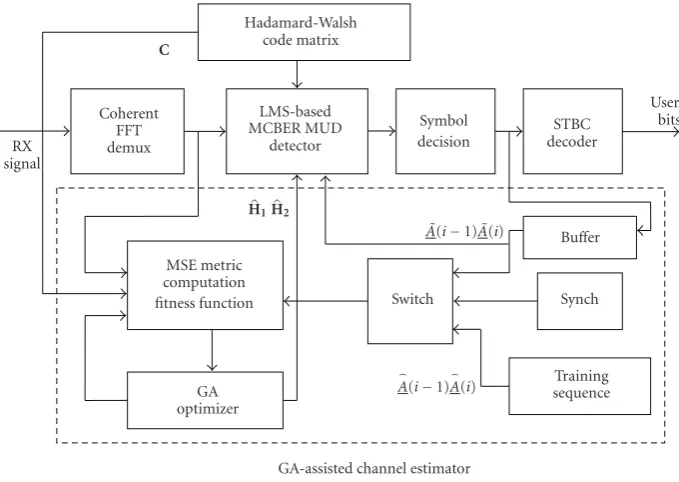
The block diagram of the complete MCBER MUD receiver with GA-assisted channel estimation is shown in
Figure 3. In order to make channel estimation robust and adaptive with respect to channel variations, we adopted a GA-assisted MMSE strategy articulated into two steps.
(1)Training-Aided Step. during this step, an L
bit-length binary training sequenceak = [ak1,. . .,aLk] is transmitted in the form of header for each userk. The bits of the training sequence are organized inL/2 consecutive pairs, each one corresponding to a pair of symbols transmitted in two consecutive signaling periods. In such a way, the vectors of known bits
A(i−1)= {ak(2i−1)k =1,. . .,K, i= 1,. . . L/2}
employed to compute the MSE metric. The training step is repeated with a period approximately equal to the coherence time of the channel. The GA optimizer computes at each signaling period the estimated channel matrices using a selected parameterization in terms of generation numberGTr, population size
PTr, crossover, and mutation probabilities αTr and
γTr, respectively. The footer Tr means that the GA parameterization is related to the training step.
(2)Decision-Directed Adaptive Step: the output of the
training step is the channel matrices (H1) Tr
and (H2)
Tr
obtained by the GA-based optimizer parame-terized in such a way to “learn” the channel in reliable way. During a coherence time period, the stochastic values of the channel coefficients acting over each subcarrier are strongly correlated. By this, a decision-directed adaptive updating step should be reasonably forecast. In the present dealing, the decision-directed updating step is performed by the GA, working with a different parameterization. The GA-based updating procedure is initialized by the solution computed during the training-aided step. During a symbol period, a single iteration is performed by the GA, and a single generation of individuals is produced. The symbols employed in this step to fill the data vectorsA(i−1) andA(i) are the estimated symbols decided at the previous signaling period, that is,
A(i − 1) and A(i). In such a step, crossover and mutation operators do not work, because only a GA generation runs. This updating procedure is “light,” but this is reasonable because only small variations of the channel amplitude and phase are to be tracked during the coherence period. Moreover, in such a way, the effects of possible symbol errors on channel estimation are conveniently reduced.
In order to make our approach clearer to the reader, we can summarize the whole GA-assisted channel estimation procedure as follows (the flowchart of the procedure has been shown inFigure 4).
(i) At timet = 0 the GA-based procedure is initialized by a constant-value population. In particular, the identity matrices have been chosen for initialization.
(ii) The training-aided step begins. The L-bit known training sequence is transmitted, and the estimated channel matrices are computed by minimizing the cost function of (13). The GA parameteri-zation is chosen as generation number = GTr, population size = PTr, crossover probability = αTr, and mutation probability=γTr.
(iii) The training-aided step ends with the computation of the channel matrices at the timet = LT+εT (ε
is the execution time of the GA-based optimization procedure expressed in number of bit periods). Now, the GA switches to the decision-directed adaptive modality.
(iv) At the beginning of the adaptive step, the GA is initialized with the channel matrices computed at the end of (ii), and the GA parameters are reassigned as follows: generation numberGD = 1, population sizePD, crossover probabilityαD =0, and mutation probability γD = 0. The footerD means that the GA parameterization is related now to the decision-directed adaptive step. The GA procedure produces a single population of individuals that are quite close to the one chosen during the previous signaling interval. Such kind of population is stochastically generated in Gaussian way, imposing to the Gaussian generator an updating standard deviation σup that actually is a system parameter. Such a parameter is linked to the Doppler spread and to the signal-to-noise ratio. An explicit mathematical link is very difficult to be obtained, but, as thumb rule, we can say that it needs to be increased asSNRand Doppler spread in-crease.
(v) The decision-directed updating step ends at the time
t =LT+εT+WcohT, whereWcohis the coherence time-window of the channel (expressed in number of bits). The GA is reinitialized with the channel matrices computed at the end of the coherence time-window and reparameterized in order to start again with the training-aided step (ii).
4. Experimental Results
4.1. Simulation Results. The performances of the proposed
STBC MC-CDMA receiver are evaluated by means of inten-sive simulation trials (performed in MATLAB-SIMULINK 7.5 environment) in a Rayleigh fading channel fixing the following parameters: number of subcarriers N = 8, transmission data raterb=1024 Kb/s, coherence bandwidth of the channel 2.1 MHz, and Doppler spread of the channel 100 Hz. We considered two test cases: the most theoretical case related to the MCBER detector exploiting the ideal CSI knowledge and the more realistic case related to the MCBER detector supported by the GA-assisted channel estimation. In such a way, we shall be able to test the effectiveness of the channel estimation strategy adopted together with the impact of nonideal channel estimation on MCBER performances.
In order to verify the effectiveness of the proposed approach, we considered other state-of-the-art receivers for comparison, namely,
(i) the ideal MMSE MUD receiver exploiting ideal CSI knowledge [7];
(ii) the LMS adaptive implementation of MMSE receiver [7];
(iii) the single-user Equal-Gain Combining (EGC) receiver [7];
GA initialization
Fitness computation Training
sequences
Genetic algorithm-based
optimization
End of iterations?
No
Fed STBC MCBER combined with estimated channel
matrices
Symbol decision
Parameterization of the GA optimizer
(training step)
Parameterization of the GA optimizer
(decision-directed
Training /decision-directed enabler
(controller)
Switch
Switch Switch
Temporization EN
Yes
step)
Figure4: Flowchart of the GA-assisted channel estimation algorithm for STBC MC-CDMA.
As lower bound, we considered the BER curve obtained by Maximal Ratio Combining (MRC) detection in the single-user case (i.e., the optimal single-single-user detection, supposing the absence of multiuser interference). In our simulations, we considered three different scenarios including K = 2,
K = 4, and K = 6 users. The GA optimizer has been parameterized as follows: (i) training-aided stepGTr = 30,
PTr = 30, αTr = 0.9, γTr = 0.01,L = 32, (ii) decision-directed adaptive stepPD =10. As the Jakes channel model has been adopted for simulation, the channel coherence time window approximately equals about 1800 bits. Therefore, the overhead due to the insertion of the training sequence equals to less than 1.8%.
The corresponding BER curves versusEb/N0are shown for all the tested receivers in Figures5,6, and7, respectively. It can be seen that in all scenarios the proposed LMS-based MCBER detector with and without ideal CSI knowledge
10−7
10−6
10−5
10−4
10−3
10−2
10−1
100
B
it
er
ror
ra
te
(BER)
0 2 4 6 8 10 12 14 16 18 20
Eb/N0(dB)
MMSE with ideal CSI knowledge LMS-based adaptive MMSE receiver
LMS-based MC-BER receiver with ideal CSI knowledge Single-user bound
EGC receiver with ideal CSI knowledge MMSE with GA-assisted channel estimation LMS-based MC-BER receiver with
GA-assisted channel estimation N=8,k=2, Mtx=2, Mrx=1
Figure 5: BER versusEb/N0 yielded by the LMS-based MCBER (with ideal CSI knowledge and GA-assisted channel estimation), EGC (with ideal CSI knowledge), LMS-based MMSE and ideal MMSE (with ideal CSI knowledge and GA-assisted channel estima-tion) multiuser detectors forN=8 subcarriers andK=2 users.
optimum ML detection as it does not take into account the presence of the multiuser interference. In case of increasing number of users, it is getting more and more difficult for a linear receiver to approach the single-user bound.
Focusing our attention on the effectiveness of the GA-assisted channel estimation applied in such an MCBER-MUD framework, we can see from Figures 5–7 that the MCBER detector supported by nonideal channel estimation performs very close to MCBER detector exploiting the ideal channel knowledge for K = 2 and K = 4 users. The effects of nonideal channel estimation are more evident for higher number of users (K = 6) and therefore in the presence of higher level of multiuser interference. In this last case, the MCBER receiver with GA-assisted channel estimation performs a bit less than MMSE receiver with ideal CSI knowledge but better than the MMSE using the same algorithm for channel estimation. In our opinion, the most relevant fact able to confirm the correctness of our analysis is that the proposed MCBER detector always outperforms MMSE MUD when working together in the same conditions of “channel knowledge.”
In Figure 8, some results have been shown about the variance of the channel estimation error (EEV). One can note that such a variance, computed on the overall channel coefficients, is decreasing withEb/N0and exhibits satisfactory values (i.e., lower than 10−2 for E
b/N0 > 10 dB for K = 2, K = 4, and K = 6 users). As expected (and already evidenced by BER curves of Figures5–7), EEV increases with the number of users, because MUI increases.
10−7
10−6
10−5
10−4
10−3
10−2
10−1
100
B
it
er
ror
ra
te
(BER)
0 2 4 6 8 10 12 14 16 18 20
Eb/N0(dB)
MMSE with ideal CSI knowledge LMS-based adaptive MMSE receiver
LMS-based MC-BER receiver with ideal CSI knowledge Single-user bound
EGC receiver with ideal CSI knowledge MMSE with GA-assisted channel estimation LMS-based MC-BER receiver with
GA-assisted channel estimation N=8,k=4, Mtx=2, Mrx=1
Figure 6: BER versus Eb/N0 yielded by the LMS-based MCBER (with ideal CSI knowledge and GA-assisted channel estimation), EGC (with ideal CSI knowledge), LMS-based MMSE and ideal MMSE (with ideal CSI knowledge and GA-assisted channel estima-tion) multiuser detectors forN=8 subcarriers andK=4 users.
10−7
10−6
10−5
10−4
10−3
10−2
10−1
100
B
it
er
ror
ra
te
(BER)
0 2 4 6 8 10 12 14 16 18 20
Eb/N0(dB)
MMSE with ideal CSI knowledge LMS-based adaptive MMSE receiver
LMS-based MC-BER receiver with ideal CSI knowledge Single-user bound
EGC receiver with ideal CSI knowledge LMS-based MC-BER receiver with GA-assisted channel estimation
MMSE with GA-assisted channel estimation N=8,k=6, Mtx=2, Mrx=1
4.2. Computational Complexity Considerations and
Algo-rithmic Parameterization. As far as computational issues
are concerned, the current literature claims that MCBER criterion has a computational order which is linear with the number of users [14]. In such a case, the computational effort would be reduced with respect to the ideal MMSE detector (which isO(K3) [7]), and it would be comparable with the LMS-based adaptive implementation of MMSE (which is linear again). In our opinion, the reduction of the computational complexity is one of the main advantages yielded by the proposed approach. In fact, the MCBER criterion is theoretically closer to optimality than MMSE, and simulation results shown in Figures 5–7 confirm this claim. But the developed adaptive MCBER-MUD algorithm is also less demanding from a computational viewpoint than ideal MMSE, despite requiring the same knowledge of the channel state information.
About computational complexity of the GA-assisted channel estimator we can say that GA requires a number of elementary operations to derive a solution that is equal toυop = (α+γ)GP[19]. Thus, the computational burden required during the training-aided step is of the order of
L·K ·N·GTr·PTr elementary operations to be executed during an execution time windowεT, whereε >1. The value assigned toεmainly depends on the computational power of the signal-processing device employed. During the decision-directed adaptive step, the computational requirement of the GA is reduced to K ·M·PD elementary operations to be executed during an STBC modulation period. Such a com-putational requirement is comparable with that one involved in state-of-the-art STBC channel estimation algorithms (see [18] for the comparison).
In order to conclude this section, we provide now some notes about algorithmic parameterization. The step-size parameterλof both LMS-based algorithms (MMSE and MCBER) has been chosen empirically for each scenario in order to minimize the overall BER over the various Eb/N0 values. From the parameters selection phase, we noted that LMS-based MCBER detector is characterized by a reduced sensitivity to parameterization with respect to state-of-the-art LMS-based MMSE MUD. Indeed, fixing the number of users K, the step-size λ is substantially invariant with respect to Eb/N0 values. On the other hand, LMS-based MMSE multiuser detector would require a different value of λ for each Eb/N0 in order to provide satisfactory BER performances. As far as the parameterization of the GA-based optimizer is concerned, we must say that formal methodologies targeted to find an optimal parameterization of genetic procedures are not available. In the literature, there are only some interesting heuristic analyses like the one proposed by Tsoy in [21] . So GA parameters have been selected by means of explicitly devoted simulation trials, performed by keeping into account the major guidelines pointed out in [21] that basically are the following two: (a) the population size should be sufficiently large in order to have a conveniently dimensioned space search, and (b) the number of generations should be appropriately assigned in dependence of the population size. In fact, in case of large population, too strict limit for the search time can force
10−3
10−2
10−1
100
Estimatio
n
er
ro
r
var
ianc
e
0 2 4 6 8 10 12 14 16 18 20
Eb/N0(dB) K=2
K=4 K=6
N=8, Mtx=2, Mrx=1
Figure8: Variance of the channel estimation error (EEV) versus Eb/N0measured forN =8 subcarriers,K=2,K=4, andK =6 users.
algorithm to stop without having enough time to realize its search possibility. At the end of the simulation trials devoted to parameterization, we found numerical values for generation number, population size, crossover, and mutation probabilities (shown in Section 4.1) that have assured the best tradeoff between achieved results and computational load. In particular, we assumed an intermediateEb/N0equal to 15 dB as reference value, and we derived by simulations the best parameterization for this value. Then, we observed by other simulations that the GA parameterization chosen for the reference Eb/N0 is “very close to the best” also for higher and lower Eb/N0. The reduced sensitivity to parameterization of GA procedures, already observed in [18], is again confirmed.
5. Conclusions
as the number of users approaches the maximum allowable value. This behaviour is intrinsic to the linear multiuser detection and fully motivated by the nature of the MCBER criterion adopted.
Future research activities might concern the utilization of evolutionary optimization algorithms (e.g., GA, Particle Swarm Optimization (PSO), etc.) to provide a numerical solution to the MCBER problem instead of the proposed LMS-based solution. Also the adoption of PSO-assisted channel estimation, instead of GA-assisted one, may repre-sent an interesting topic for future research.
References
[1] L. Hanzo, L. L. Yan, E. L. Kuan, and K. Yen,Single and Multi-Carrier DS-CDMA, Wiley, Chichester, UK, 2003.
[2] D. Tse and P. Visvanath,Fundamentals of Wireless Communi-cations, Cambridge University Press, Cambridge, Mass, USA, 2005.
[3] S. Ahmadi, “An overview of next-generation mobile WiMAX technology,”IEEE Communications Magazine, vol. 47, no. 6, pp. 84–98, 2009.
[4] K. Johansson, J. Bergman, D. Gerstenberger, M. Blomgren, and A. Wall´en, “Multi-carrier HSPA evolution,” inProceedings of the 69th IEEE Vehicular Technology Conference (VTC ’09), pp. 1–5, Barcelona, Spain, April 2009.
[5] R. W. Aldhaheri and A. H. Al-Qahtani, “Performance analysis of fixed and mobile WiMAX MC-CDMA-based system,” in
Proceedings of the 7th International Symposium on Wireless Communications Systems (ISWCS ’10), pp. 436–440, York, UK, September 2010.
[6] M. Juntti, M. Vehkapera, J. Leinonen et al., “MIMO MC-CDMA communications for future cellular systems,” IEEE Communications Magazine, vol. 43, no. 2, pp. 118–124, 2005. [7] J. M. Auffray and J. F. Helard, “Performance of multicarrier
CDMA technique combined with space-time block coding over Rayleigh channel,” in Proceedings of the 7th IEEE International Symposium on Spread Spectrum Techniques and Applications, vol. 2, pp. 348–352, Prague, Czech Republic, September 2002.
[8] S. Chen, A. K. Samingan, B. Mulgrew, and L. Hanzo, “Adaptive minimum-BER linear multiuser detection for DS-CDMA signals in multipath channels,”IEEE Transactions on Signal Processing, vol. 49, no. 6, pp. 1240–1247, 2001.
[9] S. J. Yi, C. C. Tsimenidis, O. R. Hinton, and B. S. Sharif, “Adaptive minimum bit-error-rate multi-user detection for asynchronous MC-CDMA systems in frequency selective Rayleigh fading channels,” in Proceedings of the 14th IEEE Personal, Indoor and Mobile Radio Communications Conference (PIMRC ’03), vol. 2, pp. 1269–1273, Beijing, China, September 2003.
[10] S. Chen, A. Livingstone, and L. Hanzo, “Minimum bit-error rate design for space—time equalization-based multiuser detection,”IEEE Transactions on Communications, vol. 54, no. 5, pp. 824–832, 2006.
[11] A. Conti, B. Masini, F. Zabini, and O. Andrisano, “On the down-link performance of multi-carrier CDMA systems with partial equalization,”IEEE Transactions on Wireless Communi-cations, vol. 6, no. 1, pp. 230–239, 2007.
[12] B. M. Masini and A. Conti, “Adaptive TORC detection for MC-CDMA wireless systems,”IEEE Transactions on Communica-tions, vol. 57, no. 11, pp. 3460–3471, 2009.
[13] L. D’Orazio, C. Sacchi, R. Fedrizzi, and F. G. B. De Natale, “An adaptive minimum-BER approach for multi-user detection in STBC-MIMO MC-CDMA systems,” in Proceedings of the 50th IEEE Annual Global Telecommunications Conference (GLOBECOM ’07), pp. 3427–3431, Washington, DC, USA, November 2007.
[14] A. Dua, U. B. Desai, and R. K. Mallik, “Minimum probability of error-based methods for adaptive multiuser detection in multipath DS-CDMA channels,”IEEE Transactions on Wireless Communications, vol. 3, no. 3, pp. 939–948, 2004.
[15] P. M. Dayal, U. B. Desai, and A. Mahanta, “Minimum conditional probability of error detection for MC-CDMA,” inProceedings of the IEEE International Symposium on Spread Spectrum Techniques and Applications (ISSSTA ’04), pp. 51–55, Sydney, Australia, September 2004.
[16] S. M. Alamouti, “A simple transmit diversity technique for wireless communications,”IEEE Journal on Selected Areas in Communications, vol. 16, no. 8, pp. 1451–1458, 1998. [17] B. Seo, W.-G. Ahn, C. Jeong, and H.-M. Kim, “Fast
conver-gence LMS adaptive receiver for MC-CDMA systems with space-time block coding,”IEEE Communications Letters, vol. 14, no. 8, pp. 737–739, 2010.
[18] L. D’Orazio, C. Sacchi, M. Donelli, and F. G. B. De Natale, “MMSE multi-user detection with GA-assisted channel esti-mation for STBC MC-CDMA mobile communication sys-tems,” inProceedings of the 10th IEEE International Symposium on Spread Spectrum Techniques and Applications (ISSSTA ’08), pp. 182–187, Bologna, Italy, August 2008.
[19] D. E. Goldberg, Genetic Algorithms in Search, Optimization and Machine Learning, Addison-Wesley, Reading, Mass, USA, 1999.
[20] P. Rocca and A. Massa, “Evolutionary-based optimization techniques for inverse scattering—a review,” in Proceedings of the 28th Progress in Electromagnetics Research Symposium (PIERS ’10), Cambridge, Mass, USA, July 2010.