R E V I E W
Open Access
Similarity reduction and closed form
solutions for a model derived from two-layer
fluids
Marianna Ruggieri
1*and Maria Paola Speciale
2*Correspondence:
[email protected] 1Faculty of Engineering and
Architecture, Kore University of Enna, Enna, Italy
Full list of author information is available at the end of the article
Abstract
In this paper, we study an integrable system of coupled KdV equations, derived by Gear and Grimshaw (Stud. Appl. Math. 70(3):235-258, 1984), modeling the strong interaction of two-dimensional, long, internal gravity waves propagating on neighboring pycnoclines in a stratified fluid. In particular, we present the complete group classification of the model and find conditions on arbitrary parameters for which the system admits symmetries. Some exact solutions of physical relevance are derived.
1 Introduction
In the last years, some types of coupled Korteweg-de Vries (KdV) equations have been encountered in various natural science fields and they are relevant in physical systems such as plasmas, fluids and for describing the lattice vibrations of a crystal at low temperatures. In the literature, some kinds of coupled KdV equations have been introduced to describe two resonantly interacting normal modes of internal-gravity waves in a shallow stratified liquid [].
Having in mind the rich treasure of nonlinear coupled KdV equations, in this paper we turn our attention to a system introduced by Gear and Grimshaw in [] to model in-teractions of solitary waves in a stratified fluid. The model under consideration has the structure of a pair of Korteweg-de Vries equations coupled through both dispersive and nonlinear terms:
ut+uxxx+ uux+ evvx+e(uxv+uvx) +evxxx= ,
cvt+vxxx+ vvx+cvx+c
e(uxv+uvx) + euux+euxxx
= ,
()
whereu(t,x) andv(t,x) are the dependent variables and subscripts denote partial deriva-tive with respect to the independent variables tand x; moreover, ei (i= , , ) and cj
(j= , , ) represent arbitrary constants.
Some mathematical questions related to the Cauchy problem (CP) of () were studied by Bonaet al.[] who showed that the (CP) is globally well posed in suitably strong function spaces. Moreover, Bona and Saut also stated that system () is susceptible of experienc-ing the dispersive blow-up phenomenon. Followexperienc-ing the guide of the approximate method
proposed in [] (see references therein for a review), an approximate analysis of model () is performed in [].
Motivated by a great number of physical applications, we focus our attention on Lie symmetries admitted by system () in order to find conditions on real parameters for which the system does admit symmetries. This is done because the group classification problem is interesting not only from a purely mathematical point of view, but is also important in the applications [–]. Originally developed by Lie at the beginning of the nineteenth century, the symmetry analysis plays a key role in almost all scientific fields.
This paper is arranged as follows. In Section , we briefly explain the basic definitions and notations required to perform the Lie group analysis, and we provide the vector fields of the symmetries admitted by coupled KdV equations (). In Section , we use some sym-metries to reduce () and find some exact solutions, whose snapshots are provided in order to show their properties.
2 Symmetry group of coupled KdV equations
In order to discuss the group classification of system (), we apply the classical Lie theory. Symmetry analysis is very successfully used in several branches of sciences and plays an important role in the theory of differential equations since it allows for the development of systematic procedures to integrate by quadrature - or at least lower the order - of ODEs; in the case of PDEs, Lie symmetries may lead to the determination of invariant solutions of a variety of initial and boundary value problems in different fields such as transport, reaction and diffusion, dissipative phenomena [–], of unsteady solutions starting from known steady solutions when the equations are invariant with respect to the so-called pro-jective group (for instance, two-dimensional Euler equations) [], or to the construction of relations between different differential equations that turn out to be equivalent [–]; moreover, by using symmetries of classes of differential equations (equivalence transfor-mations [, ]) it is possible to map a system of balance laws to an equivalent system of conservation laws [, ].
Then, we look for the one-parameter Lie group of infinitesimal transformations in (t,x,u,v)-space given by
ˆ
t=t+εξ(t,x,u,v) +Oε,
ˆ
x=x+εξ(t,x,u,v) +Oε,
ˆ
u=u+εη(t,x,u,v) +Oε,
ˆ
v=v+εη(t,x,u,v) +Oε,
()
whereεis the group parameter and the associated Lie algebraLis the set of vector fields of the form
X=ξ ∂ ∂t+ξ
∂ ∂x+η
∂ ∂u+η
∂
∂v. ()
andcj(j= , , ), we have that the principal Lie algebraLPof system () is two-dimensional
and is spanned by the operators
X= ∂
∂t, X=
∂
∂x. ()
On the contrary, the complete symmetry classification of model () gives the following extensions of the principal Lie algebra.
Case .
A special case arises when bothkandcare equal to zero; in such a situation, we have operators
We get the operator
where= ; on the contrary, if= , we fall in other cases of the classification (ife=e, we fall in Case , ife= ore–e– e– = , we recover Case ).
Case .
A singularity arises whene= –e, that leads us to considering the special valuese= ,
e= –,c= (±
√
); then the related operator reads
¯
X= kt¯ ∂ ∂t+
¯
kx– c(c+ )t
∂
∂x
– c( + c) + ¯
k– c(c– )
u– cv
∂
∂u
+ –c( + c) + (c+ )cu– ¯
kv– c(c– )
v∂
∂v, ()
wherek¯= –c
– c– . Case .
Finally, another singularity arises ife= ande= , whereupon we obtain
ˆ
X= t ∂ ∂t+x
∂ ∂x– u
∂
∂u– (c+ v)
∂
∂v, ()
and
ˆ
X= t ∂ ∂x+
∂ ∂u+c
∂
∂v. ()
3 Exact solutions
In this section, we construct some exact solutions which are invariant with respect to some of the symmetries determined above. The main advantage of the procedure is that it allows us to find solutions of the original system of partial differential equations (PDEs) by solving a system ofreduced equationswhich are ordinary differential equations.
Starting from the operatorX+aX+aXˆ, we obtain the following similarity variable and similarity solution:
z=x–at–at,
u(x,t) =at+U(z), v(x,t) =cat+V(z).
()
The reduced functionsU(z) andV(z) must satisfy the ODEs
eV+U+U(U–a) –a= ,
V+ceU+V(V+c–ac) +ac= .
()
A particular solution of () is
U(z) =
a±
a
– az– α
,
V(z) = – e
a±
a– az– α
.
Then the corresponding solution of () reads as
A second solution can be obtained on the basis of the infinitesimal operatorX˜coupled along with the conditionc= ; without loss of generality and in order to simplify the calculations, we neglect space and time translations.
Then the similarity variable and similarity solution read as
z= x
The reduced system of () assumes the form
eV+
An exact solution of () is given by
U(z) = e(e+e)
(e–e)(e– )(e+e+ee)
z, V(z) = , ()
wheree+e+ee= for compatibility with constraint ().
Then, in terms of the original variables, a closed form solution of () is
u(x,t) = e(e+e)
Of course, we may include time and space translations directly in the solution simply by means of the replacementst→t–t andx→x–x, wheretandxare arbitrary constants.
Two more similarity solutions for generalized coupled KdV equations () can be ob-tained from operator (). Neglecting once again space and time translations, we obtain
Then the reduced system assumes the following form:
An exact solution of () is
U(z) = α
z, V(z) = α
z, ()
α,αbeing constants of integration that have to satisfy the following constraints:
α( +α) +cα(e+eα+eα) = , α(e+eα) +α( +eα) +α= .
()
Then the corresponding solution of () is
u(x,t) =ce
In particular, whenc= , excluding the trivial solutions for (), we are able to write the solution () forα= (– +e+ exactly (), () and () respectively, wherekandcare considered as coefficients of the linear combination of two operators (k=aandc=a).
Considering once again the infinitesimal operator (), we have a second type of solutions that can be expressed in terms of remarkable functions. Skipping the details of calcula-tions, in terms of the original variables, the corresponding solution of () reads as
u(x,t) =ce
pergeometric function, while(·) represents an Euler gamma function, andKi(i= , , )
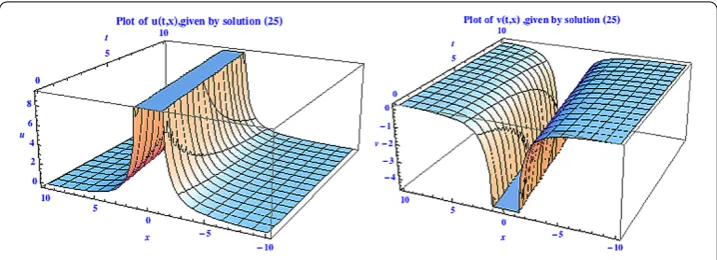
Figure 1 The figures represent the bright and the dark solitary wave solutions (25), wherebrightis used to describe solitary waves whose peak intensity is larger than background (reflecting
applications in optics) and the descriptordarkis used to describe solitary waves with lower intensity than the background, withc1= –2,c2= –1,e1= 3,e2= 4 ande3= 1.
Figure 2 2D and 3D view of solution (26) withe1= 0,e3= –2,c2= 1,λ= 2,K1= 3,K2=K3= 1.
Moreover,c,e,λare arbitrary constants,c=+eλ
+eλ,c=λ ,e
ande are linked by the relationλe+λe+ = (for instance, ife= , thene= –λ; on the contrary,e= impliese= –λ).
Finally, another solution of () can be obtained by using a linear combination of the operatorsX,X andX,i.e., considering the operatorX+aX+aX along with the conditionk= .
Then the similarity variable and similarity solution are
z=x–at–a
e–e
t,
u(x,t) = eat+U(z), v(x,t) = –eat+V(z),
()
respectively.
The reduced system of () assumes the form
U+ V+U(eV+ U–a) +V(eV+eU) + ae= ,
ceU+V+cU(eU+eV) +V(ceU+ V–ac+c) –ace= .
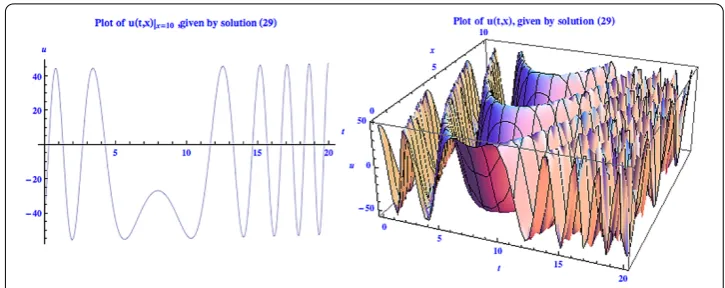
Figure 3 2D and 3D view of solution (29) withe2= 0,λ= 4,a2= –2,a3= –1,α6= 10 andK1=K2= 25.
Then, in terms of the original variables, a closed form solution of () reads as
u(x,t) = eat+
–az+αλ λa
+Ke
a(λ–)
λ z+Ke–
a(λ–)
λ z,
v(x,t) = –eat+λ
–az+αλ λa
+Ke
a(λ–)
λ z+Ke–
a(λ–)
λ z,
()
withz=x–at–a(e–e)t, whileλ,eandeare linked by the relationλe+λe+ = , αbeing an arbitrary constant of integration.
In this case, space and time translation must be included to obtain a relevant new simi-larity variable.
3.1 Analysis of solutions
The solutions we have found, apart from their own theoretical value, can be used as a benchmark test for numerical schemes and codes.
In particular, by the analysis of the solutions obtained which are invariant with respect to the symmetries of Case , we can observe that, as shown in Figure , the behavior of solu-tion () is governed by the Bessel funcsolu-tion which is decreasing with increasing argument. Taking into consideration solution (), we can observe, from Figure , an oscillatory pro-file of the obtained solution. Finally, for what concerns solution (), we can observe that it can be counted among the rational type solutions as in [].
In order to show the trend of some of the obtained solutions, just as an example, snap-shots of solutions (), () and () are shown in Figures -.
Competing interests
The authors declare that they have no competing interests.
Authors’ contributions
The authors wrote this paper in collaboration and with the same responsibility. All authors read and approved the final version of the manuscript.
Author details
1Faculty of Engineering and Architecture, Kore University of Enna, Enna, Italy.2Department of Mathematics and Computer Science, University of Messina, Messina, Italy.
Acknowledgements
The authors acknowledge the financial support by G.N.F.M. of INdAM through the projectMetodologie di tipo analitico e numerico per lo studio di problemi iperbolici ed iperbolico-parabolici di natura ondosa.
References
1. Gear, JA, Grimshaw, R: Weak and strong interactions between internal solitary waves. Stud. Appl. Math.70(3), 235-258 (1984)
2. Bona, JL, Ponce, G, Saut, J-C, Tom, M: A model system for strong interaction between internal solitary waves. Commun. Math. Phys.143, 287-313 (1992)
3. Ruggieri, M, Valenti, A: Approximate symmetries in nonlinear viscoelastic media. Bound. Value Probl.2013, Article ID 143 (2013). doi:10.1186/1687-2770-2013-143
4. Ruggieri, M, Speciale, MP: Approximate analysis of a generalized KdV-like equations (2013, to appear) 5. Olver, PJ: Applications of Lie Groups to Differential Equations. Springer, New York (1986)
6. Ibragimov, NH: Lie Group Analysis of Differential Equations. CRC Handbook. CRC Press, Boca Raton (1994)
7. Fushchych, WI, Shtelen, WM: Symmetry Analysis and Exact Solutions of Nonlinear Equations of Mathematical Physics. Kluwer Academic, Dordrecht (1993)
8. Ruggieri, M, Valenti, A: Symmetries and reduction techniques for dissipative models. J. Math. Phys.50, 063506 (2009) 9. Ruggieri, M, Valenti, A: Exact solutions for a nonlinear model of dissipative media. J. Math. Phys.52, 043520 (2011) 10. Ruggieri, M: Kink solutions for class of generalized dissipative equations. Abstr. Appl. Anal.,2012, Article ID 237135
(2012). doi:10.1155/2012/237135
11. Oliveri, F, Speciale, MP: Exact solutions to the equations of ideal gas-dynamics by means of the substitution principle. Int. J. Non-Linear Mech.33, 585-592 (1998)
12. Oliveri, F, Speciale, MP: Exact solutions to the equations of perfect gases through Lie group analysis and substitution principles. Int. J. Non-Linear Mech.34, 1077-1087 (1999)
13. Oliveri, F, Speciale, MP: Exact solutions to the unsteady equations of perfect gases through Lie group analysis and substitution principles. Int. J. Non-Linear Mech.37, 257-274 (2002)
14. Oliveri, F, Speciale, MP: Exact solutions to the ideal magneto-gas-dynamics equations through Lie group analysis and substitution principles. J. Phys. A, Math. Gen.38, 8803-8820 (2005)
15. Margheriti, L, Speciale, MP: Unsteady solutions of Euler equations generated by steady solutions. Acta Appl. Math.
113, 289-303 (2011). doi:10.1007/s10440-010-9600-8
16. Donato, A, Oliveri, F: Reduction to autonomous form by group analysis and exact solutions of axi-symmetric MHD equations. Math. Comput. Model.18, 83-90 (1993)
17. Donato, A, Oliveri, F: Linearization procedure of nonlinear first order systems of PDE’s by means of canonical variables related to Lie groups of point transformations. J. Math. Anal. Appl.188, 552-568 (1994)
18. Currò, C, Oliveri, F: Reduction of nonhomogeneous quasilinear 2×2 systems to homogeneous and autonomous form. J. Math. Phys.49, 103504 (2008)
19. Oliveri, F: Lie symmetries of differential equations: classical results and recent contributions. Symmetry2, 658-706 (2010)
20. Oliveri, F: General dynamical systems described by first order quasilinear PDEs reducible to homogeneous and autonomous form. Int. J. Non-Linear Mech.47, 53-60 (2012)
21. Ovsiannikov, LV: Group Analysis of Differential Equations. Academic Press, New York (1982)
22. Lisle, IG: Equivalence transformations for classes of differential equations. PhD dissertation, University of British Columbia, Vancouver B.C., Canada (1992)
23. Oliveri, F, Speciale, MP: Equivalence transformations of quasilinear first order systems and reduction to autonomous and homogeneous form. Acta Appl. Math.122, 447-460 (2012)
24. Oliveri, F, Speciale, MP: Reduction of balance laws to conservation laws by means of equivalence transformations. J. Math. Phys.54, 041506 (2013)
25. Darwish, A, Fan, EG: A series of new explicit exact solutions for the coupled Klein-Gordon-Schrodinger equations. Chaos Solitons Fractals20, 609-617 (2004)
10.1186/1687-1847-2013-355