R E S E A R C H
Open Access
Lucas polynomials semi-analytic solution for
fractional multi-term initial value problems
Mahmoud M. Mokhtar
1*and Amany S. Mohamed
2*Correspondence:
[email protected] 1Department of Basic Science,
Faculty of Engineering, Modern University for Technology and Information (MTI), El-Mokattam, Egypt
Full list of author information is available at the end of the article
Abstract
Herein, we use the generalized Lucas polynomials to find an approximate numerical solution for fractional initial value problems (FIVPs). The method depends on the operational matrices for fractional differentiation and integration of generalized Lucas polynomials in the Caputo sense. We obtain these solutions using tau and collocation methods. We apply these methods by transforming the FIVP into systems of algebraic equations. The convergence and error analyses are discussed in detail. The
applicability and efficiency of the method are tested and verified through numerical examples.
MSC: 65M70; 11B39; 34A08; 41A25
Keywords: Caputo derivative; Fractional differential equations; Spectral methods; Generalized Lucas polynomials
1 Introduction
Ordinary and partial derivatives are special cases of fractional order derivatives. Many scientists are interested in linear and nonlinear fractional differential equations (FDEs). Many phenomena are described using fractional-order differentiation and integration. Their applications appeared in fluid, engineering, mechanics, physics, mathematics, op-tics, and other fields of science. So the fractional calculus investigates the rules, properties of derivatives, and integrals of noninteger orders. For handling these equations, the re-searchers apply many numerical methods such as finite difference method [1–3], finite element method [4–6], homotopy analysis method [7,8], variational iteration method [9– 11], a domain decomposition method [12–15], and Haar wavelet method [16,17].
Recently, the approximate solutions of the fractional differential equations have been evaluated by the spectral methods. These methods help to solve different kinds of dif-ferential equations with small error and a small number of unknowns; [18] solutions of fractional differential equations by using Jacobi operational matrix, [19] solutions of third and fifth-order differential equations by using Petrov–Galerkin methods, [20] solutions of fractional differential equations by using shifted Jacobi spectral approximations. The most used spectral methods are the Galerkin, collocation, and tau methods; [21] solutions of time-fractional telegraph equation by using Legendre–Galerkin algorithm, [22] solution for telegraph equation of space fractional order by using Legendre wavelets spectral tau algorithm, [23] solutions of differential problems by using tau method, [24] solutions for
the parabolic and elliptic partial equations by the ultra-spherical tau method, [25] solu-tions for a class of variable-order fractional differential equasolu-tions by using Jacobi wavelets method. The choice of this method depends on the type of the investigated problem and its initial and boundary conditions. For more applications about numerical and exact so-lutions of fractional differential models, please see [26–37].
Multi-term fractional IVPs appear in many applications in various disciplines, most of numerical studies use the orthogonal polynomials, only rare studies use nonorthogonal polynomials, this motivates us to use these polynomials as a new basis functions, to test their ability to handle these problems.
In this paper, we solve the fractional ordinary differential equations with initial and boundary conditions applying generalized Lucas polynomials. We obtain the integrated equations and solve them. We use tau and collocation methods to evaluate numerical so-lutions. We have a system of nonlinear algebraic equations with initial and boundary con-ditions. Then we solve them by using Mathematica. We compare our numerical results with the Haar wavelet method [38].
There are many techniques in literature to handle multi-term fractional IVPs using or-thogonal polynomials, i.e., Legendre, Chebyshev, Jacobi, and others, and there are very few studies on nonorthogonal linearly independent set of polynomials, i.e., Lucas and Fi-bonacci polynomials. The main advantages of the present technique is that new polyno-mials can be used as a basis for spectral methods, the generation of these polynopolyno-mials is easy, and the exponential rate of convergence.
The results in this paper are more efficient and of higher accuracy than the other meth-ods. The sections are organized as follows. In section 2 definitions, properties of fractional calculus, and generalized Lucas polynomials, which are used in the following sections, are introduced. In section 3 derivatives for generalized Lucas polynomials of integer and frac-tional orders are stated. In section 4 the algorithm of this method is explained. In section 5 we investigate the convergence and error analysis. In section 6 we give some examples and their numerical solutions. In the last section we introduce some conclusions.
2 Preliminaries
In this section, some definitions, properties for fractional calculus [39–41], and the gen-eralized Lucas polynomials [42,43] are stated. We introduce the important relations for the generalized Lucas polynomials which will be used in the following sections.
2.1 Properties and definitions of fractional calculus
Definition 1 The fractional integral of orderβ(β≥0) according to Riemann–Liouville is
⎧ ⎨ ⎩
Iβg(z) = 1
Γ(β) z
0(z–t)
β–1g(t)dt, β> 0,z> 0,
I0g(z) =g(z).
AndIβsatisfies the following properties:
⎧ ⎪ ⎪ ⎨ ⎪ ⎪ ⎩
IβIγ=Iβ+γ,
IβIγ=IγIβ,
Iβzυ= Γ(υ+1)
Γ(υ+β+1)z
Definition 2 The fractional derivative of orderβaccording to Caputo
Dβg(z) =Im–βDmg(z) = 1 Γ(m–β)
z
0
(z–t)m–β–1g(m)(t)dt, (1)
wherem– 1 <β≤m, andDβsatisfies the following properties:
⎧ ⎨ ⎩
(DβIβg)(z) =g(z),
Dβzυ= Γ(υ+1)
Γ(υ–β+1)z
υ–β. (2)
For more details about the properties of fractional derivatives, please see [43].
2.2 An overview and relations of generalized Lucas polynomials
Lucas polynomialsLj(z) [43] have the following recurrence relation:
Lj+2(z) =zLj+1(z) +Lj(z), (3)
with the initial values
L0(z) = 2, L1(z) =z. (4)
Lucas polynomials have Binet’s form
Lj(z) =
(z+√z2+ 4)j+ (z–√z2+ 4)j
2j , j≥0, (5)
and also have the power form
Lj(z) =j
j
2
i=0
1
j–i j–i
i
zj–2i, j≥1, (6)
where jrepresents the largest integer less than or equal toj. Ifaandb are nonzero real numbers, the sequence of Lucas polynomials{Lj(z)}j≥0is generalized by the sequence
{ϕja,b(z)}j≥0generated by the recurrence relation
ϕja,b(z) =azϕja–1,b(z) +bϕja–2,b(z), j≥2, (7)
with the initial values
ϕ0a,b(z) = 2, ϕ1a,b(z) =az, (8)
so Lucas polynomialsLj(z) are derived fromϕja,b(z) ifa=b= 1. We have the following:
ϕ2a,b(z) =az2+ 2b, ϕ3a,b(z) =a3z3+ 3abz, (9)
whereϕja,b(z) have the power form
ϕja,b(z) =j j
2
n=0
aj–2nbnj–n n
j–n z
j–2n, j≥1, (11)
and
ϕja,b(z) = 2j
j
m=0
ambj–2mζj+kj–n
n
j+m z
m, j≥1, (12)
where
ζ=
⎧ ⎨ ⎩
1, even,
0, odd. (13)
ϕaj,b(z) have Binet’s form
ϕja,b(z) =(az+ √
a2z2+ 4b)j+ (az–√a2z2+ 4b)j
2j , j≥0. (14)
The following relations, used for solving the problems, are very important.
3 Integer and fractional derivatives of generalized Lucas vector
In this section, we state the integer and fractional derivatives of generalized Lucas poly-nomials in a matrix form.
3.1 Integer derivatives for generalized Lucas matrix
Suppose that the functionW(z) can be expanded in terms of generalized Lucas polyno-mials
W(z) =
∞
i=0
eiϕia,b(z). (15)
If we approximate this function as
W(z)≈WN(z) = N
i=0
eiϕia,b(z) =ETΦ(z), (16)
where
ET= [e0,e1, . . . ,eN], (17)
Φ(z) =ϕ0a,b(z),ϕ1a,b(z), . . . ,ϕaN,b(z)T. (18)
If the first derivative of dΦdz(z)is written as
dΦ(z)
dz =H
whereH(1)= (H(1)
3.2 Fractional derivatives for generalized Lucas matrix
We state in this section the fractional derivative of generalized Lucas matrix, which is the general case for integer derivative.
Theorem 1 The fractional derivatives of generalized Lucas vector,which is defined in(14),
have the form[42]
have the elements in the form
Hnmβ =
4 The algorithm of the method
In this section, we explain the method for solving the boundary FDE with constant coef-ficients by using generalized Lucas polynomials
with the boundary conditions
W(i)(0) =ai, i= 0, 1, 2, . . . , (28)
where 0 <α≤1, 1 <β≤2. Suppose that equation (27) has the approximating solution
W(z)≈WN(z) =ETΦ(z). (29)
By using Theorem1, we have
DβW(z)≈z–βETH(β)Φ(z), (30)
and now the residual of equation (27) has the form
R(z) =z–βETH(β)Φ(z) +z–αETH(α)Φ(z) +ETH(2)Φ(z) +ETΦ(z) –g(z). (31)
Then we have
zβR(z) =ETH(β)Φ(z) +zβ–αETH(β)Φ(z) +zβETH(2)Φ(z) +zβETΦ(z) –zβg(z). (32)
By using the tau method, we obtain the system of equations
1
0
zβR(z)ϕia,b(z)dz= 0, i= 0, 1, . . . . (33)
With the boundary conditions (28), we have
ETH(i)Φ(0) =ai, i= 0, 1, 2, . . . . (34)
Equations (33)–(34) give a linear system of equations in coefficients ei,i= 0, 1, . . . ,N.
These coefficients can be efficiently solved by Gaussian elimination.
5 Investigation of convergence and error analysis
In this section, we explain the convergence and error analysis of generalized Lucas expan-sion. The following lemmas are satisfied.
Lemma 1 For all t∈[0, 1],the following inequality holds for generalized Lucas polynomi-als:
ϕia,b≤2a+√a2+bi. (35)
Proof See Abd-Elhameed and Youssri (2017) [43].
Lemma 2
ϕia,b= 2i
i
k=0
where
λi,k=
akbi–2kζ i+k
i+k
2
i–k
2
i+k . (37)
Proof See Abd-Elhameed and Youssri (2017) [43].
Theorem 2 If W(z)is defined on[0, 1]and|W(i)(0)| ≤Li,i≥0,where L is a positive
con-stant and if W(z)has the expansion
W(z) =
∞
i=0
eiϕia,b(z). (38)
Then one has
|ei| ≤
|a|–iLicosh(2|a|–1b12L)
i! . (39)
Proof See Abd-Elhameed and Youssri (2017) [43].
IfεN=max|W(z) –WN(z)|, then we have the following truncation error.
Theorem 3 We have the following truncation error estimate:
εN<
2eL(1+√1+a–2b)cosh(2L(1+√1+a–2b))(1+√1+a–2b)N+1
(N+ 1)! (40)
or
εN<
2eLρcosh(2Lρ)ρN+1
(N+ 1)! , (41)
whereρ= 1 +√1 +a–2b.
Proof See Abd-Elhameed and Youssri (2017) [43].
Lemma 3 The derivatives ofϕi(α),ϕi(β),andϕiare denoted by the following estimates:
(i) ϕi(α)≤2i3,
(ii) ϕi(β)≤2i3,
(iii) ϕi≤2i3.
Proof By applying the differential operators to the right-hand side of equation (29) and noting thatt< 1, and finally by induction oni, we get the desired results.
Theorem 4 If W(z) =∞i=0eiϕai,b(z)is the exact solution of equation(21)satisfies the
hy-potheses of Eq. (6)and W(z)is approximated by WN(z) =
N
i=0eiϕia,b(z),then we have the
following global error estimate:
N=WN+W
(α)
N +W
(β)
N +WN–g<
ΩNξ
whereΩis a generic constant and
ξ= 3A+ 1, A= L
|a|. (43)
Proof Now the global error estimate
N=WN+W
From equation (21) we have
N=WN–W+W
series comparison test, we have
∞
In this section, we solve some examples on equations (21), (22) using the generalized Lucas polynomials.
Example1 Consider the following fractional-order initial value problem [38]:
DβW(z) + 3
57W(z) =z+
3zβ+1
with the boundary conditions
We apply the generalized Lucas tau method and obtain the following equations:
2
We solve these equations by Mathematica, we obtain
Table 1 Maximum absolute errorsEof Example1
z m= 32
β= 1.4
N= 16
β= 1.4
m= 32
β= 1.6
N= 16
β= 1.6
m= 32
β= 1.8
N= 16
β= 1.8
m= 32
β= 2
N= 16
β= 2
0.1 1.4·10–6 1.9·10–7 1.5·10–7 6.9·10–8 1.4·10–7 1.6·10–8 3.5·10–8 5.5·10–18 0.2 6.9·10–9 7.2.0·10–7 3.8·10–8 7.3·10–8 8.9·10–7 1.7·10–8 6.5·10–8 2.6·10–19 0.3 3.3·10–8 6.02·10–7 5.7·10–7 6.0·10–8 1.1·10–7 1.3·10–8 8.7·10–8 6.0·10–18 0.4 3.1·10–7 9.6·10–8 3.8·10–7 3.4·10–8 1.8·10–7 7.7·10–9 9.7·10–8 2.0·10–18 0.5 7.8·10–7 8.1·10–10 3.6·10–7 2.8·10–10 2.6·10–7 6.6·10–11 8.9·10–8 1.1·10–17 0.6 1.5·10–6 9.6·10–8 2.3·10–7 2.8·10–8 6.0·10–7 5.6·10–9 5.9·10–8 4.1·10–18 0.7 4.8·10–7 1.1·10–7 3.6·10–8 3.3·10–8 1.0·10–6 6.7·10–9 4.8·10–9 5.5·10–18 0.8 7.9·10–7 1.1·10–7 2.2·10–7 2.9·10–8 1.8·10–7 5.3·10–9 8.0·10–8 6.1·10–17 0.9 1.1·10–6 6.5·10–8 5.5·10–7 1.5·10–8 3.5·10–7 2.6·10–9 1.9·10–7 2.2·10–17
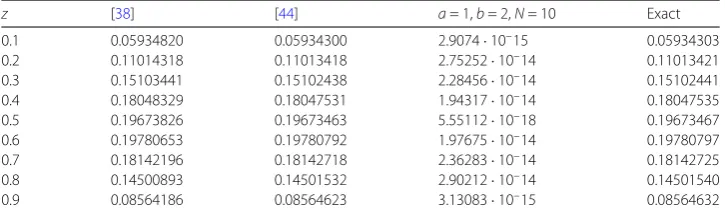
Table 2 Comparison between different errorsEof Example2
z [38] [44] a= 1,b= 2,N= 10 Exact
0.1 0.05934820 0.05934300 2.9074·10–15 0.05934303
0.2 0.11014318 0.11013418 2.75252·10–14 0.11013421
0.3 0.15103441 0.15102438 2.28456·10–14 0.15102441
0.4 0.18048329 0.18047531 1.94317·10–14 0.18047535
0.5 0.19673826 0.19673463 5.55112·10–18 0.19673467
0.6 0.19780653 0.19780792 1.97675·10–14 0.19780797
0.7 0.18142196 0.18142718 2.36283·10–14 0.18142725
0.8 0.14500893 0.14501532 2.90212·10–14 0.14501540
0.9 0.08564186 0.08564623 3.13083·10–15 0.08564632
e2=
33(–222,794 + 3,871,765√π+ 57,000π) 5a2(107,324,217 – 341,088√π+ 320π),
e3= –
143(–27,588 – 393,483√π+ 11,400π) 6a3(107,324,217 – 341,088√π+ 320π).
(57)
In Table1, we compare our results for the casea=b= 1 andN= 16 with the results of [38] form= 32 for different values ofβ. In Table2, we compare between different solutions of Example2.
Example2 Consider the following fractional-order initial value problem [38]:
DβW(z) –DαW(z) =ez–1+ 1, 0 <β≤1, 1 <α≤2, (58)
with the boundary conditions
W(0) = 0, W(1) = 0. (59)
The exact solution of equation (38) isW(z) =z(1 –ez–1). The residual of this equation is
zβR(z) =ETH(β)Φ(z) –zβ–αETH(α)Φ(z) –zβez–1–zβ. (60)
Example3 Consider the following fractional-order initial value problem [38]:
DβW(z) +e
–3π √
πW(z)
= e
–3π
40√π
with the boundary conditions
W(0) = 0, W(1) = –1
40. (62)
The exact solution of equation (41) isW(z) =z2(z3–3720z+3340). The residual of this equa-tion is
zβR(z) =ETH(β)Φ(z) +e
–3π √
πz
β
ETΦ(z)
– e
–3π
40√π
z240z2– 74z+ 33+ 4e3π√z128z2– 148z+ 33zβ.
We apply our algorithm for the casea= 1,b= 2,N= 5,β=3
2, which yields
e1= 511/10, e3= –237/20, e5= 1,
e0= –33/2, e2= 233/4, e4= 0,
and consequently,
W(z) = –(33/2)2 + (511/10)z+ (233/4)4 +z2– (237/20)6z+z3+ 20z+ 10z3+z5,
which is the exact solution.
Example4 Consider the following fractional-order initial value problem [38]:
W(z) + 8 17D
β
W(z) +13 51W(z) =
z–12 89,250√π
48p(z) + 7√zq(z), 1≤β< 2, (63)
where
p(z) = 16,000z4– 32,480z3+ 21,280z2– 4746z+ 189, (64)
q(z) = 3250z5– 9425z4+ 264,880z3– 44 (65)
with the boundary conditions
W(0) = 0, W(1) = 0. (66)
The exact solution of equation (45) isW(z) =z5–29z4
10 + 76z3
25 – 339z2
250 + 27z
125. The residual
of this equation is
zβR(z) =zβETH(2)Φ(z) + 8 17E
TH(β)Φ(z) +13
51z β
ETΦ(z)
– z –1
2+β 89,250√π
We apply our algorithm for the casea= 2,b= 1,N= 5,β=32, which yields
e1= –1439/2000, e3= 179/800, e5= 1/32,
e0= –819/4000, e2= 193/500, e4= –29/160,
and consequently,
W(z) = –(819/4000)2 – (1439/2000)2z+ (193/500)2 + 4z2+ (179/800)6z+ 8z3
– (29/160)2 + 16z2+ 16z4+ (1/32)10z+ 40z3+ 32z5,
which is the exact solution.
7 Conclusion
Herein, a generalized Lucas polynomial sequence approach based on the operational ma-trix of fractional derivatives Lucas polynomials to spectrally solve fractional multi-term initial value problem was successfully applied to handle these equations. Four examples to a system of linear algebraic equations were solved by Mathematica software showing the exponential rate of convergence of the method. This method can be modified in the future work to solve different types of ordinary and partial FDEs with nonhomogeneous conditions and with variable coefficients.
Acknowledgements
The authors are very grateful to the anonymous referees for careful reviewing and crucial comments, which enabled us to improve the manuscript.
Funding
This research received no specific grant from any funding agency in the public, commercial, or not-for-profit sectors.
Competing interests
The authors declare that they have no competing interests.
Authors’ contributions
All authors contributed equally to this work. All authors read and approved the final manuscript.
Author details
1Department of Basic Science, Faculty of Engineering, Modern University for Technology and Information (MTI),
El-Mokattam, Egypt. 2Department of Mathematics, Faculty of Science, Helwan University, Helwan, Egypt.
Publisher’s Note
Springer Nature remains neutral with regard to jurisdictional claims in published maps and institutional affiliations.
Received: 20 July 2019 Accepted: 1 November 2019 References
1. Li, C., Zeng, F.: Finite difference methods for fractional differential equations. Int. J. Bifurc. Chaos22, 1230014 (2012) 2. Sweilama, N.H., Khader, M.M., Nagy, A.M.: Numerical solution of two-sided space-fractional wave equation using
finite difference method. J. Comput. Appl. Math.235, 2832–2841 (2011)
3. Mustapha, K., Furati, K., Knio, O.M., Le Maitre, O.P.: A finite difference method for space fractional differential equations with variable diffusivity coefficient. Mathematics, Numerical Analysis (2018)
4. Badr, A.A.: Finite element method for linear multiterm fractional differential equations. J. Appl. Math.2012, Article ID 482890 (2012)
5. Jiang, Y., Ma, J.: High-order finite element methods for time-fractional partial differential equations. J. Comput. Appl. Math.235, 3285–3290 (2011)
6. Zhu, X., Yuan, Z., Wang, J., Nie, Y., Yang, Z.: Finite element method for time–space-fractional Schrodinger equation. Electron. J. Differ. Equ.2017, 166 (2017)
8. Jafari, H., Seifi, S.: Solving a system of nonlinear fractional partial differential equations using homotopy analysis method. Commun. Nonlinear Sci. Numer. Simul.14, 1962–1969 (2009)
9. Sakar, M.G., Erdogan, E., Yildirim, A.: Variational iteration method for the time fractional Fornberg–Whitham equation. Comput. Math. Appl.63, 1382–1388 (2012)
10. Khan, Y., Faraz, N., Yildirim, A., Wu, Q.: Fractional variational iteration method for fractional initial-boundary value problems arising in the application of nonlinear science. Comput. Math. Appl.62, 2273–2278 (2011)
11. Singh, B.K., Kumar, P.: Fractional variational iteration method for solving fractional partial differential equations with proportional delay. Int. J. Differ. Equ.2017, Article ID 5206380 (2017)
12. Hu, Y., Luo, Y., Lu, Z.: Analytical solution of linear fractional differential equation by a domain decomposition method. J. Comput. Appl. Math.215, 220–229 (2008)
13. Ray, S.S., Bera, R.K.: Solution of an extraordinary differential equation by a domain decomposition method. J. Appl. Math.4, 331–338 (2004)
14. Shawagfeh, N.T.: Analytical approximate solutions for nonlinear fractional differential equations. Appl. Math. Comput.
131, 517–529 (2002)
15. Daftardar-Gejji, V., Jafari, H.: Adomian decomposition: a tool for solving a system of fractional differential equations. J. Math. Anal. Appl.301, 508–518 (2005)
16. Sweilam, N.H., Nagy, A.M., Mokhtar, M.M.: On the numerical treatment of a coupled nonlinear system of fractional differential equations. J. Comput. Theor. Nanosci.14, 1184–1189 (2017)
17. Sweilam, N.H., Nagy, A.M., Mokhtar, M.M.: New spectral second kind Chebyshev wavelets scheme for solving systems of integro-differential equations. Int. J. Appl. Comput. Math.3(2), 333–345 (2017)
18. Doha, E.H., Bhrawy, A.H., Ezz-Eldien, S.S.: A new Jacobi operational matrix: an application for solving fractional differential equations. Appl. Math. Model.36, 4931–4943 (2012)
19. Abd-Elhameed, W.M., Doha, E.H. Youssri, Y.H.: Efficient spectral Petro–Galerkin methods for third and fifth-order differential equations using general parameters generalized Jacobi polynomials. Quaest. Math.36, 15–38 (2013) 20. Doha, E.H., Bhrawy, A.H., Baleanu, D., Ezz-Eldien, S.S.: On shifted Jacobi spectral approximations for solving fractional
differential equations. Appl. Math. Comput.219, 8042–8056 (2013)
21. Youssri, Y.H., Abd-Elhameed, W.M.: Numerical spectral Legendre–Galerkin algorithm for solving time fractional telegraph equation. Rom. J. Phys.63, 107 (2018)
22. Mohammed, G.S.: Numerical solution for telegraph equation of space fractional order by using Legendre wavelets spectral tau algorithm. Aust. J. Basic Appl. Sci.10, 381–391 (2016)
23. OrtizE, L., Samara, H.: Numerical solutions of differential eigen values problems with an operational approach to the tau method. Computing31, 95–103 (1983)
24. Doha, E.H., Abd-Elhameed, W.M.: Accurate spectral solutions for the parabolic and elliptic partial equations by the ultra-spherical tau method. J. Comput. Appl. Math.181, 24–45 (2005)
25. Zaky, M.A., Ameen, I.G., Abdelkawy, M.A.: A new operational matrix based on Jacobi wavelets for a class of variable-order fractional differential equations. Proc. Rom. Acad., Ser. A: Math. Phys. Tech. Sci. Inf. Sci.18, 315–322 (2017)
26. Baleanu, D., Asad, J.H., Jajarmi, A.: New aspects of the motion of a particle in a circular cavity. Proc. Rom. Acad., Ser. A: Math. Phys. Tech. Sci. Inf. Sci.19(2), 361–367 (2018)
27. Hajipour, M., Jajarmi, A., Baleanu, D., Sun, H.G.: On an accurate discretization of a variable-order fractional reaction–diffusion equation. Commun. Nonlinear Sci. Numer. Simul.69, 119–133 (2019)
28. Mohammadi, F., Moradi, L., Baleanu, D., Jajarmi, A.: A hybrid functions numerical scheme for fractional optimal control problems: application to non-analytic dynamical systems. J. Vib. Control24(21), 5030–5043 (2018)
29. Baleanu, D., Jajarmi, A., Asad, J.H.: The fractional model of spring pendulum: new features within different kernels. Proc. Rom. Acad., Ser. A: Math. Phys. Tech. Sci. Inf. Sci.19(3), 447–454 (2018)
30. Hajipour, M., Jajarmi, A., Baleanu, D.: On the accurate discretization of a highly nonlinear boundary value problem. Numer. Algorithms79(3), 679–695 (2018)
31. Hajipour, M., Jajarmi, A., Malek, A., Baleanu, D.: Positivity-preserving sixth-order implicit finite difference weighted essentially non-oscillatory scheme for the nonlinear heat equation. Appl. Math. Comput.325, 146–158 (2018) 32. Alsuyuti, M.M., Doha, E.H., Ezz-Eldien, S.S., Bayoumi, B.I., Baleanu, D.: Modified Galerkin algorithm for solving multitype
fractional differential equations. Math. Methods Appl. Sci.42(5), 1389–1412 (2019)
33. Firoozjaee, M.A., Yousefi, S.A., Jafari, H., Baleanu, D.: On a numerical approach to solve multi-order fractional differential equations with initial/boundary conditions. J. Comput. Nonlinear Dyn.10(6), 061025 (2015) 34. Bhrawy, A.H., Baleanu, D., Assas, L.M.: Efficient generalized Laguerre-spectral methods for solving multi-term
fractional differential equations on the half line. J. Vib. Control20(7), 973–985 (2014)
35. Rostamy, D., Alipour, M., Jafari, H., Baleanu, D.: Solving multi-term orders fractional differential equations by operational matrices of BPs with convergence analysis. Rom. Rep. Phys.65(2), 334–349 (2013)
36. Baleanu, D., Shiri, B., Srivastava, H.M., Al Qurashi, M.: A Chebyshev spectral method based on operational matrix for fractional differential equations involving non-singular Mittag-Leffler kernel. Adv. Differ. Equ.2018, 353 (2018) 37. Baleanu, D., Shiri, B.: Collocation methods for fractional differential equations involving non-singular kernel. Chaos
Solitons Fractals116, 136–145 (2018)
38. ur Reham, M., Ali Khan, R.: A numerical method for solving boundary value problems for fractional differential equations. Appl. Math. Model.36, 894–907 (2012)
39. Miller, K.S., Ross, B.: An Introduction to the Fractional Calculus and Fractional Differential Equations. Wiley, New York (1993)
40. Podlubny, I.: Fractional Differential Equations (1999) 41. Rainville, E.D.: Special Functions. Chelsea, New York (1960)
42. Abd-Elhameed, W.M., Youssri, Y.H.: Spectral solutions for fractional differential equations via a novel Lucas operational matrix of fractional derivatives. Rom. J. Phys.61, 795–813 (2016)
43. Abd-Elhameed, W.M., Youssri, Y.H.: Generalized Lucas polynomials sequence approach for fractional differential equations. Nonlinear Dyn.89, 1341–1355 (2017)