R E S E A R C H
Open Access
Simultaneous identification of initial field
and spatial heat source for heat conduction
process by optimizations
Bingxian Wang
1*, Bin Yang
1and Mei Xu
1*Correspondence:
[email protected] 1School of Mathematics Science,
Huaiyin Normal University, Huaian, P.R. China
Abstract
Consider the simultaneous identification of the initial field and spatial heat source for heat conduction process from extra measurements with the two additional
measurement data at different times. The uniqueness and conditional stability for this inverse problem are established by using the properties of a parabolic equation and the representation of solution after reforming the equation. By combining the least squares method with the regularization technique, the inverse problem is
transformed into an optimal control problem. Based on the existence and uniqueness of the minimizer of the cost functional, an alternative iteration process is built to solve this optimizing problem by the variational adjoint method. The negative gradient direction is selected as the first search direction. For further iterations, the alternative iteration algorithm is used for the initial field and heat source identification. The efficiency of the proposed scheme is tested by the numerical simulation experiments.
MSC: 35R30; 35J05; 76Q05
Keywords: Inverse problem; Parabolic equation; Initial field; Heat source; Adjoint variational method; Numerics
1 Introduction
Consider the following heat conduction problem:
ut–u=f(x) inΩ×(0,T), (1)
with initial condition
u(x, 0) =φ(x) inΩ, (2)
and boundary condition
u(x,t) = 0 on∂Ω, (3)
whereΩ⊂Rd(d= 1, 2) is bounded,f(x) is the space-dependent heat source andφ(x) is the initial temperature withφ|∂Ω= 0. Iff,φ∈L2(Ω), then the solution of (1) is unique and
u∈L2(0,T;H1
0(Ω)) in the distributional sense which satisfies (2) (see [1]), and
uL2(0,T;H1 0(Ω))≤C
fL2(Ω)+φL2(Ω)
,
whereCis independent off andφ.
The problem considered in this paper is to determine the initial temperatureφ(x) and the space-dependent sourcef(x) simultaneously from two additional measurement data at timesT1,T2for 0 <T1<T2≤T:
u(x,T1) =ψ1(x), x∈Ω, (4)
u(x,T2) =ψ2(x), x∈Ω. (5)
It is well known that if the source termf(x) in (1) is given, the recovery of the initial valueφ(x) fromu(x,T) is severely ill-posed. For the classical heat conduction equation, it is called a backward heat conduction problem. Many authors have studied this kind of inverse problem; see [2–7]. On the other hand, when the initial valueφ(x) is known, estimating the sourcef(x) from the final observation is also an ill-posed problem [8,9]. The degree of ill-posedness is equivalent to that of second-order numerical differentiation [10,11]. The problem in this paper was firstly investigated by Johansson and Lesnic in [12] where the uniqueness was presented and an iterative regularization algorithm was used to solve it.
This article is organized as follows. In Sect.2, we give uniqueness analysis and a con-ditional stability result for the inverse problem (1)–(5). An optimization problem is pre-sented and an alternative iteration scheme is constructed by means of the variational ad-joint method in Sect.3. Numerical examples are given in Sect.4.
2 Uniqueness and conditional stability
Supposef(x),φ(x)∈L2(Ω) and setw(x,t) =u(x,t) –φ(x), then (1)–(3) will change into
⎧ ⎪ ⎪ ⎨ ⎪ ⎪ ⎩
wt–w=f(x) –φ(x) inΩ×(0,T),
w(x,t) = 0 on∂Ω,
w(x, 0) = 0 inΩ,
(6)
withw(x,T1) =ψ1(x) –φ(x) andw(x,T2) =ψ2(x) –φ(x). Applying separation of variables, we can obtain the solution to (6) as
w(x,t) =
Ω
t
0
K(t–τ,x,y)f(y) –φ(y)dτdy, (7)
where
K(t–τ,x,y) = ∞
n=1
e–λn(t–τ)X
n(x)Xn(y).
Thus, fori= 1, 2, we can obtain
Ω
f(y) –φ(y) Ti
0
Setφ˜(x) =φ(x) withφ(x) = 0 (x∈∂Ω) andψ˜i(x) =ψi(x) (i= 1, 2) withψi(x) = 0 (x∈ mined by means of the measurements at different timesT1andT2. So combining with the properties of the problem (1)–(3), we have the following result:
Lemma 2.1 Supposeφ,f ∈L2(Ω),andψ1,ψ2∈H01(Ω),then the solution to the inverse problem(1)–(5)is unique in L2(Ω)×L2(Ω).
Now, we give a conditional stability analysis for the inverse problem. Suppose∂Ω∈C2+α
andφ,f ∈C2+α(Ω¯), then
ψ1,ψ2∈C2+α(Ω¯)⊂C2(Ω¯)⊂L2(Ω) (13)
by Theorem 2.2.5 in [13].
We divide the time interval [0,T2] into [0,T1] and [T1,T2]. In [T1,T2], for the source f(x), we have the following stability result in the framework of Hölder spaces [14]:
Now we consider the conditional stability with respect toφin [0,T1] with the aid of the stability result (14). By separation of variables we can obtain the solution to (1)–(4) as follows:
Similarly, from (17), we have
On the other hand, (18) yields
Now we introduce the following norms ofφandf:
φ2F1:=
and define the following admissible set ofφandf:
P1=
From the above analysis, by the linearity of the inverse problem and (14),(24), we have
Theorem 2.2 Suppose∂Ω∈C2+α.Forφi∈P to the inverse problem has the following stability estimate:
φ1–φ22
3 Iteration scheme for solving the optimization problem
We reformulate the inverse problem (1)–(5) as the following optimization problem: Find (φ∗,f∗) such that
Jφ∗,f∗= min
φ∈L2(Ω),f∈L2(Ω)J(φ,f), (27) where the cost functional is
J(φ,f) :=J1(φ,f) +J2(φ) +J3(f), (28) ization parameter;φη andfηare some prior information ofφandf, respectively. Similar
to a discussion in [15], we have the following result for the optimization problem:
Lemma 3.1 For anyγ > 0,J(φ,f)has a unique pair of minimizers(φ∗,f∗)in L2(Ω)× L2(Ω).
SettingΩ⊂R2, we will propose an alternative iteration scheme for minimizingJ(φ,f) based on the variational adjoint method to generate the approximate solution to our in-verse problem. The crucial steps are the derivation of the gradient of the cost functional and an efficient iteration scheme based on the gradient.
3.1 Derivation of the gradient of functional
We first derive the tangent linear model. Denote byu(x,t),u˜(x,t), andu˘(x,t) the solutions
then by direct calculation foruˆwe have
Now we calculate the Gatéaux derivative of the cost functionalJ(·,·). Generally, Gatéaux derivative is defined as
(∇fJ,fˆ) + (∇φJ,φˆ) :=lim
So we calculate directly the two limits on the right-hand side of (32), and by means of the conditions of the problem (1)–(3), we have Secondly, define the adjoint systems:
Adding (38) to (39), (33) can be changed into
(∇φJ,φˆ) + (∇fJ,fˆ) =
Ω
p1(x, 0)φˆ(x)dx+
T1
0
Ω
p1ˆf dx dt
+
Ω
p2(x, 0)φˆ(x)dx+
T2
0
Ω
p2f dx dtˆ
+γ2
Ω
ˆ
φφ–φηdx+γ2
Ω
ˆ
ff –fηdx.
Due to the irrelevance ofφˆandfˆ, the gradient ofJ(φ,f) at (φ,f) alongφˆ,fˆcan be ob-tained as follows:
∇φJ=p1(x, 0) +p2(x, 0) +γ2
φ–φη, (40)
∇fJ=
T1
0
p1(x,t)dt+
T2
0
p2(x,t)dt+γ2
f –fη. (41)
3.2 Iteration algorithm
Starting from the initial guessφ0(x) andf0(x), we construct the following iteration scheme:
φn+1(x) =φn(x) +r1nD1n, n= 0, 1, 2, . . . , (42)
fn+1(x) =fn(x) +r2nD2n, n= 0, 1, 2, . . . , (43)
whereri
n> 0 (i= 1, 2) is the step size selected by the Wolfe line search [16], andD1n,D2n are the searching directions. The negative gradient direction is selected as the first search direction forD1n,D2n. For the succeeding iterations, two kinds of optimization method are used for the initial temperature inversion and the heat source identification, respectively. An alternative iteration scheme is constructed to improve the computation efficiency.
According to the construction of the iterative scheme (42)–(43), we design the following alternate iteration algorithm for solving (φn,fn):
Fix the maximum iterative stepNmax, the error level, and the maximum length of
cor-rection steprmax> 0.
Step 1: Given the initial guessφ0,f0and initial search stepr01,r20∈(0,rmax), calculate
D10= –g0:= –∇φJ|(φ0,f0), φ1(x) =φ0(x) +r 1 0D10(x), D20= –s0:= –∇fJ|(φ1,f0), f1(x) =f0(x) +r02D20(x).
Repeat forn= 2, 3, 4, . . ..
Step 2: Calculate the two tangent directions ofJwith respect toφ,f:
gn–2=∇φJ|(φn–2,fn–2), gn–1=∇φJ|(φn–1,fn–2), sn–2=∇fJ|(φn–1,fn–2), sn–1=∇fJ|(φn–1,fn–1).
Here, for given(φi,fj), we first need to solve the direct problem (1)–(3) and
get the solutionu[φi,fj], and the adjoint problem (34)–(35) is then also solved to
obtainp1[φi,fj],p2[φi,fj], where
Step 3: Calculate the correction stepξn–1,ζn–1in thenth iteration direction as
ξn–1= gn–1
gn–2, ζn–1=
sTn–1(sn–1–sn–2) sT
n–2(sn–1–sn–2) .
Step 4: Modify the negative gradient direction and get the new iteration direction ofφn, fn:
D1n–1= –gn–1+ξn–1D1n–2, D2n–1= –sn–1+ζn–1D2n–2.
Step 5: Calculate the step size(r1n–1,rn–12 )for update(φn–1,fn–1)by Wolfe line search. Step 6: Calculate
φn(x) =φn–1(x) +r1n–1D1n–1(x), fn(x) =fn–1(x) +r2n–1D2n–1(x);
Step 7: Check whethermax{gn,sn}<εorn>Nmax? If it is true, stop the iteration
and outputφn,fn. Otherwise, setn+ 1⇒nand return toStep 2.
4 Numerical implementation
In this section, we give two numerical implementations for the iteration algorithm. All the computations were performed using MATLAB 2016a on a personal computer with Intel Core i5 and 8.00 GB memory. Setx= (x1,x2),Ω= [0,π]×[0,π], denote the stepsizes inx1 andx2byh1=π/M1andh2=π/M2, respectively, whereM1,M2∈Nare grid parameters with respect tox1,x2. The stepsize intdenotedτis chosen byT1=N1τ,T2=N2τ. What needs to be explained is that an alternate iterative scheme is proposed. In Example1, we compare the numerical results with the solutions by the primary iteration scheme. The final time giving the inversion input data is taken asT1= 1/2,T2= 1 for the two examples, while the noisy final measurement data are simulated by
uδ(x,Ti) =u(x,Ti) +δ×randn(x), (44) whererandn(x)∈[–1, 1] are from the normal distribution with mean 0 and standard de-viation 1. Here the direct problem (1)–(3) and adjoint system (34) and (35) are solved by D’Yakonov ADI scheme. The error estimates ofφ(x) andf(x) are defined byL2-estimation:
errφnδ,φ∗=φδn–φ∗
L2(Ω), err
fnδ,f∗=fnδ–f∗L2(Ω). (45) Example1 The exact solution of (1)–(3) is
u(x1,x2,t) =
2 –e–2tsinx1sinx2, (46)
and thenφ∗(x1,x2) =sinx1sinx2andf∗(x1,x2) = 4sinx1sinx2. According to (46), the noisy data is simulated by
uδ(x1,x2,Ti) =
2 –e–2Tisinx
1sinx2+δ×rand(x1,x2), i= 1, 2. (47)
In this example, we selectφη=fη= 0 and divide the domainΩas 60×60 pixels and take
the regularizing parametersγ = 10–2. Setφ
in-Figure 1Reconstructions of Example1: (first line) exact and approximate solutionsφ(x1,x2) withδ= 0; (second line) approximate solutions forδ= 0.001, 0.01; (third line) approximate solutions forδ= 0.02, 0.03, respectively
put data (47) withδ= 0, 0.001, 0.01, 0.02, 0.03, respectively. The inverse results ofφ(x1,x2) andf(x1,x2) are shown in Figs.1and2. Here, in order to represent the advantage of an alternate iteration in this paper, we also calculateJ(φδ
n,fnδ),err(φnδ,φ∗), anderr(fnδ,f∗) with
δ= 0 by means of alternate iteration and primary iteration, which are shown in Table1. ForJ(φδ
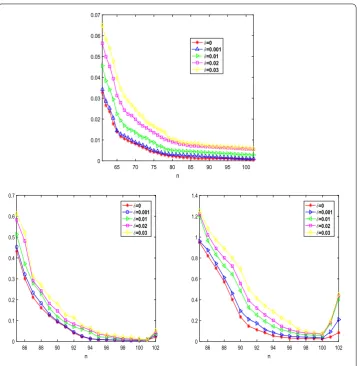
n,fnδ), the functional value is reduced faster than when using alternate iteration af-ter the same number of iaf-terations. Furthermore, the estimated error valueserr(φnδ,φ∗) and err(fδ
n,f∗) are small after 100 iterations by using the alternate iteration scheme, but respec-tive errors when using the primary iteration scheme are reduced slowly. It can be seen that the efficiency of computation is greatly improved by alternate iteration. Figure3(first line) shows the numerical performance for noisy input data by giving the behavior ofJ(φδn,fδ
Figure 2Reconstructions of Example1: (first line) exact and approximate solutions off(x1,x2) withδ= 0; (second line) approximate solutions forδ= 0.001, 0.01; (third line) approximate solutions forδ= 0.02, 0.03, respectively
Table 1 Functional value ofJ(φnδ,fnδ), errors err(φδn,φ∗) and err(fnδ,f∗) by the primary iteration scheme; “J1”, “err1” represent the results of the alternate iteration scheme
n J(φδ
n,fnδ) J1(φnδ,fnδ) err(φδn,φ∗) err1(φδn,φ∗) err(fnδ,f∗) err1(fnδ,f∗)
85 5.3832E–01 1.5323E–02 1.0866 5.3221E–01 1.4455 1.0483
87 5.2923E–01 1.3229E–02 1.0254 3.1208E–01 1.2833 8.0214E–01
89 5.0202E–01 1.2026E–02 1.0086 1.9327E–01 1.2312 5.0118E–01
91 4.8282E–01 1.1224E–02 9.7452E–01 8.0323E–02 1.1955 2.0543E–01
93 4.6211E–01 1.0981E–02 9.4924E–01 3.8345E–02 1.1523 1.0214E–01
95 4.5886E–01 1.0735E–02 9.3229E–01 1.4148E–02 1.1101 5.1183E–02
97 4.4553E–01 1.0498E–02 9.1223E–01 5.8643E–03 1.0775 2.9752E–02
99 4.2814E–01 8.2701E–03 8.8426E–01 4.8327E–03 1.0291 2.7538E–02
100 4.0755E–01 7.5523E–03 8.7208E–01 4.0462E–03 9.8123E–01 2.5147E–02
Figure 3Numerical performance ofJ(φδ
n,fnδ) (first line), err(φδn,φ∗) (second line, (left)), err(fnδ,f∗) (second line,
(right)) with respect to the number of iterations forδ= 0, 0.001, 0.01, 0.02, and 0.03 of Example1
Example2 The exact initial temperature and the source field are
φ(x1,x2) =sin2x1sin2x2, x1,x2∈[0,π],
f(x1,x2) =
⎧ ⎨ ⎩
1, π/4≤x1,x2≤3π/4, 0, else.
Then the exact solution has the same form
u(x1,x2,t) = ∞
n=1 ∞
m=1
Hmn(t)sinmx1sinnx2, 0≤x1,x2≤π, (48)
where
Hmn(t) =
4e–(m2+n2)t
π2
t
0
π
0
π
0
f(x1,x2)sinmx1sinnx2dx2dx1
e(m2+n2)τdτ
+
π
0
π
0
φ(x1,x2)sinmx1sinnx2dx2dx1
Figure 4Reconstructions of Example2: (first line) exact approximate solutions ofφ(x1,x2) withδ= 0; (second line) approximate solutions forδ= 0.001, 0.01; (third line)approximate solutions forδ= 0.02, 0.03, respectively
SetN1=N2= 30, then (48) is computed numerically by itsN1×N2terms, and (44) yields the noisy inversion input data
uδ(x1,x2,Ti) = N1
n=1 N2
m=1
Hmn(t)sinmx1sinnx2+δ×rand(x1,x2), (49)
wherei= 1, 2.
We setfη=φη= 0.01, and consider the input data (49) withδ= 0, 0.001, 0.01, 0.02, and
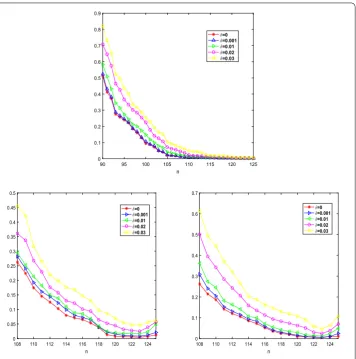
0.03, respectively, in this example. The regularizing parameters are selected asγ = 10–2. The initial guess isφ0(x1,x2) = 0 andf0(x1,x2) = 0. We obtain the inverse results ofφ(x1,x2) andf(x1,x2), which are shown in Figs.4and5. In Fig.6, we give the numerical performance for noisy input data by giving the behavior ofJ(φδ
Figure 5Reconstructions of Example2: (first line) exact and approximate solutions off(x1,x2) withδ= 0; (second line) approximate solutions forδ= 0.001, 0.01; (third line) approximate solutions forδ= 0.02, 0.03, respectively
err(fδ
n,f∗) with respect to the iteration numbernand noise levelδ(second line, (left) and (right)).
Remark4.1 The penalty termJ2can also be replaced byγ 2 2
T1 0
Ω|∇u|
2dx, which means that the heat flux is bounded in physics. In comparison with J2used in this paper, the regularization effect is more obvious for the inversion ofφ, and the number of iteration is decreasing. We have already tested it in 1-dimension.
5 Conclusion
measure-Figure 6Numerical performancesJ(φδ
n,fnδ) (first line), err(φnδ,φ∗) (second line, (left)), err(fnδ,f∗) (second line,
(right)) with respect to the number of iterations forδ= 0, 0.001, 0.01, 0.02, and 0.03 of Example2
ment data at two different times. The uniqueness and conditional stability results have been established. In Example1, we calculatedJ(φδ
n,fnδ),err(φδn,φ∗) anderr(fnδ,f∗) withδ= 0 by means of alternate and primary iteration schemes. In addition, the alternate iteration scheme takes 3 min, while the primary iteration scheme takes 5 min for 100 iterations in Matlab2016a. And as seen from Table1, by using the alternate iteration scheme, the value of functionalJ(φn,fn) is reduced faster than by the primary iteration scheme for the same number of iterations.
Acknowledgements
The authors would like to thank the anonymous referees for very helpful suggestions and comments which led to improvement of our original manuscript.
Funding
This work is supported by the Natural Science Foundation of Jiangsu Province of China (No. BK20181482), the Natural Science Foundation of the Jiangsu Higher Education Institutions of China (No. 18KJD110002) and the Scientific Research Foundation of Huaiyin Normal University (No. 31WBX00).
Competing interests
The authors declare that they have no competing interests.
Authors’ contributions
Publisher’s Note
Springer Nature remains neutral with regard to jurisdictional claims in published maps and institutional affiliations.
Received: 7 March 2019 Accepted: 16 September 2019 References
1. Evans, L.C.: Partial Differential Equations, 2nd edn. Am. Math. Soc., Providence (2010)
2. Colton, D.: The approximation of solutions to the backwards heat equation in a nonhomogeneous medium. J. Math. Anal. Appl.72, 418–429 (1979)
3. Liu, J.J.: Determination of temperature field for backward heat transfer. Bull. Korean Math. Soc.16, 385–397 (2001) 4. Liu, J.J.: Numerical solution of forward and backward problem for 2-D heat conduction problem. J. Comput. Appl.
Math.145, 459–482 (2002)
5. Liu, J.J., Lou, D.J.: On stability and regularization for backward heat equation. Chin. Ann. Math., Ser. B24(1), 35–44 (2003)
6. Cheng, J., Liu, J.J.: A quasi Tikhonov regularization for a two-dimensional backward heat problem by a fundamental solution. Inverse Probl.24, 065012 (2008)
7. Liu, J.J., Wang, B.X.: Solving the backward heat conduction problem by homotopy analysis method. Appl. Numer. Math.128, 84–97 (2018)
8. Yan, L., Yang, F.L., Fu, C.L.: A meshless method for solving an inverse spacewise-dependent heat source problem. J. Comput. Phys.228(1), 123–136 (2009)
9. Johansson, B.T., Lesnic, D.: A variational method for identifying a spacewise-dependent heat source. IMA J. Appl. Math.72, 748–760 (2007)
10. Wang, Z.W., Wang, H.B., Qiu, S.F.: A new method for numerical differentiation based on direct and inverse problems of partial differential equations. Appl. Math. Lett.43, 61–67 (2015)
11. Xiong, X.T., Yan, Y.M.: A direct numerical method for solving inverse heat source problems. J. Phys. Conf. Ser.290, 012017 (2001)
12. Johansson, B.T., Lesnic, D.: A procedure for determining a spacewise dependent heat source and the initial temperature. Appl. Anal.87, 265–276 (2008)
13. Ye, Q.X., Li, Z.Y.: An Introduction to Reaction–Diffusion Equation. Science Press, Beijing (1994)
14. Isakov, V.: Inverse Problems for Partial Differential Equations, 2nd edn. Applied Mathematical Sciences, vol. 127. Springer, New York (2006)
15. Wang, Z.W., Qiu, S.F., Ruan, Z.S., Zhang, W.: A regularized optimization method for identifying the space-dependent source and the initial value simultaneously in a parabolic equation. Comput. Math. Appl.67, 1345–1357 (2014) 16. Shi, Z.: On the convergence of memory gradient method with Wolfe line search. Nonlinear Anal. Hybrid Syst.29, 9–18