R E S E A R C H
Open Access
Efficient trust management with
Bayesian-Evidence theorem to secure public key
infrastructure-based mobile ad hoc
networks
Janani V S
*and Manikandan M S K
Abstract
In mobile ad hoc networks (MANETs), the reliability of nodes, quality of data and access control cannot be achieved successfully for various network functionalities through traditional cryptographic security, which makes MANET vulnerable to illegitimate node behaviour changes. These node misbehaviours, referred as soft security threats, need to be detected and prevented in order to protect against the accumulation of false measurements with selfish and malicious intentions. Trust has been employed as a powerful tool to handle the soft security threats and to provide security among uncertain and dynamic nodes effectively in MANET. Therefore, it is of great importance that efficient trust management mechanisms should be developed in a public key infrastructure (PKI), in order to verify the identities on the ad hoc networks for reliable and secure group communication. However, the independent nature of nodes and the computational complexities make the trust management a challenging one in MANET. In this paper, we present an efficient distributed trust computation and misbehaviour verification method with Bayesian and Evidence theorem, on hexagonally clustered MANET. Besides, a secured PKI system is designed in the paper by applying the proposed trust management scheme in terms of certificate revocation, which is an important functionality of PKI cryptosystem. The uncertainty impacts the node’s anticipation of neighbour’s behaviour and decisions during communication; we include uncertainty in the trust management system. An efficient method to reduce the uncertainty is to exploit the mobility characteristics of MANET that accelerates the trust convergence. The simulation results reveal a better performance against adversaries in creating considerable untrustworthy transactions with a mobility-aware cluster guarantee. Moreover, the proposed trust application shows its betterment in the revocation process in terms of revocation rate and time. Thus, the proposed scheme provides an effective security solution that incorporates the optimistic features of trust mechanisms and hierarchical Voronoi clustering.
Keywords:Bayesian and evidence theorem, Certificate revocation, Clustering, MANET, Public key infrastructure, Trust computations, Verification, Security
1 Introduction
In mobile ad hoc network (MANET), malicious attacks on different layers have been identified and analysed by researchers over several years. Several routing protocols were introduced in order to secure routing and forwarding packets in MANET from malicious attackers. Most of these conventional routing protocols rely on a centralized public key infrastructure (PKI) to detect and secure malicious
misbehaviours using hard security or cryptographic mechanisms. However, these solutions provide only a partial security in the initial stages of managing mobile nodes, where malicious nodes can affect the credibility of the network. In certain cases, nodes may be vulnerable to the behaviour changes with the influence of attacker participants, even if they behave as legitimate nodes initially in a secure group communication and therefore pass the hard security checks. However, these unauthorized nodes may become selfish or malicious nodes and report false information with the intention to damage the reliability
* Correspondence:[email protected] Thiagarajar College of Engineering, Madurai-15, India
of group communication. The traditional cryptographic mechanisms cannot detect and prevent these continual changes in the node behaviour. In other words, the reli-ability of communication, the quality of data and access control cannot be achieved fully with the hard security techniques. Therefore, a security mechanism is required to defend against the node behaviour changes commonly referred as soft security threats and assure integrity, reliability and access control to the group communication in MANET. Consequently, an effective distributed and self-organising mechanism quantified with trust to identify and secure the misbehaviour in ad hoc network should be established.
While considering the PKI security system, the necessity of centralised or distributed certificate authority (CA) is of greater importance. The PKI system manages trust in communication conducted by the nodes, over the network. The vital elements used for trust management are the certificates and security protection in the environments of the different participants involved. The CA controls the entire certificate and public key management in which trust plays a vital role. These elements are derived by a trust management mechanism for the communication purpose of the exchanges, associated with the public-private keys. In the PKI domain, to establish a distributed trust relation-ship, the public key needs to be imported and afeguard its integrity, communication or storage to other entities.
The researches on distributed trust systems in MANET require the nodes to be organized with some hierarchical security methodology to achieve performance guarantee, especially when applied to emergency communication. To manage the uncertain mobile nodes, various clustering tech-niques have been introduced as a hierarchical architecture for scalability issue in wireless networks. A cluster structure manages network functionalities with efficient spatial reuse, in order to deploy the PKI based security in MANET, over a finite network region. The self-organization property should be combined with distributed clustering architecture to coordinate and collaborate the dynamic nodes in MANET. This eliminates the single point of dependency and failure that occur in every traditional centralised methodology and provides a PKI framework with healing, self-configuration and self-management features to adapt the frequently changing network conditions. This can be successful only when the nodes behave in a trust-worthy manner. Trust management encounters these network challenges in order to develop an optimized distributed and self-organized security system. The trust in ad hoc networks is the subjective evaluation on the node behaviour of its neighbouring nodes. It reflects the belief and expectations on the credibility of behaviour and information sends by any node.
In spite of that, there are several pitfalls in establishing a self-organizing and distributed trust-based PKI security
system with partitions in ad hoc networks. Some of them are as follows:
Maintaining trustworthy cluster members and
headers increases computation and communication complexities.
The traditional centralized trust block may depend
on a single point for functionalities and requires more computational and infrastructural cost.
Most of the recommendation-based trust management
works on the assumption that the belief is of equal weight, which is prone to attackers.
Mobility oblivious PKI system in MANET weakens
the trust computation as it is hard to find the behaviour as the nodes moves dynamically.
The trust measurements in the traditional trust
methodologies are instantaneous and not precise.
The data sharing between nodes in a cluster greatly
depend on the location of mobile nodes. Therefore, the distance between the nodes should be computed accurately for any group communication, which is hard to attain with the traditional clustering techniques.
It is difficult to develop a complete security system
with underlying distributed trust-based clustered MANET where link failures occur frequently.
Therefore, it is comprehensible that the drawbacks of the widely known trust management techniques should be minimized to make the PKI-based security flexible for group security communication. In this pursuit, the proposed work focus on developing a distributed and self-organized security solution for PKI framework, which quantifies nodes behaviour in the form of trust.
improved spatial reuse to group the MANET area into adjacent, non-overlapping clusters of nodes. The proposed trust-based clusters guarantees improved performance with dynamic re-configurability, scalability and security.
2 Related works
Over the past several years, there has been a large amount of researches on security protocols and their implementa-tion in a PKI-based MANET security system. Most of these researches focus on the routing protocols, medium access and data forwarding algorithms. Distributed communica-tion is important to be achieved for MANET-based sensing and scrutiny applications. The communication will be effective only if all the nodes follow a trustworthy behaviour [1–3]. The MANETs is established in unconstrained environments with no centralized controlling authority, where the node compromising and attacks happen at higher probability. These unique features make constraints on the nodes to be prudent for a secure communication, predominantly in the PKI framework. Therefore, it is important to quantify the behaviour of each participant in such collaborative communications. This can be achieved by deploying trust as a system of measuring the node behaviour, where the mobile nodes are grouped into clus-ters in order to maintain scalability and reduce frequent link failures during a secure group communication.
2.1 Trust management in MANET
Numerous trust models have been proposed for secure node communication based on sharing group recom-mendation to establish cooperation in computational networks [4–7]. The trust can be defined as the degree of individual belief on the behaviour of any participant node [8]. In [9], the trust management was distinguished from other security services to provide and manage security policies and relationships. In MANET, trust management is applied to evaluate the belief level of information and nodes, to detect intrusions and to provide security services including key management, authentication, access control and node revocation [10–14]. On that account, certain computational methodologies should be utilized at regular interval to assess the trust level. Unlike a wired network, in a dynamic mobile network like MANET, the trust com-putation can be made only with many numbers of such periodic observations. The trust computation is, how-ever, a challenging task because of random node mobility and the lack of central authority. The surveys of trust management in MANET [15–17] give a summary of various techniques for trust calculations. The formalising trust method in [18] made a contribution to many later on schemes to consider the neighbour opinion along with the direct interactions in decision making. In [19], the trust of each node is calculated with two schemes, namely the reputation framework and trust establishment. A direct
observation and further distribution of information is done in reputation framework. Whereas, in trust establishment, direct observations and opinion from one-hop neighbours are combined for evaluating the trust relations. In [20–23], the concept of combined trust computation is presented in which direct trust is computed with direct observations and indirect trust is computed from recommendation. The misbehaviour verification in trust computation for non-cooperation is presented in [24]. In contrast with wired networks, to estimate trust in a fully distributed network is demanding to attain [25, 26]. A mathematical model with the Bayesian theory was introduced in [27–30], to update the reputation from direct observations. In [31–38], various trust models in a public key infrastructural network are discussed. These trust models are developed on a clustered mobile node network where security enhancement is certainly important. On the other hand, these existing trust models for computing the trust level of each node in MANET multiplied the computation as well as com-munication complexities.
2.2 Trust for MANET scalability
A Cluster based Trust-aware Routing Protocol (CBTRP) to protect packets from the attackers was proposed in [39]. With the aim to provide security, trust-based security systems were presented in different network architectures [40–43]. To overcome the drawbacks of conventional security systems, the uncertainty reasoning has been assessed as the probabilistic technique with trust in MANET where mobility is considered with greater importance [38, 39]. In most of such uncertain management meth-odologies, the distance of the nodes is calculated with respect to Euclidean distance. However, this distance calculation suits only for a specific distance function [44, 45]. To handle this distance computation issue in uncertain space, Voronoi diagrams have been introduced by [46, 47]. This computational geometric structure is applied for decomposition of network space into polygonal regions, to evaluate the distance distribution [48, 49]. The distribution of mobile nodes with increased network capacity and throughput in hexagonal structures was introduced in [50]. The regular hexagonal partitions have proven its flexibility to form non-overlapping clusters in large ad hoc networks [51]. In order to secure network functionalities, trust management has been widely applied in ad hoc networks [52–57]. These methodologies prevent various attacks that might affect the system passively or actively.
particularly for public key distribution. The PKI requires a chain of trust to verify the identities on the ad hoc net-work. Therefore, it is of great importance that efficient trust calculation and management mechanisms should be developed in a PKI-based ad hoc network with efficient clustering model (Table 1).
3 Motivation of proposed work
With the comparison of the related works, the advantage and disadvantage of trust management and its application are analysed and incorporate the best suited techniques to implement PKI system in MANET. Providing a distributed hybrid trust mechanism for MANET security is difficult
Table 1Comparison of different trust mechanisms
Authors and year Context in use Advantages Disadvantages Trust management in MANET
Li et al. 2008 [19] A reputation based on direct observations Certain attacks such as selective misbehaving, bad mouthing and On off attacks are reduced
The ratio of trustworthiness over reputation is based on direct observations
Hui Xiaet al., 2013 [22] Novel on-demand trust-based unicast routing protocol for MANETs to provide a suitable approach to select the shortest route for secured data packet transmission
Black hole attack and gray hole attack are reduced with the proposed protocol
Trust is derived only based on direct observations
A.M Shabut et al. 2015 [23] Proposed a recommendation-based trust model with clustering technique to dynamically filter out attacks related to dishonest
recommendations
Tested under several topologies and route changes
The work does not consider the past node behaviour
S. Marti et al., 2000 [24] Proposed a reputation-based trust management system
Node behaviours are monitored by watchdog and collect the reputation with pathrater
Trust evaluation is based only on direct observations
C. H. Ngai Edith and R. Lyu Michael 2004 [31]
Presented a secure PKI-based trust model to prevent false key propagation
Trust is calculated based on direct monitoring and recommendation to prevent attackers
This work does not consider the effect of mobility and distance between the nodes on trust management
Trust for MANET scalability
Cho et al. 2013 [40] Past experiences and current behaviour are combined to estimate trust using the Bayesian approach
No single point failure No precise trust measurements
Cho, J. H. et al.. 2011 [16] Trust is calculated based on packet forwarding behaviour
Can be applied to any wireless networks
Trust has instantaneously calculated based on individual nodes
R. H. Jhaveri and N. M. Patel 2016 [42]
A trust model is integrated with an attack discovery technique
Earlier detection and elimination of adversaries
No trade-off between security levels and energy consumption H. Safa et al. 2010 [39] Organizes the network into disjoint clusters and
elects cluster head with the most qualified and trustworthy nodes
Ensures the trustworthiness of by replacing malicious cluster heads
Load balance clustering is a dynamic optimization problem J. M. Nichols and J. V.
Michalowicz 2017 [44]
Distance statistics for mobile ad-hoc wireless network have focused on the three-dimensional spatial cases
High network reliability quantified with distance distribution
Distribution is performed with Euclidean distance
Kao. B. et al. 2010 [45] Propose pruning techniques that are based on Voronoi diagrams to reduce the number of expected distance calculations
Reduces the computation of expected distances between uncertain objects and cluster head
The complexity of the UK-means are not reduced by the proposed pruning techniques
X. Xie et al. 2012 [46] Voronoi diagram is used for uncertain spatial data for evaluating nearest-neighbour queries
Support probabilistic nearest-neighbour queries execution
It is computationally infeasible to create and store UV partitions MatthewL.et al. 2017 [47] Finds the Voronoi neighbours directly from
inter-object distances, before assigning coordinates
Effectiveness in the presence of noise
Increased computational complexity
Fan P. et al. 2007 [49] The probability density function of the distance between two nodes is derived using the space decomposition method. The node degree is calculated with a simple path loss model
Efficient node degree distribution and maximum flow capacity of the network
Limitation with multi-hop networks
FeiTet al. 2016 [51] A probabilistic distance-based model is presented for nodal distance distribution over a finite network
Extended to the networks with the shape of one or multiple arbitrary polygon
to establish, in the presence of differing topology. An efficient security solution for this issue should combine the beneficial features of trust and Voronoi that are partitioning for managing MANET nodes, which is still problematic. Such an optimal solution is presented in this paper for providing PKI security in MANET by resolving the drawbacks in the existing mechanisms. With this objective, we make the following contributions in this paper:
1. In this paper, we propose a novel trust management strategy which combines two prominent theorems: the Bayesian and Evidence theorem to compute the trust level directly and indirectly for use in ad hoc networks in order to reduce the complexity of
managing the underlying PKI-based security framework. 2. To reduce the nearest-neighbour finding (NNF)
problem in the conventional clustering mechanisms, the uncertain nodes are grouped by Voronoi geometric patterns.
3. To be inconsistent with the cellular clustering structure with highly overlapping partitions, the mobile nodes are grouped into Voronoi polygons with hexagon structure to reduce the cluster construction complexities. Further, the proposed scheme shows resilience to many attacks, mainly recommendation attacks.
Even though the idea of using the Dempster-Shafer theory of evidence for trust management is familiar as presented by [56] and [57], the proposed work introduces certain novel features as follows:
(a) Misbehaviour detection and isolation model (b)Hexagonal-Voronoi clustering model to form
non-overlapping spatial reuse clusters
(c)Case study, i.e., application of cluster-based trust methodology in PKI security system for certificate revocation
(d)Security-related simulation parameters such as security level, attack model, the rate of detection, revocation time and revocation rate
In this paper, the self-organized security system is developed with trust as the quantifying factor on node’s behaviour. To manage the challenges with node cooperation and security, hybrid trust management is proposed, where cluster heads (CH) are elected with low uncertainty level and high trust level. The novelty of the proposed work incorporates Voronoi clustering and Bayesian-Evidence trust management to predict the distributed security solution. The trust level of the neighbouring nodes is estimated with hybrid trust that combines direct and indirect trusts. This trust management
is validated to adapt the dynamic mobility of MANET nodes.
This paper is structured as follows. In section 2, the related works on trust management and its application in MANET are discussed, followed by the motivation in section 3. The system architecture for deploying trust scheme in MANET is mentioned in section 4. Section 5 describes the proposed mathematical model for trust man-agement scheme. The proposed misbehaviours evaluation methodology is described in section 6 with the Voronoi clustering scheme in section 7. The case study of the proposed scheme is explained in section 8 followed by the attack mitigation model in section 9. The performance evaluation and simulations are illustrated in section 10 and the concluding remarks appear in section 11.
4 System architecture
The MANET functionalities are performed in a distributive manner due to lack of infrastructure. A two-dimensional bounded space is assumed to set for our dynamic and distributed trust computation, so that the nodes move freely and randomly around the network. The transmission ranges and the location of each node denote the neighbours within which the nodes perform their communication directly. Whereas, the communication, exterior to the transmission range are forward through intermediate nodes. It is difficult to obtain a completely authenticated public key pair in MANET even in the presence of various conventional authentication metrics.
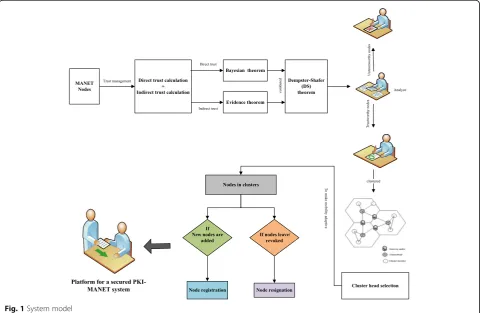
The node’s trust is assessed with direct and indirect information, where the indirect measurements are obtained from the one-hop neighbouring nodes of the target node called the recommenders. In our scheme, the recommenders are selected based on their trust level. We consider two main hypotheses for hybrid trust management. First, with the direct observations that revoke the untrustworthy node, the probability of selecting a trustable recommender gets higher. Second, the selection of higher trust recommenders conveys that those recommenders have participated constantly in group communication and are therefore familiar with the target node. However, the trustable recommenders are randomly selected to avoid undetected compromises which may dominate the communication of recommendations. The proposed system model is shown in Fig. 1: system archi-tecture. The architecture includes the step by step processes of the proposed trust management, clustering and its application to construct a secured PKI framework in MANET. Initially, the MANET nodes are computed for its trustworthiness in terms of direct and indirect trust methods, i.e., with the Bayesian and Evidence theorems, respectively. The hybrid trust values are then combined with the Dempster-Shafer (DS) theorem. During this phase, the nodes are categorised into trustworthy and untrustworthy from which the trustable nodes are chosen
and forwarded for other network functionalities. The untrustworthy nodes are thus isolated and revoked from the system. The trustworthy nodes are grouped into hexagonal clusters in which the node with the highest trust value is elected as a header node in the next phase. To adapt mobility node registration and resignation, proce-dures are carried out whenever nodes join or leave the MANET clusters. Finally, the clustered trust platform is applied for public key functionalities in order to secure the MANET environment.
5 Proposed trust management method
This section describes the distributed trust computation method to adapt the active topology and to secure PKI-MANET system. The proposed trust methodology is assumed to deploy in the clustered environment with header and members nodes. Generally, the trust of a node can be defined as the probability of belief of a trustor (m) on a trustee (n), varying from 0 (complete distrust) to 1 (complete trust). The probability of trust and distrust of the trustor on information (i) send by the trustee with context to belief (b) is given as:
Trust Degree;TD mð ;n;i;bÞ
¼P belief m½ ð ;iÞjmade By ið;n;bÞ⋀beTrue bð Þ
ð1Þ
Distrust Degree;DTD mð ;n;i;bÞ
¼P belief m½ ð ;¬i_ Þjmade By ið;n;bÞ⋀beTrue bð Þ
ð2Þ
5.1 Distributed trust management
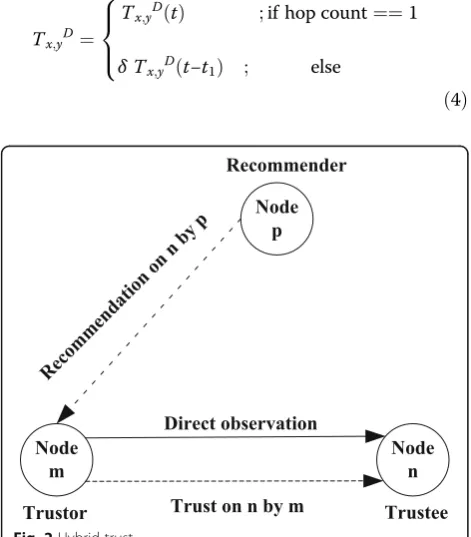
The distributed trust is computed based on a hybrid method which combines the direct and indirect trust values. The direct trust is based on direct observations obtained by sending SENSE beacon constantly to the neighbouring nodes and evaluating these observations. Whereas, recommendations from the one-hop neighbour contributes to the indirect trust computation. The hybrid trust is computed by combining the direct as well as the indirect components. Unlike a centralized trust calcula-tion, here, each node computes its own trust value on its neighbour. The trust computation of trustorxon trustee y, (Tx,y), by hybrid mechanism is given in Fig. 2: hybrid trust method. It is calculated as:
Tx;y¼ð1−ƭÞTx;yDþƭTx;yID ð3Þ whereƭis the trust component; 0≤ƭ≤1
Tx,yDis the direct trust made bymonn; 0≤Tx,yD≤1 Tx,yIDis the indirect trust made bymonn; 0≤Tx,yID≤1 The direct trust computation is performed with the direct observations of x on y at time t is given by (4). The trust may decay with the change in the time (t1), represented by the fading componentδ.
Tx;yD ¼
Tx;yDð Þt ;if hop count¼¼1
δTx;yDðt−t1Þ ; else 8
> < > :
ð4Þ
The indirect trust evaluated by x on y with respect to the recommendation from one-hop neighbour of x (node k), at time t is given by (5). The trust reduces with t1 when y receives false recommendations from a recommender (say node p) located within an appro-priate trust length from y.
Tx;yID¼
Tk;n ;jTRj>0
δTx;y ðt−t1Þ; else 8
> < > :
ð5Þ
where TR is the set of true recommendations received from x’s one-hop neighbour (i.e., k). When TR> 0, x appoints those neighbouring nodes to evaluate the trust indirectly. On the other hand, if TR= 0,y uses its pre-vious trust value Tx, y (t−t1), since it received no true
recommendations.
5.2 Direct and indirect trust management
Uncertainty is an unresolved problem in MANET, espe-cially while evaluating the trust of the network. With the uncertainty, the nodes may misbehave due to selfish or malicious attackers. In each cluster, the cluster heads are authorized to monitor the misbehaviours locally and to collaborate the cluster members to further investigate the effect of misbehaviour on the network. When a cluster head detects a sign of misbehaviour from any node (say node x), it first evaluates the credibility of the message. Subsequently, theCH requests the cluster members, especially the one-hop neighbours of the suspicious node to share their individual observations about x. We consider these observations as evidences which are assembled to evaluate the evidence trust factor (Exð Þe ). Furthermore, the CH monitors the rate of misbehaviour by directly observing the node x as (Exð Þd ). The trust management systems com-bines these direct observations and the evidences obtained from the one-hop cluster members to evaluate the trustworthiness ofx.
The trust management becomes more complex when the observing node (called recommender) itself behaves untrustworthy, which contributes false evidences. Such system makes MANET trust evaluation impracticable espe-cially in detecting which recommender is untrustworthy. Therefore, we make use of the well-known Dempster-Shafer (DS) evidence theory, where the uncertainty of nodes is represented using belief functions. The main idea of the DS theory is that a recommender attains a certain degree of belief on a hypothesis based on the subjective probability. DS theory provides an appropriate mathematical model for MANET, to combine distributed information gathered from different sources.
5.2.1 Trust verification with the Bayesian theory
We consider that theCHmonitors the packet forwarded by the suspected node and compare them with the original packets send directly to the node, in order to identify the misbehaviour nature of the node x. Let consider a node x maintains for its neighbouring node y. Then, for a set of nodesN, theCH supervises the packet ratio as in (6):
X
x∈NSxy¼
X
x∈NFxy ð6Þ
whereSxyis the number of packets forwarded to node x
by the neighbouring node y and Fxy is the number of
packets forwarded by node x. If the packet ratio is not equal, a misbehaviour is identified by the CH, i.e., if
P
x∈NSxy≠
P
x∈NFxy, it is understandable that node x is misbehaving either due to selfish or malicious attackers.
Thus, the CH directly evaluate the misbehaviour and calculates the trust factor of its cluster members with a Bayesian inference, where the unknown probabilities are hypothesized using observations. The measure of belief about a hypothesis shall be represented by the well-known Baye’s theorem:
Pð Þ ¼ijj P jð Þji Pð Þi
P jð Þ ð7Þ
where½ ijj is the measure of belief about the hypothesis (iÞ on the subject of the evidence (jÞ
P½ i is the belief aboutɑin the absence ofj
In MANET, the higher the probability of any misbehaviour, the more likely it is that the misbehaviour will occur. Therefore, the Baye’s theorem may be expressed in terms of probability distributions as:
PðδjdataÞ ¼P datað jδÞPð Þδ
P datað Þ ð8Þ
where [δ|data] is the posterior distribution for the parameter δ,P[data|δ] is the sampling density function, P[δ] is the prior distribution andP[data] is the marginal probability function of data.
From (8), we shall modify the misbehaviour verification as:
Pðδ;ajbÞ ¼R1f bð jδ;αÞPðδ;αÞ
0f bð jδ;αÞPðδ;αÞdδ
ð9Þ
where degree of belief and 0≤δ≤1, b is the rate of correctly forwarded packets by a node, α is the rate of packets received by the node, f bð jδ;αÞis the probability function that follows a binomial distribution given by
f bð jδ;αÞ ¼ α b δ
bð1−δÞα−b ð10Þ
To describe the initial knowledge concerning prob-abilities of success, we use the beta distribution to the Bayesian approach and hence the prior distributionP(, ,i) can be stated as:
whereα,β> 0, is the power function ofaandb.
The mean and variance of the beta distribution function is given as:
Mðδ α;j βÞ ¼ α
αþβ ð12Þ
and
Vðδ α;j βÞ ¼ αβ
αþβþ1
1 αþβ
ð Þ2 ð13Þ
In our scheme, the trust factor represents the behaviour which grows feebly, thereby giving more impact on the misbehaving rate in Bayesian networks. The trust factor for misbehaviour verification is given as:
(12)⇒
Mðδ α;j βÞ ¼ α
αþαxβ ð14Þ
The beta distribution is well suitable for the random behaviour of proportions. While considering the event history in the Bayesian framework, the expected value of beta distribution can be written as
(14)⇒
Mðδ α;j βÞ ¼ αt
αtþαxtβ t
ð15Þ
where
αt¼αt−1þit−1 βt ¼βt−1þbt−1
and with the prior probability distribution, we assume no observations are made initially and so α0, β0= 0.
Therefore, the direct trust factor that quantifies the behaviour of node x is deduced from the above calculations as:
TxDð Þ ¼t ðExð Þd Þ ¼Mðδ α;j βÞ ð16Þ
packets (b), which is incremented by one for each successful transmission. If the rate b is not increased, either due to unreliable network conditions or packet lifetime, the packets are considered as dropped and so discarded from the communication. Algorithm 1 describes the accuracy of direct calculation trust in the Bayesian framework.
5.2.2 Misbehavior verification with evidence theory
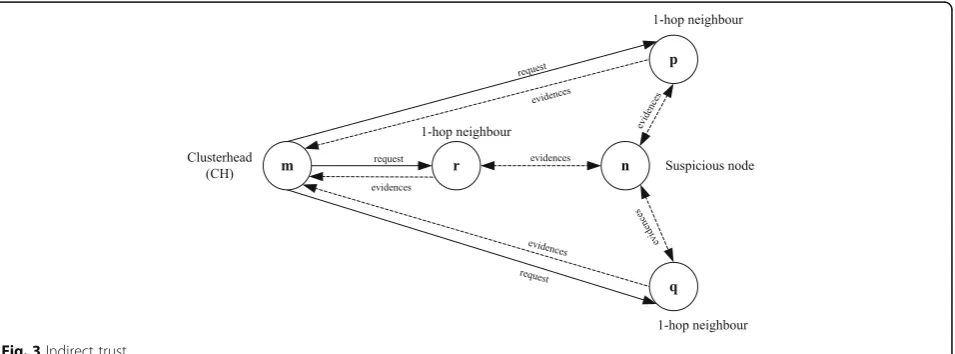
This section describes the misbehaviour verification with respect to the recommendations for the suspicious nodex from the one-hop neighbours within each cluster. The cluster head requests the one-hop neighbours of x referred as recommenders, to verify the misbehaviours based on their independent observations, as shown in Fig. 3: indirect misbehaviour verification. The recom-mendations called evidences received from the cluster neighbours give assistance in evaluating the trust value of x.The DS theory is used in practice with uncertainty or ignorance to evaluate the value of trust. This theory utilizes a belief function to combine the indirect evidences, which reflects the subjective probabilities.
The probabilities which are mutually exclusive and exhaustive are computed as a set of functions with 'Φ′
as a frame of discernment, in the DS evidence system. By including all the probabilities of the hypothesis called focal values Pkas a function of m, we consider a power set 2Φand satisfy the conditions as follows:
1. The probability value of the null set is zero, i.e.,M
δ ð Þ ¼0.
2. The sum of all elements in the power set is 1, i.e.,P
Pk⊆ΦMð Þ ¼Pk 1
The belief function of subjective probabilities shall there-fore be defined as
F xð Þ ¼X
Pk⊆xMð ÞPk ð17Þ
In the proposed trust management scheme, we con-sider two node behaviour states, i.e.,{accept, evict} represented with the DS theory. Using this, the frame of discernment is included with a set of probability pair regarding the behaviour of any random node. That is Φ= {trust, distrust}; where ‘ust’ represents the trust-worthy behaviour of the node and ‘distrust’ represents the misbehaving node state which occurred in the presence of selfish and malicious attackers.
On considering Fig. 3, the neighbours nodeA,B and C of the suspicious node x at a hop distance equal to 1 shares their evidences with the CH, as a subset of Φ. We interpret the power set with three probability forms of proposition, i.e., proposition T= {trust}, proposition M= {distrust} and finally propositionH=Φ, which rep-resent the uncertainty state where node x is uncertain whether to include as acceptable or misbehaving state. The neighbours provide recommendations as evidences by sharing its belief overΦ.
Consider an example, if node A believes that node x behaves trustworthy, then MAð ÞT isExð ÞA and therefore
MAð ÞM is 0. The evidence from nodeAcan be stated as:
MAð Þ ¼T Exð ÞA
MAð Þ ¼M 0 MAð Þ ¼H 1−Exð ÞA
ð18Þ
Likewise, if node B believes that node x misbehaves, its recommendations favours the evict function as follows:
MBð Þ ¼T 0 MBð Þ ¼M Exð ÞB
MBð Þ ¼H 1−Exð ÞB
ð19Þ
5.2.3 DS theory of combining evidences
In the proposed trust management scheme, the DS theory combines all the recommendations of one-hop neighbours with the condition that the recommendations are inde-pendent. Suppose F1(x) and F2(x) are belief functions of two independent recommending nodes, over the same suspicious node, then the orthogonal sum of these belief functions is given and represented as:
F xð Þ ¼F1ð Þ þx F2ð Þx
¼
X
j;k;Pj∩Pk¼xM1 Pj M2ð ÞPk
P
j;k;Pj∩Pk≠Φ
M1 Pj M2ð ÞPk
ð20Þ
wherePj,Pk⊆Φ.
With reference to Fig. 3, the belief of nodeAandBis calculated as
MAð Þ⊕MBT ð ÞT
¼1
I½MAð Þ MBT ð Þ þ MAT ð ÞMBT ð Þ þ MAH ð Þ MBH ð ÞT
MAð Þ⊕MBM ð ÞM
¼1
I½MAð Þ MBM ð Þ þ MAM ð ÞMBM ð Þ þ MAH ð Þ MBH ð ÞM
MAð Þ⊕MBH ð Þ ¼H 1
I½MAð Þ MBH ð ÞH
ð21Þ
where
I¼ MAð Þ MBT ð Þ þ MAT ð ÞMBT ð ÞH
þ MAð Þ MBH ð Þ þ MAH ð Þ MBH ð ÞT
þ MAð Þ MBH ð Þ þ MAM ð Þ MBM ð ÞD
þ MAð ÞMBM ð ÞH ð22Þ
We assume the rate of acceptance of the probability of nodeAandBas 0.8 and 0.7, respectively, and thus,
F Tð Þ ¼0:94 F Mð Þ ¼0 F Hð Þ ¼0:6
Thus, we shall conclude the acceptable behaviour rate from the indirect evidences with DS theory is 0.9. By combining all the belief values, we get
TxIDð Þ ¼ MAt ð ÞT ⨁MBð ÞT ⨁…::⨁MNð ÞT ð23Þ where nodes A, B, . …N are one-hop recommenders of nodex.
Therefore, the evidence trust value obtained from the recommendations can be computed as
TxIDð Þ ¼t ðExð Þe Þ ¼F xð Þ ð24Þ The indirect trust evaluation with Evidence theory and DST is depicted in Algorithm 2.
6 Proposed misbehaviours evaluation methodology
Unlike other hybrid trust computation methodologies, to improve the precision of measurement this section evaluates the misbehaviours obtained from the direct and indirect trust mechanisms as follows.
Due to the unique characteristics of MANET, nodes move independently without restrictions. In such environment, misbehaviour is more likely to appear due to selfish or mali-cious nodes. The selfish nodes are characterized by their disinclination to spend resources to cooperate on a group communication. On the other hand, the malicious nodes attack the availability of the network through flooding, wormhole, black hole, rushing and denial of service (DoS). The misbehaviour verification process of the proposed scheme includes two main phases: evaluating and revo-cation. In the first phase, the hybrid trust values of the misbehaving nodes are evaluated with a vector model. During this detection phase, the misbehaviours are classified into selfish or malicious based on their char-acteristics. In the next phase, the misbehaving nodes are revoked based on the analysis.
To detect and isolate a misbehaving node, we use a trust evaluation vector (TEV) to configure the mobile nodes, which is given as:
evaluation of node Aon node B. In order to normalize the value ofTEV, we define
TEV Að →BÞ
The direct trust value of any suspicious node is evaluated as:
wherePCBis the total packet count that nodeBhave to
forward,
PCB is the total packet count that node B actually forwarded,
PCinB is the total packets forwarded to nodeB, PCout
B is the total packets forwarded by nodeB, PCB,A is the total packets forwarded from nodeB to nodeA
and
PCA,B is the total packets forwarded from node Ato nodeB
Now, the indirect trust value of the suspicious node is evaluated as:
where Ris the recommender node which is an element of the set of recommenders represented by g. In MANET, the cluster membership changes dynamically whenever a node is added to evict from the cluster. The new nodes are added and registered into the cluster with trust verifi-cation, whereas the evicted nodes are deleted from the cluster. This is to maintain the forward and backward secrecy of the mobility aware cluster. Another significant challenge that MANET faces with this membership refor-mation is the re-evaluation of trust within each cluster. Let us consider initially, at time t, the node A places a trustTA,B(t) on its neighbouring nodeB. With the change
in mobility, at timet1, the nodeBleaves the current cluster
and joins an adjacent cluster. The nodeBis now resigned from the particular cluster. With the progress in time and mobility, the nodeB may re-join the home cluster of node A during which eventually decays the trust value TA, B(t). This time and mobility dependent trust
value can be evaluated as:
TA;Bð Þ ¼t1 TA;Bð Þ t e−ðTA;Bð Þt△TÞ
2
ð29Þ
where△T=t1−tandxis an integer, wherex≥1. LetSbe the event that a suspected node is selfish and S be the event that the node is normal with density function P(x|R) and P x jR. By Baye’s theorem, we compute a prior probability function as:
P Sð jxÞ ¼ P Sð ÞP xð jRÞ
P Rð ÞP xð jRÞ þP R P x jR ð30Þ
while considering the ratio of prior probabilities which is written as:
p¼ P Sð jxÞ
P S jx ð31Þ
If the ratio of probabilities is less than one, i.e., p<1 , the nodes are considered not to be normal than to selfish. Additionally, in the proposed trust management scheme, a malicious node test is incorporated to detect the malicious activities in the clustered MANET. Using the Baye’s theorem, we calculate the malicious events as:
P Mð jpÞ ¼ P Mð ÞP pð jMÞ
P Mð ÞP pð jMÞ þP M P p jM ð32Þ
whereMbe the event that a node behaves malicious,M be the event that a node behaves normally and pbe the event that malicious test is positive. If the value of P
Mjp
ð Þ≥0:5 , it is concluded that the suspected node is more likely not to be a malicious node.
Thus, the misbehaviour is detected by evaluating the hybrid trust value with the trust evaluation vector method. This detection mechanism shall be effectively integrated into the hexagonal clusters in order to secure the PKI framework. The mechanism detects and classifies the misbehaviour, either selfishness or malicious, to take revocation actions on those nodes.
7 Proposed clustering methodology
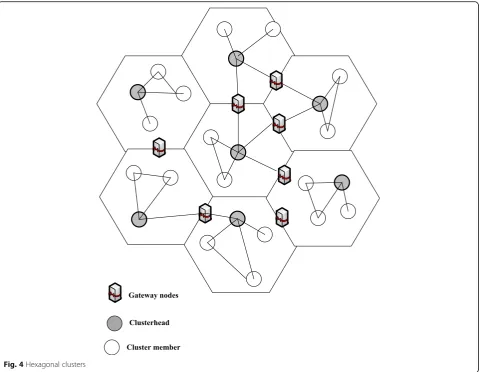
are considered as gateway nodes, which handles cluster-to-cluster operations. The CH monitors its neighbour nodes with their trustworthiness, within each cluster. We assume all the nodes communicate through bi-directional channels so that each node can forward as well as hear from its neighbouring nodes.
In an ad hoc uncertain clustering (UC) model, it has been assumed that a node′ni′should be located inside a region with a probability density function (PDF) to describe the distribution of nodes within a region. To compute the closeness of the node and the cluster repre-sentative, different methods based on mean, Euclidean distance and probability have been in practice. However,
these traditional clustering techniques of uncertain nodes increase the computational complexities and com-munication cost in mobile environment, especially in mobile ad hoc networks. To construct a highly desirable uncertain clustering cell in MANET, we propose to use Voronoi diagrams (VD) based clustering in which the clustering issues are managed considering the drawbacks of existing UC methods.
Voronoi diagrams are applied for wireless application to compute the Voronoi region of each node. To in-crease the spatial reuse, the network areas are clustered into congruent polygons with Voronoi geometric features. A hexagonal spatial geometric distribution of nodes is uti-lized in order to increase the network capacity and throughput of the network. It was proven the regular hexa-gons have the flexibility to be partitioned into smaller hex-agonal shapes and grouped together to form larger ones.
In MANET, VD is used to partition network into clusters based on Euclidean distances to nodes in a specific subset of the plane. A Voronoi diagram represents the region of influence around each of a given set of nodes. This geo-metric structure partitions the entire plane into polygon cells, called Voronoi polygonal, formed with respect to n nodes in a plane. In recent years, this structuring concept is widely used for exploring location and routing based issues. The Voronoi partition or cluster for a given set of nodes is unique and produces polygons which are route connected. A Voronoi polygon is, traditionally, constructed as follows
Vð Þni ¼ yjd nð i;yÞ≤d nj;y
;i≠j
ð33Þ
where Vð Þni is the Voronoi polygon ofni, niis the node and y is the set of points closer to ni, d(ni,y), distance from pointyandniand (nj,y) is the distance from point yandnj.
7.1 Cluster construction
ConsiderNas the number of nodes distributed independ-ently and uniformly in a regular hexagon with distance between them asd, radius of the hexagonal cluster asrand R∈E2, where E2 denotes the 2D Euclidean space and R denotes an arbitrary point in the hexagon. The probability distribution ofdis given asƤ(d≤r).
In the first step, Voronoi clusters (VC) are constructed on a set of nodes N= {n1, n2... nk} with a distance functiond:Sm×Sm→S(m-dimensional space) giving the distance d(x,y)≥0 between any nodes x,y∈Sm. The VD partitions the spaceSminkcells with cluster representa-tivesC= {c1,c2…….ck} with the property as:
d xð ;ciÞ<d x;cj
∀x∈V cð Þ;i ci≠cj
In the second step, the distance between the nodes and a cluster node is calculated. The Voronoi parti-tioning of a network can be of any polygonal shape and for its beneficial geometrical characteristics, we assume that the uncertainty region of Ni is a regular hexagon with nodes whose centers are equidistance to each other by distance d and radius r, where r> 0. The hexagonal clustering partitions a larger area into adjacent, non-overlapping areas and can be subdi-vided into smaller hexagons. Nodes join to form hexagonal clusters, and each cluster consists of CH and cluster members (CM). The distance d(a,b) between nodes in MANET plays an important role in determining the network performance. We shall as-sume that the nodes of the ad hoc network are inde-pendently and randomly distributed in the hexagonal structure. The edges of the hexagonal polygon are perpendicular to the line joining a node with another in N. Considering the radius for any query point, ∈S, d(x,ci) can be written as:
d pð ;ciÞ−d p;cj
¼riþrj ð34Þ
If two nodes overlap, the distance d(ni,nj) <ri+rj and (34) become unreal, which means the edges cannot be found, and we consider the cluster as empty. The hexagonal cluster construction in the MANET as shown in Fig. 5 is illustrated in Algorithm 3.
7.2 Cluster head selection
In MANET, the nodes join or leave the cluster dynamic-ally, and thus, the CH selection is difficult. We consider a distributed cluster head selection procedure with n nodes, which are of h hops distance within a cluster. It is much easier to select an efficient mechanism to estab-lish security, if the trust relationship among the nodes is obtainable for every cooperating node. Hence, to provide a secured communication amongst cooperative nodes, it is important to calculate the trust and distrust levels of nodes in the network.
In order to measure the trust level explicitly in an ad hoc environment, we present a trust calculation method with uncertainty level. With this, a high level of trust can be achieved for a secured communication. The certainty of nodes in MANET is considered as the summation of trust and distrust levels. Consequently, thus, the uncertainty level (UL) is defined as
we include uncertainty in the trust management system. It represents whether a trustor node collected the required information from past communications with a trustee and its confidence in that communication. An efficient method to reduce the uncertainty is to exploit the mobility charac-teristics of the MANET. The node mobility can increase the propagation of direct and indirect measurements and hence accelerates the trust convergence.
An important factor that affects the trust level of a node is the history of events (He), which specifies the number of successive interactions between the trustor and the trustee in a network. Initially, we assumeHeas greater than or equal to 0. The trust and the distrust level of any node can be measured with the relation as shown in (38).
TL mð ;n;i;bÞ ¼Mðδ α;j βÞ
Pn
x¼1dpð Þx
He
and
DL tð;s;i;bÞ ¼ðExð Þe Þ
Pn
x¼1dnð Þx
He
ð38Þ
Therefore, (37)⇨
UL tð;s;i;bÞ ¼1− Mðδ αj ;βÞ Pn
x¼1dpð Þx
He þ E
xð Þe ð Þ
Pn x¼1dnð Þx
He
ð39Þ
The degree of successive encounter'x'made be trustee on trustor may be either positive (represented as dp(x)) or negative (represented as dp(x)). Here, to evaluate the trust, we consider three cases of uncertainty level, i.e., =0, 0 <UL< 1 and UL= 1. When the uncertain level is low (UL= 0), the nodes are highly trustable. This highly certain case shows that the trustor is very much confident with the trustee. If the uncertain level varies from low to high (0 <UL< 1), the trustor may not have sufficient confidence with the trustee. On the other hand, a highly uncertain case occurs when the uncertain levelUL= 1. At this state, the trustor may be completely unknown about the trustee.
The nodes with the highest trust level, i.e., UL= 0 and TL= 1, is considered as CH, initially at timeT1. As time progresses, the topology changes frequently in a MANET that varies the cluster nodes and the cluster heads. Hence, the cluster head selection procedure is adaptable for the change in topology. The trust value of each node is recomputed and the CH is selected, compar-ing the current CH (CHc) with the previous CH (CHp) and location (Lp).
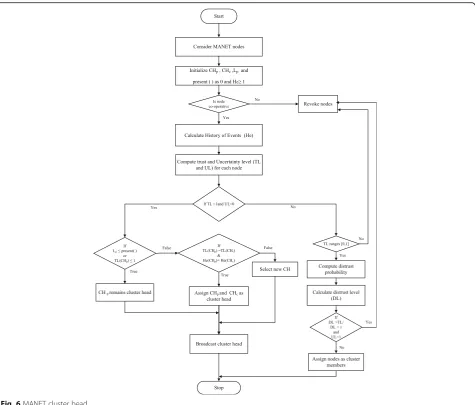
The nodes with trust level between 0 and 1(i.e., 0 < UL< 1) have undergone a distrust test to reduce the rate of risks. In comparison with the trust level and the distrust level of such nodes, they are either revoked or considered as cluster members, i.e., the nodes with the highest distrust level (DL= 1 or DL>TL and UL= 1) are revoked and the remaining nods are assigned as CH. This trust-based cluster head selection as shown in Fig. 6 eliminates a certain amount of risk in communica-tion within the network. To perceive the exact locacommunica-tion in-formation of any node, each node in the network is enabled with a position identification system. Our proposed scheme makes use of the clusters as well as the location information intensively. To construct a mobility adap-tive MANET, nodes are either registered or resigned whenever the cluster membership changes.
8 Case study: application of cluster-based trust in PKI MANET systems
certificates of a detected attacker or malfunctioning vehicles can be revoked. The most common way to revoke certificates is the distribution of CRLs (Certificate Revocation Lists) that contain the most recently revoked certificates. The nodes in a secured group communication in ad hoc networks participate until the certificates are valid. A certificate is said to be valid if it has not expired and it is not revoked by the CA. Checking the revoked status of any certificate involves acquiring the CRL corre-sponding to that certificate (i.e., the CRL with the CRL series number specified in the certificate). When trans-mitting a message, the sender appends to the message the following: (a) the sender’s certificate and (b) the signature of (the hash of ) the message using the sender’s private key. When receiving a message, the receiver (a) verifies the validity of the sender’s certifi-cate and (b) verifies the signature on the message
(using the sender’s public key that is a part of the sender’s certificate) before accepting it.
Therefore, it is clear that the complexity of the PKI system should be minimized in order to make the PKI-based security viable for node to node security deploy-ment. In this pursuit, we propose a trust-based certifi-cate revocation for use in ad hoc networks with significant reduction in the cost. In addition, we ensure the infrastructural complexity does not grow further in order to improve the performance of the PKI-based se-curity framework; in particular, it reduces the load on the wireless communication medium for disseminating the certificates and CRLs. The network is initialized as follows:
1. CA chooses a secret polynomial functionFiand
private keyKs, where Fi¼
Pt−1
x¼1ðFxixÞmod m,
with coefficientFxand variableix.
2. CA computes a secret share key for group communication and broadcasts through secured channel to the group members asKi=F(ni), where
niis the identity of group members.
3. CA constructs a polynomial functionfxmby
interpolation of points for each clusters, to
determine the public information. The polynomial is constructed asfxm⇒ðdki↦m;EncryptH1ðekiAmÞðekmÞ additive cyclic group of orderq.
5. Each node verifies the integrity of the secret value as
KiΘG¼
Px−1
y¼0 xyFy
:
The revocation process with hybrid trust is performed within each cluster whenever misbehaviours are identified. It is important to evaluate the trust to authenticate and manage certificates in PKI system. Therefore, the application of proposed hybrid trust management in the public key functionalities is significant to provide soft security for a secured group communication. The node’s trustworthiness determines the revocation rate. The revocation rate depends on the number of revocations made against node ni, as well as the number of attacker node ni made. If a number of uncertainty states are made against a member, it is likely that this member might be a mis-behaving node. During such cases, the certificate of the accused node is revoked by the CA and the revo-cation information is distributed within each cluster. This paper presents an efficient method of revoking certificates by quantifying the trustworthiness of nodes to construct trust framework in PKI without assessing the PKI structure. Compared with the conventional methods, this scheme has lower revocation time and higher revocation rate in order to guarantee a secured MANET framework. Now, the revocation list cost of single cluster is given as:
Costrevoke¼
whereQis the estimated number of certificates that will eventually be revoked prior to expiration,Tis the number of time slots for which a certificate is issued.
Q
T is the average number of certificates revoked per time slot, Lrevoke is the length of the revoked message corre-sponding to each revoked certificate.
A 3pffiffi3a2
2
is the number of hexagonal regions with area of
overall region asA.
The revocation mechanism is described in the Algorithm 4 as:
9 Attack mitigation model
The attacker capabilities that affect the system are enumerated as follows:
Attackers can control the group communication
between the nodes and CA
Attackers can modify/alter the message in group
communication.
Attackers can remove or add messages, shared
among the group members.
Attackers can be an identity spoofing, node cloning,
reply or an unauthorized access.
Attackers can remotely access CA for altering the
shared parameters.
Attackers can flood the packet to consume larger
Attackers falsely send recommendations to create an untrustworthy network.
We consider the following attacks that affect the trust computation
False recommendation attackfalsely sends
recommendations to include an untrustworthy node in the cluster functionalities. The hybrid trust calculation we used measures the direct trust from direct observations, in addition to the indirect trust obtained in the form of
recommendations. This direct trust value gives higher importance for analyzing the
trustworthiness of any node, which degrades fake recommendations.
Impersonation attackcan be an identity spoofing,
node cloning, reply or an unauthorized access. However, the attackers fail to pass the source and location authentication as well as integrity check.
Packet dropping attackinterrupts the service
availability of the nodes. The attackers deactivate nodes from their cluster by making a connection
failure or cluster disconnection. TheSENSEbeacon
send by theCHduring node missing, re-establishes
the connection with the deactivated node, after veri-fication process.
Flooding attackresends replicate of packets received
previously from the node members. This flooding consumes larger bandwidth and power that might terminate network functionalities.
Sybil attackcan break down the security, when a
node in the network claims multiple identities. The integrity check of the node gets rid of such
attackers, where the honesty of that node is proved.
Also theCHrecords the location, history of each
node, which aids it to detect the attacker node with multiple identities and same location particulars.
Besides, we consider the attacks that generate with the malicious and selfish node behaviours, such as flooding attack, wormhole attack, black hole attack, rushing attack and denial of service (DoS). These at-tacks are mitigated with the misbehaviour evaluation mechanism explained in section 6. The potential coun-termeasures proposed to isolate these attacks are as follows:
Black hole attack/wormhole attack: By ensuring
trust-based secure packet transmission in group communication selects reliable routes that mitigate black hole attacks. This authenticated routing protects routing messages from unauthorized modifications.
Impersonation: To prevent identity theft in the PKI
MANET system, an effective access control mechanism is provided by hybrid trust, by which stronger authentication and authorization is achieved.
Dropping attack: The two-level security, i.e.,
cryptographic and soft securities, provided in the proposed scheme detects and prevent the packet drop attacks. By monitoring the packet send and the packet delivery ratio, the presence of attackers is identified here.
Flooding attack: The proposed distributive
self-organised scheme runs the trust management code in cooperative fashion to identify and isolate flooding attackers in PKI MANET system. By categorising the nodes as {trust, distrust,
uncertain}, the probability of malicious behaviour is identified in which the packets from distrust nodes are isolated. To prevent packet flooding, a
threshold level is set by each node to accept packets from its neighbours.
Sybil attack: It is detected by cooperative
monitoring of MANET nodes. With authorised certificates, the integrity of nodes can be
monitored for determining the attackers, whenever packets are transmitted. The possibility theory applied in trust computation detects Sybil attackers by logically evaluating the node behaviour and assigning trust value. Accordingly, the proposed system identifies the node
behavioural discriminations caused by Sybil attackers.
By executing the Algorithm 1, a final trust value can be evaluated by mitigating fake recommendations. Consequently, a secure communication can be achieved between the trustor and the nodes with higher trust value.
10 Performance analysis 10.1 Simulation analysis
To evaluate the performance of the proposed method, we have developed a MANET environment in QualNet 4.5 simulator. The node behaviour comprises the packet sending and forwarding, observations as well as recom-mendation broadcasting. The simulation platform is setup in such a way to monitor the neighbour’s behaviour and to categorise it into trustworthy and/or untrustworthy actions, with a time gap exponentially distributed between successive actions. We consider a 50 number of nodes simulated at a time of 500 s. A MANET environment is configured with many mobile devices (mobile phones, laptops, etc.) which move randomly to communicate among their neighbours in the network of transmission range 250 m.
The nodes are assumed to move randomly at different node mobility from 5 to 25 m/s over network traffic of constant bit rate (CBR) that is applied between the sender and receiver nodes. The probability of selecting a new node as CH is set to 0.3. The nodes follow a ran-dom way point (RWP) approach, where the speed and the direction of each node are chosen randomly and independently.
When the simulation starts, each node chooses one location randomly as the destination within terrain of 1000 by 1000 m terrain in QualNet simulator for 802.11b and ad hoc on demand routing protocol over the simulation field. The nodes then moves with con-stant velocity chosen uniformly and randomly in a range [0, Vm], where ‘Vm’ is the maximum range of velocity that a node travels. When the node reaches its destination, it halts for a time period, referred as halt time ‘Thalt’. If Thalt= 0, a continuous mobility is experienced. However, when the ‘Thalt’ expires, the nodes again move randomly in the simulation field. The performance of the proposed THCM is evaluated by varying the two parameters ‘Vm’ and ‘Thalt’ for topology alterations (i.e., if ‘Vm’ is less and ‘Thalt’ is high, a relatively stable topology is achieved, while a highly dynamic topology is obtained if ‘Vm’ is high and
‘Thalt’ is less). Each data point in the simulation was limited to 10 observations for trust value calculation during simulation. We analyze the node behaviour by sustained monitoring system that includes two parts: monitoring phase and calculation phase. In the moni-toring phase, theCHclosely monitors its members and indicates the probability of behaviour changes if any.
The higher the probability rate the more will be the accuracy. In the second phase, the trust value of each node is evaluated based on the set of observations obtained previously.
10.1.1 Direct and indirect trust for different nodes
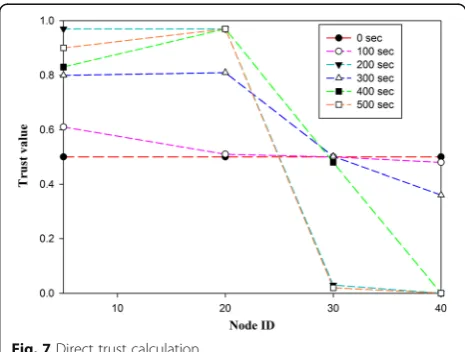
Figure 7: direct trust for different nodes shows the direct trust calculated for random node 5, 20, 30 and 40 at a maximum time period of 500 s. From the figure, it is clearly shown that the nodes 30 and 40 misbehaved and so the trust value that is calculated directly by observing node 30 and 40 is gradually decreased to zero, whereas the other two nodes show an increased trust level with their trustworthy behaviour. The indirect trust for nodes 5, 20, 30 and 40 are calculated and plotted in Fig. 8: indirect trust for different nodes with a simulation time set at 300 s. The trust value for nodes 5 and 10 is greater than 0.5, which show higher node cooperation for trust value. On the other hand, the indirect trust of nodes 30 and 40 degrades below 0.5 due to misbehaviour observed using the Bayesian-Evidence theorem.
10.1.2 Performance metrics
10.1.2.1 Network complexity The network complexity
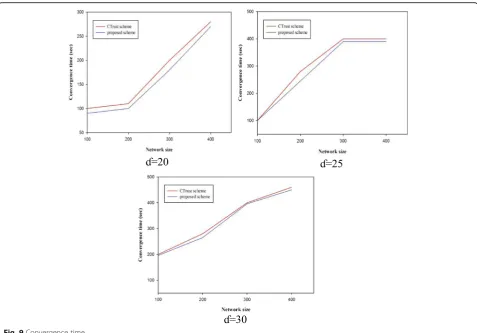
greatly depends on the convergence time. The conver-gence time is the time period required to achieve a trust convergence. The trust convergence of a node can be defined as the difference between the variance of two continuous trust values above a predefined trust thresh-old of 0.5. With the increase in the number of nodes, the convergence time increases, which in turn contri-butes to network complexities. From Fig. 9: convergence time, we compare the proposed trust methodology with CTrust schemes in [58] for variousɗ, whereɗ represents the node degree. In both schemes, the convergence time multiplies gradually with the growth in the network size.
This is because of the false trustworthiness values computed by the recommender which is high in the existing method-ology that increases the convergence time.
With the increase in the node degree, the measurements from the recommenders gets increased which further increases the network complexities. The misbehaviour verification algorithm in the proposed scheme safeguards
the network from the increase in convergence time, even if the number of recommenders and their evidences increases. Therefore, on comparing with the CTrust method, the proposed shows a better performance mar-ginally by decreasing the convergence time that results in controlling the further rise in network complexity. This distinctly shows the scalability feature of the pro-posed trust management scheme.
10.1.2.2 Communication overhead The average
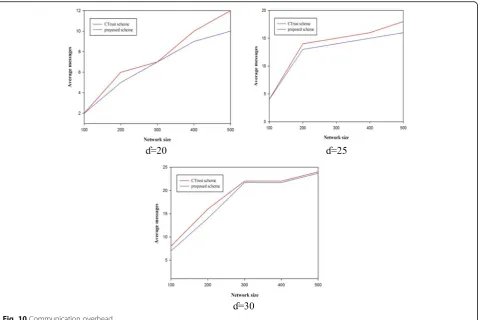
com-munication overhead occurs during the trust computation per node in a cluster is shown in Fig. 10: communication overhead. The proposed scheme reveals a reduction in overhead in communication by using the mathematical theorems compared to CTrust scheme [58]. For each recommendation request, each node receives recommen-dation reply only for its one-hop neighbours which lower the redundant accumulation of packers that urges in overhead reduction.
10.1.2.3 Trust accuracy It measures the inferred trust
computations with its attacker mitigating property. Compared to CTrust, the accuracy is maintained above 92% in all the cases except whenɗ= 30, where almost the
Fig. 8Indirect trust calculation
same level of accuracy is achieved for larger network size in both the schemes as shown in Fig. 11: trust accuracy. Though the network complexity is lowered, the MANET shows a high accuracy rate that makes our scheme more advantageous.
10.1.3 Mobility factors
This section discusses some factors that affect the cluster property with respect to the mobility of MANET nodes, namely, cluster size, node’s probability in a cluster and average cluster head changes as shown in Figs. 12, 13 and 14. We compare the proposed scheme with the established existing protocols such as 2ACK [59] and CBTRP [39].
10.1.3.1 Cluster size with node mobility With the
increase in the node velocity in MANET, the size of clusters varies. The network performance may get inter-rupted with the traffic overload, when the cluster size increases. Therefore, the cluster size should be main-tained from increasing to achieve favourable clustering scalability. Figure 12: cluster size shows the mobility influential clusters for the existing 2ACK, CBTRP with the proposed trust-based scheme. The result demonstrates how each methodology accepts the
cluster changes whenever the membership alters. When the node speed is increased as high as 25 m/s from a lower speed of 5 m/s, the cluster size get reduces from 25 to 7 nodes in the proposed scheme. This makes the proposed method more suitable for packets to establish and maintain routes. On the other hand, the existing schemes present a higher size of clusters with different increased node velocity. This further increases the clus-ter communication as more data need to be transmitted among the CH and the cluster multi-hops.
Simultaneously, the communication from cluster members to the CH drops significantly, since the less number of CH is present. This is because, if these proto-cols does not restrict the cluster size, a less number of clusters results in high intra-cluster communication overhead with the increase in the single size of clusters. It is clear that all the schemes construct large clusters with low mobility of nodes and smaller clusters over higher mobility. The efficient hexagonal clusters with Voronoi geometric patterns divide the network area into regular clusters with the shortest distance and expected number of transmissions computed between each node and the corresponding CH. The proposed scheme, thus, maintains appropriate clusters of optimal size with effec-tual mobility adaptiveness.
10.1.3.2 Node probability Figure 13: node’s probability, illustrates the probability that each node is available in the clusters with respect to the mobility. The efficiency of any scheme depends on the high probability of the node that remains in the clusters which greatly depends on the clustering parameters. In the proposed scheme, the nodes remain clustered every time, which is
greater than 0.9 even in the presence of large mobile nodes at a speed of 25 m/s. Whereas, the existing schemes show lesser probability on nodes being clustered compared to the proposed methodology. This beneficial feature of the proposed scheme is attained only because of the Voronoi clustering technique, where the nearest neighbour problem is solved greatly on non-overlapping
0 10 20 30 40 50
5 10 15 20 25
Clu
ster size
Node velocity (m/s)
2ACK CBTRP Proposed scheme
Fig. 12Size of cluster
0.45 0.55 0.65 0.75 0.85 0.95
5 10 15 20 25
Pro
b
a
b
ility
o
f n
o
d
e
Node velocity (m/s)
2ACK CBTRP Proposed scheme
Fig. 13Probability of node
partitions so that each node remains in the cluster region. The simulation result thus shows the desirable property of the proposed scheme that the probability of nodes being clustered is high even in the presence of greater node speed.
10.1.3.3 Cluster head change with mobility Figure 14:
average cluster head change with mobility demonstrates the CH age of the proposed scheme against existing schemes. The CH duration is measured as the average time that a CH is active at each time instants. This factor indicates the cluster stability, i.e., with more change in the CHs the lesser will be the cluster stability. For a stable cluster construction, the CH duration should be relatively lesser with high trust level. As expected, the proposed scheme performs better than the existing methodologies as the former exclusively uses higher trust level and the latter identity and node degree information to form the cluster structure. The CBTRP scheme also incorporates trust metric in cluster con-struction, thereby undesirably influencing the cluster stability; also, as the size of cluster increases, it is more predictable to appeal to re-clustering due to nodes mobility. The proposed scheme provides better results, as the CH depends on the node mobility with hybrid trust. Compared to the existing schemes, the proposed mechanism has lesser CH age, even at higher rates of node mobility. The result also shows the advantages of the proposed scheme in the reaffiliation rate, which represents the average CH change and its affiliation with rate of change of mobility. The proposed scheme presents a higher probability of reaffiliation that remains its CH for a longer time. This advantage of the average CH change for the proposed scheme is because of the lower link formations and failures in the cluster construction.
10.1.4 Security level with mobility
Figure 15: security level demonstrates the level of secu-rity, which is one of the significant factors for meas-uring the security strength of the proposed scheme. The Hackman tool integrated with the QualNet net-work simulator analyses different attackers at periodic time intervals. The Block Cipher Cryptography Class (BCCC) interface with Hackman tool enabled with Hackman SDK. The tool in the simulator tries to break the data packets and calculates the packets that are hacked successfully for evaluating the security level in percentage. The proposed scheme presents a higher security level to different selfish and malicious attackers compared to other existing schemes. An overall secur-ity of 93%is attained by the proposed scheme in the presence of different misbehaving activities, at larger node mobility. Whereas, the existing schemes such as 2ACK and CBTRP shows lower security level of 69 and 74%, respectively.
Besides, the attacks that generate the malicious and selfish node behaviours, such as flooding attack, black hole attack, wormhole attack, impersonation attack, packet dropping attack and Sybil attacks, are managed
0 5 10 15 20 25
20 40 60 80 10
Av
era
g
e CH
ch
a
n
g
e
Network size
2ACK CBTRP Proposed scheme
Fig. 14Average cluster head changes
50 60 70 80 90 100
5 10 15 20 25
Secu
rity
lev
el
(%
)
Rate of misbehaving node (in %)
2ACK CBTRP Proposed scheme
Fig. 15Security rate