Lava identification by paleomagnetism: a case study and some problems
surrounding the 1631 eruption of Mount Vesuvius, Italy
Gennaro Conte-Fasano1∗, Jaime Urrutia-Fucugauchi1, Avto Goguitchaichvili1, Alberto Incoronato2, and Pasquale Tiano2
1Laboratorio de Paleomagnetismo y Geofisica Nuclear, Instituto de Geof´ısica, UNAM, Ciudad Universitaria, 04510 Mexico, D.F., Mexico 2Dipartimento di Scienze della Terra, Universit`a degli Studi di Napoli Federico II, Largo S. Marcellino no. 10, 80138 Naples, Italy
(Received February 7, 2005; Revised February 23, 2006; Accepted March 7, 2006; Online published September 16, 2006)
Detailed rock magnetic, paleomagnetic and absolute paleointensity studies of lava flows from the disputed 1631 Mount Vesuvius eruption are reported. The magnetic carrier consists of pseudo-single domain state Ti-poor titanomagnetites. Characteristic magnetization directions determined from detailed stepwise alternating field and thermal demagnetizations provide four new well-defined flow unit mean directions, withα95ranging from 0.7◦ to 2.6◦. Paleodirections for 11 lava flows from 24-four flows studied previously appear to be related to the 1631 eruption, as indicated by their correlation to the early 17th century segment of the Italian paleosecular variation reference curve. This provides new evidence supporting the conclusion that the 1631 episode was an explosive-effusive eruption. The paleointensity results obtained from this study are the first to be published for Mount Vesuvius, with virtual dipole moments of 9.24±1.8×10²² and 13.5±0.4×10²²Am2higher than the present-day geomagnetic field strength.
Key words:Paleosecular variation, Vesuvius volcano, 1631 eruption, paleointensity, Italy.
1.
Introduction
The Somma-Vesuvius complex is localized in the Cam-pania plain, a region of southern Italy bordered by Meso-zoic carbonate platforms. Its formation was related to the tectonic activity that commence in the upper Pliocene, fol-lowing formation of the Apennine belt. During the Qua-ternary, an intense and complex volcanic activity, in asso-ciation with the subduction of the African plate beneath the Apennines chain, formed the large Roman-Campana Province (Di Girolamo, 1978). The main eruptive cen-ters are localized in the Lazio (Vulsini, Vico, Sabatini) and Campania regions (Roccamonfina, Campi Flegrei, islands of Ischia and Procida, and Somma-Vesuvius).
The Somma-Vesuvius complex is one of the most dan-gerous volcanic complexes in southern Italy and is char-acterized mainly by explosive activity. Its eruptive history has been well documented in historical documents since 79 A.D. The Somma-Vesuvius complex is formed by two su-perposed volcanic structures: Vesuvius volcano, with a con-ical shape truncated at the summit, and the older Somma volcano, which represents the caldera of the volcanic com-plex. Stratigraphical observations and radiometric dating of some of the volcanic products intercalated between pa-leosoils have provided evidence of several cycles of erup-tive activity, which begin usually with Plinian eruptions and have durations of less than 2000 years. The oldest
prod-∗Also at: Instituto de Investigaciones Antropologicas, UNAM, Ciudad
Universitaria, 04510 Mexico, D.F., Mexico.
Copyright cThe Society of Geomagnetism and Earth, Planetary and Space Sci-ences (SGEPSS); The Seismological Society of Japan; The Volcanological Society of Japan; The Geodetic Society of Japan; The Japanese Society for Planetary Sci-ences; TERRAPUB.
ucts of the Somma volcano are estimated to date from about 25 ka ago. In general, the activity of the Somma-Vesuvius complex can be divided into three long periods (Delibriaset al., 1979; Arn´oet al., 1987; Santacroce, 1987). The first is the longest and oldest period of the volcanic complex, ex-tending from 25 ka ago to 79 A.D. (the large historic Plinian eruption);, this period is characterized by the formation of the caldera. The second period includes the period of post-caldera activity, during which time there were several erup-tions (at least 11), with the most famous being the 79 A.D. and 1631 ‘big’ eruptions. The third period comprises the recent eruptive activity between 1631 and 1944.
It is generally agreed that the ‘big eruption’ of Vesuvius in 1631 apparently occurred after 500 years of quiescence. The eruption started in early morning of 16 December 1631 with the formation of a tall Plinian column and culminated with the emission of pyroclastic flows and the generation of secondary lahars. This event is considered to be one of the most destructive episodes in the volcanic history of Mount Vesuvius and the last in which large pyroclastic flows were emitted. As far as the nature of this eruption is concerned, it was initially accepted that lava flows were associated to this eruption, as also supported by the first paleomagnetic study (Hoye, 1981) of two lava flows. The nature of this eruption was later questioned by Rosi and Santacroce (1984) and Rosiet al.(1993) who considered this event to be an explo-sive eruption, suggesting that lavas previously attributed to this event were much older and had probably been erupted during the 968–1039 period. Rolandi et al. (1991) and Rolandi and Russo (1987, 1989, 1993) considered the 1631 event to be an explosive-effusive eruption, with the lavas al-ready having been mapped by Le Hon (1865). To provide new data that would contribute towards solving this dispute,
40°50’N
40°45’N
14°22’E 14°28’E
|
|
Tanguy et al., 1999 Carracedo et al., 1993
Gialanella et al., 1993
This study
Presumably 1631 eruption
Undifferentiated pyroclastic products of the Vesuvius and Mt. Somma. Air-fall deposits and pyroclastic flows, surges and lahar deposits younger than 17,000 years.
Lava flows of the A.D. 1760 eruption. Rocks with association ranging in composition between tephritic and phonolitic leucitites.
Lavas of the period A.D. 1855-1872.
Lava flows before A.D. 1631 and after A.D. 79, frequently covered by thick pyroclastic deposits of the A.D. 1631 eruption.
Main fragmental flow deposits (glowing clouds and associated ash clouds, lahars) of the A.D. 1631 eruption.
Lavas of the period A.D. 1913-1944; flows and exogenous tholoids showing generally ìaaî and ropy “pahoehoe” surfaces. Rocks of the high potassium.
| |
Fig. 1. Simplified geologic/volcanological map (modified from Principeet al., 1987) showing the location of paleomagnetic sampling sites (the location of sites studied by Tanguyet al.(1999) are not shown because these flows are reported in Carracedoet al.(1993) while those of Hoye (1981) are unknown). Stars refer to the presumed 1631 eruption.
new paleomagnetic studies were initiated in the early 1990s onwards, but these have provided conflicting results. For instance, Carracedoet al.(1993) did not recognize any flow associated to this eruption, a conclusion also reached by Tanguyet al.(1999), who re-sampled at the same sites the flows studied by Carracedoet al.(1993), and by Tanguyet al.(2003). In contrast, Gialanellaet al.(1993) and Incoro-nato (1996) concluded that the 1631 eruption was character-ized by an effusive phase. In particular, Incoronato (1996) showed that the disputed lava flows were characterized by mean directions of magnetization that clearly differed from those of the Medieval flows, the age of which had been pa-leomagnetically evaluated (968–1039) in a regional study (Incoronato and Del Negro, 2004).
The problem of the nature of the 1631 eruption is of ac-tual relevance in the evaluation of potential volcanic hazards in the Vesuvius area. In this study, we re-examined previ-ously published paleomagnetic data and assessed these data in combination with new, high-quality rock magnetic, pale-omagnetic, and absolute paleointensity results that we ob-tained from lava flows that are presumed to be associated with the 1631 eruption. Nine to fifteen standard paleomag-netic cores were obtained from each site using a portable electric-powered drill that was oriented with a sun compass prior to removal. A total of 49 samples from four sites were collected (Fig. 1; modified from Principeet al., 1987). The cores were later sliced into standard specimen cores
(diam-eter: 2.5 cm; length: 2.1 cm) for laboratory measurement. It cannot be ascertained that there are any sites obviously belonging to the same lava flow. In our sampling area, there was no evidence of previous samplings (i.e., with the field drilling technique).
2.
Rock Magnetic, Paleomagnetic and
Paleointen-sity Measurements
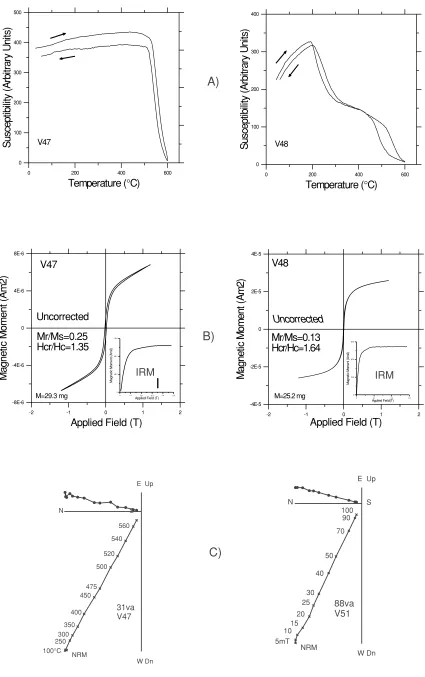
2.1 Continuous susceptibility curves
NRM
Temperature (°C)
0
Temperature (°C)
0
Table 1. Mean paleodirections of cleaned remanence for Vesuvius lava flows that presumably erupted in 1631. N, Number of treated samples; n, number of specimens used for calculation; Dec, Declination; Inc, Inclination; k andα95, precision parameter and radius of 95% confidence cone of Fisher statistics, respectively. Note: in Tanguyet al.(1999) the sampling was performed on the same sites as those used by Carracedoet al.(1993), but the data are different.
Site Age n/N Dec (◦) Inc (◦) α95(◦) k
This Study
V-45 1631? 7/9 7.4 66.7 2.4 611
V-47* 1631? 9/13 11.5 61.6 1.5 1124
V-48* 1631? 10/15 13.8 65.1 2.6 340
V-51* 1631? 11/12 15.9 64.6 0.7 3863
Tanguyet al.(1999)
V8 1631? 10 12.0 66.9 1.2 1454
V9 1631? 15 20.1 59.4 1.2 943
V10 1631? 9 16.8 60.4 1.4 1040
V11 1631? 14 15.9 60.7 1.1 1198
V12 1631? 10 19.0 60.4 1.8 634
Carracedoet al.(1993)
V8 1631? 5 23.9 57.5 4.1 350
V9 1631? 11 5.1 61.1 2.4 371
V10 1631? 9 4.6 60.6 2.8 343
V11 1631? 7 20.6 63.7 2.3 709
V12 1631? 7 14.3 57.5 2.0 930
V14 1631? 6 10.2 61.2 1.4 2376
V16* 1631? 9 11.8 65.3 2.7 358
V19 1631? 5 11.3 60.3 2.1 1383
V20* 1631? 5 14.0 62.3 1.5 2477
V27 1631? 4 6.4 66.1 2.4 1473
V31 1631? 5 359.3 68.7 2.2 1171
Gialanellaet al.(1993)
1* 1631? 5/9 12 65 2.3 1100
2* 1631? 6/8 14 64 1.6 1675
8* 1631? 6/7 14 64 1.2 3120
9 1631? 4/12 16 57 3.2 559
10* 1631? 6/7 13 63 2.2 961
11 1631? 3/12 4 66 4.8 666
12* 1631? 11/15 14 63 1.9 585
Hoye (1981)
A* 1631? 5/5 14.2 63.4 1.5 2553
B 1631? 5/5 15.6 66.2 3.1 627
ALL* N=11, Dec=13.5◦, Inc=63.7◦,α95=0.7◦, k=3738 *Presumably 1631
2.2 Hysteresis measurements
All samples were subjected to magnetic hysteresis exper-iments using an AGFM “Micromag” apparatus in fields up to 1.4 Tesla. The hysteresis parameters (saturation rema-nent magnetization Mr, saturation magnetization Ms, and
coercive force Hc) were calculated after correction for the
paramagnetic contribution. The coercivity of remanence (Hcr) was determined by applying a progressively
increas-ing back-field after saturation. Typical hysteresis plots are shown in Fig. 2(b); as can be seen, the curves are quite symmetrical in all cases. Near the origin no potbellied and wasp-waisted behaviors were detected (Tauxeet al., 1996), which probably reflects the very restricted ranges of the opaque mineral coercivities. In the ratio plot of hystere-sis parameters, samples fall in the pseudo-single-domain (PSD) grain size region (Dayet al., 1977; Dunlop, 2002a, b). Isothermal remanent magnetization (IRM) acquisition curves indicate that saturation is reached in moderate fields
of 100–200 mT, which points to some spinels as remanence carriers (most probably titanomagnetites).
2.3 Paleodirections
The intensity and direction of natural remanent magne-tization (NRM) of 9–15 samples from each cooling unit were measured with both JR-5A and JR6 spinner magne-tometers (sensitivity: approx. 10−9 Am2). The coercivity and unblocking temperature spectra, stability, and vectorial composition of NRM were investigated by detailed progres-sive alternating field (AF) or stepwise thermal demagneti-zations. AF demagnetization was carried out in eight to ten steps up to maximum fields of 70 or 100 mT using a Mol-spinAF demagnetizer, while thermal demagnetization was carried out in 12–14 steps up 580◦C using a non-inductive Schonstedt thermal demagnetizer.
NRM
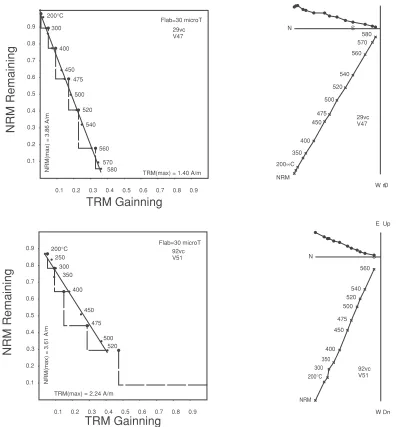
Fig. 3. The representative NRM-TRM plots and associated orthogonal diagrams from Vesuvius samples. The notations in the orthogonal diagrams are the same as in Fig. 2.
viscous origin, was easily removed during the first steps of demagnetization. The alternating field and thermal treat-ments, carried out on the same cores, generally yielded similar results. The greater part of the remanent magne-tization was removed at temperatures between 520◦ and 560◦C, which indicates low-Ti titanomagnetites as the main remanence carriers. The median destructive fields ranged between 30 and 40 mT, which is in agreement with data from the hysteresis experiments. Few samples showed more complex or unstable remanence behavior and no primary magnetization was determined; these samples were there-fore rejected for further paleomagnetic analysis. The prin-cipal component analysis (PCA) of remanent magnetization for individual specimens was carried out using the linearity test of Kirschvink (1980) using 6–11 points for the mean direction determination. Site-mean directions were calcu-lated by vector addition, which gives unit weight to sample directions. Site-mean directions and their statistical Fishe-rian parameters are summarized in Table 1 (Fisher, 1953).
2.4 Thellier paleointensity experiments
The method of Thellier (1959) as modified by Coeet al.
(1978) was used to determine absolute paleointensities. For the experimental study, heating and cooling steps were car-ried out using a MDT80 furnace (Magnetic Measurement Ltd.) with the laboratory field set to 30 microTesla. Thir-teen temperature steps were distributed between room tem-perature and 580◦C. Temperature reproducibility between two steps was in general better than 2◦C. During the experi-ment five control heating measureexperi-ments (so-called “pTRM” checks) were performed after every second step to check the thermal alteration (Coeet al., 1978).
-10 0 10 20 30
This Study
V45 V47 V48 V51 V8 V9 V10 V11 V12 V14 V16 V19 V20 V27 V31
Flows
1 2 8 9 10 11 12 A B
Gialanella et al. 1993 Hoye 1981
DECLINA
TION (
°
)
52 56 60 64 68 72
This Study
V45 V47 V48 V51 V8 V9 V10 V11 V12 V14 V16 V19 V20 V27 V31 1 2 8 9 10 11 12 A B Gialanella et al. 1993 Hoye 1981
INCLINA
TION (
°
)
Flows
Expectedat 1631
Expectedat 1631
Tanguy et al. 1999 ( ) Carracedo et al. 1993
Tanguy et al. 1999 ( ) Carracedo et al. 1993
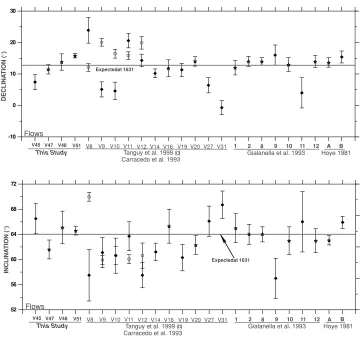
Fig. 4. Summary of characteristic unit mean paleodirections obtained from the Vesuvius ‘1631’ lava flows. Stars refer to the presumed 1631 eruption.
the following criteria: (1) obtained from at least six NRM-TRM (thermoreminant magnetization) points correspond-ing to a NRM fraction larger than one third, (2) yielded a quality factor (Coeet al., 1978) of about 5 or more; (3) with positive ‘pTRM’ checks—i.e., the deviation of the “pTRM” checks was less that 15% (Table 2).
3.
Main Results and Discussion
Characteristic magnetization directions were success-fully isolated for all samples, and flow unit directions were precisely determined (Table 1), withα95ranging from 0.7◦ to 2.4◦. The thermomagnetic curves show that the rema-nence is carried by Ti-poor titanomagnetite resulting from oxy-exsolution of the original Ti-rich titanomagnetite dur-ing flow cooldur-ing; this most probably indicates the thermore-manent origin of a primary magnetization. The unblocking temperature spectra and relatively high coercivities point to PSD grains as being responsible for remanent magnetiza-tion.
With respect to the paleodirections, mean directions can be compared with a reference secular variation curve (SVC) for the area. The reference curve for the last few millen-nia in certain areas of Western Europe (France and Great Britain, for example) is reasonably well defined (Bucur, 1994; Gallet et al., 2002), in contrast those available for other areas, including Italy. There have also been consid-erable developments in the construction of secular variation curves and global databases (see Jacksonet al., 2000; Le
Goffet al., 2002). Archeomagnetic data are still relatively scarce in Italy and, consequently, the reference curve re-lies on volcanic data and on relatively recent historical ob-servatory observations (Evans and Hoye, 2005; Lanza et al., 2005). The integration of secular variation data de-rived from different materials and direct observations has also enabled evaluation of the precision and spatial valid-ity (recalculation to near and far away sites) of directional results. The data from volcanic rocks on such directional results are usually characterized by high angular precision; nevertheless, sources of discrepancy and reduced accuracy have been observed at Italian volcanoes (e.g., Tanguy and Le Goff, 2004; Lanzaet al., 2005) that are similar to results on other areas (e.g., Urrutia-Fucugauchiet al., 2004).
Two of reference secular variation curves currently being used for geomagnetic secular variation analyses and dating are available: the SISVC (Southern Italy Secular Variation Curve) (Incoronatoet al., 2002; Incoronato and Del Negro, 2004) and the SIVC (South Italian Volcanic Curve) (Tanguy
et al., 2003; largely derived from Tanguyet al., 1999). As these reference curves, derived using different procedures, have been extensively discussed in Incoronatoet al.(2002) (see also Incoronato and Del Negro, 2004 and Conteet al., 2006), we will briefly summarize only some of the main arguments here.
The SISVC relies on:
de-This Study
Carracedo et al. 1993 Tanguy et al. 1999
Gialanella et al. 1993
Hoye 1981
Presumably 1631 eruption
1037 1885
1651 1646
1631 1537 1536
1139
968 1689
-30 30
50
70
1037
0
1595 1910
1983
1858 1885 1804
1760 1689 1669
1651 1646
1631 1537 1536
1301 1284/1285
1139
968
Fig. 5. Site-mean characteristic paleodirections from Vesuvius lava flows presumably related to the 1631 eruption with reference to the Southern Italy secular variation curve (Incoronatoet al., 2002). The statistical uncertainties were used to draw the swath of error. Squares refer to historical measurements of the geomagnetic field in Rome and the stars refer to the presumed 1631 eruption.
magnetization in order to check the presence of mag-netization components.
2) Information on the magnetic carriers.
3) Separation of the different magnetization components achieved by PCA. In dealing with lava flows emplaced a few hundred years ago only, very low maximum angular deviation have been used in order to separate primary components of magnetization from secondary ones that have been acquired in such a small time interval of a few hundred years only, although this caused many specimens or sites to be rejected. 4) Relocation of geomagnetic/magnetization directions,
via the inclined geocentric dipole, performed within a few hundred kilometers only.
The bulk of the data on which the SIVC relies derives from measurements of partial progressive alternating mag-netic field demagnetization (PAFD); there are no PCA anal-ysis, Zijderveld diagrams, and information on magnetic car-riers available.
We will take the different procedures leading to these SVCs when using the SISVC in our discussion of the re-sults. To draw the swath of error on the curve we used the statistical uncertainties.
Mean directions from 11 flows fall close to the early 17th century segment. The difference found between the pa-leodirections retrieved from the reference curve and those from the pyroclastic lava (unambiguously pertaining to this eruption) seems to be related to the mechanism of rema-nence acquisition in the pyroclastic flow. The evidence of the unsuitability of pyroclastic lava as a basis for
determin-ing a reference direction comes directly from Carracedoet al.’s (1993) paper. The main problem is that the temperature of emplacement of the 1631 pyroclastic flow is unknown. These rocks most likely carry a partial thermoremanence instead of a full thermoremanent magnetization. Moreover, rather unstable magnetic behavior was detected during the thermal stepwise demagnetization due to the some lithic (clasts) inclusion in the juvenile pumice. Strictly speaking, only lava flow V48 from the present study matches the cor-responding segment of the reference curve (Figs. 4 and 5), although two other lavas, V47 and V51, also show similar paleodirections close to this reference curve. However, the absolute paleointensities of the latter differ (Table 2). Site V45 has paleodirections that differ considerably from the reference curve. The lava flows from the Carracedoet al.
(1993) study yield highly scattered directional results. Two sites (V16 and V20) may be also related to the 1631 erup-tion, while all flows (excepting two sites 9 and 11) studied by Gialanellaet al.(1993) give directions concordant with the reference curve, as far as is reported in his work. The same applies for site A of Hoye (1981).
Table 2. First paleointensity results from the Vesuvius. N, The number of NRM-TRM points used for paleointensity determination;Tmin–Tmax, the temperature interval used;f,g, andq, the fraction of extrapolated NRM used, the gap factor and quality factor (Coeet al., 1978), respectively. Fe is the individual paleointensity estimate with associated error, VDM and VDMm are individual and average virtual dipole moments.
Site Sample N Tmin–Tmax f g q FE±σ(FE) VDM VDMm
◦C (μT) 1022Am2 1022Am2
V47 V29 14 20–580 0.96 0.90 69.24 79.5±0.9 13.7 13.5±0.4
V31 14 20–580 0.96 0.90 46.69 83.2±1.5 14.0
V32 14 20–580 0.95 0.90 97.08 77.6±0.7 13.3
V33 14 20–580 0.96 0.89 60.40 73.9±1.1 12.9
V34 14 20–580 0.93 0.90 82.86 79.5±0.8 13.7
V35 14 20–580 0.94 0.90 79.39 79.6±0.8 13.5
V51 V88 5 350–500 0.51 0.74 4.09 51.3±4.7 8.34 9.24±1.8
V90 5 350–500 0.47 0.74 3.83 53.4±4.9 8.48
V91 6 350–520 0.53 0.78 5.13 57.8±4.7 9.24
V92 9 200–520 0.63 0.85 12.31 76.4±3.3 12.3
V95 6 350–520 0.56 0.77 6.65 48.8±3.2 7.89
Genevey and Gallet, 2002 Chauvin et al., 2000 Jackson et al., 2000 (models)
Age (AD)
Intensity
(
T)
(V47)
(V51)
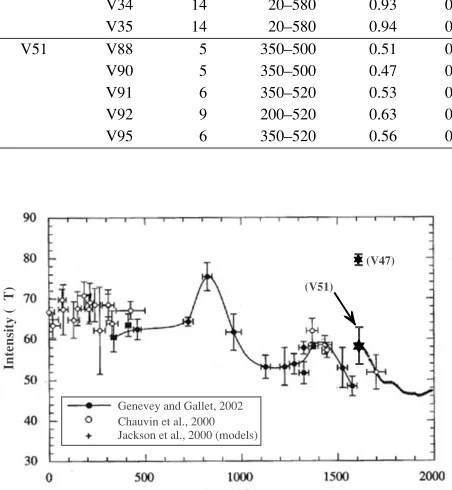
Fig. 6. Evolution of the geomagnetic field intensity in Western Europe during the last two millennia as assessed from archeomagnetic data (Chauvinet al., 2000; Genevey and Gallet, 2002) and geomagnetic field models (Jacksonet al., 2000). All data are reduced to the latitude of Paris, France.
1993 and sites V9, V10, V11, V12 of Tanguyet al., 1999). In summary, the paleodirections of 11 of the lava flows from the 24 flows studied coincide within associated un-certainties with the corresponding segment of the SISVC. Thus, this major event in Vesuvius volcanic history—the 1631 eruption—can be considered to be an explosive-effusive eruption.
Eleven samples yielded acceptable paleointensity esti-mates; these estimates are the first published to date for Mount Vesuvius (Table 2). The fraction of the NRM f
used for paleointensity determination ranges between 0.47 and 0.96, and the quality factor q from 3.8 to 97.1 (gen-erally being greater than 5). NRM end points obtained from the Thellier experiments at each step are reason-ably linear and point to the origin (Fig. 3); no deviation of the NRM left direction towards the applied laboratory field was observed, indicating the high technical quality of the paleointensity determinations. Obtained VDMs (vir-tual dipole moments)—9.24±1.8×10²² Am2 for site V51 and 13.5±0.4×10²²Am2for site V47—are higher than the present-day geomagnetic field strength.
Absolute paleointensity studies on recent Italian lava
flows are mainly devoted to the Etna volcano. However, the geomagnetic significance of the data has recently been seri-ously questioned by Calvoet al.(2002) and, consequently, these data cannot be used as reference material. However, an abundance of good archeointensity data has been re-cently reported for Western Europe (mainly from France). Chauvinet al.(2000) and Genevey and Gallet (2002) com-piled archeointensity results for the last two millennia. In addition, these authors obtained numerous intensity deter-minations on well-dated potteries, which has greatly im-proved the archeointensity reference curve for Western Eu-rope (Fig. 6). The data derived from the Jackson et al.
(2000) model are also incorporated in this curve. Two pa-leointensity determinations obtained from Mount Vesuvius lava flows (V47 and V51, see also Table 2) are reduced to the latitude of Paris (Fig. 6) as well as all data from
Chau-vinet al.(2000) and Genevey and Gallet (2002). There is
a good agreement with the value obtained from flow V51 and the historical geomagnetic field model (Jacksonet al., 2000) at about 1631 (Fig. 6). It is probable that this lava also belongs to the 1631 eruption even though it shows slightly different magnetic declination with respect to the SISVC (Fig. 4). In contrast, the intensity retrieved from lava flow V47 differs significantly from the curve, showing an un-usually high geomagnetic field strength that better matches with segment on the 8th to 10th centuries. It may be specu-lated that this lava erupted during the 968–1039 period. Al-ternatively, this unusually high absolute intensity value may be due to the problems related to the Thellier paleointensity determination.
4.
Conclusion
The paleodirections of 11 lava flows out of 24 (this study; Hoye, 1981; Carracedoet al., 1993; Gialanella et al., 1993; Tanguy et al., 1999) coincide—within associ-ated uncertainties—with the corresponding segment of the Southern Italy Secular Variation Curve. Thus, we conclude that this major event in Vesuvius volcanic history repre-sented an explosive-effusive eruption.
References
Arn´o, V., C. Principe, M. Rosi, R. Santacroce, A. Sbrana, and M. F. Sheri-dan, Eruptive history, in“Somma-Vesuvius” Quaderni de “La Ricerca Scientifica” C. N. R., edited by R. Santacroce, 114, 243 pp., 1987. Bucur, I., The direction of the terrestrial magnetic field in France, during
the last 21 centuries. Recent progress,Earth Planet. Sci. Lett.,87, 95– 109, 1994.
Calvo, M., M. Pr´evot, M. Perrin, and J. Riisager, Investigating the reasons for the failure of paleointensity experiments: A study on historical lava flows from Mt. Etna (Italy),Geophys. J. Int.,149, 44–63, 2002. Carracedo, J., C. Principe, M. Rosi, and V. Soler, Time correlation by
palaeomagnetism of the 1631 eruption of Mount Vesuvius. Volcanolog-ical and volcanic hazard implications,J. Volcanol. Geothermal Res.,58, 203–209, 1993.
Chauvin, A., Y. Garcia, P. Lanos, and F. Laubenheimer, Paleointensity of the geomagnetic field recovered on archeomagnetic sites from France,
Phys. Earth Planet. Int.,120, 111–136, 2000.
Coe, R., S. Gromme, and E. A. Mankinen, Geomagnetic paleointensity from radiocarbon-dated lava flows on Hawaii and the question of the Pacific non-dipole Low,J. Geophys. Res.,83, 1740–1756, 1978. Conte, G., J. Urrutia-Fucugauchi, A. Goguitchaichvili, and A. Incoronato,
Paleomagnetic dating of lava flows of uncertain age, Somma-Vesuvius volcanic complex (Southern Italy), Int. Geol. Rev., 48(4), 349–359, 2006.
Day, R., M. Fuller, and V. A. Schmidt, Hysteresis properties of titanomag-netites: Grain size and compositional dependence,Phys. Earth Planet. Int.,13, 260–267, 1977.
Delibrias, G., G. Di Paola, M. Rosi, and R. Santacroce, La storia eruttiva del complesso vulcanico Somma-Vesuvio ricostruita nelle successioni piroclastiche del M. te Somma,Rend. Soc. It. Mineral. Petrol.,35, 411– 438, 1979.
Di Girolamo, P., Geotectonic setting of Miocene-Quaternary volcanism in and around the Eastern Tyrrhenian sea border (Italy) as deduced from major element geochemistry,Bull. Volcanol.,41, 229–250, 1978. Dunlop, D. J., Theory and application of the Day plot (Mrs/Ms versus
Hcr/Hc) 1: Theoretical curves and tests using titanomagnetite data,J. Geophys. Res.,107(B3), 10.1029/2001JB000486, 2002a.
Dunlop, D. J., Theory and application of the Day plot (Mrs/Ms versus Hcr/Hc) 2: Application to data for rocks, sediments, and soil,J. Geo-phys. Res.,107(B3), 10.1029/2001JB000487, 2002b.
Evans, M. E. and G. S. Hoye, Archaeomagnetic results from southern Italy and their bearing on geomagnetic secular variation,Phys. Earth Planet. Int.,151, 155–162, 2005.
Fisher, R. A., Dispersion on the sphere,Proc. R. Soc. London Ser. A,217, 295–305, 1953.
Gallet, Y., A. Genevey, and M. Le Goff, Three millennia of directional variation of the earths magnetic field in western Europe as revealed by archeological artifacts,Phys. Earth Planet. Int.,131, 81–89, 2002. Genevey, A. and Y. Gallet, Intensity of the geomagnetic field in western
Europe over the past 2000 years: New data from ancient French poteries,
J. Geophys. Res.,107(B11), 2285, 10.1029/2001JB000701, 2002. Gialanella, R., A. Incoronato, F. Russo, and G. Nigro, Magnetic
stratigra-phy of Vesuvius products. I-1631 lavas,J. Volcanol. Geothermal Res., 58, 211–215, 1993.
Hoye, G. S., Archaeomagnetic secular variation record of Mount Vesuvius. Nature,291, 216–218, 1981.
Incoronato, A., Magnetic stratigraphy procedures in volcanic areas: the experience at Vesuvius. Palaeomagnetic and Tectonics of the Mediter-ranean Region. Geological Soc. Special Pub.,105, 367–371, 1996. Incoronato, A. and C. Del Negro, Magnetic Stratigraphy Procedures at
Etna, inThe Mt. Etna Volcano, edited by A. Bonaccorso, S. Calvari, M. Coltelli, C. Del Negro, and S. Falsaperla, AGU Geophys Monogr. Ser.,143, 263–271, 2004.
Incoronato, A., A. Angelino, R. Romano, A. Ferrante, R. Sauna, G. Vana-core, and C. Vecchione, Retrieving geomagnetic secular variations from lava flows: evidence from Mount Arso, Etna and Vesuvius (southern Italy),Geophys. J. Int.,149, 724–730, 2002.
Jackson, A., A. Jonkers, and M. Walker, Four centuries of geomagnetic secular variation from historical records,Philos. Trans. R. Soc. London, Ser. A,358, 957–990, 2000.
Kirschvink, J. L., The least-squares line and plane and the analysis of palaeomagnetic data,Geophys. J. R. Astr. Soc.,62, 699–718, 1980. Lanza, R., A. Meloni, and E. Tema, Historical measurements of the Earth’s
magnetic field compared with remanence directions from lava flows in Italy over the last four centuries,Phys. Earth Planet. Int.,148, 97–107, 2005.
Le Hon, H., Histoire complete de la grande eruption du Vesuve de 1631 (With a topographic map of Vesuvius lavas from 1631 till 1861),Bull. R. Acad. Sci. Lett. Beaux Arts, Belg.,20, 483–538, 1865.
Le Goff, M., Y. Gallet, A. Genevey, and N. Warm´e, On archeomagnetic secular variation curves and archeomagnetic dating,Physics of the Earth and Planetary Interiors,134, 203–211, 2002.
Nagata, T., R. A. Fisher, and K. Momose, Secular variation of the geo-magnetic total force during the last 5000 years,J. Geophys. Res.,68, 5277–5281, 1963.
Pr´evot, M., R. S. Mankinen, S. Gromme, and A. Leccaille, High paleoin-tensity of the geomagnetic field from thermomagnetic studies on rift valley pillow basalts from the middle Atlantic ridge,J. Geophys. Res., 88, 2316–2326, 1983.
Principe, C., M. Rosi, R. Santacroce, and A. Sbrana, Explanatory Notes to the Geological Map of Vesuvius. Quaderni de “La Ricerca Scientifica”, CNR, Roma, 114, 8, 11–51, 1987.
Rolandi, G. and F. Russo, Contributo alla conoscenza dell’attivit`a storica del Vesuvio. La stratigrafia di Villa Inglese (Torre del Greco),Rend. Acad. Sci. Fis. Mat. Napoli,54, 123–127, 1987.
Rolandi, G. and F. Russo, Contributo alla conoscenza dell’attivit`a storica del Vesuvio: dati stratigrafici e vulcanologici nel settore meridionale tra Torre del Greco, localit`a Villa Inglese, e Torre Annunziata,Boll. Soc. Geol. Ital.,108, 521–536, 1989.
Rolandi, G. and F. Russo, L’eruzione del Vesuvio del 1631,Boll. Soc. Geol. Ital.,112, 315–332, 1993.
Rolandi, G., A. Barrella, A. Borrelli, and G. D’Alessio, The 1631 Vesuvian eruption, Int. Conf. on Active Volcanoes and Risk Mitigation. Abstr., 91, 1991.
Rosi, M. and R. Santacroce, The famous AD 1631 eruption of Vesuvius: a revised interpretation in light of historical and volcanological data, Workshop on Volcanic Blast, Mount St. Helens, abstr., 1984.
Rosi, M., C. Principe, and R. Vecchi, The 1631 eruption of Vesuvius reconstructed from the review of chronicles and study of deposits,J. Volcanol. Geotherm. Res.,58, 151–182, 1993.
Santacroce, R., Somma-Vesuvius. Quaderni de “La Ricerca Scientifica”, CNR, Roma 114, 8, 243 pp., 1987.
Tanguy, J. C. and M. Le Goff, Distortion of the geomagnetic field in vol-canic terrains: an experimental study of the Mount Etna stratovolcano,
Phys. Earth Planet. Int.,141, 59–70, 2004.
Tanguy, J. C., M. Le Goff, V. Chillemi, A. Paiotti, C. Principe, S. La Delfa, and G. Patan`e, Variation s´eculaire de la direction du champ g´eomagn´etique enregistr´ee par les laves de l’Etna et du V´esuve pendant les deux derniers mill´enaires,C. R. Acad. Sc. Paris Sci. Terre Plan`et., 329, 557–564, 1999.
Tanguy, J. C., M. Le Goff, V. Chillemi, A. Paiotti, C. Principe, S. La Delfa, and G. Patan`e, Archeomagnetic dating of Mediterranean volcanics of the last 2100 years: validity and limits,Earth Planet. Sci. Lett.,211, 111–124, 2003.
Tauxe, L., T. A. T. Mullender, and T. Pick, Pot-bellies, wasp-waists and su-perparamagnetism in magnetic hysteresis,J. Geophys. Res.,95, 12337– 12350, 1996.
Thellier, E. and O. Thellier, Sur l’intensite de champ magnetique terrestre dans le passe historique et geologique,Ann. Geophys.,15, 285–376, 1959.
Urrutia-Fucugauchi, J., L. Alva-Valdivia, A. Goguitchaichvili, M. L. Ri-vas, and J. Morales, Palaeomagnetic, rock-magnetic and microscopy studies of historic lava flows from Paricutin volcano, Mexico: Impli-cations for the deflection of palaeomagnetic measurements,Geophys. J. Int.,156, 431–442, 2004.