Volume 2008, Article ID 670503,5pages doi:10.1155/2008/670503
Research Article
Performance of Coded Systems with Generalized
Selection Diversity in Nakagami Fading
Salam A. Zummo
Electrical Engineering Department, King Fahd University of Petroleum and Minerals (KFUPM), Dhahran 31261, Saudi Arabia
Correspondence should be addressed to Salam A. Zummo,[email protected]
Received 22 April 2007; Revised 21 September 2007; Accepted 2 December 2007
Recommended by David Laurenson
We investigate the performance of coded diversity systems employing generalized selection combining (GSC) over Nakagami fading channels. In particular, we derive a numerical evaluation method for the cutoffrate of the GSC systems. In addition, we derive a new union bound on the bit-error probability based on the code’s transfer function. The proposed bound is general to any coding scheme with a known weight distribution such as convolutional and trellis codes. Results show that the new bound is tight to simulation results for wide ranges of diversity order, Nakagami fading parameter, and signal-to-noise ratio (SNR).
Copyright © 2008 Salam A. Zummo. This is an open access article distributed under the Creative Commons Attribution License, which permits unrestricted use, distribution, and reproduction in any medium, provided the original work is properly cited.
1. INTRODUCTION
Diversity is an effective method to mitigate multipath fading in wireless communication systems. Diversity improves the performance of communication systems by providing a receiver with M independently faded copies of the trans-mitted signal such that the probability that all these copies are in a deep fade is low. The diversity gain is obtained by combining the received copies at the receiver. The most general diversity combining scheme is the generalized selec-tion combining (GSC), which provides a tradeoffbetween the high complexity of maximal-ratio combining (MRC) and the poor performance of selection combining (SC). In GSC, the largestMc branches out ofM diversity branches
are combined using MRC. The resulting signal-to-noise ratio (SNR) at the output of the combiner is the sum of the SNRs of the largestMcbranches.
A general statistical model for multipath fading is the Nakagami distribution [1]. The error probability and the cutoff rate of GSC over Rayleigh fading channels was analyzed in [2,3], respectively. In [4], the performance of some special cases of GSC systems over Nakagami fading channels was analyzed. A more general framework to the analysis of GSC systems over Nakagami fading channels was presented in [5] and more recently in [6]. In [7], the cutoff rate and a union bound on the bit-error probability of coded SC systems over Nakagami fading channels were derived.
The derivation is based on the transfer function of the code. To the best of our knowledge, no analytical results on the performance of coded GSC systems over Nakagami fading channels exit yet.
In [8], a new approach to analyzing the performance of GSC over Nakagami fading channels was presented. The approach is based on converting the multidimensional integral that appears in the error probability of GSC into a single integral that can be evaluated efficiently. In this paper, we generalize this approach to derive the cutoff rate and a union bound on the bit-error probability of coded GSC over Nakagami fading channels. The bound is based on the transfer function of the code and is simple to evaluate using the Gauss-Leguerre integration (GLI) rule [9]. Results show that the proposed union bound is tight to simulation results for a wide range of Nakagami parameter, SNR values, and diversity orders.
The paper is organized as follows. The coded GSC system is described inSection 2. InSection 3, the cutoffrate of coded GSC systems is derived. In Section 4, the proposed union bound on the bit-error probability is derived, and results are discussed therein. Conclusions are discussed inSection 5.
2. SYSTEM MODEL
be convolutional, turbo, trellis-coded modulation (TCM), or any other coding scheme. The encoder encodes a block ofK
information bits into a codeword ofLsymbols. The code rate is defined asRc=K/L. For thelth symbol in the codeword,
the matched filter output of theith diversity branch is given by
yl,i=
Esal,isl+zl,i, (1)
whereEsis the received signal energy per diversity branch
andal = {al,i}Mi=1are the fading amplitudes affecting theM
diversity branches, modeled as independent and identi-cally distributed (i.i.d) Nakagami random variables. Here, we assume ideal interleaving and independent diversity branches. The noise sampleszl = {zl,i}Mi=1are i.i.d complex
Gaussian random variables with zero-mean and a variance ofN0/2 per dimension.
Signals received at different diversity branches are com-bined such that the performance is improved. In MRC, the received signals at different diversity branch are weighted by the corresponding channel gain. The resulting SNR for symbollin the codeword is given by γlEs/N0, whereγl = M
i=1a2l,i. In GSC, the receiver selects the largestMcdiversity
branches among theM branches and combines them using MRC. If we arrange the fading amplitudesal,1,. . .,al,M in a
The cutoff rate R0 has been generally referred to as the
practical channel capacity. Reliable communication beyond this rate would become very expensive to achieve. Even after the discovery of near-Shannon limit achieving codes such as turbo and LDPC codes [10,11], the required large block size and inherent delays would make the cutoffrate a valid figure-of-merit to compare different modulation schemes. The cutoff rate for discrete-alphabet modulation schemes [12] is defined as
where |S| is the size of the modulation alphabet S and
C(si,sj) is the Chernofffactor defined as
as the moment generating function (MGF) of the random variableβand using the result of [8], the Chernofffactor can be written as
density function (pdf) and cumulative distribution function (CDF) of the SNR of each diversity branch, andφa2(d,x) is
the marginal MGF [8] defined as
φa2(d,x)= ∞
x e
−dtf
a2(t)dt. (5)
For Nakagami fading channels, the pdf and CDF are given, respectively, by
Gamma function and Γ(·) is the Gamma function. The marginal MGF for Nakagami fading [8] is given by
φa2(d,x)= 1 simplifying, (9) can be written as
C(si,sj)= evaluated efficiently as
∞
are computed according to the GLI rule as in [9]. It was found through our simulations thatP =20 is enough to get the required accuracy in the bound.
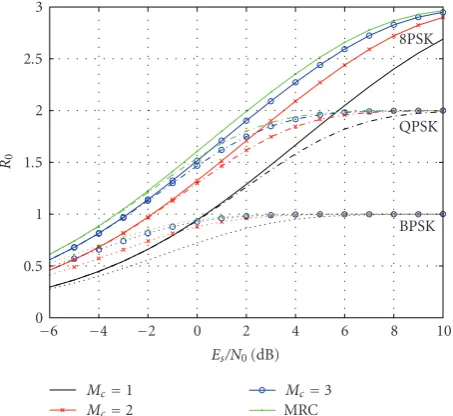
10
number of selected diversity branches in Nakagami fading with
m=2.
number of combined diversity branches increases, the cutoff rate increases. This is expected since combining more diver-sity branches increases the reliability of the communication system allowing higher transmission rate at the same SNR.
Figure 2shows the cutoffrates of an 8PSK GSC system with different combinations ofMandMc. Note that the proposed
evaluation method of the cutoff rate is very simple and efficient as compared with the integral method of [5].
4. BIT-ERROR PROBABILITY
The conditional pairwise error probability (PEP) for coded GSC can be written as
P(S−→S|A)
whereyl,(i)is the matched filter output corresponding to the
diversity branch with fading gainal,(i),SandSare the length-Lvectors representing the correct and decoded codewords, respectively, andAis anL×Mmatrix containing the fading amplitudes affecting a codeword. The conditional PEP [12] can be simplified as
P(S−→S|A)=P
where ξ is a zero-mean Gaussian random variable with variance 2LEs
L l=1
Mc
i=1a2l,(i)|sl−sl|2. This probability [12]
can be further simplified as
P(S−→S|A)=Q
Figure2: Cutoffrate of 8PSK-coded GSC with different number of
diversity orders in Nakagami fading withm=4.
where dl = Es|sl − sl|2/4N0 and βl = Mc
i=1a2l,(i) is the
normalized SNR at the output of the GSC combiner for symbollin the codeword. Using the the integral expression of theQ-function,Q(x)=(1/π)0π/2e(−x
2/2sin2
θ)dθ[13], the
unconditional PEP is written as
P(S−→S) = 1
independence of the fading variables affecting different symbols. Note that the expectation in (16) is the same as (3). Thus starting from (9), and making the change of variable
y=mx(1 +βαθ/m), the unconditional PEP can be simplified
andLη = |η|represents the minimum time diversity of the
code, whereη = {l : sl=/ sl}. Using the transfer function
6 5 4 3 2 1 0
Eb/N0(dB) Mc=1
Mc=2 Mc=3 10−8
10−7 10−6 10−5 10−4 10−3 10−2 10−1
Pb
Figure3: Bit-error probability of convolutionally coded GSC with
M = 4 in Nakagami fading withm = 2 (solid: bound, dashed: simulation).
whereDis a variable whose exponent represents the distance from the all-zero codewords,I is a variable whose exponent represents the number of information bits to the encoder, andT(D(θ),I) is the transfer function of the code evaluated atD(θ) that is given by
D(θ)|D=e−Es/4N0=
1
1 +dl/m
m(Mc−1)
1 +dlαθ/m m
×
∞
0 e
−yym−1h(y)d y,
(20)
where h(y) is defined in (18). The expression in (20) is evaluated using the GLI rule defined in (12) withP = 20, as discussed in Section 3. Once (20) is evaluated for every value of the argument θ, (19) is evaluated using a simple trapezoidal numerical integration [9] since it is a definite integral. It was found that 10 steps are enough to evaluate (19) with a good accuracy.
The proposed bound was evaluated for a rate-1/2 (5, 7) convolutional code and an 8-state 8PSK TCM system presented in [12, Section 5.3]. Nevertheless, the bound is applicable to any coding scheme with a known transfer function such as turbo codes and product codes. Figures3–5
show the simulation and analytical results for convolution-ally and 8PSK TCM-coded systems over different Nakagami fading channels and with different selected diversity branches out of M = 4. We observe that the bound is tight to simulation results for a wide range of SNR values, diversity orders, and Nakagami parameters. It is also noted that the bound is appropriate for Nakagami fading channels with noninteger fading parameters. In addition, we note that the bound is simple to evaluate using the GLI rule. Figures 6
and 7 show the performance of convolutional and 8PSK
6 5 4 3 2 1 0
Eb/N0(dB) Mc=1
Mc=2 Mc=3 10−8
10−7 10−6 10−5 10−4 10−3 10−2 10−1
Pb
Figure4: Bit-error probability of convolutionally coded GSC with
M =4 in Nakagami fading withm=0.75 (solid: bound, dashed: simulation).
8 7 6 5 4 3 2 1 0
Eb/N0(dB) Mc=1
Mc=2 Mc=3 10−8
10−7 10−6 10−5 10−4 10−3 10−2
Pb
Figure 5: Bit-error probability of 8PSK TCM-coded GSC with
M = 4 in Nakagami fading withm = 4 (solid: bound, dashed: simulation).
8 7 6 5 4 3 2 1
Eb/N0(dB) M=2
M=4 M=6 10−8
10−7 10−6 10−5 10−4 10−3 10−2 10−1
Pb
Figure6: Bit-error probability of convolutionally coded SC with
different number of diversity branches in Nakagami fading wihm= 2 (solid: bound, dashed: simulation).
10 9 8 7 6 5 4 3
Eb/N0(dB) M=2
M=4 M=6 10−8
10−7 10−6 10−5 10−4 10−3 10−2
Pb
Figure 7: Bit-error probability of 8PSK TCM-coded SC with
different number of diversity branches in Nakagami fading wih
m=4 (solid: bound, dashed: simulation).
5. CONCLUSIONS
In this paper, we presented a new evaluation method for the cutoff rate of coded GSC systems. In addition, we derived a new union bound on the error probability of coded coherent GSC systems over Nakagami fading channels. Results show that the new bound is tight to simulation results. Furthermore, the bound is general to any coded system with a known transfer function, Nakagami fading
with a general Nakagami parametermand any combinations of diversity order,M, and selected diversity branches,Mc.
ACKNOWLEDGMENT
The author would like to acknowledge KFUPM for support-ing this work under Grant no. FT060027.
REFERENCES
[1] M. Nakagami, “The m-distribution- a general formula of intensity distribution of fading,” in Statistical Methods in Radio Wave Propagation, W. C. Hoffman, Ed., Pergamon Press, Elmsford, NY, USA, 1960.
[2] M.-S. Alouini and M. K. Simon, “An MGF-based performance analysis of generalized selection combining over Rayleigh fad-ing channels,”IEEE Transactions on Communications, vol. 48, no. 3, pp. 401–415, 2000.
[3] A. B. Adinoyi and S. A. Al-Semari, “Performance of coherent schemes with generalized selection combining in Rayleigh fading,” inProceedings of the 12th IEEE International Sympo-sium on Personal, Indoor and Mobile Radio Communications (PIMRC ’01), vol. 1, pp. B-95–B-99, San Diego, Calif, USA, September-October 2001.
[4] M.-S. Alouini and M. K. Simon, “Performance of coherent receivers with hybrid SC/MRC over Nakagami-m fading channels,”IEEE Transactions on Vehicular Technology, vol. 48, no. 4, pp. 1155–1164, 1999.
[5] Y. Ma and C. C. Chai, “Unified error probability analysis for generalized selection combining in Nakagami fading channels,”IEEE Journal on Selected Areas in Communications, vol. 18, no. 11, pp. 2198–2210, 2000.
[6] Y. Ma and S. Pasupathy, “Efficient performance evaluation for generalized selection combining on generalized fading channels,” IEEE Transactions on Wireless Communications, vol. 3, no. 1, pp. 29–34, 2004.
[7] R. Annavajjala, A. Chockalingam, and L. B. Milstein, “Per-formance analysis of coded communication systems on Nak-agami fading channels with selection combining diversity,” IEEE Transactions on Communications, vol. 52, no. 7, pp. 1214– 1220, 2004.
[8] A. Annamalai and C. Tellambura, “A new approach to performance evaluation of generalized selection diversity receivers in wireless channels,” inProceedings of the 54th IEEE Vehicular Technology Conference (VTC ’01), vol. 4, pp. 2309– 2313, Atlantic City, NJ, USA, October 2001.
[9] W. Press, S. Teukolsky, W. Vetterling, and B. Flannery, Numerical Recepies in C: The Art of Scientific Computing, Cambridge University Press, Cambridge, UK, 4th edition, 1992.
[10] C. Berrou and A. Glavieux, “Near optimum error correcting coding and decoding: turbo-codes,” IEEE Transactions on Communications, vol. 44, no. 10, pp. 1261–1271, 1996. [11] D. J. C. MacKay, “Good error-correcting codes based on very
sparse matrices,” IEEE Transactions on Information Theory, vol. 45, no. 2, pp. 399–431, 1999.
[12] S. H. Jamali and T. Le-Ngoc,Coded-Modulation Techniques for Fading Channels, Kluwer Academic Publishers, Boston, Mass, USA, 1994.