Volume 2010, Article ID 141340,15pages doi:10.1155/2010/141340
Research Article
Network Modulation: An Algebraic Approach to
Enhancing Network Data Persistence
Xiaoli Ma,
1Giwan Choi,
1and Wei Zhang
21School of Electrical and Computer Engineering, Georgia Institute of Technology, Atlanta, GA 30332, USA 2Qualcomm CDMA Technology, Qualcomm Inc., Santa Clara, CA 95054, USA
Correspondence should be addressed to Wei Zhang,[email protected]
Received 2 January 2010; Revised 19 May 2010; Accepted 6 July 2010
Academic Editor: Xiaodai Dong
Copyright © 2010 Xiaoli Ma et al. This is an open access article distributed under the Creative Commons Attribution License, which permits unrestricted use, distribution, and reproduction in any medium, provided the original work is properly cited.
Large-scale distributed systems such as sensor networks usually experience dynamic topology changes, data losses, and node failures in various catastrophic or emergent environments. As such, maintaining data persistence in a scalable fashion has become critical and essential for such systems. The existing major efforts such as coding, routing, and traditional modulation all have their own limitations. In this work, we propose a novelnetwork modulation(NeMo) approach to significantly improve the data persistence. Built on algebraic number theory, NeMo operates at the level of modulated symbols (so-called “modulation over modulation”). Its core notion is to mix data at intermediate network nodes and meanwhile guarantee the symbol recovery at the sink(s) without prestoring or waiting for other symbols. In contrast to the traditional thought thatnlinearly independent equations are needed to solve fornunknowns, NeMo opens a new regime to boost the convergence speed of achieving persistence. Different performance criteria (e.g., modulation and demodulation complexity, convergence speed, finite-bit representation, and noise robustness) have been evaluated in the comprehensive simulations and real experiments to show that the proposed approach is efficient to enhance the network data persistence.
1. Introduction
Today large-scale distributed systems are routinely deployed for many computing, detection, communication, and mon-itoring tasks. These systems are comprised of a large number of spatially distributed autonomous devices. Sensor networks, cellular networks, Wi-Fi, computational grids, data center, and peer-to-peer networks are among the typical examples of this type of systems with broad practical appli-cations in both civilian and military areas. It is very common for these systems to incur data losses and node outages. For instance, sensor nodes may be short-lived due to limited energy resources or the failure in catastrophic/emergent environments. Also because of nodes’ random placement, network topology is unknown and the sink location(s) may be unknown. Owing to all of these network uncertainties, how tosafely and soundly deliver the data to the sink(s)— data persistence—becomes challenging and critical.
There are two major issues which have to be considered and resolved for enhancing data persistence in a large-scale
distributed system. One ishow to deliver the existing data to the sink(s) as soon as possible. This is an important metric to evaluate the performance of an algorithm targeting data persistence. Routing data to the sink(s) with the minimal transmission overhead (e.g., delay) is a straightforward solu-tion to this issue. However, existing routing protocols such as [1–7] do not work appropriately due to lack of topology information, or they have to pay high communication and storage overhead when nodes are required to initiate data reading and transmission immediately without learning the network topology. The dynamics of network topology and unexpected node failures make things even worse.
require the sink to collect enough packets to decode the next coded packet (see, e.g., [14]). This causes extra delay and decoding complexity at the sink and may be impractical for some applications with strict timeliness requirement such as sensor networks for catastrophe monitoring. Also the existing coding techniques are not flexible enough to incorporate new node joins and/or asynchronous nodes.
In this work, we view these two issues from a new angle: fast delivery can be interpreted as high transmission rate, while robustness to node failure or noise can be viewed as low error probability. This novel view makes enhancing data persistence analogous to achieving Shannon’s capacity— the maximum error-free data rate over a channel [15]. In general, it is well known that there are two ways to achieve Shannon’s capacity—coding and modulation. Recognizing this, it is not surprising to see that coding techniques can enhance data persistence. In addition, it becomes natural to introduce our approach—modulation.
Traditionally, there are two major categories of mod-ulation schemes—analog and digital modmod-ulations. Analog modulation is applied continuously in response to the analog information signal, for example, frequency modulation (FM) for radio broadcasting. Clearly these modulation methods are not capable of incorporating the distributed digital data from sensors or other distributed autonomous devices. Digital modulation is a way to generate waveforms or symbols from a digital bit stream, for example, phase shift keying (PSK), quadrature amplitude modulation (QAM). However, these traditional digital modulation schemes are hard to “grow” when one node wants to combine two symbols (not bits) to a new symbol in a higher constellation. The symbols have to be demodulated back to bits and then the union of two sets of bits is modulated to a new symbol. Given the limited resources of a network node, this process may cost infeasibly high energy and memory consumption.
In this paper, we propose a novel approach that is referred to as network modulation (NeMo). NeMo is based on algebraic number theory to enhance data persistence. This approach adopts an algebraic way to “combine” symbols, which increases the information in a symbol while still guaranteeing the decodability at the sink. The core notion of NeMo is to mix the data at intermediate network nodes while allowing the sink to decode without prestored symbols.
Two different ways are proposed to modulate the symbols—nonregenerative NeMo and regenerative NeMo. They differ in the way that the newly received packet is processed. In the nonregenerative version, a node simply combines the incoming symbol with the local data. But the regenerative version demodulates the arrived symbol before combining it with the local data. Note that the modulation and demodulation of NeMo operate at the level of modulated symbols (called “modulation over modulation”) and thus it can be independent from network layer. We formally prove that for both of these methods the symbol recovery is guaranteed at the sink and also carefully study all kinds of performance tradeoffs of them. Furthermore, we derive the upper bounds of the persistence curves with NeMo, which illustrate that our approach is more efficient than the existing Growth Codes (GCs) [13]. In addition, we propose solutions
to several practical concerns such as packet header design and asynchronous node joins and failure.
The rest of this paper is organized as follows. We summarize the related works in Section 2 and formulate the problem and describe the network setting inSection 3. Section 4introduces the basics of NeMo and the modulation and demodulation steps. Section 5 evaluates the perfor-mance of NeMo. Implementation issues are addressed and evaluated in Section 6. Section 7 presents the experiment results. Section 8 concludes the paper and proposes some future research directions.
2. Related Work
Distributed coding has been established as an effective paradigm to deliver high data persistence in networked systems. Like channel coding, its basic idea is to introduce data redundancy to the network. The redundancy spread over the network can help to recover the lost data in the presence of noise and node failure. Some distributed coding schemes have been developed for distributed storage systems to provide the reliable access to the data [8,9,11,12], and for wireless sensor networks and peer-to-peer networks to deliver significant improvement in throughput [16–21] and reliability [13,22–25]. Also, algebraic approach to network coding was introduced in [26] and this frame was extended to incorporate vector communication in linear deterministic networks [27].
However, most of the techniques in this area require accumulating a large number of codewords before decoding by using the traditional coding techniques such as Reed-Solomon [28], LT [29], Digital Fountain [14], LDPC [30], and turbo codes [31]. This is not desirable in a number of scenarios where resources are limited, nodes are subject to failure at anytime, or a smooth data persistence curve is required to provide low latency. In contrast, our NeMo can perform decoding instantaneously after receiving the data. Superposition coding is proposed to enhance the network throughput in MAC layer [32] by taking into account physical layer link information. However, symbol recovery is needed at each node and the data persistence is not considered.
analysis and investigates the design of fountain codes which provide good intermediate performance and unequal error protection for video streaming.
3. Problem Statement
In this section, for simplicity of illustration, we first present a description of a simple network model we will use to describe the design of NeMo. The model will be extended for a number of practical issues later in this paper. Then we define data persistence formally and formulate the problem we attack in this work.
3.1. Network Description. Our network model is similar to that considered in related works. It consists of a large sensor network with N sensors/nodes and 1 sink. The network is zero-configuration such that nodes only sense their neighbors with whom they can communicate directly and do not know where the sink is. The network topology is random and can be altered. Typically the majority of the nodes cannot communicate with the sink directly. In addition, our initial studyalso makes the following assumptions:
(i) every node has infinite processing power and mem-ory;
(ii) there is no node failure and data transmission error (e.g., channel fading or additive noise);
(iii) each node takes only a single reading; (iv) all data packets have the same importance;
(v) all nodes have the same transmission range;
(vi) every node employs the same modulation technique and runs the same protocol;
(vii) all nodes have half-duplex capability, that is, trans-mitting and receiving at different time slots (The work in [13] assumes full-duplex capacity. However, we believe half-duplex is more practical in the con-text. Our scheme also works for full-duplex scenario.)
The above assumptions construct a simple network model which is most appropriate to show the design principles and facilitate the analysis. Most of the assumptions are also adopted in the literature (see, e.g., [6,13,21,25]). We will consider more practical network settings to address most of the above unrealistic assumptions inSection 6.
3.2. Problem Formulation. Data persistence is defined as the fraction of data generated within the system that eventually reaches the sink [13]. Now let us use a simple example to illustrate what makes NeMo unique to enhance the data persistence.
Example 1. Suppose that there are two nodes (Node 1 and Node 2) with two readings/symbols, s1 and s2 for each. The network is two-hop from Node 1 to Node 2 and then to Sink (see Figure 1). The goal is to deliver both s1 and
s2 to the sink. Without combining s1 and s2 at Node 2, 3 hops are needed. We can do it in two hops if Node 2
Node 1 Node 2
Sink Node 1 Node 2
Sink NeMo
s1
s1
s1 s2
x=f(s1,s2)
Traditional
Figure1: A two-node example.
can transmit a combination of s1 and s2, x = f(s1,s2), in one slot. One question is: given two symbols, can we find an efficient approach to combine them as one symbol by guaranteeing identifiability at the sink side?For example, for BPSK modulated symbols s1 and s2, that is, s1,s2 ∈
{±1}, when simple “adding” x = s1 +s2 is applied, the possible values ofx(known as constellation) are shown in the right subfigure ofFigure 2. The (s1,s2) pair to generate
xis depicted under the corresponding point ofx. From the figure, it is ready to see that the unique recovery of original readings is not guaranteed. For example, ifx =0, the sink does not know which pair among (0, 0), (−1, 1), and (1,−1) was sent from Node 1 and Node 2. However, if we “smartly” combines1ands2asx =s1+ejπ/4s2, the constellation ofx is shown in the left subfigure of Figure 2. From the figure, we can see that one uniquexis designated to every pair of
s1ands2. That means when the sink receivesx, it can easily recover the original two symbolss1 ands2. This shows that if we combine two symbols “smartly,” symbol recovery is guaranteed.
Mathematically, we formulate the problem as follows. Suppose thats2 is the local symbol at Node 2 and s1 is a symbol newly received at Node 2. After linear combination, the symbol transmitted from this node to another node or sink is
x=λ(θ1s1+θ2s2), (1)
where λ is the power normalizer, and θ1 and θ2 are two coefficients which are specified by modulation schemes. In general, we have
x=λ D
n=1
θnsn=λθsT, (2)
whereθ = [θ1· · ·θD] ands = [s1· · ·sD]. The remaining question is how to choose{θn}so that{sn}can be uniquely
recovered fromx. This may look like an ill-posed problem— given one equation, how can one solve two or more unknowns? The key is that {sn} are not real or complex numbers, but belong to some lattice (e.g., all QAM symbols belong to complex Gaussian integer lattice). By appropriately choosing{θn}, it can be guaranteed that{sn}will be uniquely identified fromx. We give the detailed design in the following sections.
4. Design of NeMo
(0,1) (0,−1)
(1,0) (−1,0) (1,1)
(−1,−1)
(1,−1) (−1,1)
(0,0)
(0,1)
(0,−1)
(1,0)
(−1,0) (1,1)
(−1,−1) (1,−1)
(−1,1) (0,0)
Re
Im Im
Re
Figure2: Constellation at the sink in a two-node example.
4.1. Terminology and Notation. In the following, we summa-rize some terminologies and corresponding notations which will be used in the rest of the paper.
Symbol. We adopt sk’s to denote the originally modulated symbols (before nodes exchange information), for example,
M-ary QAM. We call them OM symbols. Multiple OM symbols can be modulated by NeMo into another symbolxk
called anNM symbol.
Degree of an NM Symbol. The degree of an NM symbolx
is the number of OM symbols employed to generate this symbol and is denoted asd.
Maximum Degree of an NM Symbol. Due to computational power and memory size constraints, the degree of NM symbols is usually upper bounded. The maximum degree allowed is denoted asdmax.
Neighbor. The nodes within the transmission range of a node are called neighbors of this node.
Node ID. Node ID is a unique identity of a certain node in the network. It can be an IP address, or a geographic location.
Symbol Overlap. If two NM symbols contain some common OM symbols, we say these two symbols have some overlap.
Degree of a Modulator. It is defined as the length of the vector as in (2) from which the coefficientsθn’s are drawn. We will see that the degree of a modulator isNOTalways equal to the degree of the corresponding NM symbol.
4.2. Algebraic Number Theory for NeMo. Before we pursue the detailed modulation scheme, we need to introduce some basics of algebraic number theory which will be used to design NeMo.
Euler Numbers. Given an integerP, the Euler numberφ(P) of P is the cardinality of the set{q : gcd(q,P) = 1,q ∈
[1,P)}, where gcd stands for the greatest common divisor. As we mentioned, the key point of designingθin (2) is to make sure that when the OM symbols are linearly combined as an NM symbol, they can still be uniquely demodulated. There are different ways to designθ. Here we are providing
Table1: Design ofα=ej2πq/P.
D 2 3 4 5 6 7 8 9 10
P 8 9 16 25 36 49 32 18 50
a systematic and general way based on algebraic number theory. For a given number of OM symbols D, the design of has the following special structure
θ=1α· · ·αD−1, (3)
whereα is a scalar which will be designed as follows. The general design ofαonly depends on the modulator’s degree. It does not depend on the original modulation size (say 4-QAM or 16-4-QAM).
For a given modulator degreeD, select an integerPwhich is a multiple ofDandφ(P) = 2mD, wheremis a positive integer. The generatorα(and thus θin(3)) can be designed as
α=ej2πq/P, (4)
whereqis selected from[1,P/D)such thatgcd(q,P)=1, and j=√−1.
In the following, we provide one example to illustrate the design ofα.
Example 2. IfD=2k,k∈N∪ {0}, then we can selectP =
2k+2=4D, and the Euler numberφ(P)=2D. We can choose
q=1 such that gcd(q,P)=1. Hence,α=ej2π/P.
Note that the choice of α is not unique. Different α
choices for the same size D may provide different perfor-mance in physical layer (see, e.g., [33]), but all of them achieve the same symbol identifiability. InTable 1, we list the design ofαwith some commonly used values ofD. Although the choice ofqis nonunique, in the following, we adopt the universal choice for allD, that is,q=1.
collision happens. The basic procedure is divided into three stages and works as follows.
Initialization. Every node has one packet ready if any.
Exchange. In each round, each node transmits its packet with probabilityp.
(a) If a node decides to transmit the packet, it will randomly select a neighbor to forward the packet. The selected neighbor will receive the packet if it does not transmit in the meanwhile (recall that we assume half-duplex channel.). Otherwise the packet is dropped and the rest of the round becomes idle. Collision may also happen if a node is chosen for exchange by more than one neighboring nodes at the beginning of a round. Therefore, to summarize, for one node to successfully receive a packet from another node, three conditions must be met: (i) this node decides not to transmit; (ii) it is selected by another node to forward packets; and (iii) it is not selected by more than one node (if collision is considered).
(b) Those nodes which successfully received packets will forward their stored packets back to the correspond-ing nodes to complete an exchange round.
Packet Processing. When a node receives a packet from its neighbor, it will first check the packet header. If the packet is completely new, that is, there is no overlap with the node’s currently stored packet, the node will combine it into the stored packet (i.e., network modulation). If the newly received packet has some overlap with the stored one (judged from the packet header), then the newly received packet will be stored to replace the old one. In this case, the transmission pair of two nodes just exchanges their packets.
It is not hard to see that exchanging may bring some information loss if an old packet is replaced by the new one even when the old one has new OM symbols. However, here we consider a resource constrained environment (e.g., sensor networks) so that intermediate nodes may not be able to afford demodulating every NM symbol.We will discuss the variation in Section 4.6when nodes can afford up to a certain level of demodulation cost. If the node is the sink, then it will demodulate the packet and save the data.
The aforementioned procedure works iteratively and after some rounds the full data persistence will be achieved at the sink. Next, we will describe how to process and modulate incoming packets in detail.
4.4. Network Modulation. Suppose that a node has an NM symbolx1 of degree d1 in the memory and receives a new NM symbolx2of degreed2. The node will check the packet header first for symbol overlap. If they have overlap, the node’s old packet will be replaced by the new one. If they have no overlap, the node will perform NeMo as follows.
Case 1. Ifd1=d2=1 (i.e., both are OM symbols), then the modulation step is the same as the one in (2) withD=2.
Case 2. Ifd1 ord2 is greater than 1, we need to check the degrees of modulator forx1andx2. Suppose that the degree of the modulator ofx1isD1and that ofx2isD2 ≥D1, the new NM symbol is then generated as
x=λα1/2 2 x1+x2
, (5)
whereα2is the generator ofx2. After modulation,xbecomes an NM symbol with the degree of the modulatorD=2D2, but it only containsd1+d2nonzero OM symbols.
The proof for the symbol recovery of nonregenerative NeMo is given as follows. First, based on Cases1and2, one can verify that all NM symbols haveθ’s sizeD = 2k, k ∈ N∪ {0}, recursively.
Second, based onExample 2inSection 4.2, the generator
αforθisej2π/PandP =2k+2 providedD= 2k. Given two
, we obtain thatx actually is a linear combination of x1 and x2 with modulator degree 2D2. According to Example 2inSection 4.2, this newαguarantees identifiabil-ity. Note that the degree of the modulator is greater than the degree of the NM symbol here.
Next, we will illustrate how the sink demodulates the received packets to recover original OM symbols.
4.5. Network Demodulation. After explaining the modula-tion schemes of NeMo, we now define the demodulamodula-tion of NeMo, that is, how to recover OM symbols from the received NM symbols at the sink.
modulation coefficientsθk’s can be derived and the adopted coefficients are known (seeSection 6.1for details).
The demodulation proceeds as follows.
(i) Ifde = 0, the sink simply discards the packet with NM symbolxsince all the OM symbols contained in
xare known.
(ii) If de = 1, the only unknown OM symbol can be obtained by subtracting other demodulated OM symbols fromx.
(iii) If de > 1, we first cancel the known OM symbols from x and obtain an NM symbol modulated by
de unknown symbols finally. Then, by exhaustively searching over all possiblede×1 OM symbol vectors which have been saved in a look-up table, we can determine the rest unknown OM symbols. Due to the design ofθ inSection 4.2, ade×1 OM symbol vector can be uniquely determined given only one NM symbol.
Note here, the demodulation of NeMo is different from the decoder of the GC in [13]. Instead of discarding the packets which contain more than one unknown symbol as in GC, NeMo is able to demodulate any number of unknown OM symbols through a look-up table. The demodulation complexity of NeMo is mainly determined by searching the look-up table. Suppose that the size of the constellation of OM symbol isM. Then, the complexity of the exhaustive search isO(Mde). The constellation size for OM symbols is
typically small, for example, constellation size 2 (BPSK) and 4 (QPSK) are usually adopted. Therefore, the demodulation complexity is mainly determined by the distribution of the effective degree of received NM symbol. Later we will use simulation to illustrate the distribution of the effective degrees at the sink.
4.6. Regenerative NeMo. So far NeMo requires no demod-ulation at each node. Thus, in the following, we name it
nonregenerative NeMo. However, this may be too pessimistic in some scenarios and cannot increase persistence “efficiently and aggressively” since it discards overlapping NM symbols even when they contain new OM symbols. In the following, we propose a variation of NeMo, namelyregenerative NeMo, which is able to exploit the tradeoffbetween computational resources and performance.
In contrast to nonregenerative NeMo, in regenerative NeMo nodes will demodulate the NM symbol in each incom-ing packet into OM symbols (the demodulation procedure is the same as the one described inSection 4.5) and only keep the ones which have not been stored at the node. Note that here the nodes only store OM symbols. When a node decides to exchange packets, it will modulate all the OM symbols it stores into an NM symbol and send it to the randomly picked neighbor as
x=λ
⎛ ⎝d
k=1
θksk
⎞
⎠, (8)
whereθkis thekth entry of a vector with lengthd,λis the power normalizer, andsk’s are the selected OM symbols.
Note that the demodulation complexity is determined by the degree of the NM symbols d. Therefore, a nonsink node may not be able to afford demodulating NM symbols with unbounded degrees and have to set a constraint on the maximal degree (denoted bydmax) of an NM symbol. With a
dmaxsetting, the procedure of regenerative NeMo is modified as follows.
Suppose that a node receives an NM symbol x with effective degreedeand it hasm(1≤m≤dmax) OM symbols stored (including the local reading).
(i) If de > dmax, the node will discard the arrival since it does not have enough resource to afford demodulation ofx.
(ii) If de = dmax, the node demodulates x into de new OM symbols and then randomly replaces one OM symbol among thedeOM symbols received with its local reading. Thesedmax OM symbols will be saved in the memory and other symbols in the memory will be discarded.
(iii) Ifde < dmaxandde+m > dmax, after demodulation, the node will randomly pickdmax−de−1 symbols from them−1 nonlocal OM symbols, and save them with the local reading and de newly received OM symbols. The other OM symbols in the memory are discarded.
(iv) Otherwise (de+m≤dmax), the node just savesde+m
OM symbols in the memory.
In any case, the node only stores up todmaxOM symbols in its memory. Whenever there is a chance for transmission, the node just modulates the OM symbols in its memory into one NM symbol as in (8) and sends it out.
In summary, the general rules for regenerative NeMo are: (i) giving the newly received OM symbols and local reading higher priority to be stored and transmitted in the next round so that the new data have more chances to be circulated as soon as possible; and (ii) discarding the old OM symbols in the memory in order to limit storage space usage and search complexity.
We can further demodulate a subset of the incoming NM symbols selectively (e.g., random selection or thresh-olding on the degree of NM symbol) in order to achieve different tradeoffs between computational complexity and performance in different environments. In this sense, the nonregenerative version can be viewed as a special case of regenerative NeMo.
5. Performance Evaluations
0 50 100 150 200
Figure3: Optimal performance of NeMo with differentdmax.
5.1. Optimal Case. Let us first evaluate the optimal cases for NeMo, that is, the upper bound of the persistence performance. As shown in (5) and (8), NeMo combines two NM symbols with degreesd1andd2to generate a new NM symbol of degreed1+d2. Each node aggressively increases the degree of its NM symbol no matter nonregenerative or regenerative NeMo is adopted. Suppose at the current exchange round, all NM symbols at the nodes of the network have degreed(ordOM symbols). Then after one exchange round, the degree of all NM symbols will be increased to as high as 2d when the new arrival contains completely new symbols (denoted by optimal case). Assume at the beginning (round 0), all nodes only have one OM symbol (or can be seen as NM symbol of degree 1), the degree of all the NM symbols will become 2k after k exchanges under the
optimal case. Therefore the maximal number of OM symbols recovered at the sink afterKexchange rounds isKk=−012k = 2K −1. Considering at mostNOM symbols exist in anN
-node network, the upper bound of the persistence afterK
rounds is thus min((2K−1)/N, 1).
If we bound the degree of NM symbols at each node by
dmax, the upper bound on the persistence afterKexchanges becomes
In Figure 3, we plot the optimal persistence curves with differentdmax for a network ofN = 500 nodes. Different from GC, the optimal persistence curves with dmax can increase faster than linear with slope 1/N. For example, when
dmax=2, the persistence rate is (2K−1)/Nwhich increases with slope 2/N.
200 400 600 800 1000
Non-reg NeMo,ts=150
Figure4: The effects of synchronousness.
The numerical evaluation setup for our NeMo tech-nique is described as follows. The network is generated by randomly distributing N = 500 nodes in a 1×1 square area. One sink node is also randomly placed in the network to collect the information but does not generate its own reading. Differing from the related works [13,22,25], we consider the sink as a normal node which does not send out any packets. Since no node knows where the sink is, the sink will not send out requests to its neighbors but simply wait for random deliveries. The radius of the neighborhood for each of these 501 nodes isR = 0.3. BPSK modulation is employed for OM symbols generated at each node. Also, symmetric link is assumed between each pair of nodes within the transmission range. On MAC layer, we adopt slotted transmissions (i.e., the time is divided into exchange rounds), and collisions are possible at each node but the sink can resolve collisions. The probability that each node transmits its packet at the beginning of each exchange round is fixed asp=0.5.
5.2. Average Persistence
Synchronization Issue. When the sensor nodes are deployed in emergent scenarios, such as fires, floods, or earthquakes, they must start collecting and transmitting data quickly, having little chance to synchronize among themselves. Also different sensors may get their readings at different times. Thus, here we study the effects of synchronousness. For the same simulation setup as Section 5.1, we set the starting time of every node to be randomly selected from 1 to ts. Figure 4 shows the persistence as a function of exchange rounds for nonregenerative NeMo, regenerative NeMo (no
dmaxanddmax =6), and GC (with a scheduled sink) when the nodes are not synchronized (ts = 500 andts = 150). We can see the performance of GC degrades dramatically though we adopted “scheduled sink” as in [13]. Again, this is because the optimal degree distribution, which is hard-coded into the nodes before their deployment, cannot maximize the decoding probability at the sink while the degree of a codeword is increased. However, NeMo does not have any requirement on synchronization and is much less affected by the asynchronism.
Collision Effects. As in most related works such as [13,22, 25], a full-duplex network with perfect collision resolution is considered, for example, one node can exchange with multiple nodes at the same time. Here, we use this full-duplex scenario as a benchmark on the performance study. We plot the data persistence of nonregenerative NeMo, regenerative NeMo (nodmaxanddmax=6, 10), and the GC inFigure 5(a). From the figure, we observe that the data persistence of GC cannot reach one if the sink follows the same protocol as a normal node (“GC, normal sink”). This is because the sink is not always chosen by the neighbors to exchange packets and thus the optimal degree distribution proposed in [13] is violated. However, NeMo still reaches persistence 1 fast even with this normal sink. Even when GC performs scheduling at the sink (“GC, scheduled sink”) as in [13], NeMo outperforms GC with much faster convergence speed. Regenerative NeMo converges faster than nonregenerative NeMo because it more aggressively collects new symbols at the expense of higher complexity. Regenerative NeMo with a degree constraintdmax =6, 10 (with a normal sink), which is more practical given resource constrained networks, also performs much better than GC (with a normal sink) and no coding scheme.
Now, we come back to the more practical setup—half-duplex transmission with collision. Figure 5(b) compares different schemes where collisions may happen in every node (including sink). Compared with collision resolution case, the persistence curves converge slower than the case in Figure 5(a). NeMo is quite robust to collision. Usually, the “perfect no collision” case in Figure 5(a) is too optimistic, while the “collision at every node” case inFigure 5(b)is too pessimistic. InFigure 5(c), we consider that only the sink is capable to resolve collisions while other nodes cannot. Here, we can see that NeMo performs similarly to the other two cases and outperforms GC. In the following, we just adopt this network setup unless otherwise mentioned.
5.3. Outage Analysis. To show the bandwidth efficiency of our designs, we now investigate the outage performance.
The outage probability is defined as the probability that the network persistence is less than a certain threshold.We consider nonregenerative and regenerative NeMo, and plot the outage probability versus exchange rounds inFigure 6by fixing the threshold persistence as 90%. We do not plot the outage curve for GC because it cannot reach 90% persistence as we can see in Figure 5(c). For the fixed threshold persistence, the design represented by the curve on the left has better outage performance than the one associated with the curve on the right, since the left curve achieves zero outage probability with fewer exchanges. FromFigure 6, we find that regenerative NeMo with dmax = 10 has the worst outage performance. This is because the NM symbol degrees are limited bydmax, and thus introduce a large “tail” in the pdf of persistence. It is clear that regenerative NeMo (nodmax) achieves the best outage performance (i.e., decay fastest) since the nodes decode received NM symbols and retain the new information, while in nonregenerative NeMo some new information will be dropped.
5.4. Complexity Analysis. Usually, network nodes (e.g., sen-sors) have limited computing power. In NeMo, nodes need to perform modulations and/or demodulations described inSection 4. If the modulation/demodulation complexity is high, the node may lack timely response and be drained fast. In this subsection, we analyze the complexity of modulation and demodulation schemes at the sink and the other nodes. The complexity is evaluated by counting the number of arith-metic operations required for modulation/demodulation.
5.4.1. At the Sink. Effective degree is an important indicator on the complexity of demodulation. We first plot the cdf of the effective degrees of received NM symbols at the sink in Figure 7(a). The X-axis represents the effective degree and
Y-axis denotes the corresponding percentage of the received symbols which have effective degrees less than or equal to this degree. From the figure, we can see that the probability to demodulate a symbol with high effective degree is really low, since for most packets (>90% for nonregenerative NeMo and>85% for regenerative NeMo) received at the sink the degree is less than or equal to 5. The reason that regenerative NeMo has higher effective degree than nonregenerative NeMo is that regenerative NeMo increases the degree more aggressively. Furthermore, we find that upper bounding the degree of NM symbols by dmax = 6 can further reduce the percentage of high degrees. Therefore, we claim that the complexity of demodulation scheme of NeMo is fairly low.
The sink node demodulates incoming packets and stores the demodulated OM symbols in the memory. These OM symbols are used to cancel the effect of known symbols on the received NM symbol x of degree d to get a new NM symbolxe of effective degree de. This requiresd−de
adding and multiplying operations. Then, we compare all possibleMdevectors withxeto find a unique symbol vector,
Non-reg NeMo Reg NeMo
Reg NeMo,dmax=10 Reg NeMo,dmax=6
GC, normal sink GC, scheduled sink No coding
200 400 600 800 1000 0
0 1
0.1 0.2 0.3 0.4 0.5 0.6 0.7 0.8 0.9
Number of exchange rounds
Data
persist
enc
e
(a)
200 400 600 800 1000 0
0 1
0.1 0.2 0.3 0.4 0.5 0.6 0.7 0.8 0.9
Number of exchange rounds
Data
persist
enc
e
Non-reg NeMo Reg NeMo
Reg NeMo,dmax=10
Reg NeMo,dmax=6 GC
(b)
200 400 600 800 1000 0
0 1
0.1 0.2 0.3 0.4 0.5 0.6 0.7 0.8 0.9
Number of exchange rounds
Data
p
ersist
enc
e
Non-reg NeMo Reg NeMo
Reg NeMo,dmax=10
Reg NeMo,dmax=6 GC
(c)
Figure5: (a) Collisions are resolved at every node; (b) collisions happen at every node; (c) collisions happen at nodes except sink.
de×Mde + (d−de) operations are needed to demodulate
one NM symbol at the sink. The demodulation complexity at the sink for differentdmaxwhen BPSK is employed is plotted in Figure 7(b). As dmax becomes large, the sink receives NM symbols with higher degree and hence the complexity becomes higher due to exhaustive search for demodulation.
5.4.2. At the Other Nodes. Non-regenerative NeMo does not require to demodulate at each node. The demodulation complexity of regenerative NeMo is the same as that at the sink. Typically, the normal nodes have less computing
resource than the sink so that they will have more limited degree constraint.
Next we compare the modulation complexity for regen-erative and nonregenregen-erative NeMo. For regenregen-erative NeMo, the modulation complexity depends on the number of OM symbols in the memory of the node. As shown in (8), d
multiplications andd−1 additions are required to modulate
200 400 600 800 1000 0
Number of exchange rounds 10−2
10−1 100
Outage
P
ro
babilit
y
(log
scale)
Non-reg NeMo, 90% Reg NeMo, 90%
Reg NeMo,dmax=10, 90%
Figure6: Outage performance.
matter whatd1 andd2are. The node performs 1 additional adding and multiplying operation when it adds its own information.Figure 7(c)plots the complexity curves for both regenerative and nonregenerative versions. We find they are close to each other and climb up slowly with the increase ofdmax.Figure 7(c)also includes a demodulation curve for comparison. We can see that the complexity of modulation is orders of magnitude smaller than that of demodulation. This confirms the intuition that regenerative NeMo consumes more computing resource and the NM degree needs to be limited.
6. Implementation Issues
To this point, we have presented the NeMo under the ideal case with the assumptions in Section 3.1. To implement NeMo in a real network, we have to deal with a number of limitations and requirements arisen from a resource-constrained environment. In this section, we carefully inves-tigate and evaluate the major implementation issues includ-ing limited communication and storage usage, and node failure, making NeMo feasible for real world applications.
6.1. Packet Overhead. As stated inSection 4, nodes exchange packets with each other, and a packet includes a packet header and an NM symbol as the payload. Since the processing of received packets are different for regenerative and nonregenerative NeMo, the corresponding design of the packet header is also different.
For nonregenerative NeMo, to determine the coefficients that are adopted to modulate the NM symbol, the packet header must include the information to design the vectorθ in (3) and the positions of coefficients adopted, since not all the elements of θ are used to modulate OM symbols.
Table2: Average packet overhead (in bits).
N=500 N=1000
nonreg NeMo 704 1168
Reg NeMo 394 751
Reg NeMo (dmax=6) 64 71
GC (persistence 35%) 428 667
Becauseθ is uniquely determined by the modulator degree
D as shown in Section 4.2 andD is always selected as 2k
for nonregenerative NeMo, we only need log2(log2D) bits in the header to determineD(and thusθ). To indicate which elements of θ are used, we can put the indices of all the adopted coefficients into the header, requiringdlog2Dbits. Notice that in this way we record the ordering information of the used elements, which is important for demodulation at the sink. Alternatively, we can have a D-bit bit-map to indicate whether an element ofθis adopted (e.g., “1” at the
nth bit means thenth element is adopted). But this way loses the ordering information. The node ID overhead is the same as the one in GC [13].
In general, the header design is not unique [13], we use the first two bits of the header to signify which format is used in this packet. Besides, we use the following 4 bits to represent
D, which can support a maximumDas 216−1. The next log2N bits (or log2dmax bits if dmax is set) are dedicated to signify the degree of the packet.
For regenerative NeMo, we do not need to provide the information of modulation coefficients, since the coefficients are uniquely determined by the degree of the packet. Therefore, only the node IDs are needed. So we only need to record the sequence of the related source node IDs in the packet header.
We simulate random networks in a 1×1 square area with the radius of the neighborhood of a nodeR=0.3 and compare the average length of packet headers for GC and NeMo. The average in bits is provided inTable 2. For all the schemes, the sink works as a normal node (not scheduled sink) as we described before. The average packet overhead for NeMo is obtained when persistence 1 is achieved, while GC only achieves around 35% during the same time period.
0 5 10 15 65
70 75
80 85 90 95 100
e
Non-reg NeMo Reg NeMo Reg NeMo,dmax=6
(
de
≤
e
)(
%
)
(a)
0 5 10 15 20 25 30
103 104 105 106 107 108 109
dmax
N
umber
of
ar
ithmetic
o
per
ations
(log
scale)
Non-reg NeMo Reg NeMo
(b)
0 5 10 15 20 25 30
dmax
N
umber
of
ar
ithmetic
o
per
ations
(log
scale)
100 102 104 106 108
Reg NeMo, demodulation complexity Reg NeMo, modulation complexity Non-reg NeMo, modulation complexity
(c)
Figure7: (a) Distribution of the effective degrees; (b) complexity at the sink; (c) complexity at each node.
the persistence 1, the nonregenerative NeMo actually has the less total overhead.
6.2. Waveform Storage and Noise Effect. To make NeMo work well in a resource-constrained system, memory usage is an important issue. Usually the distributed devices (e.g., a sensor) only have very limited memory space such that not all the received information can be stored. In other words, for practical implementation in a real network, we want the memory usage to be as few as possible. In the following, we discuss how the node stores its packet to maximize the efficiency of memory usage.
0 100 200 300 400 500 600 700 800
Figure8: Effect of finite-bit storage on NeMo.
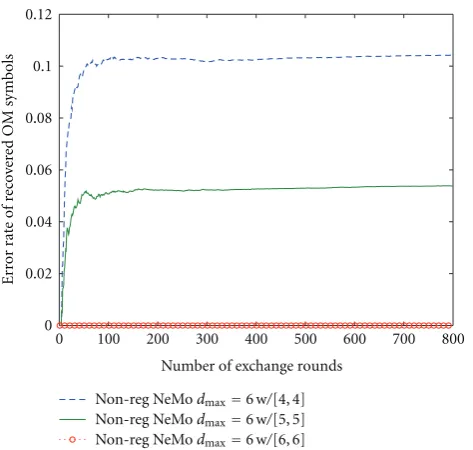
network. We will show that only with a small number of bits, the NeMo works very well numerically.
The network setup is the same as that in Section 5. We adopt fixed-point arithmetics with G integer bits and
F fractional bits to store NM symbols in the memory. Figure 8depicts the error rate of recovered OM symbols at the sink as a function of exchange rounds when dmax = 6 for nonregenerative NeMo. Three curves are plotted for (G,F) combinations (4, 4), (5, 5), and (6, 6), respectively. We find that for (4, 4) and (5, 5) combinations, the error rate increases quickly in the first a few rounds and keeps the same level after that. This means the quantization error does not deteriorate over time. We also find that with the increase of memory usage, the error rate decreases dramatically. When the fixed-point representation with (6, 6) combination is adopted, the performance is the same as that of the ideal case, that is, no error happens at the sink. Similar claims hold for regenerative NeMo.
Here, we reveal tradeoffs of NeMo on persistence rate, memory usage, and complexity. If more bits are adopted, the memory usage and complexity are higher, but persistence rate is also higher. The trigger of these tradeoffs isdmax. These also show that NeMo is independent from physical layer modulation once the waveforms are stored and operated as bits. Therefore, the selection ofdmax should depend on the network resources (e.g., complexity, delay constraint), but not on the physical layer noise and link quality.
6.3. Node Failure. We want to make our scheme effective and robust in a resource-constrained and disaster-prone environment. Here we evaluate our NeMo in two types of scenarios: (i) random failure, where every node randomly dies due to the limited resource (e.g., battery power); and (ii) regional failure, where the network or its parts may be
0 100 200 300 400 500 600
Figure9: (a) Random failure whentr =20 and 100; (b) Regional failure whentd=10 and 100.
destroyed or affected in some way. For example, in the event of fire, flood, or earthquake, the nodes in a certain region may stop functioning simultaneously.
Reg NeMo
GC
200 400 600 800 1000 0
0 1
0.1 0.2 0.3 0.4 0.5 0.6 0.7 0.8 0.9
Number of exchange rounds
Data
persist
enc
e
Non-reg NeMo
Figure10: Average persistence from experiments.
Table3: CPU time (in seconds).
Persistence 95% 35% 10%
Nonreg NeMo 55.07 3.55 0.84
Reg NeMo 38.77 4.76 1.65
GC N/A 1.5 0.25
nonregenerative and regenerative) is not impacted much since they converge very fast (close to persistence 1 before 100 rounds). Whentr = 20, the achieved persistence decreases since a portion of symbols have not obtained the opportunity to propagate to the active areas. Thedmaxconstraint worsens the performance.
6.3.2. Regional Failure. We simulate this scenario by dis-abling part of the network at the time of disaster. Suppose thattdis the exchange round when the disaster happens, and the nodes within distancerfrom a randomly located disaster center will stop functioning and all the links connecting them fail together. In Figure 9(b), we plot data persistence as a function of the disaster radiusr fortd = 10 and 100, respectively. Similar to the observed in the random case, whentd=100, both regenerative and nonregenerative NeMo (their curves are overlapped in the figure.) achieve the perfect persistence regardless of the disaster radius due to the fast convergence speed of NeMo. But if there isdmaxconstraint, the achieved persistence decreases when the disaster radius increases. Again, we observe that more symbols are recovered at the sink for a disaster that happened attd =100 than that attd=10.
7. Experiment Results
We carry out an experiment with the software-defined radio (SDR) to demonstrate the feasibility of NeMo in
practice. Both the transmitter and the receiver of SDR are implemented by RFX2400 daughterboards as in [34], which is a Universal Software Radio Peripheral (USRP) [35]. Channel coding is not applied in this experiment. Signal processing modules such as modulation and demodulation are implemented in Matlab. The square-root raised cosine pulse shaping filter is adopted, and the symbol duration is Tc = 5Te, where Te = 1μs is the sampling period. Complex samples are passed to the transmitter, where they are converted to an analog signal by the digital to analog converter, upconverted to the carrier frequency 2422 MHz, and then transmitted through a wireless channel. This process is inverted at the receiver.
For the network setup, 500 sensors/nodes and one sink node are placed randomly in a 1 × 1 square area as in Section 5. The radius of the neighborhood of each node is R = 0.3. The OM symbols generated at each node is BPSK modulated as 1 or−1. The slotted transmissions with collisions are considered. The probability that each node transmits its packet at the beginning of each exchange round is fixed as 0.5. We set dmax = 6 for both nonregenerative and regenerative NeMo and assume that the sink operates as a normal node. Here we also give nonregenerative NeMo an upper bound on the modulation degree due to the unavoidable noise effect in the real environment.
The communications among the 500 nodes are simulated
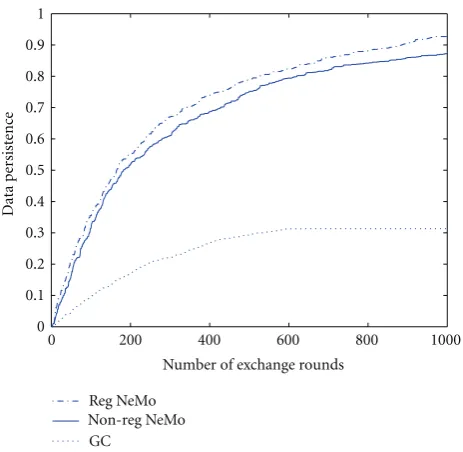
in Matlab, while the transmission from one neighbor
(transmitter) to the sink (receiver) is implemented using two RFX2400 daughterboards. The average persistence of nonregenerative NeMo and regenerative NeMo is depicted in Figure 10. The performance of GC is also given as a reference. From the figure, we can see that both regenerative and non-regenerative NeMo approach persistence 1 (even withdmax= 6) in a practical environment quickly, while GC only collects around 35% information. This confirms our observation in simulation. We also compare the complexity of NeMo and GC inTable 3by measuring the CPU time required to achieve persistence 95%, 35%, and 10%, respectively. Note that the computational time to generate the network and the neighbor list is not included. From the table we can see that regenerative NeMo in general consumes more time than nonregenerative NeMo because of the demodulation complexity at each node. GC requires less time to achieve low persistence thanks to its binary operations. As persistence increases, GC becomes comparable with NeMo since NeMo reaches higher persistence faster. In addition, GC never reaches persistence higher than 35%.
8. Conclusion
speed. We have evaluated NeMo with different performance criteria (such as modulation and demodulation complexity, convergence speed, and memory usage). Both simulation and experiment results show effectiveness of NeMo. NeMo reveals a new regime for random network transmissions. Some future research directions include enhancing network lifetime by taking into account nodes with finite energy, designing NeMo for nodes with unequal importance and/or mobility, and investigating NeMo over wireless fading envi-ronments.
References
[1] W. R. Heinzelman, J. Kulik, and H. Balakrishnan, “Adaptive protocols for information dissemination in wireless sensor networks,” in Proceedings of the 5th Annual ACM/IEEE International Conference on Mobile Computing and Networking (MOBICOM ’99), pp. 174–185, Seattle, Wash, USA, August 1999.
[2] J. N. Al-Karaki and A. E. Kamal, “Routing techniques in wire-less sensor networks: a survey,”IEEE Wireless Communications, vol. 11, no. 6, pp. 6–27, 2004.
[3] C. Perkins and P. Bhagwat, “Highly dynamic destination-sequenced distance-vector routing (DSDV) for mobile com-puters,” in Proceedings of the ACM Conference on Applica-tions, Technologies, Architectures, and Protocols for Computer Communication (SIGCOMM ’94), pp. 234–244, London, UK, August-September 1994.
[4] D. Johnson and D. Maltz, “Dynamic source routing in ad-hoc wireless networks,” inProceedings of the ACM Conference on Applications, Technologies, Architectures, and Protocols for Computer Communication (SIGCOMM ’96), pp. 153–181, Stanford, Calif, USA, August 1996.
[5] C. Perkins and E. M. Royer, “Ad-hoc on-demand distance vector routing,” inProceedings of the 2nd IEEE Workshop on Mobile Computing Systems and Applications, pp. 90–100, New Orleans, La, USA, February 1999.
[6] B. Karp and H. T. Kung, “GPSR: greedy perimeter stateless routing for wireless networks,” inProceedings of the 6th Annual International Conference on Mobile Computing and Networking (MOBICOM ’00), pp. 243–254, Boston, Mass, USA, August 2000.
[7] S. M. Das, H. Pucha, and Y. C. Hu, “MicroRouting: a scalable and robust communication paradigm for sparse ad hoc networks,” inProceedings of the 19th IEEE International Parallel and Distributed Processing Symposium (IPDPS ’05), Denver, Colo, USA, April 2005.
[8] S. Acedanski, S. Deb, M. M´edard, and R. Koetter, “How good is random linear coding based distributed networked storage?” inProceedings of the 1st Workshop on Network Coding, Theory, and Applications, Riva del Garda, Italy, April 2005.
[9] A. G. Dimakis, P. B. Godfrey, M. J. Wainwright, and K. Ram-chandran, “Network coding for distributed storage systems,” inProceedings of the 26th IEEE International Conference on Computer Communications (INFOCOM ’07), pp. 2000–2008, Anchorage, Alaska, USA, May 2007.
[10] A. G. Dimakis, J. Wang, and K. Ramchandran, “Unequal growth codes: intermediate performance and unequal error protection for video streaming,” in Proceedings of the IEEE Workshop on Multimedia Signal Processing, pp. 107–110, Chania, Greece, October 2007.
[11] A. G. Dimakis, V. Prabhakaran, and K. Ramchandran, “Ubiq-uitous access to distributed data in large-scale sensor networks through decentralized erasure codes,” inProceedings of the 4th International Symposium on Information Processing in Sensor Networks (IPSN ’05), pp. 111–117, Los Angeles, Calif, USA, April 2005.
[12] A. Jiang, “Network coding for joint storage and transmission with minimum cost,” inProceedings of the IEEE International Symposium on Information Theory (ISIT ’06), pp. 1359–1363, Seattle, Wash, USA, July 2006.
[13] A. Kamra, V. Misra, J. Feldman, and D. Rubenstein, “Growth codes: maximizing sensor network data persistence,” in Pro-ceedings of the ACM Conference on Applications, Technologies, Architectures, and Protocols for Computer Communication (SIGCOMM ’06), pp. 255–266, Pisa, Italy, September 2006. [14] J. W. Byers, M. Luby, M. Mitzenmacher, and A. Rege, “A digital
fountain approach to reliable distribution of bulk data,” in
Proceedings of the ACM Conference on Applications, Technolo-gies, Architectures, and Protocols for Computer Communication (SIGCOMM ’98), pp. 56–67, Vancouver, Canada, August-September 1998.
[15] C. E. Shannon, “A mathematical theory of communication,”
Bell System Technical Journal, vol. 27, pp. 379–423, 623–656, 1948.
[16] R. Ahlswede, N. Cai, S.-Y. R. Li, and R. W. Yeung, “Network information flow,”IEEE Transactions on Information Theory, vol. 46, no. 4, pp. 1204–1216, 2000.
[17] S.-Y. R. Li, R. W. Yeung, and N. Cai, “Linear network coding,”
IEEE Transactions on Information Theory, vol. 49, no. 2, pp. 371–381, 2003.
[18] T. Ho, R. Koetter, M. M´edard, D. Karger, and M. Effros, “The benefits of coding over routing in a randomized setting,” in
Proceedings of IEEE International Symposium on Information Theory (ISIT ’03), pp. 227–234, Yokohama, Japan, June-July 2003.
[19] D. Wang, Q. Zhang, and J. Liu, “Partial network coding: theory and application for continuous sensor data collection,” in
Proceedings of the 14th IEEE International Workshop on Quality of Service (IWQoS ’06), pp. 93–101, New Haven, Conn, USA, June 2006.
[20] S. Katti, D. Katabi, W. Hu, H. Rahul, and M. M´edard, “The importance of being opportunistic: practical network coding for wireless environments,” in Proceedings of the Annual Allerton Conference on Communication, Control, and Computing, Allerton, Ill, USA, September 2005.
[21] S. Katti, H. Rahul, W. Hu, D. Katabi, M. M´edard, and J. Crowcroft, “XORs in the air: practical wireless network coding,” in Proceedings of the ACM Conference on Applica-tions, Technologies, Architectures, and Protocols for Computer Communication (SIGCOMM ’06), pp. 243–254, Pisa, Italy, September 2006.
[22] D. Munaretto, J. Widmer, M. Rossi, and M. Zorzi, “Network coding strategies for data persistence in static and mobile sensor networks,” inProceedings of the International Workshop on Wireless Networks: Communication, Cooperation and Com-petition, pp. 1–8, Limassol, Cyprus, April 2007.
[23] J. Liu, Z. Liu, D. Towsley, and C. H. Xia, “Maximizing the data utility of a data archiving & querying system through joint coding and scheduling,” inProceedings of the 6th International Symposium on Information Processing in Sensor Networks (IPSN ’07), pp. 244–253, Cambridge, Mass, USA, April 2007. [24] Y. Lin, B. Li, and B. Liang, “Differentiated data persistence
International Conference on Distributed Computing Systems (ICDCS ’07), pp. 47–47, Toronto, Canada, June 2007. [25] S. Karande, K. Misra, and H. Radha, “Natural growth
codes: partial recovery under random network coding,” in
Proceedings of the 42nd Annual Conference on Information Sciences and Systems (CISS ’08), pp. 540–544, Princeton, NJ, USA, March 2008.
[26] R. Koetter and M. M´edard, “An algebraic approach to network coding,”IEEE/ACM Transactions on Networking, vol. 11, no. 5, pp. 782–795, 2003.
[27] J. Ebrahimi and C. Fragouli, “Algebraic algorithms for vec-tor network coding,” 2010, http://infoscience.epfl.ch/record/ 144144.
[28] S. B. Wicker,Reed-Solomon Codes and Their Applications, IEEE Press, Piscataway, NJ, USA, 1994.
[29] M. Luby, “LT codes,” inProceedings of the IEEE Symposium on the Foundations of Computer Science (FOCS ’02), pp. 271–271, Vancouver, Canada, November 2002.
[30] R. G. Gallager, “Low-density parity-check codes,”IEEE Trans-actions on Information Theory, vol. 8, no. 1, pp. 21–28, 1962. [31] C. Berrou, A. Glavieux, and P. Thitimajshima, “Near Shannon
limit error-correcting coding and encoding: turbo-codes,” in
Proceedings of the IEEE International Conference on Commu-nications (ICC ’93), pp. 1064–1070, Geneva, Switzerland, May 1993.
[32] L. Li, R. Alimi, R. Ramjee et al., “Superposition coding for wireless mesh networks,” in Proceedings of the 13th Annual ACM International Conference on Mobile Computing and Networking (MobiCom ’07), pp. 330–333, Montreal, Canada, September 2007.
[33] Y. Xin, Z. Wang, and G. B. Giannakis, “Space-time diversity systems based on linear constellation precoding,”IEEE Trans-actions on Wireless Communications, vol. 2, no. 2, pp. 294–309, 2003.
[34] S. Katti, S. Gollakota, and D. Katabi, “Embracing wireless interference: analog network coding,” in Proceedings of the ACM Conference on Applications, Technologies, Architectures, and Protocols for Computer Communication (SIGCOMM ’07), pp. 397–408, Kyoto, Japan, August 2007.
[35] Ettus Research LLC, “Universal software radio peripheral,”