Guidelines for malaria vector control
ISBN 978-92-4-155049-9
© World Health Organization 2019
Some rights reserved. This work is available under the Creative Commons Attribution-NonCommercial-ShareAlike 3.0 IGO licence (CC BY-NC-SA 3.0 IGO; https://creativecommons. org/licenses/by-nc-sa/3.0/igo).
Under the terms of this licence, you may copy, redistribute and adapt the work for non-commercial purposes, provided the work is appropriately cited, as indicated below. In any use of this work, there should be no suggestion that WHO endorses any specific organization, products or services. The use of the WHO logo is not permitted. If you adapt the work, then you must license your work under the same or equivalent Creative Commons licence. If you create a translation of this work, you should add the following disclaimer along with the suggested citation: “This translation was not created by the World Health Organization (WHO). WHO is not responsible for the content or accuracy of this translation. The original English edition shall be the binding and authentic edition”.
Any mediation relating to disputes arising under the licence shall be conducted in accordance with the mediation rules of the World Intellectual Property Organization.
Suggested citation. Guidelines for malaria vector control. Geneva: World Health Organization; 2019. Licence: CC BY-NC-SA 3.0 IGO.
Cataloguing-in-Publication (CIP) data. CIP data are available at http://apps.who.int/iris.
Sales, rights and licensing. To purchase WHO publications, see http://apps.who.int/ bookorders. To submit requests for commercial use and queries on rights and licensing, see http://www.who.int/about/licensing.
Third-party materials. If you wish to reuse material from this work that is attributed to a third party, such as tables, figures or images, it is your responsibility to determine whether permission is needed for that reuse and to obtain permission from the copyright holder. The risk of claims resulting from infringement of any third-party-owned component in the work rests solely with the user.
General disclaimers. The designations employed and the presentation of the material in this publication do not imply the expression of any opinion whatsoever on the part of WHO concerning the legal status of any country, territory, city or area or of its authorities, or concerning the delimitation of its frontiers or boundaries. Dotted and dashed lines on maps represent approximate border lines for which there may not yet be full agreement.
The mention of specific companies or of certain manufacturers’ products does not imply that they are endorsed or recommended by WHO in preference to others of a similar nature that are not mentioned. Errors and omissions excepted, the names of proprietary products are distinguished by initial capital letters.
Contents
Glossary v
Abbreviations xiii
Executive summary xiv
Recommendations xvi
1. Introduction 1
1.1 Background 1
1.2 Objectives 1
1.3 Scope 2
1.4 Outcomes 2
1.5 Target audience 3
1.6 Funding 3
1.7 Management of conflicts of interest 3
1.8 Methods used to formulate recommendations 4
1.9 Dissemination 9
1.10 Updating 10
1.11 User feedback 10
2. Malaria and related entomological and vector control concepts 11
2.1 Etiology 11
2.2 Vectors and their behaviour and distribution 12
2.3 Background and rationale for vector control 14
3. Recommendations on malaria vector control 17
3.1 Prevention, mitigation and management of insecticide
resistance 21 3.2 Vector control across different malaria transmission settings 30
4. Recommendations on core interventions 34
4.1 Insecticide-treated nets (ITNs) 34
5. Recommendations on supplementary interventions 48
5.1 Larval source management (LSM) 48
6. Recommendations on personal protection measures 52 6.1 Topical repellents, insecticide-treated clothing and spatial/
airborne repellents 52
7. Other interventions 56
7.1 Space spraying 56
7.2 Housing improvements 57
8. Special situations 58
8.1 Residual transmission 58
8.2 Epidemics and humanitarian emergencies 58
8.3 Migrant populations and populations engaged in high-risk
activities 60
9. Implementation challenges 61
9.1 Acceptability, participation and ethical considerations 61
9.2 Equity, gender and human rights 63
9.3 Resource implications and prioritization 64
9.4 Human resources and entomological capacity 65
10. Monitoring and evaluation of vector control 67
10.1 Quality assurance of vector control interventions 67
11. Research agenda to support future updates 70
References 72
MALARIA
The majority of the following definitions are from the WHO publication on malaria terminology, which is subject to periodic update. For the latest edition, please see: www.who.int/malaria/publications/atoz/malaria-terminology/en/. Definitions not yet captured in the WHO malaria
terminology document are indicated with an asterisk.
anthropophilic Description of mosquitoes that show a preference for
feeding on humans, even when non-human hosts are available.
Note: A relative term requiring quantification to indicate the extent of the mosquitoes’ preference for anthropophily versus zoophily, usually expressed as the human blood index (proportion of mosquitoes that have fed on humans out of total that have fed).
artemisinin-based combination therapy
The combination of an artemisinin derivative with a longer acting antimalarial drug that has a different mode of action.
bioassay In applied entomology, experimental testing of the
biological effectiveness of a treatment (e.g. infection, insecticide, pathogen, predator, repellent) by
deliberately exposing insects to the treatment Note: When bioassays are used for the periodic monitoring of the continued efficacy of residual insecticide deposits on sprayed surfaces in houses (as in indoor residual spraying), attention should be paid to the environmental conditions and possible adverse factors (e.g. washing, re-plastering, soot) that affect the deposits on treated surfaces; these factors may reduce the effectiveness of treatment in a way that differs from the intrinsic rate of decay of the insecticide.
biological
insecticide* Pesticides made from natural materials that are meant to kill or control insects. These natural source materials
may include animals, plants, bacteria or minerals.
biting rate Average number of mosquito bites received by a
host in a unit of time, specified according to host and mosquito species (usually measured by human landing collection).
coverage,
universal Access to and use of appropriate interventions by the entire population at risk of malaria.
endemic area An area in which there is an ongoing, measurable
incidence of malaria infection and mosquito-borne transmission over a succession of years.
endemicity,
level of Degree of malaria transmission in an area. Note: Various terms have been used to designate levels of
endemicity, but none is fully satisfactory. Parasite rate or spleen rate has been used to define levels of endemicity in children aged 2–9 years, i.e. hypoendemic: 0–10%, mesoendemic: 10–50%, hyperendemic: constantly > 50% and holoendemic: constantly ≥ 75% with a low adult spleen rate. Parasite density decreases rapidly between 2 and 5 years of age.
endophagy Tendency of mosquitoes to blood-feed indoors.
Note: Contrasts with exophagy.
endophily Tendency of mosquitoes to rest indoors; usually
quantified as the proportion of mosquitoes resting indoors; used in assessing the effect of indoor residual spraying
Note: Contrasts with exophily. entomological
inoculation rate Number of infective bites received per person in a given unit of time in a human population.
Note: This rate is the product of the ‘human biting rate’ (the number of bites per person per day by vector mosquitoes) and the sporozoite rate (proportion of vector mosquitoes that are infective). At low levels of transmission, the estimated entomological inoculation rate may not be reliable, and alternative methods should be considered for evaluating transmission risk.
exophagy Tendency of mosquitoes to blood feed outdoors.
Note: Contrasts with endophagy; usually quantified as the proportion biting hosts outdoors versus indoors, conveniently assessed by comparative human landing catches outdoors and indoors or by observation of biting rates on non-human hosts outdoors.
exophily Tendency of mosquitoes to rest outdoors; usually
quantified as the proportion of mosquitoes resting outdoors versus indoors; used in estimating outdoor transmission risks.
MALARIA
spraying Operational procedure and strategy for malaria vector control that involves spraying interior surfaces
of dwellings with a residual insecticide to kill or repel endophilic mosquitoes.
infectious Capable of transmitting infection; a term commonly
applied to human hosts.
infective Capable of producing infection; a term commonly
applied to parasites (e.g. gametocytes, sporozoites) or to the vector (mosquito).
infectivity* Ability of a Plasmodium strain to establish an infection
in an anopheline mosquito species and undergo development until the mosquito has sporozoites in its salivary glands.
insecticide Chemical product (natural or synthetic) that kills
insects: Ovicides kill eggs; larvicides (larvacides) kill larvae; pupacides kill pupae; adulticides kill adult mosquitoes. Residual insecticides remain active for an extended period.
Note: WHO maintains a prequalification listing of vector
control products (1).
insecticide
resistance Property of mosquitoes to survive exposure to a standard dose of insecticide; may be the result of
physiological or behavioural adaptation. Note: The emergence of insecticide resistance in a vector population is an evolutionary phenomenon due to either behavioural avoidance (e.g. exophily instead of endophily) or physiological factors whereby the insecticide is metabolized, not potentiated, or absorbed less than by susceptible mosquitoes.
integrated vector
management Rational decision-making for optimal use of resources for vector control
Note: The aim is to improve the efficacy,
larval source
management Management of aquatic habitats (water bodies) that are potential habitats for mosquito larvae in order to
prevent completion of development of the immature stages.
Note: The four types of larval source management are: i) habitat modification, which is a permanent alteration of the environment, e.g. land reclamation; ii) habitat manipulation, which is a recurrent activity, e.g. flushing of streams; iii) larviciding, which is the regular application of biological or chemical insecticides to water bodies; and iv) biological control, which consists of the introduction of natural predators into water bodies.
larvicide Substance used to kill mosquito larvae.
Note: Larvicides are applied in the form of oils (to asphyxiate larvae and pupae), emulsions, or small pellets or granules of inert carrier impregnated with insecticide, which is released gradually when they are placed in water.
malaria control Reduction of disease incidence, prevalence, morbidity
or mortality to a locally acceptable level as a result of deliberate efforts. Continued interventions are required to sustain control.
malaria
elimination Interruption of local transmission (reduction to zero incidence of indigenous cases) of a specified malaria
parasite in a defined geographical area as a result of deliberate activities. Continued measures to prevent re-establishment of transmission are required. Note: The certification of malaria elimination in a country requires local transmission to be interrupted for all human malaria parasites.
malaria
eradication Permanent reduction to zero of the worldwide incidence of infection caused by human malaria
parasites as a result of deliberate activities.
Interventions are no longer required once eradication has been achieved.
malaria prevalence (parasite prevalence)
Proportion of a specified population with malaria infection at one time.
malaria incidence Number of newly diagnosed malaria cases during a
defined period in a specified population. malariogenic
MALARIA
malarious area Area in which transmission of malaria is occurring or
has occurred during the preceding three years. net,
insecticide-treated* Mosquito net that repels, disables or kills mosquitoes that come into contact with the insecticide on the
netting material. The three categories of insecticide-treated net are:
• Conventionally treated net: a mosquito net that has been treated by dipping it into a WHO-recommended insecticide. To ensure its continued insecticidal effect, the net should be re-treated periodically.
• Long-lasting insecticidal net: a factory-treated mosquito net made of netting material with
insecticide incorporated within or bound around the fibres. The net must retain its effective biological activity for at least 20 WHO standard washes under laboratory conditions and three years of recommended use under field conditions.
• Pyrethroid-PBO net: a mosquito net that includes both a pyrethroid insecticide and the synergist piperonyl butoxide. To date, pyrethroid-PBO nets have not met required thresholds to qualify as long-lasting insecticidal nets.
Note: Untreated mosquito nets can also provide substantial protection against mosquito bites, but they have less effect against vectorial capacity and transmission rates.
plasmodium Genus of protozoan blood parasites of vertebrates that
includes the causal agents of malaria. P. falciparum, P. malariae, P. ovale and P. vivax cause malaria in humans. Human infection with the monkey malaria parasite P. knowlesi and very occasionally with other simian malaria species may occur in tropical forest areas.
prequalification Process to ensure that health products are safe,
appropriate and meet stringent quality standards for international procurement.
Public health
intervention* A public health intervention is any effort or policy that attempts to improve mental and physical health on
a population level. Common types of interventions include screening programmes, vaccination, food and water supplementation, and health promotion. Common issues that are the subject of public health interventions include obesity, drug, tobacco and alcohol use, and the spread of infectious diseases such as malaria.
An effort or policy may meet the criteria of a public heath intervention if it prevents disease on both the individual and community level and has a positive impact on public health. For malaria vector control tools, technologies and approaches designed to prevent disease at the community level (e.g. IRS and ITNs), demonstration of public health value is required for WHO to issue a policy recommendation.
public health
value* A product has public health value if it has proven protective efficacy to reduce or prevent infection and/
or disease in humans.
Note: Public health value = epidemiological impact
receptivity Receptivity of an ecosystem to transmission of malaria.
Note: A receptive ecosystem should have e.g. the presence of competent vectors, a suitable climate and a susceptible population.
repellent Any substance that causes avoidance in mosquitoes,
especially substances that deter them from settling on the skin of the host (topical repellent) or entering an area or room (area repellent, spatial repellent, excito-repellent).
sporozoite Motile stage of the malaria parasite that is inoculated
by a feeding female anopheline mosquito and may cause infection.
surveillance Continuous, systematic collection, analysis and
interpretation of disease-specific data for use in planning, implementing and evaluating public health practice.
MALARIA
synergist* A substance that does not itself have insecticidal
properties, but that, when mixed and applied with insecticides of a particular class, considerably enhances their potency by inhibiting an enzyme that normally acts to detoxify the insecticide in the insect system.
transmission
intensity The frequency with which people living in an area are bitten by anopheline mosquitoes carrying human
malaria sporozoites.
Note: Transmission intensity is often expressed as the annual entomological inoculation rate, which is the average number of inoculations with malaria parasites estimated to be received by one person in a given period. Because of the difficulty of measuring entomological inoculation rate, parasite prevalence in young children is often used as a proxy for transmission intensity.
transmission,
residual Persistence of malaria transmission following the implementation in time and space of a widely effective
malaria programme.
Note: The sources of and risks for ‘residual transmission’ may vary by location, time and the existing components of the current ‘effective malaria programme’.
transmission,
seasonal Transmission that occurs only during some months of the year and is markedly reduced during other months.
transmission,
stable Epidemiological type of malaria transmission characterized by a steady prevalence pattern, with
little variation from one year to the next, except as the result of rapid scaling up of malaria interventions or exceptional environmental changes that affect transmission.
Note: In areas with stable transmission, the affected population often has high levels of immunity, and malaria vectors usually have high longevity and human biting rates.
transmission,
unstable Epidemiological type of malaria transmission characterized by large variation in incidence patterns
from one year to the next.
vector In malaria, adult females of any mosquito species in which Plasmodium undergoes its sexual cycle (whereby the mosquito is the definitive host of the parasite) to the infective sporozoite stage (completion of extrinsic development), ready for transmission when a vertebrate host is bitten.
Note: Malaria vector species are usually implicated (incriminated) after field collection and dissection indicates that the salivary glands are infected with sporozoites; specific assays can be used to detect and identify circumsporozoite protein, especially where infection rates are low.
• Principal vector: The species of Anopheles mainly responsible for transmitting malaria in any particular circumstance.
Note: Principal vectors may overlap seasonally or alternate in importance.
• Secondary or subsidiary vector: Species of Anopheles thought to play a lesser role in
transmission than the principal vector; capable of maintaining malaria transmission at a reduced level.
vector control Measures of any kind against malaria-transmitting
mosquitoes, intended to limit their ability to transmit the disease.
Note: Ideally, malaria vector control results in the reduction of malaria transmission rates by reducing the vectorial capacity to a point at which transmission is interrupted.
Note: vector control interventions include tools, technologies and approaches.
vector
susceptibility The degree to which a mosquito population is susceptible (i.e. not resistant) to insecticides.
vectorial capacity Number of new infections that the population of a
given vector would induce per case per day at a given place and time, assuming that the human population is and remains fully susceptible to malaria.
vulnerability The frequency of influx of infected individuals or
groups and/or infective anopheline mosquitoes. Note: Also referred to as ‘importation risk’. The term can also be applied to the introduction of drug resistance in a specific area.
MALARIA
VE
CT
OR CONTROL
GUIDELINE
S
Abbreviations
ANC antenatal care
CIDG Cochrane Infectious Diseases Group
EIR entomological inoculation rate
EPI expanded programme on immunization
GMP Global Malaria Programme
GRADE grading of recommendations assessment,
development and evaluation
IRM insecticide resistance management
IRS indoor residual spraying
ISO International Organization for Standardization
ITN insecticide-treated net
ITPS insecticide-treated plastic sheeting
IVM integrated vector management
LLIN long-lasting insecticidal net
LSM larval source management
MPAC Malaria Policy Advisory Committee
PBO piperonyl butoxide
PICO population, participants or patients; intervention or indicator; comparator or control; outcome
PQ prequalification (WHO)
RCT randomized controlled trial
VCAG Vector Control Advisory Group
VCTEG Technical Expert Group on Malaria Vector Control
Executive summary
Vector control is a vital component of malaria prevention, control and elimination strategies because it can be highly effective in providing personal protection and/or reducing disease transmission. This 1st edition of the World Health Organization (WHO) Guidelines for malaria vector control has been prepared in accordance with the latest WHO standard methods for guideline development. It is a consolidated document that incorporates: i) new recommendations based on systematic reviews of the available evidence on the effectiveness of most, but not yet all, vector control interventions; and ii) existing recommendations developed previously based on expert opinion. Reviews on other interventions are ongoing, and the findings will be added to later editions of the Guidelines. The primary aim of consolidating the available evidence and recommendations was to condense the large, yet fragmented volume of available guidance into an up-to-date and coherent resource for national malaria programmes and their implementing partners. In cases where readers observe inconsistencies with earlier WHO publications, the Guidelines should be considered to supersede prior guidance.
The Guidelines cover core interventions, supplementary interventions, personal protection measures and other interventions. Core interventions for malaria vector control are applicable for all populations at risk of malaria in most epidemiological and ecological settings, namely: i) deployment of insecticide-treated nets (ITNs) that are prequalified by WHO, which in many settings are long-lasting insecticidal nets (LLINs); and ii) indoor residual spraying (IRS) with a product prequalified by WHO. Once high coverage with one core intervention has been achieved, supplementary interventions – namely the deployment of chemical or biological larvicides – can be used in addition to the core interventions in specific settings and circumstances.
The evidence base for larval source management through habitat modification and habitat manipulation was not considered in the
MALARIA
VE
CT
OR CONTROL
GUIDELINE
S
Personal protection measures considered in development of the
Guidelines were topical repellents, insecticide-treated clothing and
indoor spatial/airborne repellents. The evidence base for these
interventions was deemed insufficient to support their recommendation for use as interventions with public health value. However, due to the likely protection of users from mosquito bites and, in turn, malaria infection, the use of topical repellents and insecticide-treated clothing are considered to be public health interventions. WHO is investigating a process and associated evaluation endpoints to develop evidence-based policy recommendations on these and other public health interventions designed to provide personal protection.
1 Statements reflecting consensus of the guidelines development group, but not supported by a systematic
Recommendations
Malaria vector control
MALARIA BURDEN REDUCTION AND ELIMINATION
Priority should be given to delivering either ITNs or IRS at high coverage and to a high standard, rather than introducing the second intervention as a means to compensate for deficiencies in the implementation of the first intervention.
Conditional recommendation against combining the core interventions to
reduce morbidity and mortality, moderate-certainty evidence
Universal coverage with effective vector control using a core intervention (ITNs or IRS) is recommended for all populations at risk of malaria in most epidemiological and ecological settings. The population at risk of malaria may increase or decrease as a result of changes in malariogenic potential of a given geographical area.
Good practice statement 1
Once high coverage with one core intervention has been achieved, programmes may consider deploying the other core intervention as an approach to prevent, manage and mitigate insecticide resistance. The ITN and IRS products selected for co-deployment must not contain the same insecticide class(es). For instance, IRS with a pyrethroid should not be deployed in the same households or areas as ITNs. The decision to deploy a second core vector control intervention should only be taken after conducting a prioritization analysis across malaria interventions, not just vector control, to ensure maximum impact of any additional resources. Good practice statement
Once high coverage with a core intervention has been achieved,
MALARIA
VE
CT
OR CONTROL
GUIDELINE
S
2 The minimum size of an area is determined by the availability of reliable disaggregated disease
surveillance data and feasibility for making decisions on vector control implementation. The area is not necessarily based on administrative boundaries.
3 Defined as 10–80% mosquito mortality in standard WHO susceptibility tests or CDC bottle bioassays deploy a supplementary vector control intervention should only be taken after conducting a prioritization analysis across malaria interventions, not just vector control, to ensure maximum impact of any additional resources. Good practice statement
In areas2 with ongoing local malaria transmission (irrespective of both the pre-intervention and current level of transmission), vector control interventions should not be scaled back. Universal coverage with effective malaria vector control of all inhabitants of such areas should be pursued and maintained.
Good practice statement
In areas2 where transmission has been interrupted, the scale-back of vector control should be based on a detailed analysis that includes assessment of the receptivity and vulnerability, active disease surveillance system, and capacity for case management and vector control response.
Good practice statement
Core interventions
INSECTICIDE-TREATED NETS
Pyrethroid-only LLINs prequalified by WHO are recommended for deployment as a core intervention in all malaria-endemic settings. Strong recommendation as an intervention with public health value, high-certainty evidence
Recipients of ITNs should be advised (through appropriate communication strategies) to continue using their nets beyond the three-year anticipated lifespan of the net, irrespective of the condition of the net, until a
replacement net is available. Good practice statement
Recipients of ITNs should be advised (through appropriate communication strategies) to continue using their net even if it is damaged or contains holes, irrespective of the age of the net, until a replacement net is available. Good practice statement
Recipients of ITNs should be advised (through appropriate
communication strategies) not to dispose of their nets in any water body, as the residual insecticide on the net can be toxic to aquatic organisms (especially fish).
Good practice statement
Old ITNs should only be collected where there is assurance that: i)
communities are not left uncovered, i.e. new ITNs are distributed to replace old ones; and ii) there is a suitable and sustainable plan in place for safe disposal of the collected material.
Good practice statement
If ITNs and their packaging (bags and baling materials) are collected, the best option for disposal is high-temperature incineration. They should not be burned in the open air. In the absence of appropriate facilities, they should be buried away from water sources and preferably in non-permeable soil.
Good practice statement
INDOOR RESIDUAL SPRAYING
IRS deploying a product prequalified by WHO is recommended as a core intervention in all malaria-endemic settings. DDT has not been prequalified; it may be used for IRS if no equally effective and efficient alternative is available, and if it is used in line with the Stockholm Convention on Persistent Organic Pollutants.
MALARIA
VE
CT
OR CONTROL
GUIDELINE
S
Supplementary interventions
LARVICIDING
The regular application of biological or chemical insecticides to water bodies (larviciding) is recommended as a supplementary intervention in areas where high coverage with a core intervention has been achieved, where aquatic habitats of the principal malaria vector(s) are few, fixed and findable, and where its application is both feasible and cost-effective. Conditional recommendation as an intervention with public health value, low-certainty evidence
Personal protection measures
TOPICAL REPELLENTS
Deployment of topical repellents is not recommended as an intervention with public health value; however, topical repellents may be beneficial as an intervention to provide personal protection.
Conditional recommendation against deployment as an intervention with
public health value, low-certainty evidence
INSECTICIDE-TREATED CLOTHING
Use of insecticide-treated clothing is not recommended as an intervention with public health value; however, insecticide-treated clothing may be beneficial as an intervention to provide personal protection in specific population groups.
Conditional recommendation against deployment as an intervention with
Other interventions
SPACE SPRAYING
Space spraying should not be undertaken for malaria control, and IRS or ITNs should be prioritized instead.
MALARIA
VE
CT
OR CONTROL
GUIDELINE
S
1. Introduction
1.1 BACKGROUND
Malaria remains an important cause of illness and death in children and adults throughout the world, with 87 countries reporting one or more cases of malaria in 2017. Malaria control requires an integrated approach, including prevention (with an emphasis on vector control, plus chemoprevention), early diagnosis and prompt effective treatment. The WHO Guidelines for the treatment of malaria were first developed in 2006 and have been revised periodically, with the most recent edition published in 2015. To date there has been no equivalent comprehensive guidelines document on malaria vector control.
WHO guidelines contain recommendations on clinical practice or public health policy intended to guide end-users as to the individual or collective actions that can or should be taken in specific situations to achieve the best possible health outcomes. Such recommendations are also designed to help the user to select and prioritize interventions from a range of potential alternatives. The recommendations in this 1st edition of the Guidelines for malaria vector control are based on a firm evidence base
for certain interventions, whereas for other interventions, major information gaps necessitated formulation of guidance based on expert opinion. The Guidelines will therefore remain under regular review; updates are envisioned on an ongoing basis as new evidence becomes available.
The recommendations and their rationale presented in the main body of this document are brief so as to facilitate quick reference. More detail on the underlying evidence base is provided in a series of annexes.
1.2 OBJECTIVES
The objectives of the Guidelines are:
1. to provide evidence-based recommendations on the appropriate choice(s) of vector control options for malaria prevention and control; 2. to inform and guide technical decisions on the effective implementation
3. to support the development by WHO Member States of evidence-based national malaria vector control policies and strategies; 4. to facilitate uptake of WHO guidance by bringing together a large
number of existing guidance documents on malaria vector control into one document; and
5. to inform a research agenda to support revision of the Guidelines by identifying gaps in evidence that are constraining the development of guidance or weakening current recommendations.
1.3 SCOPE
The Guidelines provide evidence-based recommendations pertaining to vector control tools, technologies and approaches (collectively termed “interventions”) that are currently available for malaria prevention and control, and for which sufficient evidence on their efficacy is available to support systematic reviews. For areas where evidence is currently weak or absent, the development of guidance relies on expert opinion to a considerable extent. The vector control recommendations presented in the Guidelines are based on a consideration of the evidence gained from randomized controlled trials (RCTs) and other types of trials and studies, as well as the technical knowledge and experience of the Guidelines Development Group, Guidelines Steering Group and External Review Group (the latter of which was comprised of members of the Malaria Policy Advisory Committee (MPAC)) (Annex 1).
The Guidelines are intended to provide an underlying framework for the design of effective, evidence-based national vector control strategies and their adaptation to local disease epidemiology and vector bionomics.
1.4 OUTCOMES
MALARIA
protecting individual users, although they may have some as yet unproven public health value. Other interventions with potential public health value are also presented. For some interventions, the evidence base is currently under review. The outcome of these revisions will inform the formulation of revised or new recommendations, to be incorporated into the Guidelines.
1.5 TARGET AUDIENCE
The Guidelines have been developed primarily for programme managers, health professionals, environmental health services professionals,
procurement agencies and others responsible for implementing and financing malaria vector control in malaria-endemic countries. The
Guidelines are also intended for use by international development
partners, donors and funding agencies in order to support decision-making on the selection of interventions and procurement of appropriate vector control products. They are also intended to guide researchers and those interested in the outcomes of research to address the evidence gaps that are constraining the development of guidance or weakening current recommendations.
1.6 FUNDING
The Guidelines, developed by the WHO Global Malaria Programme, were funded through an umbrella grant agreement with the Bill & Melinda Gates Foundation. No other external source of funding either from bilateral technical partners or from industry was solicited or used.
1.7 MANAGEMENT OF CONFLICTS OF INTEREST
All members of the Guidelines Development Group and the Expert Review Group made declarations of interest, which were managed in accordance with standard WHO procedures and cleared by the Office of Compliance, Risk Management and Ethics. The WHO Guidelines Steering Group and the Chair of the Guidelines Development Group were satisfied that there had been a transparent declaration of interests. No case necessitated the exclusion of any Guidelines Development Group or Expert Review Group members. No potential conflicts of interest that could have
1.8 METHODS USED TO FORMULATE
RECOMMENDATIONS
The Guidelines were prepared in accordance with latest standard WHO methods for guideline development (3). Types of outcome measures
assessed in the evidence reviews included: rate of all-cause child mortality; incidence rate of malaria; incidence rate of severe malaria episodes; rate of clinical malaria; rate of uncomplicated episodes of P. falciparum; malaria incidence; parasite prevalence (also specifically P. falciparum and P. vivax prevalence); anaemia prevalence; entomological inoculation rate (EIR); density of immature vector stages; and, number of larval sites positive for immature vector stages.
The WHO guideline development process involves planning; conducting a ‘scoping’ and needs assessment; establishing an internal WHO Guidelines Steering Group and an external Guidelines Development Group; formulating key questions in PICO format; commissioning evidence reviews; applying Grading of Recommendations Assessment, Development and Evaluation (GRADE) to the certainty of evidence; and making
recommendations. This methodology (see Annex 2) ensures that the link between the evidence base and the recommendations is transparent.
The WHO Guidelines Steering Group was responsible for drafting the scope of the Guidelines and preparing the planning proposal, formulating key questions, identifying potential members for the Guidelines Development Group, obtaining declarations of interest from Guidelines Development Group members, managing any conflicts of interest, and submitting the finalized planning proposal to the Guidelines Review Committee for review.
The Guidelines Development Group was an external body whose central task was to develop the evidence-based recommendations contained in the Guidelines. The specific tasks of the Guidelines Development Group included:
• providing inputs as to the scope of the Guidelines;
• assisting the Guidelines Steering Group in developing the key questions in PICO format;
• choosing and ranking priority outcomes to guide the evidence reviews and focus the recommendations;
MALARIA
• interpreting the evidence, with explicit consideration of the overall balance of benefits and harms;
• formulating recommendations, taking into account benefits, harms, values and preferences, feasibility, equity, acceptability, resource requirements and other factors, as appropriate;
• identifying methodological issues and evidence gaps, and providing guidance on how to address these; and
• reviewing and approving the final document prior to submission to the Guidelines Review Committee.
The Guidelines Development Group established for these Guidelines consisted of 13 members that included: relevant technical experts; intended end-users (programme managers and health professionals responsible for adopting, adapting and implementing the Guidelines); other
representatives from malaria-endemic countries; and experts in assessing evidence and developing evidence-based guidelines. The Chair of the Guidelines Development Group and several of its members had expertise in ensuring that equity, human rights, gender and social determinants are taken into consideration in efforts to improve public health outcomes.
The Guidelines Development Group used GRADEPro software (https://gradepro.org/), specifically the interactive Evidence-to-Decision Framework, to assist in the process of evidence review and recommendation-setting. The Evidence-to-Decision Framework considers 12 criteria to arrive at a recommendation for or against an intervention; these are listed in Annex 3 along with accompanying descriptions.
The Evidence-to-Decision Framework summaries for each of the recommendations contained in the Guidelines are presented alongside the GRADE tables in Annex 4. Selected external reviewers, consisting of persons interested in the subject of the Guidelines and individuals who would be affected by the recommendations, conducted a peer review of the draft Guidelines document to inform revisions prior to its submission to the Guidelines Review Committee for approval.
Sources of evidence
systematic reviews covering larviciding, the deployment of larvivorous fish, and ITNs were updated. GRADE tables for IRS were produced based on the existing 2010 review (as no new studies have been published since 2010), and an ongoing systematic review on topical insect repellents was completed.
The inclusion criteria for the reviews were RCTs and quasi-experimental designs, including controlled before-and-after studies, interrupted time series (controlled and uncontrolled), and stepped wedge designs. All reviews and updates involved searches of the CIDG Specialized Register; the Cochrane Central Register of Controlled Trials, the Cochrane Library; MEDLINE (PubMed); Embase (OVID); CABS Abstracts (Web of Science); and LILACS (BIREME). The WHO International Clinical Trials Registry Platform, ClinicalTrials.gov and the ISRCTN registry were also searched to identify trials in progress. A combination of controlled vocabulary terms and free-text terms was used, including: malaria, mosquito, Anopheles, insecticides, bednets, ITN, IRS, and additional terms for the interventions specific to each review. Detailed search terms are reported in the Appendix of each review protocol, as published in the Cochrane Database of Systematic Reviews. Searches were not limited by time or publication language. Reference lists of all included studies were reviewed and the “similar articles” function in MEDLINE was used to see if additional studies could be identified.
Each search was independently assessed by two review authors. Included studies were described, assessed, and data presented as specified in the protocol using Covidence and Review Manager 5 software. GRADE formulation and application of subgroup analysis was carried out by the review author teams, with oversight from the CIDG editorial team, including the Co-ordinating Editor, three Editors, and the SIDG Statistician.
In formulating its recommendations, the Guidelines Development Group also considered additional evidence that was deemed unsuitable for inclusion and analysis under the Cochrane systematic review process, particularly in developing the Evidence-to-Decision Frameworks (Annex 4). IRS is a core intervention for malaria prevention and control that has been used successfully in malaria-endemic countries for decades, but is an intervention for which few RCTs have been conducted. Therefore, the availability of data suitable for use in a Cochrane-style meta-analysis is limited. A separate systematic review of the large body of evidence generated from the IRS implementation trials and from national control programmes will be conducted to further strengthen the evidence base to support recommendations pertaining to this core intervention.
MALARIA
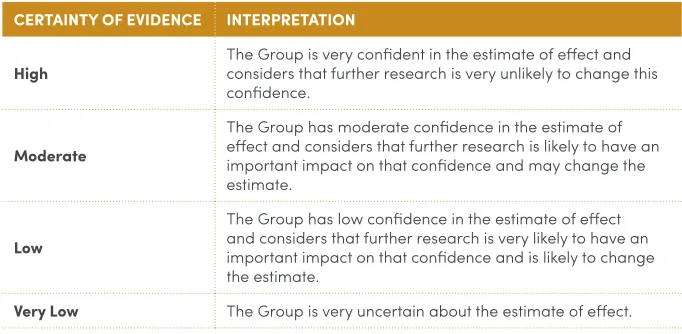
The certainty of evidence from the systematic reviews was assessed for each outcome and rated on a four-point scale (Table 1), after considering the risk of bias (including publication bias) and the consistency, directness and precision of the effect estimates. The terms used in the certainty assessments refer to the Guidelines Development Group’s level of
confidence in the estimate of effect (and not to the scientific quality of the investigations reviewed).
TABLE 1
The four classes of certainty of evidence used in GRADE
CERTAINTY OF EVIDENCE INTERPRETATION
High The Group is very confident in the estimate of effect and considers that further research is very unlikely to change this confidence.
Moderate
The Group has moderate confidence in the estimate of effect and considers that further research is likely to have an important impact on that confidence and may change the estimate.
Low
The Group has low confidence in the estimate of effect and considers that further research is very likely to have an important impact on that confidence and is likely to change the estimate.
Very Low The Group is very uncertain about the estimate of effect.
Presentation of evidence and link to recommendations
For ease of reference, the recommendations are presented in a simplified descriptive form in the main document. The recommendations are shown in boxes in each respective section (light green);an evidence box (light grey) is also presented for each recommendation. The complete GRADE tables and additional references are provided in Annex 4.
Formulation of recommendations
of the intervention to the beneficiaries. Although cost is a critical factor in setting national vector control policies and was broadly considered in the recommendation formulation process, explicit analyses of the costs and cost-effectiveness of the various interventions did not form part of the Cochrane reviews conducted for this 1st edition of the Guidelines. Expanded evidence-based recommendations on resource implications will be
developed and incorporated into a revised version of the Guidelines.
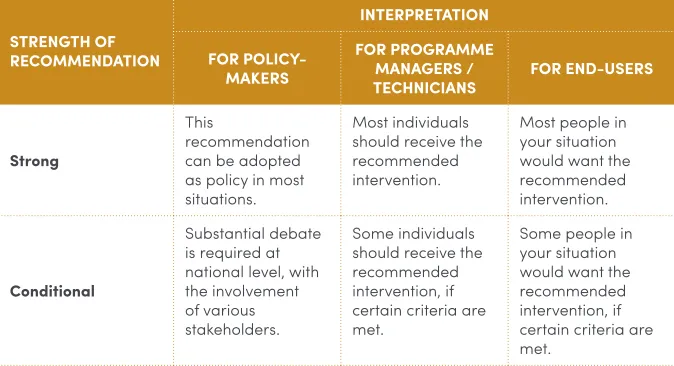
The Guidelines Development Group discussed the proposed wording of each recommendation at in-person meetings and through e-mail correspondence and teleconferencing, and rated the strength of each recommendation in accordance with the four-point scale presented in
Table 1. The guideline development process aimed to generate group consensus; voting on specific points was available as an option to finalize recommendations on which no consensus could be reached. The final draft was circulated to the Guidelines Development Group and the
External Review Group (Annex 1). Comments from external reviewers were incorporated into the revised Guidelines as appropriate.
TABLE 2
Factors other than certainty of evidence considered in the formulation of recommendations
FACTORS CONSIDERED RATIONALE
Balance of benefits and harm
The more the expected benefits outweigh the expected risks, the more likely it is that a strong recommendation will be made. When the balance of benefits and harm is likely to vary by setting or is a fine balance, a conditional recommendation is more likely.
Values and preferences If the recommendation is likely to be widely accepted or highly valued, a strong recommendation is more likely.
Feasibility If an intervention is achievable in the settings in which the greatest impact is expected, a strong recommendation is
more likely.
Types of guidance
Two types of guidance are presented in the Guidelines.
• Intervention recommendations: These recommendations were
MALARIA
• Good practice statements: These statements reflect a consensus
among the panel that the net benefits of adherence to the statement are large and unequivocal, and that the implications of the statement are common sense. These statements have usually been taken or adapted from existing recommendations or guidance initially developed through broad consultation, such as through the WHO Technical Expert Group on Malaria Vector Control (VCTEG) or MPAC. These statements are made to reinforce the basic principles of good management practice for implementation.
Strength of recommendations
Each intervention recommendation was classified as strong or conditional using the criteria in Table 3:
TABLE 3
to ensure the wide dissemination of the Guidelines to all malaria-endemic countries. The Guidelines will also be disseminated through webinars and through regional, subregional and country meetings, as appropriate. Member States will be supported by WHO in the development and update of national strategies based on these Guidelines.
1.10 UPDATING
Updates to the Guidelines will be undertaken as soon as possible once new evidence for interventions with an existing policy recommendation becomes available, or as the Vector Control Advisory Group (VCAG) assesses new vector control tools, technologies or approaches, their public health value is validated and a WHO policy recommendation supporting their deployment has been formulated (4). Periodic monitoring and
evaluation of the use of the Guidelines by Member States will be conducted by means of malaria programme reviews and other technical support missions.
1.11 USER FEEDBACK
MALARIA
VE
CT
OR CONTROL
GUIDELINE
S
2. Malaria and related
entomological and
vector control concepts
2.1 ETIOLOGY
Malaria is a life-threatening disease caused by the infection of red blood cells with protozoan parasites of the genus Plasmodium that are transmitted to people through the bites of infected female Anopheles mosquitoes. Four species of Plasmodium (P. falciparum, P. vivax,
P. malariae and P. ovale) most commonly infect humans. P. falciparum
and P. vivax are the most prevalent species and P. falciparum is the most dangerous. A fifth species, P. knowlesi (a species of Plasmodium that primarily infects non-human primates) is increasingly being reported in humans inhabiting forested regions of some countries of South-East Asia and the Western Pacific regions, and in particular on the island of Borneo.
The intensity of transmission depends on factors related to the parasite, the vector, the human host and the environment. Transmission tends to be more intense in places where the mosquito lifespan is longer and where the females prefer to bite humans rather than other animals. The survival and longevity of female mosquitoes is of critical importance in malaria transmission, as the malaria parasite generally requires a period of 7–10 days to develop inside the mosquito into a form that is infective to humans. Female mosquito longevity is dependent on intrinsic, genetic factors, as well as on environmental factors including temperature and humidity. The strong human biting habit of the African vector species is one of the reasons why approximately 90% of the world’s malaria cases occur in Africa.
inoculation,4 partial immunity to clinical disease is acquired in early childhood which results in a reduced risk of developing severe malaria in older children. In situations where transmission is stable, clinical disease is confined mainly to young children before they have acquired partial immunity. These children may develop high parasite densities that can progress very rapidly to severe malaria. By contrast, adolescents and adults are partially immune and consequently seldom suffer clinical disease in these endemic settings, although they may continue to have low densities of parasites in their blood and are capable of infecting mosquitoes. This is the situation in many parts of sub-Saharan Africa. Immunity is modified during pregnancy, such that pregnant women, especially those undergoing their first pregnancy, are at increased risk of both infection and severity of infection. Immunity is gradually lost, at least partially, when individuals move out of an endemic area for long periods of time (usually many years).
In areas of ‘unstable malaria transmission’, which prevail in much of Asia, Latin America and the remaining parts of the world where malaria is endemic, the intensity of malaria transmission fluctuates widely by season and year and over relatively small distances. P. vivax is an important cause of malaria in these regions. The generally low level of transmission retards the acquisition of immunity such that people of all ages – adults and children alike – suffer from acute clinical malaria, with a significant risk that the disease will progress to severe malaria if left untreated. Epidemics may occur in areas of unstable malaria transmission when the EIR increases rapidly following a sudden increase in vector population density or
longevity. Epidemics manifest as a very high incidence of malaria in all age groups. During epidemics, severe malaria is common if prompt, effective treatment is not widely available. Non-immune travellers to a malaria-endemic area are at particularly high risk of severe malaria if their infection is not detected promptly and treated effectively.
2.2 VECTORS AND THEIR BEHAVIOUR AND
DISTRIBUTION
Malaria is transmitted through the bites of infective female Anopheles mosquitoes. There are more than 400 different species of Anopheles mosquito, of which around 40 are malaria vectors of major importance.
Annex 5 presents a list of principal vector species by WHO region, along with a brief description of the key ecological and behavioural characteristics relevant to control.
MALARIA
Anopheles mosquitoes lay their eggs in water. The eggs hatch to produce
larvae, which undergo several moults before emerging from the pupal stage as adult mosquitoes. Different species of Anopheles mosquito have their own preferred aquatic habitats; for example, some prefer small, shallow collections of fresh water such as puddles and animal hoof prints, whereas others prefer large, open water bodies including lakes, swamps and rice fields.
Immediately after emerging from the pupal stage, mosquitoes rest on the water surface until their wings have fully expanded and hardened. After taking an initial meal of plant nectar, female mosquitoes seek a blood meal as they require protein to develop their eggs. In the majority of species of Anopheles, the females feed on warm-blooded animals, usually mammals. Different mosquito species demonstrate preferences for feeding on animals (zoophily) or on humans (anthropophily); however, these preferences are not absolute and females may take a blood meal from a non-preferred host when these are present in the area. Blood-feeding can take place inside human habitations (endophagy) or outdoors (exophagy), depending on the mosquito species. Several factors have been implicated in the attraction of female mosquitoes to a host, including exhaled
carbon dioxide, lactic acid, host odours, warmth and moisture. Different host individuals may be more or less attractive to mosquitoes than other individuals of the same species.
Female Anopheles mosquitoes feed predominantly at night, although some species may bite during the day in heavily shaded conditions, and some exhibit a peak in biting activity in the early evening or early morning. The interplay between the peak biting time of the Anopheles vector and the activity and sleeping patterns of the human host has important consequences for malaria transmission and the choice of appropriate vector control interventions.
After blood-feeding, female mosquitoes rest in order to digest the blood meal and mature their eggs. Female mosquitoes may rest indoors (endophily) or outdoors (exophily), and this depends on innate species preferences as well as the availability of suitable resting sites in the local environment. The mosquitoes’ choice of post-feeding resting site also has major implications for the selection of control interventions.
as the deployment of vector control interventions can all influence biting and resting behaviours. For example, the highly efficient African malaria vector Anopheles gambiae s.s. is generally considered to be human-biting, indoor-biting and indoor-resting, but it can also exhibit more zoophilic and exophagic tendencies. Anopheles arabiensis is a species that generally exhibits an outdoor biting and resting habit, but may exhibit indoor biting and resting tendencies, depending on the availability of alternative hosts.
Accurate species identification is crucial for all studies and surveillance activities on field populations of vectors. Many of the vectors belong to species complexes and require advanced molecular analyses for species identification, necessitating appropriate laboratory resources. Without accurate species identification, data collected on behaviour, distribution and infection rates for decision-making by control programmes will have limited use.
2.3 BACKGROUND AND RATIONALE FOR VECTOR
CONTROL
The role of arthropods in the transmission of diseases to humans was first elucidated in the late 19th and early 20th centuries. Since effective vaccines or drugs were not always available for the prevention or treatment of these diseases, control of transmission often had to rely principally on control of the vector. Early control activities included the screening of houses, the use of mosquito nets, the drainage or filling of swamps and other water bodies used by insects for breeding, and the application of oil or Paris green to breeding places. Following the discovery of the insecticidal properties of dichlorodiphenyltrichloroethane (DDT) in the 1940s and subsequent discovery of other insecticides, the focus of malaria vector control shifted to the deployment of insecticides to target both the larval and adult stages of mosquito vectors.
MALARIA
The control of malaria, unlike that of most other vector-borne diseases, has seen a major increase in financial resources since 2000, leading to a significant reduction in the global burden. Between 2000 and 2015, the infection prevalence of P. falciparum in endemic Africa was halved and the incidence of clinical disease fell by 40% (8). Malaria control interventions averted an estimated 663 (credible interval (CI) 542–753) million clinical cases in Africa, with ITNs making the largest contribution (68% of cases averted). IRS contributed an estimated 13% (11–16%), with a larger proportional contribution where intervention coverage was high (7).
Global vector control response 2017–2030
In 2017, the World Health Assembly welcomed the Global vector control
response 2017–2030 (6) and adopted a resolution to promote an
integrated approach to the control of vector-borne diseases. The approach builds on the concept of integrated vector management (IVM),5 but with renewed focus on improved human capacity at national and subnational levels, and an emphasis on strengthening infrastructure and systems, particularly in areas vulnerable to vector-borne diseases.
The vision of WHO and the broader infectious diseases community is a world free of human suffering from vector-borne diseases. The ultimate aim of the Global Vector Control Response is to reduce the burden and threat of vector-borne diseases through effective, locally adapted, sustainable vector control in full alignment with Sustainable Development Goal 3.3. The 2030 targets are: to reduce mortality due to vector-borne diseases globally by at least 75% (relative to 2016); to reduce case incidence due to vector-borne diseases globally by at least 60% (relative to 2016); and to prevent epidemics of vector-borne diseases in all countries. Detailed national and regional priority activities and associated interim targets for 2017–2022 have also been defined.
Effective and locally adaptive vector control systems depend on two foundational elements: i) enhanced human, infrastructural and health system capacity within all locally relevant sectors for vector surveillance and vector control delivery, monitoring and evaluation; and ii) innovation for the development of new tools, technologies and approaches and increased basic and applied research to underpin optimized vector control. Both elements are required to ensure the maximum impact of sustainable vector control by using an evidence-based approach to planning and implementation.
5 WHO defines IVM as a rational decision-making process to optimize the use of resources for vector
Effective and sustainable vector control is achievable only with sufficient human resources, an enabling infrastructure and a functional health system. Countries should conduct a vector control needs assessment (9) to help appraise current capacity, define the requisite capacity to conduct proposed activities, identify opportunities for improved efficiency in vector control delivery, and guide resource mobilization to implement the national strategic plan.
Action is required in four key areas (pillars) that are aligned with IVM: i) strengthening inter- and intra-sectoral action and collaboration;
ii) engaging and mobilizing communities; iii) enhancing vector surveillance and monitoring and evaluation of interventions; and iv) scaling up and integrating tools and approaches.
In some settings, vector control interventions can reduce transmission and disease burden of more than one disease. Examples include ITNs against malaria and lymphatic filariasis (in settings where Anopheles mosquitoes are the principal vector), IRS against malaria and leishmaniasis in India, and larval control for malaria and dengue vectors in cities with particular vector habitats. Approaches effective against Aedes spp. mosquitoes can have an impact on dengue, chikungunya, Zika virus disease and possibly yellow fever where their vectors and distributions overlap. However,
programmes should avoid an approach that overlays multiple interventions to compensate for deficiencies in implementation of any one intervention; this may divert resources and attention away from reaching the full impact of existing interventions and lead to resource wastage.
MALARIA
VE
CT
OR CONTROL
GUIDELINE
S
3. Recommendations on
malaria vector control
UNIVERSAL COVERAGE
Universal coverage with effective vector control using a core intervention (ITNs or IRS) is recommended for all populations at risk of malaria in most epidemiological and ecological settings. The population at risk of malaria may increase or decrease as a result of changes in malariogenic potential. Good practice statement
Universal health coverage means that all individuals and communities receive the health services they need without suffering financial hardship. It includes the full spectrum of essential, quality health services, from health promotion to prevention, treatment, rehabilitation and palliative care. In the context of malaria, universal coverage is defined as access to and use of appropriate interventions by the entire population at risk of malaria. The Global Technical Strategy for Malaria 2016-2030 states that it is essential for malaria programmes to “ensure universal access to malaria prevention, diagnosis and treatment” (Pillar 1). This strategy includes effective vector control as a major component, with a significant budgetary allocation.
BOX 1.
Summary of evidence from Cochrane systematic review IRS compared to ITNs:
Two RCTs were included in the systematic review. Studies were conducted in an area with intense transmission (United Republic of Tanzania) and an area with unstable transmission (India).
• IRS may lead to a greater reduction in malaria incidence than ITNs in areas of intense transmission.
(Rate Ratio: 0.88; 95% CI (0.78–0.98); one study; low certainty evidence)
• There may be little or no difference in parasite prevalence between IRS and ITNs in areas of intense transmission.
(Odds Ratio: 1.06; 95% CI (0.91–1.22); one study; low certainty evidence)
• IRS may reduce malaria incidence to a lesser extent than ITNs in areas of unstable transmission.
(Rate Ratio: 1.48; 95% CI (1.37–1.60); one study; low certainty evidence)
• There may be little or no difference in parasite prevalence between IRS and ITNs in areas of unstable transmission.
(Odds Ratio: 1.70; 95% CI (1.18–2.44); one study; low certainty evidence)
In terms of the relative effectiveness of IRS compared to ITNs, there was only low certainty evidence available for areas of intense transmission and for areas with unstable transmission. It was therefore not possible to arrive at a definite conclusion on their comparative effectiveness. WHO therefore currently views these two core interventions as of equal effectiveness and there is no general recommendation to guide selection of one over the other. Preferences of national malaria programmes, beneficiaries or donors are usually based on operational factors, such perceived or actual implementation challenges (see Section 9) and the requirement for insecticide resistance prevention, mitigation and management (see
MALARIA
Priority should be given to delivering either ITNs or IRS at high coverage and to a high standard, rather than introducing the second intervention as a means to compensate for deficiencies in the implementation of the first intervention.
Conditional recommendation against combining the core interventions to
reduce morbidity and mortality, moderate-certainty evidence
BOX 2.
Summary of evidence from Cochrane systematic review IRS in addition to ITNs:
Four RCTs were included in the systematic review. Studies were conducted in Benin, Eritrea, Gambia and United Republic of Tanzania.
• IRS in addition to ITNs probably has little or no effect on malaria incidence compared to ITNs alone
(Rate Ratio: 1.17; 95% CI (0.92–1.46); two studies; moderate certainty evidence)
• IRS in addition to ITNs may have little or no effect on parasite prevalence compared to ITNs alone
(Odds Ratio: 1.04; 95% CI (0.73–1.48); four studies; low certainty evidence)
• It is unknown whether IRS in addition to ITNs reduces the EIR compared to ITNs alone
(Rate Ratio: 0.57; 95% CI (0.26–1.25); two studies; very low certainty evidence)
• IRS in addition to ITNs probably has little or no effect on anaemia prevalence compared to ITNs alone
(Odds Ratio: 1.04; 95% CI (0.83–1.30); two studies; moderate certainty evidence)
may be considered for resistance prevention, mitigation or management should sufficient resources be available (see the following text and
Section 3.1). Given the resource constraints across malaria endemic countries, the deployment of a second core vector control intervention on top of high coverage with an existing core vector control intervention should only be considered as part of a broader prioritization analysis aimed at achieving maximum impact with the available resources. In many settings, a switch from one to the other core intervention, rather than their combination, is likely to be the only financially feasible option
COMBINATION OF INSECTICIDE-TREATED NETS AND INDOOR RESIDUAL SPRAYING
Once high coverage with one core intervention has been achieved, programmes may consider deploying the other core intervention as an approach to prevent, manage and mitigate insecticide resistance. The ITN and IRS products selected for co-deployment must not contain the same insecticide class(es). For instance, IRS with a pyrethroid should not be deployed in the same households or areas as ITNs. The decision to deploy a second core vector control intervention should only be taken after conducting a prioritization analysis across malaria interventions, not just vector control, to ensure maximum impact of any additional resources Good practice statement
Insecticide resistance threatens the effectiveness of insecticidal interventions and hence is a key consideration in determining which vector control interventions to select to ensure impact of is maximised. One approach to the prevention, mitigation and management of vector insecticide resistance is the co-deployment (or combination) of interventions with different insecticides (see Section 3.1). Therefore, WHO guidance developed based on the 2014 review differentiated between the effect of combined interventions on malaria morbidity and mortality versus the utility of this approach in a resistance management strategy (9). A summary of the conclusions (with slight updates for clarity) used to develop the above recommendations is as follows:
1. In settings with high ITN coverage where these remain effective, IRS may have limited utility in reducing malaria morbidity and mortality. However, IRS may be implemented as part of an insecticide resistance management (IRM) strategy in areas where there are ITNs (11).
MALARIA
3. Malaria control and elimination programmes should prioritize the delivery of ITNs or IRS at high coverage and to a high standard, rather than introducing the second intervention as a means to compensate for deficiencies in the implementation of the first intervention.
4. Evidence is needed to determine the effectiveness of combining IRS and ITNs in malaria transmission foci, including in low transmission settings. Evidence is also needed from different eco-epidemiological settings outside of Africa.
5. All programmes in any transmission setting that decide to prioritize the combined deployment of ITNs and IRS over other potential use of their financial resources should include a rigorous programme of monitoring and evaluation (e.g. a stepped wedge introduction of the combination) in order to confirm whether the additional inputs are having the desired impact. Countries that are already using both interventions should similarly undertake an evaluation of the effectiveness of the combination versus either ITNs or IRS alone.
These findings and conclusions were substantiated by a systematic review of the evidence (currently under peer review) that was conducted in preparing the Guidelines (12). However, subsequently released results from
a study in one s