R E S E A R C H
Open Access
Bridging the gap among actor
–
sensor
–
actor communication through load
balancing multi-path routing
Jun Long, Chao Gao, Sheng He, Xiao Liu and Anfeng Liu
*Abstract
Wireless sensor actor networks (WSANs) consist of a large amount of sensor nodes with low cost and little actor nodes with better processing capabilities. The actor nodes tend to get partitioned due to low actor density in case of economic considerations. So, the communication among actors requires sensor nodes to relay his data to the destination actor which lead to the bottleneck in communication. A high-throughput disjoint multi-path (HTDM) routing scheme is proposed in this paper which allows actor simultaneously forwards data through multiple disjoint paths to achieve high throughput. HTDM routing scheme can quickly establish multiple disjoint routing paths, which can increase the throughput among actors a lot, and the routing path can be adjusted dynamically according to the energy status of their nodes, which can achieve load balancing. Simulation results show that, compared with related routing schemes, HTDM routing scheme can achieve higher throughput performance and distribute transmission loads more evenly to most of the nodes in the network.
Keywords:Wireless sensor networks, Throughput, Disjoint multi-path routing, Network lifetime, Load balancing
1 Introduction
Wireless sensor actor networks (WSANs) are com-posed of a lot of sensor nodes and the amount of actor nodes [1, 2]. WSANs and other wireless net-work can monitor the environment through sensor nodes, then send these information to corresponding actor nodes; actor nodes can judge, analyze and take action on detection an event [3–14]. This feature of WSANs also makes it more widely used in environ-mental monitoring, health monitoring, smart home, animal positioning and tracking, intelligent transpor-tation, precision agriculture, and other civilian areas in the future [15–23]. The wireless-enabled actor nodes are equipped with better processing capabilities, higher transmission powers, and longer battery life, and its resource is rich [1, 2]. It is common in WSANs that a large number of sensor nodes [23–27] and a relatively fewer number of actor nodes are
deployed in the terrain under monitoring [1–3]. The number of actor nodes is less due to they are related to the cost. Effective sensor-to-actor communication (SAc) and actor-to-actor communication (AAc) are two important issues in WSANs. If the deployment of actor nodes can connect with each other, AAc is not a serious problem [1–3]. But if the number of actor nodes deployed in the terrain is not large enough, this causes the actor network topology becomes sparse and achieving effective AAc becomes an im-portant problem [1–3]. In order to heal the partitions in the actor network, using the sensor nodes to sup-port the communication among actors could be a rea-sonable solution [28–35]. When the actor cannot communicate with other actors through AAc, it could forward its data to the sensor nodes, and uses the sensor nodes to relay its data to the target actor [35–40]. Guo et al. [8] call this transmission pattern actor-sensor-actor communication (ASAc).
But due to the huge difference of communication capacity between actors and sensor nodes, the routing transmission of ASAc becomes the communication * Correspondence:[email protected]
School of Information Science and Engineering, Central South University, ChangSha 410083, China
bottleneck of the whole network. The system not only exist the mismatch problem for the communication rate in ASAc, but also the unbalance problems of en-ergy consumption in previous schemes [22]. In previ-ous researches, the communication among partition actors uses the shortest routing method. There exist unbalanced problems of energy consumption: (1) the nodes among partition actors in the shortest path are often chosen as routing, and the nodes in other area are seldom selected as routing [22], which cause un-balanced energy consumption; (2) overall, sensor nodes in the center area of network often become routing path node of multiple pair of partition actors, thus, its energy consumption is higher. The probabil-ity of those nodes, which is at the edge area of the network, selected as routing is small, this causes the nodes at the central region of network first died and the peripheral area of network left much energy, which affecting the network lifetime [22, 41]. There-fore, it is important to balance energy consumption to alleviate or eliminate communication bottleneck among partition actors in WSANs.
In order to overcome the shortcomings of ASAc for WSANs in previously researchers, a high-throughput disjoint multi-path (HTDM) routing scheme is proposed to solve this issue. The major contributions of this paper are the following:
(1) A HTDM routing scheme is proposed in this paper. HTDM routing is different from previous researches in two main features. (a) Several disjoint routing is built simultaneously in HTDM routing scheme, which can be largely improve communication throughput of partition actors due to data are transmitted through multiple paths simultaneously, thus largely smooth communication capabilities between actors and sensor nodes. The network delay can be reduced. (b) The difference from multi-path routing of the previous studies is the real non-interfering multi-path routing is estab-lished from the source node to the destination node in HTDM routing scheme, which can greatly improve the throughput of the system. In previous schemes, multiple routing have the same source or destination node, therefore, the data cannot be transmitted simultaneously, which did not realize multi-path routing [42].
(2) HTDM routing scheme has a better capacity for balancing energy consumption and prolonging network life. In HTDM scheme, the more left energy of the routing (though the path may be longer) is, the bigger the probability of routing selected as routing path is, so as to make the network energy consumption balanced as far as
possible, which prolong network lifetime. We regard the HTDM problem as an optimization problem and propose a new routing path optimization approach to fix it.
(3) Through our extensive theoretical analysis and simulation study, we demonstrate that for HTDM routing scheme, both throughput and lifetime can be improved simultaneously. Comparing with the previous actor-sensor-actor communication (ASAc) scheme, HTDM routing scheme has three advantages. Firstly, it takes full advantage of the energy, and the energy utilization ratio of network can be improved largely, so it can improve the network lifetime. Secondly, the throughput can be improved several times. Thirdly, the HTDM routing scheme can significantly smooth communication capabilities of the capabilities between actors and sensor nodes, so the network delay is reduced.
The rest of this paper is organized as follows: in Section 2, the related works are reviewed. The system model and problem statement are described in Section 3. In Section 4, the details of disjoint multi-path for high-throughput routing scheme are presented. Experimental results and comparison are given in Section 5. We con-clude in Section 6.
2 Related work
The core problems of wireless sensor actor networks (WSANs) are to deploy network using the most eco-nomical style and to monitor the network with low latency, energy efficient, high throughput through the coordination between sensor nodes and actors. There are a lot of issues need to be studied on WSANs [1, 2, 21, 43–46].
Melodia et al. [47] presented a coordination frame-work for WSANs and discussed the sensor-actor and actor-actor coordination problems. For sensor–actor communication model, sensor nodes are partitioned to different sets associated with one or more actors based on event-driven partitioning. They formulated it as an integer linear problem (ILP). When the event occurs, sensor nodes send the sensed information to the actor in their set, then many actors in different sets communi-cate with each other to reach the purpose of coordin-ation communiccoordin-ation of the whole network. For actor– actor communication model, Melodia et al. [47] regard coordination problem formulate among actors as a mixed integer non-linear program under condition that the energy needed for actor mobility can be conserved and fulfill the deadline and resource constraints of events.
efficient directional routing (EEDR) protocol which is proposed in Ref. [1]. Network communication of WSANs can be divided into the following categories by Selvaradjou et al. [1]: (a) the sensor–actor communica-tion. This kind of communication is similar to the com-munication between sensor node and sink node. Common sensor node route data to actor using short-range communication channel through multiple hop method. (b) The actor–actor communication in a set. Because actor nodes have more resources and stronger communication ability, thus, the actor–actor commu-nication within a set adopts the long-range communi-cation channel with farther communicommuni-cation distance and higher throughput. (c) The actor–actor communi-cation in different sets. This type of communicommuni-cation requires sensor nodes to relay data. EEDR protocol make data reach sensor nodes nearest to the destin-ation actor using the directional broadcasts way, which resulting in the lower end-to-end latency and lower energy consumption. But the communication difference between actor and sensor node is huge, EEDR protocol can only realize the actor–actor com-munication, but not give the method for how to make up the bottleneck problem.
In WSANs, routing policy for improving energy effi-cient is an important issue to study. It is different from the wireless sensor network because the WSANs have multiple actors, each actor node is equivalent to a sink in the WSNs. Therefore, sensor node sends data to an actor, which is similar to send data to virtual sink. Wan et al. [48] studied how does dispatch, the traffic gener-ated by sensor nodes to the physical sink via a set of vir-tual sinks in case of congestion notification. Zhou et al. [2] proposed a power aware routing protocol named power-speed that performs energy-efficient and timely reporting of events from sensor nodes to any of the actor nearest to actors.
Unlike WSNs, in WSANs, actor can move to per-form a particular task; this task can be a data collec-tion, or the event handling. So, the efficient events detecting in terms of limit time and energy consump-tion of actors’ mobility in WSANs is another import-ant issue.
ORACLE approach is proposed to make actors predict events before sensors detection and migrate to the areas where the event may occur [49]. Then, Kaoru et al. propose an event prediction scheme to predict an event from collected sensory data by utilizing the maximum likelihood estimation. Based on the perception, they de-sign a control policy of actor’s mobility pattern with Markov decision process.
The previous routing approaches which are mainly fo-cused on creating route path to transmit data. The route path can be divided two parts: one is the routing of
actor. In order to make effective energy consumption, the shortest length of routing path, and the lowest rout-ing time, the main problem is how to plan routrout-ing path of actor when an event occurs. Those researches always adopt linear programming and prediction method [49] to achieve the above objectives. But the shortages of those schemes are: because the occurrence of the event is unpredictable, if the scheme can predict the location where the event occurs, actor can move to the area where the event occurs using the method of prediction to deal with the problem quickly. But if it does not, it will cost more to solve this problem. Another is actor– sensor–actor communication (ASAc) which is same as our research. In the main task of this scheme is that de-tecting sensed areas need to be completed by actor with deployed sensor nodes. In WSANs, the difference of building routing between actor–sensor communication and wireless sensor networks (WSNs) is the routing is generally stable in WSNs, the destination node of rout-ing path is always sink. But in WSANs, the routrout-ing is dy-namic. Because actors often move, which resulting in network topology changes frequently, this leads to its routing requires to be adjusted constantly. Thus, a better robust are needed for establishing routing mechanism to adapt to this change. At present, routing mechanism is still in the primary stage in WSANs, the main goal is to establish communication routing, and the routing qual-ity is less considered [1, 21, 47, 50].
3 The system model and problem statement
3.1 The system model
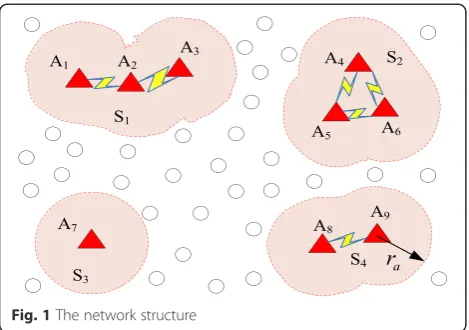
(1) According to Ref. [1,21], a large number of sensor nodes and several actors are randomly deployed in the WSAN. The maximum transmission ranges of actors and sensor nodes are represented byraand
(2) Communication rate among actor nodes isυa, communication rate among sensor nodes isυs, in generally,υa> >υs. The same as Ref. [21], all the actors which can communicate with each other directly through actor node are called an actor set (AS). In an actor set, the communication among actors (AAc) adopts long-range communication channel. The communication among sensors adopts short-range communication channel. Actor nodes communicate with each other over a long-range communication channel without interfering with the short-range communication channel [1, 21]. The communication among actors in different actor sets uses sensor nodes to relay its data to the target actor. Source actor nodes can switch to a sensor communication channel with a long-range transmission to reduce the number of hops and number of intermediate sensor nodes required to act as a bridge between actor nodes [3,8], but the communicate rate isυsin this time.
(3) All sensor nodes do not move after being deployed [1,21]. On detecting an event, a sensor node will generate messages and send those messages to one of the actors [1,21]. Actor makes decision after the actor receives the information of merging other actors, so it needs to exchange event information among actors. We consider the probability of the communication among any two actors is equal. Therefore, the communication among actors in a set adopts AAc style, and the communication among actors in different actor sets uses ASAc style.
3.2 Energy consumption model and related definition
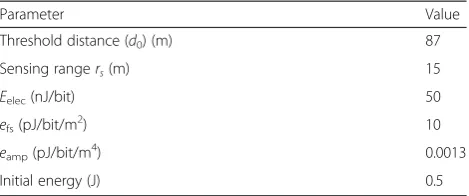
According to the typical energy consumption model [3, 7 12], energy consumption for transmitting (see Eq. (1)) and energy consumption for receiving are represented by Eq. (2).
Eelec represents transmitting circuit loss. If the
trans-mission distance is less than the threshold d0, the free
space (d2power loss) are used in the model. When the transmission distance is greater than or equal to the threshold, the multi-path fading (d4power loss) channel models are used in the model. εfs and εamp are
respect-ively the energy required by power amplification in the two models. The energy consumption for receiving l is the number of bit of packet. The above parameter set-tings are shown in Table 1, as adopted from [5–7, 9, 10].
3.3 Problem statement
The main goal of this paper is to alleviate this problem that ASAc cannot satisfy the practical application, be-cause the communication ability of sensor nodes in the actor–sensor–actor is less than the actor–actor. This re-sults in the small communication capacity of the sensor nodes in the middle area, which limits the application of the network. A high-throughput disjoint multi-path (HTDM) routing scheme is proposed to bridge the gap of ASAc so as to meet the requirements of application. HTDM routing scheme needs to achieve the following goals:
(1) Bridge the gap of communication bottleneck. In this paper, the main problem needs to be solved is to alleviate the communication capabilities difference between actors and sensor nodes. The communication capabilities among actors are
υa, and the actor–sensor–actor communication (ASAc) capabilities isυasa. Letς=υasa/υarepresent the mismatch degree betweenυasaandυa. Obviously whenυasa=υa,ςis 1. It illustrates that communication capabilities of actor–sensor–actor is equal to the actor’s maximum value. And the worst case is
υasa=υs, at this point, the communication capabilities of actor–sensor–actor is the same to communication capabilities among sensor nodes. Therefore, routing strategy of this paper is to makeςmaximum, namely:
minð Þ ¼ς minðυasa=υaÞ ð3Þ
(2) Maximize the network lifetime. The fundamental goal of application is to make the network lifetime maximum. The network lifetime can be defined as the time of the node that dies first. Because after the first node dies, it is likely that they will seriously affect the network connectivity and coverage, which lead to network cannot fully play their role. Therefore, the same as Ref. [24], the network
lifetime can be defined as the time of the node that dies first. Set Ei is the energy consumption of node i, so the network lifetime maximization can be expressed:
max Tð Þ ¼ min max
0<i≤nð ÞEi ð4Þ
(3) Data collection with low delay. For real-time transmission, data packets should be transmitted to sink as fast as possible. The concept of delay is different for different nodes. Specifically, due to the same communication ratio among sensor nodes, the communication delay is affected by the length of the routing path, the longer the length of route path is, the longer the delay is, otherwise, the delay is small [19, 20]. In this paper, the delay is defined as the requirement time for transmitting unit data when actor sets communicate with other actor sets. Obviously, the longer theςis in actor–actor communication, the smaller the corresponding delay is. Let the timet 1rep-resent the requirement time for transmitting unit data among actors, that is t1= 1/υasa. Let
the time t2 represent the time for establishing routing path among actors. Delay is defined as
D=t1+t2. Optimization goal is to make the delay minimum, namely min(D) = min(t1+t2). To sum up, the optimization goal of this paper can be obtained:
4 The high-throughput disjoint multi-path scheme If communicating actor sets belong to different parti-tions, the long-range actor channel cannot be utilized. It is essential that intermediate sensor nodes are in-volved in establishing the communication between source nodes and destination nodes [1, 21]. Because the communication capability of actor is greater than
sensor node, the multi-path routing method is
adopted to fill the gap in this paper. The HTDM routing scheme mainly contains the following two stages: (1) initial stage. At this stage, each node ob-tains the shortest hop to each actor set through the hop count diffusion protocol [12]. (2) The stage of multi-path routing. When nodes in different actor sets need to communicate with other nodes, they can communicate through creating multi-path routing be-tween source nodes and destination nodes.
4.1 Building the hop for actors and sensors
The main purposes of HTDM routing scheme in the first stage are
(1)The formation of actor set and routing among actors in the same actor set.
At this stage, each actor can broadcast their routing information with the communication radiusra, the format of broadcast packets are
IDa;ID1;ID1;n;hops;ID2;ID2;n;hops;…;IDk;IDk;n;hops
ð6Þ
Broadcast packets are composed of the actor’s own ID and multiple three tuples as Eq. (6). The composition of each three tuples (ID, next ID, and hop number) denote the target actor’s ID, the ID of the next actor, and the hop count from the node to the target actor, respectively. ElementIDarepresents the ID of actor which generate broadcast packet. The information can only contain their own ID number in the source node, in which the content of packet is
(2)The routing from sensor nodes to each actor and actor set are formed.
Every actor node in each actor sets switch to a sensor communication channel with long-range transmission to broadcast themselves information. The sensor nodes in the communication range of actor can receive broadcast information of actors. Thus, actors can send data to those nodes directly, so these nodes mark themselves as actor direct transmission area (ADTA), and set the hop count from themselves to this actor set is 0; the distance to all the actors in other actor set is∞. After the information are broadcasted, the hop count from all sensor node in ADTA to their actor set is 0, the
distance to the actor in other actor sets is infinity. Sensor nodess1,s7in Fig.1b belong to ADTA of actor set 2 (AS2); sensor nodess5,s6,s11,s12belong to ADTA of actor set 4 (AS4).
Then, each actor broadcasts message (packet) with {IDa,IDas, 0}. The 0 of the message means that the
its own table, after a period of time, the sensor node broadcast his routing tables. After all, its neighbor nodes receive the broadcast packet, the nodes see whether there is a need to update their routing table. This process repeats until each sensor node deter-mines the minimum hop count and next hop node to all actors and actor sets which is described by algorithm 2.
4.2 Building multi-path between source-destination actor set pair
(1)If all the actors are located in the same actor set, its routing method is as follows:
The main idea for creating multi-path routing is: for the communication among actors in the same actor set, algorithm 1 gives the minimum hop count from one actor to each actor in the same actor set and the next node according to the principle of shortest path, so the actors in the same actor set can communicate with each other according to the shortest routing method. The algorithm is shown in algorithm 3.
(2)The communication among actors in different actor set, its routing approach is as follows:
The fact that the difference of communication ability is huge between actors and sensor nodes, thus, as long as the data of actor a1 are sent to any actor in the actor set located by actor a2, it does not affect communication throughput. There is no bottleneck of actor–actor communication. For the sender, due to the communication capacity among actors are stronger than sensor node, when the sender actor wants to communicate with other actor, the actors are adopted as the relay nodes unless when the communication cannot be bypass by sensor node. Therefore, in the HTDM, although the actor communicate with the other actor in different actor sets, our main goal is to send the data in any actor located by sender actor to any actor node in the actor located by receiver actor. Because, it can be communicated using algorithm 3 when the actor inside of the sender actor set and the receiver actor set. So, the algorithm 4 can only consider how to send the data in actor set located by sender actor to the actor set located by receiver actor.
Due to the ability of the actor is bigger, and it has GPS positioning information, etc. So, all the actors in the
actor set know the hop count from each sensor node in actor direct transmission area (ADTA) to the actor set located by receiver actor. In HTDM scheme, the approach for creating first routing path is as follows: (1) The sponsor actor a1 select sensor node s in the
range of the ADTA and the minimum hop count to actor set located by receiver actor as the starting node of the first routing path. If the sender actor a1
cannot communicate with sensor node directly, then the actor a1 routes the data packet to the actor which
can communicate directly with the sensor node s. Then the data packet can be sent to the sensor node s. The reason is that the communication capacity among actors is much higher than sensor node, and the communication that passes by the actor is the most fast and save energy style. (2) The sensor node s routes the data packet to the area of ADTA located by target actor a2 using the shortest routing
algo-rithm. The sensor nodes in ADTA route the data packets to the actor nearest to destination actor using the shortest routing algorithm. This actor routes the data packets to target a2 using routing algorithm 3.
(3) In the process of creating a routing path, if the sensor nodes in the range of one hop of routing path eavesdropping the information about creating routing path, then record the ID information of the routing path. This means that this node is in the range of communication interference of the routing path.
Then more routing paths base on the created rout-ing path can be created. The method for creatrout-ing other routing paths is are follows: (1) sensor node with minimum hop to target actor set, which is not in the range of interference of the created routing path, such as, node b, is selected as the next hop node by sender actor a1. If sensor node b cannot
communicate with sender actor a1, actor a1 routes
using algorithm 3. (2) Creating a new routing path from sensor node b. Sensor node can be selected as the next hop node by sensor node b using the same method. If a node cannot be found by sensor node b, but sensor node b is the left side of the first routing path, sensor node, which have same hop count with him and in the left side of sensor node b can be selected as the next hop node by sensor node b (the equivalent of the left hand rule around an empty routing algorithm). (3) After the data packets are rou-ted to the area locarou-ted by target actor a2, sensor
nodes in ADTA route data packets to the actor near-est to dnear-estination actor according to the shortnear-est routing algorithm. Then those data packets can be routed to target actora2 using algorithm 3. (4) Repeat
the above (1)–(3) to create a new routing path; (5) in the process of creating routing path, it marks the in-fluence range of routing. If the node eavesdropping routing message of creating routing path, it records
the ID information of the routing path, this said it is in the range of communication interference of this routing path. Algorithm 4 shows the algorithm for creating multi-path.
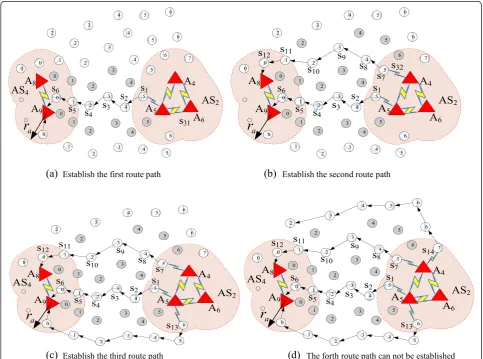
Figure 2 shows the process of establishing multi-path routing, such as Fig. 2a, considering that actor A6 has data needs to be sent to actor A8. Each sensor
node can get the hop count to any actor using algo-rithm 1 and algoalgo-rithm 2. The digital of the nodes in Fig. 2 can express the minimum hop count to the actor in actor set 4 (AS4). Because the hop count is
minimum from sensor node s1 to the actor in AS4, s1
is chosen to the first sensor node of the first routing path. The node, which distance from AS4 is smaller
than node s1, is selected as the next hop node by
node s1. So the first routing path is established as
Fig. 2a firstly, data packets of A6 are sent to A5.
Second, those data packets are sent to A9 along the
first routing path. Finally, the data are sent to target
Fig. 2Illustration of the HTDM routing scheme.aEstablish the first route path.bEstablish the second route path.cEstablish the third route path.
actor A8. At the same time, the nodes in the range of
interference of first routing path are marked as grey. The grey nodes are not selected in the latter of creat-ing routcreat-ing path.
Second, it turn to create the second routing path, at this point, the first routing path and interference nodes in the first routing path are not selected as the inter-mediate node. So, the remaining node nearest to AS4is s7, nodes7can be selected as the first node in the second
routing path. Then, node s7creates the routing path as
Fig. 2b based on the shortest routing path method. In this way, the routing of data transmission is firstly, data packets of A6 are sent to node A4. Second, those data
packets are send to node A8 along the second routing
path. According to algorithm 4, sensor node s13 is the
best node as the first sensor node of creating the third routing path, so, you can create the third routing path, such as Fig. 2c. But the forth routing path cannot be cre-ated, such as Fig. 2d.
4.3 The load balancing multi-path routing
Multi-path routing is proposed to bridge the gap among the actor–sensor–actor communication (ASAc). But the proposed routing policy is only able to build
multiple routing paths, but not consider the balanced problem of the energy consumption, which can dam-age the network lifetime. A practical example to ex-plain the question in the following. For the network diagram in Fig. 1, according to the above algorithm, the routing of the network communication among four actor sets are routed along the shortest routing path. If the communication probability among each actor sets is equal, due to the central region of the network is the intersection area of AS1 and AS4, AS2
and AS3, so the energy consumption in the
intersec-tion area is higher than other areas.
Figure 4 shows the result of the experiment. For the network diagram as Fig. 3, whenAS4communicates with AS1, and AS3 communicates with AS2, the energy
con-sumption in the intersection area is much higher than other regions (see from Fig. 4), which affect the network lifetime. In fact, when AS4 communicates with AS1, the
length of the routing path is not always the shortest, it also can choose the other path to route data to balance the energy consumption. For example, when AS4 sends
data toAS1, it also can send data toAS2, then send data
to AS1. This can balance the network energy
consumption.
Therefore, the proposed multipath routing algorithm can be improved in this section; the improved algorithm can increase the ability of balancing the energy con-sumption, the improved algorithm called enhanced high-throughput disjoint multi-path (EHTDM) routing scheme. The difference between EHTDM and HTDM scheme are (1) when actor create routing path, the next hop node can be selected according to the principle with minimum hop counts and maximum residual energy. (2) In the previous schemes, the node can be selected as the next-hop node according to shortest path, which can cause that the energy consumption in
these routing areas are much higher than other areas. A scheme is proposed to balance the energy con-sumption of the network; this method is that if the number of creating multiple routing path is k, when data packet needs to be sent to sink, k routing path with lowest energy consumption can be selected by the node to transmit data. Because looking for much paths need to consume more energy, it cannot be used regularly. Thus, the way of looking for the much possible paths is to be executed at set intervals in EHTDM scheme.
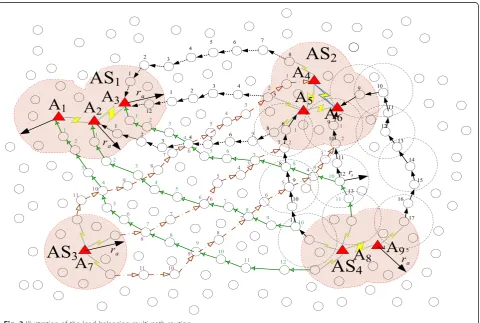
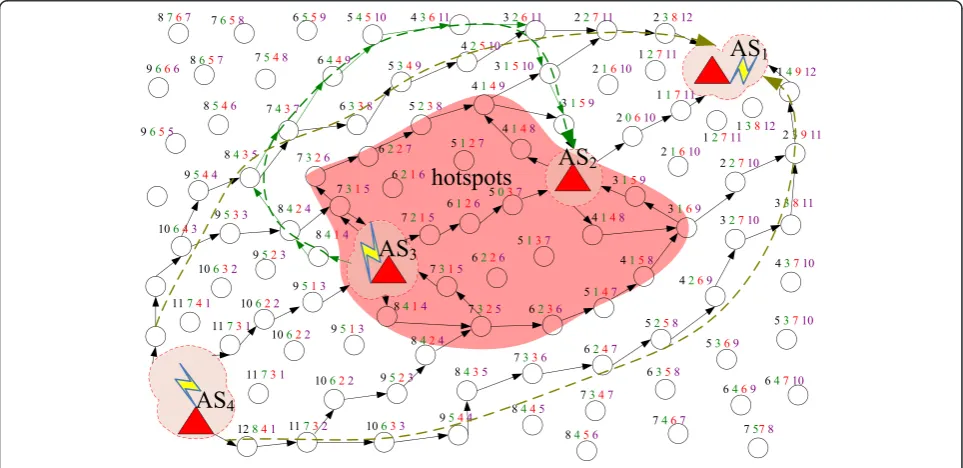
An enhanced high-throughput disjoint multi-path routing is illustrated in Fig. 5. For example, four AS regions are arranged in a row in Fig. 5. Considering the probability of communication among actors is equal, because there are three actors in AS1; three
ac-tors in AS2, and one actor in AS3, and two actors in AS4. Therefore, the probability of routing between AS4 andAS2is 2 3 = 6, the probability of routing
be-tween AS4 and AS3 is 2 1 = 2, the probability of
routing between AS4 and AS1 is 2 3 = 6, the
prob-ability of routing between AS2 and AS3 is 3 1 = 3,
the probability of routing between AS2 and AS1 is
3 3 = 9, the probability of routing between AS3 and AS1 is 1 3 = 3. So comprehensively, the probability
of routing assumed by the nodes between AS3 and AS1 is 14; the probability of routing assumed by the
nodes between AS2 and AS3 is 8 + 12 = 20, the
prob-ability of routing assumed by the nodes between AS2
and AS3 is 3 + 9 + 6 = 18. Therefore, the energy
con-sumption in hotspots area of red area in Fig. 5 is the
Fig. 5Illustration of enhanced high-throughput disjoint multi-path routing
Fig. 4High energy consumption at the route intersection with
highest. If the system adopts HTDM routing scheme, the nodes in hotspots area will die in advance
be-cause of the high energy consumption. But in
EHTDM routing scheme, when the system is running for a period of time, EHTDM scheme searches rout-ing path as much as possible, and then select the routing path with the lowest energy consumption to transmit data. Thus, for the WSANs of Fig. 5, when AS4 communicates with AS1, it will choose the
rout-ing path without passrout-ing the hotspots area to trans-mit data, such as the brown routing path of Fig. 5. When AS2 communicates with AS3, in order to
by-pass hotspots area, EHDM scheme will choose green routing path in Fig. 5 to communication, which bal-ances the energy consumption of the network and prolongs the network lifetime. Here are EHTDM routing algorithms.
5 Experimental evaluation
OMNET++ is used for experimental verification which has been widely recognized by academics [51]. The
network topology adopted in this paper can be seen from Figs. 1 and 5. In the following section, the network scenario in Fig. 1 is denoted as experimental scenario (1), and the network scenario in Fig. 5 is denoted as experimental scenario (2). To the best of our know-ledge, there are no similar researches to bridge the gap among the actor–sensor–actor communication (ASAc) using the multi-path routing, thus, this experiment mainly verify the following questions: (1) The pro-posed HTDM and EHTDM routing scheme is feasible. It is mainly illustrated through the experiment of sec-tion 5.1. (2) The throughput situasec-tion of HTDM and EHTDM routing scheme, that is, the comparison of the number of transmitting data in a fixed time be-tween the proposed scheme and other multi-path routing scheme. (3) The comparison of data transmis-sion delay between HTDM and EHTDM routing scheme. That is, the comparison of the requirement time when transmits a certain number of data be-tween the proposed scheme and other multi-path routing scheme. (4) The comparison of network
lifetime between HTDM and EHTDM routing scheme, it can demonstrate that the EHTDM routing scheme can improve the network lifetime due to balance the energy consumption.
5.1 The energy consumption and running of HTDM routing scheme
The experimental results in the paper are mainly to
verify the running situation of HTDM routing
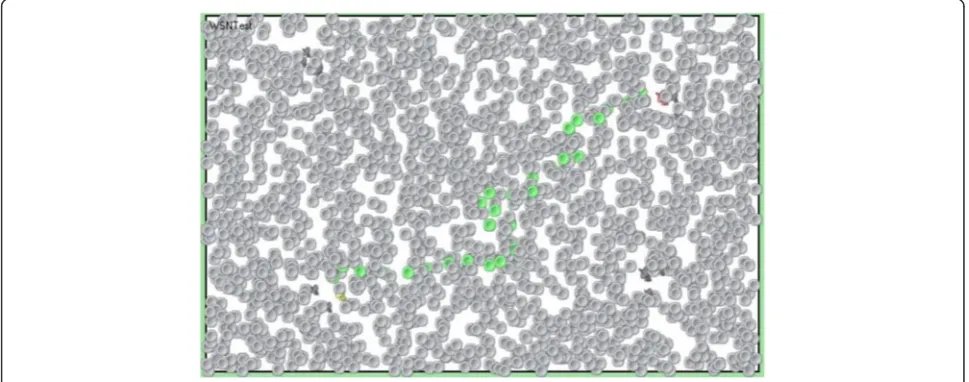
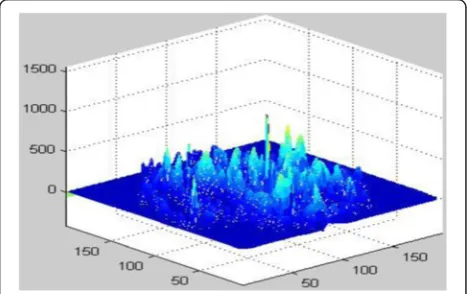
scheme in WSANs, which illustrate that HTDM routing scheme is feasible. Figure 6 gives that experi-ment screenshot of creating an actor–actor routing path according to the traditional routing scheme in experimental scene (1). It can be seen from Fig. 6: if the system only creates a single routing path, namely the shortest routing path, in this case, the network
energy consumption is given in Fig. 7. The energy consumption in the area passed by the routing path is very high, and the energy consumption in other area is low, which can cause energy consumption in the network unbalanced. At the same time, it can been seen from the following experiment that the network throughput of sensor node is small when the system creates a single routing path among ac-tors, due to the huge gap of transmission capacity between actors and sensor nodes. Thus, the network throughput is limited and the data transmission time is long.
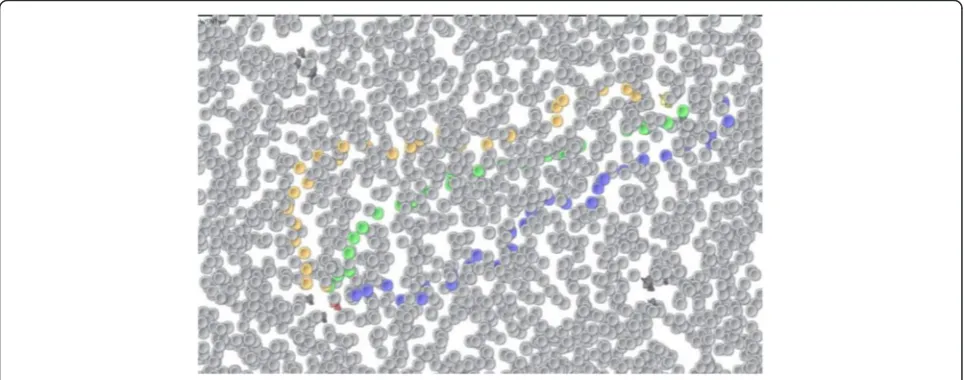
The experiment screenshots of three routing paths created by HTDM routing scheme from actor set 2 (AS2) to actor set (AS3) in scene (1) is given in Fig. 8. Data packet can simultaneously be routed to destination
Fig. 8Experimental screenshot of multi-route path (scene 1)
Fig. 11The energy consumption in the multi-route path strategy (scene 2)
Fig. 9The energy consumption in the multi-route path strategy (scene 1)
actor by multiple routing in HTDM scheme. The bottle-neck problem can be alleviated in actor–sensor–actor communication (ASAc), and the communication cap-acity among actors can be improved several times. On the other hand, multiple routing paths are running at the same time, the network energy consumption is rela-tively balanced, such as Fig. 9.
The experiment screenshots of three routing paths created by HTDM routing scheme from actor set 1 (AS1) to actor set 4 (AS4) in scene (2) is given in Fig. 10. The energy consumption can be shown in Fig. 11. Multiple routing are established in the HTDM routing scheme to fill the gap of communi-cation capability in actor–sensor–actor
communica-tion based on the shortest routing approach.
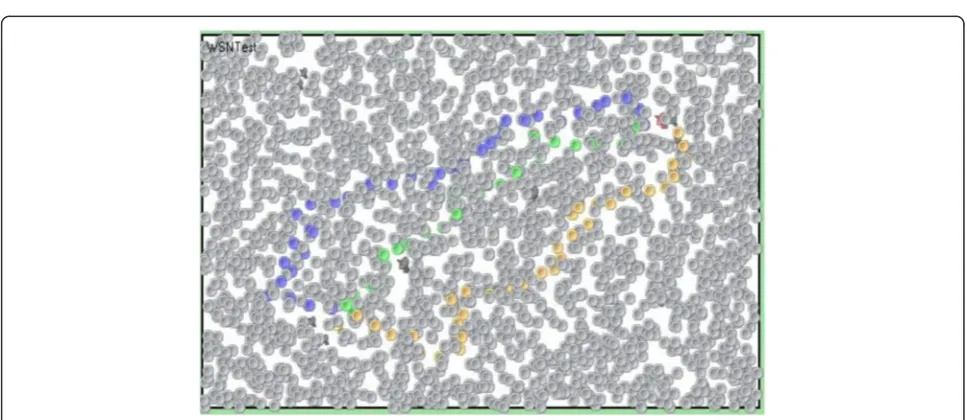
However, this scheme can cause the energy con-sumption in the area of multiple paths pass by is much higher than other areas, which affects the net-work lifetime. The balanced energy consumption for whole network does not take into account in HTDM scheme. Therefore, EHTDM routing scheme builds routing path through selecting the path of the lar-gest residual energy, which can bypass the node whose energy is not rich, so the scheme can balance the network energy consumption in whole network and prolong network lifetime. When multiple routing paths are need to be established from actor set 2 to actor set 3, in EHTDM scheme, the routing path can be established from actor set 2 to actor set 4 (see the bottom of routing path from Fig. 12), then from actor 4 to actors 3. Although this routing length is longer than the routing which is routed directly from actor set 2 to actor set 3, the more residual energy can be full used on those areas whose node’s residual energy is rich. So, the energy consumption
is more balance in whole network which can be seen from Fig. 13.
5.2 The comparison of throughput
Before analysis, the performance of different schemes, the reason which the performance of HTDM scheme is better than previous multi-path routing scheme [42] is shown in this part. The HTDM routing scheme and the multi-path routing scheme are given in Figs. 14 and 15, respectively. In HTDM routing scheme, the source and terminal of the route are composed by two parts: source node group with multiple actors and receiver node group. The communication capacity of actor is bigger than sensor node; the group composed with multiple ac-tors can transmit data simultaneously. So, the through-put of path routing scheme is big. But in multi-path routing scheme [42], only a sensor node with low capacity is in source node and receiver node. Though
Fig. 12Experimental screenshot of EHTDM routing scheme (scene 1)
Fig. 13The energy consumption of EHTDM routing scheme
three routing paths are created, the capacity is deter-mined by the sender capacity of source node or the re-ceiver capacity of rere-ceiver node. Though the capacity of throughput is increased in this scheme compared to sin-gle routing path scheme, the increased capacity of throughput is limited. It is only bigger than the through-put of one routing path in HTDM routing scheme, but is smaller than the throughput of two routing paths in HTDM routing scheme. Multiple routing paths are cre-ated in HTDM routing scheme, so the performance of HTDM scheme is better than the previous multi-path routing scheme.
The experimental results of the throughput of HTDM routing scheme in network scenario 1 and 2 are given in Figs. 16 and 17, respectively. For network scenario 1, the routing path is from actor set 2 (AS2) to actor set (AS3), and in network scenario 2, the routing path is from actor set 1 (AS1) to actor set (AS4).
The proposed HTDM routing scheme is a kind of real multiple routing scheme; multiple routing paths are created among actors, which make up the differ-ence of communication capacity between actors and
sensor nodes. It can be seen from Figs. 16 and 17 that the throughput in the HTDM routing scheme is almost proportional to the number of creating routing paths. Therefore, the number of created routing paths can be identified according to the practical demand, which can offset the difference of communication ability between actors and sensor nodes. From experimental re-sults, the throughput of multi-path routing scheme is smaller than that of HTDM scheme which creates two routing paths, and it is much smaller than that of HTDM scheme which creates three routing paths. Those results show HTDM scheme has a better throughput.
Similarly, Figs. 18 and 19 show the experiment results of the throughput of EHTDM routing scheme in
Fig. 15The multi-path routing scheme
Fig. 16The throughput of HTDM routing scheme vs multi-path
scheme (scene 1)
Fig. 17The throughput of HTDM routing scheme vs multi-path
scheme (scene 2)
network scenario 1 and 2. Because EHTDM routing scheme can only improve the capacity of balancing the energy consumption, the experimental results are almost the same as the above.
Figures 20 and 21 show the comparison of the throughput between HTDM and EHTDM routing scheme. Experiment setting is the number of creating multiple routing paths are three. The routing path is from actor set 2 (AS2) to actor set (AS3) in network scenario 1, and the routing path is from actor set 1 (AS1) to actor set (AS4) in network scenario 2. It can be seen from the experimental results that the throughput in HTDM scheme is higher than EHTDM scheme. Because HTDM scheme creates multiple routing paths based on the principle of shortest path way, the routing path is shorter. But for EHTDM scheme, in order to balance the energy consumption,
the path often needs to pass the area with high en-ergy consumption to transmit data, so the routing path is longer, which lead to more nodes need to be passed by for transmitting data to the target node (see Section 5.4), and more time is required to complete the routing. Although the throughput in EHTDM scheme is lower than HTDM scheme, it can balance the network energy consumption and prolong network lifetime (see Section 5.5).
5.3 The comparison of delay
The delay of HTDM routing scheme vs multi-path rout-ing scheme in different network scenarios is given in Figs. 22 and 23. The parameters in the experiment are the same as the previous experiments. The delay refers to the requirement time for transmitting a certain
Fig. 19The throughput of EHTDM routing scheme (scene 2)
Fig. 20The throughput of HTDM vs EHTDM routing scheme
(scene 1)
Fig. 21The throughput of HTDM vs EHTDM routing scheme
(scene 2)
amount of data from one actor to another actor. The ex-perimental results confirm the effectiveness of our pro-posed strategy.
The delay of EHTDM routing scheme in different network scenarios are given in Figs. 24 and 25. Simi-larly, EHTDM routing scheme can also reduce the re-quirement time for transmitting data by creating multiple routing paths. However, the requirement time in EHTDM scheme is relatively longer, this is the cost to make the network energy consumption balanced.
5.4 The experiment of the requirement hops for routing
The number of total required hop count for routing in HTDM scheme and EHTDM scheme are given in
Figs. 26 and 27. It can be seen from the experimental results: (1) The number of required hop count for routing is proportional to the number of creating routing paths. (2) The number of required hop count in EHTDM scheme is greater than that of HTDM scheme’s, the more the number of creating routing paths are, the more its routing hop counts are. This shows that to balance the energy consumption, the data packets are routed around the farther nodes with the more residual energy in EHTDM scheme. There-fore, the routing needs more hop count to route data packets, and the routing path consumes more energy, which can make full use of the residual energy of the nodes and prolong the network lifetime (see the next section).
Fig. 24The delay of EHTDM routing scheme (scene 1)
Fig. 25The delay of EHTDM routing scheme (scene 2)
Fig. 22The delay of HTDM routing scheme vs multi-path routing
scheme (scene 1)
Fig. 23The delay of HTDM routing scheme vs multi-path routing
5.5 The comparison of network lifetime
Figures 28 and 29, respectively, give the network life-time of multi-path routing scheme, HTDM and EHTDM routing scheme in network scene (1) and (2). As it can be seen from the results of the experi-ment, EHTDM routing scheme can balance the net-work energy consumption, so the netnet-work lifetime in
EHTDM routing scheme is better than HTDM
scheme. It shows the effectiveness of the proposed scheme. For multi-path routing scheme, due to its en-ergy consumption is almost equal to HTDM scheme’s, the lifetime of multi-path routing scheme is almost equal to HTDM scheme’s.
6 Conclusion
In WSANs, the communication among actors in dif-ferent partition can be completed through relaying the data to the destination actor by sensor node, but the difference of throughput capacity between sensor
nodes and actors is huge, which affects the through-put of the network. In this paper, a novel
high-throughput disjoint multi-path (HTDM) routing
scheme is proposed to fill the gap. In the thesis, the routing protocol of HTDM scheme is introduced in detail. It has proved that multiple routing paths are established among actor sets in HTDM scheme, thus bridging the gap among actor–sensor–actor commu-nication (ASAc). Then, an EHTDM scheme is proposed to balance the energy consumption and prolong net-work lifetime. The results of the experiment show that the proposed scheme can significantly improve the net-work capacity and reduce the time for transferring data. In this paper, the HTDM scheme did not involve the safety problems; we will study the secure routing scheme in the future [22, 32, 52].
Fig. 28The lifetime in difference scheme (scene 1)
Fig. 29The lifetime in difference scheme (scene 2)
Fig. 27The total hops of routing (scene 2)
Competing interests
The authors declare that they have no competing interests.
Acknowledgements
Supported by the National Natural Science Foundation of China (61379110, 61073104, 61472450, and 61272150) and the National Basic Research Program of China (973 Program) (2014CB046305).
Received: 30 September 2015 Accepted: 18 November 2015
References
1. K Selvaradjou, N Handigol, AA Franklin et al., Energy-efficient directional routing between partitioned actors in wireless sensor and actor networks. IET Commun.4(1), 102–115 (2010)
2. Y Zhou, ECH Ngai, MR Lyu, et al. POWER-SPEED: a power-controlled real-time data transport protocol for wireless sensor-actuator networks. Wireless Communications and Networking Conference, 2007. WCNC 2007, 2007: 3736–3740.
3. Y Liu, A Liu, Z Chen, Analysis and improvement of send-and-wait automatic repeat-reQuest protocols for wireless sensor networks. Wirel. Pers. Commun.
81(3), 923–959 (2015)
4. M Li et al., A survey on topology control in wireless sensor networks: taxonomy, comparative study, and open issues. Proc. IEEE101(12), 2538–2557 (2013) 5. N Chilamkurti, et al. Cross-layer support for energy efficient routing in
wireless sensor networks, Journal of Sensors 2009
6. Y Yao et al., EDAL: an energy-efficient, delay-aware, and lifetime-balancing data collection protocol for heterogeneous wireless sensor networks. IEEE/ACM Trans. Networking23(3), 810–823 (2015)
7. Y Hu, A Liu, An efficient heuristic subtraction deployment strategy to guarantee quality of event detection for WSNs. Comput. J.58(8), 1747–1762 (2015) 8. K Han, J Luo, Y Liu et al., Algorithm design for data communications in
duty-cycled wireless sensor networks: a survey. IEEE Commun. Mag.
51(7), 107–113 (2013)
9. Z Sheng et al., A survey on the ietf protocol suite for the internet of things: standards, challenges, and opportunities. IEEE Wirel. Commun.
20(6), 91–98 (2013)
10. Y Xiao et al., Tight performance bounds of multihop fair access for MAC protocols in wireless sensor networks and underwater sensor networks. IEEE Trans. Mob. Comput.11(10), 1538–1554 (2012)
11. Y Zeng et al., Directional routing and scheduling for green vehicular delay tolerant networks. Wirel. Netw19(2), 161–173 (2013)
12. L Jiang, A Liu, Y Hu, Z Chen, Lifetime maximization through dynamic ring-based routing scheme for correlated data collecting in WSNs. Computers & Electrical Engineering41, 191–215 (2015)
13. X. Liu, et al. Compressed data aggregation for energy efficient wireless sensor networks. SECON 2011: 46–54
14. S Sengupta et al., An Evolutionary multiobjective sleep-scheduling scheme for differentiated coverage in wireless sensor networks. IEEE Transactions on Systems, Man, and Cybernetics, Part C
42(6), 1093–1102 (2012)
15. G Wei et al., Prediction-based data aggregation in wireless sensor networks: combining grey model and Kalman filter. Comput. Commun.
34(6), 793–802 (2011)
16. X Liu et al., CDC: compressive data collection for wireless sensor networks. IEEE Transactions on Parallel & Distributed Systems
26(8), 2188–2197 (2015)
17. Y Song et al., A biology-based algorithm to minimal exposure problem of wireless sensor networks. IEEE Trans. Netw. Serv. Manag.
11(3), 417–430 (2014)
18. Y Liu et al., Multi-layer clustering routing algorithm for wireless vehicular sensor networks. IET Commun.4(7), 810–816 (2010)
19. X Xu, et al. Hierarchical data aggregation using compressive densing (HDACS) in WSNs. ACM Transactions on Sensor Networks (TOSN), 11(3) (2015). 20. M Bhuiyan, G Wang, A Vasilakos, Local area prediction-based mobile
target tracking in wireless sensor networks. IEEE Trans. Computers
64(7), 1968–1982 (2015)
21. Y Guo, Z Xu, C Chen et al., DGR: dynamic gradient-based routing protocol for unbalanced and persistent data transmission in wireless sensor and actor networks. Journal of Zhejiang University SCIENCE
12(4), 273–279 (2011)
22. Y Liu, A Liu, S He, A novel joint logging and migrating traceback scheme for achieving low storage requirement and long lifetime in WSNs. AEU-International Journal of Electronics and Communications69(10), 1464–1482 (2015) 23. C Busch, R Kannan, AV Vasilakos, Approximating congestion + dilation
in networks via“quality of routing”games. IEEE Trans. Comput.
61(9), 1270–1283 (2012)
24. P Li et al., Reliable multicast with pipelined network coding using opportunistic feeding and routing. IEEE Transactions on Parallel Distributed Systems25(12), 3264–3273 (2014)
25. A Dvir et al., Backpressure-based routing protocol for DTNs. ACM SIGCOMM Computer Communication Review41(4), 405–406 (2011)
26. A.Vasilakos, et al., Delay Tolerant Networks: Protocols and Applications. CRC Press, 2012
27. M Dong et al., Joint Optimization of Lifetime and Transport Delay under Reliability Constraint Wireless Sensor Networks, accepted by IEEE Transactions on Parallel and Distributed Systems. DOI: 10.1109/TPDS.2015. 2388482
28. A Liu, X Jin, G Cui et al., Deployment guidelines for achieving maximum lifetime and avoiding energy holes in sensor network. Inf. Sci.
230, 197–226 (2013)
29. L Liu et al., Physarum optimization: a biology-inspired algorithm for the Steiner tree problem in networks. IEEE Trans. Comput.64(3), 819–832 (2015) 30. T Meng, TF Wu, Z Yang, et al. Spatial reusability-aware routing in multi-hop wireless networks. IEEE Transactions on Computers, doi: 10.1109/TC. 2015.2417543
31. Z Liang et al., Context-aware middleware for multimedia services in heterogeneous networks. IEEE Intell. Syst.25(2), 40–47 (2010) 32. M Dong, X Liu, Z Qian et al., QoE-ensured price competition model for
emerging mobile networks. IEEE Wirel. Commun.22(4), 50–57 (2015) 33. J Long, A Liu, M Dong et al., An energy-efficient and sink-location privacy
enhanced scheme for WSNs through ring based routing. Journal of Parallel and Distributed Computing81, 47–65 (2015)
34. G Acampora et al.,Interoperable and Adaptive Fuzzy Services for Ambient Intelligence Applications ACM Transactions on Autonomous and Adaptive Systems (TAAS) 5 (2), 8, 2010
35. J Zhou et al., Secure and privacy preserving protocol for cloud-based vehicular DTNs. IEEE Transactions on Information Forensics and Security
10(6), 1299–1314 (2015)
36. ZM Fadlullah, T Taleb, AV Vasilakos et al., DTRAB: combating against attacks on encrypted protocols through traffic-feature analysis. IEEE/ACM Transactions on Networking (TON)18(4), 1234–1247 (2010)
37. Y Hu, M Dong, K Ota, et al. Mobile target detection in wireless sensor networks with adjustable sensing frequency. IEEE System Journal, doi: 10. 1109/JSYST.2014.2308391
38. Q Jing, AV Vasilakos, J Wan et al., Security of the Internet of Things: perspectives and challenges. Wirel. Netw20(8), 2481–2501 (2014) 39. X Liu, M Dong, K Ota, P Hung, A Liu. Service pricing decision in
cyber-physical systems: insights from game theory. IEEE Transactions on Services Computing. doi: 10.1109/TSC.2015.2449314.
40. Z Yan, ZP Zhang, AV Vasilakos, A survey on trust management for Internet of Things. J. Network and Computer Applications42, 120–134 (2014) 41. J Gui, M Ahmadi, F Tong, Dynamically constructing and maintaining virtual
access points in a macro cell with selfish nodes. J. Syst. Softw.108, 1–22 (2015) 42. BY Li, PJ Chuang, Geographic energy-aware non-interfering multipath
routing for multimedia transmission in wireless sensor networks. Inf. Sci.
249, 24–37 (2013)
43. J Gui, Z Zeng, Joint network lifetime and delay optimization for topology control in heterogeneous wireless multi-hop networks. Comput. Commun.
59, 24–36 (2015)
44. MİAkbaş, D Turgut, Lightweight routing with dynamic interests in wireless sensor and actor networks. Ad Hoc Netw.11(8), 2313–2328 (2013) 45. S He, X Li, J Chen et al., EMD: energy-efficient P2P message dissemination in
delay-tolerant wireless sensor and actor networks. IEEE Journal on Selected Areas in Communications31(9), 75–84 (2013)
46. T Melodia, D Pompili, VC Gungor et al., Communication and coordination in wireless sensor and actor networks. IEEE Trans. Mob. Comput.
6(10), 1116–1129 (2007)
48. C. Y. Wan, S. B. Eisenman, A. T. Campbell, et al. Siphon: overload traffic management using multi-radio virtual sinks in sensor networks. Proceedings of the 3rd international conference on Embedded networked sensor systems. ACM, 2005: 116–129.
49. K Ota, M Dong, Z Cheng et al., ORACLE: mobility control in wireless sensor and actor networks. Comput. Commun.35(9), 1029–1037 (2012) 50. J. Long, A. He, A. Liu, et al. Adaptive sensing with reliable guarantee
under white gaussian noise channels of sensor networks. Journal of Sensors, 2015, (2015)
51. The OMNET++ simulator. [Online] Available: http://www.omnetpp.org/. Accessed 10, 2015
52. U Bodin, K Wolosz, Proportional throughput differentiation with cognitive load-control on WSN channels. EURASIP J. Wirel. Commun. Netw.
2015(1), 1–14 (2015)
Submit your manuscript to a
journal and benefi t from:
7Convenient online submission
7Rigorous peer review
7Immediate publication on acceptance
7Open access: articles freely available online
7High visibility within the fi eld
7Retaining the copyright to your article