R E S E A R C H
Open Access
Fuzzy-logic framework for future dynamic
cellular systems
Talal Alsedairy
1*, Mohammed Al-Imari
2and Muhammad Imran
3Abstract
There is a growing need to develop more robust and energy-efficient network architectures to cope with ever increasing traffic and energy demands. The aim is also to achieve energy-efficient adaptive cellular system architecture capable of delivering a high quality of service (QoS) whilst optimising energy consumption. To gain significant energy savings, new dynamic architectures will allow future systems to achieve energy saving whilst maintaining QoS at different levels of traffic demand. We consider a heterogeneous cellular system where the elements of it can adapt and change their architecture depending on the network demand. We demonstrate substantial savings of energy, especially in low-traffic periods where most mobile systems are over engineered. Energy savings are also achieved in high-traffic periods by capitalising on traffic variations in the spatial domain. We adopt a fuzzy-logic algorithm for the multi-objective decisions we face in the system, where it provides stability and the ability to handle imprecise data.
Keywords: Energy efficiency, Adaptive network architecture, Multi-objective decision-making
1 Introduction
Increasing concern regarding the energy consumption of cellular networks is driving operators to optimise energy utilisation without detracting from the user experience. This has motivated researchers to investigate solutions to reduce energy consumption. Indeed, energy consumption within the information and communication technology (ICT) sector has become an important subject for both economic and environmental consideration. ICT alone accounts for 2–10 % of global greenhouse gas emissions, a figure expected to increase annually [1, 2]. The volume of transmitted data is predicted to increase by a factor of approximately ten every 5 years, which equates to an increase in ICT-related energy consumption of approxi-mately 16–20 % over that same period [3]. Thus, energy consumption is an ever-increasing problem that becomes more pressing the longer it remains unaddressed. This work is motivated by the reality that mobile communi-cation systems are designed to support the maximum demanded throughput needed during peak traffic peri-ods. As the traffic demand varies with time and space, this results in some areas that are over-optimised, hence, in
*Correspondence: [email protected]
1King Abdulaziz City for Science and Technology (KACST), Riyadh, Saudi Arabia Full list of author information is available at the end of the article
excessive energy consumption. Thus, it is essential that the system be capable of scaling its energy consumption with traffic, without sacrificing quality of service (QoS).
In current systems, major energy is consumed in the radio access portion of the network, making it the ideal target for optimisation. There is much room for improve-ment in the energy efficiency of cellular systems, since a base-station consumes more than 90 % of its peak energy even if it is experiencing little or no activity [4]. Even if some of the radio transceivers in a base-station are switched off, which provides some savings, this is still not sufficient [4]. To make significant energy savings, a dynamic deployment approach is required that allow the system to operate in an energy-efficient mode.
Cellular architecture is generally categorised as macro-, micro-, pico-, and femto-cells, according to their cell sizes. To maintain communication coverage, a small cell-based topology requires many base-stations with a low level of transmitting power to provide users with high data rates. On the other hand, a large cell-based topology requires only a few base-stations, each with a high level of trans-mitting power. Each type of base-station has its own characteristics in terms of coverage, data rate, and power consumption. We aim to adopt a heterogeneous network
comprising different base-station types so that for differ-ent periods of the day, the most suitable architecture is deployed.
Although different papers have evaluated the idea of dynamically changing the architecture of the network in the aim of saving energy [5, 6], they lacked in develop-ing a framework in which the decision can be made. As switching a base-station affects the network performance by changing its coverage, throughput and other elements, it is considered as a dynamic deployment architecture. The decision in which network elements are switched off and on is a multiple-objective decision-making (MODM) problem comprising different criteria and requirements, such as link quality, quality of service, network availability and network reliability.
Traffic load varies from time to time and location to location, and current mobile networks are not designed to benefit from such variation in traffic. Therefore, a large amount of energy is wasted on base-stations that are not active with users in low-traffic periods. This has sparked the idea of dynamically switching off base-stations, thereby achieving a dynamic deployment architecture. When a base-station is switched off, radio coverage and QoS must still be guaranteed by neighbouring base-stations or other means [5, 6]. A common approach in reconfiguring the network is in deriving necessary thresh-olds to be satisfied that might be in terms of service outage probability [7], traffic in terms of Erlangs [8], percent of the peak traffic [4] and minimum signal-to-interference-plus-noise ratio (SINR) [9], but it fails to provide a full picture on how the decision can be made.
As discussed above, there has been a significant amount of work showing the benefits of dynamic deployment; however, there is a lack of work tackling the problem of how a dynamic deployment can be achieved without human intervention by identifying the specific nodes that can be switched off or on. This paper proposes an energy-efficient dynamic-architecture technique based on fuzzy logic. In particular, we propose a novel scheme, the fuzzy-logic architecture selection. We show how using multi-ple network parameters in architecture decision reduces energy consumption.
The remainder of this paper is organised as follows: Section 2 describes the dynamic network management framework, Section 3 explains the fuzzy-logic algorithm proposed and Section 4 presents the simulation and results. Finally, Section 5 concludes the work.
2 Dynamic network-management framework
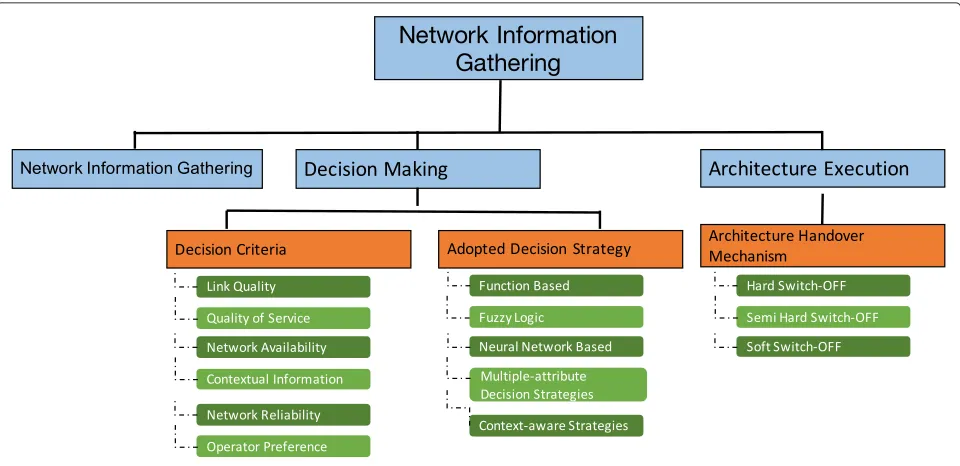
A flexible framework that covers different aspects of the network and has the ability to make a multiple-objective decision for energy utilisation is required. The designed framework should have the ability to cope with high traffic demand and provide an energy-efficient operation and flexibility. Figure 1 presents the dynamic network-management concept, which has the following three main phases:
1. Network information-gathering: In this phase, all the information that is needed to identify the requirement of architecture-switching is gathered, with the ability to initiate an architecture switch.
2. Architecture multiple-objective decision-making: Here, it is determined whether a network
architecture change can or needs to be adopted by selecting the most suitable deployment architecture, based on a given criteria, such as link quality and network reliability. Also, it gives instructions to the execution phase.
3. Architecture execution: This phase manages the change of network architecture based on the users affected during the network architecture change.
2.1 Architecture handover mechanism
Based on the average daily data traffic profile in Europe, we decided to switch off on an hourly basis. The deci-sion is driven by the fact that the traffic is almost constant within a single hour. On this basis, at the beginning of each time slot, the system parameters would be gathered and provided to the MODM unit, and if the switch-off deci-sion was taken, then this would signal the base-stations in the area to initiate for activation. At this point, one of three choices is implemented [10], which are explained as follows.
• Soft switch-off : In this scenario, when the switch-off decision is taken, the network waits until no user is accessing the cell, then switched-off only when idle. This can be considered as the least invasive approach for users.
• Semi-hard switch-off : Here, as soon as the switch-off decision is taken, no new service requests are accepted by the cell, which can be switched-off as soon as all services in progress at the time of the switch-off decision terminate. This implies that some service requests will be blocked.
• Hard switch-off : With this option, immediately after the switch-off decision is taken, users are forced to implement a handover from the macro-cell that is going to be switched off to micro-cells in the area. This is the most invasive approach for users, but forced handover is foreseen by long-term evolution (LTE) standards, and thus, the algorithm is well within the possibilities of present LTE equipment.
We assume that the base-station can switch off com-pletely as there are active micro-cells that can serve the traffic (and vice versa). This would result in large sav-ings as a base-station consumes power even if the RF part is switched off. At the next time slot, the pro-cess is repeated as each micro- and macro-cell mea-sures the traffic demand that is served. The same process occurs when the traffic exceeds a certain level; the macro-cell is initiated and micro-cells are switched off.
The computational cost of using Fuzzy logic is minimal as a new entity can be installed that computes the deci-sions and executes them. Each base-station (i.e. macro-station) is responsible for forming a decision on which of the micro-nodes are active, and if its services to users are required or not. On the other hand, micro-nodes are responsible for serving the users in their small coverage area if they are activated. Therefore, from the perspec-tive of micro-nodes, it is considered to be a centralised approach. However, from the perspective of the network as a whole, it is a decentralised approach as the decision is carried out on a cell level. The centralised approach ben-efits from an overall picture of the cell status, and thus, the macro-station can manage the performance level with the knowledge of the impact activating each node would have. On the other hand, the decentralisation benefits the network in terms of the simplicity it provides and its suitability for cellular deployments in a wide scenario.
2.2 Decision-making
In this section, we evaluate some of the popular decision-making approaches and discuss their suitability to be adopted for dynamic network architecture decision-making.
2.2.1 Function-based decision approach
The function-based decision approach combines different metrics in a cost-function manner. Therefore, it is the sum of several weighted functions. The general form of a cost functionFnfor the networknis [11, 12]
Fn=
where lns,i represents the cost in thei-th architecture to carry out the s-th service on networkn, and ws,i is the weight (importance) assigned to thei-th architecture to perform services, whereiws,i=1.
The use of cost function has been widely adopted in dif-ferent handover mechanisms [13]. Although it has been successful for the use of handover decisions, this approach may not be suitable for network architecture decision. As from the perspective of the network, different crite-ria changes at different periods of the day that may cause the decision to fluctuate between two outcomes, causing instability in the overall network. Therefore, function-based decision-making may be more suitable for user-centric decision-making problems.
2.2.2 Multiple-attribute decision strategies
with choosing a decision from a set of alternatives that are specified by their attributes [12]. There are a number of different MADM methods adopted throughout the lit-erature, such as simple additive weighting—the weighted sum of all the attribute values determines a given net-work score level—and analytic hierarchy process—in this approach, the problem (main objective) is decomposed into its constituent parts (criteria, sub-criteria, alterna-tives etc.) [14].
2.2.3 Context-aware strategies
A context-aware approach relies on the knowledge of the context information from the network as well as the mobile terminals to form a decision. In this premise, this approach evaluates the context information and tracks changes of the network and can then provide a context-aware decision on whether a network architecture change is required. The context-aware decision approach can be applied with an analytic hierarchy process method such as the work given in [15, 16].
2.2.4 Fuzzy logic (FL)
The conventional MADM methods lack the ability to make an efficient decision when imprecision or ambiguity is introduced to the data. Therefore, the use of fuzzy logic provides the ability to deal with imprecise data, and also to evaluate multiple criteria simultaneously to provide a robust mathematical framework for decision-making [12, 17–19]. Fuzzy logic has been used in a variety of fields, for example, handover-decision protocols [17, 19]. It has also been used in wireless sensor networks for cluster formation and energy efficiency of cluster forma-tion [20]. Others have used fuzzy logic for cluster-head selection in wireless sensor networks [21, 22]. Moreover, fuzzy logic provides the ability for human experts’ qualita-tive thinking to be a part of the algorithm, which provides a higher level of efficiency [23]. This makes the fuzzy-logic approach the most suitable to adopt for dynamic network architecture decision-making.
3 Applying fuzzy logic in decision-making
In this paper, we consider a heterogeneous network com-prising different base-station types. To optimise energy consumption, some of the network base-stations are switched off and others are switched on. The decision of which network elements are active and which are not is an MODM problem, comprising different net-work criteria and requirements. We adopt a fuzzy-logic approach for decision-making due to its inherent strength in solving problems where imprecision and statistical uncertainty is introduced. Conventional decision-making algorithms lack the ability to efficiently solve a decision problem where imprecise data are imposed; thereby the use of fuzzy logic provides the ability to handle impre-cise data and to combine and evaluate multiple criteria simultaneously.
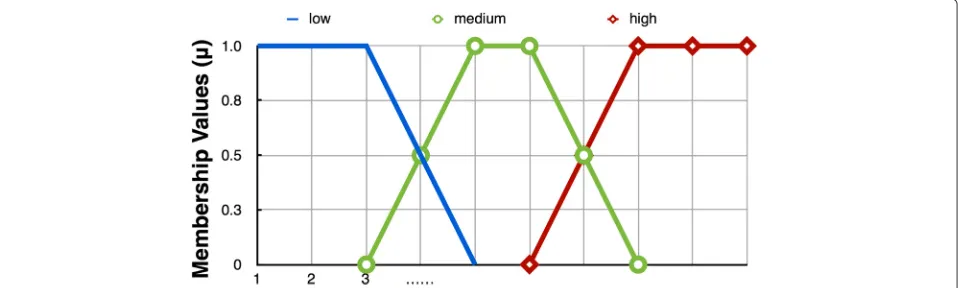
The algorithm has three different stages as shown in Fig. 2. In the first stage, the system parameters are fed into a fuzzifier, in which they are transformed from a crisp set of parameters into fuzzy sets. A fuzzy set com-prises of elements with varying degrees of membership in sets ranging from zero to one depending on the member-ship function [19] as seen in Fig. 3. On the other hand, in a crisp set, a value is considered a member of a class only if it has full membership in the class. Therefore, in a fuzzy set, an element can be a member of more than one class. The membership values are generated from the mapping of a value (crisp value) onto a membership func-tion. Three trapezoidal membership functions are used for representing all the subsets of the inputs and out-comes. A trapezoidal membership function is specified by four parameters{A1,A2,A3,A4}[24]:
Fig. 3Example membership functions representing low, medium and high subsets group
In the second stage, the fuzzy sets are fed into an infer-ence engine where a set of fuzzy rules is applied. These fuzzy rules can be defined as a set of possible outcome scenarios involving if-then rules [25]:
R1: ifx1isη11andx2isη12and . . .andxnisη1n theny1=g1(x1,x2,. . .,xn)
R2: ifx1isη21andx2isη22and . . .andxnisη2n theny2=g2(x1,x2,. . .,xn)
..
. ... ... ...
..
. ... ... ...
RN : ifx1isηN1 andx2isηN2 and. . . xnisηnN thenyN =gN(x1,x2,. . .,xn),
(3)
whereRi is thei-th fuzzy rule,xare the variables of the premise that appear also in the part of the consequence, x=[x1,x2, ...,xn],ηinare the antecedent fuzzy sets or the premise variables for the inputs,yiis the output of thei-th fuzzy rule andgnis the function that implies the value of ynwhenx1−xnsatisfies the premise.
The third stage involves converting the fuzzy output to a crisp value in which the decision can be made (defuzzi-fication). It is the transformation of a fuzzy quantity into a crisp (precise) quantity. We adopt the centroid method for converting the fuzzy outcome to a crisp value in which the decision would be made.
The defuzzifier combines the output sets corresponding to all the fired rules in some way to obtain a single output set and then finds a crisp number that is representative of this combined output set, e.g. the centroid defuzzifier finds the union of all the output sets and uses the centroid of the union as the crisp output. For example, the cen-troid of setA, whose domain is discretized into pointsN, is given as
CA= N
i=1
xiμA(xi)
N
i=1μA( xi)
, (4)
CA= N
i=1
xiμA(xi)
N
i=1μA( xi)
, (5)
where the membership grade ofx∈XinAisμA(x), which is a fuzzy set in [ 0, 1]. We consider optimising the energy consumption of the network using a fuzzy-logic-based approach while satisfying two criteria in the decision-making, the probability of handover and the blocking probability for simplification, although this algorithm can handle many different aspects of the network with the same premise. The probability of handover would reflect the impact of the increasing traffic and the ability to ser-vice the incoming traffic. On the other hand, blocking probability would reflect the ability of the system to serve the incoming traffic.
In the algorithm, at each time step, the base-station would measure the incoming traffic and evaluate the handover and blocking probability (other criteria can be added) for each possible architecture (micro or macro). Hence, the decision is based on the current requirement of the base-station and its ability to save power consumption. The handover and blocking-probability results are divided into three levels: high, moderate and low to represent the minimal required values. A total of nine fuzzy rules are formulated to cover all possible combinations (three sub-sets for each input). Table 1 summarises the rules within the inference engine.
Table 1Inference engine fuzzy rules
Achievable blocking Expected handover Architecture
probability probability score
3.1 Base-station types and power models
The power consumption of a base-station depends on the cell size (covered area), as well as the degree of cov-erage required. Conventional macro-cells are designed to provide large area coverage, thereby featuring large power consumption figures. On the other hand, micro-cells cover a much smaller area and feature much lower power consumption figures. The relation between the average power consumption(Pin)and the average radiated power per site is given in [26–28]:
Pin=NTRX(P0+PPout), 0<Pout≤Pmax, (6)
whereP0is the power consumption at the minimum non-zero output power,Pout is the RF output power,Pmaxis
the maximum RF output power at maximum load,Pis
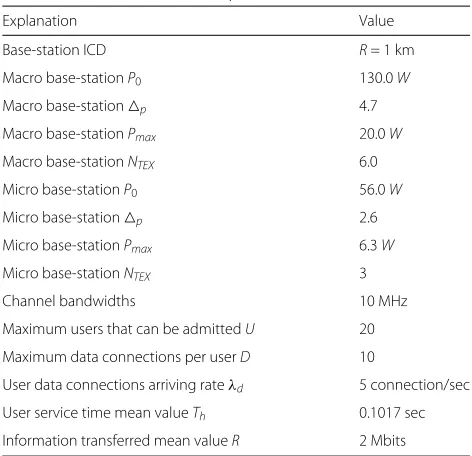
the slope of the load-dependent power consumption and NTRXis the number of transceiver chains. The parameters of the linear power model for the considered base-station types are listed in Table 2. Summing up the power con-sumption, figures of all elements in a network would then yield the total power consumption of the network:
P=
i∈I
Pin,i, (7)
where the individual power figures Pin for i-th base-station correspond to the power consumption of each individual base-station type. The total power consump-tion is then scaled by the network area.
3.2 Probability of handover
In this section, we aim to find the probability of a mobile terminal handing off to a new base-station. In Fig. 4, we consider the scenario of a mobile terminal located at point Xhanding off from an old station to a future base-station. We assume that cells are in a hexagonal shape, where the borders of the base-stations are defined by the threshold value of the received signal strength (RSS) that
Table 2Parameters and assumptions
Explanation Value
Base-station ICD R= 1 km
Macro base-stationP0 130.0W
Macro base-stationp 4.7
Macro base-stationPmax 20.0W
Macro base-stationNTEX 6.0
Micro base-stationP0 56.0W
Micro base-stationp 2.6
Micro base-stationPmax 6.3W
Micro base-stationNTEX 3
Channel bandwidths 10 MHz
Maximum users that can be admittedU 20 Maximum data connections per userD 10
User data connections arriving rateλd 5 connection/sec
User service time mean valueTh 0.1017 sec Information transferred mean valueR 2 Mbits
would initiate the handover process. Initially, the mobile terminal would be served by the old base-station and is moving with a velocity ofv, which is uniformly distributed in [vmin;vmax]. We assume that a mobile terminal can move in any direction with equal probability; hence, the PDF of the mobile terminal direction of motionθis [29]:
fθ= 1
2π, −π < θ < π. (8) We also assume that the speed and direction of motion of a mobile terminal from pointXuntil it goes out of cov-erage remains constant. Since the distance from pointXto the cell boundary is not great, this assumption is valid [29]. At this point, the mobile terminal would handover when the direction of motion is between θ ∈ (−ϑ,ϑ), from
where p is the distance between point X and the cell boundary andais the hexagon side length. From [29, 30], the probability of a mobile terminal handing off in a time less thanτis:
Fig. 4The assumed handover scenario of a mobile terminal [29]
given in [27] which defines the average daily data traf-fic profile in Europe. We assume that user arrival pro-cess is a continuous-time Markov propro-cess with rateλu, and each user can generate multiple data connections, arriving according to the Poisson process with rate λd. Therefore, foruusers, the data connection arrival rate is sλd. This traffic model is applied using a MMPP/M/l/D-PS queue (a single-server processor-sharing queue, with MMPP (Markov-modulated Poisson process) arrival pro-cess and Markovian service time) [31]. The user service rate is exponentially distributed with a mean value of
μu=1/ , where is the mean value of the service time. The amount of information transferred in each data con-nection is exponentially distributed with a mean valueR. Therefore, the data connection service time is exponen-tially distributed with a mean valueμd =Th/R, whereTh is the throughput. The steady-state probability is defined asw(u,d), whereuanddare the number of users and data connections, respectively, with a maximum of U users that can be admitted and a maximum ofDdata connec-tions. The blocking probability is the probability of having a new user or a data connection unable to be admitted for service.
The steady-state probability is defined as the station-ary vector π = (π0,π1,π2,. . .,πD+1), where πd =
(πd,0,πd,1,πd,2,. . .,πd,U) andπd,u = w(u,d)satisfies the following:
πQ=0, πe=1, (11)
whereQis the infinitesimal generator matrix. From the steady-state probability we can calculate the blocking probability as follows [31]:
pb= D
d=0
πd,Uλu+ U
u=0
λD,uuλd
U
u=0 D
d=0
πd,u(uλd+λu)
. (12)
4 Results and discussion
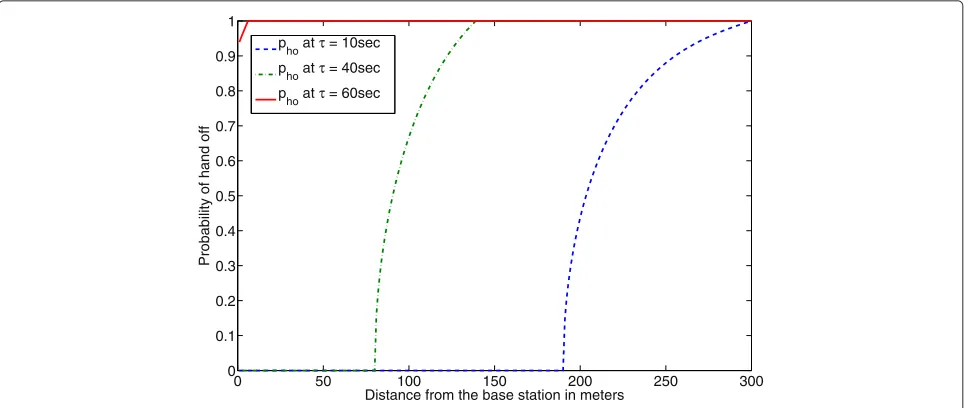
Fig. 5Macro base-station probability of handover with a coverage radius ofR= 1000 m
switched off. We assume that the energy-efficient algo-rithm operates on an hourly basis. This decision is driven by the fact that traffic load is almost constant within the duration of an hour. We assume that a base-station sector is either transmitting at full power or fully switched off.
As in the scenario given in Fig. 4, a comparison between a macro with coverage ofR=1 km and a micro with cov-erage ofR=300 m for differentτis shown in Figs. 5 and 6, respectively. As can be seen at τ = 10 sec, the per-centage of the cell area with a probability not equal to zero is 11 % for the macro-station and 36.7 % for the
micro-station, which is expected due to the difference in coverage requirement.
Moreover, if we assume that traffic is uniformly dis-tributed in the cell area, then we can calculate the per-centage of traffic load in the area where the probability of handover at a given time duration τ is not equal to zero from Figs. 5 and 6. As seen from Fig. 7, the algo-rithm would not allow the handover probability to exceed a certain value. When micro-cells are active (a total of five micro-cells were used to ensure coverage), they consume
a maximum total of 0.2471 kW/km2 and a minimum of
0 50 100 150 200 250 300
0 0.1 0.2 0.3 0.4 0.5 0.6 0.7 0.8 0.9 1
Distance from the base station in meters
Probability of hand off
p
ho at τ = 10sec
p
ho at τ = 40sec
p
ho at τ = 60sec
Fig. 7Handover probability comparison between the conventional and the energy-efficient adaptive system
0.2155 kW/km2varying with traffic load and the number of micro-cells used, and for four micro-cells, the power consumption ranges between 0.1977 and 0.1724 kW/km2. On the other hand, macros consume a maximum total of 0.3364 kW/km2and a minimum of 0.3002 kW/km2.
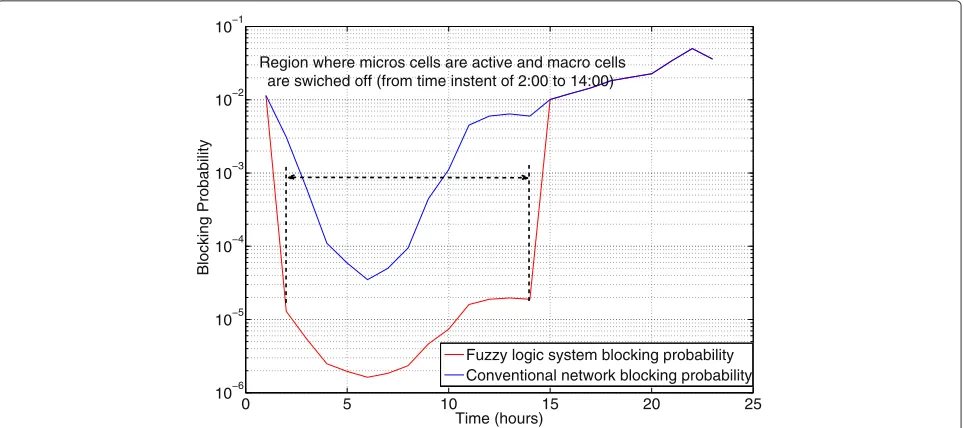
In Figs. 7 and 8, we can see the comparison between the conventional cellular system and the proposed energy-efficient hybrid cellular system. As can be observed, as the traffic decreases, the algorithm tends to switch off more macro-cells and activate the micro-cells in the targeted
area. This results in the desired scaling of power con-sumption, providing large savings in low-traffic periods. The system as designed is able to minimise energy con-sumption throughout different periods of the day, as it automatically adjusts to different traffic demand levels. The algorithm demonstrates the ability to consume less energy during periods of high traffic demand by capi-talising on traffic diversity in the spatial domain. In the proposed algorithm, the micro-cells are activated dynam-ically during different periods while avoiding interference
0 5 10 15 20 25
10−6
10−5
10−4
10−3
10−2
10−1
Time (hours)
Blocking Probability
Fuzzy logic system blocking probability Conventional network blocking probability Region where micros cells are active and macro cells
are swiched off (from time instent of 2:00 to 14:00)
with the macro base-station and providing coverage and service to the weaker areas of the network.
5 Conclusions
In this paper, we have proposed an energy-efficient frame-work for cellular systems that operates whilst conserv-ing energy. We have shown that deployconserv-ing a fuzzy-logic architecture selection algorithm that is able to respond to different traffic demands, whilst maintaining system-wide QoS can minimise energy consumption without human intervention. The aim was not to have a sys-tem that conserves energy by compromising operational parameters, but a system that consumes less energy whilst maintaining coverage, handover probability and QoS. The system as designed is able to minimise energy consump-tion throughout different periods of the day, as it adjusts to different traffic demand levels. The fuzzy-logic algo-rithm prevents the system from lowering system per-formance, but chooses the best outcome while avoiding continuous switching from on state to off state or vice versa, which can affect the system performance sub-stantially. The proposed algorithm has the advantage of being scalable to accept other variables as decision criteria, thereby providing more accurate decision-making. Furthermore, the algorithm can be tuned to be more relaxed in terms of the criteria to provide either more flexibility in allowing more energy saving or more strict in terms of the minimal accepted system performance.
Competing interests
The authors declare that they have no competing interests.
Author details
1King Abdulaziz City for Science and Technology (KACST), Riyadh, Saudi Arabia. 2Samsung Electronics R&D Institute UK (SRUK), Staines-upon-Thames, UK. 3Institute for Communication Systems (ICS), University of Surrey, Guildford, UK.
Received: 27 January 2015 Accepted: 29 October 2015
References
1. Global Action Plan, “An inefficient truth”, Report, Dec. 2007. 2. A Gladisch, C Lange, R Leppla, inEuropean Conference on Optical
Communication. Power efficiency of optical versus electronic access networks (IEEE, Brussels, Belgium, 2008), pp. 1–4
3. B Badic, T O’Farrrell, P Loskot, J He, inIEEE Vehicular Technology Conference. Energy efficient radio access architectures for green radio: Large versus small cell size deployment (IEEE, Anchorage, AK, 2009), pp. 1–5 4. E Oh, B Krishnamachari, X Liu, Z Niu, Toward dynamic energy-efficient
operation of cellular network infrastructure. IEEE, Commun. Mag.49(6), 56–61 (2011)
5. E Oh, B Krishnamachari, inIEEE Global Telecommunications Conference. Energy savings through dynamic base station switching in cellular wireless access networks (IEEE, Miami, FL, 2010), pp. 1–5
6. MA Marsan, L Chiaraviglio, D Ciullo, M Meo, inInternational Conference on Communications and Electronics. Multiple daily base station switch-offs in cellular networks (IEEE, Hue, 2012), pp. 245–250
7. D Cao, S Zhou, Z Niu, inIEEE International Conference on Communications. Optimal base station density for energy-efficient heterogeneous cellular networks (IEEE, Ottawa, ON, 2012), pp. 4379–4383
8. MF Hossain, KS Munasinghe, A Jamalipour, inIEEE Wireless
Communications and Networking Conference. Two level cooperation for energy efficiency in multi-RAN cellular network environment (IEEE, Shanghai, 2012), pp. 2493–2497
9. P Ghosh, SS Das, S Naravaram, P Chandhar, inNational Conference on Communications. Energy saving in OFDMA cellular systems using base-station sleep mode: 3GPP-LTE a case study (IEEE, Kharagpur, 2012), pp. 1–5
10. L Chiaraviglio, D Ciullo, M Meo, MA Marsan, inInternational Teletraffic Congress. Energy-efficient management of UMTS access networks (IEEE, Paris, 2009), pp. 1–8
11. J McNair, F Zhu, Vertical handoffs in fourth-generation multinetwork environments. IEEE Wireless Communications.11(3), 8–15 (2004) 12. M Kassar, B Kervella, G Pujolle, An overview of vertical handover decision
strategies in heterogeneous wireless networks. Comput. Commun. 31(10), 2607–2620 (2008)
13. HJ Wang, RH Katz, J Giese, inIEEE Workshop on Mobile Computing Systems and Applications. Policy-enabled handoffs across heterogeneous wireless networks (IEEE, New Orleans, LA, 1999), pp. 51–60
14. PML Chan, YF Hu, RE Sheriff, inIEEE Wireless Communications and Networking Conference. Implementation of fuzzy multiple objective decision making algorithm in a heterogeneous mobile environment (IEEE, FL, USA, 2002), pp. 332–336
15. S Balasubramaniam, J Indulska, Vertical handover supporting pervasive computing in future wireless networks. Comput. Commun.27(8), 708–719 (2004)
16. L Mokhesi, A Bagula, inAnnual Research Conference of the South African Institute of Computer Scientists and Information Technologists. Context-aware handoff decision for wireless access networks using bayesian networks (ACM, Vanderbijlpark, South Africa, 2009), pp. 104–111 17. L Xia, L-g Jiang, C He, inIEEE International Conference on Communications.
A novel fuzzy logic vertical handoff algorithm with aid of differential prediction and pre-decision method (IEEE, Glasgow, 2007), pp. 5665–5670 18. S Ghosh, Q Razouqi, HJ Schumacher, A Celmins, A survey of recent
advances in fuzzy logic in telecommunications networks and new challenges. IEEE Trans. Fuzzy Syst.6(3), 443–447 (1998)
19. PML Chan, RE Sheriff, YF Hu, P Conforto, C Tocci, Mobility management incorporating fuzzy logic for heterogeneous a IP environment. IEEE Commun. Mag.39(12), 42–51 (2001)
20. R Mathur, MK Sharma, A Misra, D Baveja, inInternational Conference on Advances in Computing, Control, Telecommunication Technologies. Energy-efficient deployment of distributed mobile sensor networks using fuzzy logic systems (IEEE, Trivandrum, Kerala, 2009), pp. 121–125 21. G Ran, H Zhang, S Gong, Improving on LEACH protocol of wireless
sensor networks using fuzzy logic. Int. J. Inf. Comput. Sci.7(3), 767–775 (2010)
22. J-M Kim, S-H Park, Y-J Han, T-M Chung, inInternational Conference on Advanced Communication Technology. CHEF: cluster head election mechanism using fuzzy logic in wireless sensor networks (IEEE, Gangwon-Do, 2008), pp. 654–659
23. X Yan, YA ¸Sekercio ˘glu, S Narayanan, A survey of vertical handover decision algorithms in fourth generation heterogeneous wireless networks. Comput. Netw.54(11), 1848–1863 (2010)
24. W El-Hajj, D Kountanis, A Al-Fuqaha, M Guizani, inIEEE International Conference on Communications. A fuzzy-based hierarchical energy efficient routing protocol for large scale mobile Ad Hoc networks (FEER), vol. 8 (IEEE, Istanbul, 2006), pp. 3585–3590
25. T Takagi, M Sugeno, Fuzzy identification of systems and its applications to modeling and control. IEEE Trans. Syst. Man Cybern.SMC-15(1), 116–132 (1985)
26. F Richter, AJ Fehske, GP Fettweis, inIEEE Vehicular Technology Conference. Energy efficiency aspects of base station deployment strategies for cellular networks (IEEE, Anchorage, AK, 2009), pp. 1–5
27. G Auer, V Giannini, I Godor, P Skillermark, M Olsson, MA Imran, D Sabella, MJ Gonzalez, C Desset, O Blume, inIEEE Vehicular Technology Conference. Cellular energy efficiency evaluation framework (IEEE, Yokohama, 2011), pp. 1–6
29. S Mohanty, IF Akyildiz, A cross-layer (layer 2 + 3) handoff management protocol for next-generation wireless systems. IEEE Trans. Mob. Comput. 5(10), 1347–1360 (2006)
30. A Papoulis, SU Pillai,Probability, Random Variables, and Stochastic Processes. (McGraw-Hill Companies, New York, 2002)
31. Y Qi, MA Imran, R Tafazolli, inIEEE International Symposium on Personal Indoor and Mobile Radio Communications. Energy-aware adaptive sectorisation in LTE systems (IEEE, Toronto, ON, 2011), pp. 2402–2406 32. 3GPP TR 36.814, “Further advancements for E-UTRA physical layer
aspects”, Tech. Rep., Release 9, (Mar. 2010). Available at “http://www. 3gpp.org/dynareport/36814.htm”
33. 3GPP TR 25.814, “Physical layer aspects for evolved Universal Terrestrial Radio Access (UTRA)”, Tech. Rep., Release 7, Sep. 2007. Available at “http:// www.3gpp.org/DynaReport/25814.htm”
Submit your manuscript to a
journal and benefi t from:
7Convenient online submission
7Rigorous peer review
7Immediate publication on acceptance
7Open access: articles freely available online
7High visibility within the fi eld
7Retaining the copyright to your article

![Fig. 4 The assumed handover scenario of a mobile terminal [29]](https://thumb-us.123doks.com/thumbv2/123dok_us/944439.1115155/7.595.56.540.85.293/fig-assumed-handover-scenario-mobile-terminal.webp)