ISOLATION AND IDENTIFICATION OF NATURALLY OCCURRING LARVICIDAL COMPOUND
ISOLATED FROM ZINGIBER ZERUMBET (L).J.E. SMITH
TRI MURINI
1, MAE SRI HARTATI WAHYUNINGSIH
1*, TRI BASKORO T SATOTO
2, ACHMAD FUDHOLI
3,
MUHAMMAD HANAFI
41Department of Pharmacology and Therapy, Faculty of Medicine, Universitas Gadjah Mada, Indonesia, 2Department of Parasitology, Faculty of Medicine, Universitas Gadjah Mada, Indonesia, 3Department of Technology Pharmacy, Faculty of Pharmacy, Universitas Gadjah Mada,
Indonesia, 4Research Centre for Chemistry, Indonesian Institute of Sciences (LIPI), PUSPIPTEK Serpong, Banten 13510, Indonesia.
Email: [email protected]
Received: 30 October 2017, Revised and Accepted: 09 November 2017
ABSTRACT
Objective: Anaturally occurring larvicidal compound is an alternative to eradication of Aedes aegypti larvae. This compound is toxic to larvae but relatively safe for human. Rhizome of Lempuyang gajah (Zingiber zerumbet (L.) J. E. Smith) has been used traditionally to prevent mosquito bites. An initial study indicated that petroleum ether (PE) soluble fraction of the methanol (MeOH) extract of Z. zerumbet was toxic against larvae lethal concentration (LC50), 67.01±2.35 versus 153.57±4.01 ppm (MeOH ext.). Therefore, this study aimed to isolate and identify the compounds with larvicidal activity from Z. zerumbet rhizome.
Methods: The PE soluble (PE-soluble) fraction was subjected to a bioassay-guided fractionation and isolation method to obtain four (4) fractions (I-IV). Two compounds (1 and 2) were isolated from Fraction I that was the most active compared to other fractions (II-IV). Compound 1 turned out to be more active than compound 2; therefore, compound 1 was then identified by means of spectroscopic data.
Results: Based on the LC50 values, compound 1 was more active than compound 2 (LC50, 41.75±0.05 and LC90, 57.66±3.37 [1] versus 1122.27±1.80 and 1875.69±1.35 ppm [2]), and compound 1 was identified as Zerumbone.
Conclusion: Zerumbone was the main active compound; in the future, this compound can be formulated as a standardized preparation based on the content.
Keywords: Zingiber zerumbet, Larvicidal, Lethal concentration 50, Identification, Zerumbone.
INTRODUCTION
Dengue fever remains a major health problem in third world countries. Approximately 100 million cases of dengue fever are estimated to occur annually in the world [1]. No ideal treatment is currently available for eliminating the viruses that cause dengue fever. Some efforts to discover dengue vaccines have recently been made, but there are no clear signs of success. In the past few decades, chemical insecticides have been used to control mosquitoes as a dengue vector. However, this method is not recommended due to the risk of physiological and biochemical resistance [2,3].
Safe and environmentally-friendly insecticides are, therefore, more encouraged, including the use of naturally-occurring compounds [4], such as Lempuyang gajah (Zingiber zerumbet) that is traditionally used to protect the skin from mosquito bites. A preliminary study of this species found that the rhizome of Z. zerumbet contained a variety of naturally-occurring compounds, such as terpenoids and phenolic compounds, including flavonoids, alkaloids, and saponins [5-7]. In addition, the dichloromethanolic extract of Z. zerumbet rhizome tested against Artemia salina Leach (Brine shrimp lethality test) resulted in 40.4 µg/mL lethal concentration (LC50), while on Anopheles nuneztovari, the LC50 reached 62.8 µg/mL [8]. These values indicate that the rhizome of Z. zerumbet has the potential to be developed into a larvicide.
Previous research on the effects of methanolic extract of Z. zerumbet rhizome on Aedes aegypti larvae found the value of LC50 reaching
153.57±4.01 ppm. In addition, the petroleum ether (PE)-soluble fraction of the methanolic extract performed even higher activities (LC50 = 67.01±2.35 ppm) compared to the methanolic extract [9]. Determining the structures of the active compound in the PE -soluble fraction is, therefore, deemed crucial to discover a safe and environmentally-friendly larvicide. The objective of this study was to explore deeper the results of the previous research to find out isolat of Z. zerumbet (L) J.E. Smith, which possess larvicidal activity, and what compound responsible for action.
METHODS
Z. zerumbet rhizomes were obtained from Jatimulyo, Kulon Progo District of Yogyakarta, in May 2014. The rhizome was authenticated at the Department of Pharmaceutical Biology (BF/284/Ident/Det/ VI/2014), the Faculty of Pharmacy of Universitas Gadjah Mada, Yogyakarta – Indonesia. All the organic solvents were of pro-analytical grade, and the instar larvae III-IV of A. aegypti were obtained from the Parasitology Laboratory of the Faculty of Medicine, Universitas Gadjah Mada according to standard [1].
The instruments used were rotary vacuum evaporator (Heidolfvv 2000, Germany), oven (Memmert, Germany), and silica gel GF254 (E Merck). The ultraviolet (UV) spectrum was recorded on UV spectrometer (Shimadzu UV-365), while IR spectrum was on Perkin Elmer Spectrum 1000, nuclear magnetic resonance (NMR) spectra were observed using Bruker HX 500, and mass spectrum was recorded using Shimadzu GC-17, QP-5000.
© 2018 The Authors. Published by Innovare Academic Sciences Pvt Ltd. This is an open access article under the CC BY license (http://creativecommons. org/licenses/by/4. 0/) DOI: http://dx.doi.org/10.22159/ajpcr.2018.v11i2.21703
Larvicidal bioassay
Preparation of A. aegypti colony
Colonization of A. aegypti was done in the Parasitology Laboratory, Faculty of Medicine using [1] procedure. Adult A. aegypti was put in a cage completed with an aspirator and a cup containing water for the mosquito to lay eggs. The A. aegypti eggs were then placed on a tray containing 1500 mL of water, and after 1–2 days the eggs hatched into larvae. During the process of colony formation, a chicken liver was added as the food. Identification of instar larvae III-IV of A. aegypti was performed 7 days after the eggs hatched, observed macroscopically and using a loupe whenever necessary.
Larvicidal activity test
The test used 7 concentrations for Fraction I and the isolated compounds (40, 44.16, 48.75, 53.82, 59.42, 65.60, and 75 ppm), while for Fractions II, III, and IV, concentrations at 1000, 1120, 1254.40, 1404.93, 1573.52, 1762.34, and 2000 ppm were applied [10]. Each concentration was suspended with a couple drops of tween-80, and then distilled water was added until 100 mL in a 200 mL flask. Each flask contained 25 instar larvae III-IV of A. aegypti. The number of dead larvae was counted after 24 h on adding tested samples. Larvae were claimed dead when they drowned or did not move even when they were touched with a pipette on siphon or thorax. The test was replicated 3 times. The data were presented in LC50 and LC90 values that were determined through the probit regression analysis using A. Woods U.N.S.W. 1.1 version program.
Statistical analysis
Data were analyzed using one-way ANOVA. Significant differences between the treatments were determined using Tukey’s multiple-range test (p<0.05).
Isolation and structure identification
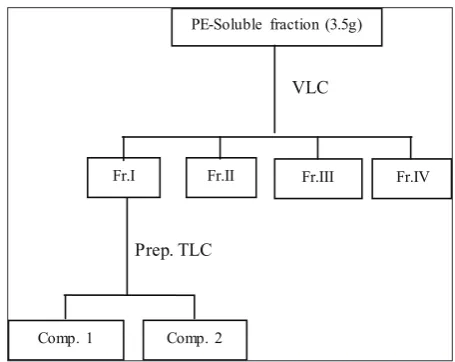
Isolation of larvicidal active compounds was conducted based on the bioassay-guided fractionation and isolation method (Fig. 1) [11] with slight modification. Each extract, fraction, and isolated compound obtained in this process was monitored through a larvicidal assay.
Fractionation, isolation and identification of larvicidal compound The vacuum dried MeOH extract was triturated with PE to obtain PE-soluble (3.5 g) and PE-insoluble fractions (precipitate) [9]. The PE-soluble indicating larvicidal activity was fractionated through vacuum liquid chromatography (VLC, SiO2) eluted by PE–EtOAc with increasing amount of EtOAc to produce four combined Fractions (I-IV) (Fig. 2). Larvicidal active compound was isolated from Fraction I (1.0 g) that displayed the best larvicidal activity among the other fractions obtained by preparative thin layer chromatography (TLC) (SiO2 GF254 prep. grade, PE: EtOAc 1:3 v/v) to make two compounds (1 and 2). Both compounds were tested for their larvicidal activity, and it turned out that compound 1 was more active than compound 2. The larvicidal active compound identity was figured out according to its spectroscopic (UV, IR, 13C-and 1H-NMR) data and comparison with reported literature.
RESULTS AND DISCUSSION
The fractionation using VLC chromatography with PE solvent resulted in 10 fractions combined into four fractions (Fraction I [1000 mg], Fraction II [100 mg], Fraction III [90 mg], and Fraction IV [70 mg]) (Table 1). Each fraction was tested for their larvicidal activity against A. aegypti larvae.
The values of LC50 and LC90 of the four fractions indicate that Fraction I had the highest larvicidal activity with 51.70±0.46 ppm of LC50, followed by Faction III, IV, and II with 1323.71±1.04 ppm, 1484.52±1.82 ppm, and 1491.00±0.80 ppm of LC50 values, respectively (Table 1). The table shows that Fraction I performed the highest activity as a larvicide against A. aegypti larvae as opposed to Fractions II, III, and IV. Danga et al. [12] conducted a study of larvicide against A. aegypti larvae obtained from the fractionation of Plectranthus glandulosus leaf extract
using several solvents with varied polarizations. Fractions from four solvents (hexane, chloroform, ethyl acetate, and methanol) resulted in 89.08, 209.38, 1987.10, and 2533.66 ppm of LC50, respectively. A similar study was performed by Lame et al. [13], examining the methanolic extracts of Annona senegalensis and Boswellia dalzielii. The LC50 values of hexane, chloroform, and ethyl acetate fractions from the methanolic extract of A. senegalensis leaves were 379.3, 595.2, and 1240.3 ppm, respectively. Meanwhile, the B. dalzielii methanolic extract produced 537.1 and 785.5 ppm of LC50 from its hexane and chloroform fractions. Other research on the larvicidal activity of three extracts using organic solvents indicated that the hexane extract was highly effective against A. aegypti larvae. The LC50 for 24 h were found to be 240.9 ppm, 142.2 ppm, and 87.2 ppm for chloroform, PE, and hexane extracts, respectively, each against the instar III of A. aegypti larvae [14]. A similar research using crude extracts obtained from PE (A), ethyl acetate (B), and methanol (C) of C. infundibuliformis against Anopheles stephensi, A. aegypti and Culexquinque fasciatus indicated that the PE extract (A) has a good mortality against A. stephensi and the methanolic extract (C), can inhibit A. aegypti to a higher level when compared to the other extracts [15]. Another study on larvicidal activities of six varying extracts of Acalypha indica leaves against A. albopictus indicated that A. indica leaf extract could be one of the new potential bio larvicidal agent against the vector A. albopictus [16]. Fractions have higher larvicidal activity than extracts because a fraction contains an active compound that is not as complex as an extract. Differences in the solvent polarity for extraction and fractionation also affect the larvicidal activity. The crude extract of bioactive compounds or phytoconstituents isolated from medicinal plants can be an alternative to synthetic insecticides currently used today. The bioassay-guided fractionation showed that the fraction active from Sphaeranthus indicus extract has mosquito larvicidal activity against all the three species [17] the biological activities of plant
Table 1: LC50 and LC90 values of Z. zerumbet Fractions (I‑IV) against A. aegypti
Fraction Weight (mg) Mean±SD (ppm)
LC50 LC90
I 1000 51.70±0.46a 72.38±1.67b
II 100 1491.00±0.80a 2099.75±1.90b
III 90 1323.71±1.04a 2220.43±1.57b
IV 70 1484.52±1.82a 2166.58±0.95b
Z. zerumbet: Zingiber zerumbet, A. aegypti: Aedes aegypti. The value expressed as mean±SEM. n=3 fraction. Statistical analysis to compare Fraction I (active) with other Fraction (II-IV=non active) was performed by ANOVA followed by Tukey test. Valuesa, b were statistiscally different compared to fraction active (I)
p<0.05. SD: Standard deviation, LC50: Lethal concentration
PE-Soluble fraction (3.5g)
VLC
Fr.I Fr.II Fr.III Fr.IV
Comp. 1 Comp. 2
Prep. TLC
Fig. 1: Scheme of bioassay-guided fractionation for larvicidal
extracts are likely caused by various compounds, including phenolates, terpenoids, and alkaloids found in the plants [18].
Fraction I as the most active larvicidal fraction was isolated using the preparative TLC. Two isolated compounds, compound 1 weighing 170 mg and 50 mg of compound 2, were obtained (Table 2). After a larvicidal activity test, the activity of compound isolate 1 was compared to that of compound 2 for LC50 (41.75±0.05 vs. 1122.12±1.80) as well as for LC90 (57.66±3.37 vs. 1875.69±1.35). Considering the values of LC50 and LC90 of the four fractions (Table 1) and compared with isolated compounds 1 and 2 (Table 2), compound 1 had much lower values of LC50 and LC90 than the others. The LC50 of compound 1 was only 10 ppm lower than Fraction I because compound isolate 1 became the most dominant component in Fraction I (LC50:51.70±0.46 vs. 41.75±0.05 ppm). It means isolated compound 1 served as the main active compound of Z. zerumbet as a larvicide. The bioassay-guided isolation is a relatively new method applied globally for discovering the active compounds of natural resources, and a wide range of active compounds have been successfully isolated using this method, including the isolation of a cytotoxic compound tagitinin C against melanoma cell lines (M19) [19]. Therefore, the molecular structure of isolated compound 1 needed further identification.
Structure identification of compound 1
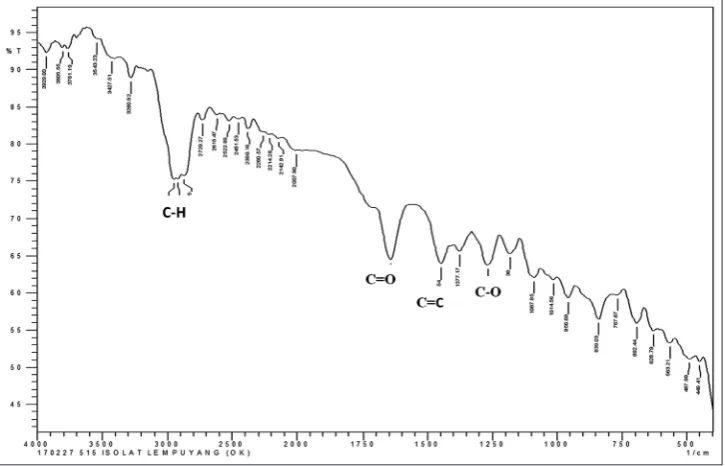
Compound 1 appeared as white amorphous powder. The infrared spectra (KBr, cm−1) of compound 1 indicated the presence of aliphatic
hydrocarbon as shown by the bands at 2947, 2916, and 2885 cm−1.
Astrong band at 1643 cm−1 attributed to α, β unsaturated C=O functional
group, while a characteristic absorption band of C=C group and C-O bond appeared as the bands at 1444 and 1267 cm−1, respectively
(Fig. 3).
The 1H-NMR (CDCl
3, 500 MHz) spectra of compound 1 showed the characteristics of four peaks of methyl (-CH3) singlets (s) at δ 1.08, 1.24, 1.57, and δ 1.77 (s). Four protons of 2 CH2 groups appeared at a different chemical shift and multiplicity as well due to the differences in CH2 proton environments. Therefore, one CH2 proton
Table 2: LC50 and LC90 values of compounds isolated from the rhizome of Z. zerumbet against A. aegypti
Compound Weight (mg) Mean±SD (ppm)
LC50 LC90
1 170 41.75±0.05a 57.66±3.37b
2 50 1122.27±1.80a 1875.69±1.35b
The value expressed as mean±SEM. n=3 isolated. Statistic analysis to compare isolate 1 and isolate 2 was performed by Tukey’s test. Valuesa, b were
statistically different compare to isolate active (1) were significantly different p<0.05. Z. zerumbet: Zingiber zerumbet, SD: Standard deviation, LC50: Lethal
concentration
Fig. 2: Infrared spectrum (KBr, cm−1) of compound 1 of Zingiber zerumbet
Fig. 3: 1H-nuclear magnetic resonance (CDCl
appeared at δ 1.91(1H, d, 13.2Hz) and 2.28(1H, d, 13.2Hz), while other 2 CH2 protons appeared at δ 2.26(2H, m) and 2.36 (2H, m), in which the protons split between each other causing multiplet appearances. In addition, there were four signals appeared at the aromatic proton region, and they were identified as protons
of unsaturated carbons (δ 5.29 [dd, 14.9 and 4.5 Hz], δ 6.11 [d], and δ 5.97 [s, 2H]) (Fig. 4). Based on the data, compound 1 was suspected as zerumbone, and further spectroscopic data were, therefore, pursued.
The 13C-NMR spectrum exhibited 15 signals indicating that there were 15 carbons present in the molecule. The characteristic signal at
δ 206.94 ppm was a carbonyl carbon, specifically as a ketone carbon. Two quaternary carbons at δ 138.98 and 137.72 ppm were identified
as unsaturated carbons (C-3 and C-7). The three methylene groups
appeared at δ 42.23, 40.34, and 39.45 ppm. The two upfield signals at δ 11.56 and 14.71 ppm were identified as a gem dimethyl (C-14, C-15)
(Fig. 4).
Based on the above data and comparison with reported data [20], it could be confirmed that the compound was zerumbone. In addition, a mass spectrum exhibited a molecular ion peak at m/z 218.16 and had molecular elements identified as C15H22O that matched the reported data of zerumbone (Fig. 5).
Studies of Z. zerumbet rhizome have been widely published. Several aromatic and flavonoid compounds have also been isolated from the chloroform extract of Z. zerumbet rhizome, while some terpenoid compounds were isolated from Z. zerumbet roots [21,22]. The existence of sesquiterpenoids (zerumbone, humulene, caryophyllene, and zingiberene) as well as monoterpenoids (borneol, linalool, camphene, eucalyptol, and myrcene) has also been reported [23,24]. Salvador-Neto et al. [25] found that sesquiterpene (+)-obtusol isolated from Alga Laurencia dendroidea J. Agardh had a potent larvicidal activity against A. aegypti larvae. Zerumbone has been reported to have antinociceptive, anti-inflammatory, and antitumor activities in vivo. Meanwhile, in several in vitro studies, it was found that zerumbone showed antiplatelet and anti-proliferative aggregations [26]. Dash et al. [27] suggested that zerumbone could be utilized as a lead molecule in the world of herbal therapeutics functioning as an immunomodulator drug for the treatment of chronic infection and various autoimmune disorders.
CONCLUSION
This study showed that compound 1, the major larvicidal compound isolated from the rhizome of Z. zerumbet, was identified as 2,6,9-humulatrien-8-one (Zerumbone) on the basis of spectroscopic data and comparison with literature data. Zerumbone demonstrated the best larvicidal activities with LC50 41.75±0.05 ppm and LC90 value of 57.66±3.37 ppm.
ACKNOWLEDGMENT
The authors would like to thank the staff of Research Center for Chemistry, Indonesian Institute of Sciences, for 1H NMR and 13C NMR measurements for this work.
AUTHORS CONTRIBUTION
TM and MSH contributed to the preparation of manuscript and research design, data collection, analysis and interpretation. TBTS and AF contributed to revision of the manuscript especially on the Larvicidal activity. MH contributed to revision of the manuscript especially on the Structure identification of compounds Isolated from Zingiber zerumbet (L). J.E. Smith. All the authors read and approved the final manuscript.
CONFLICTS OF INTERESTS
Authors declare that there are no conflicts of interest.
REFERENCES
1. World Health Organization. Guidelines for Laboratory and Field Testing of Mosquito Larvicides. Geneva: WHO; 2005. p. 9. Available from: http://www.whqlibdoc.who.int/hq/2005/WHO/CDS/WHOPES/ GCDPP/2005.13.pdf.
2. Decision of the Minister of Health of the Republic of Indonesia. Guidelines for the Use of Insecticides in Vector Control. Available from: http://www.text-id.123dok.com/document/lzg6mn7q-buku-pedoman-penggunaanInsektisida.html. [Last accessed on 2017 Jul 05]. 3. Ranson H, Burhani J, Lamjuan N, Black IV. Insecticide resistance
in dengue vectors. Trop IKA Net 2010;1(1). Available from: Error!Hyperlinkreferencenotvalid.?Sci_arttext. [Last accessed on
Fig. 4: 13C‑nuclear magnetic resonance (CDCl
3 ‑TMS, 500 MHz) spectra of compound 1 of Zingiber zerumbet
2017 May 28].
4. Rattan RS. Mechanism of action of insecticidal secondary metabolites of plant origin. Crop Prot 2010;29:913-20.
5. Jang DS, Han AR, Park G, Jhon GJ, Seo EK. Flavonoids and aromatic compounds from the rhizomes of Zingiber zerumbet. Arch Pharm Res 2004;27:386-9.
6. Chien TY, Chen LG, Lee CJ, Wang CC. Anti-inflammatory constituents of Zingiber zerumbet. Food Chem 2008;11:584-9.
7. Hashemi SR, Zulkifli I, Bejo MH, Farida A, Somchit MN. Acute toxicity study and phytochemical screening of selected herbal aqueous extract in broiler chicken. Int J Pharmacol 2008;4:352-60.
8. Bücker A, Falcão-Bücker NC, Nunez CV, Pinheiro CC, Tadei WP. Evaluation of larvicidal activity and brine shrimp toxicity of rhizome extracts of Zingiber zerumbet (L.) smith. Rev Soc Bras Med Trop 2013;46:377-80.
9. Murini T, Satoto TB, Wahyuningsih MS. Larvicidal activities of Zingiber zerumbet (L) smith rhizome purified extract against Aedes aegypti Larvae. JKB 2017;29:293-298. Available from: http://www.jkb. ub.ac.id/index.php/jkb/article/view/1790.
10. Finney DJ. Probit analysis, a Statistical Treatment of Sigmoid Response Curve. 3rd ed. New York: Cambridge University Press; 1971. p. 67-79. 11. Ghareeb M, Hamed MM, Abdel-Aleem AA, Saad AM, Abdel-Aziz MS,
Hadad AH. Extraction, isolation, and characterization of bioactive compounds and essential oil from Syzygium jambos. Asean J Pharm Clin Res 2017;10:194-200.
12. Danga YS, Nukenine EN, Younoussa L, Esimone CO. Phytochemicals and larvicidal activity of Plectranthus glandulosus (Lamiaceae) leaf extracts against Anopheles gambiae, Aedes aegypti and Culex quinquefasciatus (Diptera: Culicidae). Int J Pure Appl Zool 2014;2:60-170.
13. Lame Y, Nchiwan E, Pierre DY, Esimone CO. Larvicidal activity of Annona senegalensis and Boswellia dalzielii. Int J Mosq Res 2014;1:25-9.
14. Patil PB, Kallapur SV, Kallapur VL, Holihosur SN. Larvicidal activity of cleodendron inerme gaertn. Extracts against Aedes aegypti L. and Culex quinquefasciatus say. mosquito species. Asian J Pharm Clin Res 2014;7 Suppl 1:206-9.
15. Madhumitha G, Saral AM. Screening of larvicidal activity of Crossandra infundibuliformis extracts against Anopheles stephensi, Aedes aegypti and Culex quinquefasciatus. Int J Pharm PharmSci 2012;4 Suppl 1:485-7.
16. Ashwini U, Taju G, Thirunavukkarasu P, Asha S. Pupal emergence
inhibition activity of Acalypha indica leaf extract against dengue vector, Aedes albopictus mosquito. Int J Pharm PharmSci 2017;9:114-8. 17. Vidhya PT, Mathew N. Bioassay guided fractionation of Sphaeranthus
indicus extract against mosquito vectors. Int J Pharm Sci Res 2014:5:3965-71.
18. Srinivasan S, Wankhar W, Rathinasamy R, Rajan R. Larvicidal potential of Indigofera tinctoria (Fabaceae) on dengue vector (Aedes aegypti) and its antimicrobial activity against clinical isolates. Asian J Pharm Clin Res 2015;8:316-9.
19. Wahyuningsih MS, Wijayanti MA, Budiyanto A, Hanafi M. Isolation and identification of potential cytotoxic compound from kembang bulan [Tithonia diversifolia (Hemsley) A. Gray] leaves. Int J Pharm Pharm Sci 2015;7:298-301.
20. Riyanto S. Identification of the isolated compounds from Zingiber amaricans BL. Rhizome. Indones J Chem 2007;7:93-6.
21. Jang DS, Han AR, Park G, Jhon GL, Seo EK. Flavonoid and aromatic compounds from the rhizomes of Zingiber zerumbet. Arch Pharm Res 2004;27:386-9.
22. Dai DN, Thang TD, Chau LT, Ogunwande IA. Chemical constituents of the root essential oils of Zingiber rubens Roxb, Zingiber zerumbet (L.) Smith. Am J Plant Sci 2013;4:7-10.
23. Chang CJ, Tzeng T, Liou S, Chang Y, Liu I. Absence of genotoxic and mutagenic effects of Zingiber zerumbet (L) smith in rodents. Evid Based Complement Alternat Med 2012;2012:1-7.
24. Rahman HS, Rasedee A, How CW, Abdul AB, Zeenathul NA, Othman HH, et al. Zerumbone-loaded nanostructured lipid carriers: Preparation, characterization, and antileukemic effect. Int J Nanomedicine 2013;8:2769-81.
25. Salvador-Neto O, Gomes SA, Soares AR, Machado FL, Samuels RI, Nunes da Fonseca R, et al. Larvicidal potential of the halogenated sesquiterpene (+)-obtusol, isolated from the Alga laurenciadendroidea J. Agardh (Ceramiales: Rhodomelaceae), against the dengue vector mosquito Aedes aegypti (Linnaeus) (Diptera: Culicidae). Mar Drugs 2016;14(20):1-14.
26. Yob NJ, Jofrry SM, Affandi MM, Teh IK, Salleh MZ, Zakaria ZA. Review article, Zingiberis zerumbet (L) smith: A review of its ethnomedicinal, chemical, and pharmacological uses. Evid Based Complement Alternat Med 2011;50:201-6.