R E S E A R C H
Open Access
A new technique to solve the initial value
problems for fractional fuzzy delay
differential equations
Truong Vinh An
1, Ho Vu
2and Ngo Van Hoa
3,4**Correspondence: [email protected] 3Division of Computational Mathematics and Engineering, Institute for Computational Science, Ton Duc Thang University, Ho Chi Minh City, Vietnam
4Faculty of Mathematics and Statistics, Ton Duc Thang University, Ho Chi Minh City, Vietnam
Abstract
Using some recent results of fixed point of weakly contractive mappings on the partially ordered space, the existence and uniqueness of solution for interval fractional delay differential equations (IFDDEs) in the setting of the Caputo
generalized Hukuhara fractional differentiability are studied. The dependence of the solution on the order and the initial condition of IFDDE is shown. A new technique is proposed to find the exact solutions of IFDDE by using the solutions of interval integer order delay differential equation. Finally, some examples are given to illustrate the applications of our results.
Keywords: fractional interval-valued differential equations; fractional interval-valued delay differential equations; weakly contractive mapping
1 Introduction
Fractional calculus and fractional differential equations are a field of increasing interest due to their applicability to the analysis of phenomena, and they play an important role in a variety of fields such as rheology, viscoelasticity, electrochemistry, diffusion processes, etc. Usually applications of fractional calculus amount to replacing the time derivative in a given evolution equation by a derivative of fractional order. One can find applications of fractional differential equations in signal processing and in the complex dynamic in biological tissues (see [–]). To observe some basic information and results of various type of fractional differential equations, one can see the papers and monographs of Samko et al. [], Podlubny [] and Kilbas et al. [].
Interval analysis and interval differential equation were proposed as an attempt to han-dle interval uncertainty that appears in many mathematical or computer models of some deterministic real-world phenomena in which uncertainties or vagueness pervade. In the recent time this theory has been developed in theoretical directions, and a wide number of applications of this theory have been considered (see, for instance, [–]). Recently, the issue of fuzzy fractional calculus and fuzzy fractional differential equations has emerged as the significant subject, and this new theory has become very attractive to many scien-tists. The concept of fuzzy type Riemann-Liouville differentiability based on the Hukuhara differentiability was initiated by Agarwal et al. in [, ] with some applications to frac-tional order initial value problem of fuzzy differential equation. By using the Hausdorff
measure of non-compactness and under compactness type conditions, authors proved the existence of solution of fuzzy fractional integral equation. Following this direction, the concepts of fuzzy fractional differentiability have been developed and extended in some papers to investigate some results on the existence and uniqueness of solutions to fuzzy differential equations, and have been considered in a wide number of applications of this theory (see, for instance, [–]).
It is well known that the Banach fixed point theorem is a useful tool in mathematics and plays an important role in finding solutions to nonlinear, differential and integral equa-tions, among others. In the recent time this theorem has been extended and generalized by several authors in various ways, for instance, the results on the existence of a fixed point in partially ordered sets for first order ordinary differential equations, Fredholm and Volterra type integral equations, among others, have been studied. In particular, some applications of fixed points in partially ordered sets to resolution of matrix equation were presented by Ran and Reurings in [], and the applicability of the existence of a unique fixed point for mappings defined in partially ordered sets to the study of the existence of a unique solution for periodic boundary condition problems for integer order ordinary differential equations was shown by Nieto and Rodríguez-López in [, ]. In [] Harjani and Sadarangani pre-sented some fixed point generalized theorems involving altering distance functions in the ordered metric spaces, and this result was used to investigate the existence problem of solution to first and second order ordinary differential equations. Besides, Villamizar-Roa et al. [] used some more generalized fixed point results of weakly contractive mappings in a partial order metric space of fuzzy-valued functions to investigate the existence and uniqueness of fuzzy solutions of the initial-valued problem for integer order fuzzy dif-ferential equation in the setting of generalized Hukuhara derivatives. By employing the weakly contractive mapping in the partially ordered space of fuzzy functions, Long et al. [–] studied the existence and uniqueness of weak solution for some classes of fuzzy fractional partially differential equations under Caputo gH-differentiability without the Lipschitzian right-hand side. Briefly in this paper some recent results of fixed point of weakly contractive mappings on the partially ordered space are used to investigate the ex-istence and uniqueness of solution for interval fractional delay differential equations in the setting of the Caputo generalized Hukuhara fractional differentiability. We focus on the following initial value problem for an interval-valued delay differential equations with Caputo generalized Hukuhara fractional differentiability under the form
⎧ ⎨ ⎩
(CDα
a+X)(t) =F(t,X(t),Xt), t∈[a,b],
X(t) =ϕ(t–a), t∈[a–σ,a], (.)
whereCDα
a+is the Caputo derivative of orderα∈(, ],Fis a continuous interval function
on [a,b], and the initial functionϕis continuous on [a–σ,a]. Our aims are to
- give the existence and uniqueness theorem of solution for a general form of the interval fractional integral equation by using some recent results of fixed point of weakly contractive mappings on partially ordered sets, and use these results in order to investigate the existence and uniqueness result of solution for problem (.). - show that the solutions of the initial value problem (.) depend continuously on the
- propose a new technique to find the exact solutions of problem (.) by using the solutions of interval integer order delay differential equation.
This paper is organized as follows. In Section , some basic concepts and notations about fractional derivative for interval functions are introduced. Besides, some properties con-cerning the partially ordered space of interval functions and a fixed point theorem in par-tial metric spaces are presented. In Section , we prove the existence and uniqueness of solution for a general form of the interval fractional integral equation and use this result to investigate the existence and uniqueness results of solutions for problem (.). Finally, a new technique to find the exact solutions of problem (.) is provided and two examples are given to illustrate this technique.
2 Preliminaries
In this section, we present basic notations and necessary preliminaries used throughout the paper. Some of them were detailed further in [–, , –] and the references therein. In the following, we denote the space of all nonempty compact intervals of the real lineRbyKC(R). LetA= [A,A],B= [B,B]∈KC(R), then the usual interval operations, i.e., Minkowski addition, Minkowski difference and scalar multiplication, are defined by
A+B= [A+B,A+B],A–B=A+ (–)B= [A–B,A–B] and
λA=λ[A,A] =
⎧ ⎪ ⎪ ⎨ ⎪ ⎪ ⎩
[λA,λA] ifλ> ,
ifλ= ,
[λA,λA] ifλ< .
It is well known that with respect to the above operations,KC(R) is a quasilinear space (Markov []). LetA= [A,A],B= [B,B]∈KC(R), then the generalized Hukuhara difference (or gH-difference for short) of two intervalsA,Bis defined as follows [, ]:
[A,A]g[B,B] =
min{A–B,A–B},max{A–B,A–B}.
The width ofA∈KC(R) is defined byw(A) =A–A. Then it is easy to see thatw(–A) =
w(A),w(A+B) =w(A) +w(B) andw(AgB) =|w(A) –w(B)|. The Hausdorff-Pompeiu met-ricHinKC(R) is defined as follows:
H[A,B] =max|A–B|,|A–B| . (.)
It is well known that (KC(R),H) is a complete, separable and locally compact metric space. Some properties of the Pompeiu-Hausdorff metric are well known in (see []). As (KC(R), +,·,H) is a quasilinear metric space, then the concepts of continuity and limit for interval-valued functions are understood in the sense of the metric H. Next, for
X,Y ∈KC(R) withX= [X,X],Y = [Y,Y], we can define the partial orders andas
XY (XY) if and only ifX≤Y andX≤Y (X≥Y andX≥Y). Some interesting
properties on the partial orderingsandare presented in [].
Lemma .([, ]) On KC(R)the following properties hold:
(i) If(X)n∈N⊂KC(R)is a nondecreasing sequence such thatXn→XinKC(R),then
(ii) Every pair of elements ofKC(R)has a lower bound or an upper bound.
The partial orderingandcan be extended to the space of interval functions as follows:
XYif and only ifX(t)≤Y(t) andX(t)≤Y(t), ∀t∈[a,b].
In this paper we callC([a,b],KC(R)) the set of continuous interval functions on [a,b]. It is well known thatC([a,b],KC(R)) is a complete metric space with respect to the metric
HC[X,Y] =XgYC, whereXC:= sup a≤t≤b
H[X(t), ].
Lemma .([, ]) Let(KC(R),)be a partial ordered space,then we have the following
properties:
(i) (C([a,b],KC(R)),)is a partial ordered space.
(ii) If(X)n∈N⊂C([a,b],KC(R))is a nondecreasing sequence such thatXn→Xin
C([a,b],KC(R)),thenXnXfor alln∈N.
(iii) Every pair of elements ofC([a,b],KC(R))has a lower bound or an upper bound.
Let an interval functionX: [a,b]→KC(R), thenXis calledw-increasing (w-decreasing) on [a,b] ift→w(X(t)) is nondecreasing (nonincreasing) on [a,b]. We say thatXisw -monotone on [a,b] ifXisw-increasing orw-decreasing on [a,b].
Generalized Hukuhara fractional derivative. [] Lett∈[a,b], then the generalized
Hukuhara derivative (gH-derivative for short) of an interval mappingX: [a,b]→KC(R) attis the functionX(t)∈KC(R) given by
X(t) =lim
h→
X(t+h)gX(t)
h . (.)
We recall some definitions of Riemann-Liouville and Caputo derivatives for interval-valued functions and some necessary results are given to use in the next section. Some of them were detailed further in [, ] and the references therein.
LetL([a,b],KC(R)) denote the space of all Lebesgue integrable interval-valued functions on the bounded interval [a,b]. Letα∈(, ], then the interval-valued Riemann-Liouville integral of interval-valued functionX∈L([a,b],KC(R)) is defined by
α
a+X
(t) =
(α)
t
a
(t–s)α–X(s)ds fort∈[a,b] (.)
and the Riemann-LiouvillegH-fractional derivative ofXis defined by
RL Dα
a+X
(t) =
( –α)
t
a
(t–s)–αX(s)ds
fort∈[a,b].
Remark .([]) Let X,Y ∈C([a,b],KC(R)) andA∈KC(R) and alsoXY, then for everyα∈(, ], we have
(i) (α
(ii) A(–)(α
a+X)(t)A(–)(αa+Y)(t),∀t∈[a,b], providedA(–)(αa+X)(t)and
A(–)(α
a+Y)(t)are well defined.
LetX∈L([a,b],KC(R)) be an interval-valued function such that the Riemann-Liouville
gH-fractional derivativeRLDα
a+X,α∈(, ] exists on [a,b]. In this case the interval-valued
Caputo fractional derivative (or Caputo gH-fractional derivative) of orderα∈(, ] ofX
is defined as follows:
C
Dα a+X
(t) :=RLDaα+
X(·)gX(a)
(t) fort∈[a,b].
Generalized fixed point theorems. In the sequel we recall some generalized fixed point theorem in partially ordered space (see []) that will be used in the next section to analyze the existence of solutions for a general form of the interval fractional integral equation.
LetC(R+,R+) denote the space of all continuously nonnegative functionsψ:R+→R+,
then a real-valued functionψ∈C(R+,R+) is called an altering distance function on [,∞)
ifψis nondecreasing and satisfies the following property:ψ(t) = if and only ift= . Some examples for altering distance functions on [,∞) aret,ln( +t) andt–ln( +t). Let
(X,≤) be a partially ordered set andf :X→X. The functionf is said to be monotone nonincreasing (or nondecreasing) ifu≤vforu,v∈X, thenf(v)≤f(u) or (f(u)≤f(v)), respectively.
Theorem .([]) Assume that(X,≤)is a partially ordered set such that every pair of elements of X has a lower bound or an upper bound,and there exists a metric d onXsuch that(X,≤)is a complete metric space.Let f :X→Xbe a monotone nondecreasing function satisfying the weakly contractive condition
ψdf(u),f(v)≤ψd(u,v)–ξd(u,v)
for all u≥v and for some altering distance functionsψ andξ.In addition,suppose thatX satisfies the following property:
(i) if a nondecreasing sequence(un)n∈N⊂Xconverges touinX,thenun≤ufor all
n∈N,or
(ii) if a nonincreasing sequence(un)n∈N⊂Xconverges touinX,thenu≤unfor all
n∈N.
Then,if there exists u∈Xsatisfying case(i)such that u≤f(u)or there exists u∈X
satisfying case(ii)such that u≥f(u),then f has a unique fixed point.Moreover,if u∗is
the fixed point of f,then it holdslimn→∞fn(u) =u∗for all u∈X.
3 Main results
defined by
Hσ[X,Y] = sup t∈[–σ,]
HX(t),Y(t).
DefineI= [a,b],J= [a–σ,a]∪I= [a–σ,b]. Then, for eacht∈I, we denote byXt the element ofCσ defined byXt(s) =X(t+s),s∈[–σ, ].
Interval-valued delay fractional integral equation: Consider the following interval-valued delay fractional integral equation:
⎧ ⎨ ⎩
X(t)gX(a) = (α)
t a(t–s)
α–F(s,X(s),X
s)ds, t∈[a,b],
X(t) =ϕ(t–a), t∈[a–σ,a], (.)
whereF: [a,b]×KC(R)×Cσ→KC(R),ϕ(t–a)∈KC(R). We say that a continuous interval functionX: [a,b]→KC(R) is a solution to the interval fractional integral equation (.) if it satisfies equation (.). Let us suppose that X∈C([a,b],KC(R)) is w-monotone on [a,b] and satisfies (.). AsXisw-monotone on [a,b], then it follows thatX(t)gX(a) is
w-increasing on [a,b]. Hence, from (.) it follows that the right-hand side of (.) must bew-increasing on [a,b] (see []). Furthermore, we observe that if a continuous interval functionXis a uniquew-monotone solution of (.) on [a,b], then the functionY(t) :=
X(t)gX(a) isw-increasing on [a,b]. In addition, the functionYmay create two solutions of (.): a uniquew-increasing solution of (.) and a uniquew-decreasing solution of (.) on [a,b].
Remark . IfX∈C([a,b],KC(R)) is such thatw(X(t))≥w(X(a)) for allt∈[a,b], then (.) can be rewritten as
⎧ ⎨ ⎩
X(t) =ϕ() +(α)at(t–s)α–F(s,X(s),X
s)ds, t∈[a,b],
X(t) =ϕ(t–a), t∈[a–σ,a].
If X∈C([a,b],KC(R)) is such thatw(X(t))≤w(X(a)) for allt∈[a,b], then (.) can be rewritten as
⎧ ⎨ ⎩
X(t) =ϕ()(–)(α)at(t–s)α–F(s,X(s),X
s)ds, t∈[a,b],
X(t) =ϕ(t–a), t∈[a–σ,a].
Definition . Aw-monotone interval functionXL∈C([a,b],K
C(R)) is a lower solution
for (.) if
⎧ ⎨ ⎩
XL(t)gXL(a) =(α)
t a(t–s)
α–F(s,XL(s),XL
s)ds, t∈[a,b],
XL(t) =ϕL(t–a)ϕ(t–a), t∈[a–σ,a]. (.)
A w-monotone interval-valued function XU ∈C([a,b],K
C(R)) is an upper solution for
In the following, for givenk> , we consider the setBkof all continuous interval functions
X∈C([a–σ,b],KC(R)) such thatsupt∈[a–σ,b]{H[X(t), ]exp(–k(t+σ))}<∞. OnBkwe can define the following metric:
Hk[X,Y] = sup t∈[a–σ,b]
HX(t),Y(t)exp–k(t+σ) ,
X,Y∈C[a–σ,b],KC(R)
, (.)
wherek> is large enough such thatk> /α. It is well known that (C([a,b],K
C(R)),Hk) is a complete metric space.
Theorem . Let F ∈C([a,b]×KC(R)×Cσ,KC(R))and suppose that F(t,A,B)is
non-decreasing in A and B for each t∈[a,b],that is, if AC and BD,then F(t,A,B)
F(t,C,D).Moreover,assume that the following conditions are satisfied:
(A) there exists aw-monotone lower solutionXL∈C([a,b],KC(R))for problem(.);
(A) F(t,A,B)is weakly contractive for comparable elements,that is,for some altering distance functionsTandT,it holds
T
HF(t,A,B),F(t,C,D)
≤T
H[A,B]–T
H[A,B]+T
Hσ[A,B]
–T
Hσ[A,B]
,
if AC,BD and t∈[a,b].Then there exists a unique w-monotone solution X for prob-lem(.)in some intervals[a,T],withT≤b.
Proof LetX(t) :=X(t)g X(a),t∈[a–σ,b]. We define the operatorQ:C([a–σ,b],
KC(R))→C([a–σ,b],KC(R)) by
(QX)(t) =
⎧ ⎨ ⎩
ϕ(t–a)gϕ(), t∈[a–σ,a],
(α)
t a(t–s)
α–F(s,X(s),X
s)ds, t∈[a,b].
We check that the conditions in Theorem . are satisfied. Indeed, letXY andXtYt on [a,b], then we have (QX)(a) = (QY)(a),t∈[a–σ,a], and fort∈[a,b]
F(t,X,Xt)F(t,Y,Yt).
From the result of Remark .-(i), we obtain
QX(t) =
(α)
t
a
(t–s)α–Fs,X(s),Xs
ds (α)
t
a
(t–s)α–Fs,Y(s),Ys
ds
= (QY)(t).
ThenQX QYwheneverXY,XtYt on [a,b], and consequently, the operatorQis nondecreasing. Now, condition (A) shows that
HFt,X(t),Xt
,Ft,Y(t),Yt
Therefore, it holds that
T
Hk[QX,QY]
≤T
Hk[X,Y]
kα
=T
Hk[X,Y]
–
T
Hk[X,Y]
–T
Hk[X,Y]
kα
.
Then, ifT(t) =T(t) –T(t/kα), it follows that
T
Hk[QX,QY]
≤T
Hk[X,Y]
–T
Hk[X,Y]
for allXY. Finally, using the existence of the lower solution, we check thatXis such that
XLQXL. Indeed, sinceXL(t) =ξ(t–a)ϕ(t–a) fort∈[a–σ,a] and fort∈[a,a+p],
XL(t)gX(a)
(α)
t
a
(t–s)α–Fs,XL(s),XsLds,
it follows that
⎧ ⎨ ⎩
XL(t) :=XL(t)
gϕ()ϕ(t–a)gϕ() =QXL(t), t∈[a–σ,a],
XL(t)
(α)
t a(t–s)
α–F(s,XL(s),XL
s)ds=QXL(t), t∈[a,a+p].
As the operator Q satisfies all hypotheses of Theorem ., Q has a fixed point in
C([a–σ,b],KC(R)). Moreover, since every pair of interval-valued functions in C([a–
σ,b],KC(R)) has an upper bound (see Lemma .), the operator Q has a unique fixed
pointXandX is the unique solution to (.).
Remark . The conclusion of Theorem . is still valid if the existence of aw-monotone lower solution for problem (.) is replaced by the existence of aw-monotone upper solu-tion for problem (.).
Interval-valued delay fractional differential equation:Let us consider again the interval-valued delay fractional differential equation with Caputo generalized Hukuhara fractional differentiability under the form
⎧ ⎨ ⎩
(CDα
a+X)(t) =F(t,X(t),Xt), t∈[a,b]
X(t) =ϕ(t–a), t∈[a–σ,a]. (.)
Denote by C,F([a,b],K
C(R)) the space of interval-valued functions which are continu-ous Caputo gH-fractional differentiable on [a,b]. A solutionX∈C([a–σ,b],KC(R))∩
C,F([a,b],KC(R)) of (.) is said to bew-monotone if it isw-increasing orw-decreasing on [a,b].
Lemma . Let F be interval functions such that F∈C([a,b],KC(R))for any X∈KC(R).
Then a w-monotone interval function X∈C([a–σ,b],KC(R))is a solution of initial value
interval-valued function t→ α
a+F(t)is w-increasing on[a,b],where
F(t) :=Ft,X(t),Xt
, t∈[a,b]. (.)
Proof The proof of this lemma is similar to the proof of Lemma . in [].
Corollary . If a w-monotone interval function X is a solution of(.)such that the function t → α
a+F(t) is w-increasing on [a,b], then X is a w-monotone solution of
(.).
Definition . A w-monotone interval function XU ∈ X ∈ C([a – σ,b],KC(R)) ∩
C,F([a,b],K
C(R)) is an upper solution for (.) if
C Dα
a+XU
(t)Ft,XU(t),XtU, t∈[a,b],
XU(t) =ξ(t–a)ϕ(t–a), t∈[a–σ,a].
(.)
Aw-monotone interval-valued functionXL∈C([a–σ,b],K
C(R))∩C,F([a,b],KC(R)) is a lower solution for (.) if it satisfies the reverse inequalities of (.).
Corollary . Let F∈C([a,b],KC(R))and suppose that F(t,A,B)is nondecreasing in A,B
for each t∈[a,b],that is,if AC,BD,then F(t,A,B)F(t,C,D).Moreover,assume that the following conditions are satisfied:
(A) there exists aw-monotone upper solution
XU∈C([a–σ,b],K
C(R))∩C,F([a,b],KC(R))for problem(.);
(A) for an altering distance functionT,it holds
HF(t,A,B),F(t,C,D)
≤H[A,B] +Hσ[B,D]
–T
H[A,B]+T
Hσ[B,D]
if AC,BD and t∈[a,b].Then there exists a unique w-monotone solution X for prob-lem(.)in some intervals[a,T],withT≤b.
Proof In the same way as the proof of Theorem ., letX :=X(t)gX(a),t∈[a–σ,b], and we define the operatorP:C([a–σ,b],KC(R))→C([a–σ,b],KC(R)) by (PX)(t) =
ϕ(t–a)gϕ(),t∈[a–σ,a] and
(PX)(t) =
(α)
t
a
(t–s)α–Fs,X(s),Xs
ds, t∈[a,b].
From the proof of Theorem . it is easy to see that from hypothesis of the nondecreasing property ofFwith respect to the second and third variables, the operatorPis nondecreas-ing, that is,PXPYwheneverXY. On the other hand, hypothesis (A) is implied from hypothesis (A) with consideringT(u) =u. Therefore, we can easily infer that the
oper-atorPis contractive-like. Finally, hypothesis (A) infers thatXUPXU. Indeed, since
get
Thus XU PXU. We see that the operator P verifies all the hypotheses of Theorem
.. In consequence,Phas a fixed point inC([a–σ,b],KC(R)). Furthermore, the space
C([a–σ,b],KC(R)) satisfies that every pair of elements ofC([a–σ,b],KC(R)) has an up-per bound (see Lemma .). It follows thatPhas a unique fixed point. The proof is
com-plete.
In the following corollary, we analyze the dependence of the solution on the order and the initial condition for problem (.).
Theorem . Let F satisfy the assumptions of Corollary.,and letα∈(, ),δ> such
respectively.Then the following holds:
HX(t),Z(t)≤B(t) +
respectively. Observe that fort∈T, wall’s inequality (see Theorem in []), that
HX(t),Z(t)≤B(t) +
Remark . Under the hypothesis of Corollary ., ifδ= , then we get the following
estimate:
In the sequel, we show that the solutions of initial value problem (.) depend continuously on the initial condition, the order and the right-hand side of equation.
Theorem . Let F,G satisfy the assumptions of Corollary.,and letα∈(, ),δ>
respectively.Assume also that there exists a positive constantεsuch that
Then the following holds:
Proof LetX,Z denote the solutions of problems (.) and (.), respectively. For t∈
[a,T], we get
Therefore, we obtain the following estimate:
HX(t),Z(t) wall’s inequality (see Theorem in []), that
HX(t),Z(t)≤C(t) +
Corollary . Assume that the conditions of Corollary.hold.Then a solution of(.),
XFO,is given by
⎧ ⎨ ⎩
XFO(t) =XIO((t–a) α
(α+)), t∈[a,b]
XFO(t) =ϕ(t–a), t∈[a–σ,a],
where XIO(v)is a solution of IVP of the interval-valued delay integer order differential
equa-tion ⎧ ⎨ ⎩
XIO (v) =F∗(v,XIO(v),XIO,v), v∈[, (b–a)α/(α+ )]
XIO(v) =ϕ(t–a– [(t–a)α–v(α+ )]/α), v∈[–σ, ],
(.)
where F∗(v,XIO(v),XIO,v) =F(k(t,v),XFO(k(t,v)),XFO,k(t,v)),and k(t,v) :=t–([t–a]α–v(α+
))/α.
Proof From Corollary ., we infer that the solution of problem (.),XFO, exists and is given by
⎧ ⎨ ⎩
XFO(t)gXFO(a) =(α)
t a(t–s)
α–F(s,X
FO(s),XFO,s)ds, t∈[a,b]
XFO(t) =ϕ(t–a), t∈[a–σ,a].
(.)
Lets=t– [(t–a)α–v(α+ )]/α,t∈[a,b]. Then the interval delay fractional integral equation (.) can be written as
XFO(t)gXFO(a) =
(t–a)α/(α+)
Fk(s,v),XFO
k(s,v),XFO,k(s,v)
dv
=
(t–a)α/(α+)
F∗v,XIO(v),XIO,v
dv. (.)
On the other hand, from the interval differential equation (.) we obtain
XIO(v)gXIO() =
v
F∗v,XIO(v),XIO,v
dv, (.)
where v∈[, (b–a)α/(α+ )]. From (.), (.), X
FO(a) =XIO() =ϕ() and as ≤ (t–a)α/(α+ )≤(b–a)α/(α+ ), we get
XFO(t)gϕ() =XIO(v)gϕ()
=XIO
(t–a)α
(α+ )
gϕ().
The proof is completed.
Example . Consider the fractional order initial value problem for interval-valued delay differential equation given by
⎧ ⎨ ⎩
(CD.
+X)(t) =λX(t– ) –λt, t∈[, ]
whereλ,λ∈R\{}. Using the result of Corollary . for this example, we get
F∗v,XIO(v),XIO,v
=λX
k(t,v) – –λ
√t(/)v–v(/).
The corresponding differential equation of this fractional initial value problem (.) is
⎧ ⎨ ⎩
XIO (v) =λXIO(k(t,v) – ) –λ(
√
t(/)v–v(/)), v∈[, /(/)]
XIO(v) = [k(t,v) – ,k(t,v)], v∈[–, ],
wherek(t,v) = (√t(/)v–v(/)). Then, by using the method of steps, we get the following problem:
⎧ ⎨ ⎩
XIO (v) =λ[k(t,v) – ,k(t,v) – ] –λk(t,v), v∈[, /(/)]
XIO() = [–, ].
Case . λ,λ ∈R+ and XIO is w-increasing. Then we obtain the solution XIO(v) = [XIO(v),XIO(v)], where
XIO(v) = (λ–λ)
√
t(/)v–(/)v
– λv– ,
XIO(v) = (λ–λ)
√
t(/)v–(/)v
–λv.
From the result of Corollary ., the solution of the given fractional order (.) isXFO(t) =
XIO( t
.
(.)) = [XFO(t),XFO(t)], where
XFO(t) = (λ–λ)
t/
(/)– λ
√ t
(/)– , XFO(t) = (λ–λ) t/
(/)–
λ
√ t (/).
Case.λ,λ∈R–andXIOisw-decreasing. Similar to Case , we obtain
XFO(t),XFO(t)
= (λ–λ)
t/
(/)+
–λ
√ t (/)– , –
λ
√ t (/)
.
In the sequel we consider an example which corresponds to the interval version of the problem of the fish population size over time, and the propositional harvesting model in uncertain environment is presented to show the efficiency of the approach. First of all, we recall the framework of the fish population growth model in the situation where quantity of fish is precisely described. Under simplified conditions such as a constant environment (and with no migration), it can be shown that the change in population sizepthrough time
t(the time horizon is from zero tob> ) will depend on three factors including birth rate, death rate and harvest rate, and given by
dp(t)
dt =βp(t) –
m+cp(t)p(t) –h(t), p() =z, (.)
h(t) is the harvest rate which depends on timet, andβ,m,care negative proportional-ity constants. The symbolpdenotes the initial population size andpdenotes the
cur-rent population size. If the partial information in the classical population model (.) may be known or in the parameters used in the above model may be uncertainty, then model (.) can be appropriate by interval or fuzzy theory. Therefore, the corresponding to (.) model incorporating uncertainty could be the interval fish population growth model by using the concept of interval Caputo fractional derivative. Furthermore, in the classical population model (.), it is considered that the birth rate changes im-mediately as soon as a change in the number of individuals is produced. However, the members of the population must reach a certain degree of development to give birth to new individuals and this suggests an introduction of a delay term into the prob-lem.
Example . From the crisp problem (.), in this example we choose a form (represen-tation) for the corresponding interval fractional order initial value problem with delay as follows:
⎧ ⎨ ⎩
(CD.+P)(t) +H(t) = (β–m)P(t) +P(t– ), t∈[, ]
P(t) = [t+ ,t+ ]∈KC(R), t∈[–, ],
(.)
where (β–m)∈R\{} andH(t) := [,ht]∈K
C(R) is the harvest rate, for h> , and there is no overcrowding, i.e.,c= . Using the result of Corollary . for this example, we get
F∗v,PIO(v),PIO,v
=λPIO(v) +PIO
k(t,v) – ,hk(t,v),
whereλ:=β–m. The corresponding differential equation of this fractional initial value
problem (.) is
⎧ ⎨ ⎩
PIO(v) =λPIO(v) +PIO(k(t,v) – )[,hk(t,v)], v∈[, /(/)]
PIO(v) = [k(t,v) + ,k(t,v) + ], v∈[–, ],
wherek(t,v) = (√t(/)v–v(/)). Then, by using the method of steps, we get the following problem:
⎧ ⎨ ⎩
PIO(v) =λPIO(v) + [k(t,v),k(t,v) –hk(t,v) + ], v∈[, /(/)]
PIO() = [, ].
Case .λ∈R+ andPIO isw-increasing. Then we obtain the solution PIO(v) = [PIO(v),
PIO(v)], where
PIO(v) =(/)
λ
(/)λ
λv+ v
– λ
√
t(λv+ ) + (/)
,
+eλv
+(/)
λ
λ
√
PIO(v) =
From the result of Corollary ., the solution of the given fractional order (.) is
PFO(t) =PIO( t
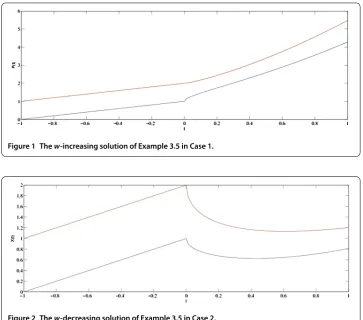
increasing solution of (.) is shown in Figure .
Figure 1 Thew-increasing solution of Example 3.5 in Case 1.
Figure 2 Thew-decreasing solution of Example 3.5 in Case 2.
+
λ
hπ√πt–λ√πt– λt– hπ λt– h
√
π λt/
+
λ
λt+ hπt– h√π λt/+ hλt
+h
λ
√πt/–λt
+ h
λ
t
,
PFO(t) =
λ
–λt+π
+exp
λ
√ t √
π
+
λ
(λ
√
πt–π/)
.
In our numerical simulations, we use the value of parametersλ= – andh= .. The
w-decreasing solution of (.) is shown in Figure .
Acknowledgements
The authors would like to express their gratitude to the anonymous referees for their helpful comments and suggestions, which have greatly improved the paper. The first named author would like to thank the University of Technical Education, Ho Chi Minh City, Vietnam.
Competing interests
The authors declare that they have no competing interests. Authors’ contributions
All authors contributed equally to the writing of this paper. All authors read and approved the final manuscript. Author details
Publisher’s Note
Springer Nature remains neutral with regard to jurisdictional claims in published maps and institutional affiliations.
Received: 9 March 2017 Accepted: 5 June 2017
References
1. Magin, R: Fractional calculus models of complex dynamics in biological tissues. Comput. Math. Appl.59, 1586-1593 (2010)
2. Magin, R, Ortigueira, M, Podlubny, I, Trujillo, JJ: On the fractional signals and systems. Signal Process.91, 350-371 (2011)
3. Merala, FC, Roystona, TJ, Magin, R: Fractional calculus in viscoelasticity: an experimental study. Commun. Nonlinear Sci. Numer. Simul.15, 939-945 (2010)
4. Samko, SG, Kilbas, AA, Marichev, OI: Fractional Integrals and Derivatives: Theory and Applications. Gordon & Breach, Switzerland (1993)
5. Podlubny, I: Fractional Differential Equation. Academic Press, San Diego (1999)
6. Kilbas, AA, Srivastava, HM, Trujillo, JJ: Theory and Applications of Fractional Differential Equations. Elsevier, Amesterdam (2006)
7. Lupulescu, V: Hukuhara differentiability of interval-valued functions and interval differential equations on time scales. Inf. Sci.248, 50-67 (2013)
8. Malinowski, MT: Interval differential equations with a second type Hukuhara derivative. Appl. Math. Lett.24, 2118-2123 (2011)
9. Malinowski, MT: Interval Cauchy problem with a second type Hukuhara derivative. Inf. Sci.213, 94-105 (2012) 10. Stefanini, L, Bede, B: Generalized Hukuhara differentiability of interval-valued functions and interval differential
equations. Nonlinear Anal., Theory Methods Appl.71, 1311-1328 (2009)
11. Stefanini, L: A generalization of Hukuhara difference and division for interval and fuzzy arithmetic. Fuzzy Sets Syst.
161, 1564-1584 (2010)
12. Chalco-Cano, Y, Rufián-Lizana, A, Román-Flores, H, Jiménez-Gamero, MD: Calculus for interval-valued functions using generalized Hukuhara derivative and applications. Fuzzy Sets Syst.219, 49-67 (2013)
13. Agarwal, RP, Lakshmikantham, V, Nieto, JJ: On the concept of solution for fractional differential equations with uncertainty. Nonlinear Anal., Theory Methods Appl.72, 2859-2862 (2010)
14. Agarwal, RP, Arshad, S, O’Regan, D, Lupulescu, V: Fuzzy fractional integral equations under compactness type condition. Fract. Calc. Appl. Anal.15, 572-590 (2012)
15. Allahviranloo, T, Salahshour, S, Abbasbandy, S: Explicit solutions of fractional differential equations with uncertainty. Soft Comput.16, 297-302 (2012)
16. Alikhani, R, Bahrami, F: Global solutions for nonlinear fuzzy fractional integral and integro-differential equations. Commun. Nonlinear Sci. Numer. Simul.18, 2007-2017 (2013)
17. Arshad, S, Lupulescu, V: On the fractional differential equations with uncertainty. Nonlinear Anal., Theory Methods Appl.7, 85-93 (2011)
18. Hoa, NV: Fuzzy fractional functional integral and differential equations. Fuzzy Sets Syst.280, 58-90 (2015) 19. Hoa, NV: The initial value problem for interval-valued second-order differential equations under generalized
H-differentiability. Inf. Sci.311, 119-148 (2015)
20. Hoa, NV, Phu, ND, Tung, TT, Quang, LT: Interval-valued functional integro-differential equations. Adv. Differ. Equ.2014, 177 (2014). doi:10.1186/1687-1847-2014-177
21. Hoa, NV: Fuzzy fractional functional differential equations under Caputo gH-differentiability. Commun. Nonlinear Sci. Numer. Simul.22(1), 1134-1157 (2015)
22. Fard, OS, Salehi, M: A survey on fuzzy fractional variational problems. J. Comput. Appl. Math.271, 71-82 (2014) 23. Malinowski, MT: Random fuzzy fractional integral equations-theoretical foundations. Fuzzy Sets Syst.265, 39-62
(2015)
24. Salahshour, S, Allahviranloo, T, Abbasbandy, S: Solving fuzzy fractional differential equations by fuzzy Laplace transforms. Commun. Nonlinear Sci. Numer. Simul.17, 1372-1381 (2012)
25. Salahshour, S, Ahmadian, A, Senu, N, Baleanu, D, Agarwal, P: On analytical solutions of the fractional differential equation with uncertainty: application to the Basset problem. Entropy17, 885-902 (2015)
26. Mazandarani, M, Kamyad, AV: Modified fractional Euler method for solving fuzzy fractional initial value problem. Commun. Nonlinear Sci. Numer. Simul.18, 12-21 (2013)
27. Mazandarani, M, Najariyan, M: Type-2 fuzzy fractional derivatives. Commun. Nonlinear Sci. Numer. Simul.19, 2354-2372 (2014)
28. Mazandarani, M, Pariz, N, Kamyad, AV: Granular differentiability of fuzzy-number-valued functions. IEEE Trans. Fuzzy Syst.99(2017). doi:10.1109/TFUZZ.2017.2659731
29. Ran, ACM, Reurings, MCB: A fixed point theorem in partially ordered sets and some applications to matrix equations. Proc. Am. Math. Soc.132, 1435-1443 (2004)
30. Nieto, JJ, Rodríguez-López, R: Contractive mapping theorems in partially ordered sets and applications to ordinary differential equations. Order22, 223-239 (2005)
31. Nieto, JJ, Rodríguez-López, R: Existence and uniqueness of fixed point in partially ordered sets and applications to ordinary differential equations. Acta Math. Sin.23, 2205-2212 (2007)
32. Harjani, J, Sadarangani, K: Generalized contractions in partially ordered metric spaces and applications to ordinary differential equations. Nonlinear Anal.72, 1188-1197 (2010)
33. Villamizar-Roa, EJ, Angulo-Castillo, V, Chalco-Cano, Y: Existence of solutions to fuzzy differential equations with generalized Hukuhara derivative via contractive-like mapping principles. Fuzzy Sets Syst.265, 24-38 (2015) 34. Long, HV, Son, NTK, Hoa, NV: Fuzzy fractional partial differential equations in partially ordered metric spaces. Iran. J.
Fuzzy Syst.14, 107-126 (2017)
36. Long, HV, Nieto, JJ, Son, NTK: New approach for studying nonlocal problems related to differential systems and partial differential equations in generalized fuzzy metric spaces. In: Fuzzy Sets and Systems (2016)
https://doi.org/10.1016/j.fss.2016.11.008
37. Long, HV, Son, NTK, Tam, HTT, Yao, JC: Ulam stability for fractional partial integro-differential equation with uncertainty. Acta Math. Vietnam. (2017). doi:10.1007/s40306-017-0207-2
38. Hoa, NV, Lupulescu, V, O’Regan, D: Solving interval-valued fractional initial value problem under Caputo gH-fractional differentiability. Fuzzy Sets Syst.309, 1-34 (2017)
39. Lupulescu, V: Fractional calculus for interval-valued functions. Fuzzy Sets Syst.265, 63-85 (2015) 40. Quang, LTQ, Hoa, NV, Phu, ND, Tung, TT: Existence of extremal solutions for interval-valued functional
integro-differential equations. J. Intell. Fuzzy Syst.30, 3495-3512 (2016)
41. Markov, S: Calculus for interval functions of a real variables. Computing22, 325-337 (1979)
42. Lakshmikantham, V, Bhaskar, TG, Devi, JV: Theory of Set Differential Equations in Metric Spaces. Cambridge Scientific Publisher, United Kingdom (2006)
43. Rodríguez-López, R: Monotone method for fuzzy differential equations. Fuzzy Sets Syst.159, 2047-2076 (2008) 44. Ye, H, Gao, J, Ding, Y: A generalized Gronwall inequality and its application to a fractional differential equation.