R E S E A R C H
Open Access
Global experimental verification of
Docker-based secured mVoIP to protect
against eavesdropping and DoS attacks
ByungRae Cha
1, JongWon Kim
1, HaeMin Moon
2and SungBum Pan
3*Abstract
The cloud-computing paradigm has been driving the cloud-leveraged refactoring of existing information and communications technology services, including voice over IP (VoIP). In this paper, we design a prototype secure mobile VoIP (mVoIP) service with the open-source Asterisk private branch exchange (PBX) software, using Docker lightweight virtualization for mobile devices with the immutable concept of continuous integration and continuous deployment (CI/CD). In addition, the secure mVoIP service provides protection against eavesdropping and
denial-of-service (DoS) attacks, using secure voice coding and real-time migration. We also experimentally verify the quality of the secure voice and the associated communication delay over a distributed global connectivity
environment to protect against eavesdropping and real-time migration to mitigate DoS attacks.
Keywords: Docker, Secure mVoIP, Virtualization, Communication verification test, Eavesdropping/DoS attacks
1 Introduction
Recently, cloud computing has become one of the hottest keywords in the information and communications tech-nology (ICT) sector [1]. Cloud computing is a kind of Internet-based computing service that provides shared computing resources (computing, networking, and stor-age) and data to computers and other devices on demand. In addition, Docker lightweight virtualization (i.e., con-tainerization) is quickly emerging from the Linux camp. Cloud computing is a means of innovation to change an enterprise’s business environment, allowing it to evolve into an IT service model. When associated with a busi-ness, cloud computing can add value through business agility, operational efficiency, and infrastructure stability. In addition, the existing legacy application software can be made to evolve in the IT service model through the stabil-ity of the IT infrastructure. The existing ICT service and solution provider can add value in the move from a hard-ware (HW)-centric approach to a softhard-ware (SW)-centric approach. The ability to constantly grow by evolving the
*Correspondence: [email protected]
3Department of Control and Measuring Robot Engineering, Chosun University, Gwangju, South Korea
Full list of author information is available at the end of the article
service delivery approaches that generate stable revenue is important. In summary, the exploding cloud-computing paradigm has been driving the cloud-leveraged refactor-ing of existrefactor-ing ICT services. In this paper, to check the merit of a cloud native computing paradigm, we select the example of secure mobile voice over IP (mVoIP). That is, we attempt to apply the power of cloud comput-ing to improve the security of voice communications in smartphones. We attempt to support secure mVoIP as a software-as-a-service (SaaS) application. Thus, we design prototype secure mobile VoIP services with the open-source Asterisk private branch exchange (PBX) SW by employing Docker lightweight virtualization for mobile devices with the immutable concept of continuous inte-gration (CI)/continuous delivery (CD) [2, 3]. In addi-tion, the proposed secure mVoIP service supports pro-tection against eavesdropping and denial-of-service (DoS) attacks using secure voice coding and real-time migra-tion. We also experimentally verify the quality of the secure voice and the associated communication delay over a distributed global connectivity environment in a domes-tic/international zone to protect against eavesdropping and real-time migration to mitigate DoS attacks.
2 Related work
In this section, we describe the related basic concepts of mVoIP, voice over long-term evolution (VoLTE), security aspects, and service quality in VoIP, Docker lightweight virtualization with CI/CD to implement a secure mobile VoIP, 5G, and Cisco Application Centric Infrastructure (ACI).
2.1 mVoIP, PBX SW Asterisk, and VoLTE
VoIP [4] is a methodology that combines technologies to deliver voice communication and multimedia sessions over the Internet (Internet protocol (IP) networks). VoIP systems employ signaling protocols and session controls to control the voice signaling, setup, and tear down of the communication calls (Fig. 1). It transports an audio stream over IP networks using special media delivery pro-tocols to encode voice, audio, video with specific audio codecs, and video codecs as digital streamable media. The various codecs exist to optimize the media stream-ing based on the application requirements and network bandwidth; some of the implementations rely on nar-rowband and compressed speech, while others support
high-fidelity stereo codecs. VoIP is available on smart-phones, PCs, and other Internet-enabled devices. How-ever, due to the current political and social situation, eavesdropping security incidents are on the rise. In par-ticular, the US NSA has been suspected of tapping the German Chancellor’s phone for more than 10 years, and it has recently been confirmed that the Chinese leaders have also been the target of eavesdropping. To support secure voice communication using VoIP, we examine the ways of guaranteeing the quality of service (QoS) of VoIP and surveying security issues associated with VoIP. The min-imum response strategy and network tuning for specific parameters (e.g., packet loss, packet delay in transmis-sion, jitter, and others) are required to guarantee the QoS of voice communication over the IP network. mVoIP is an extension of VoIP with mobility support [5]. Two types of communication are generally supported: (i) short-range or campus communication with cordless/digital enhanced cordless telecommunications (DECT)/physical coding sublayer (PCS) protocols where all base stations are linked into the same local area network (LAN) and (ii) wide-area communications using 3G/4G/5G protocols.
There are several methodologies that allow a mobile handset to be integrated into a VoIP network. One imple-mentation turns the mobile device into a standard session initiation protocol (SIP) client, which uses a data network to send and receive SIP messaging and the real-time trans-port protocol (RTP) for the voice traffic. This method-ology requires minimum support from a mobile handset and high-speed IP communication. The standard VoIP protocols (typically SIP) can be used over any broadband IP-capable wireless network connection. Lastly, Asterisk [6] is a SW implementation of a telephone PBX; it allows attached telephones to make calls to one another and to connect to other telephone services, such as the public switched telephone network (PSTN) and VoIP services. Its name is inspired by the asterisk symbol “*.”
VoLTE is a network-based IP Multimedia Subsystem (IMS) with specific profiles for the control plane and media plane of a voice service on LTE as defined by the GSMA in PRD IR.92 [7]. The result of this approach is voice service (control and media planes) delivery as a flow of data within the LTE data bearer. This means that there is no dependency on (or, ultimately, requirement for) maintaining the legacy circuit-switched voice network. VoLTE has a greater capacity for voice and data, up to a factor of 3 compared with 3G universal mobile telecom-munications systems (UMTS), and up to a factor of 6 compared with 2G global systems for mobile communi-cations (GSM). Furthermore, it saves bandwidth because VoLTE’s packet headers are smaller than in unoptimized VoIP/LTE [8].
2.2 Security issues and service quality of VoIP
Ruck [9] and the National Institute of Standards and Tech-nology (NIST) [10] published documents on the security and QoS of VoIP. They noted 10 security issues relating to VoIP security as follows.
• Issue 1: VoIP traffic might be Internet bound. • Issue 2: Gateway security options for VoIP are limited. • Issue 3: Patching problems.
• Issue 4: VoIP security is only as reliable as the underlying network security.
• Issue 5: Many call-processing systems run on common operating systems (OSs), and they have their own security issues to worry about. • Issue 6: DoS takes down telephony.
• Issue 7: Eavesdropping on calls using VOMIT or SipTap.
• Issue 8: Spam over IP telephony (SPIT).
• Issue 9: More ports open means more ports to secure. • Issue 10: Wireless phones require advanced wireless
security.
NIST summarized these problems into seven items for QoS issues in VoIP: latency, jitter, packet loss, bandwidth
and effective bandwidth, throughput speed, power fail-ure and backup systems, and QoS implementations for security.
With regard to VoIP security, in this study, we focus on eavesdropping (issue 7) and DoS attacks (issue 6). Eavesdropping is secretly listening to the private conver-sations of others without their consent. DoS attacks are an attempt to make a machine or network resource become unavailable to its intended users, such as temporarily or indefinitely interrupting or suspending the services of a host connected to the Internet.
2.3 Docker lightweight virtualization technology and CI/CD Docker [11] is an open-source project that automates the integration and deployment of applications inside software containers by providing an additional layer of abstraction and automation of OS-level virtualization on Linux. To avoid overhead from starting and main-taining virtual machines, Docker uses the resource iso-lation features of the Linux kernel such as cgroups and kernel namespaces, and a union-capable filesys-tem such as aufs and others to allow independent “containers” to run within a single Linux instance. The Linux kernel’s namespaces support mostly iso-lates an application’s view of the operating environ-ment, (e.g., user IDs, process trees, network, and mounted file systems), while the kernel’s cgroups pro-vide resource limiting (e.g., CPU, memory, block I/O, and network). Recently, there has been a trend to replace the hypervisor [12] with Docker for virtualization. Figure 2 illustrates the differences between hypervisor and Docker.
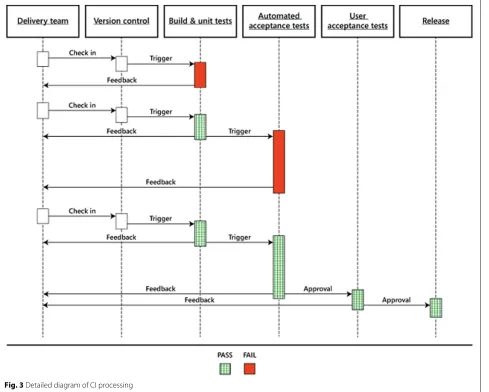
CI means that whenever a developer checks in code to the source repository, a build is automatically triggered as shown in Fig. 3. If the build and automated unit tests are successful, CD takes this one step further by automatically deploying the application to an environment for more in-depth testing.
Fig. 2Difference between virtualization (with hypervisor) and containerization (with Docker)
2.4 5G wireless systems and Cisco ACI
The 5G technology [13, 14] will provide further services and added benefits to the world compared with 4G. It will provide very high bandwidth, which the user will not have experienced previously. It also has many advanced
features which makes it a powerful tool for wireless com-munication. By pushing 5G into VoIP-enabled devices, users will experience a level of data transmission and call volume as never before. Moreover, 5G technology will offer high QoS in many fields such as product engineering,
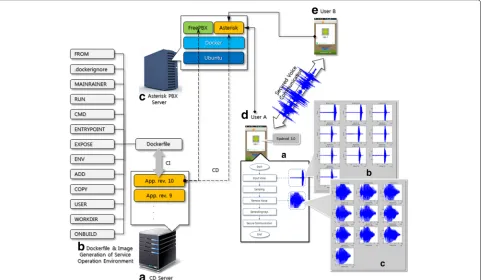
Fig. 4Concept diagram of the registration and deployment of a secure mVoIP service
Internet of Things (IoT), Internet of Everything (IoE), All to One (AtO), Industrial IoT (I2oT), and electronic transactions (e-payments, e-tickets, and e-transactions).
IT departments and the associated businesses are look-ing for cloud automation tools and software-defined net-working (SDN) [15] architectures to:
• Accelerate application delivery • Reduce operating costs
• Greatly increase business agility
Cisco Application Centric Infrastructure (ACI) [16] is a comprehensive SDN-based architecture. The policy-based automation solution of Cisco ACI supports a business-relevant application policy language and
provides greater scalability through a distributed enforce-ment system and greater network visibility. These benefits are realized through the integration of physical and vir-tual environments under one policy model for networks, servers, storage, services, and security.
3 Design and implementation of Docker-based
secure mVoIP with CI/CD
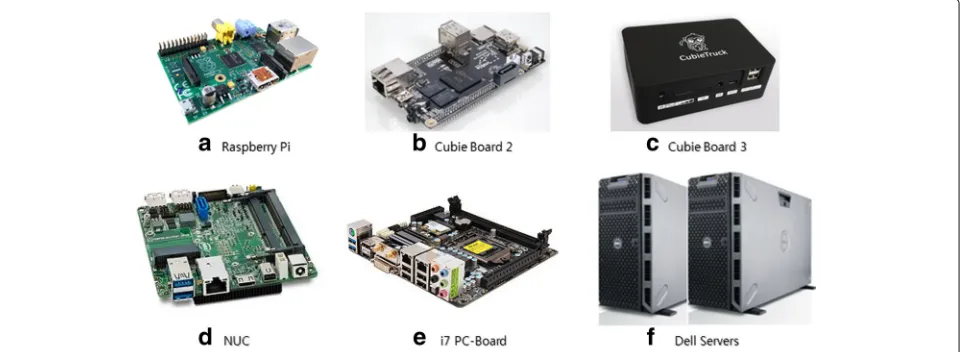
To support CI/CD with lightweight virtualization for secure mVoIP, the secure mVoIP based on Docker can be implemented by utilizing the open-source PBX SW Asterisk with HW on a single board or PC instance of high-performance servers. Figure 5 shows the HW plat-form testbed of the PBX SW Asterisk from single-board
Raspberry Pi 2 to Dell servers. The single-board Rasp-berry Pi 2, Cubie-Board 2, and Cubie-Board 3 are standalone-based mVoIP platforms. The Intel NUC, Intel i7 PC, and Dell servers are cloud and Docker-based mVoIP platforms. Figure 6 shows the architecture of the Docker-based PBX SW Asterisk [6] and dashboard FreePBX [17]. As shown in Fig. 6, Dockerfile [18] keywords used to gen-erate the Docker image are presented. Docker can build images automatically by reading the instructions from a Dockerfile, a text file that contains all the commands, in order, needed to build a given image. Dockerfiles support the functions of CI/CD. Dockerfiles adhere to a specific format and use a specific set of instructions.
To support a secure mVoIP app (cf. issue 7 in Section 2.2), Fig. 6 (a) shows the continuous deliv-ery server with generated images using the Dockerfile. Figure 6 (b) shows the architecture of the Docker-based PBX SW Asterisk and dashboard FreePBX in the backend server. As shown in Fig. 6 (c), Dockerfile keywords used to generate the Docker image are presented. The functions of the Dockerfile support CI/CD. The idea behind CI/CD is that we should create jobs that perform certain opera-tions such as building, testing, delivering, and deploying. Those jobs should be linked together to create a CI/CD pipeline.
The main concept of Docker is the immutable infrastructure concept that extends CI/CD as shown in
Fig. 6, and the features of the immutable infrastructure are summarized as follows: manageability, scalability, testa-bility, and portability. Figure 6 (d) and (e) show the user interface (UI) screen of the secure mVoIP app based on an Android device for a secure voice communication service. In particular, to prevent eavesdropping on calls using VOMIT or SipTap, Fig. 6 (d) shows the secure key generation process to support secure voice communica-tion including the steps of voice sampling, white-noise removal, and secure key generation [19].
4 Verification of the secure voice test to protect
against eavesdropping and the global communication test of secure mVoIP
In this section, we perform verification testing between the user’s original voice and the user’s secure voice for respectively real voice communication and secure voice communication testing of global and domestic communi-cation environments using the developed secure mVoIP based on Docker.
4.1 Verification of the secure voice test to protect against eavesdropping
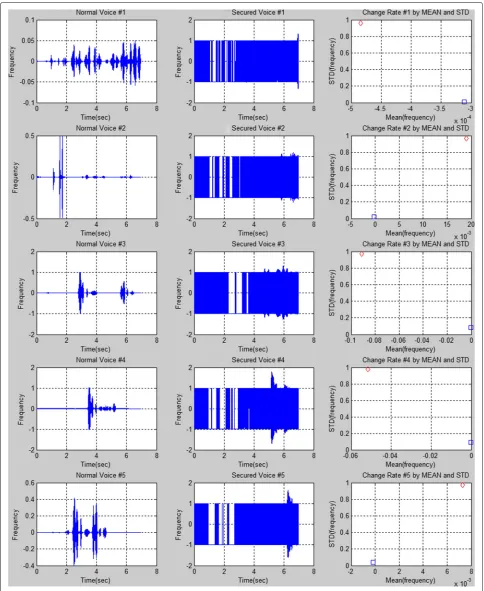
We performed the verification testing of secure voice communication to protect against eavesdropping using an Android-based secure mVoIP app and Docker-based PBX SW Asterisk with a PC to support lightweight virtualization. Figures 7 and 8 show the verification of
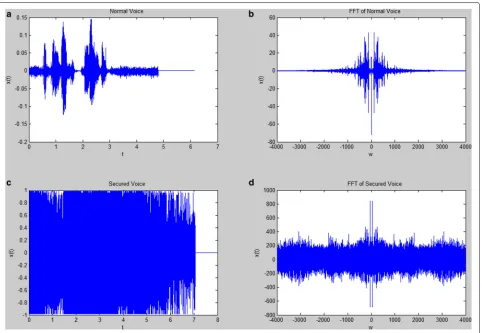
Fig. 8Original and secured voices and their FFT versions.aNormal voice.bFFT of normal voice.cSecure voice.dFFT of secure voice
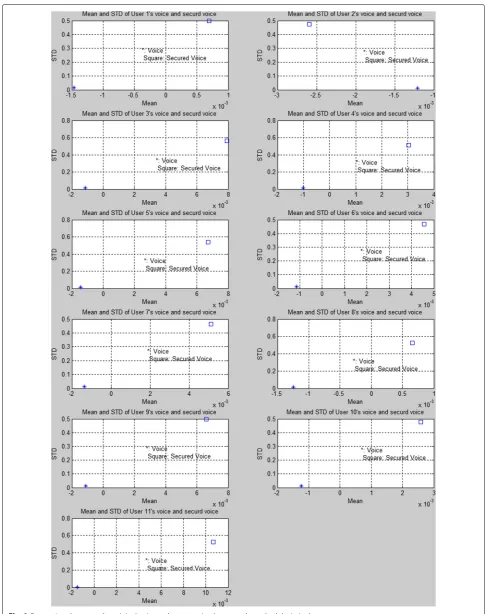
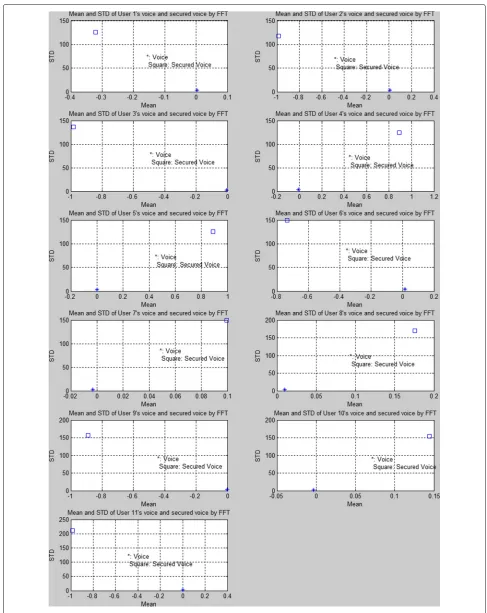
the secure voice test to protect against eavesdropping by original voice and secure voice. Figure 7 presents the user’s original voice and the user’s secure voice through the secure mVoIP app. The third column of Fig. 7 shows the locations of the original voices (blue squares) and the secure voices (red diamonds) with regard to the average (x-axis) and standard deviation (y-axis) to demonstrate objectivity. The distances between original voice and secure voice intuitively demonstrate the security of voice communication. Figure 8 shows the user’s original voice and secure voice. Figure 8a, b present respectively the original voice and fast Fourier transformation (FFT [20]) signal of the original voice. Figure 8c, d present respectively the secure voice and FFT signal of the secure voice. Figure 9 presents a comparison between original voices and secure voices (mean and standard deviation), and Fig. 10 shows the distribution comparison between original voice and secure voice by FFT.
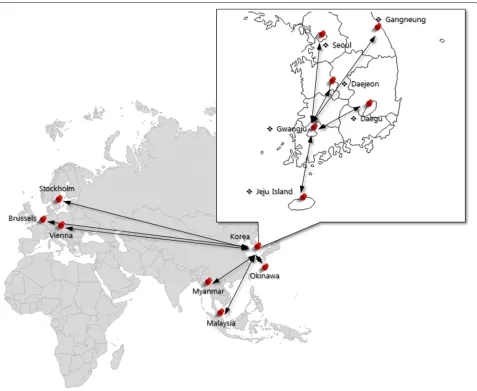
4.2 Verification of the domestic voice communication test The domestic real voice communication test of the secure mVoIP was conducted between the metropolitan areas of Seoul, Daejeon, Daegu, Gangneung, or Jeju Island
and Gwangju metro-city as shown in Fig. 11. The real voice two-way communication speed is approximately distributed in the range from 133 to 145 ms as shown in Table 1. Figure 12 shows the results of 100 iterations of the network traffic delay test between secure mVoIP apps in Gwangju metro-city.
4.3 Verification of the voice communication test in South-East Asia
Fig. 11Global and domestic verification experiment: locations and connectivity
4.4 Verification of the voice communication test in Europe
The real voice communication test of the secure mVoIP in Europe was conducted between Brussels, Stockholm, or Vienna and Gwangju metro-city as shown in Fig. 11. Table 3 presents the real voice communication test results between Brussels, Stockholm, and Vienna and Gwangju
Table 1Experimental verification of the domestic voice communication test results
Domestic area Minimum delay time (ms) Maximum delay time (ms)
Seoul 78 78
Daejeon 78 140
Gangneung 78 140
Jeju Island 133 145
metro-city. The real voice two-way communication speed in Europe is approximately 78 ms in all cases. In conclu-sion, the real voice communication speed of the entire European zone is consistent with that of the real voice communication speed of the South-East Asian zone.
5 Cloud-based real-time migration test of VoIP to
mitigate DoS attacks
Fig. 12Network traffic delay test between secure mVoIP apps in Gwangju metro-city
a graph of the network traffic using Cacti [21] and the data communication graph using FreePBX showing the real-time migration between hosts. We observed a much larger amount of network traffic and data communica-tion during real-time migracommunica-tion than during settlement. The real-time migration generates a burst of data types between 15 and 10 s as shown in Fig. 13. In particular, the migration traffic needs a higher level of bandwidth only at the start of the migration as shown in Fig. 14. The amount of real-time migration traffic itself requires less bandwidth, but the absolute priority of real-time migra-tion traffic should be guaranteed as critical traffic to detour/avoid DoS attacks.
6 Conclusions
Recently, the paradigm of the computing environment has changed, and following changes to the communi-cation environment, VoIP technology is being revisited
Table 2Voice communication test result between Gwangju metro-city and South-East Asian locations
Location Minimum delay time (ms) Maximum delay time (ms)
Okinawa 78 181
Malaysia 108 140
Myanmar 78 175
to support various services in the ICT field. In this paper, we designed a prototype secure mVoIP service with the open-source Asterisk PBX SW by employ-ing Docker lightweight virtualization for mobile devices with the immutable concept of CI/CD. In addition, the secured mVoIP service supports protection against eavesdropping and DoS attacks using secure voice cod-ing and real-time migration. We also experimentally verified the quality of the secure voice and the asso-ciated communication delay over a distributed global connectivity environment. In particular, the global real voice communication test was conducted in both South-East Asia and Europe. The real voice communication speed of the entire European zone was consistent, and the real communication speed of the South-East Asian zone was variable. We have shown that real-time migration has the potential to provide DoS attack mitigation.
Table 3Voice communication test result between Gwangju metro-city and Europe
Location Minimum delay time (ms) Maximum delay time (ms)
Brussels 78 78
Stockholm 78 78
Fig. 13Network traffic graph using Cacti
Acknowledgements
This work was supported by an Institute for Information Communications Technology Promotion (IITP) grant and funded by the Korean government (MSIP) (no. B0190-15-2030, Web Service User Account Information Management and Spill/Exploit Detection Technology Development) and by the Human Resource Training Program for Regional Innovation and Creativity, through the Ministry of Education and National Research Foundation of Korea (2015H1C1A1035823).
Competing interests
The authors declare that they have no competing interests.
Publisher’s Note
Springer Nature remains neutral with regard to jurisdictional claims in published maps and institutional affiliations.
Author details
1School of Electrical Engineering and Computer Science, GIST, Gwangju,
South Korea.2Department of Information and Communication Engineering, Chosun University, Gwangju, South Korea.3Department of Control and Measuring Robot Engineering, Chosun University, Gwangju, South Korea.
Received: 29 June 2016 Accepted: 20 March 2017
References
1. Gartner Group. http://www.gartner.com/. Accessed 28 Mar 2017 2. CI/CD. https://www.docker.com/use-cases/cicd. Accessed 28 Mar 2017 3. CI/CD.
http://www.asp.net/aspnet/overview/developing-apps-with-windows-azure/building-real-world-cloud-apps-with-windows-azure/ continuous-integration-and-continuous-delivery. Accessed 28 Mar 2017 4. VoIP. http://www.voip-info.org/wiki/view/What+is+VOIP. Accessed 28
Mar 2017
5. Mobile VoIP. https://www.mobilevoip.com/. Accessed 28 Mar 2017 6. Asterisk. http://www.asterisk.org/. Accessed 28 Mar 2017
7. N Russell, Official document IR.92 - IMS profile for voice and SMS. GSMA (2015)
8. E Elkin, The secret value of VoLTE. TMCnet (2014)
9. M Ruck, Top ten security issues with voice over IP. 2010 White Paper Series, Technology Consultants and Network Engineers (2010) 10. DR Kuhn, TJ Walsh, S Fries, Security considerations for voice over IP
systems. NIST Special Publication 800-58, 1-91 (2005) 11. Docker. https://www.docker.com/. Accessed 28 Mar 2017
12. Hypervisor. https://en.wikipedia.org/wiki/Hypervisor. Accessed 28 Mar 2017
13. A Aryaputra, N Bhuvaneshwari, inProceedings of the World Congress on Engineering and Computer Science 2011 Vol II.5G- the future of mobile network, (2011), pp. 19–21
14. X Li, A Gani, R Salleh, O Zakaria, The future of mobile wireless
communication networks. International Conference on Communication Software and Networks, 554–557 (2009)
15. SDN. https://www.opennetworking.org/sdn-resources/sdn-definition. Accessed 28 Mar 2017
16. Cisco ACI. http://www.cisco.com/c/en/us/solutions/data-center-virtualization/application-centric-infrastructure/index.html. Accessed 28 Mar 2017
17. FreePBX. https://www.freepbx.org/. Accessed 28 Mar 2017 18. Dockerfile. https://docs.docker.com/engine/userguide/eng-image/
dockerfile_best-practices/. Accessed 28 Mar 2017
19. BR Cha, SJ Shim, S Park, JW Kim, Secured mVoIP service over cloud and container-based improvement. 2015 IEEE 29th International Conference on Advanced Information Networking and Applications, 791–795 (2015) 20. Fast Fourier transformation (FFT). http://mathworld.wolfram.com/
FastFourierTransform.html. Accessed 28 Mar 2017 21. Cacti. http://www.cacti.net/. Accessed 28 Mar 2017
Submit your manuscript to a
journal and benefi t from:
7 Convenient online submission
7 Rigorous peer review
7 Immediate publication on acceptance
7 Open access: articles freely available online
7 High visibility within the fi eld
7 Retaining the copyright to your article
![Fig. 1 Voice data processing in a VoIP system [10]](https://thumb-us.123doks.com/thumbv2/123dok_us/932096.1113272/2.595.62.541.389.720/fig-voice-data-processing-voip.webp)