Spatio Temporal Load Re-balancing Approach
in Cloud Computing Applications
Sheetal K. Gajbhiye, Prof. Rugraj Purohit
Department of Computer Engineering, Alard College of Engineering and Management, Pune, India
ABSTRACT: Distributed computing is fueled by a motor known as Internet Data Centers (IDC). As distributed computing prospers, the vitality utilization and expense for IDCs are taking off. The vitality cost minimization issue for IDCs in deregulated power markets has produced developing premium. In this paper we concentrate how to influence both the geographic and fleeting variety of vitality cost to minimize vitality cost for dispersed IDCs. We propose a novel structural planning and two calculations for bound together spatial and fleeting burden adjusting. Thorough examination demonstrates that our calculations have a low computational many-sided quality, require a casual exactness in power value estimation, and assurance an administration culmination time for client demands. Utilizing genuine power cost and workload follows, broad assessments exhibit that contrasted with the plans utilizing either spatial burden adjusting or worldly load adjusting alone, the proposed spatio-fleeting burden adjusting strategy essentially decreases vitality cost for conveyed IDCs. For future work, we have recognized bottlenecks in Load Balancing Algorithm and proposed to execute Load Re-Balancing Algorithm. Re-Balancing Algorithm will compute Server Performance and taking into account that it will re-equalization work demands. This will ensure there is change accordingly time for administration demands.
KEYWORDS: Data center, energy, cost management, delay bound, load balance, algorithm.
I. INTRODUCTION
Big data [9] is the term for a gathering of data sets so huge and complex that it becomes hard to process using on hand database management tools or traditional data processing Environments. The difficulties incorporate storage, search, sharing, transfer, analysis, and visualization, exchange, examination, and perception. The pattern to bigger information sets is because of the extra data logical from investigation of a solitary extensive arrangement of related information, when contrasted with particular littler sets with the same aggregate sum of information, permitting relationships to be found to "spot business patterns, decide nature of exploration, forestall maladies, join lawful references, battle wrongdoing, and decide constant roadway movement conditions. The confinements additionally influence Internet inquiry, fund and business informatics. Information sets develop in size partially in light of the fact that they are progressively being assembled by omnipresent data detecting versatile ethereal sensor advances (remote detecting), programming logs, cameras, mouthpieces, ID perusers, and remote sensor systems. Huge information is hard to work with utilizing most social database administration system and desktop measurements and perception bundles, requiring rather "greatly parallel programming running on a n number of servers". What is viewed as "large information" [14] changes relying upon the abilities of the association dealing with the set, and on the capacities of the applications that are customarily used to prepare and examine the information set in its area. "For a few associations, confronting many gigabytes of information interestingly might trigger a need to rethink information administration alternatives. For others, it might take tens or many terabytes before information size turns into a huge thought [10].
II. LITRETURE SURVEY
the data into chunks and applied association mining on each chunk in parallel. The results were then integrated for identifying global frequent item set. This algorithm was developed and tested on Hadoop [1] platform with parallel processing [1] programming model and its performance was reviewed.
Mr. Vipul Agarwalet al [2] dealing with some of the issues in association rule mining like security and privacy. The primary aim of privacy preservation is to extract exact patterns without accessing original data. For modification purpose, the item / the chunk is selected from the chunk set which would have minimal influence on original database. For continuing privacy of users a new algorithm named Cloud Service Preserving Model algorithm is proposed in this paper. This algorithm authorizes the correct user and hides his logical instances from others. The algorithm selection depends on situation for reducing the influence for original database. The proposed algorithm is useful in multiuser cloud computing environment.
Multi-Agent Systems (MAS)are variant systems with multiple agents looking for a solution to a common problem. The main goal in this paper is to achieve an efficient data mining process with an extensible and general architecture which can maintain multiple data types. Othmane et al [3] showed a multi-agent architecture for cloud computing as Software as a Service (SaaS) [3]. Major issues faced in achieving a scattered mining procedure with beyond mentioned characteristics were enormous data volumes, communication issues, heterogeneous nature of users and complete parallelism. Those challenges are overcome by multi-agent approach. The process of classification originate rules for categorizing records. H. Malmiret al [4] presented a difference in between two classification algorithms in conditions of speed and correctness using Genetic Algorithm (GA) classifiers. Imperialist Competitive Algorithm (ICA)[4]and Particle Swarm Optimization (PSO)[4] both the algorithms are used for improving classification speed and accuracy. Multi-Layer Perception (MLP) [4] is the neural network that was used for analyzing and evaluating these algorithms. data which is divided in two parts and processing these part on being systems which were interconnected due to this Parallel processing was achieved .
Z. Hai-Jianet al [5] examined shopper highlight extraction with distributed mining so as to compute their inclinations. Distributed computing gives monstrous capacity limit and adaptable registering ability. Procurement of exact administrations with proper innovation is the way to accomplishment for ventures when managing enormous information. Information mining in distributed computing is an effective and solid strategy for removing helpful examples from huge information. Parallel preparing decreases the undertaking's handling cost as it is not reliant on execution of machines. Parallelism enhances handling speed and gives adaptation to non-critical failure in huge information mining. In any case, this methodology has a few difficulties, for example, calculation determination, instability in calculation and assessment of results. By knowing the inclinations of clients, endeavor can reshape their association with client however it represents a genuine risk to security and protection with regards to the individual data of customers.
III.PROBLEMSTATEMENT
We model the dispatching and execution of user requests for cloud-computing service. First we describe portal server, and distributed IDC system. Next we explain workload of user requests, electricity price, workload queue, and workload scheduler. Then we give the queuing delay constraint for workload and the capacity constraint for IDC sites. We further formulate the energy cost minimization problem for the distributed IDC system
IV.PROPOSEDSYSTEM
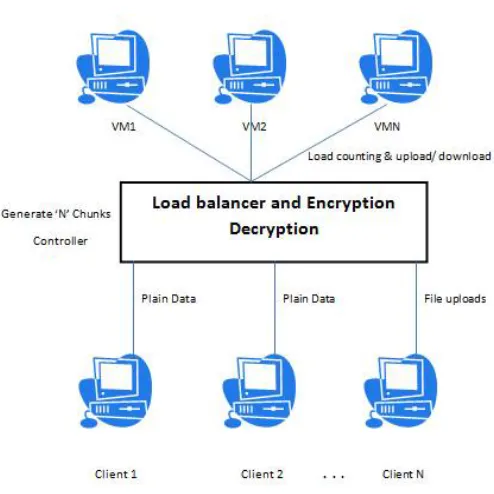
Figure 1: Proposed System Architecture
The data that is to be stored in cloud is not protected. In order to afford security to data, the data is stored in the encrypted shape in the nodes. The file that is to be uploaded in the cloud is chosen by the client. The encryption procedure is perform over the data with the key provided. The encrypted file is finished in different chunks and stored in different nodes.
ALGORITHMS
Compute VM Load from data nodes Input: ith Node input
Output: - Idle or Normal Or Overloaded in percent (%).
Compute Load (VM id) : weight Degree Inputs: The static parameter comprise the number of CPU’s, the CPU dispensation speeds, the reminiscence size, etc. active parameters are the memory consumption ratio, the CPU exploitation ratio, the network bandwidth. procedure:-
1. Characterize a load limit set: F= {F1,F2…Fm} with each Fire present the total number of the consideration. 2. Calculate the load capacity as weight Degree(N)= ∑ αiFi Where i= 1…m
3. ordinary cloud partition degree from the node consignment degree statistics as: Load amount avg=∑i=1..n
LoadingDegree(Ni)
4. Three height node position are defined Load_degree(N)=0 for inactive 0< Load_Degree (N)<=Load_Degree(N) for overfull
Equally Spread Current Execution throttledLoad balancing algorithm: Input : File form user as Fi
Output: Equally distributed chunks on data servers Step1 : Read Fi from data owner with size
Step 2: count total number of data nodes Ni
Step 3: for each(score=read each vm node and call to compute node(k)) Read when k==null
End for
Step 5: save all data on data nodes.
MATHEMATICALMODEL Inputs:
The static parameters include the number of CPU’s, the CPU processing speeds, the memory size, etc. Dynamic parameters are the memory utilization ratio, the CPU utilization ratio, the network bandwidth.
Process:-
1. Define a load parameter set: F= {F1,F2…Fm} with each Fire presents the total number of the parameters. 2.Compute the load degree as
Load Degree(N)= Σ αiFi Where i= 1…m
3. Average cloud partition degree from the node load degree statistics as: Load degreeavg=Σi=1..n Load Degree(Ni)
4. Three level node status are defined Load degree(N)=0 for Idle
0<Load Degree(N)<Load Degree(N)high for Normal
Load_Degree(N)high <= Load_Degree(N) for Overloaded
Output :-
Idle or Normal Or Overloaded
Results and Discussion
The system is work with multiple virtual machines. One we deploy the system on EC2 environment it will work fine. The estimated results for the system base on below tables.
VM Name CPU
Utilization
Chunk Size
VM1 50% 2.8 MB 5.6 MB
VM2 60% 2.8 MB 5.6 MB
VM3 60% 2.5 MB 5.0 MB
VM4 75% 1.4 MB 2.8 MB
VM5 85% 0.8 MB 1.6 MB
Total Size 10.0 MB 20.0 MB
Table of system performance
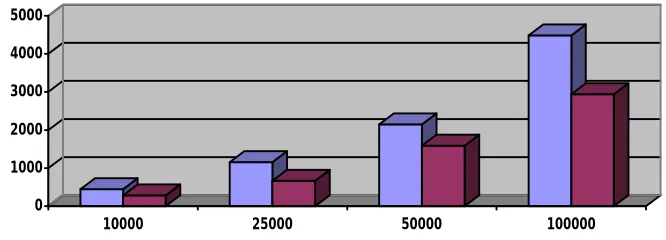
Below graph show the system performance of proposed system retrieval time for total number of files from data servers.
0 1000 2000 3000 4000 5000
10000 25000 50000 100000
Existing Proposed
V.CONCLUSION
Current Internet data centers consume enormous amount of energy and incur huge energy cost Load Balancing helps to reduce cost of operation of IDC by effectively distribute load based on Space and Time parameters. We have proposed to implement Load Re-Balancing Algorithm which will further improve performance, time, space and will help in reducing energy cost of IDC.
Future Scope
Load balancing is a idea which is still beneath research. on a daily basis new frameworks, algorithms and models are creature developed and existing models are updated. There is a huge scope for future improvement. For example, the users are distribution illogical data as a query on the web, and therefore web-centric queries can be optimized at server side to decrease server load to develop the server performance. Further, implementation of our work is awaiting and hence an improvement may be recommended in the identical.
REFERENCES
[1]. L. Li and M. Zhang, ‘The Strategy of Mining Association Rule Based on Cloud Computing’, 2011 International Conference on Business Computing and Global Information, 2011.
[2]. V. Agarwal, Y. Khandagre, and A. K. Dubey, ‘Novel Cloud Subset Preserving Mining (CSPM) algorithm for association rule mining in centralized database’, 2012 IEEE International Conference on Technology Enhanced Education (ICTEE), 2012.
[3]. Othmane, B., R. Hebri, and M. Boudiaf, ‘Cloud Computing and Multi-Agent Systems: A new Promising Approach for Distributed Data Mining’, Proc. of the ITI 2012 34th Int. Conf. on Information Technology Interfaces, Jun 25-28, 2012.
[4]. H. Malmir, F. Farokhi, and R. Sabbaghi-Nadooshan, ‘Optimization of data mining with evolutionary algorithms for cloud computing application’, ICCKE, 2013.
[5]. Z. Hai-Jian, ‘Analysis and Application of Consumer Features with Cloud Computing and Data Mining Technology’, 7th International Conference on Intelligent Computation Technology and Automation, 2014.
[6] T.R. Gopalakrishnan Nair et al, “Data Mining using Hierarchical Virtual K-means approach integrating data fragments in Cloud Computing Environment” PROCEEDINGS OF IEEE CCIS, 2011
[7] Qiwei Lu et al, “Secure Collaborative Outsourced Data Mining with Multi-owner in Cloud Computing” IEEE 11TH INTERNATIONAL CONFERENCE ON TRUST, SECURITY AND PRIVACY IN COMPUTING AND COMMUNICATIONS, 2012
[8] JianlinXu et al, “MobSafe: Cloud Computing Based Forensic Analysis for Massive Mobile Applications Using Data Mining” TSINGHUA SCIENCE AND TECHNOLOGY, Volume 18, Number 4, August 2013
[9] Yong Wang et al, “Transplantation of Data Mining Algorithms to Cloud Computing Platform when Dealing Big Data”, INTERNATIONAL CONFERENCE ON CYBER-ENABLED DISTRIBUTED COMPUTING AND KNOWLEDGE DISCOVERY, 2014