DANBY, SEAN J. D. Optimization of Proper Orthogonal Decomposition using Various Preconditioning Techniques to Analyze Autoignition Simulation Data of
Non-Homogeneous Hydrogen-Air Mixtures. (Under the direction of Dr Tarek Echekki)
The proper orthogonal decomposition (POD) method is implemented on unsteady 2D
data from direct numerical simulations (DNS) of auto-ignition in non-homogeneous
hydrogen-air mixtures. The analysis is implemented to evaluate requirements for the
reproduction of transient, multi-dimensional and multi-scalar processes in combustion.
The resulting low-order models may be used to store and manage large data sets for
post-processing and visualization, and for the implementation of POD reduced data as an
integral element of model-based closure in turbulent combustion. Data reduction is
implemented on a set of thirty snapshots of 2D fields of the passive scalar: the mixture
fraction, and reactive scalars: the reaction progress variable, the reactants, hydrogen (H2)
and oxygen (O2), mass fractions and intermediate species, H-radical and HO2 mass
fractions. The snapshots cover the evolution of the hydrogen-air mixture from induction
to high-temperature combustion stages. POD analysis shows that there are different
requirements to reproduce passive and reactive scalars depending on the degree of their
spatial and temporal variations during the autoignition process and the statistical
distribution. The mixture fraction, which is affected by the mixing process only, requires
the least number of eigenmodes, and yields a sufficient representation of the original data
with only four eigenmodes. The success of the POD reduction of the reactive scalars
pre-processing strategies of the scalar fields are explored to reduce the number of
required eigenmodes. The strategies are designed to reduce the temporal and spatial spans
of scalar values. The results show that different pre-processing strategies may yield
different outcomes for the passive and reactive scalars reduction process depending on
Non-Homogeneous Hydrogen-Air Mixtures
by
Sean J. D. Danby
B.S. (New Mexico Institute of Mining and Technology) 2001
Submitted to the graduate faculty of North Carolina State University
in partial fulfillment of the requirements of the degree of Master of Science
in
Mechanical Engineering
Biography
Acknowledgment
Contents
List of Tables ...v
List of Figures ...vi
1. Introduction...1
1.1.Motivation...1
1.2.Direct Numerical Simulation Data and Proper Orthogonal Decomposition ...1
1.3.Specific Content of DNS Data...3
1.4.Objectives ...5
1.5.Thesis Outline...6
2. Numerical Implementation ...7
2.1.POD Reduction...7
2.2.Preprocessing Techniques ...10
2.3.Assessment of the Performance of the Different Preprocessing Approaches ....12
3. Results: Investigation of POD Reduction Requirements for Spatio-Temporal Data in Combustion ...15
3.1.Requirements of Reconstruction of Spatio-Temporal Data of Autoignition for Passive and Reactive Scalars ...16
3.2.Analysis of Performance of the POD Reduction Approach for passive and reactive scalars using relative error and correlation ...17
3.3.The Importance of the Scalars’ Statistical Distribution to the POD Reconstruction Accuracy...20
4. Results: Study and Performance of Preprocessing Strategies to Increase the Accuracy of the POD Reduction Approach...47
4.1.Required Preconditioning to Reduce the Low-Order POD Model Coupling of Statistical Distribution Analysis and Preconditioning of Specific Snapshots ....48
4.2.Statistical Distribution of Specific Snapshots and Preconditioning Techniques51 5. Conclusion ...75
5.1.Impact of Preprocessing POD reduced DNS hydrogen-air mixtures ...75
5.2.Specific Implications ...77
5.3.Future Work...78
6. References...80
7. Appendix A: Review of MATLAB Code ...83
List of Tables
List of Figures
Figure 2.1: Diagram of Concatenation: a point on a sequential row at the same
termination column will continue to neighbor the previous point according to the directions labeled by the arrows. ... 14
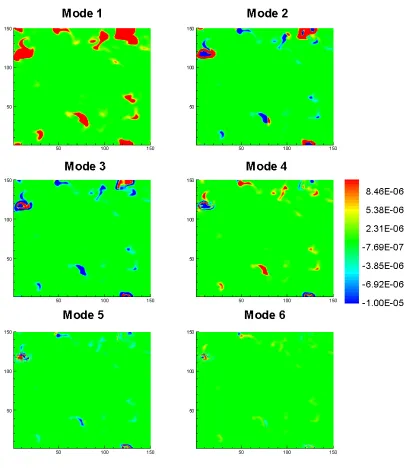
Figure 3.1: Two-dimensional field showing the first six dimensionless orthogonal
eigenfunctions for HO2 intermediate species mass fraction. ... 21
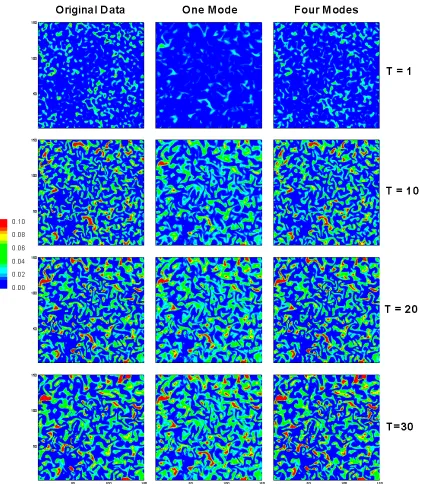
Figure 3.2: Two dimensional contour plot of mixture fraction showing the result of the POD reduction using one mode and four modes for times 1, 10, 20 and 30. ... 22 Figure 3.3: Two dimensional contour plot of progress variable showing the result of the
POD reduction using one mode and four modes for times 1, 10, 20 and 30. ... 23 Figure 3.4: Two dimensional contour plot of hydrogen reactant mass fraction showing the
result of the POD reduction using one mode and six modes for times 1, 10, 20 and 30... 24 Figure 3.5: Two dimensional contour plot of oxygen reactant mass fraction showing the
result of the POD reduction using one mode and six modes for times 1, 10, 20 and 30... 25 Figure 3.6: Two dimensional contour plot of H-radical mass fraction showing the result
of the POD reduction using one mode and six modes for times 1, 10, 20 and 30.... 26 Figure 3.7: Two dimensional contour plot of HO2 intermediate species mass fraction
showing the result of the POD reduction using one mode and six modes for times 1, 10, 20 and 30... 27 Figure 3.8: Magnitude of the Six Largest Eigenvalues and their Associated Energy
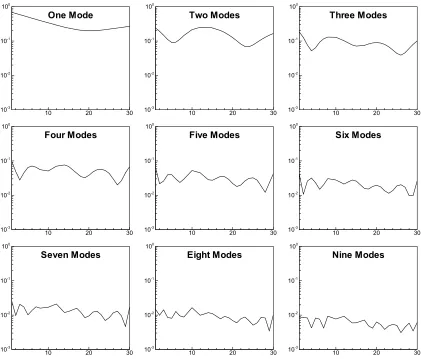
Percentage ... 28 Figure 3.9: Relative error of the POD unpreprocessed reduction for mixture fraction
showing the average error for each snapshot using various numbers of modes (1-6). ... 29 Figure 3.10: Relative error of the POD unpreprocessed reduction for progress variable
showing the average error for each snapshot using various numbers of modes (1-23, every third)... 30 Figure 3.11: Relative error of the POD unpreprocessed reduction for hydrogen reactant
showing the average error for each snapshot using various numbers of modes (1-6). ... 31 Figure 3.12: Relative error of the POD unpreprocessed reduction for oxygen reactant
showing the average error for each snapshot using various numbers of modes (1-9). ... 32 Figure 3.13: Relative error of the POD unpreprocessed reduction for H-radical showing
the average error for each snapshot using various numbers of modes (1-17 odd). .. 33 Figure 3.14: Relative error of the POD unpreprocessed reduction for HO2 intermediate
species showing the average error for each snapshot using various numbers of modes (1-23: every third)... 34 Figure 3.15: Correlation of POD reduced mixture fraction to original DNS results,
Figure 3.16: Correlation of POD reduced progress variable to original DNS results, showing an increase in the average correlation for each snapshot as the number of modes is increased ... 36 Figure 3.17: Correlation of POD reduced hydrogen reactant to original DNS results,
showing an increase in the average correlation for each snapshot as the number of modes is increased ... 37 Figure 3.18: Correlation of POD reduced oxygen reactant to original DNS results,
showing an increase in the average correlation for each snapshot as the number of modes is increased ... 38 Figure 3.19: Correlation of POD reduced H-radical to original DNS results, showing an
increase in the average correlation for each snapshot as the number of modes is increased ... 39 Figure 3.20: Correlation of POD reduced HO2 intermediate species to original DNS
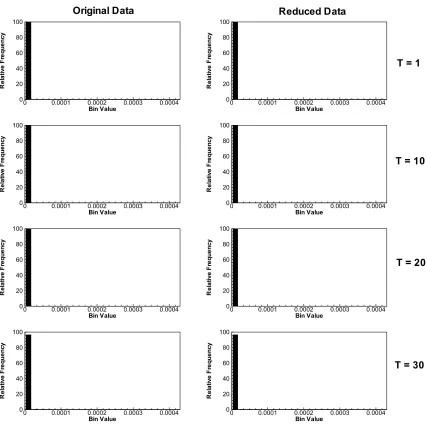
results, showing an increase in the average correlation for each snapshot as the number of modes is increased... 40 Figure 3.21: Histogram of original and unpreconditioned POD reduced mixture fraction
showing the relative frequency in percent for an even span of twenty locations for times 1, 10, 20 and 30. Notice only a slight variation in the resulting distribution after the POD reduction. ... 41 Figure 3.22: Histogram of original and unpreconditioned POD reduced progress variable
showing the relative frequency in percent for an even span of twenty locations for times 1, 10, 20 and 30. Notice a prominent variation in distribution; frequency and span. ... 42 Figure 3.23: Histogram of original and unpreconditioned POD reduced hydrogen
showing the relative frequency in percent for an even span of twenty locations for times 1, 10, 20 and 30. Notice only a slight variation in the resulting distribution after the POD reduction. ... 43 Figure 3.24: Histogram of original and unpreconditioned POD reduced oxygen showing
the relative frequency in percent for an even span of twenty locations for times 1, 10, 20 and 30... 44 Figure 3.25: Histogram of original and unpreconditioned POD reduced H-radical
showing the relative frequency in percent for an even span of twenty locations for times 1, 10, 20 and 30. Due to the low value of the majority of the data, the number of entries beyond the first value is minimal and des not show clearly. ... 45 Figure 3.26: Histogram of original and unpreconditioned POD reduced HO2 Intermediate
Species showing the relative frequency in percent for an even span of twenty
locations for times 1, 10, 20 and 30. ... 46
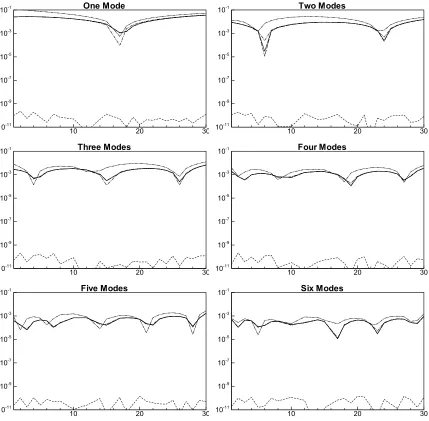
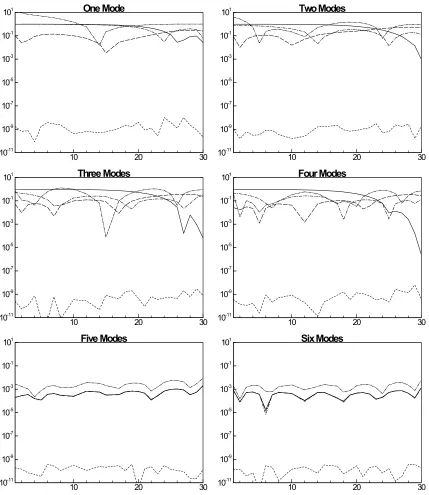
Figure 4.1: Relative error of the mean of the POD reduced mixture fraction for five different methods and up to six modes. ( ___ Unpreprocessed, ---- RMS
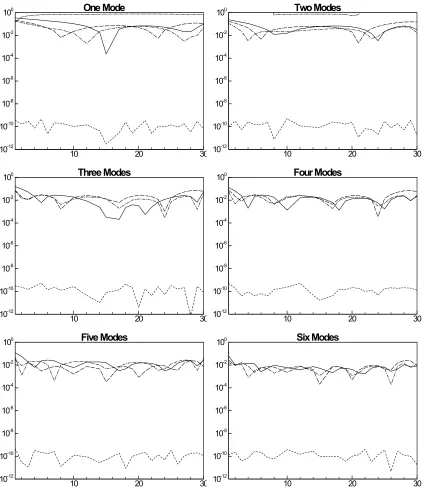
Preconditioned, -.-.-.- Mean Normalized, __ __ __ __ Max Normalized, -..-..-..- Log Preconditioned) ... 55 Figure 4.2: Relative error of the mean of the POD reduced progress variable for five
different methods and up to six modes. (Key is the same as Figure 4. 1) ... 56 Figure 4.3: Relative error of the mean of the POD reduced hydrogen for five different
Figure 4.4: Relative error of the mean of the POD reduced oxygen for five different methods and up to six modes. (Key is the same as Figure 4. 1) ... 58 Figure 4.5: Relative error of the mean of the POD reduced H-radical for five different
methods and up to six modes. (Key is the same as Figure 4. 1) ... 59 Figure 4.6: Relative error of the mean of the POD reduced HO2 intermediate species for
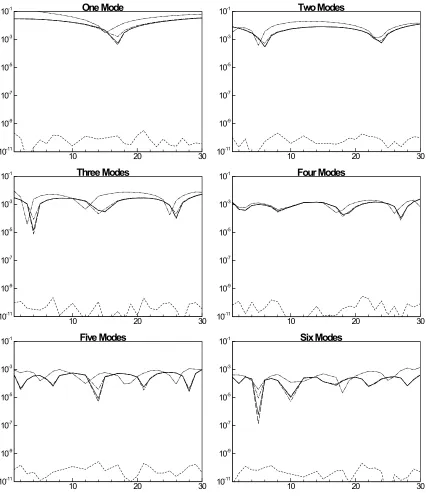
five different methods and up to six modes. (Key is the same as Figure 4. 1) ... 60 Figure 4.7: Relative error of the RMS of the POD reduced mixture fraction for five
different methods and up to six modes. (Key is the same as Figure 4. 1) ... 61 Figure 4.8: Relative error of the RMS of the POD reduced progress variable for five
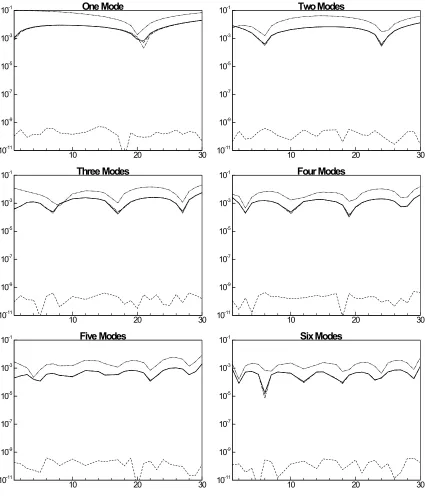
different methods and up to six modes. (Key is the same as Figure 4. 1) ... 62 Figure 4.9: Relative error of the RMS of the POD reduced hydrogen for five different
methods and up to six modes. (Key is the same as Figure 4. 1) ... 63 Figure 4.10: Relative error of the RMS of the POD reduced oxygen for five different
methods and up to six modes. (Key is the same as Figure 4. 1) ... 64 Figure 4.11: Relative error of the RMS of the POD reduced H-radical for five different
methods and up to six modes. (Key is the same as Figure 4. 1) ... 65 Figure 4.12: Relative error of the RMS of the POD reduced HO2 intermediate species for
five different methods and up to six modes. (Key is the same as Figure 4. 1) ... 66 Figure 4.13: Correlation of mixture fraction as a result of the various preprocessing
techniques. The unpreprocessed result is shown for comparison. ( ___________ Unpreprocessed, --- Log Preconditioned, -.-.-.-.-.-.-.-.- Max Normalized, __
__ __ __ Mean Normalized, -..-..-..-..-..-..-..- RMS Preconditioned)... 67 Figure 4.14: Correlation of progress variable as a result of the various preprocessing
techniques. The unpreprocessed result is shown for comparison. (Key is the same as Figure 4.13) ... 68 Figure 4.15: Correlation of hydrogen as a result of the various preprocessing techniques.
The unpreprocessed result is shown for comparison. (Key is the same as Figure 4.13) ... 69 Figure 4.16: Correlation of oxygen as a result of the various preprocessing techniques.
The unpreprocessed result is shown for comparison. (Key is the same as Figure 4.13) ... 70 Figure 4.17: Correlation of H radical as a result of the various preprocessing techniques.
The unpreprocessed result is shown for comparison. (Key is the same as Figure 4.13) ... 71 Figure 4.18: Correlation HO2 intermediate species as a result of the various
preprocessing techniques. The unpreprocessed result is shown for comparison. (Key is the same as Figure 4.13)... 72 Figure 4.19: Histograms showing the variation of the relative frequency the three scalars,
mixture fraction, hydrogen and oxygen prior to POD reduction. The snapshot number is shown on the x-axis, the ‘bin value’ is shown in the y-axis and the
frequency (percentage) is indicated by the color contour... 73 Figure 4.20: Histograms showing the variation of the relative frequency of the progress
variable, H-radical and HO2 intermediate species scalars prior to POD reduction.
Figure A.1: Initial window for the POD GUI used in the data acquisition. ... 85
Figure A.2: After selecting the ‘Load’ option from the ‘DATA’ menu, the data size and the directory the data is located can be inputted an the various preconditioning and saving options can be chosen prior to selecting ‘PROCESS’... 86
Figure A.3: An example of a typical result... 86
Figure B.1: Preprocessed histogram comparison for mixture fraction. ... 87
Figure B.2: Preprocessed histogram comparison for hydrogen reactant species... 88
Figure B.3: Preprocessed histogram comparison for oxygen reactant. ... 89
Figure B.4: Preprocessed histogram comparison for H-radical... 90
Chapter 1
Introduction
1.1 Motivation
The prediction of non-linear transient phenomena in combustion presents important
challenges for the state-of-the-art models in turbulent combustion. Turbulent mixing and
combustion are governed by multiscale processes. At large scales, turbulent stirring
contributes to increasing entrainment and multiplying interfaces between scalars (e.g.
flames), while micro-mixing or molecular diffusion contributes to the dissipation of these
scalars. In combustion flows, the process of mixing is further coupled with the time
scales associated with combustion chemistry, giving rise to the so-called
‘turbulence-chemistry’ interactions. In statistically-transient combustion phenomena, such as
autoignition, the process is also governed by transitions in modes of combustion,
involving ignition to the formation of flames, which includes transitions in the dominant
chemistries associated with the induction and high-temperature combustion stages.
1.2 Direct Numerical Simulations Data and Proper Orthogonal Decomposition
The Direct Numerical Simulation (DNS) of reacting flows has long been useful to gain
fundamental insight into the physics of “turbulence-chemistry” interactions (Poinsot,
2000; Vervish and Poinsot, 1998). These interactions reflect the coupling between fluid
dynamics, chemistry, and molecular transport in multi-component mixtures. The theory
spatio-temporal DNS data of combustion phenomena. A reduced representation of this
data may provide a mechanism for the management and storage of DNS data for
post-processing and visualization. Moreover, it is possible to exploit these reduced
representations to develop low-order models of turbulence-chemistry interactions that
also reflect the transient character of important combustion processes such as ignition and
extinction. Tools that are based on dynamical systems theory have been proposed and
implemented in the field of fluid dynamics for more than thirty years (Lumley, 1967).
One such a tool is the Proper Orthogonal Decomposition (POD) technique. POD provides
a useful systematic characterization of patterns, such as coherent structures in shear
layers or ignition kernels in combustion, which are generated by non-linear phenomena
(Holmes, et al, 1997; Sirovich, 1987). These patterns may in turn be represented in lower
dimensional models, resulting in a significantly reduced description of these patterns. In
combustion, POD has been a useful tool to identify periodic and chaotic patterns in
burner-stabilized flames (Gorman, et al, 1994; Palacios et al, 1997; Palacios et al, 1996;
Palacios et al., 1998) and for data reduction of steady, 2D DNS data of opposed jet
flames by Frouzakis, et al (2000). These studies show that, depending on the nature of the
physics to be reproduced, the number of eigenmodes maintained can range from two to
five eigenmodes that account for the bulk of spectral energy. The wide range of
requirements for different combustion phenomena are strongly affected by two important
challenges in reproducing combustion data: transient effects and the multiscale nature of
1.3 Specific Content of DNS Data
The POD analysis is implemented on 2D DNS data of autoignition of a
non-homogeneous mixture of diluted hydrogen in heated air at 5 atmospheres, which were
carried out by Echekki & Chen (2003). The data consists of 2D spatial data on a
Cartesian grid and at equal time increments of thermo-chemical scalars. The fuel is a
50% H2/50% N2 mixture by volume at 300 K, and the oxidizer is air at 1180 K. The
mixture is maintained at a pressure of 5 atmospheres. The DNS data includes temporally
and spatially-resolved data for the thermodynamic state of the mixture including the
mixture composition consisting of 9 species, H2, O2, O, OH, H2O, H, HO2, H2O2, and N2,
whose chemistry is represented by a detailed mechanism of 19 elementary steps (Yetter,
et al, 1991). The resulting autoignition chemistry is consistent with the so-called second
explosion limit for hydrogen-air systems. The initial distribution of the mixture fraction
varies from pure fuel to pure oxidizer over a characteristic length scale, of 0.1 cm,
which is expressed in terms of the two-point correlation of the mixture fraction
fluctuations. A similarly-defined characteristic length scale for the velocity
fluctuations, , is set to 0.04 cm. The corresponding initial ‘turbulence’ intensity, u'', is
2.15 m/sec.
ξ L
u
L
The autoignition chemistry in the non-homogeneous mixture at the second explosion
limit is characterized by two stages: induction and high-temperature combustion. As
ignition kernels develop past the second stage, propagating fronts form to complete the
ignition process over the remaining unignited regions of the domain. The first stage of
absence of heat release (i.e. the absence of temperature rise due to combustion) (Kreutz
and Law, 1996). This stage is centered on the build-up of a radical pool through chemical
nonlinearity as opposed to thermal feedback. In the second stage, transition to
high-temperature combustion occurs, which is characterized by thermal runaway and the
establishment of a premixed flame front. Autoignition develops at discrete ignition sites
(or kernels) where the mixture state (temperature and composition) is most favorable to
the development of a radical pool and where the rates of dissipation of this radical pool
along with the dissipation of heat is lower than the rate of radical production. Because,
the initial stage of combustion is not associated with any significant heat release, tracking
the evolution of the radical pool is the primary indication of chemical activity during this
stage. HO2 is a reasonable marker of the level of chemical activity in the mixture and the
transition between the two stages of autoignition. Moreover, during these transitions, the
HO2 mass fraction displays significant changes over time. Similarly, the concentration of
radicals, such as H, O and OH, are direct measures of the evolution of the radical pool
during the induction stage. Therefore, reactive scalars are expected to evolve rapidly in
time during transitions between the two stages of autoignition and during the growth of
the autoignition kernels. In the present study, the initial configuration results in the first
onset of high-temperature combustion at 4x10⁻⁵ sec. By approximately 6x10⁻⁵ sec, most
of the igniting kernels have transitioned to the high-temperature combustion stage.
The computations are carried out to a stage where propagating ignition fronts form after
the onset of autoignition in discrete ignition kernels. The domain size is 0.37 cm by 0.37
cm, which is discretized with a Cartesian grid of 601 x 601 points. Therefore, the
consists of 30 snapshots of 2D fields of thermo-chemical scalars and velocity vector
components provided at equal time increments of 2.15 x 10⁻⁶ sec, and ranging from 2.15
x 10-6 to 6.67 x 10⁻⁵ sec. The final time corresponds to the completion of the induction
process in the bulk of ignition kernels, and the onset of high-temperature combustion.
1.4. Objectives
While there is reasonable understanding of the relevance and limitations of the POD
approach to turbulent nonreacting flows, an understanding of the value of POD in
turbulent combustion remains limited. The bulk of POD reduction has been carried out on
relatively coarse (in space) experimental observables including, for example, velocity
data from Particle Image Velocimetry, visible flame emissions or fluorescence signals.
Highly utilized in stead-state problems, POD has not been fully analyzed in unsteady
fine-grain numerical data. Moreover, different POD reduction requirements are reported
to address different scalars and velocity components. Invariably, there should be different
POD reduction requirements for the prediction of different phenomena, especially during
highly transient processes, and the reproduction of different quantities. The relative
complexity necessary to capture transient, multi-component and multiscale processes
requires the development of different processing strategies to reduce the required number
of POD modes.
The objectives of this study are a) to evaluate requirements for the reproduction of DNS
data of the autoignition of hydrogen with heated air in a non-homogeneous mixture and
b) to explore whether different preprocessing strategies for the scalar fields can reduce
of many simulations involving strongly transient phenomena with wide scale variations.
Reduced representations of DNS data may be exploited to store and manage these data
sets for post-processing and visualization. They may also be used to develop low-order
models that accurately represent transient phenomena in combustion. These models may
then be coupled with a coarse-grained simulation, such as Reynolds Averaged
Navier-Stokes (RANS) or Large Eddy Simulation (LES) approaches.
1.5. Thesis Outline
The DNS data and the POD approach are detailed in Sections 1.3 and 1.4 respectfully.
The following section includes a description of proper orthogonal decomposition and its
multitude of uses. Next, results of the POD analysis for the passive scalar, mixture
fraction and reactive scalars; the reaction progress variable, hydrogen, oxygen, H-radical
and HO2 species mass fractions are presented and discussed first to illustrate the process
of POD reduction for the autoignition data (Section 2.1). This is followed by a discussion
of the effects of different preprocessing strategies for the reduction of passive and
reactive scalars data (Section 2.2). The results of the un-preprocessed reduction of the
auto-ignition data is shown in chapter three, while the preprocessed results are shown in
chapter four. Finally, conclusions are presented on the validity of the POD approach and
Chapter 2
The POD Reduction Approach
2.1. POD
Customarily, spatio-temporal data is represented by a large system of ordinary
differential equations (ODE’s). The solution to this large system of equations would
customarily require the direct solution to each of these ODE’s however; this system may
be represented by a reduced set of ODE’s using a Galerkin procedure (Frouzakis, et al
2000). This highly efficient and adaptable reduction technique has been used in many
different fields, including signal processing, pattern recognition, structural vibrations,
damage detection and fluid flow (Cusumano, et al, 1994; Sirovich, 1987; Ruotolo and
Surace 1999). Much like in signal processing (Hua and Liu, 1998), POD can be used to
compress and filter computational combustion data and has been effective in developing
coherent structures in dynamic particle image velocimetry (DPIV), where data size is
comparable to that of DNS (Kodal, et al, 2003 ; Bi et al, 2003). POD has also been
shown to be more effective than standard Fourier methods in when representing highly
chaotic flows (Rajaee, et al., 1993). The process of POD reduction has a variety of
different variations which include the derivation from spatial correlations or conditional
measurements (Delville, 1993). Presented here is the method of snapshots originally
developed by Sirovich (1987).
Using a MATLAB written graphical user interface (GUI), the POD method is applied on
DNS data, which represents a 2D spatial resolution of discrete grid-resolved velocity and
(See Appendix A for a description of the use of the MATLAB code). The DNS data is
organized as a matrix containing spatio-temporal data, where the spatial variation can be
seen as a column vector of size, N. The temporal variation is represented in the different
rows of the matrix with M rows, corresponding to the different temporal snapshots:
. ..., , 1 ...,
,
1 N j M
i
Xij = = (2.1)
In this equation, X corresponds to the matrix values of the desired scalar field; the index,
i, corresponds to the spatial coordinate along the column vector of discrete x and y
locations for the grid points; and the subscript j corresponds to the discrete time of the
snapshot. The character vectors are computed using a specific preprocessing technique
discussed in subsection 2.2:
data DNS processed
Xi.≡ . (2.2)
i ij ij
X X
Xˆ = (2.3)
Using the method of snapshots developed by Sirovich (1987), where the temporal
‘snapshot’ contains a basis which reflects the dynamics of the system, the covariance
matrix is evaluated using:
. ..., , 1 ...,
, 1 ˆ
ˆ X i M j M
X
Cij = i• j = = (2.4)
The eigenvalues and eigenvectors can then be evaluated from the covariance matrix. The
eigenfunctions may be expressed as:
, ,..., 1
ˆ j M
X
j
j =φ =
ψ (2.5)
where φj is the jth eigenvector and ψ( )j is the jth row eigenfunction. The eigenfunctions
reconstruct the data (Armbruster, et al, 1993). Assuming the eigenvalues represent the
spectral energy of the system and that they are organized from most energetic to least
(largest to smallest), then the sum of all the eigenvalues would give the total energy of
the system:
∑
== M
i i
E
1
λ , (2.6)
where λi is the ith eigenvalue. An associated energy percentage for each eigenvalue can
be found:
E
E i
i
λ
= , where λ1 >λ2 >...>λM >0. (2.7)
The temporal coefficients needed to represent the temporal flux of the data can be defined
as:
( )
.ˆ
k k
T k T i i
X a
ψ ψ
ψ • •
= (2.8)
Using these newly evaluated coefficients, the estimated data can be found using the most
R energetic eigenfunctions (R < M):
. 1
∑
=+
= R
k k k i
ij X a
X ψ (2.9)
The POD reduced data can then be compared to the original data by calculating a percent
difference for each time step and mapping the relative error to the appropriate location on
the grid. This method of error calculation, however, fails to capture accurately the
representation when the original field magnitude approaches zero. Therefore other error
can also be determined in order to ascertain the difference between the original and
constructed data.
In order to reduce a two dimensional unsteady field with multiple temporal values using
POD, the data needs to be reorganized. This is done by concatenating the rows of the
spatial field so the sequential row at the same column is still neighboring the value that
was previously above it and then placing these vectors, column-wise into a matrix. This
results in what is called contiguous concatenation (Figure 2.1). This method allows for a
more accurate approximation due to the continuous variation that occurs along the
resulting vector. Once completed for each time step, the resulting matrix will be
(assuming a square spatial matrix)M2 X N.
2.2 Preprocessing Techniques
The representation of temporal and spatial variations of scalar data during the
autoignition process using POD may require the use of a large number of eigenvalues and
associated eigenmodes because of the multiscale nature of these variations. In this work,
four different strategies are implemented to reduce the number of required eigenvalues to
represent the data through preprocessing of the scalar field.
• Method I: The first method is based on a simple implementation of the logarithmic
function on the scalar field. The POD procedure, Eqs. (2.2)-(2.9), is therefore
implemented on the natural logarithmic values of the scalar field matrix elements, Xij:
) log( ˆ
ij
ij X
Method II: The second method consists of normalizing the scalar field values by the
maximum values (X~ij) at a given snapshot.
, ~ ˆ
ij ij ij
X X
X = where j max ij for all
j
X% = X i (2.11)
Method III: The third method is based on the normalization of the scalar field by the
mean computed for the same snapshot (of time) to yield unity mean character vector:
ˆ ij, ij
j
X X
X
= where
1 1
,
N
j i
ij
X X
N =
=
∑
(2.12)where Xj is the mean value of the scalar field at a given snapshot (time). Therefore, the
preprocessing associated with this method consists of simply shifting the mean of the
scalars to zero. Method III is expected to yield comparable values of the means of the
character vectors. However, it does not address the deviation of the scalar field values
around this mean. More importantly, the method is expected to yield comparable values
for the different snapshots only if the means are close to the peak distributions of the
values of the scalar data. Therefore, a bimodal or more complex probability density
function (PDF) distribution associated with a highly transient process such as ignition or
extinction for reactive scalars may not provide significant improvements for the
pre-processing method III.
• Method IV: The fourth method is based on reducing the initial scalar field to the
following form prior to POD reduction:
ˆ ij j ,
ij
j
X X
X
X
− =
′′ where
( )
2 2
1
1
, N
j ij
i
X X X
N =
where X′′j is the RMS value of the scalar field at a given snapshot (time). Therefore, in
contrast to the third method (or method III), the above transformation modifies both the
location of the mean and the distribution of the modified scalar field. In accordance with
the above argument related to method III, method IV is expected to provide comparable
distributions for the scalar fields only when these distributions are simple, such as
Gaussian or log-normal.
Except for method I, the remaining methods require prior knowledge of at least one
moment or a peak value of the scalar statistics to reproduce the original field. These
moments are computed using the DNS data, and in practice are assumed to be evaluated
using transport equations for the first moments of the scalar. The transport equations are
normally evaluated using coarse-grained approaches to turbulent combustion (eg. LES or
RANS) for, at least, the mixture fraction.
2.3 Assessment of the Performance of the Different Preprocessing Approaches
The most common criterion for the evaluation of the total number of modes required to
reproduce original computational or experimental data is based on the cumulative energy
percentage expressed in Eq. (2.7) (Holmes, et al, 1997). However, this energy criterion is
consistent with the dominant patterns of the data, in contrast with the range of values
typical autoignition data represents. Therefore, this criterion may not be sufficient to
characterize the reduction process associated with the capturing of the ‘entire’ range of
scalar data of interest here. However, to reproduce autoignition data, an accurate
representation of a wide range of spatial and temporal scales is needed. The general
data can be used as an indication of successful representation. This is done with the
correlation. The correlation, Cj, is expressed as follows:
(
)
(
)
(
)
∑
∑
∑
⋅ ⋅
⋅
⋅ =
i i
POD ij POD ij orig
ij orig ij
i
POD ij orig ij
j
X X X
X
X X
C (2.14)
While able to define the ‘quantity’ (general similarity) between the two data sets, this
method does not however, completely describe the quality of the accuracy. Therefore a
percent error method is used in the following chapter to directly determine the variations
at each location on the plane:
DNS j
DNS j POD j j
X X X
E = − , (2.15)
where the superscript POD is the result from the POD reduction and DNS is the original
DNS data. Due to the low magnitudes of the original DNS values however, a direct
percent error or relative error results in erroneous inaccuracy; exaggerating the variations
in the low-scale regions. The following measures have therefore been adopted to
evaluate the quality of the POD reduction approach for unprocessed and preprocessed
passive and reactive scalars’ data and are presented in chapter four. These are:
• The relative error associated with the spatial means of the scalar at a given snapshot
of time:
DNS j
DNS j POD j mean j
X X X
E = − (2.16)
where the superscripts, POD and DNS, refer to the POD reduced data and the DNS data,
• The relative error associated with the spatial fluctuations (rms) of the scalar at a given
snapshot of time:
DNS j
DNS j POD j mean j
X X X
E
′′ ′′ − ′′
= (2.17)
The two parameters, mean and
j
E rms
j
E , provide global measures of the error associated with
the reproduction of the mean and the spread of the data as a function of time.
Chapter 3
Results: Investigation of POD Reduction
Requirements for Spatio-Temporal Data
in Combustion
The following section presents results pertaining to the proper orthogonal decomposition
of the spatio-temporal data recovered from a direct numerical simulation of the
autoignition of hydrogen and air. Due to their varying statistics and areas of
concentrations, six different spatio-temporal fields are investigated to determine the
requirements of the POD reproduction. The data includes: the mixture fraction (Z), the
reaction progress variable (C), and the mass fraction of H2, O2, H and HO2.
While there are multiple definitions of the mixture fraction, Z, the Bilger mixture fraction
definition has been used (Bilger et al, 2003):
, ,
, , , ,
( ) / 2 ( ) /
,
( ) / 2 ( ) /
H H o H O O o O
H f H o H O f O o O
Y Y W Y Y W
Z
Y Y W Y Y W
− − −
=
− − − (3.1)
where Y’s are the elemental mass fractions, W’s are atomic weights and the subscripts, f
and o, correspond to the fuel mixture and air, respectively.
Characterized as a nonconserved tracking scalar, the reaction progress variable measure
the extent of completion of reaction, and is normalized as such it is equal to zero on the
reactants’ side and unity on the products side. Intermediate values of the reaction
progress variable can be used to determine the location of flame fronts, and therefore
many forms, but is defined here as a normalization of the various temperatures associated
with the reactants. The following equation is the definition of progress variable used in
this study:
unburned adiabatic
unburned
T T
T T C
− −
= , (3.2)
where is adiabatic flame temperature corresponding to the burning of a fuel and
oxidizer mixture to chemical equilibrium at a prescribed mixture fraction, which
corresponds to the local computed Bilger mixture fraction value at the same location. The
mixture composition and temperature, T , of the reactants’ mixture is obtained
assuming an adiabatic mixing process at constant pressure. Because the mixture fraction
uniquely determines the reference unburnt,T final equilibrium temperatureT
can be tabulated as a function of mixture fraction.
adiabatic
T
unburned
unburned adiabatic
3.1 Requirements of Reconstruction of Spatio-Temporal Data of Autoignition for
Passive and Reactive Scalars
In order to observe the direct variation between the original and POD reduced data, a
visual comparison must be performed. Figure 3.2 through Figure 3.7 contrast the original
and reduced 2D unprocessed fields of the mixture fraction (Z), the reaction progress
variable (C), and the mass fractions of H2, O2, H and HO2 at four different times
corresponding to the induction and the high-temperature stages of autoignition. The
figures show that the POD reduced fields reproduce reasonably of the overall topology of
With only a visual inspection, the mixture fraction can be well reproduced with four
modes as shown in Figure 3.2. When observing the visual field of the reproduction of H2
and O2, the necessity to increase the number of modes becomes clear (Figure 3.4 and
Figure 3.5) Unlike the mixture fraction field, reactant species, H2 and O2, show a more
accurate representation during the initial times due to their higher concentration during
these times. The initial non-homogeneous field is made up of different ‘islands’ of peak
concentrations of H2, surrounded by regions of low concentrations of H2 (as shown in
Figure 3.4). A similar topology is also seen for the oxidizer, O2.
For species with low concentrations during the induction stage, H and HO2, the reduced
data is significantly different from the original data during these early stages of the
autoignition process (the first snapshot in the figure) and at limited regions for the other
snapshots. As shown in the figures (Figure 3.6 and Figure 3.7), the most significant
departure from the original data corresponds to regions of relatively low concentrations
and outside or at the periphery of the autoignition kernels.
This can be compared to DNS data from a steady state opposed-jet diffusion flame
(Frouzakis; et al, 2000). The results of this study concluded only six to nine modes are
required to represent HO2 intermediate species mass fraction to within 25% relative error.
However, the transient nature of the present autoignition data may impose more stringent
requirements on the number of modes needed to reproduce the early stages of
autoignition. These requirements are the primary motivation for exploring different
preprocessing strategies for the DNS data. Moreover, it is important to explore other
3.2 Analysis of Performance of the POD Reduction Approach for passive and reactive scalars using relative error and correlation
In order to show the contribution of each mode, a bar chart of these contributions is used.
Figure 3.8 shows the magnitudes of the six largest eigenvalues associated with the POD
reduction of the unprocessed HO2 mass fraction fields. HO2 was chosen due to its
important role as a common indicator of reaction during the two stages of autoignition.
Also shown in the figure are the cumulative energy percentages of the eigenvalues (Eq.
2.7). While the spectral energy alone does not describe the accuracy of the reduction, it
does give some insight into the amount of reduction occurring. The figure shows the
large contribution of the largest eigenvalues; where the first three alone account for 90%
of the spectral energy; while, the remaining eigenvalues make up only 10% of the
spectral energy. With three additional eigenvalues, which represent a total of the six
largest eigenvalues, 98.5% of the spectral energy is reproduced. The remaining low
dimensional modes remained unused. Since the exact accuracy of the reduction
technique is not completely defined by the spectral energy, another method must be used
to determine if the POD reduced data is accurate compaired to the original. This was
done using the relative error.
The relative error is an appropriate method for determination of accuracy between two
similar scalar fields. The average relative error is shown in Figure 3.9 through Figure
3.14 along the temporal direction. According to Figure 3.9 and Figure 3.10, moderately
varying species like mixture fraction and progress variable, require only four to five
The remaining highly varying species however, require more modes to represent than
species which posses low fluctuations. According to Figure 3.11 through Figure 3.14,
hydrogen requires six modes, oxygen requires eight to nine modes, H-radical requires
sixteen to seventeen modes and HO2 requires the most at twenty-two to twenty-three
modes. This method of error determination however, can be inaccurate. When the
magnitude of the scalars is minimal, the division by the unreduced DNS data can produce
inaccurate, high valued error (Eq. 2.16). Other approaches must be utilized in order to
compensate for this inaccuracy.
The correlation is a useful method to determine the similarity in trends between the two
data sets (Figure 3.15 through Figure 3.20). According to Figure 3.15, the number of
modes required to correlate the POD reduced mixture fraction with the original a near
singular value is only three. This agrees with the previous figure (Figure 3.9) of the
mixture fraction. This agreement is short lived as Figure 3.16 shows the requirements to
correlate progress variable. As shown, the progress variable requires many more modes
to be reproduced than previously shown. With the exception of hydrogen (Figure 3.17),
the remaining species show a similar trend, where the correlation shows the necessity to
increase the number of modes to accurately describe the temporal variations of the data.
The resulting method therefore, becomes an “interpolation” between these two
techniques. Initially monitoring the average relative error and cross-referencing that
value with the correlation can give the observer a closer approximation to the accuracy of
the POD technique. Unfortunately this is not enough to accurately determine if the POD
be explored to determine accuracy, including an investigation into the statistical
variations occurring in the data.
3.3. The Importance of the Statistical Distribution to the POD Reconstruction Accuracy
Often used to show a visual display of the relative frequency of observations which fall
into a particular class (Moore and McCabe, 2001), the relative frequency histogram
shows the general shape of the percent of observations This shape is essential to the
accuracy of the reduction, when compared for each time. The distribution of the mixture
fraction (Figure 3.21) and hydrogen reactant (Figure 3.23) can be described as skewed to
the right or positively skewed, meaning there is a separation of the mean and the median.
Figure 3.24 shows the histogram of the distribution of oxygen reactant. This distribution
can be described as negatively skewed, meaning the median is less than the average. A
species showing a skew near zero is said to be more “normal” and as a result, a more
accurate POD representation is possible. The distribution of the H-radical (Figure 3.25)
and HO2 (Figure 3.26) intermediate species is highly positively skewed. Since this skew
is coupled with a very low magnitude mean, the accuracy of the POD representation must
be determined by other methods. Since there is a definite separation of acceptable POD
representation accuracy and correlation to the original trends, as well as a questionable
statistical distribution, especially with species that show highly skewed data sets,
techniques must be developed to allow a more accurate POD representation while
maintaining a low number of modes. The next chapter presents the results from a variety
10 20 30 0.1
0.2 0.3 0.4 0.5
0.6
One Mode
10 20 30
0.02 0.04 0.06 0.080.1 0.12 0.14
Three Modes
10 20 30
0.02 0.04 0.06 0.080.1 0.12 0.14
Five Modes
102030 10 20 30
0.02 0.04 0.06 0.080.1 0.12
0.14
Two Modes
10 20 30
0.02 0.04 0.06 0.080.1 0.12 0.14
Four Modes
10 20 30
0.02 0.04 0.06 0.080.1 0.12 0.14
Six Modes
10 20 30 104
105
106
107
10
Seven Modes
10 20 30 104
105
106
107
108
Ten Modes
10 20 30 104
105
106
107
108
13 Modes
10 20 30 104
105
106
107
108
16 Modes
10 20 30 104
105
106
107
108
19 Modes
10 20 30 104
105
106
107
108
22 Modes
10 20 30 104
105
106
107
108
23 Modes 10 20 30
104
105
106
107
10
Four Modes
10 20 30 104
105
106
107
10
One Mode
10 20 30 10-3
10-2
10-1
100
Three Modes
10 20 30
10-3
10-2
10-1
100
Four Modes
10 20 30
10-3
10-2
10-1
100
Five Modes
10 20 30
10-3
10-2
10-1
100
Six Modes
10 20 30
10-3
10-2
10-1
100
One Mode
10 20 30
10-3
10-2
10-1
100
Two Modes
10 20 30 10-3
10-2
10-1
10
One Mode
10 20 30 10-3
10-2
10-1
10
Two Modes
10 20 30 10-3
10-2
10-1
10
Three Modes
10 20 30 10-3
10-2
10-1
100
Four Modes
10 20 30 10-3
10-2
10-1
100
Five Modes
10 20 30 10-3
10-2
10-1
100
Six Modes
10 20 30 10-3
10-2
10-1
100
Seven Modes
10 20 30 10-3
10-2
10-1
100
Eight Modes
10 20 30 10-3
10-2
10-1
100
Nine Modes
10 20 30 10-3
10-2
10-1
10
1 Mode
10 20 30 10-3
10-2
10-1
10
3 Modes
10 20 30 10-3
10-2
10-1
10
5 Modes
10 20 30 10-3
10-2
10-1
100
7 Modes
10 20 30 10-3
10-2
10-1
100
9 Modes
10 20 30 10-3
10-2
10-1
100
11 Modes
10 20 30 10-3
10-2
10-1
100
13 Modes
10 20 30 10-3
10-2
10-1
100
15 Modes
10 20 30 10-3
10-2
10-1
100
17 Modes
10 20 30 10-3
10-2
10-1
10
1 Mode
10 20 30 10-3
10-2
10-1
10
4 Modes
10 20 30 10-3
10-2
10-1
10
7 Modes
10 20 30 10-3
10-2
10-1
100
10 Modes
10 20 30 10-3
10-2
10-1
100
13 Modes
10 20 30 10-3
10-2
10-1
100
16 Modes
10 20 30 10-3
10-2
10-1
100
19 Modes
10 20 30 10-3
10-2
10-1
100
22 Modes
10 20 30 10-3
10-2
10-1
100
23 Modes
Snapshot
10 20 30
0.6 0.65 0.7 0.75 0.8 0.85 0.9 0.95 1
Snapshot
10 20 30
0.6 0.65 0.7 0.75 0.8 0.85 0.9 0.95 1
Snapshot
10 20 30
0.6 0.65 0.7 0.75 0.8 0.85 0.9 0.95 1
Snapshot
10 20 30
0.6 0.65 0.7 0.75 0.8 0.85 0.9 0.95 1
One
Mode
Modes
Four
Modes
Two
Modes
Three
Snapshot
10 20 30
0.2 0.4 0.6 0.8 1
Snapshot
10 20 30
0.2 0.4 0.6 0.8 1
Snapshot
10 20 30
0.2 0.4 0.6 0.8 1
Snapshot
10 20 30
0.2 0.4 0.6 0.8 1
One
Mode
Modes
Four
Modes
Two
Modes
Three
Snapshot
10 20 30
0.7 0.75 0.8 0.85 0.9 0.95 1
Snapshot
10 20 30
0.7 0.75 0.8 0.85 0.9 0.95 1
Snapshot
10 20 30
0.7 0.75 0.8 0.85 0.9 0.95 1
Snapshot
10 20 30
0.7 0.75 0.8 0.85 0.9 0.95 1
One
Mode
Modes
Four
Modes
Two
Modes
Three
Snapshot
10 20 30
0.7 0.75 0.8 0.85 0.9 0.95 1
Snapshot
10 20 30
0.7 0.75 0.8 0.85 0.9 0.95 1
Snapshot
10 20 30
0.7 0.75 0.8 0.85 0.9 0.95 1
Snapshot
10 20 30
0.7 0.75 0.8 0.85 0.9 0.95 1
One
Mode
Modes
Four
Modes
Two
Modes
Three
Snapshot
10 20 30
0.6 0.65 0.7 0.75 0.8 0.85 0.9 0.95 1
Snapshot
10 20 30
0.6 0.65 0.7 0.75 0.8 0.85 0.9 0.95 1
Snapshot
10 20 30
0.6 0.65 0.7 0.75 0.8 0.85 0.9 0.95 1
Snapshot
10 20 30
0.6 0.65 0.7 0.75 0.8 0.85 0.9 0.95 1
One
Mode
Modes
Four
Modes
Two
Modes
Three
Snapshot
10 20 30
0.6 0.65 0.7 0.75 0.8 0.85 0.9 0.95 1
Snapshot
10 20 30
0.6 0.65 0.7 0.75 0.8 0.85 0.9 0.95 1
Snapshot
10 20 30
0.6 0.65 0.7 0.75 0.8 0.85 0.9 0.95 1
Snapshot
10 20 30
0.6 0.65 0.7 0.75 0.8 0.85 0.9 0.95 1
One
Mode
Modes
Four
Modes
Two
Modes
Three
Bin Value R e la ti ve F re q ue nc y
0 0.2 0.4 0.6 0.8 1
0 2 4 6 8 10 Bin Value R e la tiv e F re q ue nc y
0 0.2 0.4 0.6 0.8 1
0 2 4 6 8 10 Bin Value R e la tiv e F re q ue nc y
0 0.2 0.4 0.6 0.8 1
0 2 4 6 8 10 Bin Value R e la ti ve F re q ue nc y
0 0.2 0.4 0.6 0.8 1
0 2 4 6 8 10 Bin Value R e la tiv e F re q ue nc y
0 0.25 0.5 0.75 1
0 2 4 6 8 10 Bin Value R e la tiv e F re q ue nc y
0 0.2 0.4 0.6 0.8 1
0 2 4 6 8 10 Bin Value R e la tiv e F re q ue nc y
0 0.2 0.4 0.6 0.8 1
0 2 4 6 8 10 Bin Value R e la tiv e F re q ue nc y
0 0.2 0.4 0.6 0.8 1
0 2 4 6 8 10
T = 1
T = 10
T = 20
T = 30 Reduced Data
Original Data
Bin Value R e la tive F re que n cy
0 0.2 0.4 0.6 0.8 1 0 20 40 60 80 100 Bin Value Re la tiv e F re q u e n cy
0 0.25 0.5 0.75 1 0 20 40 60 80 100 Bin Value Re la tiv e F re q u e n cy
0 0.25 0.5 0.75 1 0 20 40 60 80 100 Bin Value Re la tiv e F re q u e n cy
0 0.25 0.5 0.75 1 0 20 40 60 80 100 Bin Value R e la tive F re que n cy
0 0.1 0.2 0.3
0 20 40 60 80 100 Bin Value Re la tiv e F re q u e n cy
0 0.1 0.2 0.3
0 20 40 60 80 100 Bin Value Re la tiv e F re q u e n cy
0 0.1 0.2 0.3
0 20 40 60 80 100 Bin Value Re la tiv e F re q u e n cy
0 0.1 0.2 0.3
0 20 40 60 80 100
T = 1
T = 10
T = 20
T = 30 Reduced Data
Original Data
Bin Value R e la tive F re que n cy
0 0.01 0.02 0.03 0.04 0.05 0.06 0.07 0 2 4 6 8 10 Bin Value Re la tiv e F re q u e n cy
0 0.01 0.02 0.03 0.04 0.05 0.06 0.07 0 2 4 6 8 10 Bin Value Re la tiv e F re q u e n cy
0 0.01 0.02 0.03 0.04 0.05 0.06 0.07 0 2 4 6 8 10 Bin Value Re la tiv e F re q u e n cy
0 0.01 0.02 0.03 0.04 0.05 0.06 0.07 0 2 4 6 8 10 Bin Value Re la tiv e F re q u e n cy
0 0.01 0.02 0.03 0.04 0.05 0.06 0.07 0 2 4 6 8 10 Bin Value Re la tiv e F re q u e n cy
0 0.01 0.02 0.03 0.04 0.05 0.06 0.07 0 2 4 6 8 10 Bin Value Re la tiv e F re q u e n cy
0 0.01 0.02 0.03 0.04 0.05 0.06 0.07 0 2 4 6 8 10 Bin Value R e la tive F re que n cy
0 0.01 0.02 0.03 0.04 0.05 0.06 0.07 0 2 4 6 8 10
Original Data Reduced Data
T = 1
T = 10
T = 20
T = 30
Bin Value R e la tive F re que n cy
0 0.05 0.1 0.15 0.2 0 2 4 6 8 10 Bin Value Re la tiv e F re q u e n cy
0 0.05 0.1 0.15 0.2 0 2 4 6 8 10 Bin Value Re la tiv e F re q u e n cy
0 0.05 0.1 0.15 0.2 0 2 4 6 8 10 Bin Value Re la tiv e F re q u e n cy
0 0.05 0.1 0.15 0.2 0 2 4 6 8 10 Bin Value Re la tiv e F re q u e n cy
0 0.05 0.1 0.15 0.2 0 2 4 6 8 10 Bin Value Re la tiv e F re q u e n cy
0 0.05 0.1 0.15 0.2 0 2 4 6 8 10 Bin Value Re la tiv e F re q u e n cy
0 0.05 0.1 0.15 0.2 0 2 4 6 8 10 Original Data Bin Value R e la tive F re que n cy
0 0.05 0.1 0.15 0.2 0 2 4 6 8 10 Reduced Data
T = 1
T = 10
T = 20
T = 30
Bin Value R e la tive F re que n cy
0 0.0001 0.0002 0.0003 0.0004 0 20 40 60 80 100 Bin Value Re la tiv e F re q u e n cy
0 0.0001 0.0002 0.0003 0.0004 0 20 40 60 80 100 Bin Value Re la tiv e F re q u e n cy
0 0.0001 0.0002 0.0003 0.0004 0 20 40 60 80 100 Bin Value Re la tiv e F re q u e n cy
0 0.0001 0.0002 0.0003 0.0004 0 20 40 60 80 100 Bin Value Re la tiv e F re q u e n cy
0 0.0001 0.0002 0.0003 0.0004 0 20 40 60 80 100 Bin Value Re la tiv e F re q u e n cy
0 0.0001 0.0002 0.0003 0.0004 0 20 40 60 80 100 Original Data Bin Value Re la tiv e F re q u e n cy
0 0.0001 0.0002 0.0003 0.0004 0 20 40 60 80 100 Bin Value R e la tive F re que n cy
0 0.0001 0.0002 0.0003 0.0004 0 20 40 60 80 100 Reduced Data
T = 1
T = 10
T = 20
T = 30
Bin Value R e la tive F re que n cy
0 0.0001 0.0002 0.0003 0.0004 0 20 40 60 80 100 Bin Value Re la tiv e F re q u e n cy
0 0.0001 0.0002 0.0003 0.0004 0 20 40 60 80 100 Bin Value Re la tiv e F re q u e n cy
0 0.0001 0.0002 0.0003 0.0004 0 20 40 60 80 100 Bin Value Re la tiv e F re q u e n cy
0 0.0001 0.0002 0.0003 0.0004 0 20 40 60 80 100 Bin Value R e la tive F re que n cy
0 0.0001 0.0002 0.0003 0.0004 0 20 40 60 80 100 Bin Value Re la tiv e F re q u e n cy
0 0.0001 0.0002 0.0003 0.0004 0 20 40 60 80 100 Bin Value Re la tiv e F re q u e n cy
0 0.0001 0.0002 0.0003 0.0004 0 20 40 60 80 100 Bin Value Re la tiv e F re q u e n cy
0 0.0001 0.0002 0.0003 0.0004 0 20 40 60 80 100
Original Data Reduced Data
T = 1
T = 10
T = 20
T = 30
Chapter 4
Effect of Preprocessing of DNS Data on
POD Reduction Requirements
In the previous chapter, the ‘raw’ POD reduction procedure resulted in relatively
stringent requirements on the number of mode required to represent the data. Moreover,
the different measures of error show fundamentally different POD reduction requirements
for the different scalars (reactive and passive). In this chapter, we explore the effects of
preprocessing of the data on POD reduction in the aim of reducing the requirements on
the number of modes.
The following section introduces the results of the preprocessing modifications applied to
the spatial-temporal DNS data. Each species is sorted and modified according to the
techniques described in section 2.2. After preprocessing, the POD reduction technique is
applied. Due to the low magnitude associated with a majority of the data, standard
relative error analysis is not presented graphically. Accuracy is determined by proximity
to mean and rms as previously described above. The statistical distribution of the data is
analyzed to suggest a correlation between normality and POD reduction accuracy. A
table summarizing the effectiveness of each of the preconditioning techniques is shown at
the end of the chapter for ease of comparison (see Table 4.2). An ‘accurate’
representation is considered to be a representation resulting in less than 5% variation for
4.1 Required Preconditioning to Reduce the Low-Order POD Model
Figure 4.1 through Figure 4.6 show the temporal evolution of the global relative error of
the mean of the scalar fields based on Eq. (2.14) for a range of combined modes from 1
through 6 and for the different preprocessing strategies discussed in the section 2.2. The
success of the preprocessing techniques depends upon the species explored. According
to Figure 4.1 the POD reduction of the mixture fraction most successfully approximates
the mean when preconditioned by method IV (RMS), which is based on the
normalization of the data, shifted with respect to its mean, by the RMS value. This value
does not display in the figure due to the extremely low valued error ( ); in this
range round-off error overwhelms the value of the relative error. For this method, a
single mode is sufficient to reproduce the mean of the data well. Aside from the log
preconditioning, the remaining methods perform similarly with accuracy varying little
from the unpreconditioned values.
(
−11Θ
)
Figure 4.2 shows the preprocessed POD reduction for progress variable. In this instance,
two techniques are not clearly shown due to their high variation. These include method I
(log preconditioning) which has extremely high error (Θ
( )
1 toΘ( )
4 ) and method IVwhich has extremely low error
(
Θ(
−10)
)
. Compared to the other methods, method IV ismore accurate and can approximate the original field using only one mode. The
remaining figures show very similar results to those of the mixture fraction and progress
variable. Method IV is the most accurate preprocessing technique to allow a more
accurate POD reconstruction of the mean with fewer modes for all the species except
species is best approximated after the POD reduction using method II (maximum
normalization), which can accomplish this high accuracy with only six modes.
Figure 4.7 through Figure 4.12 show the temporal evolution of the global relative error of
the scalar fields based on Eq. (2.17). In order to represent the range of mixture fraction
data, Figure 4.7 suggests preconditioning is unnecessary when four modes are used.
There appears to be no significant advantage to the other preprocessing strategies;
although, method I, based on the POD reduction of the logarithmic function of the
mixture fraction, yields the highest error. POD reduction that is based on unprocessed
and modified mixture fraction fields using methods II and III requires approximately
three to four modes to yield accurate relative errors for both mean and rms. Therefore,
the overall most accurate preprocessing technique for the mixture fraction is method IV,
with a POD reconstruction utilizing only four modes. The accuracy of the range of the
progress variable data that the various preprocessing techniques influence the POD
reduction is shown in Figure 4.8. The figure shows the necessity to use six modes
regardless of the technique used. However, log-preconditioning fails to accurately
represent the original DNS progress variable with any reasonable number of eigenmodes.
The range of the progress variable is best reproduced when preconditioned using method
IV according to the figure, resulting in that method being the overall most accurate
preconditioning strategy when six modes are used. The remaining reactive scalars
require the same preconditioning method be applied to increase accuracy, which is
method II. For many of these scalars, there is little variation between the different
approaches, resulting in the overall most effective preconditioning technique being