Design and Analysis of Compact Micro strip
Patch Antenna for WLAN Application
A.Mary Joy Kinol1, T.Sunitha Biji2, S.Santhiya3
Assistant Professor, Dept. of ECE, JEPPIAAR SRR Engineering College, Chennai, Tamilnadu, India1
Assistant Professor, Dept. of ECE, JEPPIAAR SRR Engineering College, Chennai, Tamilnadu, India2
M.Tech student, Dept. of ECE, Sathyabama University, Chennai, Tamilnadu, India3
ABSTRACT: The study of micro strip patch antennas has made huge advancement in modern Communication. A compact micro strip patch antenna of frequency 5.6 GHz is designed using various substrates FR4(∈ = 4.4)and Rogger rt 5880(∈ = 2.2)for WLAN application. Here the various parameters like gain, reflection coefficient, power, and directivity are simulated using CST software. Performance of antenna is analyzed to get the better reflection coefficient. In order to get the proper reflection co efficient, the dielectric constant (∈ ) of the substrate is decreases.
KEYWORDS: WLAN, ∈ , FR4, Rogger rt 5880
I. INTRODUCTION
The past generation have witness the emergent esteem of micro strip antenna in wireless applications [3]. The micros trip antenna made of a number of flat metallic radiating patches on a grounded dielectric material that is connected together [2]. The cascading of the radiating elements is achieved by the feed network. Microstrip patch antennas have significance due to their lightweight, small size, low cost and low profile, as well as to the reality that they are easy to manufacture, matched to planar and non-planar surfaces, mechanically strong, easily integrated with circuits, allow multi frequency operation to be achieved. The substrate material is the major role to formative the size and bandwidth of an antenna. FR4 and Rogger rt 5880 are the substrate used in our task. These substrate are composite material composed of woven fiberglass cloth with an epoxy resin binder that is flame resistant FR-4 glass epoxy is a popular and versatile high-pressure with better strength to weight ratios. However, their further use in specific systems is limited because of their relatively narrow bandwidth. In principal, wide bandwidth of microstrip patch antennas (MPAS) or bandwidth enhancement can be achieved by several efficient approaches namely (i) reducing the substrate effective permittivity (ii) increasing the substrate thickness (iii) incorporating multiple resonance or (iv) optimizing impedance matching. Much attempt has also been increasingly devoted to raising the frequency agility of (MPAs). Probe line feed techniques are applied to the square microstrip patch antenna this is because it is easy and can easily be placed at any point on the patch, it has low spurious radiation[1]. The various antennas for WLAN applications, one is fixed WLAN base stations or access points, and the other one is for mobile communication terminals [4]. Antenna that capable to excite circular polarization is very attractive because it can overcome the multipath fading problem, thus enhance the system performance, especially indoor WLAN Wireless LAN can be used either to replace wired LAN or as an extension of the wired LAN infrastructure which uses microwave or millimeter band. Currently, the most commonly used WLAN system is the IEEE 802.11b System [7]. A key requirement of WLAN system is that it should be low profile, where it is almost invisible to the user. Micro strip antenna provided the better various features such as high gain, low cost and high performance.
II. RELATED WORK
microstrip antennas. For designing of a microstrip patch antenna, we have to select the resonant frequency and a dielectric medium for which antenna is to be designed. The intention of the feed line is to match the impedance from the patch without any additional matching component, however because the feed line is a patch itself it can cause radiation interfering with the patch which will reduce the bandwidth of the antenna.
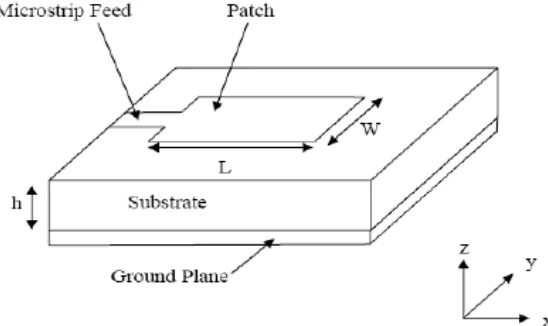
Fig 1. Microstrip antenna configuration
1. The width of the patch is calculated using the following equation [5][3][6]:
W=
Substituting, = 4.4, ∈ = 2.2 = 5.6
2. Effective length (L )
= 2
C=3x10 /s
3. The value of the effective dielectric constant ((ε ) is calculated using the following equation [5][3][6]
= + 1
2 +
−1
2 [1 + 12 ]
h=1.6mm (∈ = 4.4)andh = 1.5mm(∈ = 2.2)
4. The actual increase in length (ΔL) of the patch is to be calculated using the following equation [5][3][6]:
∆
ℎ = 0.412
+ 0.3 (ℎ + 0.264)
−0.258 (ℎ + 0.8)
5. Actual length of patch calculation(L)
6. Ground plane dimension
Now the dimensions of a patch are known. The length and width of a substrate is equal to that of the ground plane. The length of a ground plane (Lg) and the width of a ground plane (Wg) are calculated using the following equations [7]:
= 6ℎ+
= 6ℎ+
7. Inset feed depth determination(Y )
For feeding the microstrip patch antenna, there are different methods for example, feed line method, coaxial probe feeding method etc. But mostly coaxial probe method is used.
|( = ) = |( = 0) ( ∗ )
( = 0) = 243 ℎ
|( = )=50ohm
III. EXPERIMENTAL RESULTS 5.6 GHZ frequency with FR4 substrate:
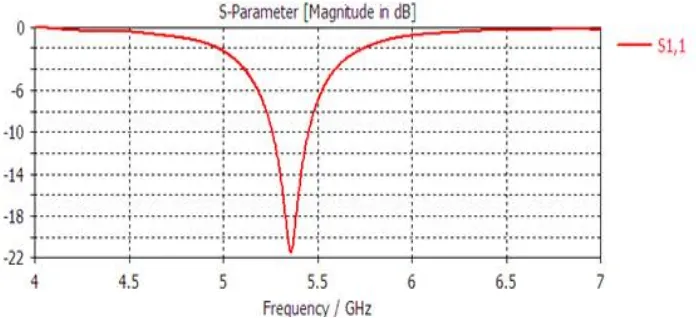
The simulated the antenna with 5.6GHz with the FR4 substrate is used to get the return loss of the -21dB, the side lobe level of -8.7dB, Main lobe magnitude of5.24dB, Angular width of 113.3.
Fig 3. Directivity with FR4 Substrate at 5.6GHz Fig4. Gain with FR4 Substrate at 5.6GHz
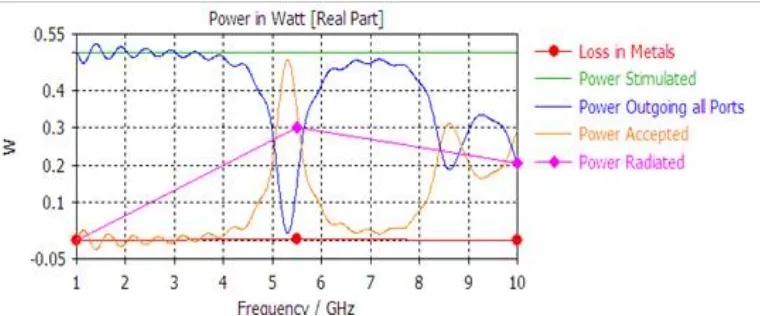
Fig 5. Power with FR4 Substrate at 5.6GHz
5.6GHZ frequency with Rogger RT 5880 substrate:
Fig 6. Reflection Co efficient With Rogger RT 5880 substrate at 5.6GHz
Fig 7. Gain with Rogger RT 5880 substrate at 5.6GHz Fig 8. Directivity with Rogger RT 5880 substrate at 5.6GHz
IV.CONCLUSION
In this study, a design and analysis of simple line fed micro strip patch antenna for global WLAN applications has been achieved. The proposed antenna was designed to operate at 5.6GHz for Standards IEEE 802.11b WLAN applications. The Substrates are FR4 and Rogger RT 5880 are used to achieve -21dB and -28db of reflection co efficient .using small dielectric constant substrate getting better Frequency. The dimensions of the feed line affect the reflection co efficient.
REFERENCES
[1] Jaswinder Kaur, Rajesh Khanna “Co-axial Fed Rectangular Microstrip Patch Antenna for 5.2 GHz WLAN Application” Universal Journal of Electrical and Electronic Engineering 1(3):94-98, 2013 DOI: 10.13189/ujeee.2013.010306 http://www.hrpub.org
[2] Ramna, Amandeep Singh Sappal “DESIGN of RECTANGULAR MICROSTRIP PATCH ANTENNA USING PARTICLE SWARM OPTIMIZATION ”International Journal of Advanced Research in Computer and Communication EngineeringVol. 2, Issue 7, July 2013 [3] James J.R., and Hall P.S., “Handbook of Microstrip Antennas” Peter Peregrinus Ltd., London, UK, 1989.
[4] Neha Ahuja, Rajesh Khanna and Jaswinder Kaur , Design of single band RMPA for WLAN application, IJCA , 2012
[5] Ramna, Amandeep Singh Sappal “DESIGN of RECTANGULAR MICROSTRIP PATCH ANTENNA USING PARTICLE SWARM OPTIMIZATION ”International Journal of Advanced Research in Computer and Communication EngineeringVol. 2, Issue 7, July 2013 [6] K. A. Hamad, "Design and enhancement bandwidth rectangular patch antenna using sinle trapezoidal slot technique," Journal of Engineering
& Applied Sciences, vol. 7, 2012.
[7] S. Jana et al., "Single layer monopole hexagonal microstrip patch antenna for satellite television," International Journal of Soft Computing and Engineering, pp. 2231-2307, 2013.
[8] Sukhbir Kumar, Hitender Gupta”Design and Study of Compact and Wideband Microstrip U-Slot Patch Antenna for Wi-Max Application” IOSR Journal of Electronics and Communication Engineering (IOSR-JECE) e-ISSN: 2278-2834,p- ISSN: 2278-8735. Volume 5, Issue 2 (Mar. - Apr. 2013), PP 45-48 www.iosrjournals.org
[9] W. Mazhar, M.A. Tarar, F.A. Tahir, S. Ullah, and F.A.Bhatti, ”Compact Microstrip Patch Antenna for Ultra-widewand Applications”, PIERS Proceedings, pp. 1100-1104, Aug 2013
[10] S. Toshniwal , S. Sharma, S. Rawat, P. Singh, and K. Ray, “ Compact Design of Rectangular PatchAntenna with Symmetrical U slots on Partial Ground for UWB Applications,” Congress on (IBICA 2015), Dec.1-3, 2015
[11] P. Singh, K. Ray and S. Rawat, “ Design of Nature Inspired Broadband Microstrip Patch Antenna for Satellite Communication,” Seventh World Congress on Nature and Biologically Inspired Computing (NaBIC2015), Dec.1-3, 2015.
[12] S. Rawat, and K.K. Sharma, Annular ring microstrip patch antenna with finite ground plane for ultra -wideband applications, International Journal of Microwave and Wireless Technologies, 2015, pp. 179-184.