VARIATION AND SELECTION W I T H I N CLONAL
LINES OF
L E M N A MINOR'NEMESIO BLAN'CO MENDIOLA
Unworsity of the Phili#phes, Monika, Phdipfiine Islands
[Received July 24, 19181
TABLE O F CONTENTS
PAGE
INTRODUCTION
. . .
.
. . .
.
. . .
.
. .
.
. . .
.
. . .
.
. . . .
.
. .
.
. .
.
. . .
. .
. .
.
. . .
.
. .
. . .
.
.
.
. . .
.
.
I51 Material used...
..
I51Variation within a wild population
....
..
...
...
...
152Shape of frond
...
I52 Speed of budding...,...
I54 Variation in the habit of root growth... . .
.
. ...
.
.
.
. . .
.
.
.
. . .
. . .
.
. . .
156Variation in size of fronds
...
...
158Variation and selection in clonal lines
...
.
.
.
..
. . .
.
. .. .. .
.
..
.
. .
..
.
..
. ... ..
..
.
. . .
159Variation and selection in shape of frond
...
I59 Effect of cul'ture media...
..
. . .
.
.,
..
. .. .
.
.. .
...
.. .
..
.. . .
.
. . . . .. .
...
..
160Inheritance of shape within a clone..
. . .
.
.
,. .
. . .
. . .
.
.
,.
.
. .
. . . .. . .
.
.
.
.
161Unusual non-heritable variations in frond shape.
. . . .
. .
. . .
.
. .
.
.
. . .
.
. . . .
164Clonal variation and selection in speed of propagation..
.
.
.
.
.
.
. . .
. .
. .
.
.
. .
164Clonal variation in size of frond
...
...
,...
...
...
169Effect of culture media on clonal size variation.. ,
. . .
. . .
. . .
.
.
.
. . .
.
172Inheritance of acquired size
...
173Inheritance of decreased size..
. . .
.
.
.
.
. .
.
. . .
.
.
.
.
..
. .
.
.
.
. . . .
.
. . .
. . . ..
.
173174 Inheritance of increased size
. . .
, 'Clonal seleotion for size of frond...
174DISCUSSION AND CONCLUSIONS.
. . .
. .
. . .
.
. .
.
. . . .
.
. . .
.
. . . .
. .
.
. .
. .
. .
. . .
. . .
.
.
180SUMMARY
...
182LITERATURE CITED
. . .
. .
. . .
.
.
. . . .
. . .
. .
. . .
. .
.
. .
.
. .
. . .
. . .
.
.
. . .
.
182...
INTRODUCTION
The experiments herein reported were conducted for the purpose of adding to our knowledge concerning clonal variation and the effect of selection on such variation, in relation to the pure-line concept. I t is un- necessary here to include a review of published data. I t is, of course, generally reco&ized that the greater bulk of experimental evidence supports the pure-line theory as elaborated by JOHANNSEN.
MATERIAL USED
The plants used in these experiments are commonly called duckweed 1 Paper No. 73, Department of plant breeding, CORNELL UNIVERSITY, Ithaca, N. Y.
1.52 NEMESIO BLANC0 MENDIOLA
and belong to the genus Lemna. This, according to GRAY (1908), is a genus widely distributed over Europe, Northern Asia and North Amer- ica, but rare in the Tropics. The duckweeds are small, floating plants without distinct stems or real leaves, and may or may not have roots. They rarely produce flowers, the usual mode of propagation being through budding. T h e present paper is concerned only with one species,
L m n a &%or Linn.
It is necessary to give a more than passing statement regarding the mode of budding. The main structure of the plant is usually called a frond. Some botanists regard it either as a stem, o r leaf, or both fused together. The term “frond” is used throughout this paper. Accord- ing to BLODGETT (1915) the frond consists of three parts : ( a ) a terminal leaf, (b) a bud rudiment inclosed by a flattened bud scale and (c) an apical region from which new fronds are developed. Vertical pressure during the early stages of growth causes the splitting of the bud rudi- ment into two buds which do not develop at the same time. These out- growths come out as a horizontal series in an overlapping form through the lack of space for vertical succession. The development of the basal region into a stalk or stipe causes the thrusting forward of each new whole structure. I n L. minor this basal region is attached marginally to the main portion of the frond; in other species, as in L. poZy.rrhizu, it is inserted upon the vertical surface some distance from the edge. Figure
I shows a parent frond with its offspring still attached to it. The mem-
bers of the family are numbered consecutively in the order of the time of their appearance.
VARIATION WITHIN A WILD POPULATION
Before studying clonal variations a study within a wild population was made concerning shape and size of fronds, speed of propagation and root habits.
Shape of f r o n d
Figure 2 shows fronds of various shapes taken from a population
which was collected on December IO, 1916, from a stagnant creek at the
I53
VARIATION AND SELECTION I N LEMNA M I N O R
FIGURE I.-A parent frond with its offspring still attached to it. X 16 diameters.
may be seen that there exist diverse forms of fronds in a wild popula- tion. To determine whether or not differences in shape are inherited, that is, to ascertain if different forms represent distinct strains, several fronds were isolated from the wild stock. Each frond was allowed to propagate in a tumbler containing tap water and kept in a greenhouse section in which the temperature was generally
15"
C at night and 25" C by day. Preliminary cultural experiments had shown that the plants die after a time if frequent change.of water in the culture tumblersNEMESIO BLANC0 MENDIOLA
I54
c
3
0
0
0
-FIGURE 2.-Fronds of Lemna minor showing variation in shape within a wild popula- tion.
x
16 diameters.is not made. To meet this difficulty] the tumblers were arranged in rows, the members of each row being connected with one another with siphon tubes. By allowing the water to siphon from a big deposit j a r into the tumblers a t the head of the rows, this water in turn being si-
phoned into those that follow, a provision was thereby made which per- mitted a partial but continuous change of water most of the time.
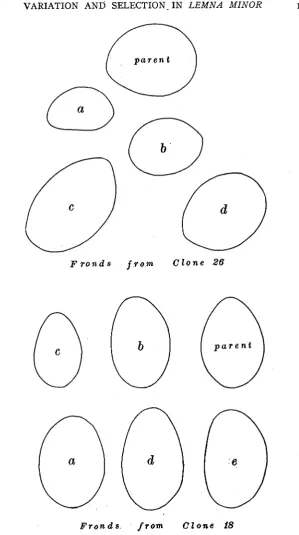
Figure 3 shows camera drawings of fronds from two clones. Each figure shows individuals from one line. From a close study of these and similar unpublished drawings it was seen that while the individuals within a line vary in shape to a greater o r less degree, there is much more re- semblance among members of the same clone than among those of dif- ferent lines. It is only fair to conclude from this that in a wild popula- tion there exist races of diverse shape.
Speed of budding
VARIATION AND SELECTION. I N LEMNA M I N O R
I55
p a r e n t
F r o n d s f r o m C l o n e 26
F r o n d s . f r o m C l o n e 18
FIGURE fronds from clones 18 and 26. X 16 diameters.
NEMESIO BLANC0 MENDIOLA
156
of new individuals to be produced from an original frond, or by de- termining the number of individuals produced within a given length of time. The latter method is simpler and was used in this study.
I n this experiment it is necessary that the starting fronds be of the same age, In this and in all other cases where there was necessity of using individuals of the same age, a number of fronds from which no bud had yet appeared were selected from the stock. These were then observed and all fronds appearing for the first time on the same day were taken to be of similar age. By increasing the initial number of starting fronds almost any reasonable number of similar-aged buds could be obtained.
T o determine the variation in the speed of propagation, each of a number of buds of the same age from which the first buds appeared at the same time was placed in a culture tumbler and there allowed to pro- pagate. After a certain number of days, the total number of fronds in each tumbler was counted.
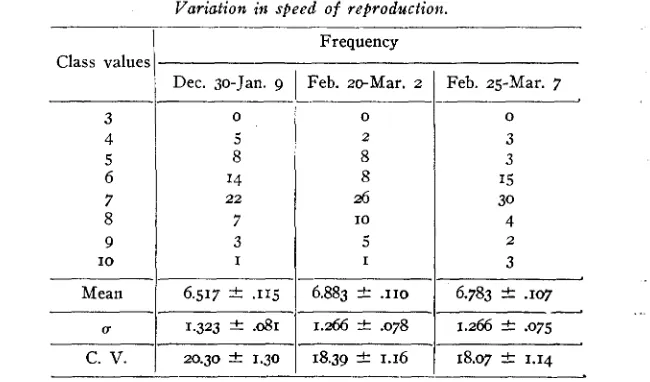
Table I contains the results obtained from three determinations and
gives a rough idea of the degree of variation in the speed of reproduction.
TABLE I
Variation in speed of reproduction.
0 5 8 I4
7
3
22
I
Class values
0 2
8 8
a6
5
IO
I
-
3
4 5
6
7 8
9
IO
Mean
U
c.
v.
Frequency
6.517 & .115 6.883 2 .IIO 6.783 4 .IW
-
1.323 2 .&I 1.266 2 .O78 1.266 c .O75
-
20.30 & 1.30 18.39 2 1.16 18.07 2 1.14
Dec. go-Jan. 9
1
Feb. 20-Mar. 2 Feb. as-Mar. 70
3 3 I5 30
4 2 3
The variations shown in the preceding table do not appear to be multi- modal and do not indicate that they represent different speed strains.
Variation in the habit of root growth
I t is commonly observed that there is a tendency for plants of
L.
minorI57
ing is by no means uniform. While in general the curling is only im- mediately below the tip, other plants have longer portions of their roots in a twisted condition. In a few cases, the twisting may even come to the middle of the root.
The value of ,this habit of the plant as a character for the study of variation depends upon whether it is hereditary or is merely the effect of environment.
Unfortunately, variation in this character cannot be measured with any degree of accuracy and does not lend itself readily to genetical study. What is worse, it makes the study of the variation in size, such as in length of the roots almost impossible. An attempt was made to grow a number of the duckweeds on 2 percent agar-containing nutrient solution,
hoping to get straight roots which would lend themselves to measure- ments, but this attempt failed, the roots refusing to grow or sink into the agar media.
VARIATION A N D SELECTION I N LEMNA MINOR
. c l a s s v a l u e s sq.mm
FIGURE +-Curve showing variation in size in a population of L. minor.
158 NEMESIO BLANC0 MENDIOLA
Variation in size of fronds
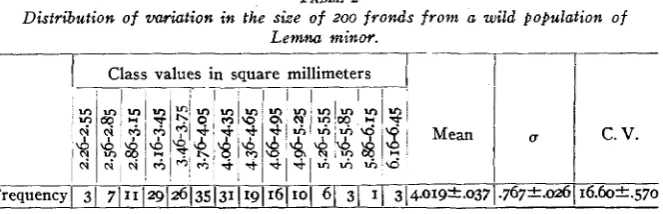
T h e size of a frond was determined by measuring its camera-magni- fied area with the aid of a small planimeter and then computing the true area by dividing the magnified area by 256, the number of times the ob- ject was magnified. Two hundred mature-population fronds which were of the same age and which matured a t the same time were so measured. Table z gives the results of the measurement and figure 4 shows the frequency curve. The curve shows a tendency to three modes, one of these occurring a t 3.16-3.45 mm', another at 3.76-4.05 mm2, and a third at 6.16-6.45 mm2. It might be concluded from this that in a population of L. minor there is a probability of the existence of diverse size strains. Such diverse strains need not be found in all localities since the extreme rareness with which this plant has a chance to cross-breed and the rapidity with which it reproduces by budding, both tend, with the help of natural selection, to reduce the inhabitants of a locality to that of a clonal line. None of the clonal lines studied showed a bimodal condition. Following the determination of the frequency distribution shown in table 2 it would have been only logical to ascertain whether the size modes
persist, that is, whether o r not the size races found are permanent. An attempt was made to do this. It was planned to isolate several lines representing widely different sizes and then to determine at different intervals of time the average of each line. This attempt, however, was unsuccessful. It was found that L. minor cannot be grown successfully in tap water ,for several months in spite of frequent change of this medium. After a month or so, the fronds usually begin to decrease in size and by the time when enough individuals are needed to give a fair sample, the lines usually have run out. As will be learned later in this paper, continuous culture was maintained by the use of a mineral nutrient solution. It was deemed unwise, however, to use this culture in such an experiment as the determination of the persistence of size differences, since, as will soon be seen, mineral solution had a decided effect in in- creasing the size of the fronds and no form of culture check could be devised with which this effect could be controlled.
TABLE 2
VARIATION A N D SELE'CTION IN L E M N A M I N O R I 5 9
VARIATION AND SELECTION IN CLONAL LINES
Variation and selection in shape of frond
It has been seen already, in the discussion of the permanence of shape strains, that different clones with distinctly diff erent-shaped fronds tend to reproduce their respective characteristic shapes. A certain amount of variation in shape within the clones was also pointed out. Further studies along this line were carried out. The plants, as previously, were grown in tumblers, but in mineral nutrient solution instead of tap water., The use of this solution made the continuous change of culture media unnecessary. The nutrient solution was prepared according to the fol- lowing modified formula of PFEFFER :
Constituents Grams per liter
NaCl
...
0.1MgS04
. . .
0 . 1 KHzPOa...
0.1Fe, ( PO4)
...
0. IKNO,
...
.O.I Ca( NO,)...
.0.4T o study the variation in shape, one hundred mature fronds grown
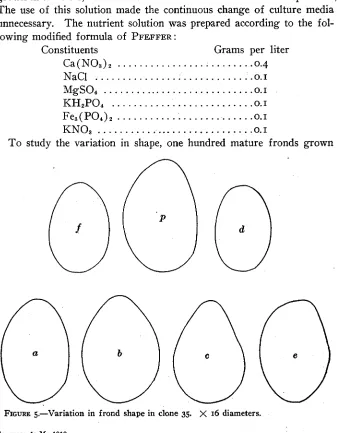
FIGURE s.-Variation in frond shape in clone 35.
x
16 diameters.I 6 0 NEMESIO BLANC0 MENDIOLA
35
from buds of the same age were drawn for each clone. The resulting drawings were classified according to shapes. Figure 5 will give some idea of the dominant shape and the shapes of the varying individuals in clone 35. This dominant shape is represented by the letter p, while the varying shapes are represented by letters a, b, etc.
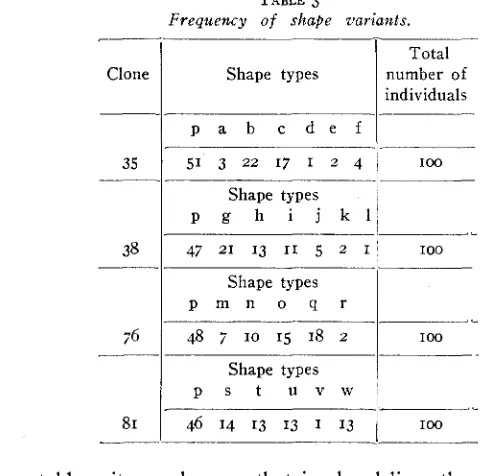
T h e frequency of the different shape types in four clones studied is given in table 3.
TABLE 3
Frequency of shape variants.
p a b c d e f
51 3 22 17 I 2 4
Clone Shape types
Shape types
p g h i j k l
38
1
47 21 13 1 1 5 z I76
81
Shape types
p m n o q r
48 f IO 15 18 2
Shape types
p s t u v w
46 I4 I 3 13 I I3
Total number of individuals
Io0
IO0
IO0
I o 0
From table 3 it may be seen that in clonal lines there exist different shapes of fronds, with some one type predominating.
Before taking up the subject of inheritance in shape in clonal lines, it is well to discuss the results of the study of several of the factors affecting variation.
Effect of cdture media
VARIATION AND SELECTION IN LEMNA MINOR 161
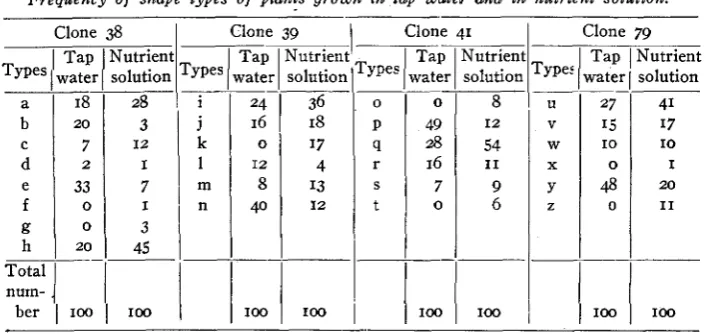
in tap water came from stock growing in tumblers containing water and garden soil, while buds of those grown in nutrient solution came from stocks already growing in nutrient medium. The four series were not grown at the same time as were the paired cultures from each clone. From each culture one hundred mature fronds were harvested, drawn, and classified according to shape. Table 4 gives the frequency of the different types observed.
TABLE 4
Frequency of shape types of plants grown in tap water and in. nutrient so1utio.n.
Clone 38
a 18 28
b 20 3
C 7 12
d 2 I
e 33 7
f 0 I
g 0 3
h 20 45
~ _ _ - ~
Total
I
num-1
ber
I
1o0I
100Clone 39
__I_
k 0 I7
1 I 2 4
m 8 I3
n 40 12
____
Clone 41
Nutrien solution
8
54
9
6
I 2
I1
Io0
Clone 79 Nutrient solution
41
I 7
IO I
U)
I 1
IO0
Table 4 shows two important points : (I ) in every case there was found greater variation in nutrient-grown plants than in those grown in t a p water, and ( 2 ) the predominant shape in each clone is different for
the two culture media. I n clone 38, for example, shape e was predomi- nant among the tap-water-grown plants while among those grown in nutrient solution shape h was the predominating type.
Inkritance of shape m'thin a clone
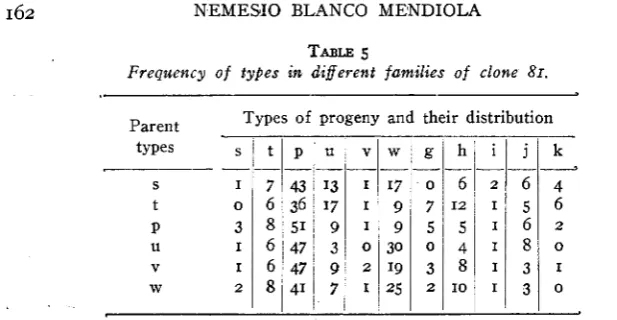
I t has already been pointed out (see table 3 ) that a study of one hun- dred mature fronds of clone 81 revealed six shape types, s to w, with type p predominating. To determine to what extent these different shape types are hereditary, a family was bred from each type in nutrient solu- tion and one hundred mature fronds from each were drawn and studied as to variation in shape. Table 5 contains the results of this study.
W e see from table 5 that the parental type seems to have had no effect c n the type distribution (excepting the type representing the clone. An interesting fact brought out by the above data is that while the diverse shapes which do not represent that of the clone were not hereditary, they
types s ' t p u
S I 7 4 3 1 3
t o 6 3 6 1 7
appeared in approximately the same relative proportion to one another irrespective of their parental shapes.
I n order that this point may be seen more clearly, the data in table
5
were made into curves shown in figure 6.
Another attempt to change the dominant shape type of clone 81 was made by continuous selection of shapes U and w. The experiment was
carried through three periods, each period comprising many generations. There were three cultures during each period, one for U selection, one
for w and another for p. The latter served as control. One hundred mature fronds were examined from each harvest. Table 6 contains the results.
TABLE 6
Reszllts of continuous selection for types U and w in clone 81.
v w g h ( i j k
I g 7 1 2 I 5 6
- - _ _ _ _ _ _ _ - - - _ _ 1
163
VARIATION A N D SELECTION IN LEMNA MZNOR
48
40
36
a
U
e
0
a w
Q
b 2 4
k
18
8
8 6 P U W W B A i E
0
FIGURE 6.-Frequency curves of different shape types in different families of clone 81.
It would appear from the results shown in tables
5
and 6 that the different non-dominant shape types in clone81
are merely somatic vari- ations, probably physiological, and are not inheritable, and that selection for these different shapes has made no progress.As
early as1894,
GUPPY(1894)
reported that long exposure to different habits of life, as growing in mud, had not produced any permanent change in the ex- ternal appearance of duckweeds.164 NEMESIO BLANC0 MENDIOLA
Unusual non-heritable variations in f r o n d shape
During the entire period of investigation, a watch was continually kept for mutations. Three fronds of unusual shapes appeared in nutri- ent cultures, two in clone 41 and one in clone 42. When they were found, they were still attached to their parent fronds. Each of these un- usual-shaped fronds together with each parent was placed in a separate culture tumbler and allowed to propagate to determine if they were mu- tations. When matured individuals in each tumbler numbered fifty or more, the cultures were discontinued and the mature fronds examined.
It was found that none of these aberrant shapes was hereditary. Selection in opposite directions was made in each of the four clones mentioned above. Each selection was carried through five periods. Plus selection was made by continuous selection of individuals falling in classes g and IO, and minus selection, of those in classes
5
and 4.A
check culture of unselected individuals was also grown. The three cul- tures in each clone-plus, minus and check,-were always grown a t the same time. The plants were grown in the nutrient medium and good care was taken to render cultural and other ccntrollable conditions as much alike as possible for each series. Tables 8-11, inclusive, show the results of this selection, and table 1 2 contains the differences between
the means of the check cultures and those of the plus and minus se- lections. If the selection be effective, there should be an increasing difference between the means of the check and selection series from the first to the last period of the experiment.
Clonal variation am! selection in speed of projwgation
In this study, clones 38, 39, 78 and 81 were used. The unit of time taken was I I days. Sixty individuals were studied in each culture.
Ini-
tial studies of variation in speed of propagation of these different lines gave results which are shown in table 7. A “class value” in this case represents the total number of individuals obtained by allowing an origi- nal bud and its offspring to propagate during 1 1 days.TABLE 7
Clonal variation in speed of propagation.
1
31 41 5 - $3 May &June 18I
o 31 6 39 May 18-June 18I
I 21 278 June 11-June 21
1
o 31 7I
“
6 71 8 9 IO I S
8 23111 8 I o 7.017f.r1811.360+.o84 19.38k1.24 6 24/11 8 5 I 7.43+.13311.53zr+.094 zo.61+1.32
VARIATION AND SELECTION I N L E M N A M I N O R 165
From table
7
it is to be seen that clones 38 and 81 seem to have the same speed of budding. The other two clones, however, appear to possess distinctly different means, whose difference is .683+.172,
so that it may be considered as highly probable that in a population ofLemm minor, there exist also different strains in regard to speed of asexual propagation.
TABLE 8
Selection in speed of propagation in clone 38.
2 7 1 5 2 6 8 2 6.6172.093 1.066k.066
Check 1 7 1 4 2 7 9 2 6.700+.0& 1.021k.063
Minus (-) I IO 12 25 IO 2 6.650lt.095 1.cglt.067
16.11lt1.02 15.24fo.g6 16.44lt1.04
GENETICS 4: Mr 1919
Plus (+)
I
I
I
8)rj/28/ 61 31I
1
6.683k.086 o.gpf.061 18.83k0.93Plus (f) 3 4 IO
Check 3 8 IO
Minus (-) 2 4 11
25 12 6 6.950k.106 1.217lt.075 17.52lt1.11 25 11 2 I 6.717k.108 1.240k.076 18.46k1.17 24 11 5 3 7.083+.114 1.308k.081 18.47e1.17
Plus
(+I
Cheok Minus (-)
2 8 12 26 g 2 I 6.700+.1oz 1.173k.072 17.5121.11
I 66
Selection
NEMESIO BLANC0 MENDIOLA
1
c.
v.
I
Frequency of
class values Mean
I
UTABLE 9
Results of continuous selection in speed o f propagation in clone 39.
. Plus (+)
Check Minus (-)
7.1172.115 1.318f.081 18.5221.18
2 4 4 30 8 8 3 I 7.3172.121 1.384rt.085 18.9121.20
3 3 7 3 0 8 6 3 2 6 6 q IO 4 2 I
I
7.0671t.117T-r-
1.3402.083 18.96*1.21 -19.7621.26 20.5821.32 m.72fI.33
18.13k1.15
18.942 1.21
21.442 1.38
VARIATION A N D SELBCTION I N L E M N A M I N O R 167
Plus
(+I
'Check Minus (-)TABLE IO
Results o f continuous selection in speed o f propagation in clone 78.
1
Frequency of1
Selection
1
class valuesI
Meani u
1
C.V.5 I7 31 5 2 6.7002.075 0.862f.053 12.86k0.80
I 2 6 1 4 2 7 8 2 6.6002.100 I. 14.3 f .O7O 17.32-C I. IO
5 7 1 3 2 4 8 3 6.5332.108 1.245-C.077 1g.0621.21
I
31 41 6 1 71 9 1 1 0 1 1 1 ~i
I
First period
Minus (-)
Second period
Minus. (-)
Third period
I 68
I
Frequency of1
Selection
I
class valuesI
MeanI
1
31 41 5161
71 81 91101111I
NEMES'IO BLANC0 MENDIOLA
C.V.
TABLE 11
Results of continuous selection in speed of propwatiolz in clone S I .
-
5.833 &. 123
Check 5.7172.127
5.217f.113
_______
1.416& .087 24.272 1.58
1.4621fI.090 25.57f1.67 1.zgzf.080 24.76f1.61
Plus (f)
1 I
2 1110 25 13 5 4 7.283k.110 1.a66k.078 17.38&1.1o1 1
7 Check
Minus (-)
28 IO 6 I I 7.1832.104 I.I90&.073 16.5721.05
VARIATION AND SELECTION I N L E M N A M I N O R 169
Period
TABLE 12
Differences between the means of the check and those of the selections.
Difference between means of check andplus
First
...
Second...
Third...
Difference between means of check and minus
selections
0.233 2 .I15 4 . 0 3 3 2 .I59 0.100 f .125 Clone 38
First
...
I
-0.083 2 .I24-0.067 2 .In
Third
...
0.084 2 .I34 Fourth...
0.233 f .151Second
...
I
Fifth
...
I
0.100 f .140Clone 39
0.050 & .125
0.250 2 .133
-0.167 f .I34 4 . 3 6 6 2 .I57 0.050 f .13g
I ,
First
...
I
-0.200 2 .167Second
...
-0.200 & .I60Third
...
0.100 f .I790.250 t .I@ 0.183 & .166
-0.050 f .IQ
...
0.200 f .I67-0.116 f .ZOI
I
0.250 f .176 0.316 & .zcg
Fourth
i
Fifth
...
I
Clone 78
-0.100 f .117 0.100 f .158
0.184 f .IM 0.067 & .I47
0.134 f .I#
Clone 81
First
...
Second...
ThirdFourth
Fifth
...
...
I
...
I
0.116 f .177
0.100 f .151 -0.566 f .I60
0.133 f .138 0.017 .I54
-
0.500 f .170
0.300 2 .158 0.000 f .150 4 . 4 0 0 f .138
4 . 1 0 0 f .161
From the data in table 12 it may be concluded that there was no
progress obtained in either the
PIUS
or minus selection for speed of budding.Clonal variation in size of f r o n d
As a preliminary selection study the variation in size of fronds in Selection was later performed in these same The plants were grown in nutrient solution contained in four clones was studied.
four lines.
b
lLx?z
SCE-94.2
SL*z-gZ.z
~ W E - g z ' E
I__-
____-I
SCZ-gL.1SL.11-gZ.1 I
.. "
.-
-
I-1
SCII-gL'orI
SL'OI-gZOI+I +I +I +I
4
1
s26-gL'E+I +I +I +I
0
0
--
I - - -
0 m - N
- U 3
-
drow W N
Fi
0
lm,Raa
m e
3
o\
5
0h
e
d
m
P
0
z
171
VARIATION A N D SELECTION I N LEMNA M I N O R
tumblers. One hundred mature fronds were measured from each clone. The results of this study are shown in table 13. From table 13 it is seen that clones 38 and 76 have about the same range of variation. They also approach each other in mean size, which is 6.555-+-.098 mm2 in clone 38 and 6.735k.112 mm2 in clone 76. The standard deviations are 1.460t.070 and 1.665t.079 mm2 respectively. Clone 79 has ,the widest range of variation and the least mean size, 6.220-t-.099 mm2. Its standard deviation is 1.472f.070 mm2. Clone 81 has the largest mean size, 7.075to.090 mm2, and the least standard deviation, 1.334t.064
mm'. Clones 79 and 81 show a significant difference. The difference in the mean is .855t.134.
TABLE 14
Variation in size o f fronds grown in nutrient solution and in tap water.
-
Clone
-
38
81
-
1aD water
Third Nutrient Tap water .-.-.-
Nutrient
First Tap water ~
Nutrient Tap water Nutrient Tap water
Second
Third
Nutrient
Nutrient water Nutrient TaD water
Frequency of class values in square millimeters ("2)
I I 4 2 6 14 12 12 15 Io IO 24 14 18 6 I
I
&
& 4
I
2
-_-
IIlI2l 8
NEMESIO BLANC0 MENDIOLA
172
E f e c t of culture media on clonal size variation
In the study of inheritance of acquired size in Lemna minor, which is reported later on in this paper, parallel cultures were grown from each clone in nutrient solution and in tap water. The materials obtained from this experiment may also be examined for the effect of different culture media on variation in size. From each of the four clones used, 38,
41,
79 and 81, three series were grown in different periods of time. One hundred mature fronds were measured from each culture. The results of these measurements are given in tables 14 and
15,
the former gives the frequency distributions of the different classes found, and the latter, the different constants calculated.TABLE 15
Constants from taMe 14.
Nutrient Tap water
-
Culture
medium
1
Mean1
C.V.1
U6.940 f .114 24.38 f 1.23 1.692 t .&I
3.930 f .@ 2 5 . 9
*
1.31 1.018 2 .049Clon Perioc %"t -utm
First Tap water Nutrient 4.070 7.210 2 2 .IOZ .066 2410 20.87 f f 1.04 1.21 O.@I 1.505 2 f .072 .047 0.524 C
.&
Seconc Tap water Nutrient 4.425 6.285 f 2 .067 .049 16.43 15.88 f f 0.77 0.80 0.998 0.727 f f .047 .OS5 0.271 C .os8
38
Third Nutrient 6.365 f .085 19.81 t 0.g8 1.261 f .&
Tap water 3.985 t .060 22.43 2 1.12 0.894 f .043 0.367 & .074 First Nutrient 7.485 & .086 17.01 2 0.83 1.273 f .&I
Tap water 4.430 t .073 24.27 t 0.93 1.075 f .o51 0.198 .079
Second Nutrient 6.220 f .078 18.55 t 0.91 1.154 2 .OS4
Tap water 4.030 f .061 22.55 f 1.13 0.- f 0.4 0.245 -C
.a
Third Nutrient 6.985 & .& 18.74 2 0.92 1.309 & .o6z
Tap water 4.575 2.087 28.13 2 1.4 1.287 zk .&I 0.022
c
.087First Tap water Nutrient 4.710 7.145 f f .IO3 .OS 21.53 f 21.34 f 1.07 1.06 1.538 1.005 f rt .073 .048 0.533
c
.087Second Nutrient Tap water 6.635 3.980 f f .IO$ .085 31.81 24.08 f C 1.21 1.66 1.266 1.59s t f .076 .060
~
0.332 2 .Og7 79
-
SI
-
Third Tap water 6.925 3.825 2 f .106 .os5 22.71 21.44 2 2 0.753 2 .084 6.815 & .og3 20.32 f
Tap water 3.755 f ,064 25.22 f Nutrient
Nutrient
First 0.438 -C .&
0.450 ? .&I
0.674 k .og5
Second
~~ ~~
Nutrient
VARIATION A N D SELECTION IN L E M N A M I N O R I73
Parent mean
solution Clone in nutrient
38 6.555 f
.@
The outstanding result shown by table
1 5
is that, using standard deviation as the expression of variation, the plants grown in nutrient solution were always more variable in size than those grown in tap water. The differences between the standard deviations of parallel cultures are significant and are, with two exceptions, all well beyond the limits of probable error.Ilzheritance of acquired Size
The fact has already been pointed out that plants growing under natural conditions have demonstrated their capacity to react readily with favorable medium for growth, not only by a change in shape of the fronds but also by a considerable increase in size, amounting in some cases to more than roo percent. Likewise it was observed that fronds previously grown in nutrient solution produced off spring which are very much smaller than themselves.
Ilzheritawe of decreased size
An experiment to determine the inheritance of decreased size was made with clones 38 and 41 as follows: From a stock culture of each clone, the same number of buds of the same age were transferred to both tap water and nutrient media and there allowed to propagate until
a sufficient harvest of mature fronds could be obtained a t any one time. This constitutes the first period of the experiment. I n the second period, cultures in both tap water and nutrient solutions were grown from buds from the tap water culture of the first period. At the same time a check culture in nutrient medium was grown. In the third period, tap water and nutrient cultures were similarly grown from the tap water stock of the preceding period and again a check culture was set. There are sev- eral months of interval between each two periods to give the plants time
to be “acclimatized” in each new medium for growth. From each of
TAB^ 16
Mean size in square millimetws o f fronds f r o m nutrient solution, g r o w irt tap auter, and of their offspring when grown again in nutrient solution.
Offspring Mean when Check in mean back in nu- nutrient in tap water trient solution solution
4.070 f ,066 6.315 -C .o66 6.775 f .0g1
4.425 -C .04g 6.365 -C .o85 6450 f .ogz
7.1s ’..073 4.430 -C .073 6.220 -C .078 6.615 f
.&
4.030 f .&I 6.805 f .OgO 6.985 f
.&
I I I I
NEMESIO BLANC0 MENDIOLA
I74
Clone
79 81
these cultures one hundred fronds were measured. Table 16 contains a summary of the results of this experiment.
From table 16 it may be concluded that decreased size acquired by nutrient fronds in their sojourn in tap water is not inherited.
Inheritance of increased size
The plan of this experiment is inversely similar to that of the inheri- tance of decreased size.
This experiment was carried through only two periods. As usual, one hundred mature fronds were studied from each culture. The results
of the measurements are shown in table 17.
TABLE 17
Mean sizes in square millimeters of tap-water fronds g r o w in nutrient solution and
of their offspring when. grown in tap water.
Parent mean in tap water
4.750 2 .068 3.990 -+ .o66
Offspring mean in nu- trient solution
-
7.405 .IO4
6.815 -+ .og3
~~
Mean when Check
back in in
tap water ,tap water
~
--
c~3.980
*
.085 3.825 2 .OS54.160 -I- .064 3.930 k .o6g
From table 17 it is seen that while starved plants grown in nutrient media increase in size by nearly 100 percent, when grown again in tap
water reversion to the starved mean may be complete, showing no in- heritance of the acquired increased size.
C t o d selection f o r size of frond
I n table 13 the variations in size of clones 38, 76, 79 and 81 have al- ready been shown. Selections for both large and small size were carried out with these four clones as an attempt to shift the means of the lines. Each selection was carried through five periods. Plus selection, or se- lection for large size, was made by continuously selecting individuals above the mean, and minus selection, or selection for small size, was per- formed by continuous selection of individuals below the mean. A check culture containing unselected individuals was also grown a t the same time with the plus and minus series. The plants were grown in nutri- ent solution and extreme care was taken to render all controllable condi- tions as much alike a s possible for each set of three cultures. Tables 18 to 2 1 contain the results of this experiment. The differences between
the means of the check cultures and those of the plus and minus selec- tions are placed in table 22 so that the effect of selection may be studied
%
g U-
c, . % 9, .E., E; . C-
-
DE
8
6
2 s .t-
E
4 :
s
4
'C
8
E
03 .C 2
z
B
s
5
g
3
,e Ug
G;
u
9
c,
%
II)
U
2
3
B
z
z
D
2
5
U c, U-
4z
<2
g
4- ni
Fd 2-i1
;
'1;;
4'863,
1"-
" O 8 Z t".?Z ? ?
%YE
N R 2%%$
539
+I +I +I
gt&l
=%
9 9 .
G%T
$8'6
I$@
ti ti ti ti ti ti
8 8 2 So";=:
'ob?? Tf"'o
\ow- W \ o W
mco rr)
H U H H c l Y
1
-N rr)m
=f
; 2 $1,
\ o m
+2
2
2-$%io? 0 H N O
2
2'2H
.- L C
r='i?o,
i-
E 16' 2f.;::::
m-
* x O $ a N r r ) N 5 r r ) b H
. s l a
.pgp,x
g
N * W g h m h L.r&CO g 5 F
~-
- 8,:/pz
2 Q Z$k
p
2z?o'--
YSXOq 2 r0"O
3
a a z3
O'i?s$
ob
-4
r;k'm'22E'
72:kazo!
\o"s
ll.22
t
T
/ p *
P\Q
--
N.E
F
r4 F W
+2g
U)p a 2
F
3 2 %
b 3 - qk
v?__ ___
3 2 5
22Co E O zm-
r-8 N.
k
L .
N r r )
y
ZB'i?17
eqG
1;:
%$?"
O N ?
222 Z k . 2 ZBF: +I +I ti ti ti ti +I +I +I
8 Z S 0 - o\
858
5%$
3 x 2 0 0 0 %%2
2 2 :
4
@
'80'8
543
$::
+I t i ti ti ti ti /ti tI ti% \ q ?
433
'9::
\o\ow h W W Ihhh
Y c l Y M H Y
a F
moIom
-1
-;
1;
--
N O
W H O W'mrr)
;I:Y
*:I_o3F
VCQH a * * O
" H & I O h 1 0
:
hA2cr-
r4$7
Z Y Y
C h V W h H A W $ o\oW%:
22% 7222:$$
I
R A J ' % E,r,
W * N " * mRag
zs%
O N H C l Y2 % : 22::
loza
-
h 3 Z . r r ) h w - J 'n\D\D -
*\DIO ( U H * * N r r )
-
- 0 O N O H *
N - 0 YY
___
Y N
a
-
___-
r-
~
3 2 5
~::;
ct
.---
F.-
e,
W
'
i
T w
-7
T w
_-
-'i
v
-
T w
* g G * gB:,
m g z v*.,U2
a * wm $ g
2 j * g
.I
Y
& V Z
2s-
. p a
m 2s.- Z&."&U24 & U Z
o\
3
i3 Y) h
T
c
*F
E
~r
G-
-/a$8
c%$8
a g g
lp;
i32$%~;$;
ip$
15%
$$?
i
B
R
4;;
1
3
:tltItI~4%
88%
: H h *s
g%ii
:I
r;;
;E
tI tI tI it1 123sxK 9 9 9 tI til i
iw
19$
f,i
Hrr)\D ??$%
t r ? ?
22:
p:
lc;c;,' l " k C (g3Q
Si?%I n * - 6x
x
E$
1888.
8 2 2 'i$3gl
pi
ti ti ti/ p t ~ $
ti
ti ti lti ti tip x h h O O W h h h h 'Cgz , h h h
y o q
l$q$
lL"
<$%
~ a q
0 Lorn
--- -
1
.d
'pi
,
:
1
1
$
k-2
/---i-__
rr)"
-
k
2 2 2
-
U ! K O 3 w n w m * N
.:
.s
ap
p
~~ __- n)" %.E""
--'? a 0
e
f
'xo.! E 6 ' 2 loto*I,,
___-e
g
:\o-cd N O $ 9'0- Q I"
g
g g s < a o m \ o m ! o h z2
%! 2 2 ' 2 a ; V . ! Q h-
H W C I Lo",*
io 2;g
.f
jgsz
a" h"-- Io\'
< a& .so0 0 . 2 .3
s
b.2
1 h M) C " " "$7
'g
S "%<E
q=
Lz % s g
> % 2 $g z -
E - \ O r L2 Q I d N[-.
__ -d
1:
%$C
_-
Hcr c1 : - h h
c1
g i o =
,?p:
22:: "Em
U <
2
s 2 k m o m p w ' o5
E'
w g
N rr)r
3 2 5
22
2
- - -r-
-
$
.-
Y:qi--$
3r.- W 8 G 3 % IC.-z lb
2-2
3
_-
~'?
X;sg
lolnT\% s g
- * *
U
2
H
"
3
" $
2
$
?.2 _c_
s
r\B N.
2
$ 25
a z z - ~~ __-
d 4-
9
N _ _ _ ___
>
2
-
--a m - h P v
B
P j2 & V E P4uE
(--I
' *
I
i "
"I
I "
"1
r--
--I-___ ___
I
! Ii ~ E--l
--I
'""'
__I_
Bi
.",_ .* 011"0r
.9,;1ICE,
'
I '
'L--
I i--- ---
IN-
p-
1
_- iL-
jN " hll i' I
-_-
F
H N " i r r ) H r r )__- _ _
N Q W u . * w ,
h * h ,&" h 0 Q
a
'i:
~
2 ' " h h
2 Q l d m2
szo
!
~
~
~
~
~
~
,
~
~
Fs
--_
% E 2
6
2 C kt- Tz; F4 " 0
1-1
N h h :p;/ z c - 2
I C H "
, M H H
'GI
c ( c ( c 1 1Km3ci
,jbc;l\
__--__
I h m 2
' -
err)/1
c-;
k--
i:_
'G
=:
122.5
m-z
5kZd
v
3 ;
i2z.il
E
I
" i
p<
i c I c ( ~#
-- I_
-01
.-.
i
r-
m
I--
eIlr
__-' i +
El
1:
:-
2
Uh
-
t -
? -
V
$87'
p$B
$@
838
ItiG
'tl-li
1 2
-
pi
p;
:i
k
I;z!
r
ti ti ti ti ti ti
R33
2::
5 2 2
;titi
ptJ,
lpg3
~;;?
"r
;
I
F
Y Z Z i-/ - 0-.*
:
c 2- $ 2 2k[
F
FE
.%
s X 2 d;
jN
cI H H C Ig - 2
3 E d \ - 2
t3
S'Rs$
r
N N N m a -F
" 9+ s g
a ; \ O U ) * q *ww ia
.5 00 0.z
0
L:
85
2 % 0: !gt\v)w & 100h b'8
y c p - 0 0 y9
:xoq
r ? N n-'j
0 a
. % a
2 0
*
-
.*
$ 2
>.-o!$ 2 \ 0 2 : g N - 02 $ ' R Z $
EZ$
"p2
u'\hg
,+q
% S E
2 8 2 1? % E +
22cc b;'222
2 h + Z ? ;:E;: :SEs
g
w;
&
t;,5
2@E\0
8
d
fz
h
00In-4
0\0 10
x u
-6
t4
._
v)
10
2 w
cl
5
10-2
8
E
d
2
5
% Z $ k G *vu33,OE H W 1 0 C9-m
$&
a - -- -
3 2 5
- -
22
5
?- W - In cl W 7A 4E .
"In 1 W h W
I C ? ? y o 1
U??
+?+9+?
;ti+?
hu, +?+It1qf5
c8$%
$%$
Z??
122:
C I C I C I2%
-0"s
gg-2,888 2 ? $ toy".
$$$
&
1;
h m -
?!:::
F5
N H .
lp
:
1
ti ti ti ti ti ti ti ti ti E 2 8 , % % @
o\
4
3
tititi
Fz;~
,+;.+;l+"i
C I O
-1b::
-ZN d
-
-
H N C I * N H \ D C I b .
m * -
F-=
CI :lmQE .*
ai=
0P 1 0 h
i
I n w g* g p
%mc
L;:
h;:g* o m
-
- m m
s
-+2:h
S X G
B=
Gh
2338 E 2 2 2 2 2
- 0 0 \ o h 2
0 0 2 2 ;:2w O Q Z
2 2 3 z 2 2 0 2 2
$u)h
10000 .via- m m m
CI
H W N N H N C I C I -
\0
W W T P C I H * N N N
O H
*
- I +_-
2^'i
F-
2 2
5-+ -
2
-23
:EE
.*-
r n * U Or
2!c-7 -
V &U2.lj
2
E u Z la25It-
- T
3 %
F
V Zs.-+
P4uz
m$:F
Zs.- v & U 2+
" $ 2
v 2 2 . 5 a u Z 1" 3 %
3
i d ijd
pim
-
2
hh 4
Q
I
I
! $ ? $
I 5
i
b1
I---
gF%
1
1
I
1t1 +I +I \ O N - id'?'?
L-
p
;[E!
2
b-G!1"s:
k
7
, n -v $ e
$1 $1 +I
H H n
~
i
I
b
--E==7E
/ % 0 1
.6
J E
.% 9) Z ! O h
L E G !
:
k
% g g - 2
-
wz
is?4
[%
G o op z
id$$
+9-;;+9
+I $1 +Igtl2
22:
ayx
23gg222
m
1635
003
9 0 0s"%$
19538
I$@
/ p a 3
$2 [ p a 9
,$%
O P TI
-
'L-L-
~ I ! I - /
r--
y
i'N H N % $ %
,"%e
H Q c2s"
D W hCO" + I t I + I tI-tItI
pl$
kt"!,
$3;
1$$6
ag!+
I%???'OdW fE.!eS
w
I;&
-
--
j
I
i;;;l
i - 1
- H I j H L 3 1 I C I c I H I H U C
N n - l= k z - z
$+I
3
lpll
'+I tI +IictI%
~
I
---I
i--Iin H i T t w
-
E
c3 ,
2q0q
E p i ik z
=: 2 ,
-e ! E
0
L: - 9 9) Q
- p j ,
gp?
g eEE
!3 *"&
k'
p J + S ? "m
*
N L . g p & W O "3
22
; p - - a!$
*
+ t h o ? z w m w2
f4$ z \ r ; * ms ,
'
2 ' 2 G -U)-4
-
u 8 9 + H n nE
._
$c
g!Qs?
,
r
J -g CY- w
c,
p c
h"F
,%$?
m u i t \E
2
b 2
D P \ Q y * N N
v
5 , h
m g 3116 h
2
0 2 : r0 'h "?__
t : "
a - --
Q Q
i j p z
p
U: I U
E
I+
Y
cl
G
p2
!2
z
e
8 .E c
,btll
m I .* 02 f " % % , " 2 4 mE
5
s
z
2 PG U Y UB
Pi2
,z63
--
[k
r
i
v
h N Tt..-
" N * / " " N~.~~~
-a bk\O m T t --a " S m
.o
-
bg n a w
qNb?
gl0"h b w m Ng "ct -. q E c t h d l 75 2 ;sCO
g
z m mv) 3GIz
'b":z2
= ) s W% E 2
pii
2 2 Ez z s
U~ s
-
22: ' - l o p \ I H M H mlO- n H - 2 2 :
,z
2%a - 0
iwoz
N n n
i--
p:
l 0 m e ' E Z Z
a z a - 2 a
22%
" 2 \O"Q m" "tc
p
l
E
& l o * / ;;OCl
c
r-
*"a N c ? N
-
H"-
b-
L
* 01 mP-
7-
~ m3
%
7 6 .
7
3u
23.': m o l 3 " v 2 3 . 9 " 5 s jZ2.5
F1
m u a;TI
Z&... a g vE
f -
VARIATION AND SELECTION I N L E M N A M I N O R
TABLE 22
Differences in square millimeters between the means of the checks and those of the selections.
I79
I
Difference between meansI
selection of check and plus PeriodDifference between means of check and minus
selection Clone 38
...
...
I
-0.- f .I37 0.240 & .I34...
0.215 & .IOO 0.030 & .100First
...I
Second...
0.060 f .113 0.210 f .Io7...
0.325 f .130 0.035 & .I54Third
I
Fourth
I
Fifth
I
Clone 76
...
0.095 f .131 0.370 f .I39...
0.415 & .I44 0.140 & .I39First . [
Second
I
Third
...
I
0.380 f .121 -0.085 & .I17...
I
-0.030 f .138 0.280 2 .I43...
0.055---I---
f .I35 0.035 f .I28Fourth
Fifth I
Clone 79
...
0.170 f .131...
0.435 f .IG -0.080 -c .138...
0.- 2 .I57 0 . q f .151First
.I
Second
Fourth
...
I
-0.010 f .130 0.165 & .I24...
...
0.175 f .I53Third
I
I
Fif,th
..:.
I
0.635 2 -166I
Clone 81
First
...
Second 0.170 & .123
...
0.225 f .123 -0.265 & .115...
0.065 f .I37 0.630 f . I P...
...
0.005 -C .156 0.090 & .I47Third
I
Fourth
I
Fifth
I
If the data in table 22 are examined, and if a significant difference be-
tween a selection mean and the mean of a 'corresponding check is as- sumed to be a t least three times the probable error, it will be found in clone 38 that while the plus means were generally greater and the minus means generally smaller than the means of the checks, no single signifi- cant difference was obtained. In clone 76 there seems to be only one important difference, that for the plus selection in the third period. It
is hard to account for this seeming effect of selection since in the last two periods of the selection, the difference was not maintained. Moreover, it will be observed that in the same (third) period, the minus series had a greater mean than the check, indicating that some factor, probably cultural, had affected the growth of the plants in the check culture, thus