DOI: 10.1534/genetics.110.118000
Extensive Loss of RNA Editing Sites in Rapidly Evolving Silene Mitochondrial
Genomes: Selection
vs
. Retroprocessing as the Driving Force
Daniel B. Sloan,*
,1Alice H. MacQueen,*
,2Andrew J. Alverson,
†Jeffrey D. Palmer
†and Douglas R. Taylor*
*Department of Biology, University of Virginia, Charlottesville, Virginia 22904 and† Department of Biology, Indiana University, Bloomington, Indiana 47405
Manuscript received April 20, 2010 Accepted for publication May 7, 2010
ABSTRACT
Theoretical arguments suggest that mutation rates influence the proliferation and maintenance of RNA editing. We identified RNA editing sites in five species within the angiosperm genus Silene that exhibit highly divergent mitochondrial mutation rates. We found that mutational acceleration has been associated with rapid loss of mitochondrial editing sites. In contrast, we did not find a significant difference in the frequency of editing in chloroplast genes, which lack the mutation rate variation observed in the mitochondrial genome. As found in other angiosperms, the rate of substitution at RNA editing sites in Silene greatly exceeds the rate at synonymous sites, a pattern that has previously been interpreted as evidence for selection against RNA editing. Alternatively, we suggest that editing sites may experience higher rates of C-to-T mutation than other portions of the genome. Such a pattern could be caused by gene conversion with reverse-transcribed mRNA (i.e., retroprocessing). If so, the genomic distribution of RNA editing site losses in Silene suggests that such conversions must be occurring at a local scale such that only one or two editing sites are affected at a time. Because preferential substitution at editing sites appears to occur in angiosperms regardless of the mutation rate, we conclude that mitochondrial rate accelerations within Silene have ‘‘fast-forwarded’’ a preexisting pattern but have not fundamentally changed the evolutionary forces acting on RNA editing sites.
I
N the organelle genomes of land plants, a variable but often large number of sites undergo C-to-U RNA editing in which a cytidine is converted to uridine by deamination (Yu and Schuster 1995; Giege andBrennicke1999). A generally much smaller number of
sites undergo ‘‘reverse’’ U-to-C editing (Steinhauser et al. 1999). RNA editing is believed to be essential for organelle gene function in plants. Editing sites are preferentially located in protein genes and, within them, at first and second codon positions (Gray2003).
Editing at these sites generally results in the restoration of phylogenetically conserved (and presumably func-tionally constrained) amino acids in mitochondrial and chloroplast protein sequences (Gray and Covello
1993; Mower 2005; Yura and Go 2008). Therefore,
there are obvious selective pressures for plants to maintain RNA editing in the short term. In contrast, the origin and long-term maintenance of RNA editing pose an evolutionary puzzle, as it is unclear what if any benefit this seemingly cumbersome process confers
over direct encoding of the edited sequence in the genomic DNA. This puzzle mirrors broader evolution-ary questions about the origin, maintenance, and function of a number of major features of gene and genome architecture (Lynch2007).
Various adaptive effects of RNA editing have been proposed, including a role in gene regulation (Hirose et al. 1999; Farajollahiand Maas2010), maintenance
of alternative functional protein isoforms (Gott2003;
Farajollahi and Maas 2010), generation of genetic
variation (Tillich et al. 2006; Gommans et al. 2009),
optimization of genomic GC content (Jobsonand Qiu
2008), nuclear control of selfish organelle genes (Burt
and Trivers2006), and mutational buffering (Borner et al. 1997). In humans, there is evidence for divergent functional roles for products of the edited and unedited forms ofapolipoprotein B(Powellet al. 1987), but there
is little evidence for the aforementioned adaptive mechanisms in plant organelles. Moreover, replace-ment of edited C’s with T’s at the genomic level appears to occur readily across lineages with no obvious detri-mental effect (Shieldsand Wolfe1997; Mower2008).
Accordingly, neutral and nonadaptive models for the proliferation of RNA editing have also been proposed (Covello and Gray1993; Fiebig et al. 2004; Lynch et al. 2006).
Supporting information is available online athttp://www.genetics.org/ cgi/content/full/genetics.110.118000/DC1.
1Corresponding author:University of Virginia, Department of Biology,
P.O. Box 400328, Charlottesville, VA 22904. E-mail: [email protected]
2Present address:Department of Ecology and Evolution, University of
Chicago, Chicago, IL 60637.
C-to-U RNA editing appears to have evolved in a recent common ancestor of land plants, but the frequency of editing varies dramatically across lineages and between genomes (Turmelet al. 2003; Saloneet al.
2007; Grewe et al. 2009). Seed plants experience
relatively frequent editing in mitochondrial genes with 400 sites per species (.1% of all coding sequence) in the few angiosperms examined so far (e.g., Giegeand
Brennicke 1999) and even higher rates inferred in
gymnosperms (Luet al. 1998; Chawet al. 2008; Ranet al.
2010). The rate of editing in seed plant chloroplast genomes is over an order of magnitude lower (Tillich et al. 2006). Outside seed plants, the mossPhyscomitrella patens has only 11 edited sites in the mitochondrial genome, and the liverwortMarchantia polymorphaappears to have lost RNA editing altogether (Ru¨ dingeret al. 2008,
2009). In contrast, other bryophytes, lycophytes, and ferns exhibit frequent mitochondrial editing (Malek et al. 1996; Greweet al. 2009; Liet al. 2009), while the only
two nonseed plant chloroplast genomes examined (from one hornwort and one fern) also have high levels of editing (Kugitaet al. 2003; Wolfet al. 2004).
Mutation rate variation is one proposed mechanism to explain phylogenetic variation in the occurrence and frequency of RNA editing. Plant mitochondria tend to have very slow point mutation rates as evidenced by their low rate of synonymous substitution (Wolfeet al. 1987;
Palmerand Herbon1988; Moweret al. 2007; Drouin et al. 2008). Lynchet al. (2006) have argued that high
mutation rates intensify selection against RNA editing because of the increased probability of disrupting sequences necessary for editing site recognition [the mutational burden hypothesis (Lynch2006)]. This led
them to conclude that the low mutation rates in plant mitochondrial genomes have created a permissive environment in which RNA editing sites have been able to proliferate by nonadaptive processes. Recent studies have documented a handful of angiosperm lineages that have experienced dramatic accelerations in synon-ymous substitution rate [and presumably the underly-ing mutation rate (Cho et al. 2004; Parkinson et al.
2005; Moweret al. 2007; Sloanet al. 2008, 2009)]. In one
extreme example, RNA editing sites appear (based on a sampling of relatively few genes) to have been almost completely eliminated in Pelargonium hortorum, which has experienced a series of two successive 10-fold increases in mitochondrial mutation rate (Parkinson et al. 2005). While these results are grossly consistent with the role of selection proposed by Lynchet al., the
data have also been interpreted as evidence for poten-tially frequent conversion of reverse-transcribed mRNA back into the genome. Parkinsonet al. (2005) suggest
that such ‘‘mutagenic retroprocessing’’ could explain both the high overall rate of mutation (because of the very high error rates in reverse transcription) and the loss of RNA editing (because the edited sequence is being incorporated into the genome).
This existing body of work raises two questions that we address in the present study: (1) Do major losses of RNA editing sites always accompany mutation rate accel-erations in angiosperms? And (2) if so, to what extent can this correlation be explained by selection (Shields
and Wolfe1997; Lynch et al. 2006; Mower 2008) as
opposed to the mutational bias introduced by retropro-cessing [RNA-mediated gene conversion (Parkinson et al. 2005; Mulliganet al. 2007)]?
The genus Silene (Caryophyllaceae) offers a particu-larly valuable system for investigating the consequences of mitochondrial mutation rate variation. Multiple species within the genus exhibit increases of.100-fold in synonymous substitution rate (Figure 1; Sloanet al.
2009). These changes appear to have occurred very recently (,5–10 million years ago), allowing for close phylogenetic comparisons between accelerated and nonaccelerated species (Mower et al. 2007; Sloan et al. 2009). The recent timing of these accelerations enables tests of molecular evolution based on synony-mous site divergence, which has yet to approach saturation despite the extreme substitution rates. In-terestingly, a previous study found little difference in the predicted frequency of mitochondrial RNA editing sites between accelerated and nonaccelerated Silene species (Mower et al. 2007). This analysis, however, was
re-stricted to a small sample of five relatively lightly edited Silene mitochondrial genes.
We performed cDNA sequencing to empirically iden-tify RNA editing sites for all mitochondrial protein-coding genes inSilene latifolia, which exhibits a slow rate of mitochondrial substitution typical of most plants, and a close relative, S. noctiflora, which has experienced a mitochondrial rate acceleration of.100-fold. We also analyzed a smaller sample of genes for three additional species includingS. conica, which has a mitochondrial substitution rate comparably high to that ofS. noctiflora. We find that the mitochondrial mutational accelera-tions in Silene have been associated with substantial loss of RNA editing sites via C-to-T substitutions. We explore these results along with previously published data in the context of competing models to infer the potential role of both adaptive and nonadaptive forces in the evolu-tion of RNA editing.
MATERIALS AND METHODS
30 min at room temperature, and postreaction cleanup was performed with a second RNeasy spin column. Genomic DNA was extracted using a modified CTAB method (Doyle and Doyle1987).
Reverse transcription, PCR, and sequencing: cDNA was produced by reverse transcription of purified RNA primed with random hexamers, using M-MulV reverse transcriptase (New England Biolabs, Beverly, MA) in accordance with manufacturer’s recommendations.
PCR primers were designed to amplify overlapping frag-ments of up to 700 bp for all mitochondrial protein genes on the basis of draft mitochondrial genome assemblies for S. latifoliaand S. noctiflora(our unpublished data). We also designed additional primers that were conserved across Silene species for portions of seven mitochondrial genes (ccmFn,cob, nad2,nad5,nad6,nad7, andnad9) and five chloroplast genes (ndhB, psbL, rpoB, rpoC1, and rps2). Primer sequences were chosen to exclude predicted RNA editing sites to avoid enriching for unedited transcripts (Mower 2005; Mower and Palmer2006). cDNA was amplified using standard PCR techniques. We also PCR amplified genomic DNA when the corresponding genomic sequence was not already available. PCR products were cycle sequenced directly on both strands as described previously (Barret al. 2007). Primer sequences are provided in Supporting Information, File S1. Sequences generated in this study were deposited in GenBank under accessions HM099771–HM099885.
Identification of RNA editing sites:RNA editing sites were identified by comparing aligned genomic and cDNA sequences and verified by manual inspection of sequencing electrophero-grams. Partially edited sites were identified and scored only when peaks for both the edited and the unedited bases were substantially above background on both strands. In some genes, all edited sites exhibited a degree of incomplete editing (see
File S2andFile S3), which could reflect true partial editing but may also result from preferential amplification of immature transcripts or contaminating genomic DNA (Mower and Palmer 2006). In such cases, only editing sites that clearly differed from the observed baseline level of incomplete editing were classified as partially edited. This conservative approach is likely to underestimate the number of partially edited sites in favor of unedited or completely edited classifications (Mower and Palmer2006).
Analysis: The mitochondrial coding sequences of all five Silene species as well asBeta vulgaris,Arabidopsis thaliana, and Oryza sativawere aligned using ClustalW and adjusted manu-ally. Regions that could not be reliably aligned in frame were excluded from subsequent analyses. RNA editing data for outgroup species were taken from REDIdb (Picardi et al. 2007). RNA editing data for matR in O. sativa were not available, so another monocot,Triticum aestivum, was used in its place.
To determine whether C-to-T substitutions occur preferen-tially at RNA editing sites, we compared the frequency of C-to-T substitutions at both RNA editing sites and twofold synonymous (nonedited) sites. The latter were chosen as a basis for comparison because they should be under the same pattern of selective constraint as editing sites with respect to protein sequence. In each case, C-to-A and C-to-G tions result in amino acid replacement, but C-to-T substitu-tions are silent. We analyzed two pairs of species,S. latifolia–S. noctifloraandA. thaliana–B. vulgaris. In each case, we used an outgroup (B. vulgaris and O. sativa, respectively) and an unweighted parsimony criterion to infer the ancestral state for each site. C-to-T substitutions were then identified by comparing the sequence of each species against the inferred ancestral state. Beta and Arabidopsis were chosen as a slowly evolving species pair to contrast with the rapid divergence observed within Silene. As members of the Caryophyllales and rosids, respectively, Beta and Arabidopsis span one of the deepest splits in the eudicot phylogeny (Wikstro¨ m et al. 2001). Therefore, they were expected to exhibit relatively substantial sequence divergence despite their slow substitu-tion rates. Codons for which the amino acid was not conserved between the two ingroup species were excluded from this analysis. We used Fisher’s exact test to assess the statistical significance of differences between frequencies of C-to-T substitutions at edited and synonymous sites.
To determine whether C-to-T substitutions at RNA editing sites are clustered within the S. noctiflora mitochondrial genome, we employed the method previously described by Roy and Gilbert (2005) for analyzing spatial patterns of intron loss. We calculated the probability distribution for the expected number of pairs of adjacent losses (i.e., C-to-T substitutions) given the number of lost and retained sites in each gene and the assumption that each loss occurs as an independent event. We compared the observed number of pairs of adjacent losses to this distribution to assess whether the lost editing sites were significantly clustered relative to a random expectation. For this analysis, we excluded 24 editing sites that were inferred to be lost inS. noctifloraby a change other than a C-to-T substitution.
Retroprocessing is expected to result in the loss of both introns and RNA editing sites. To determine whether observed intron losses were significantly associated with losses of flanking editing sites, we compared the observed number of losses to the following null distribution,
P n½ ¼ ðn11Þ r
r1l
r1
r1l1
Yn1
i¼0
li
r1li2 ð1Þ where P[n] is the probability of observing n lost flanking editing sites around a given intron, andrandlare the total number of retained and lost editing sites in the genome, respectively. The n1 1 term in Equation 1 represents the number of possible ways to obtainnflanking editing site losses. For example, there are three ways to lose two flanking sites (i.e., with the intron positioned to the left, to the right, or in between the two sites). The rest of the expression on the right side of Equation 1 represents the probability of a single one of those patterns occurring.
RESULTS
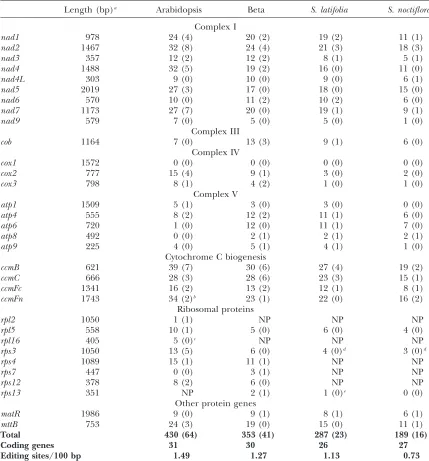
Mitochondrial RNA editing in Silene:The mitochon-drial genomes ofS. latifoliaandS. noctifloracontain 26 and 27 putatively functional protein-coding genes, respectively (Table 1). The sole difference in intact gene content between the two species isrps13, which is intact inS. noctiflorabut contains an internal stop codon inS. latifolia. Comparison of mitochondrial cDNA and genomic sequences revealed a total of 287 C-to-U edited sites in S. latifolia but only 189 sites in the rapidly evolvingS. noctifloragenome—a 34% difference (Table 1;File S2 andFile S3). No other types of editing (e.g., U-to-C) were detected. The total number of editing sites in either Silene genome is lower than in any other angiosperm mitochondrial genome analyzed to date (Giegeand Brennicke1999; Notsuet al. 2002; Handa
2003; Mowerand Palmer2006; Alversonet al. 2010;
Picardi et al. 2010). This pattern results from both a
reduced number of mitochondrial genes in Silene and a lower average density of editing sites within each gene (Table 1).
By contrast, the substantial difference in RNA editing content between S. latifolia and S. noctiflora is caused entirely by a change in the density of editing sites rather than gene loss. The difference in editing site density derives mostly from sites that have been lost in S. noctiflora rather than gained in S. latifolia. There are 111 sites that are edited inS. latifoliabut not edited inS. noctiflora. Of these, 106 sites (95.5%) are edited in Beta and/or Arabidopsis, suggesting that editing was the ancestral state. In contrast, there are only 13 sites that were edited inS. noctiflorabut not inS. latifolia, and only 3 of these (23.1%) were edited in Beta and/or Arab-idopsis. By far the most common pattern of editing site loss was C-to-T substitution at the genomic level, which obviates the need for editing (Figure 2). Although the total number of editing sites is reduced inS. noctiflora, the proportional distribution among genes is quite similar to that in S. latifolia and other angiosperms, indicating a genome-wide loss of mitochondrial RNA editing sites (Figure 3, Table 1).
On the basis of the divergence betweenS. noctiflora andS. latifolia, we found a significantly higher C-to-T substitution rate at editing sites (dRE) than at twofold
synonymous sites (dS2) (dRE/dS2¼3.05;P,0.001). This
pattern, however, was not unique to these two rapidly diverging Silene species. Comparison of two slowly evolving lineages (B. vulgaris and A. thaliana) also revealed a faster C-to-T substitution rate at RNA editing sites (dRE/dS2¼3.55;P,0.001), and a similar analysis of
monocot–eudicot divergence previously showed a com-parable (3.9-fold) excess of C-to-T substitutions at editing sites (Shields and Wolfe 1997). When we
restricted our analysis to synonymous RNA editing sites (dSRE), we still found rate elevation, but it was less
pronounced. With so few synonymous editing sites, the
rate increase was not significant in either the Silene comparison (dSRE/dS2¼2.29;P ¼0.096) or the Beta–
Arabidopsis comparison (dSRE/dS2¼1.84;P¼0.27). A
similar (2.4-fold) excess was previously found on the basis of monocot–eudicot divergence (Shields and
Wolfe1997).
We did not find any evidence for an increase in the frequency of incomplete editing associated with the history of mutational acceleration in the S. noctiflora mitochondrial genome. Both Silene species exhibited similar frequencies of partial editing (7.7 and 6.9% of editing sites in S. latifolia and S. noctiflora, respec-tively). As previously observed (Mower and Palmer
2006), partial editing was common at synonymous sites (File S2andFile S3). Synonymous editing sites were 49 times more likely to be partially edited than nonsynon-ymous sites in S. latifolia and 24 times more likely in S. noctiflora.
Analysis of other angiosperms has shown that editing sites are distributed in a clustered fashion along the length of mitochondrial genes (Mulliganet al. 2007).
This pattern is also evident in Silene, but the observed losses of editing sites in S. noctiflora are not highly clustered (after taking into account the ancestrally clustered distribution of editing sites; Figure 4). We found only 21 adjacent pairs of lost editing sites specific toS. noctiflora(counting only sites that were lost by C-to-T substitution), which is not significantly different from the random expectation (P¼0.31) (Royand Gilbert
2005). This test for clustering of lost editing sites was similarly nonsignificant when the data were analyzed as individual exons (P¼0.40) or as separately transcribed and trans-spliced fragments (P ¼0.42) rather than as whole genes.
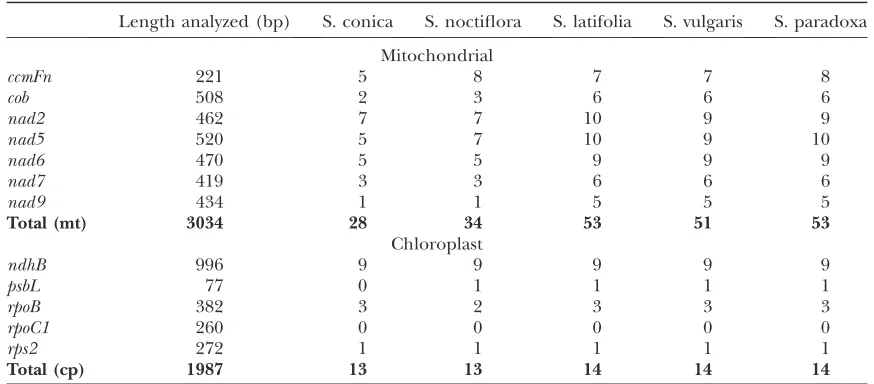
S. conica, another species exhibiting dramatic mito-chondrial rate acceleration, contains even fewer RNA editing sites (28) thanS. noctiflora(34) in a sample of
seven mitochondrial genes (Figure 6, Table 2). The number of shared losses between S. noctiflora and S. conica(13) was significantly higher than expected at TABLE 1
RNA editing sites in the mitochondrial protein genes of four eudicots
Length (bp)a Arabidopsis Beta S. latifolia S. noctiflora
Complex I
nad1 978 24 (4) 20 (2) 19 (2) 11 (1)
nad2 1467 32 (8) 24 (4) 21 (3) 18 (3)
nad3 357 12 (2) 12 (2) 8 (1) 5 (1)
nad4 1488 32 (5) 19 (2) 16 (0) 11 (0)
nad4L 303 9 (0) 10 (0) 9 (0) 6 (1)
nad5 2019 27 (3) 17 (0) 18 (0) 15 (0)
nad6 570 10 (0) 11 (2) 10 (2) 6 (0)
nad7 1173 27 (7) 20 (0) 19 (1) 9 (1)
nad9 579 7 (0) 5 (0) 5 (0) 1 (0)
Complex III
cob 1164 7 (0) 13 (3) 9 (1) 6 (0)
Complex IV
cox1 1572 0 (0) 0 (0) 0 (0) 0 (0)
cox2 777 15 (4) 9 (1) 3 (0) 2 (0)
cox3 798 8 (1) 4 (2) 1 (0) 1 (0)
Complex V
atp1 1509 5 (1) 3 (0) 3 (0) 0 (0)
atp4 555 8 (2) 12 (2) 11 (1) 6 (0)
atp6 720 1 (0) 12 (0) 11 (1) 7 (0)
atp8 492 0 (0) 2 (1) 2 (1) 2 (1)
atp9 225 4 (0) 5 (1) 4 (1) 1 (0)
Cytochrome C biogenesis
ccmB 621 39 (7) 30 (6) 27 (4) 19 (2)
ccmC 666 28 (3) 28 (6) 23 (3) 15 (1)
ccmFc 1341 16 (2) 13 (2) 12 (1) 8 (1)
ccmFn 1743 34 (2)b 23 (1) 22 (0) 16 (2)
Ribosomal proteins
rpl2 1050 1 (1) NP NP NP
rpl5 558 10 (1) 5 (0) 6 (0) 4 (0)
rpl16 405 5 (0)c NP NP NP
rps3 1050 13 (5) 6 (0) 4 (0)d 3 (0)d
rps4 1089 15 (1) 11 (1) NP NP
rps7 447 0 (0) 3 (1) NP NP
rps12 378 8 (2) 6 (0) NP NP
rps13 351 NP 2 (1) 1 (0)e 0 (0)
Other protein genes
matR 1986 9 (0) 9 (1) 8 (1) 6 (1)
mttB 753 24 (3) 19 (0) 15 (0) 11 (1)
Total 430 (64) 353 (41) 287 (23) 189 (16)
Coding genes 31 30 26 27
Editing sites/100 bp 1.49 1.27 1.13 0.73
The number of synonymous editing sites is in parentheses. NP indicates that a functional copy of the gene is not present in the mitochondrial genome of that species (although putative pseudogenes are still present in some cases)
aThe reported length for each gene is based on a multiple sequence alignment and is therefore affected by
both internal alignment gaps and trimming of nonhomologous 59and 39ends. Editing sites in unalignable regions were included in species counts.
b
TheccmFngene in Arabidopsis is divided into two separate genes.
c
The annotations forrps3andrpl16overlap in Arabidopsis. The overlapping region contains three editing sites, which were excluded from therpl16count.
d
Both Silene species lack a substantial 59portion ofrps3relative to other angiosperms. It is possible thatrps3is a pseudogene in Silene.
e
random (P ¼ 0.042; Fisher’s exact test), perhaps re-flecting a shared phylogenetic history between the two species and/or variable selection and mutation pres-sures across sites. On the other hand,S. noctifloraand S. conicaalso exhibited a large number of unique losses (7 and 10, respectively), indicating that the specific sites being lost were largely (if not entirely) independent between the two lineages.
In contrast to their rapidly evolving congeners, S. vulgaris (51) and S. paradoxa (53) maintain a set of editing sites that is nearly identical to that ofS. latifolia (53) for the same seven-gene sample. These three slowly evolving species share an identical core set of 51 editing sites. In addition, S. latifolia and S. paradoxa share a nad5 editing site that has been lost from S. vulgaris, while S. latifolia and S. paradoxa each have a unique site not found in the other two species. In comparison, Beta, Arabidopsis, and Oryza respectively maintain a total of 56, 62, and 67 editing sites in this same gene sample.
Chloroplast RNA editing in Silene: We sequenced both cDNA and genomic DNA for portions of the chloroplast genes ndhB, psbL, rpoB, rpoC1, and rps2. These loci represented all chloroplast genes that were both predicted to undergo RNA editing in Spinacia (Tsudzuki et al. 2001) and had genomic sequence
available for at least one species of Silene to aid in primer design. In contrast to the mitochondrial pattern, S. noctiflora and S. conica did not exhibit higher synonymous substitution rates than their congeners for these chloroplast genes (Figure 1). S. latifolia, S. vulgaris, and S. paradoxa share an identical set of 14 chloroplast RNA editing sites across these five genes (Figure 6, Table 2).S. noctifloraandS. conica each lost
one site by C-to-T substitution (in rpoB and psbL, respectively). The loss of 1 of 14 chloroplast editing sites (7%) represents a significantly lower rate of loss than observed in the mitochondrial genome for bothS. noctiflora(35.8%;P¼0.040; Fisher’s exact test) andS. conica (45.1%; P ¼0.011; Fisher’s exact test). All five Silene species lacked the RNA editing site inrpoC1that is present in other eudicots.
DISCUSSION
We found that recent increases in mitochondrial synonymous substitution rates within the genus Silene have been associated with substantial reductions in the frequency of RNA editing, adding further evidence for a relationship between mutation rate and the mainte-nance of RNA editing. These findings provide insight into the forces that guide the evolution of RNA editing. For example, as noted previously (Lynchet al. 2006),
the negative relationship between mutation rate and the frequency of editing runs directly counter to predictions arising from the hypothesis that editing acts as a mutational buffer (Borner et al. 1997; Horton and
Landweber 2002). In addition, these findings raise
central questions about the relative importance of adaptive and nonadaptive processes in the evolution of RNA editing, which we discuss below.
Elevated C-to-T substitution rates at RNA editing sites—the role of selection vs. retroprocessing: More than a decade ago, Shieldsand Wolfe(1997) found
that mitochondrial RNA editing sites undergo elevated rates of divergence among angiosperms. Mower(2008)
subsequently showed that the high divergence rates are the result of frequent loss (rather than gain) of editing
Figure2.—The distribution of nucleotide states at 106 po-sitions where a C-to-U RNA editing site was inferred to be lost inS. noctiflora. Shaded bars indicate sites of amino acid con-servation betweenS. latifoliaandS. noctiflora, while solid bars indicate amino acid difference.
sites by C-to-T substitution. This loss appears to be driving a general decline in the frequency of mitochon-drial RNA editing across the angiosperm phylogeny. This pattern has been interpreted as evidence for selection acting against RNA editing by preferentially favoring the fixation of C-to-T mutations at editing sites. This interpretation, however, rests on the assumption that RNA editing sites experience the same mutation rates as other sites in the genome (Shieldsand Wolfe
1997). Homologous recombination (gene conversion) with edited cDNA intermediates, i.e., retroprocessing, could violate this assumption by disproportionately affecting editing sites (Parkinsonet al. 2005; Mulligan et al. 2007). There is only limited biochemical evidence of reverse transcriptase activity in angiosperm mito-chondria (Moenneet al. 1996), but there are numerous
convincing examples of the incorporation of reverse-transcribed mRNA back into the mitochondrial ge-nome, reflected by either the simultaneous loss of introns and editing sites in the flanking exons or the loss of an entire suite of editing sites across much or all of a mitochondrial gene. Examples of the former include the loss of introns and neighboring editing
sites fromnad4in both the Caryophyllales and Asterales (Geiss et al. 1994; Itchoda et al. 2002), two separate
cases involvingrps3in conifers (Ranet al. 2010), and the
additional cases involvingcox2andnad7reported in this study. Examples of editing site losses across much or all of a gene have been reported in numerous and diverse seed plant lineages (Krishnasamyet al. 1994; Luet al.
1998; Petersenet al. 2006; Lopezet al. 2007). Moreover,
it has been suggested that the clustered distribution of RNA editing sites in angiosperm mitochondrial genes reflects the elimination of stretches of previously in-tervening editing sites by retroprocessing (Mulligan et al. 2007).
The finding of both clustered (Figure 5) and dis-persed (Figure 4) losses of editing sites in Silene raises intriguing possibilities with respect to the relative importance of selection and retroprocessing as forces acting to purge RNA editing sites. At one extreme, both forces could be operative but with selection predom-inating, i.e., with retroprocessing occurring relatively rarely and only across large regions. At the other extreme, retroprocessing could be the predominant if not the sole force driving the loss of RNA editing, acting
across a wide range of spatial scales. The latter scenario would require that gene conversion acts on relatively short stretches of nucleotides in plant mitochondrial genomes, because we observed numerous cases where editing sites were lost by C-to-T substitution with no change at nearby sites. So-called ‘‘microconversions’’ are known to occur between short stretches of homol-ogous sequence in other genomes and organisms
(Wheeler et al. 1990; Semple and Wolfe 1999;
Palmer et al. 2003), while recent evidence indicates
that microconversion (presumably DNA mediated) readily occurs in plant mitochondrial genomes (Hao
and Palmer 2009; our unpublished data).
Single-nucleotide substitutions at editing sites (independent of retroprocessing) and gene conversion with cDNA from partially edited transcripts would be ex-pected to further reduce the clustering of lost editing sites.
Exactly how selection would act against RNA editing is not well established, but it would presumably involve one or both of the following selective pressures: (1) avoiding the deleterious consequences of failed editing (Lynch et al. 2006) and (2) eliminating the need
for potentially costly site-specific editing machinery (Kotera et al. 2005; Hammaniet al. 2009; Zehrmann et al. 2009). Both of these assume that editing is functionally important. Otherwise, there would be no cost to failed editing and no need to maintain editing machinery. Therefore, if selection has been acting to eliminate RNA editing, we would expect its effects to vary across sites depending upon the functional con-sequences of editing at those sites. In particular, we would predict that synonymous sites that undergo RNA editing should be relatively free from selection, because the editing process has no effect on the resulting
protein sequence. Therefore, if selection is the pre-dominant force in the preferential C-to-T substitution at RNA editing sites, we would predict this pattern to be absent at synonymous editing sites. In contrast, retroprocessing should not discriminate between
syn-Figure 5.—Loss of in-trons incox2(A) andnad7 (B) is associated with loss of adjacent RNA editing sites in Silene. Solid trian-gles and vertical lines in-dicate introns and editing sites, respectively. Shading covers regions surrounding lost introns in which RNA editing sites have also been lost by C-to-T substitution. A more detailed phylogenetic distribution ofcox2RNA ed-iting sites and introns is pro-vided in Figure S1. RNA editing data for outgroup species were obtained from REDIdb (Picardi et al. 2007). Position values ex-clude intron sequences.
onymous and nonsynonymous edits in an mRNA transcript.
Consistent with previous studies (Shieldsand Wolfe
1997; Mower2008), we found a trend suggesting that
synonymous editing sites also experience preferential C-to-T substitutions, albeit at a lower rate than at nonsynonymous editing sites. At first glance, the rate difference between synonymous and nonsynonymous editing sites might seem inconsistent with a neutral model driven by retroprocessing. However, because synonymous editing sites are prone to both partial editing and frequent evolutionary reversion to unedited status—unaccompanied by C-to-T substitution—reverse transcription is less likely to capture the edited state at synonymous sites than at nonsynonymous sites. Indeed, using a five-state maximum-likelihood model that accounted for the transitions between edited and unedited cytidines within a phylogenetic lineage, Mower(2008) found that rates of C-to-T substitution
at synonymous edited sites are at least as high as at nonsynonymous editing sites. Overall then, empirical RNA editing data at synonymous and nonsynonymous sites are consistent with a neutral model based on retroprocessing. Although a role of selection certainly cannot be dismissed, any argument invoking selection to account for the elevated C-to-T substitution rates at RNA editing sites must explain why such selection similarly affects both nonsynonymous and synonymous sites.
Of course, synonymous editing could have important effects on codon usage, mRNA stability, or regulatory sequence conservation (Chamary et al. 2006). The
pattern of RNA editing at synonymous sites does not, however, support such adaptive mechanisms. There are relatively few synonymous editing sites in Silene and
other angiosperms (Table 1) (Gray and Covello
1993), most of which are only partially edited (File S2
andFile S3) (Mowerand Palmer2006). The extent of
editing at these sites is much more likely to vary among individuals and tissue types than at nonsynonymous sites (Bentolilaet al. 2008), and editing is frequently
lost without the C-to-T substitution needed to conserve its effects (Shields and Wolfe 1997; Mower 2008).
Overall, synonymous editing has all the hallmarks of a relatively neutral misfiring of the RNA editing machin-ery (Ru¨ dingeret al. 2009).
The potential for selection on synonymous sites is also important because, as in previous studies, we have used divergence at (nonedited) synonymous sites as a base-line for comparison. The underlying assumption is that these sites are relatively free from selection and, therefore, provide a measure of the neutral substitution rate. If instead synonymous sites are subject to strong selection pressures based on mRNA function, it is possible that the apparent excess of substitutions at RNA editing sites in angiosperms is actually the result of negative selection acting on synonymous sites rather than positive selection or retroprocessing acting on RNA editing sites. In other words, the rate of C-to-T substitutions at RNA editing sites could better reflect the true neutral rate, because such changes are silent at the mRNA level (unlike substitutions at nonedited synonymous sites). Although the available evidence for selection on translational efficiency in plant mitochon-drial DNA is limited (Sloan and Taylor 2010), this
possibility should be considered as an alternative to the hypotheses analyzed in this study.
An RNA-mediated gene conversion model for the loss of RNA editing sites:We propose a model in which double-stranded breaks and gene conversion occur TABLE 2
Mitochondrial and chloroplast RNA editing in five Silene species
Length analyzed (bp) S. conica S. noctiflora S. latifolia S. vulgaris S. paradoxa
Mitochondrial
ccmFn 221 5 8 7 7 8
cob 508 2 3 6 6 6
nad2 462 7 7 10 9 9
nad5 520 5 7 10 9 10
nad6 470 5 5 9 9 9
nad7 419 3 3 6 6 6
nad9 434 1 1 5 5 5
Total (mt) 3034 28 34 53 51 53
Chloroplast
ndhB 996 9 9 9 9 9
psbL 77 0 1 1 1 1
rpoB 382 3 2 3 3 3
rpoC1 260 0 0 0 0 0
rps2 272 1 1 1 1 1
Total (cp) 1987 13 13 14 14 14
regularly in angiosperm mitochondrial genomes, per-haps playing a role in DNA repair. Occasional gene conversion with cDNA produced from edited mRNA (retroprocessing) would result in preferential C-to-T substitution at RNA editing sites. The length of DNA sequence typically affected by gene conversion would have to be short to explain why C-to-T substitutions at editing sites frequently occur without any change at nearby editing sites. Occasionally, however, gene con-version must affect much larger fragments, explaining the loss of large stretches of editing sites and interven-ing introns. Finally, in plant lineages with high mito-chondrial mutation rates (e.g.,S. noctiflora), an elevated rate of DNA damage and double-stranded breaks would accelerate the entire process.
While this model provides an attractive explanation of the data, the available evidence is still insufficient to fully support it or to exclude a role of selection in eliminating RNA editing sites in angiosperms. Separat-ing the effects of selection and mutation bias is one of the most difficult and important challenges in the field of molecular evolution, and doing so will require additional studies that integrate phylogenetic, popula-tion genetic, and mechanistic data.
Reduced RNA editing content in Silene species with low substitution rates:AlthoughS. latifoliahas a higher density of mitochondrial RNA editing sites than its rapidly evolving congeners, it maintains fewer sites than any other angiosperm analyzed to date (Table 1). The similarity betweenS. latifolia and other slowly evolving Silene species in the number and identity of mitochon-drial RNA editing sites (see results and Table 2)
suggests that the Silene ancestor likely had a smaller complement of RNA editing sites than the typical angiosperm. Like the larger reductions in editing observed inS. noctifloraandS. conica, this pattern may be at least partially related to changes in mitochondrial substitution rate. Although dwarfed by recent acceler-ations in some Silene species (Figure 1), the ancestral mitochondrial substitution rate in the genus appears to be significantly higher than that of related angiosperms. Comparison of all mitochondrial protein gene sequen-ces reveals that the S. latifolialineage has exhibited a 56% higher synonymous substitution rate than the B. vulgarislineage (Figure S2), which itself has experi-enced a higher substitution rate than other fully sequenced angiosperm mitochondrial genomes (Alverson et al. 2010). Therefore, the relationship
between RNA editing and evolutionary rates may extend to finer scales of rate variation (see also Alversonet al.
2010).
Mutagenic retroprocessing and elevated substitution rates:Parkinsonet al. (2005) suggested that, because of
the nearly complete loss of RNA editing sites in the few mitochondrial genes sequenced in Pelargonium and the high error rate of reverse transcriptase, an increase in retroprocessing itself might be at least part of the
cause of mitochondrial mutation rate acceleration in Pelargonium. On the basis of a previous analysis that found little change in the frequency of RNA editing despite the mutational acceleration in S. noctiflora, it seemed unlikely that this mechanism would apply to Silene (Moweret al. 2007). However, given the evidence
from the present study thatS. noctiflorahas, in fact, lost a substantial fraction of its RNA editing sites, it is worth reconsidering this possibility. If mutagenic retroprocess-ing has been a major cause of high mitochondrial mutation rates in Silene, we would expect to see a disproportionate increase in C-to-T substitution rate for sites that are edited in the mRNA sequence. We did not, however, observe such an effect inS. noctiflora, as the increase in substitution rate at RNA editing sites appears roughly proportional to the rate increase at nonedited sites. Therefore, an increase in the fre-quency of retroprocessing is unlikely to be the primary cause of the high mitochondrial mutation rates in Silene. Whether mitochondrial rate accelerations in other angiosperms (e.g., Plantago and Pelargonium) are the result of mutagenic retroprocessing remains an open question that is subject to testable predictions (Parkinsonet al. 2005).
Summary:We have found that increases in mitochon-drial mutation rate in Silene are correlated with a rapid loss of RNA editing sites. However, rather than funda-mentally altering the evolutionary forces that act on RNA editing, the high mutation rates in these lineages appear to have simply accelerated a preexisting pattern in angiosperm evolution, a pattern that might depend more on a neutral model involving RNA-mediated gene conversion than on selection. Stephen Jay Gould (Gould
1990) famously asked what would happen if we were able to rewind and replay the tape of evolution. The mutational acceleration in some Silene mitochondrial genomes may instead allow us to effectively fast-forward that tape and thereby provide a glimpse into the future of RNA editing in angiosperms.
We thank Jeff Mower for his insightful comments on an earlier version of our manuscript and Michael Hood for providingS. paradoxa
andS. conicaseeds. This study was supported by National Science Foundation grant DEB-0808452 (to D.B.S. and D.R.T.) and National Institutes of Health (NIH) grant R01-GM-70612 (to J.D.P.). A.J.A. was supported by an NIH Ruth L. Kirschstein National Research Service Award Postdoctoral Fellowship (1F32GM080079-01A1).
LITERATURE CITED
Alverson, A. J., X. Wei, D. W. Rice, D. B. Stern, K. Barryet al., 2010 Insights into the evolution of plant mitochondrial ge-nome size from complete sequences ofCitrullus lanatusand Cu-curbita pepo(Cucurbitaceae). Mol. Biol. Evol.27:1436–1448. Barr, C. M., S. R. Keller, P. K. Ingvarsson, D. B. Sloanand D. R.
Taylor, 2007 Variation in mutation rate and polymorphism among mitochondrial genes inSilene vulgaris.Mol. Biol. Evol.
24:1783–1791.
Bentolila, S., L. E. Elliottand M. R. Hanson, 2008 Genetic ar-chitecture of mitochondrial editing in Arabidopsis thaliana.
Bernasconi, G., J. Antonovics, A. Biere, D. Charlesworth, L. F. Delphet al., 2009 Silene as a model system in ecology and evolution. Heredity103:5–14.
Borner, G. V., S. Yokobori, M. Morl, M. Dornerand S. Paabo, 1997 RNA editing in metazoan mitochondria: staying fit without sex. FEBS Lett.409:320–324.
Burt, A., and R. Trivers, 2006 Genes in Conflict: The Biology of Selfish
Genetic Elements.Belknap Press, Cambridge, MA.
Chamary, J. V., J. L. Parmley and L. D. Hurst, 2006 Hearing silence: non-neutral evolution at synonymous sites in mammals. Nat. Rev. Genet.7:98–108.
Chaw, S. M., A. C. Shih, D. Wang, Y. W. Wu, S. M. Liu et al., 2008 The mitochondrial genome of the gymnospermCycas tai-tungensiscontains a novel family of short interspersed elements, bpu sequences, and abundant RNA editing sites. Mol. Biol. Evol.
25:603–615.
Cho, Y., J. P. Mower, Y. L. Qiu and J. D. Palmer, 2004 Mitochondrial substitution rates are extraordinarily elevated and variable in a genus of flowering plants. Proc. Natl. Acad. Sci. USA101:17741–17746.
Covello, P. S., and M. W. Gray, 1993 On the evolution of RNA editing. Trends Genet.9:265–268.
Doyle, J. J., and J. L. Doyle, 1987 A rapid DNA isolation procedure for small quantities of fresh leaf tissue. Phytochem. Bull. 19:
11–15.
Drouin, G., H. Daoud and J. Xia, 2008 Relative rates of syn-onymous substitutions in the mitochondrial, chloroplast and nuclear genomes of seed plants. Mol. Phylogenet. Evol. 49:
827–831.
Erixon, P., and B. Oxelman, 2008 Reticulate or tree-like chloro-plast DNA evolution inSileneae(Caryophyllaceae)? Mol. Phyloge-net. Evol.48:313–325.
Farajollahi, S., and S. Maas, 2010 Molecular diversity through RNA editing: A balancing act. Trends Genet.26:221–230. Fiebig, A., S. Stegemannand R. Bock, 2004 Rapid evolution of
RNA editing sites in a small non-essential plastid gene. Nucleic Acids Res.32:3615–3622.
Geiss, K. T., G. M. Abbasand C. A. Makaroff, 1994 Intron loss from the NADH dehydrogenase subunit 4 gene of lettuce mito-chondrial DNA: evidence for homologous recombination of a cDNA intermediate. Mol. Gen. Genet.243:97–105.
Giege, P., and A. Brennicke, 1999 RNA editing inArabidopsis mito-chondria effects 441 C to U changes in ORFs. Proc. Natl. Acad. Sci. USA96:15324–15329.
Gommans, W. M., S. P. Mullenand S. Maas, 2009 RNA editing: A driving force for adaptive evolution? BioEssays31:1137–1145. Gott, J. M., 2003 Expanding genome capacity via RNA editing. C.
R. Biol.326:901–908.
Gould, S. J., 1990 Wonderful Life: The Burgess Shale and the Nature of
History.W. W. Norton, New York.
Gray, M. W., 2003 Diversity and evolution of mitochondrial RNA editing systems. IUBMB Life55:227–233.
Gray, M. W., and P. S. Covello, 1993 RNA editing in plant mito-chondria and chloroplasts. FASEB J.7:64–71.
Grewe, F., P. Viehoever, B. Weisshaarand V. Knoop, 2009 A trans-splicing group I intron and tRNA-hyperediting in the mitochon-drial genome of the lycophyteIsoetes engelmannii.Nucleic Acids Res.37:5093–5104.
Hammani, K., K. Okuda, S. K. Tanz, A. L. Chateigner-Boutin, T. Shikanai et al., 2009 A study of new Arabidopsis chloroplast RNA editing mutants reveals general features of editing factors and their target sites. Plant Cell21:3686–3699.
Handa, H., 2003 The complete nucleotide sequence and RNA edit-ing content of the mitochondrial genome of rapeseed (Brassica napusL.): comparative analysis of the mitochondrial genomes of rapeseed andArabidopsis thaliana.Nucleic Acids Res.31:5907– 5916.
Hao, W., and J. D. Palmer, 2009 Fine-scale mergers of chloroplast and mitochondrial genes create functional, transcompartmen-tally chimeric mitochondrial genes. Proc. Natl. Acad. Sci. USA
106:16728–16733.
Hirose, T., T. Kusumegi, T. Tsudzukiand M. Sugiura, 1999 RNA editing sites in tobacco chloroplast transcripts: editing as a pos-sible regulator of chloroplast RNA polymerase activity. Mol. Gen. Genet.262:462–467.
Horton, T. L., and L. F. Landweber, 2002 Rewriting the informa-tion in DNA: RNA editing in kinetoplastids and myxomycetes. Curr. Opin. Microbiol.5:620–626.
Itchoda, N., S. Nishizawa, H. Nagano, T. Kuboand T. Mikami, 2002 The sugar beet mitochondrial nad4 gene: an intron loss and its phylogenetic implication in the Caryophyllales. Theor. Appl. Genet.104:209–213.
Jobson, R. W., and Y. L. Qiu, 2008 Did RNA editing in plant organ-ellar genomes originate under natural selection or through ge-netic drift? Biol. Direct3:43.
Joly, S., L. Brouilletand A. Bruneau, 2001 Phylogenetic implica-tions of the multiple losses of the mitochondrialcoxII.i3intron in the angiosperms. Int. J. Plant Sci.162:359–373.
Kotera, E., M. Tasakaand T. Shikanai, 2005 A pentatricopeptide repeat protein is essential for RNA editing in chloroplasts. Nature433:326–330.
Krishnasamy, S., R. A. Grantand C. A. Makaroff, 1994 Subunit 6 of the Fo-ATP synthase complex from cytoplasmic male-sterile radish: RNA editing and NH2-terminal protein sequencing. Plant Mol. Biol.24:129–141.
Kugita, M., Y. Yamamoto, T. Fujikawa, T. Matsumoto and K. Yoshinaga, 2003 RNA editing in hornwort chloroplasts makes more than half the genes functional. Nucleic Acids Res.31:2417–2423.
Li, L., B. Wang, Y. Liuand Y. L. Qiu, 2009 The complete mitochon-drial genome sequence of the hornwortMegaceros aenigmaticus
shows a mixed mode of conservative yet dynamic evolution in early land plant mitochondrial genomes. J. Mol. Evol.68:665– 678.
Lopez, L., E. Picardiand C. Quagliariello, 2007 RNA editing has been lost in the mitochondrial cox3 and rps13 mRNAs in Aspar-agales. Biochimie89:159–167.
Lu, M. Z., A. E. Szmidtand X. R. Wang, 1998 RNA editing in gym-nosperms and its impact on the evolution of the mitochondrial coxI gene. Plant Mol. Biol.37:225–234.
Lynch, M., 2006 Streamlining and simplification of microbial ge-nome architecture. Annu. Rev. Microbiol.60:327–349. Lynch, M., 2007 The Origins of Genome Architecture.Sinauer
Associ-ates, Sunderland, MA.
Lynch, M., B. Koskellaand S. Schaack, 2006 Mutation pressure and the evolution of organelle genomic architecture. Science
311:1727–1730.
Malek, O., K. Lattig, R. Hiesel, A. Brennicke and V. Knoop, 1996 RNA editing in bryophytes and a molecular phylogeny of land plants. EMBO J.15:1403–1411.
Moenne, A., D. Beguand X. Jordana, 1996 A reverse transcrip-tase activity in potato mitochondria. Plant Mol. Biol. 31:365– 372.
Mower, J., 2005 PREP-mt: predictive RNA editor for plant mito-chondrial genes. BMC Bioinformatics6:96.
Mower, J. P., 2008 Modeling sites of RNA editing as a fifth nucleo-tide state reveals progressive loss of edited sites from angiosperm mitochondria. Mol. Biol. Evol.25:52–61.
Mower, J. P., and J. D. Palmer, 2006 Patterns of partial RNA editing in mitochondrial genes ofBeta vulgaris.Mol. Genet. Genomics
276:285–293.
Mower, J. P., P. Touzet, J. S. Gummow, L. F. Delphand J. D. Palmer, 2007 Extensive variation in synonymous substitution rates in mitochondrial genes of seed plants. BMC Evol. Biol.7:135. Mulligan, R. M., K. L. C. Changand C. C. Chou, 2007 Computational
analysis of RNA editing sites in plant mitochondrial genomes reveals similar information content and a sporadic distribution of editing sites. Mol. Biol. Evol.24:1971–1981.
Notsu, Y., S. Masood, T. Nishikawa, N. Kubo, G. Akidukiet al., 2002 The complete sequence of the rice (Oryza sativaL.) mito-chondrial genome: frequent DNA sequence acquisition and loss during the evolution of flowering plants. Mol. Genet. Genomics
268:434–445.
Palmer, J. D., and L. A. Herbon, 1988 Plant mitochondrial DNA evolves rapidly in structure, but slowly in sequence. J. Mol. Evol.
28:87–97.
Palmer, S., E. Schildkraut, R. Lazarin, J. Nguyenand J. A. Nickoloff, 2003 Gene conversion tracts inSaccharomyces cerevisiaecan be extremely short and highly directional. Nucleic Acids Res.31:
Parkinson, C. L., J. P. Mower, Y. L. Qiu, A. J. Shirk, K. Songet al., 2005 Multiple major increases and decreases in mitochondrial substitution rates in the plant family Geraniaceae. BMC Evol. Biol.5:73.
Petersen, G., O. Seberg, J. I. Davis and D. W. Stevenson, 2006 RNA editing and phylogenetic reconstruction in two monocot mitochondrial genes. Taxon55:871–886.
Picardi, E., T. M. Regina, A. Brennicke and C. Quagliariello, 2007 REDIdb: the RNA editing database. Nucleic Acids Res.
35:D173–D177.
Picardi, E., D. S. Horner, M. Chiara, R. Schiavon, G. Valleet al., 2010 Large-scale detection and analysis of RNA editing in grape mtDNA by RNA deep-sequencing. Nucleic Acids Res. (in press). Powell, L. M., S. C. Wallis, R. J. Pease, Y. H. Edwards, T. J. Knott
et al., 1987 A novel form of tissue-specific RNA processing pro-duces apolipoprotein-B48 in intestine. Cell50:831–840. Ran, J. H., H. Gaoand X. Q. Wang, 2010 Fast evolution of the
ret-roprocessed mitochondrial rps3 gene in conifer II and further evidence for the phylogeny of gymnosperms. Mol. Phylogenet. Evol.54:136–149.
Roy, S. W., and W. Gilbert, 2005 The pattern of intron loss. Proc. Natl. Acad. Sci. USA102:713–718.
Ru¨ dinger, M., M. Polsakiewiczand V. Knoop, 2008 Organellar RNA editing and plant-specific extensions of pentatricopeptide repeat proteins in jungermanniid but not in marchantiid liver-worts. Mol. Biol. Evol.25:1405–1414.
Ru¨ dinger, M., H. T. Funk, S. A. Rensing, U. G. Maierand V. Knoop, 2009 RNA editing: only eleven sites are present in the Physcomi-trella patensmitochondrial transcriptome and a universal nomen-clature proposal. Mol. Genet. Genomics281:473–481. Salone, V., M. Ru¨ dinger, M. Polsakiewicz, B. Hoffmann, M.
Groth-Maloneket al., 2007 A hypothesis on the identification of the editing enzyme in plant organelles. FEBS Lett.581:4132– 4138.
Semple, C., and K. H. Wolfe, 1999 Gene duplication and gene con-version in theCaenorhabditis elegans genome. J. Mol. Evol.48:
555–564.
Shields, D. C., and K. H. Wolfe, 1997 Accelerated evolution of sites undergoing mRNA editing in plant mitochondria and chloro-plasts. Mol. Biol. Evol.14:344–349.
Sloan, D. B., and D. R. Taylor, 2010 Testing for selection on syn-onymous sites in plant mitochondrial DNA: the role of codon bi-as and RNA editing. J. Mol. Evol.70:479–491.
Sloan, D. B., C. M. Barr, M. S. Olson, S. R. Kellerand D. R. Taylor, 2008 Evolutionary rate variation at multiple levels of biological organization in plant mitochondrial DNA. Mol. Biol. Evol. 25:
243–246.
Sloan, D. B., B. Oxelman, A. Rautenberg and D. R. Taylor, 2009 Phylogenetic analysis of mitochondrial substitution rate variation in the angiosperm tribe Sileneae (Caryophyllaceae). BMC Evol. Biol.9:260.
Steinhauser, S., S. Beckert, I. Capesius, O. Malekand V. Knoop, 1999 Plant mitochondrial RNA editing. J. Mol. Evol.48:303– 312.
Tillich, M., P. Lehwark, B. R. Mortonand U. G. Maier, 2006 The evolution of chloroplast RNA editing. Mol. Biol. Evol.23:1912– 1921.
Tsudzuki, T., T. Wakasugi and M. Sugiura, 2001 Comparative analysis of RNA editing sites in higher plant chloroplasts. J. Mol. Evol.53:327–332.
Turmel, M., C. Otisand C. Lemieux, 2003 The mitochondrial ge-nome ofChara vulgaris: insights into the mitochondrial DNA ar-chitecture of the last common ancestor of green algae and land plants. Plant Cell15:1888–1903.
Wheeler, C. J., D. Maloney, S. Fogel and R. S. Goodenow, 1990 Microconversion between murine H-2 genes integrated into yeast. Nature347:192–194.
Wikstro¨ m, N., V. Savolainenand M. W. Chase, 2001 Evolution of the angiosperms: calibrating the family tree. Proc. R. Soc. Lond. B Biol. Sci.268:2211.
Wolf, P. G., C. A. Roweand M. Hasebe, 2004 High levels of RNA editing in a vascular plant chloroplast genome: analysis of tran-scripts from the fernAdiantum capillus-veneris.Gene339:89–97. Wolfe, K. H., W. H. Liand P. M. Sharp, 1987 Rates of nucleotide substitution vary greatly among plant mitochondrial, chloroplast, and nuclear DNAs. Proc. Natl. Acad. Sci. USA84:9054–9058. Yang, Z., 2007 PAML 4: phylogenetic analysis by maximum
likeli-hood. Mol. Biol. Evol.24:1586–1591.
Yu, W., and W. Schuster, 1995 Evidence for a site-specific cytidine deamination reaction involved in C to U RNA editing of plant mitochondria. J. Biol. Chem.270:18227–18233.
Yura, K., and M. Go, 2008 Correlation between amino acid residues converted by RNA editing and functional residues in protein three-dimensional structures in plant organelles. BMC Plant Biol.
8:79.
Zehrmann, A., D. Verbitskiy, J. A.van derMerwe, A. Brennicke and M. Takenaka, 2009 A DYW domain-containing pentatrico-peptide repeat protein is required for RNA editing at multiple sites in mitochondria of Arabidopsis thaliana. Plant Cell 21:
558–567.
Supporting Information
http://www.genetics.org/cgi/content/full/genetics.110.118000/DC1
Extensive Loss of RNA Editing Sites in Rapidly Evolving Silene
Mitochondrial Genomes: Selection vs. Retroprocessing as the
Driving Force
Daniel B. Sloan, Alice H. MacQueen, Andrew J. Alverson, Jeffrey D. Palmer
and Douglas R. Taylor
Copyright © 2010 by the Genetics Society of America
D. B. Sloan et al. 2 SI
# "$# ( # $ '&
!! !%" # !## !# ##! ' ! # "$# # !$ " $ !$# " " ## ! !#&' "!# ### #!# # # # # # #!# # '( "$ "# "$# # #!' #&# '
FIGURE S1.—Phylogenetic distribution of cox2 introns and RNA editing sites in the angiosperms. Vertical lines indicate RNA editing sites, while black triangles indicate introns. When available, empirical RNA editing were used (REDIdb, GenBank). For species with no empirical RNA editing data (underlined), editing sites were predicted with PREP-mt (Mower 2009. Nucleic Acids Res. 37: W253-W259), using a C value of 0.5. Family-level phylogenetic relationships are based on the Angiosperm Phylogeny Website (
http://www.mobot.org/mobot/research/apweb/). Intra-family relationships are based on the following sources: Fabaceae (Adams et al. 1999. PNAS. 96:13863-13868), Brassicaceae (Yang et al. 1999. Mol. Phylogenet. Evol. 13:455-462), Poaceae (Buckler and Holtsford 1996. Mol. Biol. Evol. 13:612-622), Solanaceae (Angiosperm Phylogeny Website).
2 SI D. B. Sloan et al.
FIGURE S1.—Phylogenetic distribution of cox2 introns and RNA editing sites in the angiosper ms. Vertical lines indicate RNA editing sites, while black triangles indicate introns. When available, empirical RNA editing were used (REDIdb, GenBank). For species with no empirical RNA editing data (underlined), editing sites were predicted with PREP-mt (Mower 2009. Nucleic Acids Res. 37: W253-W259), using a C value of 0.5. Family-level phylogenetic relationships are based on the Angiosper m Phylogeny Website (http://www.mobot.org/mobot/research/apweb/). Intra-family relationships are based on the following sources:
Fabaceae (Adams et al. 1999. PNAS. 96:13863-13868), Brassicaceae (Yang et al. 1999. Mol. Phylogenet. Evol. 13:455-462),
Poaceae (Buckler and Holtsford 1996. Mol. Biol. Evol. 13:612-622), Solanaceae (Angiosper m Phylogeny Website).
D. B. Sloan et al. 3 SI
Silene latifolia
Beta vulgaris
Arabidopsis thaliana
dS dN
0.026
0.017
0.008
0.004
A
More Substitutions in S. latifolia atp1, atp6, atp8, atp9, ccmB, ccmC, ccmFc, ccmFn, cox1, cox3, matR, mttB, nad1, nad4, nad5, nad7, rps3
Equal Number of Substitutions nad3, nad4L, nad6, nad9
More Substitutions in B. vulgaris atp4, cob, cox2, nad2, rpl5 B
FIGURE S2.—Comparison of mitochondrial substitution rates between Silene latifolia and Beta vulgaris, using Arabidopsis thaliana as an outgroup. (A) The trees depict rates of synonymous (left) and non-synonymous (right) substitution based on a concatenated dataset of all protein genes. The values above each branch indicate branch length in terms of number of substitutions per site, which were estimated using codeml (PAML) as described previously (Sloan et al. 2009). The rate difference between S. latifolia and B. vulgaris for the concatenated dataset was highly significant based on both a molecular clock test implemented in codeml (2
df=1 = 24.75; p <
0.0001 ) and a relative rate test implemented in MEGA (2
df=1 = 23.96; p < 0.0001 ). These tests included both synonymous and
non-synonymous sites. The branch lengths estimated in this 3-species analysis are very similar to estimates from a larger phylogenetic analysis of fully sequenced seed plant mitochondrial genomes (data not shown). (B) The table summarizes the results of relative rate tests performed on individual protein genes in MEGA (including both synonymous and non-synonymous sites). Genes shown in bold exhibited a significant difference in rates between the two species at the p = 0.05 threshold. No corrections for multiple tests were performed. For all analyses, codons that are edited in any of the three species were excluded to ensure that substitutions at RNA editing sites themselves do not account for estimated rate differences.
0.01
3 SI D. B. Sloan et al.
D. B. Sloan et al. 4 SI
FILE S1
Primer Sequences
D. B. Sloan et al. 5 SI
FILE S2
Silene latifolia RNA Editing Sites
D. B. Sloan et al. 6 SI
FILE S3
Silene noctiflora RNA Editing Sites
File S3 is available for download as an Excel file at http://www.genetics.org/cgi/content/full/genetics.110.118000/DC1.