• No results found

Middle School Students' Reasoning About 3-dimensional Objects: A Case Study.

N/A
N/A
Protected

Academic year: 2020

Share "Middle School Students' Reasoning About 3-dimensional Objects: A Case Study."

Copied!
427
0
0

Loading.... (view fulltext now)

Full text

(1)

Case Study. (Under the direction of chair Dr. Karen Hollebrands).

According to the National Council of Teacher of Mathematics (NCTM) (2000), K-12

students should be given an opportunity to develop their spatial reasoning abilities. One of

the topics that may allow students to develop their spatial skills is forming 3-dimensional

objects using spinning and extrusion methods. Also, extrusion and spinning methods provide

an important basis on advanced mathematical topics (e.g., calculus ideas related to solids of

revolution). A 3-dimensional geometric topic often studied by children in grades K-12 is

volume with a focus on students’ spatial abilities. Researchers demonstrated the process of

students’ finding the volume of a rectangular prism to be length * width * height. However,

this formula cannot be generalized to cones, cylinders, etc. On the other hand, there is little

research about forming 3-dimensional objects by spinning or extruding 2-dimensional

figures.

(2)

tasks. The results are provided in the lens of the semiotic mediation framework (Bartolini

Bussi & Mariotti, 2008) that focused on individuals’ uses of signs. During the extrusion

activities, interactions between the themes were frequently observed. Students highlighted

multiple evidences for forming 3-dimensional objects. On the other hand, during the spinning

activities, interactions between the themes were less frequent. Students made an exchange

between the themes to convince their peer or other student(s) during the whole-class

discussion. Some signs students produced facilitated communication among students and

researchers. For example, metaphors were used for describing an object whose name was

unknown or giving examples from real life to convince other student(s). Also, students

employed gestures frequently for demonstrating how a transformation (extrusion or spinning)

took place. Gestural signs supported students thinking and facilitated communication.

(3)
(4)

by

Samet Okumus

A dissertation submitted to the Graduate Faculty of

North Carolina State University

in partial fulfillment of the

requirements for the degree of

Doctor of Philosophy

Mathematics Education

Raleigh, North Carolina

2016

APPROVED BY:

_______________________________

_______________________________

Dr. Karen Hollebrands

Dr. Hollylynne Lee

Committee Chair

_______________________________

_______________________________

(5)

BIOGRAPHY

Samet Okumuş is from Artvin, Turkey. He was born and grown up in Rize, Turkey.

After completing his K-12 education in 2004, he earned his Bachelor’s degree in primary

school mathematics teaching with an emphasis in middle school mathematics from Anadolu

University in 2008. He began his professional career as a research assistant at Rize

University starting in November 2008. Soon after, he started his Master’s program at

Karadeniz Technical University. In 2010, the Council of Higher Education of Turkey

awarded him a scholarship to do research at Indiana University, Bloomington for six months.

Then, he earned his Master’s degree in mathematics education in 2011. In January 2012 he

started his Ph.D education at North Carolina State University.

(6)

ACKNOWLEDGMENTS

It was 10/24/2011 when the Graduate School sent out my official acceptance letter

about my admission to the Mathematics Education Ph.D. program at NC State. When I look

back, I remember how I was excited to open a new page in my life. I never thought of how

the end of this journey would come too soon. However, from the beginning to the end, I

know I kept my excitement alive on being a part of NC State community. I have good

memories and will always remember!

To my chair, Dr. Karen Hollebrands, I am very thankful for your support and

encouragement throughout this process. Without your feedback and encouragement, I would

not succeed. I appreciate your generous guidance, patience, and time from the first day to the

last day. Thank you for challenging my ideas and encouraging me to think more. I am

privileged to work with you and grateful for everything I have learned from you.

(7)

Drs. Tina Starling, Zulfiye Zeybek, and Charity Cayton, thank you for reviewing my

dissertation materials before I collected my data. I appreciate your time and feedback. I am

lucky to have such professional colleagues. Also, special thanks goes to Ms. Emily Jo

Schwaller for her feedback on the meanings of literacy devices with which I was struggling.

Mr. Osman Aksit, I appreciate that you changed your plans in order to help me videotape my

instruction throughout my data collection. Thank you for being considerate and willing to

help.

Special thanks goes to the Council of Higher Education of Turkey for their support on

my education. Without their scholarships, my dream would never come true.

(8)

TABLE OF CONTENTS

List of Tables………..………..……….. xi

List of Figures………..………..………... xii

Chapter 1 – Introduction………..………... 1

Purpose Statement and Research Questions………... 4

Importance of the Study………... 4

Definition of Terms………. 6

Chapter 2 – Theoretical Background and Literature Review………. 9

Semiotic Mediation……….. 9

Semiotic Potentials of DGS………... 17

Varieties in Signs………... 26

Research Questions Revisited………... 36

Previous Research on Volume of Objects………... 37

Forming 3-Dimensional Objects using a Spinning Method, and Research on

Rotations in Spatial Geometry………. 43

Chapter 3 – Methods…………..………..………... 52

Research Design……….. 52

Participants……….. 55

Pilot Study………... 57

The Outline of Activities for the Summer Enrichment Program………. 60

(9)

Instruments used for Characterizing the Participants……….. 70

Characterization of the Participants………... 72

Charlotte………... 73

Chelsea……….. 75

Meredith……… 78

Mitch………. 79

Sloane………... 80

Stan………... 82

Vince………. 85

Virginia………. 88

Dyads and Research Settings ………... 90

Data Analysis.……….. 94

Design Decisions in Pre-Constructed Sketches………... 97

Trustworthiness……… 103

Ethical Considerations………. 104

Limitations………... 104

Chapter 4 – Findings………... 106

Students’ Strategies for Finding the Relationships between 2-Dimensional and

3-Dimensional Objects that were Created using An Extrusion Method……….. 106

Strategy 1 – focusing on the ease of fit.……… 106

(10)

Strategy 3 – focusing on the parts of the given artifact……… 112

Strategy 4 – focusing on the collection of figures……….... 115

Strategy 5 – connecting pre-image and image points………... 116

Strategy 6 – using a metaphor………..……….... 121

Strategy 7 – matching a 2-dimensional and 3-dimensional object………... 122

Interactions Between the Strategies Containing Pivot Signs………...

124

Focusing on the exact fit and focusing on the parts of the given artifact…………. 124

Focusing on the ease of/exact fit and focusing on the collection of figures………. 133

Focusing on the exact fit and connecting pre-image and image points……… 137

Focusing on the collection of figures and connecting pre-image and image

points.……….... 138

Focusing on the parts of the given artifact and focusing on the collection

of figures.……….. 145

Supporting a pivot sign with a metaphor………..………... 148

Summary of interactions between the strategies……….. 152

Students’ Strategies for Finding the Relationships between 2-dimensional and

3-dimensional Objects that were Created using a Spinning Method... 154

Strategy 1 – focusing on a static image………..……….. 157

Strategy 2 – connecting pre-image and image points………... 160

Strategy 3 – focusing on circular and continuous motion……… 164

(11)

Strategy 5 – focusing on the exact fit………..………. 170

Strategy 6 – using a metaphor………..……….... 171

Exchanges or Interactions Between the Strategies Containing Pivot Signs………… 172

Exchanges between matching a 2-dimensional and 3-dimensional objects,

and focusing on continuous and circular motion……….. 173

Exchanges between focusing on circular and continuous motion, and

using a metaphor………..………..………... 183

Exchanges between connecting pre-image and image points, and focusing

on continuous and circular motion………..………... 189

Exchanges between connecting pre-image and image points, and focusing

on circular and continuous motion using a metaphor………... 194

Interactions between focusing on the exact fit, and focusing on circular

and continuous motion………..……… 214

Summary of exchanges or interactions between the strategies containing pivot

signs……….. 218

Results from Students’ Strategies for Computing the Volume of Object…………... 220

Strategy 1 – volume as a multiplication of three quantities………... 220

Strategy 2 – volume as a metaphor………..………. 222

Strategy 3 – volume as a formula……..………..……..………... 224

Strategy 4 – volume as the accumulation of Areas……..………... 228

(12)

Volume as a comparison – the volume of rectangular pyramid and cone………… 235

Comparison of the volume of right and oblique objects……..………... 238

Summary of the strategies……..………..……..……….. 241

Exchanges between the strategies……..………..……..………... 242

Exchanges during the volume of oblique objects……..………... 246

Chapter 5 – Discussion………..……..………..……..………... 262

Discussion Related to Research Question 1……..………... 262

Employment of gestural signs……..………..……..……… 263

Use of tools in Cabri 3D……..………..……..………. 265

Interactions/Exchanges between the strategies……..………... 251

Use of linguistic signifiers……..………..……..……….. 256

Discussion Related to Research Question 2……..………... 273

Implications……..………..……..………... 276

Recommendations for teachers……..………..……..………... 276

Recommendations for curriculum writers……..……….. 283

Directions for future research……..………..……..………... 285

References……..………..……..………. 289

Appendices…………..…………..…………..…………..…………..………... 311

Appendix A – Hands-on Materials used during Semiotic Activities……….. 312

Appendix B – Semiotic Activities…………..…………..…………..………... 314

(13)
(14)

LIST OF TABLES

Table 1. Worksheets and descriptions…………..…………..…………..……….. 63

Table 2. A summary information about the participants…………..………... 91

Table 3. The data sources of research questions/sub-questions…………..…………... 93

Table 4. Interactions between the strategies……..…………..…………..………. 154

Table 5. Exchanges between the strategies…………..…………..…………..……….. 219

Table 6. Students’ given responses to the multiple choice questions in the spatial

(15)

LIST OF FIGURES

Figure 1. Extruding a circle in a continuous motion, and forming a cylinder………… 2

Figure 2. Rotating a rectangle about one of its sides, and forming a cylinder of

revolution…………..…………..…………..…………..…………..…………..…….... 3

Figure 3. A right square pyramid and cone…………..…………..………... 6

Figure 4. An oblique square pyramid and cone…………..…………..……….. 6

Figure 5. A pyramid and cone, and a plane parallel to their base…………..………… 7

Figure 6. A frustum pyramid and cone…………..…………..…………..………. 7

Figure 7. A cone added to a prism…………..…………..…………..……… 8

Figure 8. A cylinder in which a cone is subtracted…………..…………..……… 8

Figure 9. The process of instrumental genesis…………..…………..…………..……. 11

Figure 10. The elements of semiotic mediation…………..…………..………. 13

Figure 11. An illustration of a parallelogram becoming a rectangle………... 18

Figure 12. An illustration of a parallelogram becoming a rectangle with a focus on

their interior angles…………..…………..…………..…………..………. 18

Figure 13. Constructing a circle motion using the Trace tool of DGS………... 19

Figure 14. A trapezoid…………..…………..…………..…………..……… 20

Figure 15. A crossed-quadrilateral…………..…………..…………..………... 20

Figure 16. A tetrahedron from two different perspectives…………..………... 21

Figure 17. Triangle ABC…………..…………..…………..…………..………. 24

(16)

Figure 19. AB is traced…………..…………..…………..…………..………... 24

Figure 20. Triangle ABC is traced…………..…………..…………..…………..……. 25

Figure 21. Cavallieri’s Theorem…………..…………..…………..………... 25

Figure 22. Extruded 3-dimensional objects with different orientations………. 26

Figure 23. An illustration for the filling method of volume…………..………. 26

Figure 24. Cognitive conditions of mathematics understanding…………..………….. 28

Figure 25. A task related to apprehension of 3-dimensional objects………... 29

Figure 26. The genesis of signs in describing the movement of gears………... 32

Figure 27. A rectangular prism composed of unit cubes and its row-based composite

units…………..…………..…………..…………..…………..………... 38

Figure 28. A triangle perpendicular to a plane…………..…………..………... 45

Figure 29. A triangle in a plane…………..…………..…………..……… 45

Figure 30. A sample item in the Mental Rotation Test…………..………... 50

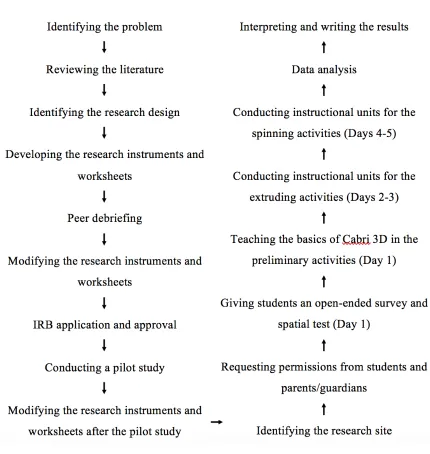
Figure 31. The flowchart of the research design…………..…………..…………... 53

Figure 32. Some hands-on materials related to spinning and extruding figures……… 68

Figure 33. A hand gesture can be used an extrusion of a 2-dimensional shape………. 69

Figure 34. A sample item in the PVR test with corresponding item in the original

PSVT…………..…………..…………..…………..…………..………. 70

Figure 35. A sample item in the Views Section of the PSVT…………..……….. 71

Figure 36. Question 10 in the spatial ability test…………..…………..……… 71

(17)

Figure 38. Charlotte’s answer to Question 11…………..…………..……… 74

Figure 39. Charlotte’s drawings for Question 15…………..…………..………... 74

Figure 40. Charlotte’s written response for comparing the volumes of objects………. 75

Figure 41. Charlotte’s work of finding the area of circle…………..………... 75

Figure 42. Chelsea’s written responses for Question 9…………..………... 76

Figure 43. Chelsea’s given answer to Question 15…………..…………..………. 77

Figure 44. Chelsea’s given answer to Question 12…………..…………..………. 77

Figure 45. Meredith’s written response for Question 12…………..……….. 79

Figure 46. Meredith’s drawings for Question 15…………..…………..…………... 79

Figure 47. Mitch’s given answer to Question 11…………..…………..……… 80

Figure 48. Sloane’s written response for Question 12…………..…………..………… 82

Figure 49. Sloane’s drawings for Question 15…………..…………..………... 82

Figure 50. Stan’s written response for Question 12…………..…………..…………... 83

Figure 51. Stan’s written response for Question 14…………..…………..…………... 83

Figure 52. Stan’s written response for Question 16…………..…………..…………... 84

Figure 53. Vince’s written response for Question 10…………..…………..…………. 86

Figure 54. Vince’s written response for Question 11…………..…………..…………. 86

Figure 55. Vince’s written response for Question 16…………..…………..…………. 87

Figure 56. Virginia’s written response for Question 10…………..…………..………. 88

Figure 57. Virginia’s written answer for Question 15…………..…………..………… 89

(18)

Figure 59. An extruded triangular prism…………..…………..…………..………….. 95

Figure 60. A triangular prism…………..…………..…………..…………..…………. 95

Figure 61. An illustration of how a circle fills an oblique cylinder…………..……….. 98

Figure 62. An overview of a spinning activity…………..…………..………... 99

Figure 63. Steps of filling a circle interior using a polygon…………..………. 100

Figure 64. A pre-constructed sketch in which hidden objects are displayed………….. 100

Figure 65. A pre-constructed sketch in which additional clues are covered within a

hidden rectangular prism…………..…………..…………..…………... 101

Figure 66. An overview of the rearranged toolbar…………..…………..………. 102

Figure 67. Charlotte makes a rectangle gesture that encompasses the triangular

cards…………..…………..…………..…………..…………..…………..………….... 107

Figure 68. Charlotte draws a rectangular box for holding the stack of the triangular

cards…………..…………..…………..…………..…………..……….. 108

Figure 69. Mitch’s static gesture to indicate the bases of the container………. 110

Figure 70. Mitch’s drawings for the “Slanted Penny” activity…………..………. 110

Figure 71. Mitch modifies his parallelogram to an oblique square prism and fills the

extra space in on the base…………..…………..…………..…………..………... 111

Figure 72. Charlotte makes an objectwise-dynamic gesture to denote the triangular

prism…………..…………..…………..…………..…………..………. 112

Figure 73. Stan’s graphical sign for demonstrating the container of the triangular

(19)

Figure 74. Vince positions the rectangle to demonstrate how it decreases……… 114

Figure 75. Vince makes an objectwise-static gesture on Figure 74 to denote how the

shape decreases…………..…………..…………..…………..…………..……… 115

Figure 76. Mitch’s drawing of a triangular prism producing a pivot sign………. 115

Figure 77. Mitch’s drawing of a cylinder producing a pivot sign…………..………… 116

Figure 78. Virginia’s static-objectwise gesture for denoting the top and bottom of a

cylinder…………..…………..…………..…………..…………..………. 117

Figure 79. Virginia’s dynamic-objectwise gesture for denoting the lateral faces of a

cylinder…………..…………..…………..…………..…………..………. 118

Figure 80. Sloane makes a pointwise-dynamic gesture to denote a cylinder…………. 118

Figure 81. Vince connect pre-image and image points…………..………... 119

Figure 82. Vince connect pre-image and image points for each vertex point………… 119

Figure 83. Vince connects pre-image and image points in the perfectly decreasing

penny activity…………..…………..…………..…………..……….. 120

Figure 84. Charlotte drags the movable point back and forth and makes an

observation…………..…………..…………..…………..…………..……… 120

Figure 85. Charlotte drags point A and observes that she could not construct the

pyramid she intended…………..…………..…………..…………..……….. 121

Figure 86. Vince lifts the circular card up…………..…………..…………..……... 121

Figure 87. A stack of DVDs and DVD container…………..…………..…………... 122

(20)

Figure 89. Stan connects pre-image and image figures……….. 123

Figure 90. Sloane constructs a cylinder onto the cylinder on the bottom………... 123

Figure 91. Sloane drags the movable point on the slider and makes an observation…. 124

Figure 92. Charlotte makes a pointwise-dynamic gesture to denote a cylinder………. 125

Figure 93. Charlotte’s written response in the worksheet for a cylinder……… 125

Figure 94. Charlotte makes an objectwise-dynamic gesture to denote a rectangular

pyramid…………..…………..…………..…………..………... 126

Figure 95. Charlotte draws out a rectangular prism and pyramid for the first question

in the worksheet…………..…………..…………..…………..……….. 126

Figure 96. Charlotte makes an objectwise-static gesture to denote a lateral face of the

rectangular pyramid…………..…………..…………..…………..……… 127

Figure 97. Charlotte’s written response for the decreasing rectangular cards

activity…………..…………..…………..…………..…………..…………..………… 128

Figure 98. Chelsea makes an objectwise-static gesture to denote a cone………... 129

Figure 99. Chelsea makes an objectwise-static gesture to demonstrate the surface of

the cone…………..…………..…………..…………..…………..………. 129

Figure 100. Charlotte’s written response for the perfectly decreasing coins activity… 131

Figure 101. Stan makes an objectwise-dynamic gesture to indicate the direction of

(21)

Figure 103. Mitch constructs a rectangular pyramid and rotates it to demonstrate that

the container allows no extra space…………..……….. 133

Figure 104. Mitch’s drawing of a triangular prism (graphical sign) identified as a

pivot sign…………..…………..…………..…………..…………..………... 135

Figure 105. Mitch’s drawing of a cylinder that denoted the collection of circles... 135

Figure 106. Virginia’s written response for the triangular card activity……… 138

Figure 107. Virginia’s written response for the penny activity…………..……… 139

Figure 108. Sloane makes a pointwise-dynamic gesture to denote a cylinder………... 140

Figure 109. Sloane adjusts the line segments, so they look perpendicular from an

over-top view…………..…………..…………..…………..…………..……… 141

Figure 110. Sloane forms a cone connecting pre-image and image points……… 141

Figure 111. Sloane’s written response for the perfectly decreasing coins activity…… 142

Figure 112. The researcher moves the vector to the vertices of the triangles………… 143

Figure 113. Vertices are connected using the Segment tool…………..………. 143

Figure 114. The triangle is traced using the Trajectory tool…………..…………... 143

Figure 115. An objectwise-dynamic gesture the researcher makes to demonstrate the

collection of identical triangular cards stacked on top of each other………. 145

Figure 116. The circle is traced using the Trajectory tool…………..………... 145

Figure 117. Vince positions the rectangle to demonstrate how it decreases……... 146

(22)

Figure 119. Vince’s drawing of the rectangular cards and denotation of the extra

space in the box…………..…………..…………..…………..………... 147

Figure 120. Sloane makes a pointwise-dynamic gesture to denote a triangular prism... 149

Figure 121. Sloane repositions the artifact before using a “roof to a house”

metaphor…………..…………..…………..…………..…………..…………..………. 149

Figure 122. Sloane’s written response for the perfectly decreasing rectangular cards

activity…………..…………..…………..…………..…………..………... 151

Figure 123. Sloane makes an objectwise-static gesture to denote the top and bottom

of volcano…………..…………..…………..…………..…………..………. 152

Figure 124. Sloane makes an objectwise-dynamic gesture to denote the lateral faces

of her rectangular pyramid (volcano) …………..…………..…………..……….. 152

Figure 125. The hands-on material for illustrating the revolving doors………. 155

Figure 126. A sample manipulative students used for the first activity in day 4……... 155

Figure 127. The images for the flip a rectangular card activity…………..……… 156

Figure 128. The resultant 3-dimensional object of Mark’s rotation………... 156

Figure 129. Stan adjusts the angle of the rotation at 180 degrees……….. 158

Figure 130. Stan draws their resultant object…………..…………..………. 159

Figure 131. Sloane rotates the rectangle, and points at the X axis………... 160

Figure 132. Sloane adjusts the angle of the rotation to 180 degrees……….. 160

Figure 133. The researcher makes an objectwise-dynamic gesture for demonstrating

(23)

Figure 134. The researcher makes an objectwise-dynamic gesture to demonstrate

spinning an object in a continuous motion…………..………... 161

Figure 135. Stan connects the pre-image and image points of the rectangles and

changes the angle of the rotation…………..…………..…………..…………..……… 162

Figure 136. Stan adjusts the angle of the rotation to 180 degrees……….. 162

Figure 137. Besides the rectangle, Stan also draws a rectangular prism in their

written response…………..…………..…………..…………..…………..……… 163

Figure 138. Vince connects pre-image and image points of the revolving doors…….. 164

Figure 139. The artifacts used for the spin a right trapezoid activity………. 164

Figure 140. Virginia makes a pointwise-dynamic gesture to demonstrate the circular

path of the triangle…………..…………..…………..…………..……….. 165

Figure 141. Virginia makes a pointwise-dynamic gesture to demonstrate the circular

path of the rectangle…………..…………..…………..…………..……… 165

Figure 142. Charlotte makes a triangle gesture making a static gesture……… 166

Figure 143. Charlotte demonstrates how the triangle spins making a

pointwise-dynamic gesture…………..…………..…………..…………..…………..……… 166

Figure 144. Virginia makes an objectwise-dynamic gesture to demonstrate the cone

(24)

Figure 148. Stan constructs a cone by the freehand circle…………..………... 169

Figure 149. Stan changes the surface style of the cone and rotates the triangle……… 169

Figure 150. Stan makes an objectwise-dynamic gesture for unfolding the right

trapezoid…………..…………..…………..…………..…………..…………..………. 170

Figure 151. Stan breaks into the right trapezoid into triangles and squares/rectangles.. 170

Figure 152. Mitch constructs a circle to demonstrate the circular path……….. 171

Figure 153. Mitch constructs a cylinder and changes its surface style to indicate the

revolving doors fit in the cylinder……….. 171

Figure 154. Charlotte makes an objectwise-dynamic gesture to demonstrate the

continuous motion of a revolving door………... 172

Figure 155. Vince traces the circular path on the screen……… 173

Figure 156. Vince changes the angle of the rotation continuously………. 174

Figure 157. Vince rotates the object, so it is an over-top view…………... 175

Figure 158. Virginia makes a pointwise-dynamic gesture to indicate the circular path

of the rotation……….. 177

Figure 159. Virginia’s written response about the resultant object for the rectangular

(25)

Figure 164. Mitch constructs a cylinder and an inverse cone………. 180

Figure 165. Mitch constructs a circle and a sphere around it………. 181

Figure 166. Mitch draws a circular arrow (pivot sign) to demonstrate the rotation of

the triangle……….. 182

Figure 167. The researcher traces the triangle and shows a blind spot of the resultant

object………... 183

Figure 168. Virginia makes an objectwise-dynamic gesture to demonstrate

continuous motion……….. 183

Figure 169. The researcher drags the point on slider 1 back and forth……….. 185

Figure 170. The researcher drags the point on slider 2 back and forth……….. 185

Figure 171. Sloane makes an objectwise-dynamic gesture to demonstrate how the

180-degree rotation…………..…………..…………..…………..………. 185

Figure 172. The researcher traces the rectangle controlled by slider 1…………... 186

Figure 173. The researcher traces the rectangle controlled by slider 2……….. 186

Figure 174. A cylinder formed by spinning a rectangle…………..………... 187

Figure 175. The researcher denotes a circle with a 2cm radius and the height of the

stack…………..…………..…………..…………..…………..…………..……… 187

Figure 176. A negative-volume solid that was formed spinning a rectangle away

from the rotation line…………..…………..…………..…………..…………..……… 188

Figure 177. Virginia’s drawing of a 2-dimensional object that would result in the

(26)

Figure 178. The negative volume object from an over-top view…………..…………. 189

Figure 179. The researcher uses a DVD metaphor and traces one of the DVDs……... 189

Figure 180. Vince and Virginia’s explanations about why Liz will not form a

triangular prism…………..…………..…………..…………..…………..………. 190

Figure 181. Vince connects pre-image and image points of the rectangles…………... 192

Figure 182. Vince rotates the triangle…………..…………..…………..…………... 192

Figure 183. Virginia makes a pointwise-dynamic gesture to demonstrate the circular

path of the triangle…………..…………..…………..…………..……….. 193

Figure 184. Vince makes a pointwise-dynamic gesture to demonstrate the circular

path of the triangle…………..…………..…………..…………..……….. 193

Figure 185. Vince and Virginia’s explanations about why Liz will not form a

triangular prism…………..…………..…………..…………..…………..………. 194

Figure 186. Stan connects pre-image and image points of the revolving doors………. 195

Figure 187. Virginia makes a pointwise-dynamic gesture to indicate the rotation of

the revolving doors…………..…………..…………..…………..…………..………... 195

Figure 188. Virginia makes an objectwise-dynamic gesture to demonstrate the

continuous motion of the rectangle…………..…………..…………..…………..……. 197

Figure 189. Charlotte makes an objectwise-dynamic gesture to demonstrate the

continuous motion of a revolving door…………..…………..…………..………. 197

Figure 190. Mitch makes an objectwise-dynamic gesture to demonstrate the

(27)

Figure 191. Sloane makes a static gesture to show that line segments were straight…. 199

Figure 192. Stan makes constructs a cylinder with extra space through the rotating

line, and looks at the object from an over-top view…………..………. 199

Figure 193. Virginia makes an objectwise-dynamic gesture to demonstrate a

rectangular prism…………..…………..…………..…………..…………..………….. 201

Figure 194. Vince makes an objectwise-dynamic gesture to demonstrate the path of a

cylinder…………..…………..…………..…………..…………..………. 201

Figure 195. Chelsea makes an objectwise-dynamic gesture to demonstrate a

rectangular prism…………..…………..…………..…………..…………..………….. 202

Figure 196. Chelsea makes a pointwise-dynamic gesture to demonstrate a circular

path…………..…………..…………..…………..…………..………... 202

Figure 197. Virginia constructs a circle on the base of the revolving doors……... 203

Figure 198. The researcher uses the Trajectory tool of Cabri 3D………... 203

Figure 199. The researcher makes an objectwise-dynamic gesture to demonstrate the

continuous motion…………..…………..…………..……… 203

Figure 200. The researcher changes the rotation line…………..………... 204

Figure 201. Sloane uses gestural signs to explain the rotation of the revolving doors... 204

Figure 202. Virginia makes a static gesture to demonstrate the new positions of the

(28)

Figure 205. Meredith produces a graphical sign and makes a pointwise-dynamic

gesture to describe the rotation…………..…………..…………..…………..……... 206

Figure 206. Charlotte constructs a negative volume object…………..……….. 208

Figure 207. The researcher uses the Trajectory tool to denote the rotation in a

continuous motion and rotates the object…………..…………..…………..…………. 208

Figure 208. Charlotte extends one of the sides of the trapezoid making a

pointwise-dynamic gesture…………..…………..…………..…………..……….. 209

Figure 209. Charlotte puts a freehand point on the rotation line, and adjusts it so it

looks line with one of the sides of the trapezoid…………..…………..……… 209

Figure 210. Charlotte constructs a cone for the extra space, and finds the volume of

the negative volume solid…………..…………..…………..………. 210

Figure 211. The researcher changes the vertex point of the cone…………..………… 211

Figure 212. Virginia and Vince’s construction of the negative volume solid………… 211

Figure 213. The researcher constructs a cone taking a freehand point on the rotation

line…………..…………..…………..…………..…………..……… 212

Figure 214. Virginia connects one of the vertices of the trapezoid and a freehand

point on the rotation line…………..…………..…………..………... 213

Figure 215. The researcher asks what other tool can be helpful to identify the exact

vertex point of the cone…………..…………..…………..…………..……….. 213

Figure 216. Virginia extends one of the sides of the trapezoids and marks the

(29)

Figure 217. Virginia constructs a cone using the intersection point as the vertex of

the cones…………..…………..…………..…………..…………..………... 214

Figure 218. Mitch makes a pointwise-dynamic gesture to indicate the circular motion

of the rotation…………..…………..…………..…………..………... 216

Figure 219. Meredith makes an objectwise-dynamic gesture to indicate how the

revolving doors rotate in both directions…………..…………..…………..………….. 216

Figure 220. Mitch constructs a cylinder through the rotation line………. 217

Figure 221. Mitch constructs a circle to demonstrate the circular path……….. 217

Figure 222. Mitch denotes how the revolving doors spin…………..……… 218

Figure 223. Stan’s drawing of a triangular prism…………..…………..………... 221

Figure 224. Sloane’s written response for identifying the volume of triangular

prism…………..…………..…………..…………..…………..…………..…………... 221

Figure 225. Sloane’s written response for identifying the volume of cylinder……….. 223

Figure 226. Sloane’s written response for describing the volume formula of a

triangular prism…………..…………..…………..…………..…………..………. 224

Figure 227. Charlotte labels a rectangular prism for holding the stack of triangular

cards…………..…………..…………..…………..…………..……….. 226

Figure 228. Charlotte’s written response for finding the volume of a triangular

prism…………..…………..…………..…………..…………..…………..…………... 226

Figure 229. Charlotte’s written response for finding the volume of a triangular

(30)

Figure 230. Mitch’s written response for finding the volume of a triangular prism….. 228

Figure 231. Mitch puts his hands on top of each other to demonstrate a

2-dimensional figure…………..…………..…………..…………..…………..………… 230

Figure 232. Mitch gestures how he forms a 3-dimensional object by extruding a

2-dimensional figure…………..…………..…………..…………..…………..………… 230

Figure 233. Sloane’s written response for describing the volume formula of a

cylinder…………..…………..…………..…………..…………..…………..………... 233

Figure 234. Virginia’s written response for describing the volume formula of a

triangular prism…………..…………..…………..…………..…………..………. 234

Figure 235. A rectangular prism and pyramid with a congruent base and height…….. 236

Figure 236. The researcher provides the volume formula of objects on the board…… 237

Figure 237. A cone and cylinder with a congruent base and height………... 238

Figure 238. The right cylinder and oblique cylinder stacked vertically on the screen... 239

Figure 239. Virginia’s objectwise-dynamic gesture to extrusion of a triangle………... 243

Figure 240. A new problem for comparing the volume of oblique and right

(31)

Figure 246. The volumes of the objects computed…………..…………..………. 257

Figure 247. The blue cylinder straightened out…………..…………..……….. 257

Figure 248. The purple cylinder straightened out…………..…………..………... 258

Figure 249. Different stacks of rectangular cards…………..…………..………... 259

Figure 250. The demonstration of conical extra space using the Circle tool…………. 266

Figure 251. Pre-constructed sketch used during the spin a rectangular door 1

activity………..…………..…………..…………..…………..…………..……… 277

Figure 252. Hands-on material used during the spin a rectangular door 1 activity…… 277

Figure 253. Some points on the right trapezoid traced out using the Trajectory tool… 281

Figure 254. Finding the volume of sphere using the volume of cones………... 282

Figure 255. A demonstration of tracing a line segment for finding the area of

(32)

Chapter 1 – Introduction

According to the National Council of Teacher of Mathematics (NCTM) (2000), K-12

students should be given an opportunity to develop their spatial reasoning abilities. These

abilities can help “lay the foundation for understanding not only their spatial world (e.g.,

reading maps) but also other topics in mathematics and in art, science, and social studies” (p.

97). Spatial abilities not only help students with daily life situations (Newcombe & Shipley,

2012), but also prepare students for different career opportunities (McClintock, Jiang, & July,

2002; Presmeg, 1986). In addition, spatial ability predicts high school students’ success in the

Science, Technology, Engineering, and Mathematics (STEM) fields (Newcombe, 2013).

Accordingly, there has been an increased interest in understanding and describing students'

reasoning about spatial tasks.

A 3-dimensional geometric topic often studied by children in grades K-12 is volume.

Research indicates younger children most often understand, and use unit cubes and

paper-pencil methods to find the volume of solids (e.g., Battista & Clements, 1996; Battista, 1999;

Ben-Haim, Lappan, & Houang, 1985; Eames, Miller, Kara, Cullen, & Barrett, 2013; Kara et

al., 2012; Sack & Vazquez, 2012). Using a unit cube method to find the volumes of

3-dimensional objects is also suggested in Common Core State Standards of Mathematics

(CCSS-M) (2010) at the fifth grade level.

(33)

finding the volume of a rectangular prism to be length * width * height. This formula cannot

be generalized to cones, cylinders, etc.

Extruding 2-dimensional figures involves a continuous motion (e.g., see Figure 1). It

is also known as linear sweeping (Bertoline & Wiebe, 2005). The extruding method can

provide students an opportunity to make connections between areas of 2-dimensional figures

and the volume of 3-dimensional objects. Using this method, students are not restricted with

forming solids with whole number edges. For example, once students derive the formula of a

cylinder, they can derive the formula of a cone keeping their base and height the same, and

comparing their volumes. A similar volume comparison can also be made between a prism

and pyramid keeping their base and height the same. Then, the ratio between the volumes

assist students in describing a rule for finding the volume of a pyramid with reference to the

volume of a prism.

(34)

(Bertoline & Wiebe, 2005). Okumuş and Hollebrands (under review) report high school

students have difficulty using spinning to form 3-dimensional objects with paper and pencil.

The difficulties stem from rotating figures in a 2-dimensional context (e.g., rotating the

rectangle through centroid of it) and/or not rotating figures in a circular and continuous

motion. More interestingly, the researchers noted students view prisms as 3-dimensional

forms of 2-dimensional figures (e.g., rectangle

rectangular prism). These findings suggest

a need to conduct research to examine how students can make connections between

extruding and spinning 2-dimensional figures.

Figure 2. Rotating a rectangle about one of its sides, and forming a cylinder of revolution

Researchers have suggested using technology for the purpose of solving

calculus-related problems involving relationships between volume and time, and calculating volumes

using unit cubes (Benacka & Ceretkova, 2013; Carreira, Amado, & Canário, 2013; Kordaki

& Pomonis, 2005; Stylianides & Stylianides, 2004). For example, Carreira et al. (2013)

focused on how students interacted with algebraic expressions, functions, and their graphs,

rather than on how 3-dimensional objects were formed. Stylianides and Stylianides (2004)

illustrated different approaches that would help reasoning about maximum volume of

rectangular prisms using a dynamic geometry program. There are several studies that shed

(35)

light on students’ reasoning about 3-dimensional objects, and the ways they find volumes

using unit cubes. However, there is little research about forming 3-dimensional objects by

spinning or extruding 2-dimensional figures. Such a transformation requires tracing the

figures in a continuous motion. This is different from previous research in which

3-dimensional objects are rotated as a whole (e.g., Gorgorió, 1998; Gutiérrez, 1995).

Purpose Statement and Research Questions

The purpose of this case study is to understand how middle school students enrolled

in a summer program reason about the volume of 3-dimensional objects using extrusion and

spinning while utilizing manipulatives and Cabri 3D (Bainville & Laborde, 2004). The

following research questions will guide this research study:

1.!

In what ways do students relate the features of 2-dimensional shapes and

3-dimensional solids that are created using extrusion and spinning methods?

2.!

What strategies do students use for computing the volume of a 3-dimensional

object when it is created using extrusion method?

Importance of the Study

Researchers report providing students opportunities to develop deep understandings

of foundational calculus concepts before college (e.g., rates of change, function) help

students succeed in advanced mathematics courses (Ferrini-Mundy & Gaudard, 1992;

Pyzdrowski et al., 2013).

(36)

(e.g., calculus ideas related to solids of revolution) (Baartmans & Sorby, 1996). However,

there is little research that shows how middle school students’ form 3-dimensional objects or

how they use dynamic geometry software to support their learning of this skill. In addition,

most research studies focus on finding the volume of rectangular prisms using unit cubes.

However, the unit cube method is less helpful for finding the volume of other solids such as

oblique solids. The current research will focus on how students reason about the volume of

oblique solids with the use of Cabri 3D.

CCSS-M (2010) gives guidance about how the volume of rectangular prisms might be

taught suggesting the use of unit cubes in middle school. No recommendations are provided

for finding the volume of other solids. Most textbooks provide an explanation of what

volume is and then provide students with volume formulas they are expected to remember

(Beck, 2012). Previous research indicates students have difficulty solving volume tasks and

understanding the volume of objects conceptually (Işıksal, Koç, & Osmanoğlu, 2010; Tan

Sisman & Aksu, in press). As a consequence, they give up solving the tasks if they cannot

remember the formula (Işıksal et al., 2010). Although some students can recite the volume of

solids they do not always understand why this formula makes sense. For the current study,

teaching materials will be developed to help students make connections between properties

of solids, and their volumes and formulas using Cabri 3D.

(37)

mental rotation processes or abilities when they rotate objects holistically.

Definition of Terms

Welchons, Krickenberger, and Pearson (1957) define a geometric solid as “a surface

completely enclosing a portion of space” (p.3). There are some right solids perhaps students

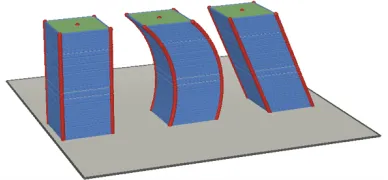
are more familiar with such as prisms, cylinders, pyramids, and cones. The altitude of right

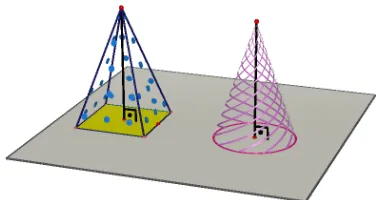
solids meets the centroid of the base (Figure 3) whereas in oblique solids the altitude does not

pass through the base (Figure 4). In other words, if you drop from the highest point of the

solid (apex), it will not pass through the center of the base. As a result, oblique solids are

tilted (Bertoline & Wiebe, 2005).

Figure 3. A right square pyramid and cone

Figure 4. An oblique square pyramid and cone

(38)

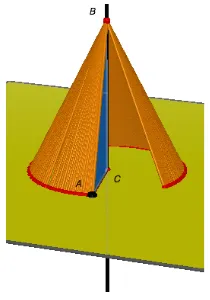
revolution, since it may be generated by revolving a rectangle about one of its sides as an

axis” (p.134). In order to differentiate a cylinder formed by an extrusion of a circle, one may

refer to it as an extruded cylinder. Similarly, other objects can be referred by the

transformations applied (e.g., a cone of revolution versus an extruded cone).

In addition, there are other geometric solids formed in certain ways and their names

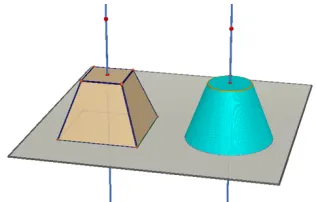
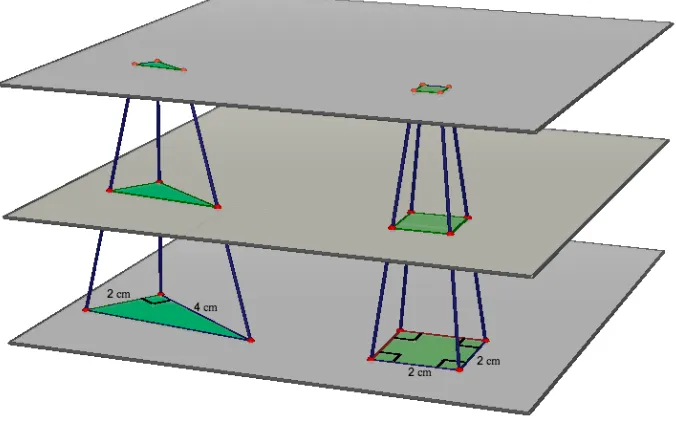
are related to how they are created. For example, the pyramid and cone are cut by a plane

that is parallel to their base (Figure 5), and a frustum pyramid and cone are created as shown

in Figure 6 (Bertoline & Wiebe, 2005). If the objects were cut by a plane that was not parallel

to their base, then a truncated pyramid and cone would be created (Bertoline & Wiebe, 2005;

Welchons et al., 1957). In this case, the top and bottom figures of the pyramid and cone

would be neither similar figures nor parallel.

Figure 5. A pyramid and cone, and a plane parallel to their base

(39)

In addition, there are some solids for which special terminology is not used. Rather,

they are described with regard to their components. Bertoline and Wiebe (2005) call such

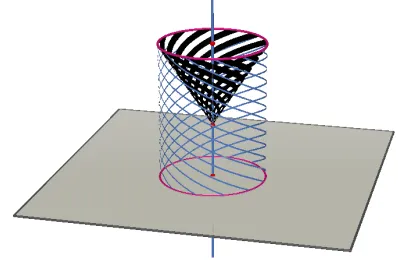
solids combinations or negative volume solids. On the one hand, in combinations or positive

volume solids, a solid is added to another such as adding a cone to the top of a cylinder

(Figure 7). On the other hand, in negative volume solids, one solid is subtracted from another

(e.g., Figure 8).

Figure 7. A cone added to a prism

(40)

Chapter 2 – Theoretical Background and Literature Review

This chapter outlines theoretical perspectives of the study, previous research related

to the research purpose of this study. The first section focuses on the theoretical perspective,

semiotic mediation (Bartolini Bussi & Mariotti, 2008), in which this study is grounded.

Afterwards, the research questions are revisited and tied with the theoretical framework. The

last two sections provide a review of the literature related to 3-dimensional geometry.

Semiotic Mediation

Vérillon and Rabardel (1995) made a distinction between artifact and instrument by

describing “the artifact, as a manmade material object, and the instrument, as a psychological

construct” (p.84). In other words, artifact can be a material, tool, symbolic object, etc. The

student uses an artifact meaningfully in order to accomplish a task in a way that the artifact

becomes an instrument – that is called instrumental genesis. In this process, utilization

schemes and techniques play a central role when the student attempts to solve a problem or

situation. Utilization schemes, which are not directly observable, refer to the mental acts of

using an artifact. Techniques indicate interactions between the student and artifact and “can

be seen as the observable counterpart of the invisible mental scheme” (Drijvers et al., 2010b,

p.109). Drijvers et al. (2010b) characterized an instrument as a collection of artifacts,

utilization schemes and techniques.

(41)

using DGS, he or she should know how to drag primitive objects such as points

(instrumentalization). The student should be familiar with a constraint of the artifact, in that

DGS may be providing rounded measurements. The student, also, needs to develop

utilization schemes and techniques such as understanding how dragging primitive objects are

influencing/updating in the resulting measures (instrumentation) (Goos et al., 2010). The

methods students use to approach the artifact vary. For example, a square can be constructed

in DGS rotating a line segment 90 degrees each time. A different approach is to use circles

and perpendicular lines to construct congruent sides. Each approach is informed by the

student’s understanding of and relationship with the instrument.

Instrumental genesis is rooted in cognitive ergonomy, and “does not aim at coping all

the needs of school education research” (Bartolini Bussi & Mariotti, 2008, p. 749).

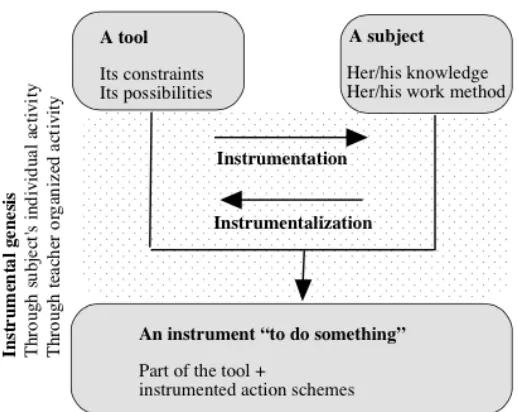
Researchers modified a sequence of teaching and learning processes (e.g., Figure 9) in which

teachers were one of the components of instrumental genesis (Drijvers, Doorman, Boon,

Reed, & Gravemeijer, 2010a; Guin & Trouche, 2002; Trouche, 2004). In these research

studies that most often took place using Computer Algebra Systems (CAS) learning

(42)

Figure 9. The process of instrumental genesis (Trouche, 2004, p. 289)

Instrumental genesis helps researchers to interpret students’ schemes from their

written and/or oral explanations, gestures, etc., provided that there is an intention of

accomplishing a task using an artifact (Bartolini Bussi, Corni, Mariani, & Falcade, 2012;

Bartolini Bussi & Mariotti, 2008; Drijvers et al., 2010b). The instrumental approach draws

attention to students’ thinking with a focus on the relationship between the artifact and

mathematical knowledge. Also, mediation is used for “referring to the potentiality of

fostering the relation between pupils and mathematical knowledge, and mostly related to the

accomplishment of a task” (Bartolini Bussi & Mariotti, 2008, p. 752) where a triadic

(43)

According to Vygotsky (1978), signs are inward in that they change “nothing in the

object of a psychological operation. It is a means of internal activity aimed at mastering

oneself; the sign is internally oriented” (p. 55). On the other hand, tools are outward in that

they “serve as the conductor of human influence on the object of activity” (p.55). In a

mediated activity, a link occurs between the tool and sign where a transformation from a tool

to sign is established – that is called the process of internalization. This link is constructed in

social learning environments where interpersonal meanings in a social/cultural environment

are progressed into intrapersonal ones.

Several researchers have used the notion of a special type of mediation, semiotic

mediation, as their theoretical perspective in a cultural learning environment to elaborate

classroom dynamics (Bartolini Bussi & Mariotti, 2008; Falcade, Laborde, & Mariotti, 2007;

Mariotti, 2009). Rooted in a Vygotskian perspective, semiotic mediation “sees

knowledge-construction as a consequence of instrumented activity where signs emerge and evolve within

social interaction” (Mariotti, 2009, p.428). Signs such as oral or written texts, gestures and

drawings are characterized as “something which stands to somebody for something in some

respect or capacity” (Pierce 1932; 2.228, quoted in Drijvers et al. 2010b, p.118). As

(44)

(e.g., coming up with an algebraic equation for a given graph) (Sabena, 2008).

Figure 10. The elements of semiotic Mediation (Bartolini Bussi & Mariotti, 2008, p.757)

In individual work, homework, etc., individual signs are produced. Collective signs

are produced in a cultural environment where whole-class discussions are generated or

students work in groups under the teacher’s supervision. Each triadic component in the

semiotic mediation refers to a notion (Bartolini Bussi, 2011; Bartolini Bussi et al., 2012;

Bartolini Bussi & Mariotti, 2008; Mariotti 2009, 2010). The four triadic components are

described below.

(45)

mathematical context such as mathematical definitions and proofs. Producing artifact signs is

more obtainable for low-achieving students before they produce a mathematical sign (e.g.,

mathematical definitions), so “mathematical signs are not intended to suddenly substitute

artefact signs” (Bartolini Bussi & Baccaglini-Frank, 2015a, p.394).

Often pivot signs are utilized to make a transition from an artifact sign to

mathematical sign or vice versa. Pivot signs play a hinge role in this transition. They “may

refer both to the activity with the artifact; in particular they may refer to specific

instrumented actions, but also to natural language, and to the mathematical domain”

(Bartolini Bussi & Mariotti, 2008, p. 757). Pivot signs link artifact and mathematical signs

(Bartolini Bussi & Baccaglini-Frank, 2015a). Bartolini Bussi and Baccaglini-Frank (2015a)

exemplified pivot signs as follows: “Pivot signs develop and are enriched by their

relationships with other pivot signs, hence building a network of pivot signs (for example, the

“bundle” of ten sticks may be related to single sticks/units or to bundles of bundles/hundreds)

and so on” (p.394).

(46)

artifact signs students used (e.g., point, point on an object). Students referred to the points

independent or dependent variable using mathematical signs. However, this sign was also

categorized as a pivot sign because it made a link between the artifact and pivot sign.

Bartolini Bussi and Mariotti (2008) stressed:

The sense of the definition (as BP stressed, and we understand easily why...) is hinged

on the interpretation of the sign <independent> that draws its meaning from the

context of the artifact. Thus the sign <independent> (as well <dependent>) can be

classified as a pivot sign, in fact it has at the same time a reference in the

mathematical context, where <independent variable> is a technical term, and a

reference in the artifact context, where, according to the current interpretation in the

natural language, expresses the fact that the Cabri points can freely move on the

screen. (p.774)

In Figure 10, “Task – Mathematical knowledge to be mediated in a cultural

environment – Artifact” refers to semiotic potential of the artifact. Mathematical tasks are

given together with an artifact in a cultural environment where students can produce signs.

The teacher has an important responsibility designing suitable tasks and classroom settings so

that students can make a transformation from an artifact sign to mathematical sign. The

teacher should be aware of the potentials of the artifact (affordances and constraints).

(47)

In a cultural environment, there is a piece of knowledge that needs to be mediated

through mediated activity. This mathematical knowledge requires using culturally

determined mathematical texts/signs with the use of artifact (“Artifact – Mathematical

knowledge to be mediated in a cultural environment – Mathematical Signs/Texts” in Figure

10). For example, in the Turkish mathematical language, brackets indicate boundness. [AB

symbolizes to a ray that starts at point A and passes through point B to infinity, and [AB]

symbolizes a line segment whose endpoints are A and B. During a semiotic activity, a student

may produce personal mathematical signs. These signs become institutional signs in a

mathematics culture (Arzarello, Paola, Robutti, & Sabena, 2009).

The Vygotskian ideas of the semiotic mediation elaborate classroom dynamics to

understand produced signs meaningfully. Falcade et al. (2007) described how Vygotsikian

perspective could support semiotic mediation as follows:

Signs generated in relation to the use of a tool, through the complex process of

internalization accomplished after social interchange, may shape new meanings. In

this respect, a specific tool may function as a semiotic mediator. At first, externally

oriented, a tool is used in action to accomplish a specific task, then, within semiotic

activities under the guidance of an expert (for instance, the teacher), the articulation

of new signs, generated by (derived from) actions with the tool, may foster an

internalization process producing a new psychological tool. This new tool is

internally oriented, completely transformed, but still maintains some aspects of its

origin. (p.321)

(48)

the importance of interpreting gesture (e.g., Arzarello, 2006; Arzarello et al., 2009;

Maschietto & Bartolini Bussi, 2009; Radford, 2009). In addition, researchers guide their

research with instrumental genesis and semiotic mediation (Maschietto, 2013; Maschietto &

Trouche, 2010). Drijvers et al. (2010b) describe the benefits of utilizing instrumental genesis

for identifying the semiotic potential of an artifact, designing suitable tasks and interpreting

students’ uses of signs as the following:

As long as the evolution of personal meanings is related to the accomplishment of a

task, it can be analyzed in terms of instrumental genesis, that is, meanings may be

related to specific utilization schemes that themselves are related to the specificity of

the tasks proposed to students. (p. 117)

Semiotic Potentials of DGS

The use of technology in mathematics classrooms has become one of the

characteristics of 21st century teaching and learning (NCTM, 2000). One of the common

technological tools integrated in mathematics classrooms is dynamic geometry software,

which is described as “active, exploratory geometry carried out with interactive computer

software” (King & Schattschneider, 1997, p.ix). Dynamic geometry software (DGS) allows

learners to explore geometric relationships between objects as a result of dragging its

(49)

students drag objects, they can interpret the behavior of the dragging such as simply by-eye,

attending visual components of the DGS with/without measuring objects, activating the

trace/locus tool, etc. To illustrate, students can be given a parallelogram (Figure 11), and

asked to observe the behavior of the parallelogram upon dragging one of the corner points.

Then, students may observe it becomes a rectangle simply by-eye. On the other hand, they

can measure the interior angles, and observe this change accordingly.

Figure 11. An illustration of a parallelogram becoming a rectangle

In addition, some DGS use technological representations to provide feedback and

cues. For example, using the marker tool of the Geometer’s Sketchpad (Version 5), a marked

angle will change to the symbol for a right angle when its measure is 90 (Figure 12).

Figure 12. An illustration of a parallelogram becoming a rectangle with a focus on their

interior angles

Another feature of DGS is the trace and/or locus tool with which students can drag

points, objects etc., observe the path of motion by activating the trace tool of DGS

(50)

Schumann & Green, 1997). With the help of the trace tool, DGS allows students to observe

and interpret the outcomes of fixed properties under different circumstances (Hollebrands &

Dove, 2011), which may provide insights into the construction of a proof (Guven, 2008). For

example, in order to identify the set of points equidistant from point in Figure 13, point

can be dragged activating the trace tool of DGS after fixing the length of

, which may

assist students to construct a definition of a circle mathematically.

Figure 13. Constructing a circle motion using the trace tool of DGS

On the other hand, students can use DGS drawings, simply by-eye, without

constructing geometrical shapes using basic functions of DGS (Healy, Hoelzl, Hoyles, &

Noss, 1994; Hölzl, 1995; Hollebrands & Smith, 2009). This process is often referred to as

drawing. However, a DGS drawing does not preserve the properties of geometric objects.

This is different from a DGS construction. When properties are used to construct a DGS

object it maintains its properties when dragged. However, DGS constructions can have

limitations if they are not properly created and thus violate mathematical and/or cognitive

fidelity (Dick & Hollebrands, 2011).

Dick and Hollebrands (2011) stress the necessity of mathematical fidelity (staying

true to the math) and cognitive fidelity (a match between student perceptions and intended

B

(51)

math meaning) of dynamic sketches. For example, a circle looks like an ellipse in an unequal

scale of a coordinate system, which violates cognitive fidelity. Also, students can be given a

construction that has a limitation(s) on mathematical fidelity. For illustration, in Figure 14,

is constructed with parallel line tool of DGS so that it remains parallel to

upon

dragging the vertices of the trapezoid. As a result, dragging upon points , and , the

trapezoid will preserve its critical attributes. However, upon dragging point towards

beyond point as shown in Figure 15, a non-trapezoid (a crossed quadrilateral) appears on

the screen although one pair of opposite sides or the figure is parallel to each other.

Therefore, this construction has a limitation.

Figure 14. A trapezoid

Figure 15. A crossed-quadrilateral (de Villers, 1994)

When it comes to 3-dimensional geometry, besides the aforementioned features, DGS

such as Cabri 3D enable users to rotate 3-dimensional objects and see them from different

perspectives (Laborde, 2008; Mithalal, 2009) that is called perspective dragging (Leung

& Or, 2009; Leung, 2011). For example, Hollebrands et al. (2008) exemplify a case of

CD

AB

A

B

D

C

D

Figure

Figure 4. An oblique square pyramid and cone
Figure 5. A pyramid and cone, and a plane parallel to their base
Figure 7. A cone added to a prism
Figure 9. The process of instrumental genesis (Trouche, 2004, p. 289)
+7

References

Related documents