A STUDY OF T H E EFFECT ON DEVELOPMENT OF “MINUTE” MUTATIONS I N DROSOPHILA
MELANOGASTERl
KATHERINE SUYDAM BREHME Columbia University, New York
Received October 27, 1938
INTRODUCTION
H E study of genetic factors influencing developmental rates has
T
come to assume primary importance in the analysis of gene action since the discovery in several genera that the expression of an adult char- acter is dependent upon a balanced interaction between different growth processes, the character being altered when the relative rates of the processes are changed by genetic or environmental influences. The work of GOLDSCHMIDT on Lymantria and Drosophila (1920, 1935, 1937), of FORD and HUXLEY on Gammarus (1927), of PLUNKETT on Drosophila (1926) and of KUHN on Ephestia (1936 and earlier papers) has thus served to turn the attention of geneticists from the empirical study of phenotypes to the experimental study of gene action with the aid of genetical and environmental factors influencing gene expression through their effect on developmen tal rates.I n Drosophila melanogaster the mutations known as “Minutes” consti- tute a series of genetical factors modifying the rate of development. Since the discovery of the first Minute by BRIDGES in 1919 (BRIDGES and MORGAN 1923), many others have been found a t a number of loci in all four chromosomes. Several Minutes are known to be deficiencies: MZ,
M30, MIV,
Mw,
MBlond, M33a, M33j, M(2)vg’l and Haplo-Iv; whether the others are deficiencies is not known. All have similar phenotypic ef- fects in reducing size of bristles; most of those studied roughen the eyes, lower viability and fertility and retard development. All are dominant and lethal when homozygous.2 These effects have been attributed by SCHULTZ(1929) to a common “Minute reaction.” In addition, certain Minutes
(Mn,
Mw,
M y , MBlond, M33j andIMP)
have been found by STERN (1936) to increase the frequency of somatic crossing over; others have not been stud- ied from this point of view.1 Submitted in partial fulfillment of the requirements for the degree of Doctor of Philosophy, in the Faculty of Pure Science, Columbia University.
*
Several recessive factors which reduce bristle size (minute-like, morula, chaetelle, bobbed, tiny bristle) are sometimes referred to as Minutes. STERN (1936) has reported that bobbed and tiny bristle produce a ‘‘physiological Minute condition” which increases the frequency of somatic crossing over. Minute-like (Mom 1925) has phenotypic effects similar to those of the dominant Minutes but is not lethal when homozygous. Little else is known about these recessive factors which would justify their classification as Minutes, and as the Minutes are by definition dominant (BRIDGES and MORGAN 1923)~ the recessives WU be omitted from the present discussion.132 KATHERINE S W D A M BREHME
In a genetical analysis of the Minute reaction, SCHULTZ found that when two or more different Minutes are present in heterozygous condition in the same fly, the combination is not lethal, nor is there a cumulative effect on viability, fertility or developmental rate. On the basis of such tests of 16 Minutes in 55 combinations, he concluded that the primary reactions causing the Minute characters are different in different Minutes. Examina- tion of the interaction of Minutes with Delta and Jammed showed that all the Minutes studied produce a similar effect, but with differences in intensity roughly proportional to the differences in viability, bristle reduction and duration of the developmen tal period. SCHULTZ there- fore postulated a secondary reaction common to all Minutes, the “Minute reaction.” He advanced the hypothesis that numerous growth proc- esses occur, some of which are controlled by the wild type alleles of the Minutes. A heterozygous Minute factor causes a decrease in the rate of one of these processes, which then becomes a limiting reaction, while in the homozygous individual the reaction does not take place a t all.
A study of the effect of Minutes on development was made by DUNN and COYNE (1935) and DUNN and MOSSIGE ( 1 9 3 7 ) ~ who found that the delay in eclosion of Minute flies, first estimated by BRIDGES and MORGAN
(1923) and later roughly timed by SCHULTZ ( 1 9 2 9 ) ~ is chiefly due to a re- tardation in the egg-larval period. DUNN and COYNE (1935 and unpub- lished) found that, in combination with Lobe or Bar, M w , M33j and
ME2 bring about a decrease in size of the eye; in the case of Lobe, the decrease is roughly proportional to the delay in development characteristic of the Minute used. However, in crowded cultures of Lobe and Lobe Minute individuals, they found that the delay in development brought about by the environmental factor of crowding results not in a decrease but in an increase in the size of the eye. They therefore concluded that the Minutes do not act through a simple slowing of the whole developmental process, but through a change in rate of development a t some point in the egg-larval stage. According to this hypothesis, the effect of Minutes on viability and on characters sensitive to growth rate would be less when the previous development was slow, greater when the previous development was rapid. This is compatible with the effects of crowding on Lobe andwith the facts that Minutes survive better a t low temperatures and that the male, with a lower growth rate than the female, is less adversely affected as to viability.
EFFECT OF “MINUTE” MUTATIONS I33
As experimental material, Minute-w
(Mw,
111-80) and Minute-l2 (All2, 11-101) were selected because, of the Minutes which have beenstudied in any detail, they show the most and the least extreme effect, on development respectively. Minute Florida ( M F l a ) , found by J. COYNE, April 1935, and located by BRYSON (1937) a t I I I - ~ O ~ , has been used for
comparative purposes. MFla may be an allele of
Mw.
HeterozygousMFla flies show a delay in emergence similar to that of
Mw.
The Columbia University stock of Florida wild type was used, inbred by brother-sister matings for 2 1 generations before the beginning of the
investigation. Stocks of heterozygous
Mw,
M12 and MFla on a Florida background were maintained by repeated backcrosses of Minute males to Florida females. In certain experiments, use was made of a stock homo- zygous for claret on a background of Florida, isogenic with the Minute and wild type stocks.MATERIALS
All experiments were conducted a t 25 L-o.5”C.
EXPERIMENTAL EVIDENCE: I. BODY SIZE OF MINUTE PLIES
I n a study of differences in developmental rate of Minute and wild type zygotes, it is of importance to know whether growth of the imaginal tissue has continued during the prolonged period of development, resulting in a larger fly, or whether the imaginal growth rate has been reduced, as evidenced by smaller body size of the fly.
Minute flies have been described throughout the literature as tending to be smaller than wild type flies, and it may readily be seen in many flies of Minute phenotype that the body is actually smaller than that of the non-Minute sibs. This is not evident in all the Minute flies of a culture, however, and in any event the difference is slight and could by no means be used as a basis for classification. The following series of measurements was made in order to determine whether body size in Minutes is signifi- cantly less than normal.
Tibia length was used as an index of body size. Since the first use of the leg segments as an index of size by CASTLE, CARPENTER, CLARK,
MAST
and BARROWS (1906), the femur or tibia have been found to give reliable indication of body size differences of flies raised a t different temperatures (ALPATOV and PEARL 1929; IMAI 1933, 1937), of the size differences be- tween species (DOBZHANSKY, working with Drosophila miranda andD.
pseudoobscura, 1935), and of the pleiotropic effects of certain genes (DOB- ZHANSKY 1930, using Stubble and stubbloid; COMBS 1937, using the Baralleles).
I34
MFla/+ 3 XMFZa/+ 9 and Florida wild type. From each of these crosses, larvae were cultured in shell vials ( 2 0 to a vial). At 24 to 48 hours
after eclosion of the adults, the third right leg was cut off and the tibia measured with an ocular micrometer.
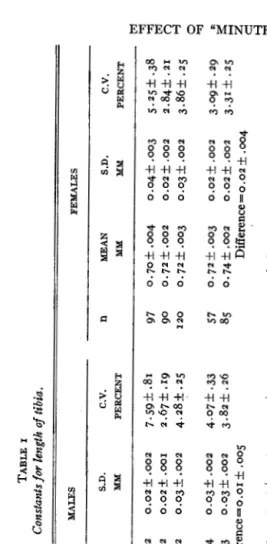
The results, given in table I , show a marked sexual dimorphism in tibia
length, the female tibiae being significantly longer than those of the males. This is to be expected, since the female fly is considerably larger than the male. The wild type tibiae are slightly but significantly longer than those of the Minutes. This may be taken to mean that the Minute fly is, as inspection suggests, smaller than its non-Minute sibs. The dif- ference between Minute and wild type is less than the difference between male and female of any given type, a fact which also may be observed by inspection.
Although in each cross, the wild type sibs serve as controls for the Minute flies, measurements for comparison were made of three Florida strains which had been raised separately without inter-crossing for five or more generations. These measurements (table I) are in close agreement with those of the wild type sibs from the Minute crosses, an indication of physiological homogeneity of the stocks.
Reciprocal crosses were made of
Mw/+
and wild type in order to test the possibility of maternal influence of the Minute mother upon body size of the offspring. The measurements indicate that there is probably no maternal effect ofMw
on tibia length. As the results from the M12 andMFla crosses are in close agreement with those from the
Mw
crosses, itis probable that here too maternal influence is lacking.
This series of experiments may be taken as evidence that the mean dif- ference in size of Minute flies, as compared with their wild type sibs, is slight but real; the Minute imagoes are the smaller. It must be concluded that the imaginal tissue of the heterozygous Minute does not grow a t the same rate as that of the wild type; if this were so, the longer duration of development would result in a larger imago. The growth rate must either be slower throughout development or be lessened a t some developmental stage.
11. THE STAGE I N DEVELOPMENT AT WHICH THE MINUTE EFFECT ON
GROWTH IS PRODUCED
TABLE I Constants joy length oj tibia. MALES FEMALES n S.D. C.V. n MEAN S.D. C.V. PHENOTYPE MEAN CROSS MM MM PERCENT MM KM PERCENT Florida (3 strains)
MWl+dX+P +dXMwl+P MIPI
+
XMW+ MFla/+ X MFlal 4- 92IO1 142
Minutes 78 Wild type 107 Minutes 49 Wild type 56 Minutes 62 Wildtype 38 Minutes 65 Wild type 31 0.67f.002 0.02f.002 7.5gf.81 0.66f.002 0.02~.001 2.67f.19 0.66f .002 0.03f .002 4.28f .25 o.67f .004 0.03f .002 4.07f .33 0.68f.003 0.03~.002 3.82f.26 Difference=o.or f .oo5 0.65f.003 0.02+.002 3.1gf.29 o.66f.003 0.03f.002 3.81f.36 Difference=o.o07+ .004* 0.662.005 0.04f.003 5.7of.51 0.67f.003 O.OZ+.OOZ 3.18f.36 Difference=o.or f .006 o.64f .002 0.02f .002 2.94f .26 0.67f.004 0.02f .003 3.01f .38 Difference = o .03 f .004
97 90 I20 57 85 51 60 37 50 37 30
0.70lk.004 0.04f.003 5.25f.38 0.72f.002 0.02f.002 2.84k.21 0.72f .003 0.03f.002 3.86f .25 0.72f.003 0.02f.002 3.09f.29 0.74f .OO2 0.02f .002 3.31f .25 DiEerence = 0.02 f .004 0.69f .005 0.03f .oo3 4.85f .48 0.72f.002 0.02f.002 2.51f.23 Difference=o.og t .oo5 0.7It.003 0.02*.002 2.90f.34 0.73f .005 0.04f.002 5.28k .53 DiEerence=o.ozf .006 0.67f .004 0.03f .oo3 3.87+ .45 0.70f .OO3 0.OIf ,002 2.08f .27 Difference = 0.03 f .oo5 * Not significant.
136
prolongation of the egg-larval stage, with a negligible delay, if any, in the pupal stage. An experiment with MP indicated that there is no delay in hatching from the egg and that the larval stage is therefore the one affected. They found that
Mw,
M33j, M z and M12 prolong development about as 40:33:30: 12.As no study had hitherto been made of the development of the MFla
heterozygote, the following experiment was planned to determine how great is the effect on duration of the developmental period of this geno- type, and whether there is any prolongation of the pupal period. An experiment with
Mw
was performed a t the same time, to make possible a direct comparison of the developmental periods of these two genotypes, and to relate the results of this study with the seriation of effects of the Minutes studied by DUNN and MOSSIGE.Mass matings in vials were made of about 40 newly hatched Florida females and 40 Minute males. On the fifth day after hatching of the females, when egg laying is a t a maximum, the females were allowed to oviposit during one 24-hour laying period on paraffined paper spoons con- taining banana agar colored with molasses. Larvae were then collected from the spoons a t a-hour intervals; the age of the larvae from hatching was thus known with an error of + I hour. The larvae were cultured, 30
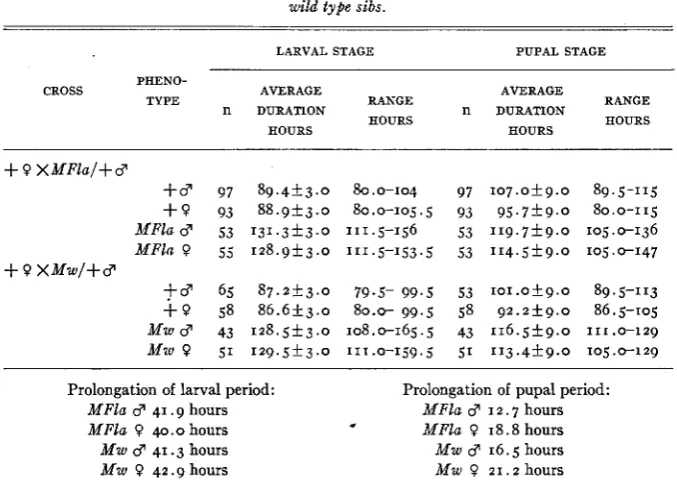
to a dish, in 7.5 cm Petri dishes on banana agar sown with a thick yeast suspension. The culture dishes were observed a t 6-hour intervals until all the larvae had pupated; a t every observation, the pupae from each dish were removed to a separate shell vial, containing a few cc of agar solution for moisture supply. The pupae were then observed a t 12-hour intervals and the phenotypes of the hatched flies recorded. The time from hatching from the egg to pupation was thus known with an error of + 3 hours; the time from pupation to emergence was known with an error of -k9 hours. The results, summarized in table 2, show that the larval periods of the
MFla and M w heterozygotes are prolonged by about the same number of hours. The amount of prolongation, about 41 hours, is in close agreement with that reported by DUNN and MOSSIGE, who observed a delay of 1.8 days (43 hours) in
Mw
larvae. It is also evident that there is no difference between the sexes in duration of the larval period of Minute or wild type larvae; this is in agreement with the results of BONNIER (1926) for a yellow non-Minute stock and of DUNN and MOSSIGE (1937) for M z ,Mw
andMI stocks.
The data given in table 2 show that the pupal period of the female is
EFFECT OF “MINUTE” MUTATIONS I3 7
is also shown in table 2. In both the MFla and the M w groups, the Minute
females are considerably more delayed in emergence than are the Minute males; since the wild type females emerge earlier than the males, this must mean that while the rate of pupal development is reduced in both males and females by the heterozygous Minute condition, the effect on Minute females is much greater than that on Minute males.
TABLE 2
Duration of the larval and pupal periods of MFla and M w heterozygotes and their wild type sibs.
LARVALSTAGE PUPAL STAGE
PHENO- TYPE
CROSS AVERAGE
n DURATION HOURS
AVERAGE
RANGE RANGE
HOURS n DURATION HOURS HOURS
+
0 X M F l a l + d+d
+ o
MFla d MFln 0
+
0 X M w I + dta
+ oMW d Mzv 0
97 93 53 55 65 58 43 51
8 9 . 4 f 3 .o
88.9 + 3 .o
1 2 8 . 9 k 3 . 0
87.2 f 3 .o
1 3 1 . 3 f 3 . 0
86.6+3 .o
128.5f3 .o
129.5 f 3 . O
80.0-104 80.0-105.5
I I I . 5-156
111.5-153.5
79.5- 99.5 80.0- 99.5 108.0-165.5 111.0-159.5 97 93 53 53 53 58 43 51
I07.0fg.O 89.5-115 9 5 . 7 f 9 . 0 80.0-115 1 1 9 . 7 f 9 . 0 105.0-136 1 1 4 . 5 + 9 . 0 105.0-147
1 0 1 . 0 + 9 . 0 89.5-113
1 1 6 . 5 f g . o 111.0-129 92.2 + 9 . 0 86.5-105
I I 3 . 4 f 9 . 0 105.0-129
Prolongation of larval period: Prolongation of pupal period:
MFla 41.9 hours MFla 3 I 2.7 hours
MFla 40.0 hours MFla 0 1 8 . 8 hours
Mw 3 1 6 . 5 hours
Mw 0 2 1 . 2 hours
Mw d 41.3 hours
Mu, 0 42.9 hours
The pupal delay observed in this experiment is very much longer than that found by DUNN and MOSSIGE for any of the Minutes which they studied, a difference in results which can probably be ascribed to the length of the interval between observations in the two series of experi- ments; DUNN and MOSSIGE observed a t 24-hour, the present worker a t 12-hour intervals. The occurrence of a significant pupal delay in MFla
and M w
is
in accordance with the findings of LI on Haplo-Iv. The amount of delay cannot be directly compared with that found by LI because of the difference in the temperatures a t which the two investigations were conducted.conclusively whether a delay in hatching from the egg is characteristic of the Minute heterozygote, the following experiment was carried out with
Mw,
MFla and M12.Matings were made and eggs collected as described above. Three con- secutive one-hour laying periods were used; the age of the eggs was then known with an error of fo.5 hour. Fourteen hours after oviposition, the larvae which had already hatched on the egg spoons were removed and cultured. The egg spoons were then examined a t hourly intervals until
2 4 hours after oviposition, and a t each observation all larvae were re-
moved and cultured. Few eggs hatch after 2 4 hours a t 25°C; larvae which
hatched later than this were retrieved next day, about 36 hours after oviposition. When the flies had completed their development, the adult phenotypes were recorded.
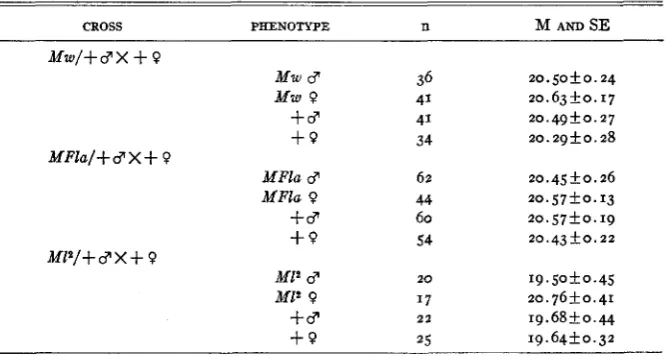
TABLE 3
Egg hatching time of Minute and wild type zygotes i n hours from oviposition.'
CROSS PHENOTYPE n M AND SE
M W l + $ X
+
0MW a
M w 0
+a
+ o
MFla 8 MFla 0
+a
+ o
Mla 3 MI' 0
+a
+ o
MFlaI+ fl X
+
0MPl+ a
x
+
036 41 41 34
62 44 60 54
2 0
17
2 5
2 2
20.50+0.24 20.63 +o. 17
20.29fo.28 20.49f0.27
19. 5 O f 0.45 2 0 . 7 6 k 0 . 4 1 19.68rt 0.44
1 9 . 6 4 f o . 32
* In calculating the mean hatching time, individuals which hatched from the egg less than 14 hours or more than 24 hours from oviposition were disregarded.
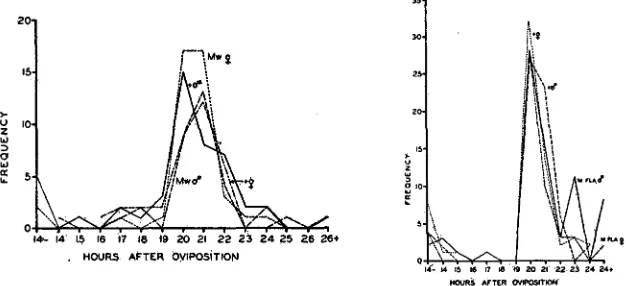
The results, given in table 3 , show conclusively that these Minutes are not delayed in hatching from the egg and that there is no sex difference in hatching time. There is only one exception to the generally consistent results, that of the MZ2 females, which hatched appreciably later than their sibs. The numbers used in the M12 experiment were very low, how- ever, especially in the MZ2 female group, and it seems possible that this discrepancy is therefore not of real significance. The distribution of hatching time for
Mw
and MFla is shown graphically in figures I and 2 ;EFFECT OF “MINUTE” MUTATIONS I39
These results show that delay in hatching from the egg is not a char- acteristic of the Minute effect. It must be concluded that the develop- mental delay characteristic of the heterozygous Minute falls chiefly in the larval stage, and to a lesser extent in the pupal stage. As the delay is mainly effective in the larval stage, this period has been studied further.
3 5 1
201
.
HWRS AFTER OVtPOSlTlON:I.$
FIGURE I (left).-Frequency polygon of larvae hatching at successive hours in
matings of M w / + g x + 9 .
FIGURE z (right).-The same, MFZa/+ 13’ X 4- 0
.
111. NATURE OF THE EFFECT ON THE LARVAL PERIODNumber of larval instars of the heterozygous minute
It is known that the number of instars undergone during insect develop- ment, although probably under hormonal control, is not fixed in all species, and that in certain forms environmental factors may induce or inhibit moulting. One case is known in which a factor thought to be genetic induces variation in the number of instars, that of Locusta migratoria, where an additional moult is controlled by a “sex-linked or sex-limited factor” (KEY 1936); no breeding tests have been made in this case, how- ever.
No departure from the usual rule of three larval instars is known in Drosophila melanogaster. It has been suggested ( GABRITSCHEWSKY and BRIDGES 1928) that the delay of three to five days in onset of pupation in the homozygous giant larva under optimum food conditions may be as- sociated with a fourth larval instar. The occurrence of a fourth instar has never been proven. SCHULTZ (MORGAN, BRIDGES and SCHULTZ 1936) has presented experimental evidence to show that retardation of secretion of a pupation hormone is the cause of the lengthening of the larval period in giant, but this does not exclude the possibility of the occurrence of a fourth instar during the additional larval interval. Since heterozygous
might be supposed that these Minutes pass through a fourth larval instar, though such a supposition seems improbable for M12, where the delay in the larval period is slight. The following technique was devised to clarify this point.
Ten eggs from a mating of M w / + male by Florida wild type female were placed in each of twelve 7.5 cm Petri dishes, containing a thin layer of Pearl’s S IOI medium and sown with a thick drop of banana-grown
yeast suspension. When all larvae in the cultures had pupated, the pupae were removed to paper spoons containing a small amount of agar solution (for moisture supply) and were kept in shell vials until emergence; the adult phenotypes were then recorded. After removal of the pupae, each dish was examined on a white background under the binocular; the moulted mouthparts could easily be seen on the almost transparent me- dium. A piece of graph paper under the dish afforded a means of orienta- tion, so that the entire dish could be thoroughly examined. I n this way it was possible to collect all moulted mouthparts. The absence of an extra set, in addition to the first and second instar sets and the third set shed in the pupa case, would prove the absence of a fourth instar. Mouthparts overlooked in this inspection were recovered by melting the medium and filtering through a small cone of filter paper, on which they were located under the binocular.
Only two sets of discarded mouth armatures were found for each larva which pupated. Since half the larvae were heterozygous Minutes it must be concluded that the heterozygous M w larva passes through three in- stars. A similar test made with the offspring of matings of M12/+ and of
MFla/+ males by Florida females gave the same results.
The evidence is conclusive that the delay in onset of pupation of the Minutes used in this investigation is not due to an additional instar in the larval stage.
The e j e c t of heterozygous M w and M12 on larval growth
Growth in the larval period has been studied for few mutant genotypes in Drosophila despite its importance in an understanding of the production of adult phenotypes. Growth of the larva as a whole has been studied only for the case of giant by GABRITSCHEWSKY and BRIDGES (1928), for ves- tigial by ALPATOV (1930) and for chubby by DOBZHANSKY and DUNCAN
(1933); homozygous giant larvae show no change in growth rate but a delay in the onset of pupation; vestigial larvae show a decrease in growth rate as compared with their wild type sibs; chubby larvae show no change in growth but an altered ratio of length to width from the beginning of larval life..
EFFECT OF “MINUTE” MUTATIONS 141 while the adult size is not greater than that of wild type, it might be ex- pected that, were this lengthening due to changed rate of growth or smaller initial size, there would be evidence of a reduced body size of the Minute larvae a t some point in development. It would be expected that a popula- tion of larvae of the same age, including Minutes and wild type sibs, would fall a t some time into two size groups, giving a bimodal frequency curve of larval size. Such bimodal curves have been obtained by KERKIS (1933) for the larval length of populations of Drosophila melanogaster X D. simu- Zans hybrids, where one sex falls behind the other in growth rate as early as 24 hours after hatching from the egg.
Length of larvae
Crosses of
Mw/+
3 by+
9,
M12/+ 3 by+
9 and Florida wild type were used to giv,e populations which would comprise one Minute to one wild type larva, and the controls respectively. The Florida stock was in the 21st generation of brother-sister matings a t the beginning of the ex- periment. Eggs were collected a t two-hour intervals by the method de- scribed above; the age of the eggs was thus known within one hour. Age of the larvae was taken as the number of hours after oviposition. When the flies were eight days old, they were no longer used as parents; within the limits of one to eight days, however, no attempt was made to control the ages of the flies, since POWSNER (1935) has found that the duration of the egg-larval period is not different for the offspring of parents three days and seven days old.I n the case of larvae measured a t 24 and 36 hours, the eggs were allowed to hatch and the larvae to develop on the spoons. I n all other groups, however, the eggs were transferred to agar slants in shell vials; 2 0 to 2 2
eggs were placed in each vial. The medium was that described in the above experiment on egg-hatching time. A t the desired age, the larvae were removed from the medium with a blunt needle, and were fixed in boiling water, in which they relaxed to their full length in a straight position (ALPATOV 1929). They were measured immediately with the aid of an ocular micrometer. Larval length was measured from the tip of the an- terior segment to the tip of the posterior spiracles, as shown in diagram
a4-hour larvae. It was found in the experiments on egg hatching time that a t 24 hours after oviposition almost all larvae have hatched, a few larvae are between five and ten hours old, a few are two hours old or less, while the vast majority are about four hours old, the mean hatching time falling between 19 and 2 0 hours. The Minute larvae hatch a t the same
quency polygon for the larvae of the three crosses a t 24 hours (fig. 3)
shows this situation. The biometrical constants for this age group, given below, show that the groups composed of Minute and wild type larvae are not smaller in mean length than the Florida control group.
n Mean (mm) S D
c v
Florida 108 0 . 7 4 & 0 . 0 1 0 . 1 2 + 0 . 0 0 8 1 5 . 4 4 5 1 . 0 5 %
M w / + c 7 X + Q 138 0 . 8 2 + 0 . 0 1 0 . 1 2 + 0 . 0 0 7 1 4 . 7 6 + 0 . 8 8 %
M12/+ 8 X
+
Q 1 0 2 0 . 8 8 5 0 . 0 1 0 . 1 1 f o . 0 0 8 13.25*0.930/036-hour larvae. Only Mw populations of this age were measured, to test for a possible bimodal distribution of larval length; no such distribution was found.
@-hour larvae. The results of measurements of this age group are given below and in figure 4.
LENGTH IN MM LENGTH IN MM
FIGURE 3 (left).-Larval length at 24 hours from oviposition in populations of heterozygous Minute and wild type larvae.
FIGURE 4 (right).-The same, 48 hours from oviposition.
n Mean (mm) S D
c v
Florida 109 1 . 6 9 5 0 . 0 4 0 . 3 9 k o . 0 3 23.21+1.570/0
M 1 2 / + 8 X
+
9 I 2 1 I . 49 & 0 . 0 3 0 . 2 8 5 0 . 0 2 18.97 & I . 2 1%Variability is very great in all three populations, and the curve for
Mw
appears to be bimodal, results which are undoubtedly due to occurrence of the first moult a t this time. The mean lengths of the Minute populations are somewhat less than that of the wild type, but in view of the high variabilities in all three cases it is inadvisable to draw conclusions con- cerning the growth of Minute larvae from these data.
96-hour larvae. The 96-hour and older larvae were classified for sex by observation of the gonads
(KERKIS
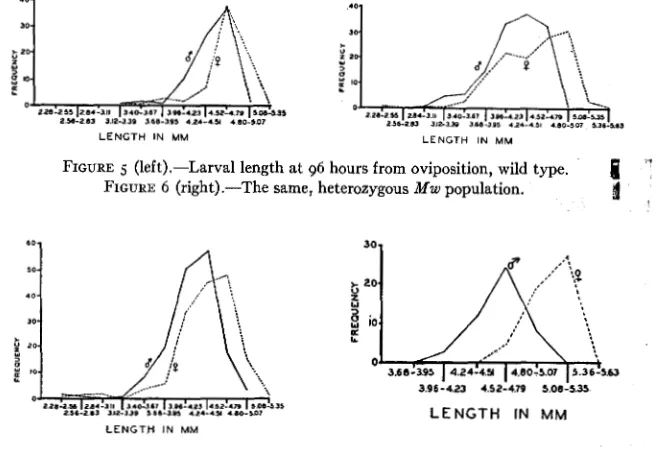
1933) and were separated before h a - tion. The data given in table 4 show that in all three groups there is marked sexual dimorphism in larval length, the males having a lower mean length and lower range than the females. No data on this point have hitherto been available.The variabilities in all groups have greatly decreased, and the frequency polygons (figs. 5 , 6 , 7) show no true bimodal distribution in any group.
EFFECT OF “MINUTE” MUTATIONS =43
The mean larval lengths of the Minute groups are slightly but significantly lower than that of the Florida; this is true for both sexes. These data sug- gest that the
Mw
and MZ2 larvae are shorter than the wild type, the differ- ence being so slight that the frequency polygons of larval length of Minute and wild type are not visibly bimodal.roo-hour and 144-hour larvae. Measurements of larvae a t 100 hours were
made only for the heterozygous
Mw
group, in order to determine whetherL E N G T H I N MM
L E N G T H IN MM
FIGURE 5 (left).-Larval length a t 96 hours from oviposition, wild type. FIGURE 6 (right).-The same, heterozygous Mw population.
1 ,
3
$ io
L
5 . 9 6 4 2 3 4.52-4.79 5.00-5.35
L E N G T H IN M M
L E N G T H I N MM
FIGURE 7 (left).-Larval length at 96 hours, heterozygous MI* population. FIGURE 8 (right) .-Larval length at IOO hours from oviposition, heterozygous Mw population.
- . _
TABLE 4
Constants for larval length of wild type and heterozygous Minute populations.
HOURS MALES FEMALES
AFTER OVIPO-
SITION M M M M PERCENT M M M M PERCENT
n MEAN S.D. C.V. n MEAN S.D. C.V.
CROSS
96, Florida 179 4 . 4 3 f 0 . 0 3 0 . 2 9 f 0 . 0 2 6 . 4 3 f o . 5 1 7 2 4 . 6 2 k 0 . 0 4 o . 3 3 f o . 0 3 7 . 1 o f o . 5 9
: M w / + $ X + 0 133 4 . 2 1 k o . 0 3 0 . 3 8 f 0 . 0 2 8 . g r f o . 5 5 1 2 7 4 . 4 3 k o . 0 4 o . q q k 0 . 0 3 1 1 . 0 6 f o . 6 9
M 1 7 1 + d X + 0 166 4 . 1 6 f 0 . 0 3 0 . 3 8 f o . 0 2 9 . 0 1 f o . 4 q 162 4 . 3 8 f o . 0 3 0 . 4 1 k o . 0 2 g . 4 1 f o . 5 2
100 M w I + $ X + 9
1st experiment
(+ and Min-
utelarvae) 53 4 . 3 6 f o . 0 4 0 . 2 ~ ~ 0 . 0 3 6 . 2 4 f 0 . 6 1 47 4 . 6 9 f 0 . 0 5 o . 3 4 f O . 0 3 7 . 2 6 f o . 7 5 2nd experiment
( f already pu-
pated) 46 4 . 3 5 f 0 . 0 2 0 . 1 5 f o . 0 2 3 . 5 1 f o . 3 7 42 4 . 6 6 f 0 . 0 3 o . 2 2 f o . 0 2 4 . 8 1 f o . s a 144 M w l + # X + 0
(only M w present)
a difference in length exists between the non-Minute larvae which are about to pupate, and the Minutes which are to continue as larvae for two days longer. Under the conditions of the experiment, pupation had begun a t 100 hours; five pupae and IOO larvae were recovered from the cultures.
The measurements show that sexual dimorphism in larval length a t IOO
hours is very marked (table 4 and fig. 8) but the curve for each sex is compact and unimodal.
At 144 hours, all wild type larvae in the heterozygous population have pupated, while the Minute larvae will begin to pupate a t about 146 hours under the conditions of the experiment. The 144-hour population, there- fore, is composed entirely of Minute larvae which are about to begin pupation. Measurements show that the marked sex dimorphism is main- tained (table 4); the difference between the means of the male and female groups is clearly significant. Comparison of the mean larval length of the Ioo-hour group, composed of non-Minutes about to pupate and of Minutes which will not pupate for two more days, and of the 144-hour group of Minutes reveals a slight but significant growth in length in both sexes during the additional two days of the Minute larval period (difference =
0.256f0.048 mm for the males, 0.368+0.054 mm for the females). It appears, therefore, that growth in length is not completely inhibited during the additional days of the Minute larval period. I n order to be cer- tain of this point, the loo-hour and 144-hour measurements were repeated, one year later, when the Florida stock was in the 49th inbred generation. The same technique was used as in the earlier experiment, except that the larvae were cultured in 7.5 cm Petri dishes, on two percent banana agar, sown with a thick yeast suspension; 30 larvae were grown in each dish. On this medium, pupation of the wild type occurred earlier than under the conditions of the previous experiment. At IOO hours, 48 percent of the
larvae had pupated, virtually all those expected to fall within the wild type group. The Ioo-hour measurements, therefore, are those of heterozy- gous
Mw
larvae a t the beginning of the two additional days of larval life. The Minute group was probably also closer to pupation than in the earlier series of measurements, but no direct test was made of this.The results (table 4) show that between IOO and 144 hours there is a
significant increase in length of the females (difference =0.285 +0.042 mm). The males show an increase in length which falls just short of sig- nificance (difference = 0.076 rf: 0.038 mm). The main conclusion of the first experiment is substantiated, that the Minutes continue to increase in length during the additional hours of larval life.
Width of larvae
EFFECT OF "MINUTE" MUTATIONS 145
was available which would make i t possible to distinguish Minute from wild type larvae. Use was later made of the observation of
BEADLE
(1937) that the Malpighian tubes of larvae homozygous for claret are colorless while those of wild type eye color are yellow. The offspring of matings of Mwlcac? by calca 9 were cultured on two-percent banana agar in 9 cm Petri dishes, sown with yeast suspension; 40 larvae were grown in each dish, and their age was known within one half hour from hatching from the egg. The larvae were classified a t 8 2 hours from hatching (about equalin age to the groups described above a t 100 hours after oviposition; pupa-
tion of the wild type had begun), and it was then seen that the Minute larvae are smaller in diameter than the non-Minute (fig. IO). The width
FIGURJI Io.-Photograph of wild type female (upper row) and heterozygous Minute-to
female (lower row) larvae, 82 hours from hatching from the egg.
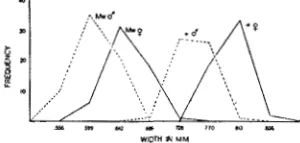
was measured from a dorsal view, a t the posterior border of the third thoracic segment and of the seventh abdominal segment respectively, with the results given in table 5 .
TABLE 5
Size of Minute and weld type larvae at 82 hours after hatchinE.
MEAN S.D. C.V.
n PERCENT
m m
Width of 3rd thoracic segment:
Mw males 66
Wild type males 53
Wild type females 61
M w females 62
Width of 7th abdominal segment: Wild type males 5 5
Mw males 66
Wild type females 54
Mw females 56
Length of larvae:
Wild type males 55
Mw males 74
Wild type females 61
Mw females 73
0.626rt0.003 0.025fo.002 0.546f 0.003 o.024f0.002 Difference = 0.080 f 0.004 0.666f0.003 o.027fo.002 0 . 5 7 6 f o ,004 0.030 ko. 003 Difference = 0.090 f 0.005 0.749fO.OO3 0.024f0.002 0.606 rt 0.003 0.028 f 0 .oo2 Difference=o. 143fo.004 0.653 k0.004 0.028 f 0 . 0 0 2 Difference = 0.146 f 0.005
0.799k0.003 0.023f0.002
4.297 f 0 ,029 0.2I4f 0 . 0 2 0 4.234f0.016 0 . 1 ~ + 0 . 0 1 2
Difference = 0.063 f 0.033 4.494rt0.024 o.191f0.017 4 . 4 1 8 f o . o ~ ~ 0.18gfo.org Difference = 0.076 k 0.032
3 . 9 5 f o . 38 4.46f0.39 4.1If0.37 5 . 2 8 f o . 47
3.20f0.30 4.65 f 0. 37 2.84f0.27 4.32 f 0 . 4 1
4.98f0.47 3.40f0.27 4.24f 0.38 4.19k0.35
of larval width is evident and roughly corresponds to that observed above for larval length.
FIGURE 9.-Width of seventh abdominal segment of larvae at 8 2 hours after hatching from the egg, heterozygous Mw population.
c
EFFECT OF ‘MINUTE” MUTATIONS 147
Growth of the Minute larvae
From the data given above, it is evident that growth in length of the heterozygous Minute larvae takes place a t a slightly lower rate than that of the wild type, and that after the time of puparium formation of the wild type, the Minutes continue to grow in length, until a t their puparium formation they are slightly longer than the wild type prepupae. Growth in width of the larva is markedly altered, so that at the time of puparium formation of the wild type, the width of the Minute larva is less than that of the wild type. Whether there is an altered ratio of growth in length to that in width throughout larval development, or whether the initial ratio of length to width differs in the embryo from that of wild type is a question which is now under investigation.
DELAY IN OCCURRENCE OF LARVAL MOULTS
In the offspring of matings of Mw/ca and MFlalca males by ca/ca females, it was observed that a t 48 hours after hatching from the egg the non-Minutes were appreciably larger than their Minute sibs, and that most of the non-Minutes had undergone the second moult. Two such populations were classified for larval instars by means of the structure of the spiracles (AUERBACH 1936) and for genotype by means of Malpighian tube color, with the following results:
Population a t 48 hours: Second instar 4 claret,
17
Mw
o claret, 21 MFlaThird instar
25 claret, I
Mw
17
claret, 4 MFlaThe second moult of the Minute larvae was evidently delayed. The follow- ing experiments were then conducted to ascertain the time a t which the first and second moults take place in the Minute larvae and their wild type sibs.
Larvae from the crosses described above were collected a t intervals of
2 hours from hatching from the egg, and were cultured in Petri dishes, as
.
148 KATHERINE SUYDAM BREHME
gotes, and 3 hours in the case of
Mw
under the conditions of the ex- periment.Similar observations were made from the 42nd hour of the larval period until all larvae had passed into the third instar. At this age the larvae could be classified for sex with speed and accuracy. The results (table 6 ) show that the
Mw
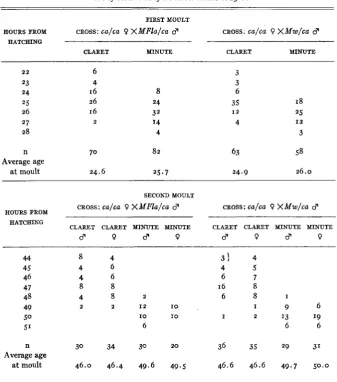
and MFla heterozygotes undergo the second moult a t an average of about 3 hours later than their wild type sibs, while the be- ginning of the moult is delayed from 5 to 6 hours. The moulting periods are almost discontinuous; practically all wild type larvae have moulted when the Minutes begin to moult. There is no sex difference in time of the second moult in either Minute or wild type.TABLE 6
Time of occurrence of the larval moiilts at 25°C.
FIRST MOULT
HOURS FROM CROSS: ca/ca 0 XMFlalca d CROSS. ca/ca 9 X M w l c a d HATCHING
CLARET MINUTE CLARET MINUTE
2 2 23 24 25 26 27 28 n Average age at moult 6 4
16 8
26 24
2 I4
4
16 32
70 82
24.6 25.7
3 3 6
35 I8
I 2 25
4 12
3
63 58
24.9 26.0
SECOND MOULT
CROSS: ca/ca 0 XMFlalca d CROSS: calca 0 X M w l c a d HOURS FROM
HATCHING
CLARET CLARET MINUTE MINUTE CLARET CLARET MINUTE MINUTE
d 0 d 0 d 9 d 0
44 45 46 47 48 49 50 51 n Average age at moult
8 4
4 6
4 6
8 8
4 8 2
2 2 I 2 1 0 .
IO IO
6
30 34 30 20
31 4 6 16 6 I 36 46.6 4 5 7 8
8 I
I 9 6
2 13 I9
6 6
35 29 31
EFFECT OF 'MINUTE" MUTATIONS I49
It may be concluded that the heterozygous Minute larva is delayed in undergoing the first and second moults; delay a t the second moult is greater than that a t the first.
The high variability in larval length of the wild type, M12 and
Mw
populations a t 48 hours from oviposition (page 149) is now seen to be due to occurrence of the first larval moult a t about this time. It is a matter of common observation that, upon moulting, the larva increases greatly in size, an increase which is evident in the growth curves published by ALPATOV (1929) and others. The bimodal distribution of larval length in the
Mw
population (fig. 4) is probably due to the delay in moulting which is characteristic of theMw
heterozygote.PRELIMINARY STUDY O F LARVAL HISTOLOGY
From the above data on size of the Minute adult, i t is evident that the Minute factors must affect the growth rate of the imaginal tissue in such a way as to produce, after a longer developmental period, an adult which is slightly smaller than the wild type. The effects of the heterozygous Minute upon the Bar and Lobe eye and upon bristles further indicate effects of the Minute factors on the imaginal tissue. Accordingly, a histo- logical study was made of Minute and wild type larvae. As few specimens were studied (five of each genotype and sex a t a given age), the following report must be regarded as preliminary, and only tentative conclusions drawn. More detailed study is now in progress.
The offspring of males heterozygous for
Mw
and claret by claret fe- males were cultured as in the investigation of the delay in time of pupationof
Mw
and MFla. Larvae were collected from the egg spoons a t two-hour intervals; their age was thus known within
rt
one hour from the time of hatching. All larvae to be compared were offspring of the same matings and were cultured together in the same dishes. Malpighian tube color was used to classify the larvae for genotype. The larvae were fixed in Kahle's fluid, imbedded in paraffin, sectioned a t 7p and stained with gentian violet and eosin. The stages investigated in this study were those a t 48, 7 2 and 1 2 0 hours. At 48 hours, all the larvae which were studiedhad entered the third instar. The 7z-hour larvae had passed through about two-thirds of the time required by the wild type to complete the third instar. At 1 2 0 hours, all wild type larvae had already pupated and
the Minutes were about to pupate.
siderably smaller in diameter than the wild type (fig. 11); a t 48 hours,
they were smaller but the difference was not so great as a t 72 hours. The
larval cells of the Minute appear smaller than those of the wild type, but careful measurement of the cells must be made before this observation can be considered reliable.
Comparison was made of the organ known as Weismann’s ring (WETS-
MANN 1864) or the ring-gland (HADORN 1937)~ which is the source of the pupation hormone. The gland was identified from dissections and from the descriptions of HADORN (1937) and SCHARRER and HADORN (1938). At 48 and 72 hours, the gland is conspicuous in both Minute and wild type
larvae; no constant difference was found between the glands of the two genotypes. The size of the gland was variable in the specimens studied; some Minute larvae had ring-glands of the same size as the largest of the wild type glands. Whether the gland cells were actively secreting in either genotype could not be determined with the stains which were used.
Imaginal disks. This study was confined to the thoracic disks and cephalic complex; the small dorsal prothoracic disk was not studied in sufficient detail to warrant discussion here.
In the large larval cells, all nuclei observed were in the resting stage; this is in conformity with the fact reported by many investigators that mitoses are rare in the larval cells after hatching. I n the imaginal disks, however, wherever one disk was larger than another, it was composed of a larger number of small cells; the differences in cell number between disks of different size were very striking, although no cell counts were made to FIGURE 11.-Photomicrographs of larvae in cross section, X 120. 7 2 hours from hatching from
the egg, females.
Upper left: wild type; section through the middle region of the ventral prothoracic disk. The section is cut a t an angle and shows the left ventral prothoracic and the right ventral mesothoracic disk.
Upper right: wild type; section through the middle region of the dorsal mesothoracic disk. The section is cut so that a more anterior region is shown at the right than a t the left side.
Lower left: heterozygous M w ; section through the ventral prothoracic disks. The section is cut at an angle such that the right side is at a more anterior level.
Lower right: heterozygous M w ; section through the dorsal mesothoracic disk. Key: C G cerebral ganglion
F fat body 0 optic disk
OE oesophagus R Weismann’s ring S salivary gland
V P ventral prothoracic disk
V MS ventral mesothoracic disk
V MT ventral metathoracic disk D MS dorsal mesothoracic disk D MT dorsal metathoracic disk
. i . \, ,.
v)
test this quantitatively. These observations are in accordance with those of TRAGER (1935, 1937) that, in holometabolous insects, in general the tissues which are to persist into the adult stage (including the imaginal disks) grow by cell division, while those which are to be histolized in the pupal stage (most of the larval tissues) grow by increase in cell size. I n the preparations used in this study, the number of mitoses in the imaginal disks could not be observed, for both division figures and plasmasomes stain heavily with gentian violet and could not be distinguished from each other.
Comparison of sections of male and female larvae showed, as would be expected from the above data on larval size, that the male tissues, in- cluding the imaginal disks, are smaller than the female. The male disks appeared in all cases, however, to have reached a stage of differentiation equal to the comparable female disks.
It was found that among the larvae of the same age, genotype and sex, the histological picture was constant; the size of the imaginal disks, es- pecially, showed slight variability. I n view of the small number of speci- mens, the possibility that this constancy might be due to sampling error was tested in the following way. Homozygous claret larvae, cultured in the same way as those used for histological study, were dissected in insect Ringer’s solution a t 7 2 hours after hatching, and the long axis of the right
ventral prothoracic disk was measured with an ocular micrometer. The following results were obtained:
Mean (mm) S D
c v
nMales 0 . 2 7 1 fo.003 0 . 0 2 0 f 0 . 0 0 2 7.37fo.820/, 40
These data indicate that larvae of this age are not highly variable in size of imaginal disks, and that the constancy observed in the histological preparations is probably not due to sampling error.
Ventral thoracic disks. At 48 hours, the ventral pro- and mesothoracic disks of the wild type (which are to give rise to the first and second legs and part of the thoracic hypodermis) are found in the mid-ventral region of the second and third thoracic segments, the prothoracic lying somewhat dorsal and anterior to the mesothoracic. Both pairs of disks are sac-like invaginations a t this time, with the cells oriented toward the lumen of the disk; the lateral border consists of several layers of cells, the medial border of a single layer. I n the heterozygous
Mw
larva a t 48 hours these disks are about half as large as those of the wild type and the difference in thickness between the two cell borders of the lumen is less marked; the lumen is smaller than that of the wild type disk.At 7 2 hours, the prothoracic and mesothoracic disks of the wild type
152 KATHERINE SWDAM BREHME
have increased greatly in size and show differentiation of the lateral cell plate into the rudiments of the segments of the legs (fig. 11, upper left).
The medial cell plate has now become the peripodial membrane, one or two cells in thickness, and the lumen of the leg, into which mesenchyme cells have already migrated, has appeared a t the lateral edge of the disk. In the
Mw
larva of 7 2 hours, the prothoracic and mesothoracic disks(fig. 11, lower left) are still sac-like, with no differentiation into leg seg-
ment rudiments and peripodial membrane. They are only slightly larger than those of the &-hour wild type larva.
The
Mw
larva of 1 2 0 hours has progressed to an advanced stage ofdifferentiation of the ventral thoracic disks comparable with that described by AUERBACH for the wild type larva which is ready to begin pupation. I n the present investigation, no wild type larvae were studied a t the time just preceding puparium formation and it is therefore impossible to tell whether the Minute imaginal tissue reaches the same stage of growth and differentiation before puparium formation as does the wild type. Compari- son of the disks a t 7 2 , and 1 2 0 hours indicates, however, that during the
period of prolongation of the larval stage, the
Mw
ventral thoracic disks continue to grow and differentiate.The ventral metathoracic disks have not been studied in such detail as the pro- and mesothoracics, but it may be stated that they present essentially the same picture and are less advanced in the heterozygous
Mw
larva of 48 and 7 2 hours.Dorsal thoracic disks. These disks, which are to give rise to the hypo- dermis of the anterior thorax and to the wing are seen in the @-hour wild type larva as large sac-like invaginations in a dorso-lateral position in the thoracic region. The inner margin is a flat plate several cells in thickness, with the cells oriented toward the lumen of the peripodial cavity; the cavity is still small and has for its outer boundary a peripodial membrane of a single layer of cells. The disk is larger (that is, composed of more cells) than that shown in diagram by AUERBACH for a corresponding stage (her text-fig. 31). I n the 48-hour
Mw
larva, the wing disk corresponds in position and structure to that of the wild type but is much smaller. At7 2 hours, the wild type mesothoracic disk, in the wing-forming region
(fig. 11, upper right) is composed of a large plate of cells showing the
folding characteristic of the advanced third instar wing bud, a large peri- podia1 cavity, and the peripodial membrane. The anterior, thorax-forming region of the disk is smaller and the cell plate is not folded (fig. 11, upper
left). I n the
Mw
72-hour larva (fig. 11, lower left and right) the diskis much smaller in both regions than that of the wild type and in the pos- terior region the folding of the inner cell plate has not yet begun. At 1 2 0
EFFECT OF “MINUTE” MUTATIONS I53 growth and differentiation, corresponding to that described by AUERBACH for the mature third instar larva of the wild type.
It may be concluded that a t 48 and 7 2 hours the dorsal mesothoracic
disk of the
Mw
larva is markedly less advanced in size and degree of differentiation than that of the wild type, and that the Minute disk con- tinues to grow and differentiate before the larva pupates.The dorsal metathoracic disk, which is to form the haltere, shows differ- ences between Minute and wild type which correspond to those of the mesothoracic; these will not be described in detail.
Cephalic complex. As described by CHEN (1929), the cephalic complex is mainly composed of two pairs of imaginal disks, those of the antennae and eyes. The antennal disk is confluent with the eye disk of the same half of the complex; in the &hour larva, there is no sharp demarcation be- tween the two disks of the same side but a t 7 2 hours they are separated
by a shallow transverse groove.
The antennal disk at 48 hours in the wild type is a sac-shaped structure histologically much like the ventral thoracic disks. In the
Mw
larva of the same age, the disk is smaller and less advanced as to differentiation of the cell layers; the difference between the disks of the two genotypes is comparable to the differences found in the ventral thoracic disks. A t72 hours, the picture is again similar to that of the ventral thoracics; the Minute antennal disk is much smaller; the wild type disk is well differ- entiated into the rudiments of segments, while this process has not begun in the cell plate of the Minute disk. The 120-hour
Mw
larva shows a well developed antennal rudiment with division of the cell plate into segments.In the 48-hour larva of
Mw
and wild type, the optic disk is an elongate plate of cells of the typical imaginal shape, oriented toward the lumen; the lumen is present only as a slit except in occasional places where pres- sure seems to have separated the two cell layers of the disk; the outer layer is one or two cells thick and the cells are somewhat flattened. There is little histological difference between theMw
and wild type optic disk a t 48 hours; theMw
disk, however, is considerably smaller than the wild type. The cell plate of the wild type, because of its size, has assumed a curved position around the oesophagus, while theMw
cell plate is still wedge-shaped.In the 72-hour wild type larvae, the cell plate of the optic disk has re- tained the shape and cellular arrangement of the &-hour disk, but has increased in cell number and, due to its greater size has assumed a curved and folded shape (fig. I I , upper left). The lumen is large and consequently
=
54 KATHERINE SUYDAM BREHMEis a t the same stage of differentiation as the wild type, and no difference could be observed in the sue of the disks of the two genotypes. This con- clusion was made only after careful comparison of camera lucida drawings of corresponding cross sections of the larvae, and it is true of all the larvae studied. In the 120-hour
Mw
larva, the optic disk has increased in size and apparently in differentiation, but no detailed study was made of this. The small number of specimens makes impossible a definite statement concerning this series of relations of the optic disks, but the evidence suggests that the optic disk of theMw
larva grows more slowly than the wild type during early larval development, then changes its rate of growth and catches up to the wild type by the time the c/n-hour stage has been reached.Conclusions. The histological data indicate that both increase in cell number and tissue differentiation are retarded in the antennal, ventral thoracic and dorsal meso- and metathoracic disks of the
Mw
larva as compared with those of the wild type. Although the specimens studied were not sufficiently numerous to make this conclusion final, it meets the expectation drawn from the size of the Minute fly, whose thoracic and head appendages are in fact smaller than those of the wild type. It is suggested that the optic disks of the Minute larva increase more slowly in cell number than those of the wild type in early larval development, then increase in rate of cell division and become as large as the wild type disks by 7 2 hours. These characteristics of growth of the optic disk are notunexpected in view of the fact that the eye of the Minute fly is not smaller than the wild type, as are the organs developing from the other disks described, but may be actually larger; and of the fact that the Minute eye is more reduced in size by the Bar and Lobe factors (DUNN and COYNE
1935) than is the wild type eye, an effect which must take place fairly early in larval development and which would be made possible by a lower growth rate of the Minute tissue a t this time.
It seems probable, although further test is necessary, that the
Mw
factor affects imaginal disk development. Since the other Minutes studied in this investigation resemble
Mw
so closely in their effect on develop- ment, it is probable that this effect is not peculiar toMw
but is charac- teristic of the other Minutes also.It should be pointed out that, in the present study, the imaginal tissues have been studied only in the larval stage, and their history during the pupal period is not known.
IV. THE FATE OF THE MINUTE HOMOZYGOTE
EFFECT OF ”MINUTE” MUTATIONS I55 Minute condition have hitherto been available. During the course of the present investigation, it has been found that the
Mw
and M12 homo- zygotes die during the first larval instar; and that of the MFZa homo- zygotes, a small proportion die just before hatching from the egg but the vast majority die during the first instar. The homozygous Minute larvae grow only very slightly and do not moult, although they may survive for three days after hatching a t 25OC. Cultures of such larvae on food mixed with borax carmine show that some larvae take in a small amount of food, while others do not feed a t all.The homozygotes may be distinguished from their wild type and hetero- zygous Minute sibs by their small size and sluggish, flaccid appearance, in which they resemble the
CZB
male larvae (BREHME 1937). Preliminary histological examination has revealed a deficiency of the fat bodies and a general necrotic condition of all larval tissues in the larvae surviving until 48 and 7 2 hours from oviposition. A full report of these observations willbe published separately.
DISCUSSION
TLis investigation was carried on in an attempt to discover the nature of the effect by which the heterozygous Minute factor brings about a pro- longation of the developmental period and the production of a smaller imago. Four differences have been found between development of the Minute and of the wild type: the time of puparium formation is delayed; there is a delay in the occurrence of the first and second moults of the Minute larva; larval growth of the Minute is affected in such a way that a t the time of puparium formation of the wild type, the Minute larva is markedly narrower and slightly shorter than the wild type; and certain of the Minute imaginal disks are retarded in growth and differentiation. The first effect, that of delay in puparium formation, may be attributed to a delayed or insufficient secretion of pupation hormone. It is also pos- sible that the hormone is produced in normal quantity a t the time when the wild type forms the puparium, but that the Minute tissues are not able a t that time to react by forming a puparium. The data presented in this paper give no means of distinguishing between these three possibilities. It is established that in the holometabolous insects, the process of pupation is initiated by a hormonal stimulus. I n the Diptera, an approximate loca- tion of the source of the hormone was made by FRAENKEL (1935); in
Calliphora erythrocephala, he found the hormone to arise in the cerebral ganglion or its immediate neighborhood. I n Drosophila melanogaster,
156 KATHERINE SUYDAM BREHME
allatum of other insects. This body is the source of the metamorphosis- inhibiting hormone in the hemimetabolous insect, Rhodnius (WIGGLES-
I n two cases in Drosophila melanogaster, delayed puparium formation has been studied from the physiological point of view. SCHULTZ (MORGAN, BRIDGES and SCHULTZ 1936) has suggested that the giant larva, delayed three to five days in pupation, pupates later because of its failure to pro- duce a sufficient quantity of pupation hormone a t the usual time. HADORN
(1937), by transplanting wild type “ring-glands” into homozygous lethal- giant larvae, has obtained an acceleration of puparium formation in this genotype, which when untreated forms the puparium 7 to 2 5 days after
oviposition (at 2 5 O C ) . He concluded that the pupation hormone in the
lethal-giant larva is produced later or in smaller quantity than in the wild type.
It seems probable that the delay in time of pupation of the heterozygous Minute also is due to an insufficient or delayed secretion of pupation hor- mone or to the inability of the tissues to react to the hormone. Although no abnormality was found in Weismann’s ring in the
Mw
larvae studied histologically, the staining technique was not one with which secretory action of the cells could be detected.The second effect of the Minute on development, delay in time of oc- currence of the larval moults, can less readily be attributed to a known agency. That moulting in holometabolous insects is controlled by a hor- mone has been demonstrated only for the Lepidoptera. BUDDENBROCK (1930), working with Sphinx and Dilina, injected body fluid from cater- pillars which were about to moult into caterpillars which had just moulted, and noted accelerated moulting in the latter. BODENSTEIN (1933), in transplantation experiments on Vanessa, found that bristle and leg trans- plants of different age than the host moulted a t the same time as the host. No study of hormonal control of moulting in the Diptera has been found in the literature.
The fact that development of the heterozygous Minutes is characterized by delay in larval moulting and also by delay in pupation, while the homozygous Minutes do not moult a t all, suggests the possibility that in Drosophila the stimuli to moulting and to pupation are one and the same. BUDDENBROCK (1930) is in fact of the opinion that in the Lepidoptera the moulting and pupation hormones are qualitatively the same. He bases his opinion on experiments in which the blood of caterpillars ready to pupate, injected into younger caterpillars, usually induced pupation but occasion- ally induced moulting. The validity of BUDDENBROCK’S methods has been questioned by other workers (PLAGGE 1938), and no relationship between