Decimal Attribute Based Encryption In
Cloud Server
Akshita Saxena1, Nitin Chaudhary2
P.G. Student, Department of Computer Science Engineering, KIST Bhopal, M.P, India1 HOD, Department of Computer Science Engineering, KIST Bhopal, M.P, India 2
ABSTRACT: Security is a standout amongst most concerning issue of Information engineering Issue. To keep authoritative or client information is essential concern. In event that association's information is not protected on cloud then there is not useful for moving from old novelty to cloud engineering. There are parcel of Non-Profit Organization which are helping & making mindfulness about security issues of Cloud computing. One of such association is Cloud Security Alliance that distributes a report in each year in regards to most famous security issues in Cloud computing Information is most vital part of cloud services so gigantic concern ought to be given to its security. A few malicious persons could use to Cloud computing for unlawful & criminal & active use of cloud for illicit intentions is called cloud ill-use. The biggest need is to maintain, manage information resources in digital format & made resource sharable for multiple access. Every organization is building its resources either by digitizing documents or by entering new data in digital form. Digital resources available are maintained & are being shared frequently over Cloud Network..
KEYWORDS: Decimal attributes, Cloud server, cloud engineering, cloud network. I. INTRODUCTION
Security is a standout amongst most concerning issue of Information engineering Issue. To keep authoritative or client information is essential concern. In event that association's information is not protected on cloud then there is no utilization of moving from old innovation to cloud server. There are parcel of Non-Profit Organization which are helping & making mindfulness about safety issues of Cloud computing. One of such association is Cloud Security Alliance that given a report in each year in regards to most special security issues in Cloud computing. In 2013 CSA reports they distinguished eight famous security dangers to cloud which could mischief client's individual information without knowing them.
Those are as follows:
1. Misuse of Cloud Computing
2. Weak & insecure Application Software Interface 3. Insider Theft
4. Vulnerabilities in shared cloud services. 5. Data Damage & loss
6. Data Breaching. 7. Service Denial Attack 8. Brute Force Attack authors.
Video as Multimedia
Video format consists of different technology concept: one is containers & another is codec. Container basically describes structure of file: where various pieces are stored, how they are interleaved & which codec are used by which pieces. It might specify an audio codec as well as video. It is used to package
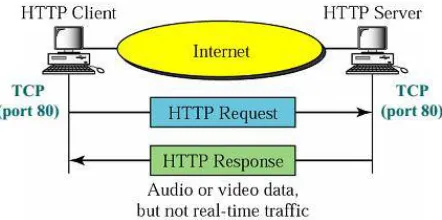
Figure 1. Non-Real Time Video Streaming (Video- on Demand)
In past decade, Real time video streaming has become one of most popular applications over Internet. All researchers have been witnessed a number of success commercial deployments with CDN or peer to-peer based engines.former achieves high availability & very short startup latencies, but suffers from excessive costs for deploy dedicated servers. It is particularly severe if user demand fluctuates significantly & servers have to be over-provisioned for peak loads. Peer-to-peer solution generally incurs lower deployment cost & is more scalable, but reliability & hence service quality could hardly be sure. There have been also efforts toward synergizing dedicated servers with peer to peer. Unfortunately, having an all-roundscalable, reliable, responsive, & cost effectiveness solution remains an elusive goal.
II. LITERATURE REVIEW
RAHATAFREEN AND S.C.MEHROTRA (2011)
This paper deals with cryptography that makes use of the public key also called as the PKC systems in short. In systems pertaining to PKC , two keys that are entirely different are utilized for encoding and decoding the data. The strength and security depends on large key size as among the two keys one is distributed and kept open to the public in PKC systems. Previously in PKC systems the mathematical problems of prime factorization and discrete logarithm are used. The security with a almost equal to the above with relatively small sizes of the key has been promised by ECC and it has been proved. The ECC implementation on application specific systems is the main point focused in the field of research. The requirement of separate crypto coprocessor can be reduced by doing a research in the category of ECC mainly related to present various combinations of speed optimized algorithms. Various mathematical techniques are considered to enhance the speed and security of ECC. [116]
Paul Kocher, Ruby Lee, Gary McGraw ,AnandRaghunathan and Srivaths Ravi (2004)
III.TOOLSANDTECHNOLOGY AUTHENTICATION ATTACKS IN CLOUD
Research studies reveal that any authentication mechanism related to web applications & cloud should provide high security, easy to use interface & support user mobility. Customers prefer to access their applications from different locations & different devices such as desktop, laptop, PDA,
smart phones, cell phones etc. Those needs pose significant requirements to security of applications. broad range of user requirements introduces wide range of attack vectors in cloud that makes security of cloud applications a thought provoking matter. Cloud service providers want to ensure that only legitimate user are accessing their services & this points out to requirement of a strong user authentication mechanism. But there exists numerous attacks that could create loop holes in authentication mechanism & hence identifying most secure authentication mechanism within high user acceptability is a big challenge in cloud environment. Thus an in-depth idea of attacks on authenticity & corresponding prevention techniques are required to draft a fool proof authentication mechanism for cloud environment.
.
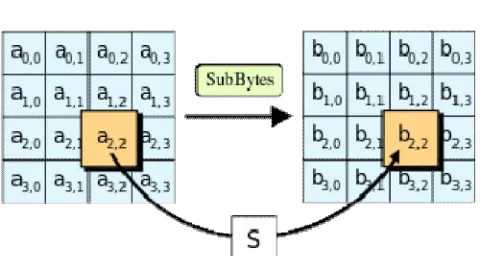
Fig 2 In SubBytes step, each byte in state is replaced with its entry in a fixed 8-bit lookup table, S; bij = S(aij).
The ShiftRows step
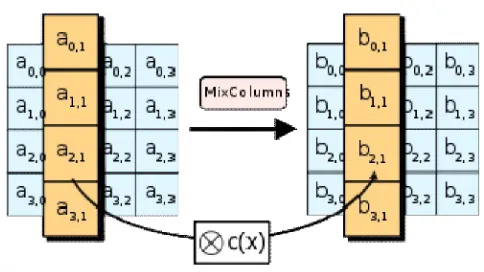
The MixColumns step
Fig 4 In MixColumns step, each column of state is multiplied with a fixed polynomial c(x).
IV.PROPOSED IMPLEMENTATION
DECIMAL ATTRIBUTE BASED ENCRYPTION IN CLOUD SERVER
Attribute-based encryption is a type of public-key encryption in which the secret key of a user and the cipher text are dependent upon attributes (e.g. the country in which he lives, or the kind of subscription he has). In such a system, the decryption of a cipher text is possible only if the set of attributes of the user key matches the attributes of the cipher text. A crucial security aspect of Attribute-Based Encryption is collusion-resistance: An adversary that holds multiple keys should only be able to access data if at least one individual key grants access.
The concept of attribute-based encryption was first proposed by AmitSahai and Brent Waters and later by VipulGoyal, OmkantPandey, AmitSahai and Brent Waters. Recently, several researchers have further proposed Attribute-based encryption with multiple authorities who jointly generate users' private keys.
Attribute-based encryption (ABE) can be used for log encryption.[11] Instead of encrypting each part of a log with the keys of all recipients, it is possible to encrypt the log only with attributes which match recipients' attributes. This primitive can also be used for broadcast encryption in order to decrease the number of keys used.
Non-efficiency and non-existence of attribute revocation mechanism. Other main challenges are:
• Key coordination • Key escrow • key revocation
Ancipher text-policy attribute based encryption scheme consists of four fundamental algorithms: Setup,Encrypt, KeyGen, and Decrypt. In addition, we allow for the option of a fifth algorithm Delegate.
Setup.
The setup algorithm takes no input other
The encryption algorithm
Takes as input the public parameters PK, a message M, and an access structure A. Over the universe of attributes. The algorithm will encrypt M and produce a cipher text CT such that only a user that possesses a Set of attributes that satisfies the access structure will be able to decrypt the message. We will assume that the cipher text implicitly contains A
Key Generation(MK,S).
The key generation algorithm takes as input the master key MK and a set of attributes S that describe the key. It outputs a private key SK.
Decrypt (PK,CT,SK).
The decryption algorithm takes as input the public parameters PK, a cipher text CT, which contains an access policy A, and a private key SK, which is a private key for a set S of attributes.
If the set S of attributes satisfies the access structure A then the algorithm will decrypt the cipher text and return a message M.
Delegate(SK,̃S).
The delegate algorithm takes as input a secret key SK for some set of attributes S and a set S⊆S . It output a secret key SK for the set of attributes.
V. IMPLEMENTATION
In order to simulate encryption& decryption of multimedia file we need following
Hardware Requirements
• CPU (1GHZ or above) • RAM( 1 GB OR MORE)
• 5GB FREE SPACE IN HARDDISK • HIGH RESOLUTION MONITOR
Data Analysis work
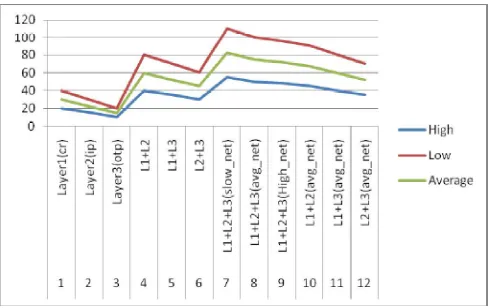
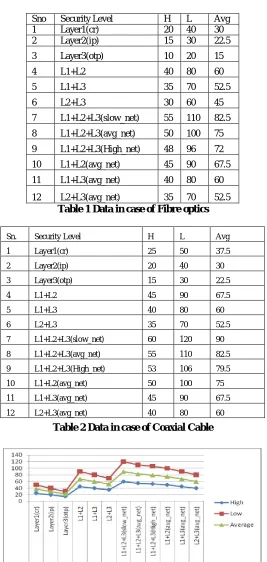
Sno Security Level H L Avg 1 Layer1(cr) 20 40 30 2 Layer2(ip) 15 30 22.5
3 Layer3(otp) 10 20 15
4 L1+L2 40 80 60
5 L1+L3 35 70 52.5
6 L2+L3 30 60 45
7 L1+L2+L3(slow_net) 55 110 82.5
8 L1+L2+L3(avg_net) 50 100 75
9 L1+L2+L3(High_net) 48 96 72
10 L1+L2(avg_net) 45 90 67.5
11 L1+L3(avg_net) 40 80 60
12 L2+L3(avg_net) 35 70 52.5
Table 1 Data in case of Fibre optics
Table 2 Data in case of Coaxial Cable
Fig 8Analysis of transmission speed of packet in
Sn. Security Level H L Avg
1 Layer1(cr) 25 50 37.5
2 Layer2(ip) 20 40 30
3 Layer3(otp) 15 30 22.5
4 L1+L2 45 90 67.5
5 L1+L3 40 80 60
6 L2+L3 35 70 52.5
7 L1+L2+L3(slow_net) 60 120 90
8 L1+L2+L3(avg_net) 55 110 82.5
9 L1+L2+L3(High_net) 53 106 79.5
10 L1+L2(avg_net) 50 100 75
11 L1+L3(avg_net) 45 90 67.5
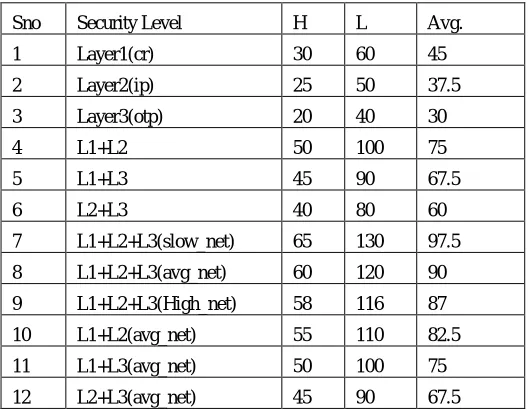
Sno Security Level H L Avg.
1 Layer1(cr) 30 60 45
2 Layer2(ip) 25 50 37.5
3 Layer3(otp) 20 40 30
4 L1+L2 50 100 75
5 L1+L3 45 90 67.5
6 L2+L3 40 80 60
7 L1+L2+L3(slow_net) 65 130 97.5
8 L1+L2+L3(avg_net) 60 120 90
9 L1+L2+L3(High_net) 58 116 87
10 L1+L2(avg_net) 55 110 82.5
11 L1+L3(avg_net) 50 100 75
12 L2+L3(avg_net) 45 90 67.5
Table 3 Data in case of Twisted Cable
Fig 9 Analysis of transmission speed of packet in case of Wireless network
VI.CONCLUSION
The main idea behind research is to integrate encryption into compression operation by parameterization of compression blocks, & (in general) not modifying compressed bits. Two main compression blocks where these techniques had been applied are Wavelet Transform & Entropy Coding.
REFERENCES
[1] Agi, I., Gong, L.: An empirical study of secure mpeg video transmissions. In: Proceedings of the Symposium on Network and Distributed
System Security, pp. 137–144. IEEE Press, New York (1996)
[2] Baugher, M., McGrew, D., Naslund, M., Carrara, E., Norrman, K.: The secure real-time trans-port protocol (SRTP) (2004)
[3] Bergeron, C., Lamy-Bergot, C.: Complaint selective encryption for h.264/avc video streams. In: IEEE 7th Workshop on Multimedia Signal
Processing, pp. 1–4 (2005). doi: 10.1109/ MMSP.2005.248641
[4] Cheng, H., Li, X.: Partial encryption of compressed images and videos. IEEE Trans. Signal Process. 48(8), 2439–2451 (2000). doi:
10.1109/78.852023
[5] Chiaraluce, F., Ciccarelli, L., Gambi, E., Pierleoni, P., Reginelli, M.: A new chaotic algorithm for video encryption. IEEE Trans. Consum.
Electron. 48(4), 838–844 (2002)
[6] Li, S., Zheng, X., Mou, X., Cai, Y.: Chaotic encryption scheme for real-time digital video. In: Real-Time Imaging VI. Proceedings of SPIE,
vol. 4666, pp. 149–160 (2002)
[7] Lian, S., Liu, Z., Ren, Z., Wang, H.: Secure advanced video coding based on selective encryp-tion algorithms. IEEE Trans. Consum.
Electron. 52(2), 621–629 (2006)
[8] Lian, S., Liu, Z., Ren, Z., Wang, H.: Commutative encryption and watermarking in video compression. IEEE Trans. Circuits Syst. Video
Technol. 17(6), 774–778 (2007)
[9] Logik Bomb: Hacker's Encyclopedia (1997)
[10] Hafner, Katie; Markoff, John (1991). Cyberpunk: Outlaws and Hackers on the Computer Frontier. New York: Simon & Schuster. ISBN
0-671-68322-5.
[11] Sterling, Bruce (1992). The Hacker Crackdown. Bantam. ISBN 0-553-08058-X.
[12] Slatalla, Michelle; Joshua Quittner (1995). Masters of Deception: The Gang That Ruled Cyberspace. HarperCollins. ISBN 0-06-017030-1.
[13] Dreyfus, Suelette (1997). Underground: Tales of Hacking, Madness and Obsession on the Electronic Frontier. Mandarin. ISBN
1-86330-595-5.
[14] Verton, Dan (2002). The Hacker Diaries : Confessions of Teenage Hackers. McGraw-Hill Osborne Media. ISBN 0-07-222364-2.
[15] Thomas, Douglas (2002). Hacker Culture. University of Minnesota Press. ISBN 0-8166-3345-2.
[16] Taylor, Paul A. (1999). Hackers: Crime in the Digital Sublime. Routledge. ISBN 978-0-415-18072-
[17] Levy, Steven (2002). Crypto: How the Code Rebels Beat the Government Saving Privacy in the Digital Age. Penguin. ISBN 0-14-024432-8.
[18] Ventre, Daniel (2009). Information Warfare. Wiley - ISTE. ISBN 978-1-84821-094-3.
[19] BhushanLalSahu,RajeshTiwari, Journal of Advanced Research in Computer Science and Software Engineering 2(9) (2012) 33-37.
[20] Peter Mell, Tim Grance (2011). The NIST Definition of Cloud Computing, the National Institute of Standards and Technology Report. 2011.
[21] Sultan Ullah, ZhengXuefeng (2013). Cloud Computing Research Challenges. IEEE 5th International Conference on Biomedical Engineering
and Informatics, pp 1397-1401.
[22] Tripathi A., Mishra A. (2011). Cloud Computing Security Considerations. Signal Processing, Communications and Computing (ICSPCC),
IEEE International Conference.