DOI: 10.1534/genetics.104.027789
Does Crossover Interference Count in
Saccharomyces cerevisiae
?
Franklin W. Stahl,*
,1Henriette M. Foss,* Lisa S. Young,* Rhona H. Borts,
†M. F. F. Abdullah
‡and Gregory P. Copenhaver
§*Institute of Molecular Biology, University of Oregon, Eugene, Oregon 97403-1229,†Department of Genetics, University of Leicester, Leicester LE1 7RH, United Kingdom,‡Department of Microbiology, Mara University of Technology, 40450 Shah Alam, Malaysia and§Department
of Biology and The Carolina Center for Genome Sciences, University of North Carolina, Chapel Hill, North Carolina 27599
Manuscript received February 19, 2004 Accepted for publication May 10, 2004
ABSTRACT
We previously proposed a “counting model” for meiotic crossover interference, in which double-strand breaks occur independently and a fixed number of noncrossovers occur between neighboring crossovers. Whereas in some organisms (group I) this simple model alone describes the crossover distribution, in other organisms (group II) an additional assumption—that some crossovers lack interference—improves the fit. Other differences exist between the groups: Group II needs double-strand breaks and some repair functions to achieve synapsis, while repair in group I generally occurs after synapsis is achieved; group II, but not group I, has recombination proteins Dmc1, Mnd1, and Hop2. Here we report experiments in
msh4mutants that are designed to test predictions of the revised model in a group II organism. Further, we interpret these experiments, the above-mentioned differences between group I and II meiosis, and other data to yield the following proposal: Group II organisms use the repair of leptotene breaks to pro-mote synapsis by generating double-Holliday-junction intermediates that lock homologs together (pairing pathway). The possible crossover or noncrossover resolution products of these structures lack interference. In contrast, for both group I and group II, repair during pachytene (disjunction pathway) is associated with interference and generates only two resolution types, whose structures suggest that the Holliday junctions of the repair intermediates are unligated. A crossover arises when such an intermediate is stabilized by a protein that prevents its default resolution to a noncrossover. The protein-binding pattern required for interference depends on clustering of sites that have received, or are normally about to receive, meiotic double-strand breaks.
A
key feature of meiosis in most organisms is crossing map) and still beguiles geneticists, microscopists, and mathematicians alike.over, the process in which homologous chromosomes
exchange segments during the repair of programmed A mathematical model that effectively describes linkage data from the X chromosome of Drosophila (McPeekand double-strand breaks (DSBs) in their DNA. The
fre-quencies of crossing over provide the basis for genetic Speed1995;Zhao et al. 1995) was put forth byCobbs (1978) andStam(1979). Their model, notable for its linkage mapping (Sturtevant1913), in which the
dis-simplicity and mathematical tractability, was foreshad-tance between genes (in morgans) is defined as the
owed by several others (reviewed inBailey 1961). It average number of points of crossing over in the interval
describes the probability distribution for the linkage that separates the genes (Haldane1919).Sturtevant
distances (in morgans) between adjacent crossovers as (1915) andMuller(1916) noted that crossovers
occur-a scoccur-aled chi-squoccur-are proboccur-ability distribution with occur-an even ring duringDrosophila melanogasteroogenesis show a kind
number of degrees of freedom. Such a distribution of territoriality—a relatively equitable, nonrandom
dis-gained biological appeal from the suggestion that cross-tribution—among and within chromosomes. This
prop-overs may be portrayed as successful outcomes of inde-erty, which they called “interference,” is a widespread
pendently distributed attempts to cross over, and that phenomenon, which may have been selected for its
abil-adjacent crossovers are separated by a fixed number of ity to encourage at least one crossover on each
chromo-failed outcomes. However, in the absence of an ex-some, without undue increase in the mean number of
pressed view of what the “attempts” or “failures” might crossovers. Interference can act over great distances
be, the model languished untilFosset al. (1993), elabo-(e.g., about half the length of the Drosophila X linkage
rating a suggestion by Mortimer and Fogel (1974), proposed that the products of all programmed meiotic DSB repair (DSBR)—observable as gene conversions 1Corresponding author:Institute of Molecular Biology, 1370 Franklin
(see Malkova et al. 2004, accompanying article, this
Blvd., 1229 University of Oregon, Eugene, OR 97403-1229.
E-mail: [email protected] issue)—represent crossoverattemptsand that the gene
conversions unaccompanied by crossing over represent the failures.
Evidence that attempts are, indeed, distributed inde-pendently (i.e., at random with respect to each other) is provided forNeurospora crassabyStadler(1959) and for (budding) yeast by Mortimer and Fogel (1974) and Malkova et al. (2004). The most direct test of independence would be a demonstration that conver-sions (crossovers plus noncrossovers) manifest no inter-ference with each other, either positive or negative. The practical difficulty of obtaining adequate data for such a test restricted those authors to asking whether
conver-Figure1.—Bisected chromosome I (afterKabacket al. 1999).
sions unaccompanied by crossing over (failed attempts)
Chromosome I (black) was bisected byKabacket al. (1992).
repress nearby crossovers, as do conversions that are
TheURAmarker on the shorter derivative (gray), cloned on
accompanied by crossing over. They did not. a plasmid with two telomeres, a centromere, and a segment A major implication of this “counting model” is that of chromosome I located to the right ofTRP, facilitated selec-the number of noncrossover gene conversions postu- tion of the bisection strain.
lated to lie between adjacent crossovers may be deter-mined experimentally as well as theoretically, and that
humans (HousworthandStahl2003) andArabidopsis
the two measurements should yield comparable values
thaliana (Copenhaveret al.2002) too, the good fit of (Foss et al. 1993). To test this prediction, published
the counting model is improved if a fraction of meiotic interference data collected from Drosophila and
Neu-crossovers is assumed to lack interference. In contrast, rospora were subjected to a best-fit analysis of the
count-the same analysis applied to data from Drosophila and ing model (McPeekandSpeed1995) to determine the
Neurospora suggests that all crossovers in these orga-number of failures between adjacent “successes.” Foss
nisms show interference (Copenhaveret al.2002).
Be-et al. (1993) compared these numbers with the
experi-low, we offer a context for these observations. mentally observed fraction of noncrossovers among
gene conversions. For Drosophila, the observed fraction of noncrossovers is close to 0.80, as determined in a
MATERIALS AND METHODS
Herculean analysis at one locus (Hillikerand
Chov-nick1981;Hillikeret al. 1991). For Neurospora, the Strains: Haploid S. cerevisiae strains carrying genetically
marked, bisected (JL51) and full-length (JL52) versions of
chro-observed fraction of noncrossovers is close to 0.67, based
mosome I, diagrammed in Figure 1, are described byKaback
on the average of numerous observations (Perkinset al.
et al. (1999). JL51 strains areMAT␣[FUN43-CEN1-URA3]fun43::
1993). As predicted, both values are in agreement with
TRP1 his3 leu2 ura3 trp1 arg4,MATa[FUN43-CEN1-URA3]YAL067 the optimal fits to the interference data determined by HIS3 cdc24 fun30::LEU2 ade1 trp1 ura3 his3 arg4 leu2; JL52 strains McPeek andSpeed (1995), who calculate the number areMAT␣fun43::TRP1 his3 leu2 ura3 trp1 arg4,MATaYAL067:: HIS3 cdc24 fun30::LEU2 ade1 trp1 ura3 his3 arg4 leu2
(mating-of obligate failures between adjacent crossovers to be
type designations were reversed in the original article; D.Kaback,
four for Drosophila and two for Neurospora.
personal communication). In both JL51 haploids the 60-kb
The success with which the counting model describes
(light gray) derivative of chromosome I carries aURA3gene
interference in Drosophila and Neurospora inspired that is not present in the 231-kb full-length chromosome FossandStahl(1995) to test another powerful predic- I-containing JL52 haploids. To avoid possible complications
resulting from differences in uracil auxotrophy, we
trans-tion of the model–that, relative to the general
popula-formed both JL52 strains fromura3 toURA3 with a 1.1-kb
tion, progeny with two close crossovers should show an
SmaI fragment from pJJ242 (Jones and Prakash 1990) to
enhanced frequency of gene conversion
unaccompa-yield JL53 haploids. Results obtained with JL52 and JL53
dip-nied by crossing over in the interval between the two loids were statistically indistinguishable and were pooled. crossovers. Testing the prediction in the only organism Strains precisely deleted for theMSH4ORF were made with
theloxP-kanMX-loxPdisruption cassette followed by excision
in which such an experiment was feasible,Saccharomyces
of thekanMXmodule by induction of the Cre recombinase
cerevisiae, they obtained an unambiguously negative
re-from plasmid pSH47 (Gu¨ ldeneret al. 1996). Oligonucleotides
sult and concluded that the counting model was either
used to effectMSH4deletion were 5⬘-AGTTATAGCATTGAAA
wrong or not applicable to yeast. TCTGTAGCTGATCAACGCAAACTATATGCATCGACAACC
The companion article to this work (Malkovaet al. CTTAATATAACTTCG-3⬘and 5⬘-CAGAAATAATGGATTATA
GTTTTAAGCTAAGCGGAAAAGCCAAAATCACCTAATAAC
2004), however, supports a third possibility—that
inter-TTCGTATAGC-3⬘.
ference in wild-type yeast, while approximating the rules
TheMSH4-targetedloxP-kanMX-loxPdisruption cassette
described by McPeek andSpeed (1995), is better
de-was generated by polymerase chain reaction (PCR) using the
TABLE 1
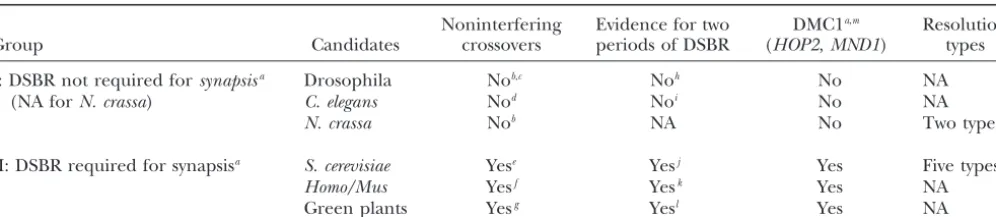
Two groups of eukaryotes
Noninterfering Evidence for two DMC1a,m Resolution
Group Candidates crossovers periods of DSBR (HOP2,MND1) types
I: DSBR not required forsynapsisa Drosophila Nob,c Noh No NA
(NA forN. crassa) C. elegans Nod Noi No NA
N. crassa Nob NA No Two typesn
II: DSBR required for synapsisa S. cerevisiae Yese Yesj Yes Five typeso
Homo/Mus Yesf Yesk Yes NA
Green plants Yesg Yesl Yes NA
NA, data not available.
aReviewed inCopenhaveret al. (2002). bFosset al. (1993);Copenhaveret al. (2002). cZhaoet al. (1995).
dMeneelyet al. (2002). eMalkovaet al.(2004).
fHousworthandStahl(2003).
gFor Arabidopsis,Copenhaveret al.(2002).
hJanget al. (2003);PageandHawley (2001);Liuet al. (2002). iA.Villeneuve(personal communication).
jXuet al.(1997) and see text. kMoenset al. (2002).
lFor Lilium,Terasawaet al. (1995).
mTakanamiet al. (2000);Gerton and DeRisi (2002);Borkovich et al. (2004); http://www.informatics.jax.org/mgihome/ MGD/aboutMGD.shtml; http://www.yeastgenome.org/; http://fly.ebi.ac.uk:7081/; http://www.arabidopsis.org/home.html; http:// www.broad.mit.edu/annotation/fungi/neurospora/; http://www.sanger.ac.uk/Projects/C_elegans/.
nStadlerandTowe (1963). oe.g.,Fosset al. (1999).
kanMX-loxPusing standard PCR: 5⬘-GTTTTGGTATGGGATGA distance changes. For data that approximate the chi-square distribution, them-value, calculated from the frequencies of CATTGTTTTACGTAG-3⬘(472 bp upstream of theMSH4ORF)
and 5⬘-TCTCAAGGTGATTTGGAGGCAGACG-3⬘(896 bp down- tetrad types, increases with increasing interference and is inde-pendent of map distance.
stream of theMSH4ORF).
Media, diploid construction, sporulation, and tetrad analy-sis:Media used were as described inMcCuskerandHaber
(1988). To reduce the tendency of the 60-kb portion of bi- RESULTS AND DISCUSSION sected chromosome I to undergo duplication, it proved
neces-sary to avoid applying selection forTRP1orHIS3when con- Two groups of eukaryotes: Some eukaryotes are structing the diploids. Thus, diploids were generated by known to depend on some meiotic DSBR functions for micromanipulating appropriate haploids together, allowing
intimate pairing and synapsis, as well as for proper
dis-colonies to grow up, and screening for nonmaters. All
subse-junction of homologous chromosomes (for reviews see
quent manipulations were at 25⬚, except for detection of the
Kleckner 1996; Roeder 1997; Zalevsky et al. 1999; CDC24allele, which was at 37⬚. Sporulation was induced on
plates at 25⬚ (Malkovaet al. 2004). Analysis of tetrad data Walker and Hawley 2000; Copenhaver et al. 2002; was facilitated by MacTetrad 6.9.1, available by Gopher from Vieraet al.2004). Other eukaryotes, including Drosoph-merlot.welcj.jhu.edu. Statistical analyses were carried out with
ila andCaenorhabditis elegans, achieve synapsis via cis
-act-the advice of Russell Lande. Online calculators are available
ing “homolog recognition centers” or “pairing centers”
at the Stahl Lab web site: http://groik.com/stahl/.
(Villeneuve1994;Dernburget al.1998;McKimet al.
Estimation of interference:The chi-square probability
distri-bution, or its gamma variation, has been shown to provide a 1998;PageandHawley2001;Liuet al.2002).
Eukary-good description of interference in a variety of organisms (e.g., otes requiring DSBR functions for synapsis share a set
Fosset al. 1993;LandeandStahl1993;McPeekandSpeed of additional meiotic features, including the prediction
1995;BromanandWeber2000). The chi-square distribution
of noninterfering crossovers (Table 1). Thus, it is
eco-is fully determined by the value of a single parameter, which
nomical to hypothesize (1) that, together, these features
Fosset al. (1993) calledm. Whenm⫽0, the chi-square
distribu-tion is exponential (i.e., no interference).m-values were deter- characterize a process that potentiates synapsis and (2)
mined from tetrad data as described inStahl and Lande that noninterfering crossovers are a (by)product of this
(1995) with the aid of the online calculator at http://www. process. molbio.uoregon.edu/%7Egraham/tetrad.html.
Additional evidence for the existence of
noninterfer-A widely used measure of interference in two-factor tetrad
ing crossovers in wild-typeS. cerevisiae:Zalevskyet al.
data, the “NPD ratio” (Papazian1952), measures aconsequence
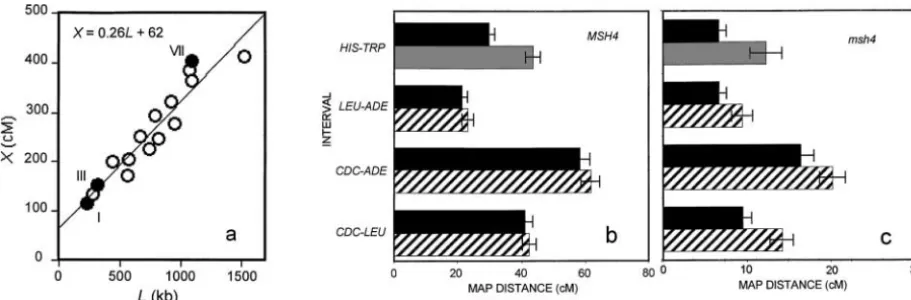
Figure2.—Relationships among chromosome length, crossover density, andmsh4phenotype. (a) Chromosome length in centi-morgans as a function of length in kilobases with the least-squares regression of the data forS.cerevisiae. They-axis intercept is above zero, indicating that crossover density is higher on short than on long chromosomes. Data are from Saccharomyces Ge-nome Database: http://db.yeastgeGe-nome.org/cgi-bin/SGD/PGMAP/pgMap. Data for chromosomes of special interest in this ar-ticle are indicated by solid points. (b) Bisection of chromosome I into a longer and a shorter derivative (see Figure 1) confirms the observation ofKabacket al.(1992) that, inMSH4(wild-type) cells, a defined interval is genetically longer when it resides on a shorter chromosome. For theHIS3-TRP1interval on the shorter derivative (60 kb), the increase in map length resulting from the bisection is significant. (c) Deletion ofMSH4(which abolishes interference and reduces the map length of all intervals) en-hances, rather than eliminates, the influence of chromosome length on crossover density. The relatively greater influence of chromosome length on the density of crossovers in themsh4mutant (significant for all intervals tested) suggests that chromosome-length dependence is a feature of the Msh4-independent crossovers. Solid bar, full-chromosome-length chromosome (231 kb); shaded bar, shorter derivative (60 kb); hatched bar, longer derivative (180 kb). Figure 2, b and c, is based on the tetrad data tabulated in Table 2.
not inC. elegans, DSBR functions aiding in the establish- affecting the frequency of gene conversion.Storlazzi
et al. (1996, p. 9047) proposed that all crossovers in ment of synapsis yield noninterfering crossovers. These
workers called attention to mutant phenotypes of the wild-type yeast are subject to interference and that in a
zip1 mutant “precrossover intermediates lacking their meiosis-specificHIM-14gene inC. elegansand those of
its S. cerevisiae homolog, MSH4. In both yeast and C. special promoting factors mature aberrantly and also, via randomization at the resolution stage, into both
elegans,msh4/him-14mutations reduce crossing over,
ap-parently without affecting the formation or final level crossovers and noncrossovers.” Although the model of Storlazziet al. accounts for the observed residual cross-of repair cross-of DSBs (Ross-MacdonaldandRoeder1994;
Novaket al. 2001;Colaia´covoet al.2003). InC. elegans, overs and their lack of interference, it does not predict the difference between the mutant phenotypes ofmsh4
however,him-14 mutations completely eliminate
cross-ing over, whilemsh4mutations in yeast allow a conspicu- in yeast and those ofhim-14inC. elegans.
The presence of noninterfering crossovers could ac-ous residuum of crossovers, and these crossovers lack
interference. One interpretation of these data is that count for a phenomenon described byZhaoet al. (1995). These workers demonstrated that the strength of inter-yeast, but not C. elegans, has a pathway of DSBR that
promotes homolog pairing and produces noninterfer- ference in wild-type yeast varies significantly among dif-ferent parts of the genome. We suggest that the weaker ing crossovers (and noncrossovers). Intermediates in
this pathway do not depend on Msh4 for crossover reso- interference in some genomic regions simply reflects a relatively higher density of noninterfering crossovers in lution, although Msh4 may aid in stabilizing the
inter-mediate during its formation as suggested (to us) by these regions. Conversely, regions of stronger interfer-ence would signal a relatively higher concentration of the delayed synapsis observed inmsh4mutants (Novak
et al. 2001; see also Moenset al. 2002; Santucci-Dar- interfering crossovers. Since crossover interference is strictly dependent on genes in the MSH4-MSH5-ZIP1
manin et al. 2000; reviewed in Hoffman and Borts
2004). epistasis group, this hypothesis predicts that mutations
in these genes should cause a greater reduction in cross-An alternative hypothesis, proposed by Storlazzi
et al. (1996; and seeSymandRoeder1994), was based ing over in genomic segments with normally strong in-terference than in segments with weak inin-terference in on mutant phenotypes of ZIP1, a member of the yeast
epistasis group that includesMSH4and, presumably, its wild-type yeast. Several sets of data indicate that this is, indeed, the case (SymandRoeder 1994;Novaket al. partnerMSH5(Novaket al. 2001).ZIP1is responsible
for making the transverse elements of the synaptonemal 2001; Figure 3). The hypothesis that the lack of interfer-ence inmsh4orzip1mutants was created by the relevant complex, and zip1 mutations, like msh4 mutations,
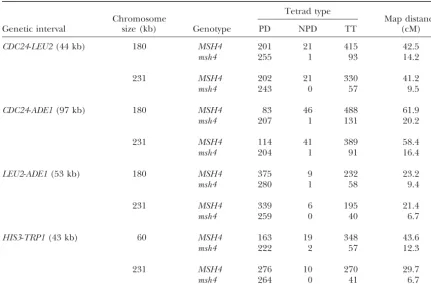
TABLE 2
Tetrad data for Figure 2, b and c
Tetrad type
Chromosome Map distance
Genetic interval size (kb) Genotype PD NPD TT (cM)
CDC24-LEU2(44 kb) 180 MSH4 201 21 415 42.5
msh4 255 1 93 14.2
231 MSH4 202 21 330 41.2
msh4 243 0 57 9.5
CDC24-ADE1(97 kb) 180 MSH4 83 46 488 61.9
msh4 207 1 131 20.2
231 MSH4 114 41 389 58.4
msh4 204 1 91 16.4
LEU2-ADE1(53 kb) 180 MSH4 375 9 232 23.2
msh4 280 1 58 9.4
231 MSH4 339 6 195 21.4
msh4 259 0 40 6.7
HIS3-TRP1(43 kb) 60 MSH4 163 19 348 43.6
msh4 222 2 57 12.3
231 MSH4 276 10 270 29.7
msh4 264 0 41 6.7
regarding the relationship between the density of Msh4- intervals examined showed a greater crossover density on the shorter chromosomes. The increase was signifi-dependent crossovers and strength of interference.
Another phenomenon, illuminated by Kabacket al. cant for theHIS3-TRP1interval on the shorter derivative of chromosome I (Figure 2b). However, instead of abol-(1999), may also be explained by the presence of
nonin-terfering crossovers. These workers started with the ob- ishing the chromosome-length dependence of crossover density observed in wild-type strains, themsh4defect ap-servation that, in yeast, the shorter chromosomes have
a higher crossover density than the longer ones (Fig- peared to significantlyenhancethe length dependence in each case (Figure 2, b and c, and Table 2).
ure 2a) and demonstrated that chromosome lengthper se
affects both crossover density and interference. Specifi- Only tetrads with four viable spores were used for the data presented in Figure 2. Such tetrads constituted 72% cally, they showed that, within a defined chromosome
segment, crossover density is higher, and interference of the total in theMSH4diploid, but only 11–13% in themsh4diploid. To guard against the possibility that weaker, when that segment is embedded in a short
chro-mosome than when it resides in a long chrochro-mosome. this small subclass misrepresented the totalmsh4tetrad population, we measured the effect of chromosome Kaback et al.(1999) hypothesized that longer
chro-mosomes are more susceptible to interference, and that length on crossover density in MSH4andmsh4tetrads with fewer than four viable spores and in MSH4 and interference suppresses crossover density. This
interpre-tation predicts that the elimination of interference,e.g., msh4 tetrads with four viable spores. The fraction of tetrads with at least one spore recombinant forHIS3and via deletion of MSH4, should remove the differential
crossover suppression and, hence, abolish the chromo- TRP1was used as a relative measure of recombination activity. In each case, deletion of MSH4 resulted in a some-length dependence of crossover density. We tested
this prediction. Using strains generously provided by relative increase in the observed chromosome length dependence of such activity (data not shown), arguing D. Kaback, we examined four intervals (one of which
is the sum of two smaller, adjacent intervals) embedded that the poor spore viability of themsh4diploid did not affect our results. Together, our results argue against the in full-length chromosome I (ⵑ231 kb) and in shorter
derivatives of chromosome I (60 and 180 kb), created by notion that suppression of crossing over by interference accounts for the lower density of crossing over on longer bisection (Figure 1;materials and methods). Crossover
densities for each interval were measured inMSH4and chromosomes.
On the other hand, the notion that yeast has two kinds
As proposed by the authors, these results suggest that there are crossovers of (at least) two types: those that depend on Msh4-Msh5 and exhibit interference and those that depend on Mms4-Mus81, lack interference, and occur at a higher density on shorter chromosomes. The data described above argue that the overall distri-bution of crossovers may be expressed as X ⫽ aL ⫹ b, where Xequals map length (in morgans), Lequals chromosome length (in base pairs),aLrepresents the component of crossovers (hypothesized to be interfer-ing) whose number increases with chromosome length, andbrepresents the crossovers (hypothesized to be non-interfering) whose number per chromosome is insen-sitive to chromosome length. Figure 2a estimates b at 62 cM and implies that the fractions of length-insensitive crossovers on chromosomes VII and III are 0.16 and
Figure 3.—Relationships among interference,
chromo-0.43, respectively. These values are compatible with the
some length, andmsh4phenotype. Two intervals in the
rela-tively short (320 kb) chromosome III and two in the longer independently derived averages of 0.21 and 0.48
(Fig-(1100 kb) chromosome VII (Figure 2a) were characterized ure 3) for the fractions of Msh4-independent (hence, with respect to map length and interference inMSH4 and
noninterfering) crossovers on chromosomes VII and msh4meioses. The fraction of crossovers that were Msh4
de-III, respectively. Presumably, the frequencies of
Mms4-pendent was greater for the intervals in the longer
chromo-dependent crossovers reported byde los Santoset al.
some, in which interference, measured asm, was stronger. In
the absence of interference,m⫽0 (materials and meth- (2003) also represent the frequencies of
Msh4-indepen-ods). Data are fromAbdullahet al. (2004) with additional dent crossovers. Their values were 0.11 and 0.34 for VII unpublished data from E.Philpott, M. F. F.Abdullahand
and III, respectively. Moreover, a fourth independent
R. H.Borts.
method of analysis, described in the companion article (Malkovaet al. 2004), yields values of 0.08–0.12 as the fraction of noninterfering crossovers on chromosome of crossovers can readily account for the results
pre-sented above. The data suggest that one kind of cross- VII. These numbers, arrived at by very different routes, are compatible with the hypothesis that wild-typeS.
cere-over occurs at a roughly fixed number per kilobase,
whereas the other occurs at a roughly fixed number per visiae meioses generate two populations of crossovers, one of which occurs independently of Msh4, lacks inter-chromosome. The latter kind would cause the shorter
chromosomes to have a relatively higher density of cross- ference, and is distributed at a roughly constant number per chromosome.
overs. The enhanced chromosome-length dependence
of crossover density apparent in themsh4mutants also For humans, as for Arabidopsis (Copenhaver et al. 2002) and for the yeast chromosome analyzed by Mal-argues that this length dependence is a feature
primar-ily of the Msh4-independent crossovers, i.e., the non- kovaet al.(2004), the frequency distributions of inter-crossover distances were significantly better described interfering crossovers. Thus, the longer chromosomes,
with their relatively higher proportion of interfering when crossovers assumed to be free of the interference were added to the chi-square distribution (Housworth (Msh4-dependent) crossovers, would suffer a relatively
greater reduction in crossing over from loss of Msh4 andStahl2003). Most of the exceptional chromosomes (i.e., those for which the fit of the data was not improved than would shorter chromosomes. We tested this
predic-tion by analyzing linkage data from two intervals on a by assuming a fraction of noninterfering crossovers) in the human and Arabidopsis data sets share an architec-long chromosome (VII) and two intervals on a short one
(III) in bothMSH4andmsh4backgrounds. The intervals tural feature: the presence of large rDNA arrays, which are thought to aid pairing and synapsis of homologous on the long chromosome proved to have stronger
inter-ference than those on the short one, and, as predicted, chromosomes (Copenhaveret al. 2002). This feature may allow these exceptional chromosomes to achieve themsh4mutations eliminated interference in each case
and removed relatively more crossovers from the longer synapsis with a minimum of DSBR. It is not obvious that chromosome I has a synapsis-promoting feature that than from the shorter chromosome (Figure 3).
These results are supported by studies implicating could account for our observation that the implied value ofⵑ0.30 Msh4-independent crossovers falls short of the the Mus81-Mms4 endonuclease in the regulation of the
Msh4-Msh5-independent crossovers.de los Santoset al. ⵑ0.56 predicted by the data shown in Figure 2a (but seeClustered intermediates, below).
(2003) report thatmms4mutations reduce or eliminate
a subset of crossovers, especially those on the shorter As with yeast, the best estimates for the frequencies of the interference-free crossovers in humans, which dif-chromosomes. Unlike the crossovers remaining in
Figure4.—Double-strand-break re-pair pathways. We propose that DSBs occurring in the pairing pathway give rise to noncrossovers (h and i) and noninterfering crossovers (f and g) via the cutting of fully ligated double Holliday junctions of joint-molecule intermediates (e). These breaks could also give rise to noncrossovers of type j via helicase-dependent unwinding of either ligated (e) or as yet unligated (d) intermediates. DSBR in the dis-junction pathay involves only joint-molecule intermediates with unli-gated Holliday junctions that are ei-ther unwound, to form noncross-overs ( j), or cut, to form interfering crossovers (f). Lowercase alphabetic designations of resolution products are afterHillersandStahl(1999). Uppercase designations indicate the implied mode of resolution of the in-termediates. U indicates unwinding (with or without the aid of a topoisomerase), as deduced from the presence of a heteroduplex on only one of the participating duplexes. The letters S or N (ordered from left to right) refer to the mode of resolvase cutting at the left and right junctions, respectively. S, cutting of the strand that has newlysynthesized DNA at the junction and/or the co-polar strand; N, cutting of the pair of co-polar strands that includesno newly synthesized DNA at the junction. Additional repair products (not shown) that could have resulted from “synthesis-dependent strand annealing” or “single-end invasion” are discussed in Paques and
Haber(1999) andHunterandKleckner(2001), respectively.
for b obtained by fitting the data for each sex to the both the early and middle stages of meiotic prophase,” with the implication that its role at both stages was relationshipX⫽aL⫹b. Such agreement supports the
view that interference-free crossovers occur at an aver- to make DSBs. The observation by Romanienko and Camerini-Otero(2000) that Spo11 is localized on pa-age number per chromosome that is independent of
chro-mosome length (L). As mentioned above, similar analyses chytene chromosomes supports the view that it has a role, although the authors, in the absence of evidence, applied to Drosophila and Neurospora do not indicate
a class of noninterfering crossovers for these organisms. eschewed the possibility that the pachytene role of Spo11 is to make DSBs. In a different interpretation of Together, the data support the idea that noninterfering
crossovers are unique to creatures that need DSBR func- a similar experiment, Liu et al. (2002), working with the Drosophila protein MEI-P22 (which they demon-tions to achieve synapsis,i.e., group II organisms.
Two periods of DSBR:In group I organisms such as strated to be required for meiotic DSB formation), took the appearance of MEI-P22 foci on synapsed chromo-Drosophila andC. elegans, evidence of repair of meiotic
DSBs is seen primarily in pachytene cells,i.e., those in somes as evidence that, in flies, DSBs are formed after synapsis. The appearance of␥-H2AX, indicative of DSBs, which synapsis of homologous chromosomes is
com-plete (Page and Hawley 2001; Liu et al. 2002; Jang only in the pachytene stage of Drosophila supports that conclusion (Janget al.2003; and seeVieraet al. 2004).
et al. 2003;Colaia´covoet al.2003). In contrast, group
II organisms depend on DSBR functions to establish Whether or not group II organisms produce DSBs at pachytene, observations made on non-yeast group II synapsis. During leptotene these organisms enjoy
pro-grammed DSBs, the repair of which may have reached organisms suggest that they, like those of group I, en-gage in a round of DSBR during pachytene.Hottaand the stage of “double Holliday junctions” (Figure 4e)
before pachytene (reviewed inZicklerandKleckner Stern(1971) used DNA-DNA hybridization, density la-bel substitutions, and sensitivity of DNA synthesis to 1998) or not (HunterandKleckner2001).
Reports (Atchesonet al. 1987;Chuet al. 1998) that hydroxyurea to demonstrate that “repair synthesis” oc-curs during pachytene in meioses of lily. Other workers the yeast transcript ofSPO11, a gene conserved among
eukaryotes and required for DSB formation, reaches used microscopy to detect the presence of labeled pro-teins involved in early stages of meiotic DSBR (e.g., the its highest level in pachytene lends credibility to the
possibility of a round of DSBs at that stage. As in yeast, strand-exchange proteins Rad51 and/or Dmc1). These proteins may appear as “foci” or “painted regions” on
SPO11 transcription in mouse occurs from leptotene
through pachytene with its maximum level in pachytene independently labeled chromosomes, indicating the oc-currence of DSBR (seeRoeder1997 for review). Such (Shannon et al. 1999). This led Shannonet al. (1999,
mouse (Ikeyaet al. 1996) meioses indicate that foci of have the joint-molecule structure diagrammed in Figure 4e. In meioses of “SK1” strains ofS. cerevisiae,dmc1 mu-labeled Rad51 and Dmc1 localize to the chromatin loops
during leptotene/zygotene, while Rad51, but not Dmc1, tants fail to form these double-Holliday-junction inter-mediates, except under special circumstances discussed appears to paint the chromosome cores during
pachy-tene. below (Schwacha and Kleckner 1997; Hunterand
Kleckner2001). Instead, thesedmc1mutants accumu-Using similar methods,Moenset al.(2002) provided
additional evidence for two periods of DSBR in mouse. late unrepaired DSBs, and their progress through meio-sis is arrested.
These authors showed that the sites of DSBR initiated
in leptotene did not coincide, in time or space, with a “BR” strains of yeast have also been used to examine
dmc1 phenotypes. In these strains the dmc1 mutations second set of DSBR sites that acquired (during
pachy-tene) foci of Mlh1, a protein required for crossing over allow significant DSBR and recombination. Rockmill
et al. (1995) demonstrated that BR dmc1 (and rad51) in mouse.
Working with yeast,ByersandGoetsch(1982) and mutants are deficient in chromosome pairing as mea-sured by fluorescence in situ hybridization (FISH). DavidowandByers(1984) used temperature elevation
to prolong pachytene and then returned the cells to Moreover, electron micrographs of silver-stained dmc1 zip1 chromosomes failed to show “axial associations,” permissive temperatures to allow sporulation and
ge-netic analysis. The authors reported that longer times the intimate connections between homologous chromo-somes visible inzip1single mutants. Thus, in group II, spent in temperature-induced pachytene arrest resulted
in higher levels of recombination and suggested that presynaptic pairing and subsequent progress through meiosis are normally dependent on Dmc1-mediated this phenomenon represents an extension of normal
events, rather than a temperature-induced novel pro- DSBR.
Two conditions, identified bySchwachaand Kleck-cess. Together, the data suggest that group II organisms
resemble Drosophila and C. elegans in undergoing a ner(1997), allowdmc1yeast mutants to undergo DSBR and form joint-molecule intermediates: (1) the absence round of DSBR (and DSBs?) during pachytene
(dis-junction pathway), but that group II organisms are of the meiosis-specific protein Red1 (and, perhaps, other members of the RED1 epistasis group) and (2)—possi-unique in also undergoing a round of presynaptic DSBR
(pairing pathway). We predict that only those crossovers bly a special case of (1)—the return of meiotic cells to growth in rich medium. The following section includes that are derived from the disjunction pathway exhibit
interference. a proposal for the significance of these observations.
Issues of special concern to group II:The transition Dmc1p appears to be a group II-specific protein:The
hypothesis summarized in Table 1 correlates presynap- from mitosis to meiosis includes a change in repair templates used for homology-based DSBR—sister chro-tic DSBR with a special set of proteins that include Dmc1
and Mnd1. These meiosis-specific proteins have been matids are the preferred templates in mitosis, whereas homologs serve predominantly as templates in meiosis. identified in protists, several yeasts, Arabidopsis, mice,
and humans; in Drosophila and C. elegans (Takanami In yeast, and possibly all group II organisms, DSBs follow promptly upon chromosome replication, at which time
et al. 2000; Gerton and DeRisi 2002; Rinaldo et al.
2002) and in Neurospora (Borkovichet al. 2004) they homologs are unpaired. In due course, homologous chromosomes realign themselves in a process that is were looked for but not found. Mnd1’s meiosis-specific
partner, Hop2, which appears to form a complex with independent of DSB formation or repair (reviewed in Burgesset al. 1999). Until then, however, homologous Mnd1 (TsubouchiandRoeder2002), is another
candi-date for a protein that occurs uniquely in group II organ- sequences on sister chromatids (acting as in mitosis) or in nonallelic (ectopic) positions could be serious isms. Only the strand-exchange protein Dmc1, however,
has been studied widely enough to inspire a hypothesis competitors to allelic homologies as templates for DSBR (Goldman andLichten 2000; Walker and Hawley as to its function in promoting synapsis. Dmc1 (Lim15
in lily) and its relative Rad51 are eukaryotic homologs 2000). Thus, since synapsis depends on allelic inter-homolog interactions, it would appear to be important of the bacterial protein RecA, which catalyzes
homology-dependent exchange between DNA segments (West that group II organisms, especially, have a mechanism for avoiding DSBR until the homologs are the primary 1992). While Rad51 functions in both vegetative and
meiotic cells of all eukaryotes examined, Dmc1 is meio- candidates for repair template. In pursuit of that possi-bility, we ask whether extant data in yeast are subject sis specific and appears to be limited to group II
organ-isms (seeCopenhaveret al. 2002 for review). to an interpretation that might solve that problem. In doing so, we do not claim that our interpretation is The phenotypes ofdmc1 mutants inS. cerevisiaeand
other group II organisms suggest that Dmc1 promotes driven by the data, and we recognize that others will interpret these data differently.
synapsis by allowing early DSBs to be processed into
intermediates that topologically bind homologous chro- Some phenotypes of mutants in the yeast RED1-MEK1-HOP1 epistasis group suggest that these genes play a matids together. Such intermediates were isolated by
DSBR is readily discernible indmc1mutants, which nor- Merkeret al.2003). Below, we discuss these “noncanon-ical” features and the mechanism for crossover interfer-mally arrest in meiotic prophase with an accumulation
of unrepaired DSBs (SchwachaandKleckner1997). ence suggested by their presence.
An early hint of noncanonical DSBR comes from an The absence of Red1 allowsdmc1mutants to repair their
DSBs and progress through meiosis (Schwacha and analysis byStadlerandTowe(1963) of the four hap-loid products from individual acts of meiosis in Neuro-Kleckner1997;Xuet al. 1997). In aDMC1background,
too, Red1 may delay DSBR as suggested by the RED1- spora. If we grant the order of markers proposed by the authors, their data are simply interpreted as indicative of dependent preference for DSBR involving the
homo-log as opposed to the sister chromatid (Schwachaand only two resolution types—essentially all of the crossover resolutions that could be typed were of type f, and none Kleckner1997).
Of course, even in RED1cells, the early DSBs need of the noncrossovers showed any sign of reciprocal trans-fer of markers between the participating chromosomes to be repaired in due time. The mutantred1anddmc1
phenotypes suggest that the accumulation of the meio- (as in h’s or i). Instead, all appeared to be of type j, as if the two participants in the intermediate had simply sis-specific protein Dmc1 is required for alleviating the
postulated Red1-induced block to DSBR. Presumably, slid apart from each other (Figure 5; h’s would not have been detected in this study because the markers by the time Dmc1 has accumulated sufficiently to
over-come the block to repair, the homologs will be closely monitoring the conversion were only on the right side of the DSB; their absence is inferred from the absence aligned so that interhomolog, rather than intersister or
ectopic, interactions are predominant. In the context of i’s with which they share molecular symmetry). The notion that participants can slide apart suggests of Table 1, the dependence on Dmc1 of timely DSBR
implies that the Dmc1-facilitated joint-molecule inter- that the Holliday junctions, instead of being fully formed as in the canonical model (Figure 4e), have mediates (Figure 4e) yield noninterfering crossovers.
Suppression of the recombination phenotype indmc1 failed to execute the final, ligation, step. Such a failure would mean that the participants are not topologically mutants by overexpression of Rad51 (Tsubouchi and
Roeder2003) or Rad54 (Shinohara et al. 2003) sug- locked together (Figure 4d) and so could be separated without the involvement of either a topoisomerase or a gests that the mechanism by which Dmc1 overcomes
the Red1-imposed barrier is to empower strand invasion junction-cutting “resolvase.” If, however, the bimolecu-lar intermediate were stabilized so as to prevent its mem-by Rad51 with the help of Rad54.
Ligated and unligated DSBR intermediates?The “ca- bers from sliding apart, it would become a substrate for a junction-cutting resolvase. As elaborated below, a nonical” DSBR model (Szostaket al. 1983, as modified
bySunet al. 1991) has served as a useful basis for studies feature that appears typical of resolvases clarifies how the concept of nonligation of the bimolecular interme-of meiotic recombination. Molecular and genetic
stud-ies of yeast meiosis have provided evidence in support diate can account for the possible absence in Neuro-spora (and paucity in yeast) of three out of the four of the major features of the model: (1) DSBs, (2) 5⬘-3⬘
resection of the broken DNA ends, (3) the bimolecular, canonical resolution types and suggests a mechanism for interference.
ligated intermediate (Figure 4e), and (4) the predicted
resolution products (Figure 4, f, g, h, and i) (Sunet al. When presented,in vitro, with a fully ligated Holliday junction, the most thoroughly characterized resolvases, 1989, 1991;SchwachaandKleckner1995;
Gilbert-son and Stahl 1996; Hillers and Stahl 1999; for RuvC from Escherichia coli and endonuclease VII from phage T4, are equally likely to cut the two “Watson” or reviews seeRoeder1997;ZicklerandKleckner1998).
Several observations, however, suggest that the canon- the two “Crick” strands (see, for example, Schwacha andKleckner1995). However, when presented with a ical DSBR model describes the DSBR required for
synap-sis in group II organisms, rather than the type of DSBR junction that is nicked (unligated or precut) on one strand, the resolvases always cut the intact strand of that results in crossover interference. For example, the
observed ligated bimolecular intermediate is normally corresponding polarity (Fogg and Lilley 2000; Bir-kenbihl and Kemper 2002). The same principle ap-dependent on Dmc1, a protein apparently lacking in
group I organisms. Moreover, three of the four canoni- pears to govern the action of the Mus81-Eme1 complex in fission yeast (Gaillardet al. 2003). In a stabilized, cal resolution products are underrepresented in yeast
and may be lacking altogether in Neurospora, a group I unligated intermediate (Figure 4d), the “nick” to be rec-ognized by the resolvase is necessarily adjacent to the candidate (Table 1, and see below). Conversely, at least
two features documented for DSBR in yeast as well as 3⬘end of the newly synthesized DNA at each junction. This limits, at each junction, the resolvase’s substrate in Neurospora were not predicted by the model: (1)
the predominance among noncrossovers of resolutions to the strand of the same polarity as that carrying the newly synthesized DNA (S in Figure 4) and dictates that of the type labeled j in Figure 4 and (2) the
predomi-nance among crossovers of type f resolutions (Figures 4 the outcome is, inevitably, a crossover of type f (SS). Candidates for proteins to stabilize bimolecular recom-and 5;StadlerandTowe1963;GilbertsonandStahl
Zalev-Figure 5.—Conversion and crossing over in thecysgene of Neurospora. The example, which shows only the two interacting chromatids, is for
cys⫹arising by conversion at a right-hand site in
cys. That results when the white (cys2) parent is cut, at the hotspot left ofcys, and resection extends rightward beyond cys2. Junction cutting is di-rected by the strand discontinuities, so that in common parlance, “the crossover is always to the left of the gene” (f, Figure 4). In noncrossovers, the participants slide apart ( j, Figure 4). In these studies, postmeiotic segregation was rare, socys⫹
is generally the result of mismatch repair to⫹at both sites. For both crossovers and noncrossovers, these rules account for “Reciprocal crossing over accompanying cysteine recombination nearly al-ways results from an exchange at the left of the cysteine locus” (p. 1323), and “The striking result that [in the⫹⫹spore pair] the right-hand marker (ylolocus) almost always identifies thecysmutant which has segregated 3:1” (Stadlerand Towe
1963, p. 1332). (These rules apply as well when the red parent is cut and conversion to⫹occurs at the cys1 site.) [Note that in the filamentous fungi examined, unlike in S. cerevisiae, meiotic mismatch repair is not directed by strand disconti-nuities, as revealed by the strong conversion dis-parities demonstrated for frameshift markers by
RossignolandPaquette(1979).]
sky et al. 1999; Kelly et al. 2000). This speculation is Resolution types:If thein vivobehavior of resolvases mimics theirin vitrobehavior, the resolution of an unli-supported by evidence that the Msh4-Msh5 heterodimer
binds specifically to Holliday junctions and is then acti- gated intermediate must yield a crossover of type f (SS) if the intermediate is stabilized or a noncrossover of vated by ATP to slide as a clamp, stabilizing the junction
(Snowdenet al. 2004). type j (U) if it is not (Figure 4). In contrast, the resolu-tion of a ligated intermediate has no such limitaresolu-tions. Our hypothesis, that unligated bimolecular
interme-diates characterize DSBR in the disjunction pathway The ligation serves both to stabilize the intermediate and to abolish the nick that would have directed the (Table 1), gains support from a study of chromosomal
DNA isolated from pachytene yeast (Bell and Byers resolvase to one substrate only. Thus, the newly synthe-sized DNA in ligated intermediates does not signal a 1983). These authors used electron microscopy to
char-acterize branched chromosomal DNA structures, which substrate for resolvase, allowing indiscriminate (though not necessarily equal) resolution into types SS, SN, NS, they expected to possess Holliday junctions. As controls
they used structures known to have Holliday junctions. or NN, as expected of the canonical DSBR model (Figure 4).
They observed, however, that the branch points of the
chromosomal pachytene structures failed to reveal the If resolution products g (NN), h (NS), and i (SN) are unique to the postulated canonical, leptotene/zygotene open centers typical of these junctions. Accordingly,
tively higher incidence of such products. Support for this prediction comes from studies in yeast of theARG4
locus on chromosome VIII, where interference is strong, and theHIS4locus or neighborhood on chromosome III, where interference is weak (King andMortimer 1991; Hoffmann 2002). At ARG4, Gilbertson and Stahl(1996) found a strong predominance of resolu-tion types f and j, reminiscent of Neurospora. AtHIS4, in contrast,HillersandStahl(1999) andHoffmann (2002) found a relatively greater fraction of the products predicted by the canonical DSBR model.
Clustered intermediates: While the presence or ab-sence of Msh4-Msh5 binding may guide the resolution fate of a DSBR intermediate (Zalevskyet al.1999), cross-over interference according to the counting model will
Figure6.—Theoretical dependence of SIC formation (and
result only if the bound intermediates routinely flank crossing over in the disjunction pathway) on DSB rate for five-a qufive-asi-constfive-ant number of unstfive-abilized intermedifive-ates. membered clusters (equivalent to m ⫽ 4 in the counting
model). The model assumes that a synapsis initiation complex
How might such a pattern be created? Perhaps (as part
(SIC) will form and a crossover in the disjunction pathway
of the process of chromosome condensation?),
neigh-will occur as long as one member of the cluster receives a
boring intermediates(-to-be) are gathered into clusters
DSB.YandXrefer to the axes. The points were hand
calcu-of more or less fixed size (Stahl1993) in which one lated from the equation withN, the number of recombination member, in a favored position, competitively comman- intermediates in the cluster,⫽5 and values forXchosen at convenient intervals. The curve was drawn by kaleidograph;
deers the multiple Msh4-Msh5 heterodimers needed for
it appears to be a good model for the experimentally based
stabilization. Then, only that member, for instance the
curve in Figure 5C ofHendersonandKeeney(2004).
middle one, becomes a crossover.
Direct evidence for clustering of sites of DSBR in yeast comes from experiments that address the relationship
following the clustering. The SICs, which we take to between meiotic DSBR and “synapsis initiation
com-be clusters of “attempts”, manifest nonrandom spacing plexes” (SICs—colocalizations of Zip3 and Zip2 and
characteristic of chiasma interference and occur at a other proteins required for normal frequencies of
cross-frequency of about two-thirds the overall cross-frequency of ing over; Fung et al. 2004). Henderson and Keeney
crossing over (Rockmillet al.2003;Funget al.2004), (2004) measured the fate of SICs, presumed sites of
making them eligible candidates for sites of crossing crossing over, as a function of decreasing frequencies of
over in the disjunction pathway.Funget al.(2004) ob-DSBs achieved through the use ofSPO11hypomorphs.
served that the spacing of SICs is unaffected by zip1
They found that loss of DSBs down toⵑ40–20% of wild
mutations, which eliminate crossover interference, sug-type had little or no effect on the survival of Zip3 foci.
gesting that the absence of Zip1, and hence of Msh4-DSB frequencies of ⬍ⵑ20%, however, caused a steep
Msh5 proteins (Novak et al. 2001), causes all DSBR decline in Zip3 foci. They report that crossovers were
intermediates in each SIC to be resolved, by default, as lost with similar kinetics. Such kinetics imply that each
noncrossovers ( j’s, Figure 4). The concept of clustering wild-type SIC has multiple DSB sites and that a mutant
is further boosted by the demonstration that “late re-SIC, and its associated crossover, will be lost only if every
combination nodules,” each of which, in group I orga-site in that SIC fails to receive a DSB. The equation for
nisms, demonstrably corresponds to a single crossover, this model fits the data of Henderson and Keeney
can be seen by electron microscopy (in pachytene of (2004) if its single adjustable parameter—cluster size of
pigeon meiosis) to be composed of four to five morpho-one crossover plusmnoncrossovers—is set at five
(Fig-logically equivalent subunits (PigozziandSolari1998). ure 6). Those authors suggest (K. A.Hendersonand
Each such subunit may represent a recombination inter-S.Keeney, personal communication) that their data are
mediate with associated proteins. better described as compatible with a range ofN-values
A cluster version of the counting model raises con-from 4 to 9. Using the two-pathway model to analyze
cerns regarding “end effects.” Clusters at one end of crossover interference in tetrad data from yeast
chromo-the chromosome (or chromo-the ochromo-ther, or both) are apt to fall some VII,Malkovaet al. (2004) estimatedm⫹1⫽4.
shy of the normal number of attempts. Crossovers in Uncertainties in the two methods of calculatingmare
such shorted clusters would manifest reduced interfer-such that the estimates appear compatible with each
ence and would occur at increased density. This effect, other.
which would have a greater impact on the analysis of This view of SICs, provoked by the data ofHenderson
interference in short chromosomes than in long ones, andKeeney(2004), demands that, in wild-type strains,
will be assessed in subsequent analyses. At this point we the items clustered are guaranteed to receive a DSB
inverse relationship between crossover density and chro- for its explanatory, predictive, and iconoclastic value and for its vulnerability to experimental test.
mosome length (e.g., Figure 2a) and might account for
the quantitative discrepancy noted above between the We thank T. Snowden, S. Acharya, C. Butz, M. Berardini and observed and “expected” frequency of Msh4-indepen- R. Fishel, and E. Philpott and Scott Keeney for sharing unpublished results; and Bernard de Massy, Anne Villeneuve, Jim Haber, Michael
dent crossovers on the very short chromosome I.
Freitag, Scott Keeney, two conscientious reviewers, and members of Implications and ramifications:An implication of the
our laboratory for helpful discussions. We thank David Kaback for
perspective presented here is that mitotic Rad51-depen- strains and David Catcheside’s lab for annotating the Neurospora dent DSBR resembles the DSBR of the disjunction path- sequence with respect to genes of significance in meiosis. Dan Graham created and posted the online calculator for estimating interference
way, and that such repair occurs via an unligated
joint-from two-factor tetrad data. Financial support for the work in Eugene
molecule intermediate. In the apparent absence of
was provided by the National Science Foundation (grant no.
MCB-proteins to stabilize this intermediate, most mitotic 0109809); work in England was supported by a Wellcome Trust Senior products would be noncrossovers, as observed (for re- Fellowship to R.H.B. and by a Merit Scholarship from the Islamic view, seeIraet al.2003). Furthermore, crossovers should Development Bank, Jeddah, to M.F.F.A.
be resolution type f, as was observed by Baker and Birmingham(2001) in their studies ofin vivo
homolo-gous recombination between a linearized transfer vector LITERATURE CITED
and a mammalian chromosome. That no direct
identi-Abdullah, M. F. F., E. R. Hoffmann, V. E. CottonandR. H. Borts,
fication of joint-molecule intermediates has been re- 2004 A role for the MutL homologue MLH2 in controlling
heteroduplex length and in regulation between two different
ported for mitotic DSBR may reflect a short life span
crossover pathways in budding yeast. Cytogenet. Genome Res.:
for such intermediates as compared with those detected
Repair Proteins in Meiosis107(in press).
in meiotic prophase. Atcheson, C. L., B. DiDomenico, S. Frackman, R. E. Espositoand
R. T. Elder, 1987 Isolation, DNA sequence, and regulation
The proposal summarized in Table 1 rests on the
prem-of a meiosis-specific eukaryotic recombination gene. Proc. Natl.
ise that the unique attributes of group II organisms all
Acad. Sci. USA84:8035–8039.
serve to promote synapsis between homologous chro- Bailey, N. T. J., 1961 Introduction to the Mathematical Theory of Genetic Linkage.Clarendon, Oxford.
mosomes. It may be distilled into the following set of
Baker, M. D., andE. C. Birmingham, 2001 Evidence for biased
related hypotheses: (1) Interference, wherever it occurs, Holliday junction cleavage and mismatch repair directed by junc-is governed by the rules of the counting model and junc-is tion cuts during double-strand-break repair in mammalian cells.
Mol. Cell. Biol.21:3425–3435.
based on the patterning and resolution of repair
inter-Bell, L. R., andB. Byers, 1983 Homologous association of
chromo-mediates; (2) the noncrossovers and the interfering cross- somal DNA during yeast meiosis. Cold Spring Harbor Symp. overs arising from the disjunction pathway of DSBR Quant. Biol.47:829–840.
Birkenbihl, R. P., andB. Kemper, 2002 High affinity of
endonucle-represent the sole alternative resolution modes of
inter-ase VII for the Holliday structure containing one nick ensures
mediates with properties such as those of the unligated productive resolution. J. Mol. Biol.321:21–28.
joint molecules pictured in Figure 4d (see also Figure 5); Borkovich, K. A., L. A Alex, O. Yarden, M. Freitag, G. E. Turner
et al., 2004 Lessons from the genome sequence ofNeurospora
(3) crossover resolution of such intermediates requires
crassa: tracing the path from genomic blueprint to multicellular
proteins such as Msh4-Msh5 to stabilize the intermediate organism. Microbiol. Mol. Biol. Rev.68:1–108.
Broman, K. W., andJ. L. Weber, 2000 Characterization of human
until its junctions are cleaved by a resolvase; (4) the
crossover interference. Am. J. Hum. Genet.66:1911–1926.
pattern of Msh4-Msh5 binding required for interference
Burgess, S. M., N. Kleckner andB. M. Weiner, 1999 Somatic
is achieved through competition within clusters [the pairing of homologs in budding yeast: existence and modulation.
Genes Dev.13:1627–1641.
size of the clusters determines the intensity of
interfer-Byers, B., andL. Goetsch, 1982 Reversible pachytene arrest of
ence (min the counting model)]; (5) those creatures
Saccharomyces cerevisiaeat elevated temperature. Mol. Gen. Genet.
(group II) that use DSBR to promote synapsis are a sub- 187:47–53.
Chu, S., J. DeRisi, M. Eisen, J. Mulholland, D. Botsteinet al., 1998
class of organisms that have crossover interference; (6)
The transcriptional program of sporulation in budding yeast.
synapsis-promoting DSBR generates canonical DSBR Science
282:699–705.
intermediates (which tie the homologs together), yield- Cobbs, G., 1978 Renewal process approach to the theory of genetic
linkage: case of no chromatid interference. Genetics89:563–581.
ing noninterfering crossovers of types g and f and
non-Colaia´covo, M. P., A. J. MacQueen, E. Martinez-Perez, K.
McDon-crossovers of types h, i, and, possibly, j (Figure 4); (7) ald, A. Adamoet al., 2003 Synaptonemal complex assembly in the noninterfering crossovers found in mutants such as C. elegansis dispensable for loading strand-exchange proteins but
critical for proper completion of recombination. Dev. Cell 5:
msh4inS. cerevisiaerepresent these noninterfering
cross-463–474.
overs present in wild-type organisms; (8) chromosomes Copenhaver, G. P., E. A. HousworthandF. W. Stahl, 2002 Cross-without pairing centers have a roughly fixed average over interference in Arabidopsis. Genetics160:1631–1639.
Davidow, L. S., andB. Byers, 1984 Enhanced gene conversion
number of Msh4-independent, noninterfering
cross-and postmeiotic segregation in pachytene-arrestedSaccharomyces
overs, regardless of chromosome length; and (9) genes cerevisiae.Genetics106:165–183.
in theRED1 epistasis group prevent premature repair de los Santos, T., N.Hunter, C.Lee, B.Larkin, J.Loidlet al., 2003 The Mus81/Mms4 endonuclease acts independently of
double-of DSBs.
Holliday junction resolution to promote a distinct subset of
cross-The body of this article exposes the rationale leading overs during meiosis in budding yeast. Genetics164:81–94.
Dernburg, A. F., K. McDonald, G. Moulder, R. Barstead, M. Dresser