DOI: 10.1534/genetics.105.044057
Conserved Functions of Yeast Genes Support the Duplication, Degeneration
and Complementation Model for Gene Duplication
Ambro van Hoof
1University of Texas Health Science Center, Microbiology and Molecular Genetics, Houston, Texas 77030 Manuscript received April 5, 2005
Accepted for publication June 1, 2005
ABSTRACT
Gene duplication is often cited as a potential mechanism for the evolution of new traits, but this hy-pothesis has not been thoroughly tested experimentally. A classical model of gene duplication states that after gene duplication one copy of the gene preserves the ancestral function, while the other copy is free to evolve a new function. In an alternative duplication, divergence, and complementation model, dupli-cated genes are preserved because each copy of the gene loses some, but not all, of its functions through degenerating mutations. This results in the degenerating mutations in one gene being complemented by the other and vice versa. These two models make very different predictions about the function of the preduplication orthologs in closely related species. These predictions have been tested here for several duplicated yeast genes that appeared to be the leading candidates to fit the classical model. Surprisingly, the results show that duplicated genes are maintained because each copy carries out a subset of the served functions that were already present in the preduplication gene. Therefore, the results are not con-sistent with the classical model, but instead fit the duplication, divergence, and complementation model.
T
HE mechanisms by which an organism acquires new traits have been discussed since before Darwin’sOn the Origin of Species, and gene duplication is often cited as one potential mechanism for the evolution of new traits. The ‘‘classical model’’ for the role of gene duplication in the evolution of new functions states that after gene duplication, two genes that carry out the same functions are redundant. This could result in one gene maintaining that function, leaving the other gene free to mutate and occasionally evolve a new function (Ohno
1970). Ohno further predicted that duplicated pairs of genes would evolve at different rates, with a slowly evolv-ing copy maintainevolv-ing the original function and a fast-evolving copy gaining a new function. This model has recently been widely cited because these predictions appear to fit some, but not all, cases of the maintenance of duplicated genes after whole genome duplication (e.g., Andaliset al.2004; Goffeau 2004; Jaillonet al.
2004; Kelliset al.2004; Piskurand Langkjaer2004;
Wolfe2004). However, there is limited direct
experi-mental evidence that gene duplication allows evolution of new functions.
Alternative models for the fate of duplicated genes are referred to as duplication, degeneration, and com-plementation (DDC) models (e.g., Hughes1994; Force
et al.1999). They state that many genes have two (or more) distinct functions. After duplication, one copy is
free to mutate so that it no longer carries out one func-tion, and the other copy is free to mutate so that it no longer carries out the other function. Thus, the two de-generated genes complement each other and together carry out the same two functions as the preduplication gene. The key difference between the classical model and DDC models is that in the classical model gene dupli-cation precedes (and allows) the evolution of a new func-tion, while in DDC models the ancestral gene evolved a second function before duplication, and duplicated genes are maintained because they each lost one or more functions.
One variation of DDC models states that a predupli-cation gene that is expressed under two conditions can evolve into two genes that are each expressed under one of those conditions. Some experimental evidence sup-ports this differential expression variant of DDC mod-els. For example, the mouse and chicken have anen1
gene that is expressed in the pectoral appendage bud and in some neurons, while zebrafish have one ortholog that is expressed in the pectoral appendage bud and a second ortholog that is expressed in neurons (Force
et al.1999). Similarly, Arabidopsis has anAGAMOUSgene that is expressed in developing carpels and stamens, while maize has two genes with one of them expressed in developing carpels and the other in developing stamens (Forceet al.1999).
Approximately 100–300 MYA the whole genome of an ancestor of the yeast Saccharomyces cerevisiaewas dupli-cated (Wolfeand Shields1997; Friedmanand Hughes
2001; Kelliset al.2004). After genome duplication, one
1Address for correspondence:University of Texas Health Science Center,
Microbiology and Molecular Genetics, 6431 Fannin MSB1.212, Houston, TX 77030. E-mail: [email protected]
copy of most pairs of genes was lost, but some pairs of duplicated genes have been preserved. Such genome duplication and subsequent loss of one member of each gene pair is not unique to yeast, but also occurred in fish and in rice ( Jaillonet al.2004; Yuet al.2005). However,
yeast offers many experimental tools that can be used to study the function of duplicated genes.S. kluyveri di-verged fromS. cerevisiaebefore whole-genome duplica-tion, and thus functions common between S. kluyveri
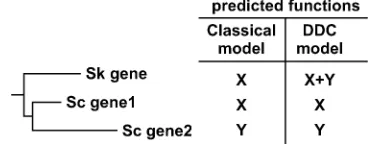
andS. cerevisiaeorthologs are most likely functions that were already present in the preduplication ancestral yeast gene. Therefore, the classical model specifically predicts that for any duplicated pair ofS. cerevisiaegenes, the orthologousS. kluyverigene may complement a mu-tation in the slower-evolvingS. cerevisiae ortholog, but not in the faster-evolvingS. cerevisiaeortholog (Figure 1). In contrast, DDC models predict thatS. kluyverigenes may complement mutations in bothS. cerevisiae ortho-logs, since they state that the preduplication gene car-ried out both functions.
The experiments presented here test the above pre-diction for a set of candidates most likely to fit the clas-sical model. The results indicate that these candidates do not fit the classical model, but instead fulfill the predictions of the DDC model. Further analysis of one of the duplicated gene pairs, and previously published
functional analysis of other gene pairs, suggests that these gene pairs do not fit the differential expression variant of the DDC model, but instead fit the DDC model with the loss-of-function mutations having oc-curred within the coding region.
MATERIALS AND METHODS
S. kluyveriwas used as a source of preduplication orthologs, because among the sequenced yeast genomes it and Kluyver-omyces waltii are the closest preduplication relatives of S. cerevisiae. S. kluyveriappears to have evolved more slowly than K. waltii(Kurtzmanand Robnett2003), which may increase the chance that its genes would complementS. cerevisiae mu-tants.S. kluyveriorthologs of duplicatedS. cerevisiaegenes were identified by conserved synteny and by sequence similarity (using BLAST).
The S. kluyveri strain FM479 was obtained from Mark Johnston (Washington University, St. Louis). PCR primers were designed to amplifyS. kluyverigenes, including500 bp of their native promoters and500 bp of their native 39-UTRs (Table 1). The PCR product was cloned into the low-copy cen-tromeric plasmid pRS416 (Sikorskiand Hieter1989) using restriction enzyme sites in the PCR primers. The 59- and 39-end of theS. kluyveri SIR3/ORC1ortholog are present in different contigs in GenBank, but the whole gene was successfully am-plified from genomic DNA and the gap was sequenced, thus confirming that these two contigs are adjacent to each other in theS. kluyverigenome. TheHBS1/SKI7gene ofS. kluyveri con-tains a putative intron (data not shown), which is included in the complementing plasmid.
To expressS. cerevisiaeSki7p and Hbs1p under control of the TDH3promoter, the coding regions were PCR amplified and cloned into p426GPD, using restriction enzyme sites in the PCR primers (Table 1; Mumberget al.1995).
Strain yRP1536 (dcp1-2 ski7D) (vanHoofet al.2000) and strain TKY609 (rps30aDhbs1D) have been described (Carr-Schmid et al.2002). All other strains were obtained from Open Bio-systems (Huntsville, AL). Each strain was confirmed to carry the correct deletion by PCR. Forski7D,hbs1D, andsir3Dstrains the plasmids described above were introduced into haploid strains using standard yeast transformation protocols. For orc1D,rnr2D,rnr4D,snf12D, andrsc6D, the plasmids described above were introduced into heterozygous diploid strains. Haploid progeny spores were obtained by the hydrophobic Figure1.—The classical model of gene duplication and
du-plication, degeneration, and complementation (DDC) mod-els make distinct predictions about what functions are conserved in theS. kluyveri(Sk) ortholog of duplicatedS. cer-evisiae(Sc) genes.
TABLE 1
Oligonucleotides used
Name Description Sequence
oAV144 59Sk HBS1/SKI7 cgagaattcggtggtagaacgttgtacaagg oAV145 39Sk HBS1/SKI7 cgatctagacaatagaaaccacacaagagg oAV201 59Sk ORC1/SIR3 cgacgactagtggaagtcctgtacatctttgagtacc oAV202 39Sk ORC1/SIR3 cgacggcggccgcccctgctcatttataagtcccttg oAV207 59Sk RNR2/RNR4 cgatctagatctcaaacccagccaagcc oAV208 39Sk RNR2/RNR4 cgactcgagatgtccatgccacttgcacg oAV209 59Sk SNF12/RSC6 cgatctagaggtacgggatcaaacagctg oAV210 39Sk SNF12/RSC6 cgactcgagacgtatgtagtgatgcgagg oAV177 59TDH-SKI7 cgaactagtaccacctgacatgtcgttattag oAV178 39TDH-SKI7 cgactcgagggattactggcatgcaattctg
oAV179 59TDH-HBS1 cgatctagactatcgagatggcttacagtg
spore isolation method essentially as described by Rockmill et al.and plated on YPD (Rockmillet al.1991). The diploid strains are heterozygous for the knock out,lys2D, andmet15D. At least 50 individual colonies were picked and scored for these segregating markers by replica plating onto YPD1geneticin, SC-MET-CYS, and SC-LYS. Haploid progeny carrying the dele-tion mutadele-tion were identified by their growth on YPD1ge-neticin and a failure to grow on SC-LYS and/or SC-MET-CYS media. These same 50 progeny strains were also replica plated to SC-URA to identify progeny that had inherited the plasmid and to 5-FOA media to identify progeny that were unable to lose the plasmid. All haploid deletion mutants grew on SC-URA, indicating that they had inherited the plasmid, and were unable to grow on 5-FOA plates, indicating that they were unable to lose this plasmid. In each case results from one such progeny are shown, but the other progeny showed the same results.
To assay mating capability, the indicatedsir3Dor wild-type control strains that all areMATa,HIS1, andhis3were grown with aMATa,his1,HIS3strain (DTY8) on SC-URA plates. After overnight growth and mating, the mixture was serially diluted in fivefold increments and spotted onto the minimal medium plate shown in Figure 2 using an 836 array replica plater (Sigma, St. Louis). Only resulting diploids can grow on this minimal medium. For all other assays, the indicated strains were grown, serially diluted in fivefold increments, and plated on the indicated media. Plates were incubated at either 25°or 30° (unless otherwise indicated) and growth was monitored for several days.
RESULTS
Specific duplicated genes to be tested were identified on the basis of five criteria. First, to ensure that the genes studied resulted from duplication of the whole gene, a list of paralogs that arose by genome duplication was used as a starting point (Kelliset al.2004). These450
gene pairs were identified on the basis of a pattern of ‘‘double conserved synteny’’ that is characteristic of whole-genome duplication. Second, gene pairs with one or two genes of unknown function were excluded. For exam-ple, both the paralogsyCL069WandyKR105Chave un-known functions, making it impossible to determine which functions are conserved or newly evolved. Simi-larly, gene pairs with largely overlapping function were excluded. For example,TEF1andTEF2encode proteins with the exact same amino acid sequence that appears functionally interchangeable (Carr-Schmidet al.1999).
Third, one specific prediction of the classical model is that gene duplication results in one more rapidly evolv-ing paralog and one more slowly evolvevolv-ing paralog. Gene pairs that fit this prediction were chosen for character-ization of conservedvs.newly evolved functions. Fourth, gene pairs in which overexpression of one paralog can complement deletion of the other paralog were excluded. This was done because whileS. kluyveriorthologs were introduced with their native promoter on a low-copy plasmid, it is impossible to ensure that the introduced
S. kluyverigene is not overexpressed. Fifth, for practical reasons gene pairs that are well characterized and have easily assayable mutant phenotypes as described in the
Sac-charomyces genome database (http://www.yeastgenome. org) were chosen for characterization.
One pair of duplicated S. cerevisiae genes that fits the criteria specified above consists ofORC1andSIR3. The Orc1p protein is essential for viability and is part of the origin recognition complex that functions during DNA replication (Bellet al.1995). Sir3p is also part of a
pro-tein complex that includes some, but not all, of the same proteins as the Orc1p complex. The Sir3p complex func-tions in silencing genes near telomeres and at the si-lent mating-type loci. As a result, mutants lacking Sir3p are alive, but cannot mate (Rineand Herskowitz1987).
Additional copies of theSIR3gene cannot complement anorc1mutation and vice versa, further indicating that the proteins carry out different functions (Bell et al.
1995). The S. kluyveri genome encodes one gene that is 48% identical to Orc1p and 24% identical to Sir3p (see supplemental material at http://www.genetics.org. supplemental/). Thus, Orc1p evolved more slowly after gene duplication and the classical model predicts that Orc1p carries out a conserved function, while Sir3p car-ries out a newly evolved function (Kelliset al.2004). To
directly test which of these two functions is ancestral, the
S. kluyveri ORC1/SIR3gene was cloned onto a low-copy plasmid and introduced into S. cerevisiaedeletion mu-tants lacking eitherORC1orSIR3. As expected by both models, theS. kluyverigene restored viability to theorc1D mutant (Figure 2A). Importantly, the S. kluyveri gene also restored mating ability to thesir3Dmutant. Thus, theS. kluyveriprotein is capable of carrying out both Orc1p and Sir3p functions. The most parsimonious explanation of these data is that the twoS. cerevisiaegenes evolved from an ancestral gene that carried out two distinct and sep-arable functions.
A second pair of duplicatedS. cerevisiaegenes encodes Snf12p and Rsc6p, which are subunits of different chro-matin remodeling complexes. Specifically, Snf12p is a subunit of the SWI/SNF complex that regulates tran-scription of theSUC2andHOendonuclease genes as well as other genes. (Cairnset al.1996a). Rsc6p is a subunit
of the related Rsc complex that regulates transcription of ribosomal protein genes as well as other genes (Cairns
et al.1996b; Angus-Hillet al.2001). Overexpression of
Snf12p or Rsc6p does not complement a mutation in the other gene, even when introduced on a high-copy plasmid, indicating that they carry out distinct functions (Cairnset al.1996b). TheS. kluyverigenome encodes
strain. The most parsimonious explanation of these data is that the preduplication ancestral gene carried out both Snf12p and Rsc6p functions.
A third example of duplicatedS. cerevisiae genes are the two R2 subunits of ribonucleotide reductase (RNR) that are encoded by theRNR2andRNR4genes (Elledge
and Davis1987; Huangand Elledge1997; Wanget al.
1997; Kelliset al. 2004).S. kluyvericontains only one
RNR R2 subunit gene that is orthologous to bothRNR2
andRNR4. Rnr2p is essential for viability and 82% iden-tical to theS. kluyveriprotein (Elledgeand Davis1987).
Rnr4p is the more rapidly evolving paralog (48% iden-tity) and deletion ofRNR4results in slow growth under a variety of conditions in some strains and inviability in other strains (see supplemental material at http://www. genetics.org/supplemental/; Huangand Elledge1997;
Wanget al.1997). These phenotypes cannot be
comple-mented by multiple copies of the other gene, even when present on a high-copy plasmid, suggesting that both have distinct functions within the RNR complex (Huangand
Elledge1997; Wanget al.1997). Figure 2C shows that
the singleS. kluyveri RNRgene complements both the
rnr2Dand thernr4D mutation. Thus, the functions of Rnr2p and Rnr4p were most likely encoded in one pre-duplication gene.
A fourth example of a pair of duplicatedS. cerevisiae
genes is HBS1 and SKI7. The genome of S. kluyveri
encodes one protein that is 47% identical to Hbs1p and 16% identical to Ski7p (see supplemental material at http://www.genetics.org/supplemental/). Thus the clas-sical model predicts that Hbs1p carries out an ancestral function, while Ski7p has a newly evolved function. The function of Hbs1p is not well defined, but lack of Hbs1p causes a slow growth phenotype at low temperature in strains that also lack the RPS30A gene (Carr-Schmid
et al.2002). As shown in Figure 2D, theHBS1/SKI7gene fromS. kluyveriis capable of complementing this pheno-type of ahbs1Drps30aDdouble mutant. The paralog Ski7p functions in mRNA degradation, and mutants lacking
SKI7have three known phenotypes. First, yeast has two general pathways to degrade mRNA. As a result, mutants lacking Ski7p are viable in an otherwise wild-type strain, but inviable if the second mRNA decay pathway is also disabled (vanHoofet al.2000). This inviability can be
made conditional by using a temperature-sensitive muta-tion (such asdcp1-2) to inactivate the second pathway (van Hoof et al. 2000). Figure 2D shows that the S.
kluyveri HBS1/SKI7 gene can complement this condi-tional inviability. Second, mRNAs that lack a stop codon are preferentially degraded by the Ski7p-dependent pathway. Therefore, ahis3-nonstop ski7Ddouble mutant grows better in the absence of histidine than ahis3-nonstop SKI7strain (vanHoofet al.2002). Figure 2D shows that
theS. kluyveri HBS1/SKI7gene can also complement this phenotype. Third,ski7mutations were initially identified because they have a super killer phenotype. That is,ski7
mutants that carry the killer virus secrete more killer toxin, and are more effective at killing uninfected yeast, than the wild-type strain (Ridleyet al.1984; Benardet al.
1999). This phenotype is also complemented by the
S. kluyveri HBS1/SKI7gene (data not shown). Thus, the
S. kluyveriprotein is capable of carrying out both Hbs1p and Ski7p functions. These data indicate the predupli-cation ancestral gene carried out both Ski7p and Hbs1p functions.
For theSKI7/HBS1gene pair it is not known whether overexpression of one paralog can suppress deletion of the other. To directly test this, the coding region of either gene was put under control of the strong TDH3 pro-moter and CYC1 39-UTR on a high-copy plasmid. As shown in Figure 3, theTDH3-SKI7 construct can com-plementski7Dbut nothbs1D, andTDH3-HBS1can com-plementhbs1D but not ski7D. These data confirm that Hbs1p and Ski7p have distinct functions.
DISCUSSION
The leading candidates for the classical model
sup-port the alternative DDC model:The results presented
here are inconsistent with the classical model for pre-servation of duplicated genes, even though one of the selection criteria for what genes to study was that they were among the best candidates to fit that model. Spe-cifically, the classical model predicts that duplicated gene
pairs consist of a slower-evolving gene with a conserved function and a faster-evolving gene with a new function. The genes studied here have widely varying levels of sequence identity with their S. kluyveri orthologs, but each duplicated gene pair studied included one more rapidly evolving paralog and one more slowly evolving paralog. In the case of Sir3p it was especially attractive to propose a new function in the silencing of mating-type cassettes, because these cassettes evolved at about the same time as the whole-genome duplication (Langkjaeret al.
2003; Butler et al. 2004). Surprisingly, the data
pre-sented here show that none of these candidates actually fit the classical model of gene duplication.
Although the results presented here do not provide any evidence for newly evolved functions, many proteins may have multiple functions, and any of the duplicated genes analyzed here may have acquired a new function, just like any of the nonduplicated yeast genes may also have acquired a new function. Importantly, the above results show that such hypothetical newly acquired func-tions are not required to explain why these duplicated genes were maintained. Most importantly, these results demonstrate that maintaining distinct ancestral func-tions provides sufficient evolutionary advantage to fully explain the maintenance of these duplicated genes. For example, theORC1 gene is likely maintained because without its ancestral function yeast is inviable, and the
SIR3gene is likely maintained because without its an-cestral function yeast is incapable of mating. There-fore, these results provide strong experimental support for the duplication, divergence, and complementation models.
Some support for the classical model for gene du-plications has been found in two-hybrid analysis of protein-protein interaction inS. cerevisiae. Most recently, it was reported that the total number of two-hybrid interactions for a duplicated gene pair is larger than the number for a nonduplicated gene (Heand Zhang2005),
suggesting that many protein interactions have been added after gene duplication. There are several possible reasons for the apparent discrepancy between those results and the results reported here. First, the experi-ments described here looked at a subset of gene dupli-cations that arose by genome duplidupli-cations as identified by a pattern of double-conserved synteny. The two-hybrid study identified paralogs by sequence similarity (BLAST). Paralogs identified by a high BLAST score may include proteins that arose by domain swapping. That is, part of a protein may have been duplicated and fused to another protein. The proteins studied here arose by whole-genome duplication and align along their entire length (see supplemental material at http:// www.genetics.org/supplemental/; Kellis et al. 2004).
While both complete and partial gene duplications should be considered, they probably should be consid-ered separately. Second, analysis of protein interactions compared duplicated genes to nonduplicated genes within Figure3.—Mutations in the coding regions are
S. cerevisiae, whereas in the current analysis the dupli-cated genes were compared to their nonduplidupli-cated
S. kluyveriortholog. Comparing duplicated S. cerevisiae
genes to nonduplicatedS. cerevisiaegenes would be in-valid if there is an underlying bias as to what genes sur-vived as duplicates. Bias toward maintaining certain genes in duplicate is evident from the fact that75% of ribo-somal protein genes are duplicated as compared to 12% of all genes (Warneret al.2001; Kelliset al.2004; and
data not shown). Genes that have more separable func-tions also may be more likely to be maintained after gene duplication (Lynchand Force2000; Walsh2003).
DDC can occur by mutations within the coding region:
In the cases ofORC1/SIR3,RNR2/RNR4, andSKI7/HBS1
divergence of function is likely to have occurred through amino acid sequence changes. This conclusion is based on different lines of evidence for the three gene pairs. In the case of SIR3/ORC1, this hypothesis is based on characterization of chimaeric proteins. Specifically, a fusion protein that contains the C-terminal region of Sir3p and the N-terminal region of Orc1p can comple-ment asir3mutation, but not anorc1mutation, while a fusion protein that contains the C-terminal region of Orc1p and the N-terminal region of Sir3p can comple-ment anorc1mutation, but not a sir3mutation (Bell
et al.1995). In the case ofSKI7/HBS1, a chimaeric gene containing either theSKI7orHBS1coding region with heterologous promoters and 39-UTRs can complement a deletion of the corresponding gene, but not a deletion of the paralog (Figure 3). Thus, in bothSKI7/HBS1and
ORC1/SIR3 diverging mutations occurred within the coding region. The most likely explanation is that these gene pairs diverged through amino acid changes, although the possibility that some element within the coding re-gion controls expression cannot be completely excluded. In the case ofRNR2/RNR4, this hypothesis is based on the conclusion that Rnr2p and Rnr4p function as a hetero-dimer and thus that amino acid differences (and not expression differences) between Rnr2p and Rnr4p prob-ably explain their different functions (Sommerhalter
et al.2004).
While previously published examples provided evi-dence for regulatory divergence (Forceet al.1999), the
HBS1/SKI7, ORC1/SIR3, and RNR2/RNR4 gene pairs likely functionally diverged through amino acid changes. There are at least two explanations for this difference. One reason that most of the gene pairs studied here functionally diverged by amino acid changes is that they were selected in part because they included a fast-evolving paralog. Other yeast gene pairs, such as those that encode very similar proteins, may have diverged through changes in expression pattern. Second, func-tional divergence of expression patterns may be more prevalent for genes involved in development of multi-cellular organisms (such asen1andAGAMOUS; Force
et al.1999), but less important in a unicellular microbe such as yeast. In either case, the results presented here
offer direct evidence that functional divergence within the coding region has occurred during evolution and is important for the maintenance of duplicated genes.
In conclusion, four sets of paralogs inS. cerevisiaewere analyzed. These four sets were carefully chosen because they were among the best candidates for the evolution of new function after yeast genome duplication. Con-trary to the predictions of the classical model, the dif-ferent functions of the paralogs were clearly already present in the preduplication ancestor. All of the data presented here are consistent with the hypothesis that the preservation of duplicated yeast genes can be ex-plained by duplication, degeneration, and complemen-tation and that newly evolved functions have contributed little to the persistence of most duplicated genes in yeast. These data are fully consistent with theoretical and population genetic analyses of DDC models (e.g., Lynchand Force2000; Walsh2003) and offer strong
experimental support for such models. One limitation of the population genetic analyses is that they require assumptions about the relative rate of different kinds of mutations. Specifically, the ratio between mutations that lead to the loss of one function and mutations that lead to loss of all functions is an important, but unknown, variable in population genetic calculations. On the basis of the current work it should be possible to experimen-tally determine this ratio with the use ofS. cerevisiaestrains complemented by bifunctionalS. kluyverigenes.
I thank Roy Parker, Kevin Morano, and Aaron Mitchell for providing thoughtful comments on this manuscript. Kevin Morano generously supplied plasmid p426GPD and yeast strain TDY8. Mark Johnston generously supplied theS. kluyveristrain used. This work was sup-ported by the PEW Scholarship Program in the Biomedical Sciences.
LITERATURE CITED
Andalis, A. A., Z. Storchova, C. Styles, T. Galitski, D. Pellman
et al., 2004 Defects arising from whole-genome duplications inSaccharomyces cerevisiae.Genetics167:1109–1121.
Angus-Hill, M. L., A. Schlichter, D. Roberts, H. Erdjument
-Bromage, P. Tempstet al., 2001 A Rsc3/Rsc30 zinc cluster
di-mer reveals novel roles for the chromatin remodeler RSC in gene expression and cell cycle control. Mol. Cell7:741–751. Bell, S. P., J. Mitchell, J. Leber, R. Kobayashiand B. Stillman,
1995 The multidomain structure of Orc1p reveals similarity to reg-ulators of DNA replication and transcriptional silencing. Cell83:
563–568.
Benard, L., K. Carroll, R. C. Valle, D. C. Masisonand R. B. Wickner,
1999 The ski7 antiviral protein is an EF1-alpha homolog that blocks expression of non-Poly(A) mRNA in Saccharomyces cerevisiae. J. Virol.73:2893–2900.
Butler, G., C. Kenny, A. Fagan, C. Kurischko, C. Gaillardinet al.,
2004 Evolution of the MAT locus and its Ho endonuclease in yeast species. Proc. Natl. Acad. Sci. USA101:1632–1637. Cairns, B. R., R. S. Levinson, K. R. Yamamotoand R. D. Kornberg,
1996a Essential role of Swp73p in the function of yeast Swi/Snf complex. Genes Dev.10:2131–2144.
Cairns, B. R., Y. Lorch, Y. Li, M. Zhang, L. Lacomis et al.,
1996b RSC, an essential, abundant chromatin-remodeling com-plex. Cell87:1249–1260.
Carr-Schmid, A., N. Durko, J. Cavallius, W. C. Merrickand T. G.
Kinzy, 1999 Mutations in a GTP-binding motif of eukaryotic
requirement for nucleotide exchange. J. Biol. Chem.274:30297– 30302.
Carr-Schmid, A., C. Pfund, E. A. Craigand T. G. Kinzy, 2002 Novel
G-protein complex whose requirement is linked to the transla-tional status of the cell. Mol. Cell. Biol.22:2564–2574. Elledge, S. J., and R. W. Davis, 1987 Identification and isolation of
the gene encoding the small subunit of ribonucleotide reductase from Saccharomyces cerevisiae: DNA damage-inducible gene re-quired for mitotic viability. Mol. Cell. Biol.7:2783–2793. Force, A., M. Lynch, F. B. Pickett, A. Amores, Y. L. Yanet al.,
1999 Preservation of duplicate genes by complementary, de-generative mutations. Genetics151:1531–1545.
Friedman, R., and A. L. Hughes, 2001 Gene duplication and the
structure of eukaryotic genomes. Genome Res.11:373–381. Goffeau, A., 2004 Evolutionary genomics: seeing double. Nature
430:25–26.
He, X., and J. Zhang, 2005 Rapid subfunctionalization
accompa-nied by prolonged and substantial neofunctionalization in dupli-cate gene evolution. Genetics169:1157–1164.
Huang, M., and S. J. Elledge, 1997 Identification of RNR4,
encod-ing a second essential small subunit of ribonucleotide reductase in Saccharomyces cerevisiae. Mol. Cell. Biol.17:6105–6113. Hughes, A. L., 1994 The evolution of functionally novel proteins after
gene duplication. Proc. R. Soc. Lond. Ser B Biol. Sci.256:119–124. Jaillon, O., J. M. Aury, F. Brunet, J. L. Petit, N. Stange-Thomann
et al., 2004 Genome duplication in the teleost fish Tetraodon nigroviridis reveals the early vertebrate proto-karyotype. Nature
431:946–957.
Kellis, M., B. W. Birrenand E. S. Lander, 2004 Proof and
evolu-tionary analysis of ancient genome duplication in the yeast Sac-charomyces cerevisiae. Nature428:617–624.
Kurtzman, C. P., and C. J. Robnett, 2003 Phylogenetic
relation-ships among yeasts of the ‘‘Saccharomyces complex’’ determined from multigene sequence analyses. FEMS Yeast Res.3:417–432. Langkjaer, R. B., P. F. Cliften, M. Johnstonand J. Piskur, 2003 Yeast
genome duplication was followed by asynchronous differentia-tion of duplicated genes. Nature421:848–852.
Lynch, M., and A. Force, 2000 The probability of duplicate gene
preservation by subfunctionalization. Genetics154:459–473. Mumberg, D., R. Mullerand M. Funk, 1995 Yeast vectors for the
controlled expression of heterologous proteins in different ge-netic backgrounds. Gene156:119–122.
Ohno, S., 1970 Evolution by Gene Duplication.Springer-Verlag, Berlin/
Heidelberg, Germany/New York.
Piskur, J., and R. B. Langkjaer, 2004 Yeast genome sequencing: the
power of comparative genomics. Mol. Microbiol.53:381–389. Ridley, S. P., S. S. Sommerand R. B. Wickner, 1984 Superkiller
mu-tations in Saccharomyces cerevisiae suppress exclusion of M2 double-stranded RNA by L-A-HN and confer cold sensitivity in the presence of M and L-A-HN. Mol. Cell. Biol.4:761–770. Rine, J., and I. Herskowitz, 1987 Four genes responsible for a
po-sition effect on expression from HML and HMR inSaccharomyces cerevisiae.Genetics116:9–22.
Rockmill, B., E. J. Lambieand G. S. Roeder, 1991 Spore
enrich-ment. Methods Enzymol.194:146–149.
Sikorski, R. S., and P. Hieter, 1989 A system of shuttle vectors and
yeast host strains designed for efficient manipulation of DNA in Saccharomyces cerevisiae.Genetics122:19–27.
Sommerhalter, M., W. C. Voegtli, D. L. Perlstein, J. Ge, J. Stubbe
et al., 2004 Structures of the yeast ribonucleotide reductase Rnr2 and Rnr4 homodimers. Biochemistry43:7736–7742.
vanHoof, A., R. R. Staples, R. E. Bakerand R. Parker, 2000
Func-tion of the ski4p (Csl4p) and Ski7p proteins in 39-to-59 degrada-tion of mRNA. Mol. Cell. Biol.20:8230–8243.
van Hoof, A., P. A. Frischmeyer, H. C. Dietz and R. Parker,
2002 Exosome-mediated recognition and degradation of mRNAs lacking a termination codon. Science295:2262–2264. Walsh, B., 2003 Population-genetic models of the fates of duplicate
genes. Genetica118:279–294.
Wang, P. J., A. Chabes, R. Casagrande, X. C. Tian, L. Thelander
et al., 1997 Rnr4p, a novel ribonucleotide reductase small-subunit protein. Mol. Cell. Biol.17:6114–6121.
Warner, J. R., J. Vilardelland J. H. Sohn, 2001 Economics of
ribosome biosynthesis. Cold Spring Harbor Symp. Quant. Biol.
66:567–574.
Wolfe, K., 2004 Evolutionary genomics: yeasts accelerate beyond
BLAST. Curr. Biol.14:R392–R394.
Wolfe, K. H., and D. C. Shields, 1997 Molecular evidence for an
ancient duplication of the entire yeast genome. Nature 387:
708–713.
Yu, J., J. Wang, W. Lin, S. Li, H. Liet al., 2005 The Genomes of Oryza
sativa: A History of Duplications. PLoS Biol.3:e38.