Reliable and Energy Efficient Protocol for
Wireless Sensor Network
Hafiyya.R.M 1, Fathima Anwar 2
P.G. Student, Department of Computer Engineering, M.E.A Engineering College, Perinthalmanna, Kerala, India1
Assistant Professor, Department of Computer Engineering, M.E.A Engineering College, Perinthalmanna, Kerala, India2
ABSTRACT: wireless sensor network (WSNs) consists of hundreds or thousands of low cost nodes fixed in some location or randomly deployed to monitor the environment. Designing a lifetime-maximization routing in wireless sensor networks poses a great challenge mainly due to unreliable wireless links and limited power supply.The lifetime maximization can be achieved by ASSORT which is an and asynchronous sleeping opportunistic routing protocol where the path diversity and the improvement of transmission reliability is improved choosing the shortest node for transmitting data increase the network lifetime by decreasing the transmission cost.Simulation results show that the methods effectively achieves network lifetime extension compared with other routing schemes.
KEYWORDS: Wireless communication, sensor networks, opportunistic routing, asynchronous sleep-wake scheduling..
I. INTRODUCTION
Wireless Sensor Networks (WSNs) over the past few years comes from the diversity of their applications and the challenges of deployment issues. Wireless sensors, which combine the capability of sensing and wireless communication, are suitable for lots of applications such as military surveillance, temperature monitoring, wildlife tracking, and disaster warning system. Due to unreliable wireless links and limited power supply, the routing must be carefully designed to conserve energy for extending the network lifetime, which is defined as the time until the first node depletes its energy . Due to channel fading and wireless contention, data transmission over wireless links is prone to failure. By involving multiple forwarders, opportunistic routing not only reduces the number of retransmissions, but also introduces randomness for perhop forwarders adaptation. Though opportunistic routing provides two desirable natural advantages, we observe that the performance of an OR scheme significantly depends on the design of the metric applied in forwarder selection as well as prioritization.In example every node broadcast the message to the neighbouring nodes & this process continues in operation when desired destination is encountered some node emerge gateways to the subsection of the network. Another aspect for energy conservation is sleep-wake scheduling, which appropriately arrange sensor nodes to sleep when data transmission/reception is not needed. In a sleep mode, the communication module of a sensor node is turned off; thus, the energy consumption is fairly low. Moreover, to avoid the energy consumption of clock synchronization, asynchronous sleep-wake scheduling makes sensor nodes wake up independently with the given rate. Asynchronous sleep-wake scheduling is suitable for a wireless sensor network, because it is easily implemented and can be done locally without additional communication overhead.
II. RELATED WORK
A. OVERVIEW OF OPPORTUNISTIC ROUTING
In traditional fixed-path routing schemes over wireless networks, each node selects specific nodes to relay data in advance. It masks the wonderful character of wireless network. In wireless network each node can transmit data in to any other node independently. Also in traditional routing, the designated relay nodes may fail to receive data over unreliable wireless links even if the most reliable link is selected. As a result, the sender must retransmit the packets to the relay nodes. In reality, all neighboring nodes in the transmission range of the sender can overhear the relayed packets because of the broadcast nature of wireless channel. As more than a single node is involved, the number of retransmission can be reduced because the probability that at least one forwarder receives the packets increases.
B. OVERVIEW OF SLEEP WAKE SCHEDULING
In traditional packet-forwarding schemes, every node has one designated next-hop relaying node in the neighborhood, and it has to wait for the next-hop node to wake up when forward a packet has to be done. In contrast, under anycast packet-forwarding schemes, each node has multiple next-hop relaying nodes in a candidate set (we call it as forwarding set) and forwards the packet to the first node that wakes up in the forwarding set. Sleep-wake scheduling protocol have been proposed in literature. In synchronized sleep–wake scheduling protocols sensor nodes periodically or aperiodically exchange synchronization information with neighbouring nodes. However, such synchronization procedures could incur additional communication overhead and consume a considerable energy. On-demand sleep– wake scheduling protocols is one scheduling where nodes turn off most of their circuitry and always turn on a secondary low-powered receiver to listen to “wake-up” calls from neighbouring nodes when to relay the packet. But this on-demand sleep–wake scheduling can significantly increases sensor nodes cost due to the additional receiver.We propose a metric, called OECS, which can reflect the curtailment of network-lifetime caused by each data transmission. The design of OEC aims at allowing each intermediate sensor to determine its forwarding set and relay sequence for prolonging the network-lifetime. Second, we develop a routing algorithm, EFFORT, which enables each node to compute its optimal OEC value in a distributed manner and addresses the implementation issues of realizing OR on the proposed OEC metric. According to sleep-wake schedules, each sensor node switches between active and sleep modes.When sensor node u has data to transmit, the sleep-wake schedule is suspended and node immediately wakes up for a period of length called probing period. At the beginning a probing, node broadcasts beacons, i.e., of Fig.2 , to notify nodes in its forwarding set that there exists data needs to be forwarded, and then waits for responses, i.e., of Fig.2. Node can start to do data transmission if it successfully receives an ACK response from any node.
III.DESIGN OF THE SYSTEM
In this section, we present the proposed OECSD metric (Opportunistic Energy Cost with Sleep-wake schedules with distance) and describe the designed routing scheme.
A. SLEEP WAKE SCHEDULING ALGORITHM
✓Determine the energy consumption for probing periods before sending data, and the energy consumption for wake
periods. Energy consumption based on transmission, reception, and idle state per time unit.
✓ At beginning a probing, node broadcasts beacons, nodes in its forwarding set that there exists data needs to be forwarded, and then waits for responses.
✓ Node can start to do data transmission if it successfully receives an ACK response from any node in its forwarding
set.
✓ If no other node wakes up for relaying data, node returns to sleep mode and then re-broadcasts beacons until at least
one forwarder wakes up.
✓ If a sensor node has no data to transmit, it sleeps for random length of intervals that are independent and
exponentially distributed with a given average rate of wakeup events.
✓ Energy Probability is given by
✓ The forwarding node will be select based on
➢ The energy cost of probing its forwarders,
➢ The energy cost in a period from the time when forwarders received probing beacon to the time when forwarders
start receiving data,
➢ The energy cost of transmitting data from node ,
➢ The energy cost of receiving data by all awake forwarders,
➢ The expected OECS value of node ’s forwarders to the sinks, and
➢ The energy cost of retransmission.
➢ Distance from the sender
➢ Based on this parameter the route will be selected. After selection route the sleep awake scheduling will be applied.
B. OECSD METRIC FORMULATION
Note that the same amount of energy consumption has different degree of impact on sensor nodes with various residual energy. More specifically, a sensor node with less residual energy should more conservatively manipulate its energy. For example, the residual energy of two sensor nodes u and v are 10 units and 2 units, respectively. In contrast with node , consuming one unit of energy is significant for node since its energy is going to be drained out. Therefore, we define energy cost as the ratio of energy consumption to a sensor node’s residual energy for OECS metric; the goal is to minimize energy cost caused by each data transmission. The rationale is to balance energy usage, so the network lifetime can be prolonged. In order to compute the end-to-end energy cost from a sensor node to the sink, every sensor node has to take the OECSD value of all its forwarder into consideration when computing its own OECSD value. With this recursive method, every sensor node computes the expected energy cost of data forwarding from a sender to the sink. More specifically, the OECSD value of sensor node is the expected opportunistic energy cost from node u to the sink, which is the summation of (1) the energy cost of probing its forwarders, (2) the energy cost in a period from the time when forwarders received probing beacon to the time when forwarders start receiving data, (3) the energy cost of transmitting data from node , (4) the energy cost of receiving data by all awake forwarders, (5) the expected OECS value of node u’s forwarders to the sinks, (6) the energy cost of retransmission, and (7) distance from the sender to the
node.Therefore, the definition of OECSD metric for node is represented, where Fu and Pu indicate the forwarding set of
node and priority assignment for all nodes of Fu . Moreover, PTS is the probability that at least one forwarder
successfully receives data.
OECS(Fu, Pu) =( (Cprob+Cwake+ Ctx+ Crx+ Cfwd->sink)/ PTS)+distance from the sender.
Each term in equation is described in detail as follows, where ru is the residual energy of sensor node u .
✓ Cprob indicates the energy cost of a sender node broadcasting beacon to its forwarders. Hence, Cprob is similar to that
of Eprob
✓ Cwake denotes the energy cost of the awake forwarders for receiving probing beacon, returning an ACK, and waiting
✓ Crx is the energy consumption of receiving data sent from the sender. Only awake forwarders can receive data, so we
also consider the probability that a sensor node is awake.
✓ Cfwd->sink denotes the expected energy cost of forwarders, which relay the received data after they received data sent
from the sender. For those nodes assigned lower priority, they will not relay data unless the nodes, with higher priority in the forwarding set, fail to relay data. In other words, forwarder only has to relay data if forwarder receives the packet correctly and all nodes, having higher priority in the forwarding set, fail to receive data.
The priority assign in the ascending order of OECSD metric.
IV. EXPERIMENTAL RESULTS
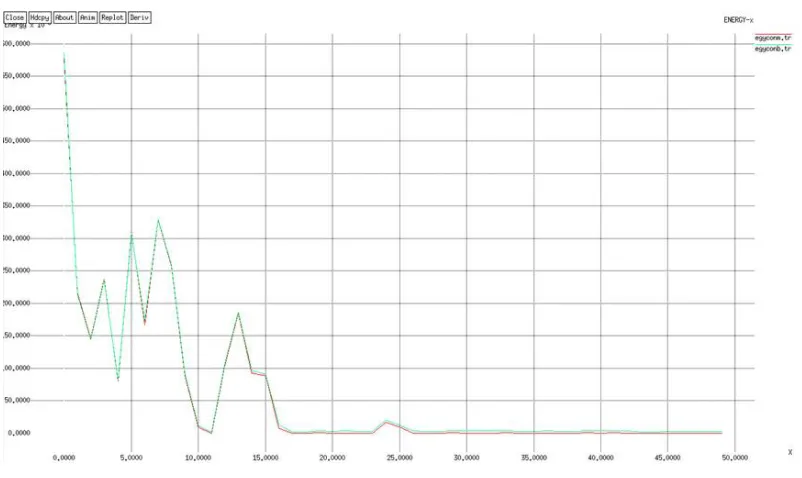
We simulate this work in NS2 simulator and trace the result shows that the proposed method can decrease the energy conception than the previous method assort.
simulator NS-2 version 2.35
Number of mobile nodes 50
Simulation area 800*400
Routing protocol DSDV
Network interface Wireless physical
Packet size 512 byte
Table1.. Experimental setup
Fig 4. Data transmission
Graph.1.. Comparison of energy conception.
V. CONCLUSION
reliability,sleep-✓LQ= retransmission packet÷ total no of packets
✓ To implement ASSORT on real sensor devices, such as, MicaZ or TelosB
REFERENCES
[1] Chih-Cheng Hsu, Ming-Shing Kuo, Shi-Chen Wang, and Cheng-Fu Chou 2014, IEEE Transactions On Computers, Vol. 63, No. 7 “Joint Design of Asynchronous Sleep-Wake Scheduling and Opportunistic Routing in Wireless Sensor Networks”.
[2] J. Kim, X. Lin, N. Shroff, and P. Sinha, “On Maximizing the Lifetime of Delay-Sensitive Wireless Sensor Networks with Anycast,” in
INFOCOM. IEEE, 2008, pp. 807 –815.S.Bhuvaneswari, T.S.Subashini, “Automatic Detection and Inpainting of Text Images”, International Journal of Computer Applications (0975 – 8887) Volume 61– No.7, 2013.
[3] M. C.-C. Hung, K. C.-J. Lin, C.-F. Chou, and C.-C. Hsu, “EFFORT: Energy-efficient Opportunistic Routing Technology in Wireless Sensor Networks,” Wireless Communications and Mobile Computing, 2011.
[4] Priyanka M.Lokhande, A.P.Thakare, March 2013International Journal of Recent Technology and Engineering (IJRTE) ISSN: 2277-3878, Volume-2, Issue-1, “An Efficient Scheduling Technique for the Improvement of WSN with Network Lifetime & Delay Constraint” [5] Chien-Chun Hung†, Kate Ching-Ju Lin§, Chih-Cheng Hsu†, Cheng-Fu Chou† and Chang-Jen Tu 2010, ICCCN 19th International conference,