Feature Extraction Methods: A Review
P.Prathusha 1, S.Jyothi 2
Asst. Professor, Department of Computer Science Engineering, RGMCET, Nandyal, AP, India1
Professor, Department of Computer Science, SPMVV, Tirupathi, India2
ABSTRACT: Extracting features from input data is vital for successful classification task and machine learning tasks.
Feature extraction, obviously, is a transformation of large input data into a low dimensional feature vector, which is an input to classification or a machine learning algorithm. The task of feature extraction has major challenges discussed in this paper. The quest for universal learning is one of the most significant, fascinating, and revolutionary intellectual developments of all time. In present day scenarios the problems are very complex ,have high dimensional data and are heterogeneous .The challenge is to learn and extract knowledge from that data to make correct decisions. The objective of this paper is to give an overview of methods used in feature extraction for various applications, give an overview of modern challenges in feature extraction.
KEYWORDS: colour features, texture features, shape features, fuzzy features, Large scale machine learning, filter methods, wrapper methods, embedded methods, feature selection, feature subset selection, dimensionality reduction, fuzzy feature extraction
I. INTRODUCTION
The huge amount of data generated has grown multiple times with millions or trillions of data sets generated every day with internet and social media. Feature extraction is a critical task which involves huge amount of data as input and transforming it in to optimal feature set. Feature extraction starts from an initial set of measured data and builds derived values(features) intended to be informative and non-redundant, facilitating the subsequent learning and generalization steps, and in some cases leading to better human interpretations.[118].
1.1 Terminology and principal representations
Let X denote the input feature space and Y denotes the set of output labels. The sample is represented as S = {(x1,y1),….(xm,ym)}
Let D is another feature space and Let Function F maps X to D. Let h*ε D is applied to every x I ε X the feature
extracted sample is h(S) = {(f(x1),y1)……..f(xm,ym)}
Feature Engineering
Feature Engineering comprises of human intervention and human logic in extracting features for any application.
Feature re-weighting
A method of assigning best weight for each feature is known as Feature Re-weighting. If weights are {0,1} it is variable selection..
as color histogram, color correlogram, edge direction histogram, and so on. The global features are advantageous in classifying simple scene categories such as "sunset,” "mountain,” "building,” etc. For regional features [67],[68],[69],[70], an image is segmented into several regions and represented as a set of visual feature vectors, each of which represents one homogenous region.[71] gives improved feature extraction in image annotation by integrating global, regional and contextual features .[72] also addresses the combination of local and global features for object recognition
II. BASICFEATUREEXTRACTIONTECHNIQUES
Feature Extraction basically uses texture, color and shape feature extraction methods .
2.1 Texture Feature Extraction
Human visual systems uses texture for Image recognition and interpretation. Textures are complex visual patterns composed of entities, or sub patterns that have characteristic brightness, color, slope, size, etc. Texture can be regarded as a similarity grouping in an image [126] .
2.2 Spatial and Spectral Features :
Depending on the domain from which the texture feature is extracted, textures are classified into spatial texture feature extraction methods and spectral texture feature extraction methods [14]. Spatial texture features are extracted by computing the pixel statistics or finding the local pixel structures in original image domain, whereas spectral transforms an image into frequency domain and then calculates feature from the transformed image
Table.1 Spatial versus Spectral features
Texture Method Advantages Disadvantages
Spatial Texture feature extraction Interpretation is easy. No loss of information
Noise Sensitivity
Spectral Texture feature Extraction Needs less computation Needs square image regions of sufficient size
Tranformation is a must
2.3 Texture Analysis
Texture analysis is characterization of regions of an image by their texture content. Texture analysis attempts to quantify intuitive qualities described by terms such as rough, smooth, silky, or bumpy as a function of the spatial variation in pixel intensities.[121] For example, smooth texture areas, the range of values in the neighbourhood around a pixel will be a small value; in areas around rough texture, the range will be larger. Standard deviation of pixels in a neighbourhood gives the degree of variability of pixel values in that region. Texture analysis is used in remote sensing, automated inspection, medical image processing etc . Texture analysis is used to find the texture boundaries, called
texture segmentation
Approaches to texture analysis are usually categorized as Structural,
Structural approaches [128] [127] represent texture by well-defined primitives (micro texture) and a hierarchy of spatial arrangements (macro texture) of those primitives.[123]
Statistical approaches [141] do not attempt to understand explicitly the hierarchical structure of the texture. Instead, they represent the texture indirectly by the non-deterministic properties that govern the distributions and relationships between the grey levels of an image [123]
Model based texture analysis [129][130][131] [132][133][134] using fractal and stochastic models, attempt to interpret
an image texture by use of, respectively, generative image model and stochastic model.
Transform methods of texture analysis, such as Fourier [138] Gabor [139][140] and wavelet transforms [137]
[136][135]represent an image in a space whose co-ordinate system has an interpretation that is closely related to the characteristics of a texture (such as frequency or size).
2.4 LDP, DLEP, MDLEP, CMDLEP
LDP - Local directional Pattern
Local Directional Pattern (LDP) [152] uses the edge response of neighbouring pixel to encode the texture of an Image. A binary value 1 or 0 is assigned depending on the presence of the edge
= ∑ ( − )∗2 , fi(x) 1, ≥0
0, < 0 (1)
DLEP - Directional Local Extrema Patterns
In this method [153] two neighbouring pixel intensities in a direction are compared with the pixel centre position to assign either 1 or 0.It describes the spatial structure of the local texture based on the local extrema of centre pixel xc.
′( ) = ( )− ( ); = 1,2, … … .8 (2)
MDLEP - Magnitude Directional Local Extrema Pattern
In [154] they proposed MDLEP to increase the performance by considering the magnitudes of local patterns
CMLDEP- Combined Magnitude Directional Local Extrema Patterns
This method is proposed in [155] which outperforms MDLEP both in terms of precision and recall. The combination of Gabor and MDLEP explores more information present in the image compared to LBP and other related local pattern operators.
Local Binary Pattern and its variations
1) Selection of its neighbourhood 2) Enhancement of its robustness
3) Improvement of its discriminative capability 4) Extension to three dimensional data
5) Combination with different other approaches
Improved LBP (ILBP) improves the discriminative ability of LBP ;Improved LBP (ILBP) which compares all the
pixels (including the central pixel) with the mean intensity of all the pixels in the patch, The authors Tan and Triggs [151] extended the original LBP to a version with 3-value codes, called Local Ternary Patterns (LTP).LTP improves the robustness of LBP on noisy images, Gabor wavelet based LBP(GWB-based LBP) and Center-Symmetric LBP
CS-LBP combine other methods with LBP to bring in new advantages. 3DLBP extends the LBP operator to describe
3D volume data. Wenchao Zhang proposes a novel face representation[147], Local Gabor Binary Pattern Histogram
Sequence(LGBPHS), which is insensitive to illumination variations due to lighting, expression, and aging. A
Center-Symmetric LBP (CS-LBP) [148], was proposed by only comparing pairs of neighbouring pixels which are in the same
diameter of the circle. The authors zaho and Pietikanein first, modelled [149] the textures with volume local binary
patterns (VLBP), which are an extension of the local binary patterns (LBP) operator widely used in ordinary texture
analysis [150],
III. PERCEPTUALTEXTURALFEATURES
Perceptual texture features was suggested by authors Abbadeni, Noureddine [124][125].
GTDM: Grey-Tone Difference Matrix
GTDM is also related to human perception of textures. Grey-Tone Difference Matrix (GTDM) was suggested by Amadasum . It defines texture measures correlated with human perception of textures.
The perceptual textural features are Coarseness, Directionality, busyness and contrast described briefly below.
3.1 Coarseness
Coarseness measures the size of the primitives that constitute the texture. A coarse texture is composed of large primitives and is characterized by a high degree of local uniformity of grey-levels. A fine texture is constituted by small primitives and is characterized by a high degree of local variations of grey-levels.
=
( ∑ ∑ ( , )/ ∑ ∑ ( , ) (4)
3.2 Directionality
Directionality is a global property in an image. It measures the degree of visible dominant orientation in an image.
3.3 Contrast
Contrast measures the degree of clarity with which one can distinguish between different primitives in a texture. A well contrasted image is an image in which primitives are clearly visible and separable.
3.4 Busyness
Busyness refers to the intensity changes from a pixel to its neighbourhood: a busy texture is a texture in which the intensity changes are quick and rush; a non busy texture is a texture in which the intensity changes are slow and gradual.
3.5 GLCM texture features
3.6 Transformations:
Some transformations are given below
3.6.1 Fourier Transform
Fourier transform performance is poor in practice, due to its lack of spatial localization.
3.6.2 Hough transformation
The Idea of the hough transformation is it converts image space into a parameter space. This conversion is a mapping that analyses the image looking for a special sort of parameterized features usually lines or circles. It’s beauty lies in the many different shapes that can be detected together with their parameters.[11]
3.6.3 Wavelet transforms advantages
Wavelets best suited for texture analysis in a specific application. Wavelets are used by [135][136]137] . Arivazhagan and Ganesan proposed an approach to classify the texture that uses wavelet transform[143].
The advantages offered by wavelets are
1. to represent textures at the most suitable scale, 2. wide range of choices exists for the wavelet function
Disadvantages:
The problem with wavelet transform is that it is not translation-invariant.
3.6.4 Gabor filters
Gabor filters [142][144] provide means for better spatial localization; they are limited in practice because there is usually no single filter resolution at which one can localise a spatial structure in natural textures. Gabor wavelets are the mathematical model of visual cortical cells of mammalian brain and using this, an image can be decomposed into multiple scales and multiple orientations. [120]
IV. SHAPEFEATUREEXTRACTIONTECHNIQUES
There are 3 main classification methods . [14]
4.1 Contour-based methods and region-based methods [15]. It is proposed by MPEG-7. It is based on the use of shape boundary points rather than shape interior points.
structural approaches and global approaches are further classifications under each category.
Fig.1 An overview of shape description techniques
4.2 Space domain and transform domain Methods in space domain match shapes on point (or point feature) basis, while feature domain techniques match shapes on feature (vector) basis[16].
4.3 Information preserving (IP) and non-information preserving (NIP). IP methods allow an accurate reconstruction of a shape from its descriptor, while NIP methods are only capable of partial ambiguous reconstruction. For object recognition purpose, IP is not a requirement.
4.4 Zerkine Moments
4.5 Geodesic Descriptors
Geodesic descriptors are invariant under geodesic isometrics, and quasi-invariant to shape articulations and bendings. This is relevant to perform robust retrieval on articulated shapes, such as animal or human with varying poses. The Geodesic descriptors are calculated after detection of the center of the Object [12][13].
V. COLORFEATURES
Color is the vital discriminative feature for images. The color spaces are RGB, LUV, HSV and HMMD [112].Color feature can be extracted from images or regions using color space. Many important color features have been proposed in the literatures, including color histogram [113][83], color moments(CM) [114], color coherence vector (CCV) [115] and color correlogram [89][116].[77] –[98] [117] are based on color features.
The common moments are mean, standard deviation and skewness, can be defined as follows:
µ = ∑ (5)
= ∑ −µ
/
(6)
= ∑ ( −µ) / (7)
Where is the color value of the ith color component of the jth image pixel and N is the total number of pixels in the image.
µ , , (i=1,2,3) denote the mean, standard deviation and skewness of each channel of an image respectively
VI. FEATUREEXTRACTIONVERSUSFEATURESELECTION
Feature extraction methods apply a transformation on the original feature vector to reduce its dimension from n to m where m<n where as Feature selection methods select a small subset of original features. Feature Extraction methods are transformative apply a transformation to data to project it into a new feature space with lower dimension. Examples are PCA, and SVD where as Feature Selection methods choose features from the original set based on some criteria to filter out unimportant or redundant features. Feature selection: reduce dimensionality by selecting subset of original variables. Example: forward or backward feature selection. Feature selection on micro array data is experimented by [179] .
6.1 Feature Selection Algorithms
Feature selection process : It consists of four basic steps (shown in Fig. 1), namely, subset generation, subset
Figure.2. Four steps of feature selection
When the input data to an algorithm is too large to be processed and it is suspected to be redundant (e.g. the same measurement in both feet and meters, or the repetitiveness of images presented as pixels), then it can be transformed into a reduced set of features (also named a feature vector). This process is called feature selection. If the input data of an algorithm is large for processing and it is redundant then it is transformed into a reduced The selected features are expected to contain the relevant information from the input data, so that the desired task can be performed by using this reduced representation instead of the complete initial data.[118].
6.1.1 Filter methods
A generalized algorithm for filter methods [32] is modelled in figure 2. For a data set X, the algorithm starts the search from a given subset SubsetN(an empty set, a full set, or any randomly selected subset) and searches through the feature space by a particular search strategy. Each generated subset S is evaluated by an independent measure M and compared with the previous best one. If it is found to be better, it is regarded as the current best subset. The search iterates until a predefined stopping CriterionStopcr is reached. The algorithm outputs the last current best subset Yoptas the final result.[35][36][37].
FILTER ALGORITHM Input:-
X (F0,F1,………….,Fn-1 ) //a training data with n features
Subset N //a subset from where to start the search
Stopcr //a stopping Criterian Output:-
Yopt // an Optimal subset Algorithm:-
begin Initialize Yopt = Subset N;
Newopt=Evaluate (Subset N, X ,M); //Evaluate subset by a Independent Measure M
do begin
S=Selectsubset(X) ; //generate a subset for evaluation New=Evaluate(S, X, M); //Evaluate the current subset S by M If(New is better than Newopt)
Newopt=New;
Yopt=S;
End until(Stopcr is met);
Return Yopt;
End
6.1.2 Wrapper Methods
A generalized wrapper algorithm (shown in figure 4) is very similar to the generalized filter algorithm except that it utilizes a predefined mining algorithm A instead of an independent measure M for subset evaluation.
WRAPPER ALGORITHM Input:-
X (F0,F1,………….,Fn-1 ) //a training data with n features
Subset N //a subset from where to start the search Stopcr //a stopping Criterian
Output:-Yopt // an Optimal subset
Algorithm:-
begin Initialize Yopt=Subset N;
Newopt=Evaluate (Subset N, X ,MinAlg);//Evaluate subset by a mining //Algorithm MinAlg
do begin
S=Selectsubset(X) ; //generate a subset for evaluation New=Evaluate(S, X, MinAlg); //Evaluate the current subset S by A If(New is better than Newopt)
End until(Stopcr is met);
Newopt=New;
Yopt=S;
Return Yopt;
end
Figure.4 Wrapper Methods
6.1.3 Hybrid or Embedded algorithms
Many researchers have proposed hybrid or embedded algorithms which combine the features of both wrappers and filter methods[33][26][27][28][29][30][31].[32] gave a generalized algorithm followed in embedded or hybrid algorithm. The hybrid algorithm starts a search with given subset either empty or with few features and iterates at each cardinality. In each round for a best subset with cardinality c, it searches through all possible subsets of cardinality c +1 by adding one feature from the remaining features. Each newly generated subset S with cardinality c + 1 is evaluated by an independent measure M and compared with the previous best one. If S is better, it becomes the current best subset Y’opt at level c + 1. At the end of each iteration, a mining algorithm A is applied on Y’opt at level c + 1 and the quality of the mined result is compared with that from the best subset at level c. If Y’opt is better, the algorithm
HYBRID ALGORITHM Input:-
X (F0,F1,………….,Fn-1 ) //a training data with n features
Subset N //a subset from where to start the search Stopcr //a stopping Criterian
Output:-Yopt // an Optimal subset
Algorithm:-
Begin
Initialize Yopt=Subset N;
C0 = Cardinality(Subset N) ; //Calculate the cardinality of subset N
θbest = Evaluate (Subset n, X, M);
σbest = Evaluate(Subset N, X , MinAlg); //Evaluate Subset N by a mining algorithm MinAlg
for c=c0+1 to N begin
for i=0 to N-c begin
S=YoptU { Fj}; //generate a subset with cardinality c for evaluation
σ = evaluate(S, X, M); //Evaluate the current subset S by M If(σ is better than σbest)
σbest=σ;
YIopt = S;
End
σ = Evaluate (YIopt, X , MinAlg); // Evaluate YIoptby MinAlg
If(σ is better than σbest)
Yopt= YIopt;
σbest=σ;
else
break and return Yopt;
end;
returnYopt; end;
Figure 5 . A generalized embedded algorithm
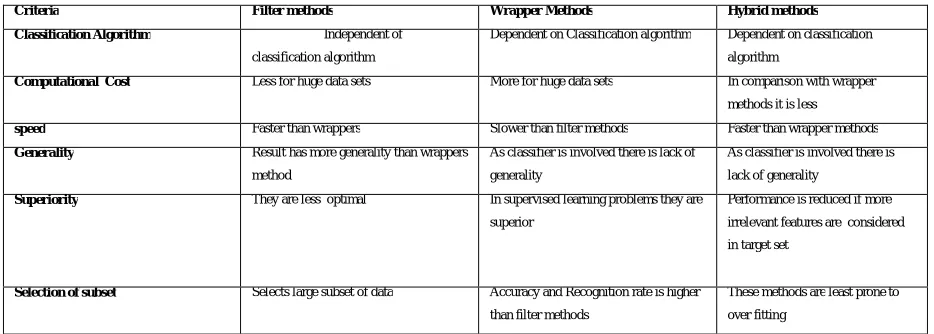
Criteria Filter methods Wrapper Methods Hybrid methods
Classification Algorithm Independent of
classification algorithm
Dependent on Classification algorithm Dependent on classification
algorithm
Computational Cost Less for huge data sets More for huge data sets In comparison with wrapper
methods it is less
speed Faster than wrappers Slower than filter methods Faster than wrapper methods
Generality Result has more generality than wrappers
method
As classifier is involved there is lack of
generality
As classifier is involved there is
lack of generality
Superiority They are less optimal In supervised learning problems they are
superior
Performance is reduced if more
irrelevant features are considered
in target set
Selection of subset Selects large subset of data Accuracy and Recognition rate is higher
than filter methods
These methods are least prone to
over fitting
Feature Extraction Techniques for Speech Recognition
Speech is the way of communication between human beings. It is defined as a process automatically recognizes the spoken words of person based on given speech signal information. It is also known as Automatic Speech Recognition or computer speech recognition and speech to text conversion. . To recognize the speech feature extraction and word recognition these two steps are followed. After feature extraction, feature matching is performed for word recognition. Ghule, Kishori R., and R. R. Deshmukh[75] reviewed about some techniques like Mel frequency Cepstral Coefficient MFCC, Linear prediction coding LPC, Linear prediction cepstral coefficient (LPCC), Discrete Wavelet Transform (DWT). MFCC is the most popular feature extraction technique.
Correlation based feature selection techniques
A feature should be highly correlated to the class and not much correlated to any other feature of the class.[34]
Entropy is a measure of uncertainty of a random variable. It can be defined by the following
H(X) = - ∑P (xi) log2 (P (xi ) (8)
And the entropy of X after observing values of another variable Y is defined as
H(X/Y) = - -∑P (yj) ∑P (xi/yj) log2 (P (xi / yj)) (9)
Here, P (xi) is the prior probabilities for all values of X, and P (xi/yj) is the posterior probabilities of X when values of
Y are given Entropy is a measure of correlation between two variables. .[18][19][20].
VII. DIMENSIONALITYREDUCTION
This techniques extract features by projecting input data into a lower dimensional subspace . Principal Component Analysis[169] , Random projection and Linear Discriminant Analysis are some methods.
Reducing the dimensionality of a dataset is an important and often challenging task.[172][173] This can be done by either reducing the number of features, a task called feature selection, or by reducing the number of patterns, called data reduction.
This methods were applied to classification methods [156][157][158]. The reduction of the patterns in a dataset, a lot of different techniques have been developed over the past few years. These include Statistical methods such as Chi-square [159], Similarity [160][171] and Aggregation [161]), Geometrical methods [162], Clustering (both classic [163] and fuzzy [164]), Autoregressive (AR) techniques [165], PCA [160][164], Singular Value Decomposition (which is one of the most popular methods) [164][166], Wavelets (DWT) [165], Independent Component Analysis [160], Fourier Decomposition (DFT [165] and a variation of FA [167]), SOM [168] and an alternative data reduction approach (ALEV) [168].
Diagonal features for character recognition
reduces the time cost from O(d2) to O(d log d), where d is the data dimensionality, with almost no compromise in kernel approximation quality compared to ORF.
VIII. FASTCLUSTERINGBASEDFEATURESELECTIONALGORITHMFORHIGHDIMENSIONAL DATA
The main concept of the FAST clustering feature selection algorithm is to cluster subsets with most similar characteristics while removing irrelevant subsets from that cluster. This FAST algorithm has both efficiency and accuracy for finding required set. The FAST algorithm has two steps the first step is it uses minimum spanning tree to divide data into different clusters and the in second step, it removes irrelevant sets and gives accurate and efficient result. All clusters formed using FAST algorithms are independent of each other. It is discussed further in [39][40][41][42][43][44][45][46][47][48].
Figure. 7. Basic Framework of FAST algorithm
IX. CHALLENGESINFEATUREEXTRACTIONMETHODS
Few specified below are the upcoming challenges in feature extraction methods.
9.1 Large Scale Machine Learning
In most of the domains today , data is arriving faster than the algorithm is able to learn from it. To avoid wasting this data, we must switch from the traditional "one-shot" machine learning approach to systems that are able to mine continuous, high-volume, open-ended data streams as they arrive. The authors Domingos, Pedro, and Geoff Hulten [3][4][5]have identified developed an approach to building stream mining algorithms that satisfies all of them. The approach is based on explicitly minimizing the number of examples used in each learning step, while guaranteeing that user-defined targets for predictive performance are met. So far, Hulten, Geoff, and Pedro Domingos [6][7][8] have applied this approach to four major (and widely differing) types of learner: decision tree induction, Bayesian network
Irrelevant feature Removal
Data Set
Minimum Spanning Tree
Construction
Tree partition & representation
feature selection
learning, k-means clustering, and the EM algorithm for mixtures of Gaussians. The researchers ultimate goal is to develop a set of primitives such that any learning algorithm built using them scales automatically to arbitrarily large data streams.[9] has given good insights of future problems in machine learning.[3] This paper introduced Hoeffding trees, a method for learning online from the high-volume data streams that are increasingly common. Hoeffding trees allow learning in very small constant time and have strong guarantees of high asymptotic similarity to the corresponding batch trees. VFDT is a high-performance data mining system based on Hoeffding trees.
Domingos, Pedro, and Geoff Hulten [4] [5] derives an upper bound for learner’s loss as a function of number of examples used in each step of the algorithm. Then minimizes each step while guaranteeing the no change in model with infinite data. It is empirically applied to K-means algorithm. Bottou, Léon, Frank E. Curtis, and Jorge Nocedal provides a review and commentary on the past, present, and future of numerical optimization algorithms in the context of machine learning applications[10]
9.2 Fuzzy Based feature extraction
The authors Pal, Nikhil R., Vijay K. Eluri, and Gautam K. Manda [57] and Nagalakshmi, G., and S. Jyothi [99] discusses about fuzzy based feature extraction method. Sammon’s non linear projection method lacks predictability and is ineffective for large data sets This paper [58] Chaudhari, Narendra S., and AvishekGhosh introduces predictability implements an extension of Sammon’s algorithm using fuzzy logic approach.
Clifton, David A., and Bruce W. Pilsworth gives the review of existing methods as histogram method and parametric Gaussian method.[59]. Histograms produce a density estimate of a series of data . From the density estimate, a probability distribution can be derived by multiplying each bin height by its bin width. Parametric Gaussian method assumes the data to be Gaussian. But the data may be skewed or multimodal which gives inaccurate results.
kernel method [59]: The kernel method is an improvement over the existing two methods for creating a density estimate. It produces highly smooth density estimates for highly skewed and multi-modal distributions, and thus exhibits the quality of robustness that is required.
Linguistic label method[59]: The concept behind this method is a novel one, and contrasts with the strictly statistical
concepts used by the Kernel Method. It is based on the idea of computing with words by intuitively categorizing data using linguistic labels. Three Linguistic label methods are “FD1” “FD2” and “FD3” .The difference in these methods lies in the length of the interval in the series of data to find fuzzy features.
A novel feature extraction criterion, fuzzy maximum margin criterion (FMMC), is proposed by means of the maximum margin criterion (MMC) and fuzzy set theory by authors Cui, Yan, and Liya Fan[61]. The between-class and within-class fuzzy scatter matrices are redefined by incorporating the membership degrees of samples. Also the use of generalized singular value decomposition (GSVD) to the criterion makes the algorithm more effective. Yang, Wankou, et al [62] proposes a new method of feature extraction and recognition, namely, the fuzzy inverse Fisher discriminate analysis (FIFDA) based on the inverse Fisher discriminate criterion and fuzzy set theory.
9.3 Privacy Aware Machine Learning
Some of the following methods are used with sensitive data
Anonymization. The data set is transformed into a derived set that blurs the sensitive attributes without actually removing them altogether.[177]
Pseudonymization. Related to anonymization, Pseudonymization works by removing sensitive attributes and replacing them with a placeholder, while keeping the internal logical structure of the data set, i.e., records with the same sensitive attributes get assigned the same pseudonym.[177]
Functional Encryption. Functional encryption allows the calculation of certain mathematical operations on the encrypted values [177]
This document web page[178] give a study of statistical risk minimization problems under a version of privacy in which the data is kept confidential even from the learner
9.4 Role of saliency Maps in feature extraction
Saliency maps are reviewed by authors Verma, Jyoti, and Vineet Richhariya [56].There is a gap in the view-based object recognition literature between the image-based systems and the feature-based systems. While the image-based systems work with complex objects, e.g. faces, they are highly sensitive to occlusion, scale, and deformation. The feature-based systems, rely on highly sensitive feature extraction processes that perform poorly in the presence of surface markings or texture. Saliency map graph offers a robust, transformation invariant, multi scale representation of an image that not only captures the salient image structure, but provides the locality of representation required to support occluded object recognition[53]
Detection of salient image regions is useful for applications like image segmentation, adaptive compression, and region-based image retrieval.[50] this paper gives a novel method to determine salient regions in images using low-level features of luminance and color.[51].Sample sub windows at random positions with random sizes to extract features method is used by Moosmann, Franck, Diane Larlus, and Frederic Jurie.[52]
Existing CNN-based methods operate at the patch level instead of the pixel level. Resulting saliency maps are typically blurry, especially near the boundary of salient objects.[53] This paper introduces deep network consists of two complementary components, a pixel level fully convolutional stream and a segment-level spatial pooling stream.
9.5 Scalability
Usually a machine learning algorithm or feature extraction algorithm is tested on small data and then extended to large data sets. When the algorithm is extended to large data sets lot of problems come into play such as curse of dimensionality, computational complexity and processing time and learning time increases exponentially. To overcome this problem it has be obviously understood that algorithms should be competent for large data sets also.
[99] –[111][182] discuses about dimensionality reduction in clustering and feature selection using feature weights. Is the algorithm chosen scalable? On What parameter data is driving?
X. RELEVANTANDOPTIMALFEATURES
Based on a review of previous definitions of feature relevance, [180 ] [181] classified features into three disjoint categories, namely, strongly relevant, weakly relevant, and irrelevant features.
Let F be a full set of features, Fi a feature, and Si = F − {Fi}. These categories of relevance can be formalized as follows.
Definition 1 (Strong relevance)A feature Fi is strongly relevant iff P(C | Fi, Si) P(C | Si).
Definition 2 (Weak relevance)A feature Fi is weakly relevant iff P(C | Fi, Si) = P(C | Si), and ∃ S’i ⊂Si, such that P(C
| Fi,S’i)P(C | S’i).
Suitable Feature extraction algorithm
Feature extraction is highly subjective in nature, it depends on what type of problem you are solving. There is no generic feature extraction algorithm which works in all cases. Like classifiers, it is not possible to say which is the best algorithm for featureselection or extraction.It depends on your application .The questions you can answer and choose the best algorithm are
What kind of problem are you solving? (classification, regression, clustering, etc.) Do you have a huge data?
Does your data has very high dimensionality? Is the datalabeled?
What do you want to perform feature extraction or feature selection? Which method you want to use a supervised or unsupervised method?
XI. CONCLUSION
This paper gives a brief review of the existing methods present in feature extraction in different applications. The method that you choose for feature extraction for your application depends on many factors. Also this paper discusses about the latest challenges in feature extraction.
REFERENCES
[1] Guyon, Isabelle, and André Elisseeff. "An introduction to variable and feature selection." Journal of machine learning research 3.Mar (2003): 1157-1182.
[2] Yager, Ronald R., and Liping Liu, eds. Classic works of the Dempster-Shafer theory of belief functions. Vol. 219. Springer, 2008.
[3] Domingos, Pedro, and Geoff Hulten. "Mining high-speed data streams." Proceedings of the sixth ACM SIGKDD international conference on Knowledge discovery and data mining. ACM, 2000.
[4] Domingos, Pedro, and Geoff Hulten. "A general method for scaling up machine learning algorithms and its application to clustering." ICML. Vol. 1. 2001.
[5] Domingos, Pedro, and Geoff Hulten. "Learning from infinite data in finite time." Advances in neural information processing systems. 2002. [6] Hulten, Geoff, and Pedro Domingos. "Mining complex models from arbitrarily large databases in constant time." Proceedings of the eighth
ACM SIGKDD international conference on Knowledge discovery and data mining. ACM, 2002.
[7] Hulten, Geoff, Pedro Domingos, and Yeuhi Abe. "Mining massive relational databases." Proceedings of the IJCAI-2003 workshop on learning statistical models from relational data. 2003.
[8] Hulten, Geoff, Laurie Spencer, and Pedro Domingos. "Mining time-changing data streams." Proceedings of the seventh ACM SIGKDD international conference on Knowledge discovery and data mining. ACM, 2001.
[9] Domingos, Pedro. "Structured machine learning: Ten problems for the next ten years." Proc. of the Annual Intl. Conf. on Inductive Logic Programming. 2007.
[10] Bottou, Léon, Frank E. Curtis, and Jorge Nocedal. "Optimization methods for large-scale machine learning." arXiv preprint arXiv:1606.04838 (2016).
[11] Aichert, André. "Feature extraction techniques." Camp Medical Seminar. Vol. 13. 2008.
[12] Bane, Shilpa, and D. R. Pawar. "Survey on Feature Extraction methods in Object Recognition." International Journal of Computer Science and Information Technologies, vol 5 (2014): 3224-3226.
[13] Bencharef, O., et al. "Color objects recognition system based on artificial neural network with Zernike, Hu & Geodesic descriptors." Sciences of Electronics, Technologies of Information and Telecommunications (SETIT), 2012 6th International Conference on. IEEE, 2012.
[14] Yang, Mingqiang, Kidiyo Kpalma, and Joseph Ronsin. "A survey of shape feature extraction techniques." (2008): 43-90.
[15] Zhang, Dengsheng, and Guojun Lu. "Review of shape representation and description techniques." Pattern recognition 37.1 (2004): 1-19. [16] Horn, Berthold. Robot vision. MIT press, 1986.
[17] Felix, X. Yu, et al. "Orthogonal random features." Advances in Neural Information Processing Systems. 2016
[23] Rao, L. Koteswara, D. Venakata Rao, and P. Rohini. "Integration of Color and MDLEP as a Feature Vector in Image Indexing and Retrieval System." Proceedings of the International Congress on Information and Communication Technology. Springer Singapore, 2016.
[24] Rohini P, KoteswaraRao L, VenkataRao D, “Combination of CDLEP and Gabor Transform for CBIR” Conference proceeding s by Springer AISC at IC3T – 2015 during July 2015
[25] Geng, Xiubo, et al. "Feature selection for ranking." Proceedings of the 30th annual international ACM SIGIR conference on Research and development in information retrieval. ACM, 2007.
[26] Ghareb, Abdullah Saeed, Azuraliza Abu Bakar, and Abdul Razak Hamdan. "Hybrid feature selection based on enhanced genetic algorithm for text categorization." Expert Systems with Applications 49 (2016): 31-47.
[27] Kabir, Md Monirul, Md Shahjahan, and Kazuyuki Murase. "A new local search based hybrid genetic algorithm for feature selection." Neurocomputing 74.17 (2011): 2914-2928.
[28] Apolloni, Javier, Guillermo Leguizamón, and Enrique Alba. "Two hybrid wrapper-filter feature selection algorithms applied to high-dimensional microarray experiments." Applied Soft Computing 38 (2016): 922-932.
[29] Talavera, Luis. "An evaluation of filter and wrapper methods for feature selection in categorical clustering." Advances in Intelligent Data Analysis VI (2005): 742-742.
[30] Das, Sanmay. "Filters, wrappers and a boosting-based hybrid for feature selection." ICML. Vol. 1. 2001.
[31] Xing, Eric P., Michael I. Jordan, and Richard M. Karp. "Feature selection for high-dimensional genomic microarray data." ICML. Vol. 1. 2001. [32] Liu, Huan, and Lei Yu. "Toward integrating feature selection algorithms for classification and clustering." IEEE Transactions on knowledge
and data engineering 17.4 (2005): 491-502.
[33] Sivagaminathan, Rahul Karthik, and Sreeram Ramakrishnan. "A hybrid approach for feature subset selection using neural networks and ant colony optimization." Expert systems with applications 33.1 (2007): 49-60.
[34] Yu, Lei, and Huan Liu. "Feature selection for high-dimensional data: A fast correlation-based filter solution." Proceedings of the 20th international conference on machine learning (ICML-03). 2003.
[35] Somol, Petr, et al. "Adaptive floating search methods in feature selection." Pattern recognition letters 20.11 (1999): 1157-1163.
[36] Ghareb, Abdullah Saeed, Azuraliza Abu Bakar, and Abdul Razak Hamdan. "Hybrid feature selection based on enhanced genetic algorithm for text categorization." Expert Systems with Applications 49 (2016): 31-47.
[37] Dash, Manoranjan, et al. "Feature selection for clustering-a filter solution." Data Mining, 2002. ICDM 2003. Proceedings. 2002 IEEE International Conference on. IEEE, 2002.
[38] Sutar, Swapnil A., and Devendra P. Gadekar. "Survey on Fast Clustering Based Feature Selection Algorithm for High Dimensional Data." International journal of science and research 3.12 (2014): 691-694.
[39] Song, Qinbao, Jingjie Ni, and Guangtao Wang. "A fast clustering-based feature subset selection algorithm for high-dimensional data." IEEE transactions on knowledge and data engineering 25.1 (2013): 1-14.
[40] Yu, Lei, and Huan Liu. "Feature selection for high-dimensional data: A fast correlation-based filter solution." Proceedings of the 20th international conference on machine learning (ICML-03). 2003.
[41] Dash, Manoranjan, Huan Liu, and Hiroshi Motoda. "Consistency based feature selection." Pacific-Asia conference on knowledge discovery and data mining. Springer Berlin Heidelberg, 2000.
[42] Chopade, Nitin B., and Beena S. Khade. "A New Clustering Based Algorithm for Feature Subset Selection."
[43] Feng, Dingcheng, Feng Chen, and Wenli Xu. "Efficient leave-one-out strategy for supervised feature selection." Tsinghua Science and Technology 18.6 (2013): 629-635.
[44] Deng, Houtao, and George Runger. "Feature selection via regularized trees." Neural Networks (IJCNN), The 2012 International Joint Conference on. IEEE, 2012.
[45] Sun, Yijun, Sinisa Todorovic, and Steve Goodison. "Local-learning-based feature selection for high-dimensional data analysis." IEEE transactions on pattern analysis and machine intelligence 32.9 (2010): 1610-1626.
[46] Saha, Sriparna, et al. "Feature selection and semi-supervised clustering using multiobjective optimization." SpringerPlus 3.1 (2014): 465. [47] Munieswari, R., and S. Saranya. "A Survey on Feature Selection Using FAST Approach to Reduce High Dimensional Data." International
Journal of Engineering Trends and Technology (IJETT) 8.5 (2014).
[48] JesnaJose,”FastforFeatureSubset SelectionOverDataset” InternationalJournal of Science and Research (IJSR), Volume3Issue6, June2014.
[49] Srivastava, Shweta, Nikita Joshi, and Madhvi Gaur. "A review paper on feature selection methodologies and their applications." International Journal of Computer Science and Network Security (IJCSNS) 14.5 (2014): 78.
[50] Achanta, Radhakrishna, et al. "Salient region detection and segmentation." Computer Vision Systems (2008): 66-75
[51] Gao, Dashan, and Nuno Vasconcelos. "Discriminant saliency for visual recognition from cluttered scenes." Advances in neural information processing systems. 2005.
[52] Moosmann, Franck, Diane Larlus, and Frederic Jurie. "Learning saliency maps for object categorization." International Workshop on The Representation and Use of Prior Knowledge in Vision (in ECCV'06). 2006.
[53] Shokoufandeh, Ali, Ivan Marsic, and Sven J. Dickinson. "View-based object recognition using saliency maps." Image and Vision Computing 17.5 (1999): 445-460.
[54] Li, Guanbin, and Yizhou Yu. "Deep contrast learning for salient object detection." Proceedings of the IEEE Conference on Computer Vision and Pattern Recognition. 2016.
[55] He, Zhiyong, Xin Chen, and Lining Sun. "Saliency mapping enhanced by structure tensor." Computational intelligence and neuroscience 2015 (2015): 3.
[57] Pal, Nikhil R., Vijay K. Eluri, and Gautam K. Mandal. "Fuzzy logic approaches to structure preserving dimensionality reduction." IEEE Transactions on Fuzzy Systems 10.3 (2002): 277-286.
[58] Chaudhari, Narendra S., and Avishek Ghosh. "Feature Extraction Using Fuzzy Rule Based System." IJCSA 5.3 (2008): 1-8. [59] Clifton, David A., and Bruce W. Pilsworth. "Critical Comparison of Methods of Fuzzy Feature Extraction."
[60] Grabisch, Michel. "Fuzzy integral for classification and feature extraction." Fuzzy measures and integrals: Theory and Applications (2000): 415-434.
[61] Cui, Yan, and Liya Fan. "Feature extraction using fuzzy maximum margin criterion." Neurocomputing 86 (2012): 52-58. [62] Yang, Wankou, et al. "Feature extraction using fuzzy inverse FDA." Neurocomputing 72.13 (2009): 3384-3390.
[63] Chang, Edward, et al. "CBSA: content-based soft annotation for multimodal image retrieval using Bayes point machines." IEEE Transactions on Circuits and Systems for Video Technology 13.1 (2003): 26-38.
[64] Li, Jia, and James Ze Wang. "Automatic linguistic indexing of pictures by a statistical modeling approach." IEEE Transactions on pattern analysis and machine intelligence25.9 (2003): 1075-1088.
[65] Mei, Tao, et al. "Coherent image annotation by learning semantic distance." Computer Vision and Pattern Recognition, 2008. CVPR 2008. IEEE Conference on. IEEE, 2008.
[66] Barnard, Kobus, et al. "Matching words and pictures." Journal of machine learning research 3.Feb (2003): 1107-1135.
[67] Jeon, Jiwoon, Victor Lavrenko, and Raghavan Manmatha. "Automatic image annotation and retrieval using cross-media relevance models." Proceedings of the 26th annual international ACM SIGIR conference on Research and development in informaion retrieval. ACM, 2003.
[68] Jeon, Jiwoon, Victor Lavrenko, and Raghavan Manmatha. "Automatic image annotation and retrieval using cross-media relevance models." Proceedings of the 26th annual international ACM SIGIR conference on Research and development in informaion retrieval. ACM, 2003.
[69] Zha, Zheng-Jun, et al. "Joint multi-label multi-instance learning for image classification." Computer Vision and Pattern Recognition, 2008. CVPR 2008. IEEE Conference on. IEEE, 2008.
[70] Blei, David M., and Michael I. Jordan. "Modeling annotated data." Proceedings of the 26th annual international ACM SIGIR conference on Research and development in informaion retrieval. ACM, 2003.
[71] Wang, Yong, et al. "Combining global, regional and contextual features for automatic image annotation." Pattern Recognition42.2 (2009): 259-266.
[72] Lisin, Dimitri A., et al. "Combining local and global image features for object class recognition." Computer Vision and Pattern Recognition-Workshops, 2005. CVPR Workshops. IEEE Computer Society Conference on. IEEE, 2005.
[73] Lowe, David G. "Distinctive image features from scale-invariant keypoints." International journal of computer vision60.2 (2004): 91-110. [74] Jindal, Anita, Renu Dhir, and Rajneesh Rani. "Diagonal Features and SVM Classifier for Handwritten Gurumukhi Character
Recognition." International Journal of Advanced Research in Computer Science and Software Engineering 2.5 (2012).
[75] Ghule, Kishori R., and R. R. Deshmukh. "Feature Extraction Techniques for Speech Recognition: A Review." International Journal of Scientific & Engineering Research 6.5 (2015): 2229-5518.
[76] Panchanathan, Sethuraman, et al. "The role of color in content-based image retrieval." Image Processing, 2000. Proceedings. 2000 International Conference on. Vol. 1. IEEE, 2000.
[77] Chen, Wei-Ta, Wei-Chuan Liu, and Ming-Syan Chen. "Adaptive color feature extraction based on image color distributions." IEEE Transactions on image processing 19.8 (2010): 2005-2016.
[78] Pei, Soo-Chang, and Ching-Min Cheng. "Color image processing by using binary quaternion-moment-preserving thresholding technique." IEEE Transactions on Image Processing 8.5 (1999): 614-628.
[79] Patil, Sandip S., and Atul V. Dusane. "Use of color feature extraction technique based on color distribution and relevance feedback for content based image retrieval." International Journal of Computer Applications 52.17 (2012).
[80] Maheshwary, P. R. I. T. I., and N. A. M. I. T. A. Srivastava. "Retrieval of remote sensing images using color, texture and spectral features." International Journal of Engineering Science and Technology 2.9 (2010): 4306-4311.
[81] Pujari, Jagadeesh, and P. Hiremath. "Content based image retrieval based on color texture and shape features using image and its complement." International Journal of Computer Science and Security 1.4 (2007): 25-35.
[82] Saad, Michele. "Low-level color and texture feature extraction for content-based image retrieval." Final Project Report, EE K381 (2008): 20-28.
[83] Zhao, Qiang, et al. "Stone images retrieval based on color histogram." Image Analysis and Signal Processing, 2009. IASP 2009. International Conference on. IEEE, 2009.
[84] Hafner, James, et al. "Efficient color histogram indexing for quadratic form distance functions." IEEE transactions on pattern analysis and machine intelligence 17.7 (1995): 729-736.
[85] Swain, Michael J., and Dana H. Ballard. "Color indexing." International journal of computer vision 7.1 (1991): 11-32.
[91] Lin, Chuen-Horng, Rong-Tai Chen, and Yung-Kuan Chan. "A smart content-based image retrieval system based on color and texture feature." Image and Vision Computing 27.6 (2009): 658-665.
[92] Huang, Jing, et al. "Image indexing using color correlograms." Computer Vision and Pattern Recognition, 1997. Proceedings., 1997 IEEE Computer Society Conference on. IEEE, 1997.
[93] Paschos, George, Ivan Radev, and Nagarajan Prabakar. "Image content-based retrieval using chromaticity moments." IEEE Transactions on Knowledge and Data Engineering 15.5 (2003): 1069-1072.
[94] Shao, Hong, et al. "Image retrieval based on MPEG-7 dominant color descriptor." Young Computer Scientists, 2008. ICYCS 2008. The 9th International Conference for. IEEE, 2008.
[95] Talib, Ahmed, et al. "A weighted dominant color descriptor for content-based image retrieval." Journal of Visual Communication and Image Representation 24.3 (2013): 345-360.
[96] Yang, Nai-Chung, et al. "A fast MPEG-7 dominant color extraction with new similarity measure for image retrieval." Journal of Visual Communication and Image Representation19.2 (2008): 92-105.
[97] Wang, Xiang-Yang, Hong-Ying Yang, and Dong-Ming Li. "A new content-based image retrieval technique using color and texture information." Computers & Electrical Engineering 39.3 (2013): 746-761.
[98] Yang, Nai-Chung, et al. "A fast MPEG-7 dominant color extraction with new similarity measure for image retrieval." Journal of Visual Communication and Image Representation19.2 (2008): 92-105.
[99] Nagalakshmi, G., and S. Jyothi. "Prawn Recognition on Fuzzy Based Feature Vectors with Image Segmentation." International Journal of Advanced Research in Computer Science and Software Engineering 6.5 (2016).
[100] Berchtold, Stefan, Christian Böhm, and Hans-Peter Kriegal. "The pyramid-technique: towards breaking the curse of dimensionality." ACM SIGMOD Record. Vol. 27. No. 2. ACM, 1998.
[101] Berchtold, Stefan, et al. "A cost model for nearest neighbor search in high-dimensional data space." Proceedings of the sixteenth ACM SIGACT-SIGMOD-SIGART symposium on Principles of database systems. ACM, 1997.
[102] Berchtold, S., Keim, D.A., Kriegel, H.-P.: The X-tree: An index structure for high dimensional data. Proc. 22nd VLDB Conf. (1996) 28–39 [103] Ravi Kanth, K. V., Divyakant Agrawal, and Ambuj Singh. "Dimensionality reduction for similarity searching in dynamic databases." ACM
SIGMOD Record. Vol. 27. No. 2. ACM, 1998.
[104] Katayama, Norio, and Shin'ichi Satoh. "The SR-tree: An index structure for high-dimensional nearest neighbor queries." ACM Sigmod Record. Vol. 26. No. 2. ACM, 1997.
[105] Kruskal, Joseph B. "Multidimensional scaling by optimizing goodness of fit to a nonmetric hypothesis." Psychometrika29.1 (1964): 1-27. [106] Kruskal, Joseph B. "Multidimensional scaling and other methods for discovering structure." Statistical methods for digital computers 3 (1977):
296-339.
[107] Hristescu, Gabriela, and Martin Farach-Colton. "Cofe: A scalable method for feature extraction from complex objects." Lecture notes in computer science (2000): 358-371.
[108] Bryant, Devon Leno. Scalable Audio Feature Extraction. Diss. University of Colorado Colorado Springs, 2014.
[109] McKay, Cory, Ichiro Fujinaga, and Philippe Depalle. "jAudio: A feature extraction library." Proceedings of the International Conference on Music Information Retrieval. 2005.
[110] Lecerf, Loic, and Boris Chidlovskii. "Scalable feature extraction from noisy documents." Document Analysis and Recognition, 2009. ICDAR'09. 10th International Conference on. IEEE, 2009.
[111] Masud, Mohammad M., Latifur Khan, and Bhavani Thuraisingham. "A scalable multi-level feature extraction technique to detect malicious executables." Information Systems Frontiers 10.1 (2008): 33-45.
[112] Stanchev, Peter, David Green Jr, and Boyan Dimitrov. "High level color similarity retrieval." (2003).
[113] Jain, Anil K., and Aditya Vailaya. "Image retrieval using color and shape." Pattern recognition 29.8 (1996): 1233-1244. [114] Flickner, Myron, et al. "Query by image and video content: The QBIC system." computer 28.9 (1995): 23-32.
[115] Pass, Greg, and Ramin Zabih. "Histogram refinement for content-based image retrieval." Applications of Computer Vision, 1996. WACV'96., Proceedings 3rd IEEE Workshop on. IEEE, 1996.
[116] J. Huang, S. Kuamr, M. Mitra, et al., “Image indexing using colorcorrelogram”, In Proc. CVPR, (1997), pp. 762-765
[117] Zhang, Dengsheng, Md Monirul Islam, and Guojun Lu. "A review on automatic image annotation techniques." Pattern Recognition 45.1 (2012): 346-362.
[118] ] https://en.wikipedia.org/wiki/Feature_extraction
[119] Nixon, Mark S., and Alberto S. Aguado. Feature extraction & image processing for computer vision. Academic Press, 2012.
[120] Arivazhagan, Sundaram, L. Ganesan, and S. Padam Priyal. "Texture classification using Gabor wavelets based rotation invariant features." Pattern recognition letters 27.16 (2006): 1976-1982.
[121] ] https://in.mathworks.com/help/images/texture-analysis.html
[122] Shidnal, Sushila. "A texture feature extraction of crop field images using GLCM approach." IJSEAT 2.12 (2015): 1006-1011.
[123] Materka, Andrzej, and Michal Strzelecki. "Texture analysis methods–a review." Technical university of lodz, institute of electronics, COST B11 report, Brussels (1998): 9-11.
[124] Prathusha.Perugu et.al A Innovative method for Image retrieval using perceptual textural features International Journal of Engineering Research and Applications (IJERA) ISSN: 2248-9622 www.ijera.com Vol. 2, Issue 5, September- October 2012, pp.246
[125] Abbadeni, Noureddine. "Computational perceptual features for texture representation and retrieval." IEEE transactions on image processing 20.1 (2011): 236-246.
[126] Rosenfeld, Azriel, and Avinash C. Kak. "Digital picture processing, vol. 2." (1982): 55-190. [127] Levine, Martin D. Vision in man and machine. McGraw-Hill College, 1985.
[129] Cross, George R., and Anil K. Jain. "Markov random field texture models." IEEE Transactions on Pattern Analysis and Machine Intelligence 1 (1983): 25-39.
[130] Pentland, Alex P. "Fractal-based description of natural scenes." IEEE transactions on pattern analysis and machine intelligence 6 (1984): 661-674.
[131] Chellappa, Rama, and Shankar Chatterjee. "Classification of textures using Gaussian Markov random fields." IEEE Transactions on Acoustics, Speech, and Signal Processing33.4 (1985): 959-963.
[132] Derin, Haluk, and Howard Elliott. "Modeling and segmentation of noisy and textured images using Gibbs random fields." IEEE Transactions on pattern analysis and machine intelligence 1 (1987): 39-55.
[133] Manjunath, B. S., and Rama Chellappa. "Unsupervised texture segmentation using Markov random field models." IEEE Transactions on Pattern Analysis and Machine Intelligence 13.5 (1991): 478-482.
[134] Strzelecki, M., and A. Materka. "Markov random fields as models of textured biomedical images." Proc. 20th National Conf. Circuit Theory and Electronic Networks KTOiUE’97. 1997.
[135] Lu, Chun S., Pau C. Chung, and Chih F. Chen. "Unsupervised texture segmentation via wavelet transform." Pattern Recognition 30.5 (1997): 729-742.
[136] Laine, Andrew, and Jian Fan. "Texture classification by wavelet packet signatures." IEEE Transactions on pattern analysis and machine intelligence 15.11 (1993): 1186-1191.
[137] Mallat, Stephane G. "Multifrequency channel decompositions of images and wavelet models." IEEE Transactions on Acoustics, Speech, and Signal Processing 37.12 (1989): 2091-2110.
[138] Rosenfeld, Azriel, and Joan S. Weszka. "Picture recognition." Digital pattern recognition. Springer, Berlin, Heidelberg, 1980. 135-166. [139] Daugman, John G. "Uncertainty relation for resolution in space, spatial frequency, and orientation optimized by two-dimensional visual
cortical filters." JOSA A 2.7 (1985): 1160-1169.
[140] Bovik, Alan C., Marianna Clark, and Wilson S. Geisler. "Multichannel texture analysis using localized spatial filters." IEEE transactions on pattern analysis and machine intelligence 12.1 (1990): 55-73.
[141] Anuradha, K. "Statistical Feature extraction to classify oral cancers." Journal of Global Research in Computer Science4.2 (2013): 8-12. [142] Manjunath, Bangalore S., and Wei-Ying Ma. "Texture features for browsing and retrieval of image data." IEEE Transactions on pattern
analysis and machine intelligence 18.8 (1996): 837-842.
[143] Arivazhagan, S., and L. Ganesan. "Texture classification using wavelet transform." Pattern recognition letters 24.9 (2003): 1513-1521. [144] Arivazhagan, Sundaram, L. Ganesan, and S. Padam Priyal. "Texture classification using Gabor wavelets based rotation invariant
features." Pattern recognition letters 27.16 (2006): 1976-1982.
[145] Ojala, Timo, Matti Pietikäinen, and David Harwood. "A comparative study of texture measures with classification based on featured distributions." Pattern recognition 29.1 (1996): 51-59.
[146] k.subbareddy andDr.A.P.Siva Kumar “Analysis of LBP and its variations –A Survey” in International Conference for IETE journal 2016 [147] Zhang, Wenchao, et al. "Local gabor binary pattern histogram sequence (lgbphs): A novel non-statistical model for face representation and
recognition." Computer Vision, 2005. ICCV 2005. Tenth IEEE International Conference on. Vol. 1. IEEE, 2005.
[148] Heikkilä, Marko, Matti Pietikäinen, and Cordelia Schmid. "Description of interest regions with center-symmetric local binary patterns." ICVGIP. Vol. 6. 2006.
[149] Zhao, Guoying, et al. "Rotation-invariant image and video description with local binary pattern features." IEEE Transactions on Image Processing 21.4 (2012): 1465-1477.
[150] Daugman, John G. "Complete discrete 2-D Gabor transforms by neural networks for image analysis and compression." IEEE Transactions on Acoustics, Speech, and Signal Processing 36.7 (1988): 1169-1179.
[151] Tan, Xiaoyang, and Bill Triggs. "Enhanced local texture feature sets for face recognition under difficult lighting conditions." IEEE transactions on image processing 19.6 (2010): 1635-1650.
[152] Jabid, Taskeed, Md Hasanul Kabir, and Oksam Chae. "Local directional pattern (LDP) for face recognition." Consumer Electronics (ICCE), 2010 Digest of Technical Papers International Conference on. IEEE, 2010.
[153] Murala, Subrahmanyam, R. P. Maheshwari, and R. Balasubramanian. "Directional local extrema patterns: a new descriptor for content based image retrieval." International journal of multimedia information retrieval 1.3 (2012): 191-203.
[154] Reddy, P. Vijaya Bhaskar, and A. Rama Mohan Reddy. "Content based image indexing and retrieval using directional local extrema and magnitude patterns." AEU-International Journal of Electronics and Communications 68.7 (2014): 637-643.
[155] Rohini, P. "Integration of MDLEP and Gabor Function as a Feature Vector for Image Retrieval System." IUP Journal of Computer Sciences 10.1/2 (2016): 62.
[156] Frohlich, Holger, Olivier Chapelle, and Bernhard Scholkopf. "Feature selection for support vector machines by means of genetic algorithm." Tools with artificial intelligence, 2003. proceedings. 15th ieee international conference on. IEEE, 2003.
[162] Song, Hao, and Hsi-Yung Feng. "A global clustering approach to point cloud simplification with a specified data reduction ratio." Computer-Aided Design 40.3 (2008): 281-292.
[163] Okun, Oleg, and Helen Priisalu. "Unsupervised data reduction." Signal Processing 87.9 (2007): 2260-2267.
[164] Russell, Stephen, and Victoria Yoon. "Applications of wavelet data reduction in a recommender system." Expert Systems with Applications 34.4 (2008): 2316-2325.
[165] Polat, Kemal, and Salih Güneş. "A novel data reduction method: distance based data reduction and its application to classification of epileptiform EEG signals." Applied Mathematics and Computation 200.1 (2008): 10-27.
[166] Vanlanduit, S., et al. "Reduction of large frequency response function data sets using a robust singular value decomposition." Computers & structures 84.12 (2006): 808-822.
[167] Vanherzeele, J., et al. "Data reduction using a generalized regressive discrete Fourier series." Journal of sound and vibration 298.1 (2006): 1-11.
[168] Toplak, Werner. "A comparison of SOM and ALEV for data reduction purposes in transport telematics." Proc. of 26th IASTED International Conference on Artificial Intelligence and Applications, CD Proceedings ISBN. 2008.
[169] Yang, Jian, et al. "Two-dimensional PCA: a new approach to appearance-based face representation and recognition." IEEE transactions on pattern analysis and machine intelligence 26.1 (2004): 131-137.
[170] Otsu, Nobuyuki. "Mathematical studies on feature extraction in pattern recognition." Electrotechnical Laboratory, Researches818 (1981): 220. [171] Itoh, Hayato, et al. "Dimension reduction methods for image pattern recognition." International Workshop on Similarity-Based Pattern
Recognition. Springer, Berlin, Heidelberg, 2013.
[172] Lee, Kichun, Alexander Gray, and Heeyoung Kim. "Dependence maps, a dimensionality reduction with dependence distance for high-dimensional data." Data Mining and Knowledge Discovery 26.3 (2013): 512-532.
[173] Wang, Jingyan, et al. "Iterated large-margin discriminant analysis for feature dimensionality reduction in medical image retrieval." International Journal of Biomedical Engineering and Technology 7.2 (2011): 116-134.
[174] Kieseberg, Peter, et al. "Protecting anonymity in data-driven biomedical science." Interactive Knowledge Discovery and Data Mining in Biomedical Informatics. Springer Berlin Heidelberg, 2014. 301-316.
[175] De Hert, Paul, and Vagelis Papakonstantinou. "The proposed data protection Regulation replacing Directive 95/46/EC: A sound system for the protection of individuals." Computer Law & Security Review 28.2 (2012): 130-142.
[176] Malle, Bernd, et al. "The right to be forgotten: towards machine learning on perturbed knowledge bases." International Conference on Availability, Reliability, and Security. Springer International Publishing, 2016.
[177] https://ercim-news.ercim.eu/en107/special/privacy-aware-machine-learning-and-the-right-to-be-forgotten [178] https://stanford.edu/~jduchi/projects/DuchiJoWa12_nips.pdf
[179] Hira, Zena M., and Duncan F. Gillies. "A review of feature selection and feature extraction methods applied on microarray data." Advances in bioinformatics 2015 (2015).
[180] Blum, Avrim L., and Pat Langley. "Selection of relevant features and examples in machine learning." Artificial intelligence 97.1 (1997): 245-271.
[181] John, George H., Ron Kohavi, and Karl Pfleger. "Irrelevant features and the subset selection problem." Machine learning: proceedings of the eleventh international conference. 1994.