Gesture Controlled Bipedal Walking Robot
Using Kinect
Neenu James1, Rose Maria Jose2
PG Student [VLSI& Embedded Systems], Dept. of ECE, V.J.C.E.T, Vazhakulam, Ernakulam, Kerala, India1
Assistant Professor, Dept. of ECE, Viswajyothi College of Engineering & Technology, Ernakulam, Kerala, India2
ABSTRACT: Recently, strong efforts have been carried out to develop natural andintelligent interfaces between computer and user based system on human gestures. Gestures provide an intuitive interface to both computer and human. The recent development in the field of gesture controlled biped robots include the gaming interface Xbox 360 released by Microsoft, another important area being depth image processing and skeletal tracking where the concept of gesture recognition is being widely used. In this paper, a gesture controlled bipedal robot than can walk, roll over and stand up is proposed using Kinect module. The movement of the user arm is monitored by the system using Kinect sensor. The skeletal image of the user’s arm obtained from the Kinect consists of joints and vectors. And to calculate angles between these two vectors, Coordinate Geometry is used here in this paper. The angles thus obtained are sent using ZigBee to the ARM7 microcontroller, which in turn generates signals which are sent to the six servo motors of the bipedal robot. The main objective of this paper is to navigate the bipedal robot using the Kinect sensor, which keeps the user’s hand free to control the robot.
KEYWORDS:Bipedal robot, Kinect, Gesture Recognition, Walking Pattern, ARM 7 Microcontroller.
I.INTRODUCTION
Robots for many people, it’s a machine that imitates like a human and it can be programmed to move, control objects and accomplish work while interacting with the environment. Robots are able to perform repetitive tasks more quickly, and accurately than humans. A bipedal robot is a type of humanoid robot which is used to imitate the human motion, i.e., it can walk on two legs without any external support for balancing. Balancing is the main aspect of producing a “stand and walk on two legs” phenomenon. With proper balancing, a bipedal becomes much more versatile as compared to the wheeled robots because of the fact that the base level of a bipedal is not fixed, thereby enabling the robot to raise itself on a higher terrain just by a simple motion of the knee joint.In general, a bipedal locomotion system consists of several members that are interconnected with actuated joints.
Human-Machine interaction is an important aspect of a successful robotic system and the gestures are having a crucial role in Human-Robot Interaction (HRI). Gestures are the body movements that are used to convey some piece of information from one person to the other. A significant development in gesture recognition can be seen with the Kinect sensor, which is a motion sensing device developed by Microsoft for Xbox 360 gaming console. At the input or the user end, the Kinect is programmed for some predefined gestures which are tracked using the Skelton tracking feature of the Kinect sensor. When the gesture is sensed, it is been processed in the system and a signal is transmitted wirelessly from the ZigBee on the system to the ZigBee on the bipedal robot. ARM7 microcontroller has been used to serve the purpose. It processes the received input and responds accordingly to move the servomotors in the robot. This paper introduces a technique to navigate the robot using only the Kinect sensor, which keeps the user’s hand free to control the robot, without any wearable sensors or remote controllers.
II.BACKGROUND
adjustable, and the Kinect software is capable of automatically calibrating the sensor based on the physical environment, accommodating for the presence of the user.
Fig. 1 Kinect Module
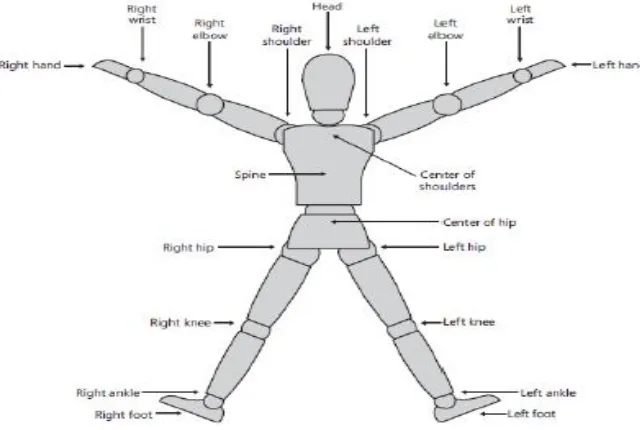
Skeleton tracking is one of the important features of the Kinect sensor. Kinect uses depth stream to detect the Skeleton tracking of human in front of camera. Due to this process Kinect can establish the positions of various skeleton joints on a human. A skeleton of human consists of 20 different positions, one for each joint of a human body as shown in Figure 2.
Fig. 2 The Twenty control points of a Skeleton
Even though Kinect has been designed to work with the Xbox 360 gaming station, but due to its ability in the field of mapping and 3D modelling in space, it become an attractive device for the researchers also. Microsoft had released the Kinect Software development Kit (SDK) for Windows. SDK enables developers to create applications that support voice and gesture recognition, using Kinect sensor technology. It allows the developer to write their application for Kinect in threedifferent programming languages such as Microsoft Visual C++, C#.Net and Visual Basic. Microsoft Visual C#.Net is widely used by programmers. C# is designed to be simple, type-safe, and powerful object oriented programming language.
from the environment, thus making the initial process easier and efficient. This makes it different from other papers which use more difficult methods to achieve the same.
III.BLOCK DIAGRAM
Angle computation and data transfer from Kinect to the system and manipulation of Biped robot using ARM 7 microcontroller are the two main parts in thisentiresystem. Figure 3 shows the block diagram of thewhole system.
Fig.3 Gesture Controlled Biped using Kinect
User
User determines the movement of the biped robot i.e. whether to move forward, backward, left, right or to kick the ball depending on the angles shown by user’s hand.
Kinect
Kinect sensor is used as the input device. It captures the human motion in real time and transfers the data to the system for processing.
Computer
Computer processes the information received from Kinect and converts it into a skeletal images by Microsoft SDK toolkit. It then calculates the angle between the vectors.
Wireless Serial Interface
It sends the angles serially from the computer to the ARM 7 microcontroller using ZigBee. ZigBee is used as a Serial Wireless communication device.
ARM 7
Depending on the angles received, the ARM 7 microcontroller is programmed to generate the PWM signals designed to move the servomotors to specific angles.
Bipedal Robot
The combined movement of the six servos at the six joints gives the required walking movement for the robot.
IV.DESIGN METHODOLOGY
Kinect and Angle Computation
The proper functioning of the Kinect based gesture controlled bipedal robot necessitates the proper computation of the angles formed by various vectors and joints. The following section describes the various steps involved in this process.
1. Motion Capture
2. Angle computation
The biped robot is a mechanical device that consists of multiple rigid structures called Links, connected by Joints. These joints and links (vectors) constitute a coordinate frame. The skeleton image program provides the coordinate frame and the various joint parameters on the basis of an arbitrary origin. The Skeleton image program is designed so that an arbitrary origin is set, a virtual coordinate system is constructed and the various coordinates of the joints are computed.
Fig. 4Constant Scaling
Here we are considering the coordinates of right shoulder, right elbow, left shoulder and left elbow. Consider the right shoulder with coordinates (X1, Y1, Z1) and right elbow with coordinates (X2, Y2, Z2) shown in figure 4. Angle between two vectors can be calculated using the following equation:
Angle, θ = ArcCos A.B (1)
||A||.||B||
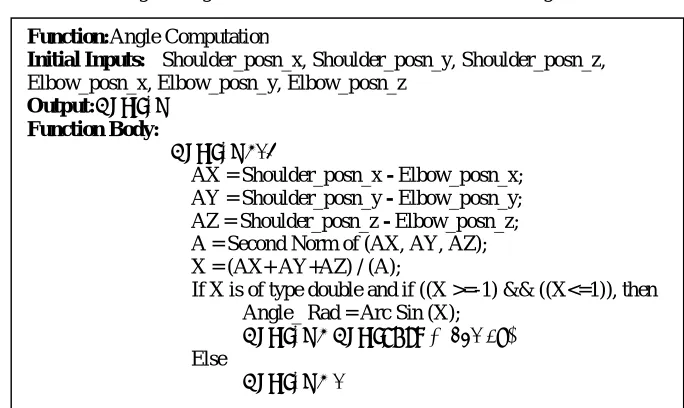
The pseudo code for calculating the angle between two vectors is shown in the Figure 5.
Fig.5. Pseudo code for computing Angles
3. Sending the computed angles by ZigBee
ZigBee is used to send the computed angles wirelessly to the ARM 7 microcontroller. Serial communication is done here, sending one bit at a time, sequentially, over a communication channel. Angle values are continuously transmitted to the servo motors of the biped in a string format ‘ #$ angle $ angle $ angle $ angle * ’.
Function:Angle Computation
Initial Inputs: Shoulder_posn_x, Shoulder_posn_y, Shoulder_posn_z, Elbow_posn_x, Elbow_posn_y, Elbow_posn_z
Output:Angle, θ Function Body:
Angle, θ =0;
AX = Shoulder_posn_x - Elbow_posn_x; AY = Shoulder_posn_y - Elbow_posn_y; AZ = Shoulder_posn_z - Elbow_posn_z; A = Second Norm of (AX, AY, AZ); X = (AX+ AY+AZ) / (A);
If X is of type double and if ((X >=-1) && ((X<=1)), then Angle_ Rad = Arc Sin (X);
Angle, θ = Angle_Rad * (180 / π)
Else
4. Servo Control
Based on the angle values received, servo motors rotate to corresponding angles. For example, when the biped receives ‘#$169$24$34$39*’ it moves forward and when it receives the string ‘#$162$28$115$30*’ the biped moves backward.
5. Bipedal Robot Programming Algorithm
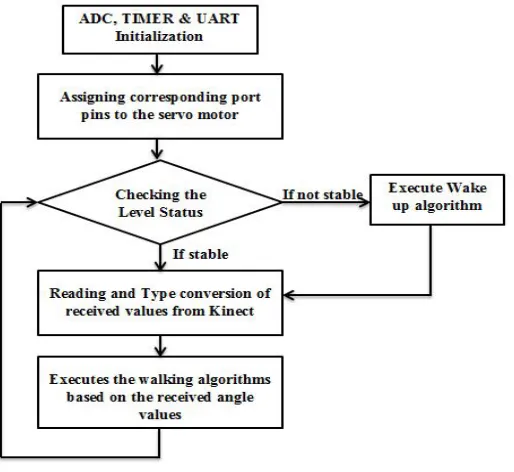
The serial communication is initialized by setting the baud rate to 115200 so that the information can be sent to the microcontroller serially. So we first initialize UART, Timer and ADC module.Then the 6 servo motors of the bipedal are connected to the corresponding GPIO pins of the ARM microcontroller and initialized as output.
Fig. 6BipedalProgram Flow
After assigning the port pins, determine the level status of the robot, whether it is in the standing stable position or in a slanting or lying position. If it is in an unstable position, then execute the wake up algorithm and if stable, then angle values are received through ZigBee and are converted in to the necessary input format. Based on the received angle values from Kinect, Bipedal robot executes the corresponding walking algorithms.The Bipedal program flow is shown in figure 6.
V. IMPLEMENTATION
Fig. 7Gesture controlled forward walking movement of bipedal robot
The figure 7 shows the Gesture controlled bipedal robot which moves forward when the user makes her left elbow in 1800 position. The walking movement of the bipedal robot is based on the gesture shown by the user, i.e. in figure 7 (a) when the user keep her left elbow in 1800position, then the Kinect captures the image and do the necessary computation and sends the angles to the microcontroller placed in the bipedal robot. The green line in the figure shows the skeletal image of the user. When the robot receives the angle, the bipedal robot moves forward. Figure 7 (b) shows the motion sequences of the bipedal robot when it moves forward.
VI.CONCLUSION
The new gesture recognition and controlling technique introduced in this paper allows the user to operate the bipedal robot in real time using Kinect sensor. The two main benefits of this method are that, it’s easy to develop and is of low cost. With this technique, the robot can move forward, backward, left, right and can avoid obstacles autonomously. And the main advantage of this technique is that it requires only the Kinect sensor for gesture recognition, and there is no need to use any controllers or inertial sensors to navigate the robot.
REFERENCES
[1] Koenemann, J. Bennewitz M, “Whole-body imitation of human motions with a Nao humanoid Human- Robot Interaction (HRI),” in 7th
ACM/IEEE International Conference 2012, vol. 32, no. 18, pp. 425-429, March 2012.
[2] Stephan Waldherr, Roseli Romero, Sebastian Tharun, “A Gesture Based Interface for Human-Robot Interaction,” Autonomous Robots, vol. 9, Issue 2, pp. 151-173, 2000.
[3] Webb, J. Ashley, J. Beginning, “Kinect Programming with the Microsoft Kinect SDK,” a press Media LLC New York, pp. 8586, Feb. 2012. [4] Y.Guan, L.Jiang, X.Zhang, J.Qui, “1-dof robotic joint modules and their applications in new robotics systems,” IEEE Int. Conference on
Robotics and Biometrics, pp. 1905-19910, April. 2008.
[5] Aaron D. Ames, “Human Inspired Control of Biped Walking Robots,” IEEE Transactions on Automatic control, vol. 59, no. 5, pp. 682-689, May 2014.
[6] Van den Bergh. M, Carton D, de Nijs.R, Mitsou N, Landsiedel C, Kuehnlenz K, Wollher D, Van Gool L, Buss M., “Realtime 3D hand gesture interactions with a robot for understanding directions from human, ”IEEE International symposium on robot and human interactive communication., vol. 7, pp. 357–362 ,July 2011.