ISSN 2286-4822
www.euacademic.org DRJI Value: 5.9 (B+)
Analysis of Problems Faced by the Working Women
in Non-Government Organizations
(A Case Study of District Mardan-KPK)
FARMAN ELAHI1
Research scholar Department of Rural Sociology The University of Agriculture Peshawar Pakistan ATTAULLAH SHAH City University of Science and Information Technology, Peshawar Pakistan
Abstract:
Work life balance is always a challenge for employed women due to psychological and social issues. The share of the female work force is marginal not because of mainly low literacy rates but also difficult job environment, lack of security and leisure time and other social issues. The present study was conducted to analyze the problems of working women in non-government organizations in district Mardan (KPK). A total of 100 samples were drawn randomly from the population. The study revealed that due to male domination in organization, women executives are disliked by male colleagues and hence male domination in organization put women at disadvantaged position. At the other hand, woman being an executive is disliked by male colleague. Organizations give special considerations to biological differences specific to woman i.e. maternity. The study concluded that despite the challenges in the working environment for women, confidence of the working women remained high. Women as equal partner to male need to be encouraged in the working environment without any apprehensions of being mistreated. Working women needs
to be properly educated through proper trainings to take care of both working environment and family life.
Key words: work life, female, job environment, security, leisure time
Introduction
Since inception of human race, women have been part of labor force, and domestic duties. However, this traditional perception began to change due to industrialization. During 19th century,
the role of so-called new women continued to evolve vividly in Europe and United States during World War 2 and 1950s. In 1972, the United States declaration of Title 7 of the Equal Opportunities Act abandoned discrimination in recruitments on basis of sex (Natasha & Kathryn, 2010). In Pakistan, the division of labor on the basis of productive and reproductive roles in society confined women to the reproductive roles by giving fewer opportunities of acceleration and career development to them resulting less stabilization of national development. (Farzana, 2000)
Research Methodology
Uni-variate analysis was carried out for independent and dependent variables, which consist of frequency distribution and percentages. Bi-variate analyses were carried out to study the association between independent and dependent variables. Chi-square (χ2) test was used to test the association between
the two variables. Following statistical procedure were adopted to calculate the value of chi-square statistics. Tai. (Tai, 1978)
(2) = ∑ ∑ (fij – Fij)2
Fi Fj Fij Where
(2) = Chi-square for two categorical variables
fij = the observed frequencies in the cross-classified category at ith row and jth column
Fij = the expected frequency for the same category, assuming no association between variables under investigation
Df = (r-1) (c-1) where
Df = Degree of freedom
r = the number of rows
c = the number of columns
Results and Discussion
It is a challenge for organizations not only to manage effective implementation of fair policies and reinforcing appropriate managerial behaviors but also to pay attention to their employees perceptions of discrimination, which is very important because employees beliefs, whether or not they are consistent with reality that directly affect their behaviors in workplace. (Eisenberger, Fasolo,and Davis-LaMastro, (1990), Barak, Cherin, and Berkman, (1998).
executive level positions, (Bose and Whaley, (2001), Fagenson and Jackson,(1993), Rice, (1994).
Boys and girls in most societies are socialized differently and this is played out in the work place later in their lives, where men always want to be in charge to dominate, (Lambani Matodzi and Nancy, (2013).
Further, the findings depict clearer picture of the subject under discussion.
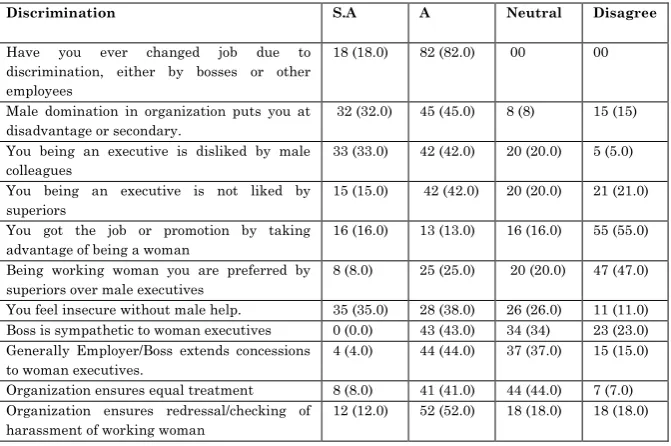
Table 1 below indicated that majority 82.0% respondents agreed that they have changed their job due to discrimination either by bosses or other employees. While on other hand 18 (18%) respondents strongly agreed with the statement. The result of the study disclosed that out of 100 respondents majority i-e 45 agreed that male domination in organization puts them at disadvantage or secondary positions. 32 respondents were strongly agreed, while 8 stayed neutral with the statement.
sympathetic to woman executives, (34%) stayed neutral, (23%) disagreed with the above statement.
The study indicates that about 44 respondents among 100 agreed that generally employer/boss extends concessions to woman executives, followed by 37 stayed neutral, 15 disagreed with the statement, 4 respondents while strongly agreed. Similarly, (44%) respondents among 100 respondents stayed neutral that organization ensures equal treatment, (41%) agreed with the statement, (8%) strongly agreed, while (7%) disagreed. Likewise, 52 strongly agreed that organization ensures redressal/checking of harassment of working woman, 18 stayed neutral, same as followed by 18 disagreed with the statement, and 12 respondents strongly agreed.
The study further shows that almost (65%) out of 100 respondents agreed that organization recognizes and gives special considerations to biological differences (Maternity) those are specific to woman, (24%) strongly agreed, while (11%) stayed neutral with the above statement.
Table 1: Frequency and percentage distribution of the respondents regarding discrimination.
Discrimination S.A A Neutral Disagree
Have you ever changed job due to discrimination, either by bosses or other employees
18 (18.0) 82 (82.0) 00 00
Male domination in organization puts you at disadvantage or secondary.
32 (32.0) 45 (45.0) 8 (8) 15 (15)
You being an executive is disliked by male colleagues
33 (33.0) 42 (42.0) 20 (20.0) 5 (5.0)
You being an executive is not liked by superiors
15 (15.0) 42 (42.0) 20 (20.0) 21 (21.0)
You got the job or promotion by taking advantage of being a woman
16 (16.0) 13 (13.0) 16 (16.0) 55 (55.0)
Being working woman you are preferred by superiors over male executives
8 (8.0) 25 (25.0) 20 (20.0) 47 (47.0)
You feel insecure without male help. 35 (35.0) 28 (38.0) 26 (26.0) 11 (11.0) Boss is sympathetic to woman executives 0 (0.0) 43 (43.0) 34 (34) 23 (23.0) Generally Employer/Boss extends concessions
to woman executives.
4 (4.0) 44 (44.0) 37 (37.0) 15 (15.0)
Organization recognizes and gives special considerations to biological differences (Maternity) those are specific to woman.
24 (24.0) 65 (65.0) 11 (11.0) 0 (0)
All the ways that women have ended up feeling badly about themselves
4(4.0) 25 (25.0) 40 (40.0) 31 (31.0)
*Values in the table present frequency while values in the parenthesis represent percentage*
Bivariate Analysis
Dependent variable (Undertaking family role) was cross tabulated with independent variable (discrimination) and appropriate statistics i.e. χ2 was used to ascertain the
relationship between the dependent and independent variables as shown below.
association detected between organization ensures equal treatment with undertaking family role. A highly significant (p=0.00) association found between organization ensures redressal/checking of harassment of working woman with undertaking family role. A significant (p = 0. 041) association detected between organization recognizes and gives special considerations to biological differences (Maternity) those are specific to woman with undertaking family role. A non-significant (p = 0.097) association was found between all the ways that women have ended up feeling badly about themselves and undertaking family role.
Association between Discrimination and Undertaking family role.
Discrimination Attitude Undertaking family
role
Total Chi square
(2) P value
satisfied Un
satisfied
Have you ever changed job due to discrimination, either by bosses or other employees
Yes 18 00 18(18.0) 2 = 24.439 (p = 0.000) No 59 (13.0) 23 (23.0) 82 (82.0)
Male domination in organization puts you at disadvantage or secondary
Strongly agree
23 (23.0) 9 (9.0) 31 (31.0) 2 = 9.016 (p = 0.029) Agree 38 (38.0) (00) 38 (38.0)
Neutral 8 (8.0) 7 (7.0) 15 (15.0) Disagree 8 (8.0) 8 (8.0) 16 (16.0) You being an executive is
disliked by male colleagues
Strongly agree
28 (28.0) 5 (5.0) 33 (33.0) 2 = 18.047 (p =0.000) Agree 33(33.0) 9(9.0) 42(42.0)
Neutral 16(16.0) 4(4.0) 20(20) Disagree (00) 5(5.0) 5(5.0) You being an executive is not
liked by superiors
Strongly agree
13 2(2.0) 15 2 = 4.952 (p = 0.175) Agree 33(33.0) 9(9.0) 42(42.0)
Neutral 17(17.0) 3(3.0) 20(20.0) Disagree 14(14.0) 9(9.0) 23(23.0) You got the job or promotion
by taking advantage of being a woman
Strongly agree
16 (16.0) 0 16(16.0) 2 =24.439 (p = 0.000) Agree 13 (13.0) 0 13 (13.0)
Neutral 16 (16.0) 0 16 (16.0) Disagree 32 (32.0) 23 (23.0) 55 (55.0) Being working woman you
are preferred by superiors over male executives
Strongly agree
8 (8.0) 00 8 (8.0) 2 = 9.593 (p = 0.007) Agree 21 (21.0) 4 (4.0) 25 (25.0)
Neutral 18 (18.0) 2 (2.0) 20 (20.0) Disagree 20 (20.0) 17 (17.0) 47 (47.0)
male help. agree (p = 0.020) Agree 18 (18.0) 10(10.0) 28 (28.0)
Neutral 19 (19.0) 7 (7.0) 26 (26.0) Disagree 7 (7.0) 4 (4.0) 11(11.0) Boss is sympathetic to woman
executives
Strongly agree
00 00 00 2 = 61.413 (p = 0.000) Agree 43 (43.0) (00) 43 (43.3)
Neutral 30 (30.0) 4 (4.0) 34 (34.3) Disagree 4 (4.0) 19 (19.0) 23 (23.0) Generally Employer/Boss
extends concessions to woman executives.
Strongly agree
00 4 (4.0) 4 (4.0) 2 = 79.467 (p = 0.000) Agree 40 (40.0) 4 (4.0) 44 (44.0)
Neutral 37 (37.0) 00 37 (37.0) Disagree 00 15 (15.0) 15 (15.0) Organization ensures equal
treatment
Strongly agree
8 (8.0) 00 8 (8.0) 2 = 30.339 (p = 0.000) Agree 37 (37.0) 4 (4.0) 41 (41.0)
Neutral 32 (32.0) 12 (12.0) 44 (44.0) Disagree 00 7 (7.0) 7 (7.0) Organization ensures
redressal/checking of harassment of working woman
Strongly agree
12 (12.0) 00 12 (12.0) 2 = 16.291 (p = 0.000) Agree 44 (44.0) 8 (8.0) 52 (52.0)
Neutral 13 (13.0) 5 (5.0) 18 (18.0) Disagree 8 (8.0) 10 (10.0) 18 (18.0) Organization recognizes and
gives special considerations to biological differences (Maternity) those are specific to woman.
Strongly agree
15 (15.0) 9 (9.0) 24 (24.0) 2 =52.081 (p = 0. 041) Agree 62 (62.0) 3(3.0) 65 (65.0)
Neutral 00 11(11.0) 11 (11.0) Disagree 00 00 00 All the ways that women have
ended up feeling badly about themselves
Strongly agree
4 (4.0) 00 4 (4.0) 2 = 6.629 (p = 0.097) Agree 17(17.0) 8(8.0) 25 (25.0)
Neutral 35 (35.0) 5(5.0) 40 (40.0) Disagree 21 (21.0) 10 (10.0) 31 (31.0)
Summary, Conclusions and Recommendations
Most of the female employees were of the view that male domination in organizations has put them in disadvantage or secondary positions. Respondents agreed that they are disliked as being executive by male colleagues and superiors and considered them less smart than the male workers. Respondents were also of the view that they are not preferred being woman by their male executives.
Most of the respondents felt insecure without male help. The study concluded that job discover on the basis on gender was not in existence inspite of male dominance.
Woman as an executive had equal opportunity to perform alike with men and were enjoying all the perks and benefits like promotion and incentives with men without receiving any sympathetic considerations for organization rather an equality and treatment on part of organization was prevalent for both the genders. Women had access to all the privileges given to them by United Nations such as maternity leave etc.
A high level of admiration was discovered for women as executives as had the capacities to initiate any strategy at the workplace. The leadership qualities emanated from women were highly elegized, however had problems in efficient management at household level while taking care of families members. Women as an equal partner to the male to be
encouraged into working environment without any
REFERENCES
Amber, F. 2005. Social Status of Rural and Urban Working Women -A Comparative Study. Dissertation zur Erlangung des Grades Doktor der Wirtschafts- und Sozialwissenschaften (Dr. rer. pol.) am Fachbereich Sozialwissenschaften der Universität Osnabrück vorgelegt 2005).
Babur and U. Zaheer. 2005. Violence Against Women in Pakistan, Current realities and strategies for change. M.A. Thesis. European University Center for Peace Studies Stadtschlaining /Burg, Austria.
Federal Bureau of Statistics. 1998. “Compendium on Gender Statistics, Pakistan. p.120.
Federal Bureau of Statistics. 1998. “Pakistan Integrated Household Survey, 1996-1997.” Round 2, Islamabad. Jehanzeb and M. Noor. 2004. DAUGHTERS OF EVE, Violence
against Women in Pakistan. Research thesis. Massachusetts institute technology.
Margaret. 2010. “World Health Organization, Equal rights and opportunities for women and girls essential for better health.” International Women’s Day.
Obaid, A. 2009. “United Nations Population Fund, Facing a changing world: women, population and climate, State of the World’s Population.” UNFPA, p. 4.
Raza B. and Ghazala. 2011. “Contribution of Pakistani women in agriculture: productivity and constraints.” Sarhad J. Agric. 27(4).
Social Policy and Development Centre. 1998. “Social Development in Pakistan.” Annual Review, p.130.
UNICEF. 2007. “State of the World’s Children.” p. 41, Figure 3.3.