FACE RECOGNITION OF DIFFERENT MODALITIES USING
STIP AND LBP FEATURES
*
G.Srividhya
**Ms.B.Vijaya Lakshmi M.E (Ph.D)
*
Final Year Research Student, Department of ECE, K.L.N.College of Information
Technology, Madurai, Tamilnadu, India.
**Associate Professor, Department of ECE, K.L.N.College of Information Technology,
Madurai, Tamilnadu, India.
ABSTRACT --- The objective of the project is to transform the samples in different modality to a common feature space. The discriminant features for the modalities are well aligned so that the comparison between them is Possible. In this paper, has been proposed method to recognize the heterogeneous face recognition. The prototype subjects (i.e., the training set) have an image in each modality (probe and gallery), and the similarity of an image is measured against the prototype images from the corresponding modality. Initially filtered with three different image filters such as Difference of Gaussians, CSDN (Center Surround Devise Normalization), Gaussian filter. After this process i have to identify the STIP, LBP features. Space Time Interest Point (STIP) algorithm and LBP algorithm is applied to the preprocessed image to perform face detection. Relevant Vector Machine (RVM) classifier is then used to retrieve the photo image from the sketch image. Comparison of results obtained for SIFT and MLBP algorithm with STIP and LBP is done in terms of accuracy and ROC.
Index Terms: Heterogeneous face recognition, prototypes, discriminant analysis, feature descriptors, RVM classification, and view sketch.
I. INTRODUCTION
The heterogeneous face recognition algorithm is not built for any specific HFR scenario. Instead, it is designed to
generalize to any HFR scenario. A frontal photograph image exists for the majority of the population and many security and intelligence scenarios necessitate identification from different modalities of face images (e.g. view sketch, infrared image) Matching non-photograph face images (probe images) to large databases of frontal photographs (gallery images) is called HETEROGENEOUS FACE RECOGNITION (HFR). Current technology does not support this scenario. HFR one of the most challenging problems in face recognition due to high intra-class variability due to change in modality Successful solutions greatly expand the opportunities to apply face recognition technology
Common modalities:
Sketch – facilitates FR when no face image exists
NIR – nighttime and controlled condition face
capture, close to visible spectrum
Thermal – passive sensing method, highly covert.
The motivation behind heterogeneous face recognition is that circumstances exist in which only a particular modality of a face image is available for querying a large database of mug shots (visible band face images) In this case a view sketch is based on a verbal description provided by a witness or the victim, is likely to be the only available source of a face image. Despite significant progress in the accuracy of face recognition systems, most commercial off-the-shelf (COTS) face recognition systems (FRS) are not designed to handle HFR scenarios. The need for face recognition systems specifically designed for the task of matching heterogeneous face images is of substantial interest.
II.RELATED WORK
HETEROGENEOUS FACE RECOGNITION
approaches first represent face images using local feature descriptors, such as variants of local binary patterns (LBP) and space time interest points (STIP) descriptors.
RVM CLASSIFICATION
Relevance vector machines (RVM) have recently attracted much interest in the research community because they provide a number of advantages. They are based on a Bayesian formulation of a linear model with an appropriate prior that results in a sparse representation. As a consequence, they can generalize well and provide inferences at low computational
cost.The relevance vector machine (RVM) technique has been
applied in many different areas of pattern recognition, including communication channel equalizations, head model retrieval, feature optimization ,functional neuroimages analysis and facial expressions recognition.
III.PROPOSED METHOD
[1] PREPROCESSING
To remove the noise present in the image by using median filter.
Median Filter:
In median filtering, the neighboring pixels are ranked according to brightness (intensity) and the median value becomes the new value for the central pixel. Median filters can do an excellent job of rejecting certain types of noise.
Filters Used:
In this module the identification of the probe images, such as Difference of Gaussian, center surround divisive normalization, Gaussian image filter.
(i) Difference of Gaussians is a feature enhancement algorithm that involves the subtraction of one blurred version of an original image from another, less blurred version of the original.
(ii) CSDN is interactions between center and surround regions of the receptive fields. A constant plus a measure of local stimulus contrast.
(iii) Gaussian filter is windowed filter of linear class; by its nature is weighted mean. Named after famous scientist Carl Gauss because weights in the filter calculated according to Gaussian distribution.
[2] STIP FEATURE EXTRACTION
It is an algorithm in computer vision to detect and describe local features in images. For any object in an image, interesting points on the object can be extracted to provide a "feature description" of the object. This description, extracted from a training image, can then be used to identify the object when attempting to locate the object in a test image containing many other objects. Local image features or interest points provide compact and abstract representations of patterns in the image. In this paper has been proposed to extend the notion of spatial interest points into the Space Time domain and argue that the resulting features often correspond to the interesting events in video and can be used for the compact representation of video.
• To detect Space Time events, build on the idea of the Harris and interest point operators and detect local structures in space-time where the image values have significant local variations in both space and time. • Then estimate the Space Time extents of the detected
events and compute their scale-invariant Space Time descriptors.
• Using such descriptors that classify events and
construct video representation in terms of labeled space-time points.
LBP FEATURE EXTRACTION
The LBP operator assigned a label to every pixel of a gray level image. The label mapping to a pixel is affected by the relationship between this pixel and its eight neighbors of the pixel. If we set the gray level image is I, and Z0 is one pixel in this image. So the operator as a function of Z0 and its neighbors, Z1… Z8. And it can be written as:
T = t (Z0, Z0-Z1, Z0-Z2… Z0-Z8)… [1]
However, the LBP operator is not directly affected by the gray value of Z0, so we can redefine the function as following,
Input
Preprocessing
Method
DOG
Filter
Result
Gaussian
Filter
CSDN
Filter
Feature Extraction
(STIP and LBP)
Database
(CUHK)
T = t (Z0-Z1, Z0-Z2… Z0-Z8)… [2]
To simplify the function and ignore the scaling of grey level, we use only the sign of each element instead of the exact value. So the operator function will become,
T = t (s (Z0-Z1), s (Z0-Z2)… s (Z0-Z8))… [3] Where the s (.) is a binary function, defined as s(x) =1, x>=0; S(x) = 0, otherwise.
[3] DATASET
Viewed Sketch to Visible is used for CUHK sketch dataset2, which was used by Tang and Wang the CUHK dataset consists of 606 subjects with a viewed sketch image for probe and a visible photograph for gallery. A viewed sketch is a hand drawn sketch of a face which is drawn while looking at a photograph of the subject. The photographs in the CUHK dataset are from the AR, XM2VTS, and CUHK student datasets. The 606 subjects were equally divided to form the training sets T1, T2, and the test set.
VIEWED SKETCH MATCHING RESULTS
In order to compare our proposed LFDA framework to published methods on sketch matching, we evaluated our
method using viewed sketches from the CUHK dataset2.This
dataset consists of 606 corresponding sketch/photo pairs that was drawn.
From three face datasets:
(1) 123 pairs from the AR face database (2) 295 Pairs from the XM2VTS database (3) 188 pairs from the CUHK student database
Each of these sketch images were drawn by an artist while looking at the corresponding photograph of the subject.
[4] RVM CLASSIFICATION
Implement Relevance vector machine (RVM). It is a machine learning technique. It uses Bayesian inference to obtain parsimonious solutions for regression and classification. The RVM has an identical functional form to the support vector machine, but provides probabilistic classification. The RVM will be trained by the dataset feature. The trained feature will classify by the RVM. Finally it will recognize the person.
Similar to regression, RVM has also been used for
classification. Consider a two-class problem with training points X = {x1,...,xN} and corresponding class
labels t= {t1….tN} with t i ∈ {0,1}. Based on the
Bernoulli distribution, the likelihood (the target conditional distribution) is expressed as:
P (t | w)=∏𝑁𝑖=1
σ
{(y(xi))}ti [1− σ{(y(xi))}]1−tiWhere σ (y) is the logistic sigmoid function:
𝛔𝛔(y(x)) = 1 1+𝑒𝑥𝑝(−𝑦(𝑥))
IV.LITERATURE SURVEY
(i) Face Recognition Using Kernel Direct Discriminant Analysis Algorithms
INFERENCE
The proposed method combines kernel-based methodologies with discriminant analysis techniques. The kernel function is utilized to map the original face patterns to a high-dimensional feature space, where the highly non-convex and complex distribution of face patterns is linearized and simplified, so that linear discriminant techniques can be used for feature extraction. The small sample size problem caused by high dimensionality of mapped patterns is addressed by an improved D-LDA technique which exactly finds the optimal discriminant subspace of the feature space without any loss of significant discriminant information. In conclusion, the KDDA algorithm is a general pattern recognition method for nonlinearly feature extraction from high-dimensional input patterns without suffering from the SSS problem.
MERITS
KDDA provide the excellent performance in the recognition system.
DEMERITS
The Algorithm will not perform for the illumination images.
(ii) Face Description with Local Binary Patterns Application to Face Recognition
INFERENCE
In this paper, a novel and efficient facial representation is proposed. It is based on dividing a facial image into small regions and computing a description of each region using local binary patterns. These descriptors are then combined into a spatially enhanced histogram or feature vector. We provide a more detailed analysis of the proposed representation. The LBP operator was originally designed for texture description. The operator assigns a label to every pixel of an image by thresholding the 3x3-neighborhood of each pixel with the center pixel value and considering the result as a binary number. Then the histogram of the labels can be used as a texture descriptor.
MERITS
LBP used to extract the texture pattern of the face image.
DEMERITS
The Accuracy of the system is very low.
(iii) Enhanced Local Texture Feature Sets for Face Recognition under Difficult Lighting Conditions
New methods for face recognition under uncontrolled lighting based on robust preprocessing and an extension of the Local Binary Pattern (LBP) local texture descriptor. There are three main contributions:
(i) A simple, efficient image preprocessingchain whose
practical recognition performance is comparable to or better than current illumination normalization methods.
(ii) A rich descriptor for local texture called Local
Ternary Patterns (LTP) that generalizes LBP while fragmenting less under noise in uniform regions. (iii) A distance transforms based similarity metric that
captures the local structure and geometric variations of LBP/LTP face images.
MERIT
The method is robust in recognizing the uncontrolled light images.
DEMERIT
The process took the more time for the execution.
(iv)Coupled Spectral Regression for Matching Heterogeneous Faces
INFERENCE
In this paper, has been developed the couple spectral regression (CSR) as an effective and efficient framework for matching heterogeneous faces. CSR first models the properties of different types of data separately and then learns two associated projections to project heterogeneous data (e.g. VIS and NIR) respectively into a discriminative common subspace in which classification is finally performed. CSR method can also be integrated with kernel trick to vernalize data into an implicit high or even infinite dimension feature space.
MERITS
It improves the generalization performance effectively and meanwhile greatly reduces the computational expenses.
DEMERITS
The system is only work for two modalities
(v)Improving Kernel Fisher Discriminant Analysis for Face Recognition
INFERENCE
In this paper, by using two new subspace methods (NLDA, NKFDA) based on the null space approach and the kernel technique. Both of them effectively solve the small sample size problem and eliminate the possibility of losing discriminative information.
The main contributions of this paper are summarized as follows:
(a) The essence of null space-based LDA in the SSSP is revealed, and the most suitable situation of null space method is discovered.
(b) A more efficient Cosine kernel function is adopted to enhance the capability of the original polynomial kernel.
MERITS
It is simpler than all other null space methods and saves the computational cost and maintains the performance simultaneously.
DEMERITS
The algorithm extract the more feature for face; it should be reduced by changing the some other algorithm.
(vi) An Efficient Face Recognition and Retrieval Using LBP and SIFT
INFERENCE
The method for face recognition and retrieval. In most of the cases various methods are unable to increase retrieval rate of face images especially LFW images, with the help of proposed system the retrieval rate drastically increased. In face recognition, inter class objects should have larger distance than intra class objects ideally. By extracting LBP & SIFT features of training images and arranging them in sparse representation; shape context and inner distance shape contexts methods are applied on test image for deriving relevant images with better performance.
MERITS
Performance improvement on four large data sets has demonstrated the effectiveness’s of Co c transduction/tri-transduction for shape/object retrieval.
DEMERITS
Insensitive to articulation and sensitive to part structures.
IV.EXPRIMANTAL RESULTS
[1] INPUT
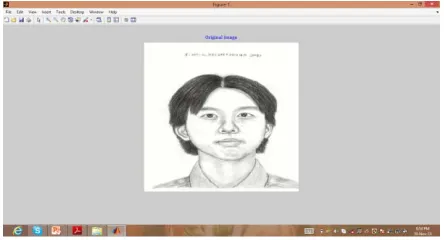
The view sketch image is likely to be the only available source of a face image.
Figure 1: Input Image
[2] FILTERING PROCESS
Figure 2: Denoised Image
DIFFERENCE OF GAUSSIAN (DOG) algorithm that involves the subtraction of one blurred version of an original
image from another
.
Figure 3: DOG Image
CSDN (Center Surround Divisive Normalization) is
interactions between centers and surround regions of the
receptive fields. A constant plus a measure of local stimulus contrast.
Figure 4: CSDN Image
GAUSSIAN FILTER is windowed filter of linear class; by its nature is weighted mean. Named after famous scientist Carl Gauss because weights in the filter calculated according to Gaussian distribution.
Figure 5: Gaussian Image
[3] FEATURE EXTRACTION METHOD FOR
DIFFERENCE OF DOG
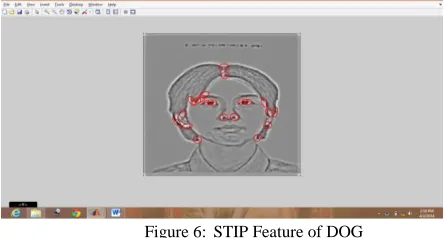
Feature descriptors describe an image or image region using a feature vector that captures the distinct characteristics of the image. Image-based features have been shown to be successful in face recognition, most notably with the use of local binary patterns. Each sketch and photo is represented by STIP and LBP feature descriptors extracted from overlapping patches.
Space Time Interest Points (or STIP) is an algorithm is used for to detect and describe local features in images of DOG.
Figure 6: STIP Feature of DOG
LOCAL BINARY PATTERN (LBP) algorithm is assigned a label to every pixel of a gray level image of DOG. The label mapping to a pixel is affected by the relationship between this pixel and its eight neighbors of the pixel.
[4] FEATURE EXTRACTION METHOD FOR DIFFERENCE OF CSDN
Space Time Interest Points (or STIP) is an algorithm is used for to detect and describe local features in images of CSDN.
Figure 8: STIP Feature of CSDN
LOCAL BINARY PATTERN (LBP) algorithm is assigned a label to every pixel of a gray level image of CSDN. The label mapping to a pixel is affected by the relationship between this pixel and its eight neighbors of the pixel.
Figure 9: LBP Feature of CSDN
[5] FEATURE EXTRACTION METHOD FOR GAUSSIAN
Space Time Interest Points (or STIP) is an algorithm is used for to detect and describe local features in images of Gaussian.
Figure 10: STIP Feature of Gaussian
LOCAL BINARY PATTERN (LBP) algorithm is assigned a label to every pixel of a gray level image of Gaussian. The label mapping to a pixel is affected by the relationship between this pixel and its eight neighbors of the pixel.
Figure 11: LBP Feature of Gaussian
[6] IDENTIFY THE ORIGINAL PERSON
The RVM has an identical functional form to the support vector machine, but provides probabilistic classification. The RVM will be trained by the dataset feature. The trained feature will classify by the RVM. Finally it will recognize the person.
Figure 12: Identified Person for Classification
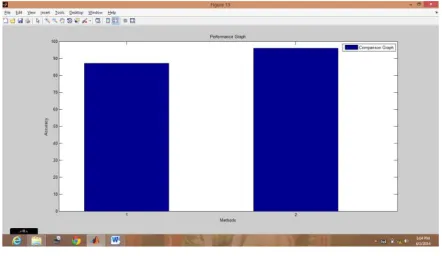
[7] COMPARISON RESULT FOR ACCURACY
Figure 13: Performance Graph
[7] ROC GRAPH
Comparison of results obtained for SIFT and MLBP algorithm with STIP and LBP is done in terms of ROC.
Figure 14: Receiver Operating Characteristic Graph
V.CONCLUSION
In the proposed method, Test and Training images
are initially filtered with three different image filters, and two different local feature descriptors are then extracted.
A training set of prototypes is selected, in which each prototype subject has an image in both the gallery and probe modalities.
Here the recognition is done based on the RVM
classifier.
The system performance is better than the existing
system.
VI.REFERENCES
[1]Brendan F. Karle, Member, IEEE, and Anil K. Jain, Fellow, IEEE “Heterogeneous Face Recognition Using Kernel Prototype Similarities”, IEEE TRANSACTIONS ON PATTERN ANALYSIS AND MACHINE INTELLIGENCE, VOL. 35, NO. 6, JUNE 2013.
[2] Stan Z. Li, Senior Member, IEEE, Ru Feng Chu,
Liao, and Lun Zhang “Illumination Invariant Face
Recognition Using Near-Infrared Images”, IEEE TRANSACTIONS ON PATTERN ANALYSIS AND MACHINE INTELLIGENCE, VOL. 29, NO. 4, APRIL 2007.
[3] Xiaoou Tang, Senior Member, IEEE, and Xiaogang
Wang, Student Member, IEEE “Face Sketch Recognition”, IEEE TRANSACTIONS ON CIRCUITS AND SYSTEMS FOR VIDEO TECHNOLOGY, VOL. 14, NO. 1, JANUARY 2004.
[4] Brendan Klare and Anil K. Jain1 IEEE,
“Heterogeneous Face Recognition: Matching NIR to
Visible Light Images”, IEEE TRANS. PATTERN ANALYSIS & MACHINE INTELLIGENCE, 29(4):627–639, JUNE 2007.
[5] Leonardo Trujillo, Gustavo Olague, Riad Hammoud
and Benjamin Hernandez IEEE, “Automatic feature
Localization in Thermal Images for Facial Expression Recognition”, IEEE.TRANS. PATTERN ANALYSIS AND MACHINE INTELLIGENCE, VOL.21, NO.12, DEC. 2004.
[6] Xian sheng Huang, Zhen Lei, Member, IEEE,
Mingyu Fan, Xiao Wang, and Stan Z. Li, Fellow, IEEE,
“Regularized Discriminative Spectral Regression Method for Heterogeneous Face Matching”, IEEE TRANSACTIONS ON
IMAGE PROCESSING, VOL. 22, NO. 1, JANUARY
2013.
[7] P.Phillips, H. Moon, P. Rauss, and S. Rizvi, “The
FERET Evaluation Methodology for Face-Recognition
Algorithms,” IEEE CONF. COMPUTER VISION AND PATTERN RECOGNITION, VOL.24, NO.5, SEPTEMBER 1997.
[8] B. Klare and A. Jain, “Sketch to Photo Matching: A
Feature-Based Approach,” Proc. SPIE Conf.
Biometric Technology for Human Identification, IEEE TRANS. INFORMATION FORENSICS AND SECURITY, VOL. 7, NO. 2, PP. 518-529, 2012.
[9] A. Quattoni, M. Collins, and T. Darrell, “Transfer
Learning for Image Classification with Sparse Prototype Representations,”Proc. IEEE CONF. COMPUTER VISION
AND PATTERN RECOGNITION, 2008.
[10] K.I. Kim, K. Jung, and H.J. Kim, “Face Recognition
Using Kernel Principal Component Analysis,” IEEE SIGNALS PROCESSING LETTERS, VOL. 9, NO. 2, PP. 40-42, FEB. 2002.
[11] A. Quattoni, M. Collins, and T. Darrell, “Transfer
Learning for Image Classification with Sparse Prototype Representations,” Proc. IEEE CONF. COMPUTER VISION AND PATTERN RECOGNITION, 2008.
[12] M.-F. Balcan, A. Blum, and S. Vempala, “Kernels as
Features: On Kernels, Margins, and Low-Dimensional
[13] W. Zhang, X. Wang, and X. Tang, “Coupled Information-Theoretic Encoding for Face Photo-Sketch Recognition,” Proc. IEEE CONF. COMPUTER VISION AND PATTERN RECOGNITION, 2011.
[14] H. Bhatt, S. Bharadwaj, R. Singh, and M. Vatsa, “On