ISSN (Print) : 2320 – 3765 ISSN (Online): 2278 – 8875
I
nternational
J
ournal of
A
dvanced
R
esearch in
E
lectrical,
E
lectronics and
I
nstrumentation
E
ngineering
(A High Impact Factor, Monthly, Peer Reviewed Journal)
Website: www.ijareeie.com
Vol. 8, Issue 5, May 2019
IOT Based Smart Irrigation System
Prof.Panchal Sachin.D1, Kaldate Anuja.V2, Bagwan Shaista.C3 , Jadhav Sonali .D4
Assistant Professor, Dept. of ECE, Sandipani Technical Campus Kolpa, Maharashtra, India1
Student, Dept. of ECE, Sandipani Technical Campus Kolpa, Maharashtra, India2
Student, Dept. of ECE, Sandipani Technical Campus Kolpa, Maharashtra, India3
Student, Dept. of ECE, Sandipani Technical Campus Kolpa, Maharashtra, India4
ABSTRACT: A resource that all living species needs Water. It is therefore very precious and for enhancing agricultural productivity. It is thecritical input. Therefore expansion, of irrigation has been a key strategy in the development of agriculture in country. Today, farmers have several issues in agriculture due to lack of rains and scarcity of water. The main motto of this paper is to save time, money and power of farmer with an automaticirrigation system. Manual intervention is requiredfor the traditional farmland techniques. Human intervention can be minimized with the automated technology overirrigation usingsoil moisture sensorlevels of soil moisture can be checked. Whenever there is a change inhumidity moisture in the soil this sensor senses the change and an -interrupt signal is passed to the microcontroller and depending on this the irrigation system works. The automated irrigation system provides a web interface to the user so that the user can monitorand control the system remotely i.e., can make the irrigation system ON and OFF remotely
KEYWORDS: Arduino,Atmega328,Soil moisturesensor,Wi-Fi Module,GSM-Module.
I. INTRODUCTION
In India, agriculture plays an important role for development in food production. In our country, agriculture are depends on the monsoons which is not sufficient source of water. This system will be a substitute to traditional farming method .We will develop such a system that will help a farmer to know his field status in his home or he may be residing in any part of the world. It proposes automatic irrigation system for the agricultural lands. Currently the automation is one of the important role in the human life. It not only provide comfort but also reduce energy, efficiency and time saving. Now the industries are use automation and control machine which is high in cost and not suitable for using in a farm field. So here it also design a smart irrigation technology in low cost which is usable by Indian farmers. An automated irrigation system was technology in low cost which is usable by Indian farmers. An automated irrigation system was developed to optimize water use for agricultural crops. Automation allows us to control appliances automatically. The objective of this paper is to develop IOT basedautomated irrigation system to reduce water requirement andincrease the productivity. This system is best suited for places where water is scarce and has to be used in limited quantity
II. INTERNET OF THINGS
The Internet of things (IoT) is the network of physical devices, vehicles, and other items embedded with electronics, software, sensors, actuators, and network connectivity which enable these objects to collect and exchange data.
ISSN (Print) : 2320 – 3765 ISSN (Online): 2278 – 8875
I
nternational
J
ournal of
A
dvanced
R
esearch in
E
lectrical,
E
lectronics and
I
nstrumentation
E
ngineering
(A High Impact Factor, Monthly, Peer Reviewed Journal)
Website: www.ijareeie.com
Vol. 8, Issue 5, May 2019
smart cities. Each thing is uniquely identifiable through its embedded computing system but is able to interoperate within the existing Internet infrastructure. Experts estimate that the IoT will consist of about 30 billion objects by 2020.
Typically, IoT is expected to offer advanced connectivity of devices, systems, and services that goes beyond machine-to-machine (M2M) communications and covers a variety of protocols, domains, and applications. The interconnection of these embedded devices (including smart objects), is expected to usher in automation in nearly all fields, while also enabling advanced applications like a smart grid, and expanding to areas such as smart cities.
"Things", in the IoT sense, can refer to a wide variety of devices such as heart monitoring implants, biochip transponders on farm animals, cameras streaming live feeds of wild animals in coastal waters, automobiles with built-in sensors, DNA analysis devices for environmental/food/pathogen monitoring, or field operation devices that assist firefighters in search and rescue operations. Legal scholars suggest regarding "things" as an "inextricable mixture of hardware, software, data and service".
III. KEY FEATURES OF THE SYSTEM
The main key feature behind this system is in connecting the soil moisture sensor, which was previously embedded into the plant, to the Arduino microcontroller,which is also connected to other electronic componentslisted above as shown in Figure.1. Measurement of soilmoisture is done by the sensor which forwards the information and parameters regarding the soil moisture tothe microcontroller, which controls the pump. If the level ofsoil moisture drops below a certain value, the microcontroller sends the signal to the relay module whichthen runs a pump and certain amount of water is delivered to the plant. Once the enough water is delivered, the pumpstops doing its work. Power supply has a task to power the complete system and the recommended voltage should respect the input supply range for the microcontroller, thatis, from 7V to 12V.
IV. SYSTEM SETUP
The system has three major parts; humidity sensing part, control section and the output section. The soil humidity was detected using YL-69 soil sensor (a resistance type sensor).The control unit was achieved using ATMega328microcontroller based on arduino platform. The output is irrigation system which is controlled by the control unit by switching it on and off depending on the soil moisture contents. Two stages of design were undertaken; hardware and software.
ISSN (Print) : 2320 – 3765 ISSN (Online): 2278 – 8875
I
nternational
J
ournal of
A
dvanced
R
esearch in
E
lectrical,
E
lectronics and
I
nstrumentation
E
ngineering
(A High Impact Factor, Monthly, Peer Reviewed Journal)
Website: www.ijareeie.com
Vol. 8, Issue 5, May 2019
The block diagram of smart irrigation system is represented in Fig. 1. It consists of a microcontroller (ATmega328) which is the brain of the system. Both the moisture and temperature sensors are connected to the input pins of the controller. The water pump and the servo motor are coupled with the output pins. If the sensors depart from the predefined range, the controller turns on the pump. The servo motor is used to control the angular position of the pipe, which ensures equal distribution of water to the soil. An LED indicator indicates the status of the pump. This system can be implemented on a large scale for farming purposes, which can further prove to be more advantageous. Owing to prevailing conditions and water shortages, the optimum irrigation schedules should be determined especially in farms to conserve water. Here, we are using modules such as moisture sensor, temperature sensor, arduinouno, transistor as switches, DC motor as motor module, module for communication as GSM shield.
B. CIRCUIT DIAGRAM
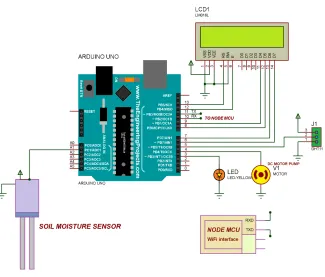
Fig 2 Circuit Diagram
The circuit diagram consists of Arduino, Relay, soil moisture sensor and LCD display. The all components are attached to Arduino board. The Arduino is powered by a 5V,2A source and soil moisture sensor is powered from the Arduino. The relay is triggered from the Arduino. The values of soil moisture sensor is read by Arduino.
V. MODULES WITH COMPONENTS WORKING PRINCIPLES
A. ARDUINO UNO BOARD
ISSN (Print) : 2320 – 3765 ISSN (Online): 2278 – 8875
I
nternational
J
ournal of
A
dvanced
R
esearch in
E
lectrical,
E
lectronics and
I
nstrumentation
E
ngineering
(A High Impact Factor, Monthly, Peer Reviewed Journal)
Website: www.ijareeie.com
Vol. 8, Issue 5, May 2019
B. WI-FI MODULE
The ESP8266 Wi-Fi module is a self -contained SOC (System on Chip) with integrated TCP/IP (Transmission Control Protocol/Internet Protocol) protocol stack that can give any microcontroller access to any Wi-Fi network. Each ESP8266 module comes pre-programmed meaning, it can be simply hooked up to Arduino device to get Wi-Fi ability. This module has a powerful enough on-boarding process and high storage capacity that allows it to be integrated with the sensors and other application specific devices.
C. GSM MODULE
GSM (Global System for Mobile Communication) is a standard developed by the European Telecommunication Standards Institute (ETSI) to describe protocols for second-generations (2G) digital cellular networks used by mobile phones. GSM describes a digital, circuit-switched network optimized for full duplex voice telephony and also expanded to include data communications, packet data transport via GPRS (General Packet Radio Services). The longest distance the GSM specification supports in practical is 35 kilometers (22mi).
D. SOIL MOISTURE SENSOR
soil moisture (definition) A soil moisture sensor measures the quantity of water contained in a material, such as soil on a volumetric or gravimetric basis. To obtain an accurate measurement, a soil temperature sensor is also required for calibration.The soil moisture sensor consists of two probes which are used to measure the volumetric content of water. The two probes allow the current to pass through the soil and then it gets the resistance value to measure the moisture value.
E. ESP-8266 MODULE
ESP8266 contains a built-in 32-bit low-power CPU, ROM and RAM. It is a complete and self-contained Wi-Fi network solution that can carry software applications as a stand-alone device or connected with a microcontroller (MCU). The module has built-in AT Command firmware to be used with any MCU via COM port.ESP8266. The ESP8266 is a low-cost Wi-Fi microchip with full TCP/IP stack and microcontroller capability produced by manufacturer Espressif Systems in Shanghai, China. ... This small module allows microcontrollers to connect to a Wi-Fi network and make simple TCP/IP connections using Hayes-style commands.
VI. CONCLUSION
Thus the “Smart Irrigation system based on soil moisture using Arduino” has been designed and tested successfully. It has been developed by integrated features of all the hardware components used. The system has been tested to function automatically. The moisture sensors measure the moisture level (water content) of the different plants. If the moisture level goes below the desired and limited level, the moisture sensor sends the signal to the Arduino board which triggers the Water Pump to turn ON and supply the water to respective plant. When the desired moisture level is reached, the system halts on itsown and the water Pump is turned OFF. Thus, the functionality of the entire system has been tested thoroughly and it is said to function successfully
REFERENCES
[1] N. Putjaika, S. Phusae, A. Chen-Im, P. Phunchongharn and K. Akkarajitsakul, "A control system in an intelligent farming by using arduino technology," 2016 Fifth ICT International Student Project Conference (ICT-ISPC), Nakhon Pathom, 2016, pp. 53-56.
[2] A. Abdullah, S. A. Enazi and I. Damaj, "AgriSys: A smart and ubiquitous controlled-environment agriculture system," 2016 3rd MEC International Conference on Big Data and Smart City (ICBDSC), Muscat, 2016, pp. 1-6.
[3] S.Muhammad Umair, Automation of Irrigation System Using ANN based Controller, International Journal of Electrical & Computer Sciences IJECS-IJENS Vol:10 No:02, 104602-5757 IJECS-IJENS © April 2010 IJENS.
[4] SANJUKUMAR, Advance Technique for Soil Moisture Content Based Automatic Motor Pumping for Agriculture Land Purpose ,
International Journal of VLSI and Embedded Systems-IJVES, Vol 04, Article 09149; September 2013.
[5] P. B. Chikankar, D. Mehetre and S. Das, "An automatic irrigation system using ZigBee in wireless sensor network," 2015 International Conference on Pervasive Computing (ICPC), Pune, 2015, pp. 1-5.
ISSN (Print) : 2320 – 3765 ISSN (Online): 2278 – 8875
I
nternational
J
ournal of
A
dvanced
R
esearch in
E
lectrical,
E
lectronics and
I
nstrumentation
E
ngineering
(A High Impact Factor, Monthly, Peer Reviewed Journal)
Website: www.ijareeie.com
Vol. 8, Issue 5, May 2019
[8] J. John, V. S. Palaparthy, S. Sarik, M. S.
[9] K. A. Patil and Prof. N. R. Kale, A Model for Smart Agriculture Using IoT, 2016 International Conference on Global Trends in Signal Processing, Information Computing and Communication pp. 543-545
[10] Mahammad Shareef Mekala and Dr P. Viswanathan, A Survey : Smart Agriculture IoT with Cloud Computing, 978-1-5386-1716-8/17 [11] Prathibha S R, Anupama Hongal, Jyothi M P, IOT Based Monitoring System in Smart Agriculture, 2017 International Conference on Recent Advances in Electronics and Communication Technology pp 81-84