A Framework to Process Range Aggregate
Query Using MongoDB
Arkaprabho Roy1, Akash Sampathkumar2, Anto Melvin K.F3, Meghana Venkatesh4
UG Student, Department of Information Science, New Horizon College of Engineering, Bangalore, India1
UG Student, Department of Information Science, New Horizon College of Engineering, Bangalore, India2
UG Student, Department of Information Science, New Horizon College of Engineering, Bangalore, India3
UG Student, Department of Information Science, New Horizon College of Engineering, Bangalore, India4
ABSTRACT: Range searching is a fairly well-structured problem in computational geometry. Big Data deals with class of problems called Range Aggregate Query problems, the aim is to deal with some composite queries involving range searching, where one needs to do more than simple range reporting or counting. A range query applies an aggregate function over all selected cells of an OLAP data cube. The essential idea is to precompute some auxiliary information that is used to answer ad hoc queries at runtime. In order to analyze and process range aggregate query M-AQ : A framework is proposed in this paper. Existing approaches were dealt only with adhoc queries and results yielded were not satisfactory. Here M-AQ is implemented on linux platform and performance is evaluated on very large park data records .M-AQ supports range queries and also runs multiple servers. When a range aggregate query arrives it is split based on the Balanced Partitioning algorithm and distributed across multiple shards (A shard is nothing but a master with one or more slaves). Queries here return specific fields of documents and also includes user defined JavaScript functions. JavaScript is used in queries, aggregate functions (such as MapReduce) and sent directly to the MongoDB to be executed. M-AQ has O(1) time complexity for the updates of data and time complexity for range aggregate queries where N happens to be the unique tuples, P happens to be the partition number B happens to be the bucket in each of the histogram. This M-AQ framework there by reduces the cost of both network communication and local file scanning and has better performance compared to hive.
KEYWORDS: Big Data, MapReduce, MongoDB, Multiple Servers, Range Aggregate Query.
I.INTRODUCTION
ISSN (Print) : 2320 – 3765 ISSN (Online): 2278 – 8875
I
nternational
J
ournal of
A
dvanced
R
esearch in
E
lectrical,
E
lectronics and
I
nstrumentation
E
ngineering
(An ISO 3297: 2007 Certified Organization)
Vol. 5, Issue 9, September 2016
utilized as an essential instrument as a part of choice administration, online proposal, pattern estimation etc. So it is a testing errand to gauge and give exact results for reach total inquiries in huge information situations. Prior Prefix-whole block method [5] was utilized as a part of OLAP to build the execution of reach total inquiries alongside Online collection. Be that as it may, with these methodologies clients can't acquire an agreeable replying with surmised precision as ahead of schedule as first and foremost stages.
II.RELATED WORK
The reach total question issue has been contemplated by SharathKumar and Gupta[3] and Malensek[4] in computational geometry and Geographic Information Systems(GIS).The work is essentially centered around approximating range total inquiry for continuous information investigation in OLAP. Ho et al. was the first to present Prefix-Sum Cube way to deal with illuminating the numeric information 3D square collection [4] issues in OLAP. The crucial thought of PC is to pre-process prefix totals of cells in the information 3D shape, which then can be utilized to answer range-total questions at run-time. In any case, the redesigns to the prefix wholes are relative to the measure of the information 3D square. Liang et al. [6] proposed a dynamic information 3D shape for reach total questions to enhance the overhaul cost. The prefix total methodologies are appropriate for the information which is static or once in a while overhauled. For enormous information situations, new information sets arrive constantly, and the up and coming data is the thing that the experts need. The PC and other heuristic pre-processing methodologies are not pertinent in such applications. A vital estimated noting approach called Online Aggregation was proposed to speed range-total questions on bigger information sets [7]. OLA has been broadly concentrated on in social databases [8] and the present cloud and spilling frameworks [9], [10]. A few learns about OLA have additionally been led on Hadoop and MapReduce [10], [11], [12]. The OLA is a class of strategies to give early returns assessed certainty interims persistently. As more information is prepared, the appraisal is dynamically refined and the certainty interim is limited until the fulfilled exactness is acquired. Be that as it may, OLA cannot react with worthy exactness inside wanted day and age, which is essentially vital on the examination of pattern for specially appointed inquiries.
III.EXISTING SYSTEM
The FastRAQ framework is a surmised noting approach that outlines exact estimations rapidly for extent total inquiries in situations including enormous information. It first partitions the information lumps into discrete free parcels by utilizing an adjusted dividing calculation, and by which a neighborhood estimation for every segment is produced. So on the landing of the reach total inquiry, FastRAQ gets the outcome by abridging the nearby estimation of each individual issue. The estimation representation is a multi-dimensional histogram which is assembled by means of the scholarly information conveyance. In FastRAQ, the characteristic qualities can be both numeric and alphabetic. The Key thought is so produce a nearby inquiry result utilizing the adjusted parceling calculation with the stratified testing model. So in FastRAQ the numerical space of the total – segment is separated into various gatherings and an estimation representation of the gathering is gotten. At the point when another record arrives it sister sent to the parcel contingent upon the present information conveyances and the quantity of servers accessible. . It first partitions the information lumps into isolated free segments by utilizing an adjusted dividing calculation, and by which a neighborhood estimation for every allotment is produced. So on the landing of the reach total inquiry, FastRAQ gets the outcome by outlining the nearby estimation of each individual issue. Fragment family development for FastRAQ, which fuses three sorts of area families related to degree complete inquiries. They are collection segment family, list portion family, and default section family. The gathering portion family joins an aggregation fragment, the record fragment family fuses diverse rundown areas, and the default segment family fuses distinctive sections for further expansions. A SQL-like DDL and DML can be portrayed adequately from the diagram.
A. DISADVANTAGES
Cost is produced by data transmission and synchronization for aggregate operations.
Scanning og local files to search selected tuples.
The updating process includes delivering the record each time to the specified partition.
Range Cardinality tree produces additional overhead.
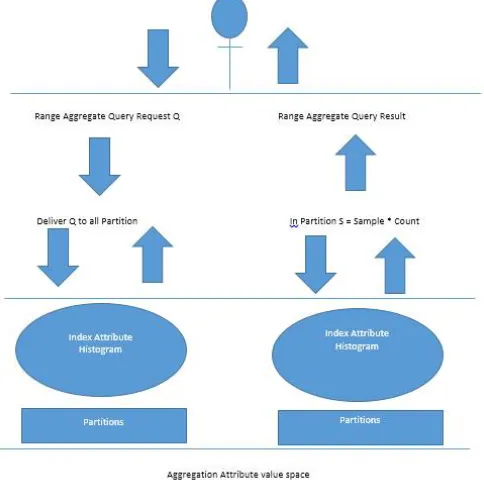
Fig 1: FastRAQ framework..
IV.PROPOSED SYSTEM
Here in the proposed part, I layout a balanced section count which works with stratified testing model. In each segment, an example for estimations of the amassing area and a multi-dimensional histogram is kept for estimations of the record portions. Exactly when an achieve complete inquiry request arrives, the adjacent result is the aftereffect of the example and a normal cardinality from the histogram. This declines the two sorts of cost at the same time. Prior FastRAQ gives a good starting stage to becoming ceaseless taking note of procedures for colossal data examination. Right when a request arrives, it is passed on into every allotment. The cardinality estimator (CE) is shaped for the addressed domain from the histogram in each package. By then we the examination regard is processed in each apportioning, which is the aftereffect of the case and the assessed cardinality from the estimator. Additionally I make utilization of the MongoDB here in the proposed segment. M-AQ joins inspecting, Histogram and information parcel ways to deal with create exact estimations including enormous information. It is intended for disseminated range total questions and it is appeared to accomplish better execution results on both inquiry and upgrade preparing in enormous information. M-AQ essentially accompanies MongoDB. It is a cross stage report arranged database. MongoDB bolsters field, range questions, standard expression looks. Inquiries can return particular fields of records furthermore incorporate client characterized Java Script capacities. MongoDB gives high accessibility imitation sets. A reproduction set comprises of two or more duplicates of the information. Every imitation set part may act in the part of essential or optional copy whenever. The essential reproduction plays out all composes and peruses as a matter of course. Optional reproductions keep up a duplicate of the information of the essential utilizing worked as a part of replication. At the point when an essential imitation falls flat, the copy set consequently leads a race procedure to figure out which optional ought to wind up the essential. Secondary can alternatively perform read operations, yet that information is in the end steady of course.
A. ADVANTAGES
M-AQ can be used as a tool in DBaaS.
It can be used to find solutions of m*n format problem. When there are m aggregation columns and n index columns of the same record.
M-AQ achieves 26 times of performance improvement on count queries than Hive.
ISSN (Print) : 2320 – 3765 ISSN (Online): 2278 – 8875
I
nternational
J
ournal of
A
dvanced
R
esearch in
E
lectrical,
E
lectronics and
I
nstrumentation
E
ngineering
(An ISO 3297: 2007 Certified Organization)
Vol. 5, Issue 9, September 2016
M-AQ achieve better performance improvement on range aggregate queries than Hive.
It can search different index-columns of queried ranges. The cost of merging due to union statements is negligible.
V. SYSTEM ARCHITECTURE OF PROPOSED SYSTEM
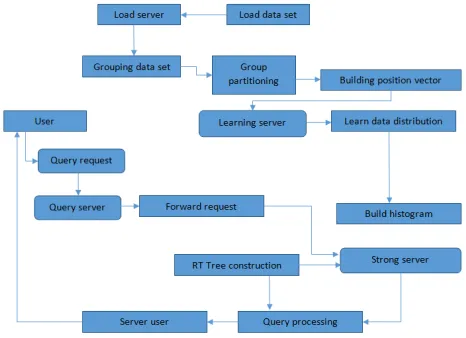
The information appropriations are measured by the bunching estimations of all record segments and they likewise make utilization of the scholarly learning to fabricate what is known as the histogram. So here the component vectors are separated from the educated information set which will create the vector set through which the last groups are shaped. The basic K-implies grouping technique is utilized to deliver the bunches. Every bunch is doled out with a novel ID.M-AQ underpins multi-dimensional extent questions which may incorporate various cans of the same histogram. It utilizes an exceptional ID for every record. The histogram is executed as a various leveled tree structure which is called as the extent cardinality tree (RC tree). A commonplace RC tree is delineated in fig 3. The RC-Tree [13] incorporates three sorts of hubs. They are root hubs, interior hubs and the leaf hubs. The root hub or the inside hub dependably indicates its kids hubs. A leaf hub relates to one basin in the histogram. The leaf hub just keeps the data and the tuples qualities are constantly put away in the pail documents. Containers are autonomous of each other, the RC-Tree structure and its development procedure is very like the B+ tree. To enhance the throughput of RC-RC-Tree, a hash table [14] for recently approaching information is presented for incremental overhauling process. The hash table comprises of different hubs which are indistinguishable to the RC-Tree's leaves hubs. On the off chance that another record is coming, it first composes into the hash table, makes hub on the off chance that it doesn't exist, and after that adds the tuples values into a brief information document. At the point when the quantity of hubs in the hash table achieves an edge, the hash table flushes hubs into the RC-Tree, and adds the impermanent documents to the formal container information records. The incremental upgrading process [15] will enormously enhance the throughput of RC-Tree in huge information situations. The accompanying upgrading calculation clarifies the incremental redesigning process in RC-Tree.
Fig.3. RC-Tree structure.
Fig.3. RC-Tree structure. Algorithm 1:Grouping
Step 1: Parse value of index-columns into key-value pairs. Step 2: Search in bucket spreads.
Step 3: Search in hash table and get the target node. Step 4: End
To query cached data in hash table, the process is the same as Algorithm 2 to obtain cardinality estimator of the cached data, and then the result is merged to the estimator into CEmerge to compute the final cardinality estimation
Algorithm 2: Range Carnality Query algorithm. Input:(Q,T,ho);
Q: Select distinct count; T: the RC-Tree;
ho :the edge range cardinality ratio. Output : R;
R:the range cardinality queried result.
Step 1: Locate the first node in RC-Tree by ColName; Step 2:Scan the bucket data file;
Step 3:Merge into the cardinality estimator CEmerge; Step 4: R<-h(CEmerge);
Step 5:return R.
VI.SYSTEM DESIGN
ISSN (Print) : 2320 – 3765 ISSN (Online): 2278 – 8875
I
nternational
J
ournal of
A
dvanced
R
esearch in
E
lectrical,
E
lectronics and
I
nstrumentation
E
ngineering
(An ISO 3297: 2007 Certified Organization)
Vol. 5, Issue 9, September 2016
Algorithm 3: Partitioning. Input:(R,VP);
R: an input record;
VP: the partition vector set. Output : PID;
PID: a partition identifier for partition p. Step 1: Parse the input record R ; Step 2: Compute the GID;
Step 3: Get the partition vector Vpi from VP with the GID,and let Vpi = < GID,Vr >; Step 4: Set the target partition identifier;
Step 5: Build the sample in partition PID; Step 6: return PI
To guarantee that information is adjusted on every server, the segment calculation isolates every gathering into various segments and sends to one server contingent upon the information dispersions. The info record R is sent to a parcel given by PID which is produced from its comparing collection section. M - AGE utilizes inexact noting methodologies, for example, inspecting, histogram, and cardinality estimation and so forth., to enhance the execution of extent total questions. We utilize relative mistake as a factual instrument for exactness investigation. Relative mistake is generally utilized as a part of a rough noting framework. Additionally, it is anything but difficult to figure the relative mistakes of consolidated appraisal variables in a circulated situation for M - AGE. In this segment, we examine the evaluated relative mistake and the certainty interim of conclusive reach total question result.
Theorem:
Proof: According to Algorithm 3,the range aggregate query result in each partition is expressed as follows : = Count * Sample, (1)
Where Count is the estimated range cardinality obtained from the histogram, Sample is a sample of values of aggregation-column in the queried partition.
VI. RESULT AND ANALYSIS
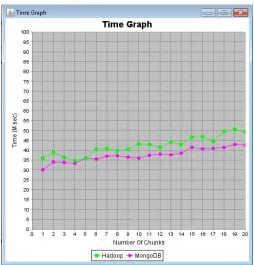
The results that are shown are with FastRAQ in comparison with Hive. FastRAQ is better than Hive in terms of performance and it reduces the two types of cost significantly.
Fig 4.Time Comparison Graph
VI.CONCLUSION
The key thought was to diminish the two sorts of cost which were noted before in the current frameworks. M-AQ is another system conveyed to guarantee the same. It is for the most part to handle and give precise results to noting range total inquiries in enormous information climates. M-AQ settles the 1:n arrangement range total inquiries issue, i.e., there is one collection section and n list segments in a record.
Real time answering method.
Range aggregate queries in big data environments. Can be used as a tool in Dbaas.
Can perform faster to access huge data.
Partitioning and Clustering mechanism improves the searching process.
REFERENCES
[1]. P. Mika and G. Tummarello, “Web semantics in the clouds,” IEEE Intell. Syst., vol. 23, no. 5, pp. 82–87, Sep./Oct. 2008.
[2]. T. Preis, H. S. Moat, and E. H. Stanley, “Quantifying trading behavior in financial markets using Google trends,” Sci. Rep., vol. 3, p. 1684, 2013. [3]. H. Choi and H. Varian, “Predicting the present with Google trends,” Econ. Rec., vol. 88, no. s1, pp. 2–9, 2012.
[4]. C.-T. Ho, R. Agrawal, N. Megiddo, and R. Srikant,, “Range queries in OLAP data cubes,” ACM SIGMOD Rec., vol. 26, no. 2, pp. 73–88, 1997. [5]. G. Mishne, J. Dalton, Z. Li, A. Sharma, and J. Lin, “Fast data in the era of big data: Twitter’s real-time related query suggestion architecture,” in Proc. ACM SIGMOD Int. Conf. Manage. Data,
[6]. W. Liang, H. Wang, and M. E. Orlowska, “Range queries in dynamic OLAP data cubes,” Data Knowl. Eng., vol. 34, no. 1, pp. 21–38, Jul. 2000. [7]. J. M. Hellerstein, P. J. Haas, and H. J. Wang, “Online aggregation,” ACM SIGMOD Rec., vol. 26, no. 2, 1997, pp. 171–182.
[8]. P. J. Haas and J. M. Hellerstein, “Ripple joins for online aggregation,” in ACMSIGMOD Rec., vol. 28, no. 2, pp. 287–298, 1999.
[9]. E. Zeitler and T. Risch, “Massive scale-out of expensive continuous queries,” Proc. VLDB Endowment, vol. 4, no. 11, pp. 1181–1188, 2011. [10]. N. Pansare, V. Borkar, C. Jermaine, and T. Condie, “Online aggregation for large MapReduce jobs,” Proc. VLDB Endowment, vol. 4, no. 11, pp. 1135–1145, 2011.
[11]. T. Condie, N. Conway, P. Alvaro, J. M. Hellerstein, J. Gerth, J. Talbot, K. Elmeleegy, and R. Sears, “Online aggregation and continuous query support in MapReduce,” in Proc. ACM SIGMOD Int. Conf. Manage. Data, 2010, pp. 1115–1118.
ISSN (Print) : 2320 – 3765 ISSN (Online): 2278 – 8875
I
nternational
J
ournal of
A
dvanced
R
esearch in
E
lectrical,
E
lectronics and
I
nstrumentation
E
ngineering
(An ISO 3297: 2007 Certified Organization)
Vol. 5, Issue 9, September 2016
[13]. K. Bilal, M. Manzano, S. Khan, E. Calle, K. Li, and A. Zomaya, “On the characterization of the structural robustness of data center networks,” IEEE Trans. Cloud Comput., vol. 1, no. 1, pp. 64–77, Jan.–Jun. 2013.
[14]. S. De Capitani di Vimercati, S. Foresti, S. Jajodia, S. Paraboschi, and P. Samarati, “Integrity for join queries in the cloud,” IEEE Trans. Cloud Comput., vol. 1, no. 2, pp. 187–200, Jul.–Dec. 2013.